Introduction
AI Personalization Engines for Customer Experience (CX) are advanced tools that enable businesses to deliver individualized content, offers, and interactions across digital channels. By analyzing behavior, engagement, transaction, and preference data, these platforms provide actionable insights that optimize user journeys, increase conversion rates, and improve retention. Modern engines leverage real-time scoring, predictive models, and AI-powered recommendations to tailor experiences dynamically, making them critical for organizations aiming to compete in highly personalized digital markets.
Why it matters
- Enhances engagement: Delivers context-aware experiences for each customer.
- Drives conversions: Predictive recommendations improve click-through and purchase rates.
- Improves retention: Identifies at-risk customers and triggers personalized interventions.
- Optimizes marketing spend: Resources are allocated efficiently based on behavior.
- Supports omnichannel experiences: Integrates web, app, email, and other touchpoints.
- Enables data-driven decisions: Insights inform product, marketing, and CX strategies.
Real-world use cases:
- Dynamic product recommendations on e-commerce websites
- Personalized email and push notification campaigns
- Behavioral journey orchestration across mobile and web
- Customer segmentation for retention and upsell
- Content personalization for media or publishing platforms
- Predictive analytics for churn prevention and engagement
Evaluation criteria
- Data integration from multiple sources
- Real-time scoring and predictions
- Multimodal data support (behavioral, transactional, engagement)
- Scalability for enterprise usage
- Customizable KPIs and dashboards
- Bias mitigation and guardrails
- Integration with CRM and marketing platforms
- Observability metrics and performance tracking
- Actionable recommendations
- Continuous model retraining
- Privacy and compliance (GDPR, SOC2)
- Ease of use for business users
What’s Changed in AI Personalization Engines
- Agentic personalization workflows automate next-best-actions
- Multimodal inputs including behavioral, transactional, and engagement signals
- Real-time predictive recommendations across all channels
- Evaluation and testing frameworks for relevance and reliability
- Guardrails for bias mitigation and safe personalization
- Enterprise privacy with configurable retention and data residency
- Cost and latency optimization with model routing and BYO models
- Observability dashboards for token usage, latency, and performance
- Governance features for audit logs and compliance reporting
- Explainable AI for transparency in recommendations
- Continuous retraining to capture evolving behavior
- Integration with CRM, marketing automation, and analytics
Quick Buyer Checklist
- Data privacy & retention
- Hosted vs BYO vs open-source model choice
- CRM and marketing automation connectors
- Evaluation & testing capabilities
- Bias guardrails and content safety
- Latency & cost monitoring
- Admin & audit controls
- Vendor lock-in risk
- Multimodal input support
- Scalability for large datasets
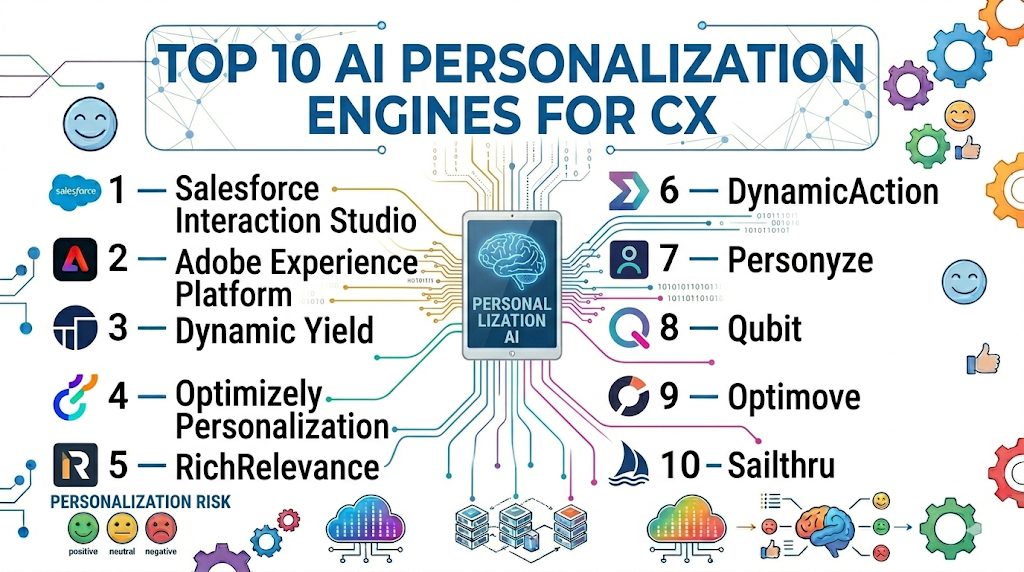
Top 10 AI Personalization Engines for CX
1 — Salesforce Interaction Studio
One-line verdict: Ideal for Salesforce enterprises needing real-time, predictive, and personalized experiences across all channels.
Short description: Provides multi-channel tracking, behavioral scoring, and actionable AI-driven recommendations integrated with Salesforce workflows.
Standout Capabilities
- Real-time journey mapping
- Predictive recommendations across web, mobile, and email
- Segmentation by engagement
- Automated personalized campaigns
- Dashboard visualizations
AI-Specific Depth
- Model support: Proprietary
- RAG / knowledge integration: Salesforce CRM, marketing cloud
- Evaluation: Regression and human review
- Guardrails: Bias detection
- Observability: Token usage, latency
Pros
- Deep Salesforce integration
- Real-time actionable insights
- Enterprise-grade personalization
Cons
- Proprietary
- Requires Salesforce ecosystem
- Setup complexity
Security & Compliance
SSO/SAML, RBAC, audit logs; Certifications: Not publicly stated
Deployment & Platforms
Web, Cloud
Integrations & Ecosystem
Salesforce Marketing Cloud, CRM, APIs, SDKs
Pricing Model
Tiered subscription
Best-Fit Scenarios
- Multi-channel engagement campaigns
- Predictive personalization for high-value customers
- Real-time experience optimization
2 — Adobe Experience Platform
One-line verdict: Best for enterprises needing predictive personalization and AI-driven engagement insights across all touchpoints.
Short description: Leverages behavioral and transactional data to provide predictive recommendations, audience segmentation, and personalization.
Standout Capabilities
- Multichannel engagement analytics
- Real-time scoring and recommendations
- Audience segmentation
- Predictive content personalization
- Advanced dashboards
AI-Specific Depth
- Model support: Proprietary
- RAG / knowledge integration: Adobe Marketing Cloud, CRM
- Evaluation: Regression and human review
- Guardrails: Bias mitigation
- Observability: Token usage, latency
Pros
- Enterprise scalability
- Multichannel personalization
- Strong analytics integration
Cons
- Proprietary
- High cost for SMBs
- Steep learning curve
Security & Compliance
SSO/SAML, audit logs; Certifications: Not publicly stated
Deployment & Platforms
Web, Cloud
Integrations & Ecosystem
CRM, Adobe Marketing Cloud, APIs, analytics connectors
Pricing Model
Tiered subscription
Best-Fit Scenarios
- Enterprise marketing campaigns
- Multichannel personalization
- Behavioral segmentation
3 — Dynamic Yield
One-line verdict: Ideal for mid-market to enterprise brands seeking omnichannel personalization with predictive recommendations.
Short description: Combines behavioral and transactional data to personalize websites, mobile apps, and email communications in real-time.
Standout Capabilities
- Omnichannel personalization
- Real-time recommendation engine
- Automated segmentation
- Predictive scoring
- A/B and multivariate testing
AI-Specific Depth
- Model support: Proprietary
- RAG / knowledge integration: CRM, analytics
- Evaluation: Regression and human review
- Guardrails: Bias mitigation
- Observability: Token usage, latency
Pros
- Real-time personalization
- Automated recommendations
- Multichannel support
Cons
- Proprietary
- Paid plans required for advanced features
- Complex for small teams
Security & Compliance
SSO/SAML, audit logs; Certifications: Not publicly stated
Deployment & Platforms
Web, Cloud
Integrations & Ecosystem
CRM, analytics, APIs, SDKs
Pricing Model
Tiered subscription
Best-Fit Scenarios
- E-commerce recommendations
- Dynamic website experiences
- Email and push personalization
4 — Optimizely Personalization
One-line verdict: Best for product and marketing teams needing experimentation combined with AI personalization.
Short description: Offers A/B and multivariate testing along with AI-driven recommendations for web and mobile experiences.
Standout Capabilities
- A/B and multivariate testing
- Predictive personalization
- Behavioral segmentation
- Dynamic content recommendations
- Dashboard analytics
AI-Specific Depth
- Model support: Proprietary
- RAG / knowledge integration: CRM, analytics
- Evaluation: Regression, human review
- Guardrails: Bias mitigation
- Observability: Token usage, latency
Pros
- Testing + personalization
- Real-time content adjustments
- Predictive recommendations
Cons
- Proprietary
- Learning curve for testing features
- Paid tiers for advanced personalization
Security & Compliance
SSO/SAML, audit logs; Certifications: Not publicly stated
Deployment & Platforms
Web, Cloud
Integrations & Ecosystem
CRM, analytics, SDKs, APIs
Pricing Model
Tiered subscription
Best-Fit Scenarios
- Web personalization experiments
- Multichannel campaigns
- Predictive engagement
5 — RichRelevance
One-line verdict: Enterprise recommendation engine delivering AI-driven product and content personalization across channels.
Short description: Uses behavioral and transactional data to deliver personalized experiences for e-commerce and media platforms.
Standout Capabilities
- Product and content recommendations
- Predictive personalization
- Behavioral analytics
- Dynamic audience segmentation
- Real-time engagement tracking
AI-Specific Depth
- Model support: Proprietary
- RAG / knowledge integration: CRM, analytics
- Evaluation: Regression and human review
- Guardrails: Bias mitigation
- Observability: Token usage, latency
Pros
- Advanced recommendation engine
- Real-time personalization
- Enterprise-scale
Cons
- Proprietary
- Complex configuration
- Higher pricing
Security & Compliance
SSO/SAML, RBAC; Certifications: Not publicly stated
Deployment & Platforms
Web, Cloud
Integrations & Ecosystem
CRM, marketing automation, APIs
Pricing Model
Tiered subscription
Best-Fit Scenarios
- E-commerce personalization
- Media content recommendation
- Enterprise engagement optimization
6 — DynamicAction
One-line verdict: Best for retailers seeking AI-driven product recommendations and journey optimization across channels.
Short description: Provides predictive recommendations, behavioral insights, and engagement optimization for omnichannel experiences.
Standout Capabilities
- Predictive product and content recommendations
- Customer segmentation and scoring
- Journey analytics dashboards
- Real-time alerts on engagement changes
- Multichannel personalization
AI-Specific Depth
- Model support: Proprietary
- RAG / knowledge integration: CRM, analytics
- Evaluation: Regression testing, human review
- Guardrails: Bias mitigation
- Observability: Latency and token usage metrics
Pros
- Retail-focused personalization
- Real-time recommendations
- Predictive engagement scoring
Cons
- Proprietary
- Paid plan required for full features
- Limited SMB adoption
Security & Compliance
SSO/SAML, audit logs; Certifications: Not publicly stated
Deployment & Platforms
Web, Cloud
Integrations & Ecosystem
CRM, e-commerce platforms, analytics, APIs
Pricing Model
Tiered subscription
Best-Fit Scenarios
- Retail personalization campaigns
- Predictive recommendations
- Omnichannel engagement
7 — Personyze
One-line verdict: Ideal for SMBs and mid-market businesses needing easy-to-deploy web personalization.
Short description: Enables personalized web content, product recommendations, and pop-ups based on behavioral and transactional data.
Standout Capabilities
- Web content personalization
- Behavioral segmentation
- Predictive recommendations
- Pop-up and CTA optimization
- Real-time dashboards
AI-Specific Depth
- Model support: Proprietary
- RAG / knowledge integration: Analytics and CRM
- Evaluation: Human review
- Guardrails: Bias mitigation
- Observability: Token usage, latency
Pros
- Easy deployment
- SMB-friendly
- Real-time personalization
Cons
- Limited enterprise integrations
- Proprietary system
- Paid plans required for advanced features
Security & Compliance
SSO/SAML, audit logs; Certifications: Not publicly stated
Deployment & Platforms
Web, Cloud
Integrations & Ecosystem
CRM, analytics platforms, APIs
Pricing Model
Tiered subscription
Best-Fit Scenarios
- SMB website personalization
- Engagement pop-ups
- Product recommendations
8 — Qubit
One-line verdict: Enterprise-level personalization engine optimized for retail and e-commerce experiences.
Short description: Provides AI-driven product recommendations, predictive personalization, and behavioral journey analytics.
Standout Capabilities
- Product recommendation engine
- Predictive personalization
- Behavioral segmentation
- Omnichannel personalization
- Real-time alerts
AI-Specific Depth
- Model support: Proprietary
- RAG / knowledge integration: CRM and analytics
- Evaluation: Regression testing, human review
- Guardrails: Bias mitigation
- Observability: Latency, token usage
Pros
- Enterprise-scale personalization
- Omnichannel engagement
- Predictive insights
Cons
- Proprietary
- Complex configuration
- Higher cost
Security & Compliance
SSO/SAML, audit logs; Certifications: Not publicly stated
Deployment & Platforms
Web, Cloud
Integrations & Ecosystem
CRM, e-commerce platforms, analytics, APIs
Pricing Model
Tiered subscription
Best-Fit Scenarios
- Enterprise e-commerce personalization
- Multichannel engagement campaigns
- Predictive recommendations
9 — Optimove
One-line verdict: Enterprise marketing platform focused on predictive analytics and retention automation.
Short description: Predicts customer behaviors across channels and automates retention campaigns based on journey analytics.
Standout Capabilities
- Predictive churn scoring
- Multi-channel campaign automation
- Cohort and segmentation analytics
- Real-time engagement alerts
- Dashboard visualization
AI-Specific Depth
- Model support: Proprietary
- RAG / knowledge integration: CRM, marketing platforms
- Evaluation: Regression testing, human review
- Guardrails: Bias mitigation
- Observability: Token usage, latency metrics
Pros
- Strong retention automation
- Predictive analytics across channels
- Real-time campaign insights
Cons
- Proprietary
- Complex setup
- Expensive for smaller teams
Security & Compliance
SSO/SAML, audit logs; Certifications: Not publicly stated
Deployment & Platforms
Web, Cloud
Integrations & Ecosystem
CRM, marketing automation, analytics, APIs
Pricing Model
Tiered subscription
Best-Fit Scenarios
- Retention campaign automation
- Multichannel predictive marketing
- Enterprise customer engagement
10 — Sailthru
One-line verdict: Best for publishers and retail brands needing AI-driven cross-channel personalization and automation.
Short description: Delivers AI-based content and product recommendations, predictive insights, and journey optimization for web and email channels.
Standout Capabilities
- Personalized email recommendations
- Website content personalization
- Predictive engagement analytics
- Multichannel orchestration
- Real-time dashboards
AI-Specific Depth
- Model support: Proprietary
- RAG / knowledge integration: CRM, analytics connectors
- Evaluation: Regression, human review
- Guardrails: Bias detection
- Observability: Token usage, latency
Pros
- Strong marketing focus
- Real-time recommendations
- Multichannel personalization
Cons
- Proprietary
- Paid plans for full features
- Learning curve for advanced analytics
Security & Compliance
SSO/SAML, RBAC, audit logs; Certifications: Not publicly stated
Deployment & Platforms
Web, Cloud
Integrations & Ecosystem
CRM, email, analytics, APIs
Pricing Model
Tiered subscription
Best-Fit Scenarios
- Publisher content personalization
- Retail cross-channel campaigns
- Predictive engagement and retention
Comparison Table
| Tool | Best For | Deployment | Model Flexibility | Strength | Watch-Out | Public Rating |
|---|---|---|---|---|---|---|
| Salesforce Interaction Studio | Enterprise | Web/Cloud | Proprietary | Real-time predictive insights | Salesforce only | N/A |
| Adobe Experience Platform | Enterprise | Web/Cloud | Proprietary | Multichannel predictive analytics | High cost for SMB | N/A |
| Dynamic Yield | Mid-market/Enterprise | Web/Cloud | Proprietary | Omnichannel personalization | Complex setup | N/A |
| Optimizely Personalization | Mid-market | Web/Cloud | Proprietary | A/B testing + personalization | Paid tiers for advanced features | N/A |
| RichRelevance | Enterprise | Web/Cloud | Proprietary | Product/content recommendations | High cost, complex | N/A |
| DynamicAction | Retail/Enterprise | Web/Cloud | Proprietary | Predictive engagement | Limited SMB support | N/A |
| Personyze | SMB/Mid-market | Web/Cloud | Proprietary | Easy web personalization | Limited enterprise integrations | N/A |
| Qubit | Enterprise | Web/Cloud | Proprietary | Enterprise e-commerce personalization | Complex configuration | N/A |
| Optimove | Enterprise | Web/Cloud | Proprietary | Retention automation | Expensive for small teams | N/A |
| Sailthru | Publisher/Retail | Web/Cloud | Proprietary | Cross-channel predictive personalization | Learning curve | N/A |
Scoring & Evaluation (Transparent Rubric)
Scoring compares features across tools based on business relevance, AI reliability, integrations, and usability. Ratings are relative and indicate how each platform performs in its category.
| Tool | Core | Reliability/Eval | Guardrails | Integrations | Ease | Perf/Cost | Security/Admin | Support | Weighted Total |
|---|---|---|---|---|---|---|---|---|---|
| Salesforce Interaction Studio | 9 | 8 | 8 | 8 | 7 | 7 | 8 | 7 | 8.0 |
| Adobe Experience Platform | 9 | 8 | 8 | 8 | 7 | 6 | 8 | 7 | 7.9 |
| Dynamic Yield | 8 | 8 | 7 | 7 | 7 | 7 | 7 | 6 | 7.3 |
| Optimizely Personalization | 8 | 7 | 7 | 7 | 8 | 7 | 7 | 6 | 7.3 |
| RichRelevance | 8 | 7 | 7 | 7 | 7 | 7 | 7 | 6 | 7.1 |
| DynamicAction | 8 | 7 | 7 | 7 | 7 | 7 | 7 | 6 | 7.1 |
| Personyze | 7 | 7 | 7 | 6 | 7 | 7 | 6 | 6 | 6.7 |
| Qubit | 8 | 7 | 7 | 7 | 6 | 6 | 7 | 6 | 6.9 |
| Optimove | 8 | 7 | 7 | 7 | 6 | 6 | 7 | 6 | 6.9 |
| Sailthru | 7 | 7 | 7 | 6 | 7 | 6 | 6 | 6 | 6.5 |
Top 3 for Enterprise: Salesforce Interaction Studio, Adobe Experience Platform, Dynamic Yield
Top 3 for SMB: Personyze, Optimizely Personalization, DynamicAction
Top 3 for Developers: Optimizely Personalization, Dynamic Yield, RichRelevance
Which AI Personalization Engine Is Right for You?
Solo / Freelancer
Tools like Personyze or Optimizely allow small teams to deploy simple personalization experiments quickly.
SMB
DynamicAction, Optimizely, and Personyze provide actionable personalization for mid-sized e-commerce and SaaS teams.
Mid-Market
Dynamic Yield and Sailthru offer predictive analytics, multi-channel personalization, and segmentation capabilities for mid-market firms.
Enterprise
Salesforce Interaction Studio, Adobe Experience Platform, and RichRelevance scale for large datasets, complex rules, and multiple channels.
Regulated industries
Tools with audit logs, retention controls, and SSO/SAML like Adobe Experience Platform and Salesforce Interaction Studio meet compliance requirements for finance and healthcare.
Budget vs premium
SMBs benefit from Personyze or Optimizely, while large enterprises require Salesforce Interaction Studio or Dynamic Yield for sophisticated personalization.
Build vs buy
Developers can leverage APIs or BYO models in Dynamic Yield or Optimove, but enterprise teams typically prefer fully managed solutions.
Implementation Playbook (30 / 60 / 90 Days)
30 Days – Pilot Phase:
- Integrate key channels (web, mobile, email)
- Define success metrics: conversion, retention, engagement
- Test personalization rules and dashboards
- Validate predictive recommendations
- Train team to use insights
- Monitor latency and performance
60 Days – Expansion Phase:
- Add additional channels (chat, social)
- Evaluate predictive model outputs
- Implement bias and guardrails
- Enable audit logs and admin oversight
- Expand team training for interpretation
- Automate alerts for drop-offs or engagement issues
90 Days – Scale Phase:
- Deploy enterprise-wide personalization
- Monitor cost, latency, and performance metrics
- Optimize routing for AI models
- Implement human-in-loop for edge cases
- Scale multichannel recommendations
- Conduct governance and compliance audits
- Refine retention, upsell, and engagement campaigns
Common Mistakes & How to Avoid Them
- Ignoring bias in AI models
- No evaluation or testing of recommendations
- Unmanaged data retention policies
- Lack of observability and dashboards
- Unexpected operational costs
- Over-automation without human oversight
- Vendor lock-in without abstraction
- Missing alerts for key drop-offs
- Poor CRM/marketing integration
- Weak guardrails
- Insufficient team training
- Ignoring multimodal inputs
- Scaling without governance
- Limited continuous learning
FAQs
- How is customer data protected?
Platforms use encryption, SSO, and RBAC with audit logs. Configurable retention ensures compliance with privacy regulations. - Can I integrate my own AI models?
Some platforms support BYO or open-source models, enabling domain-specific personalization and custom recommendations. - Are these tools suitable for small teams?
Yes, tools like Personyze and Optimizely provide actionable personalization without enterprise-scale infrastructure. - How is predictive accuracy validated?
Regression testing, offline evaluation, and human-in-loop validation ensure reliable predictions and recommendations. - Do these platforms support real-time personalization?
Yes, most provide real-time scoring and recommendations across web, mobile, and email. - Can multiple channels be analyzed simultaneously?
Yes, web, mobile, app, email, and social touchpoints can be integrated for unified journey insights. - How do these tools integrate with existing systems?
APIs and native connectors support CRM, marketing automation, and analytics integrations. - Do they support multimodal data?
Behavioral, transactional, engagement, and sometimes voice/text data are supported for comprehensive personalization. - Are these platforms scalable?
Enterprise tools like Salesforce Interaction Studio and Adobe Experience Platform handle large datasets and high traffic. - Can these tools provide actionable recommendations?
Yes, AI-driven insights suggest next-best-actions, retention triggers, and personalized campaigns. - What are the typical pricing models?
Most platforms use tiered or usage-based subscriptions; enterprise plans are customized based on scale. - Do these platforms comply with privacy regulations?
Most support GDPR, SOC2, and data residency requirements with configurable retention and access controls.
Conclusion
AI Personalization Engines for CX empower businesses to deliver tailored experiences, increase retention, and drive revenue. Enterprises benefit from Salesforce Interaction Studio, Adobe Experience Platform, and Dynamic Yield for global-scale omnichannel personalization, while SMBs can leverage Personyze, Optimizely, and DynamicAction for lighter, actionable insights. Mid-market organizations benefit from predictive analytics and behavioral segmentation through Dynamic Yield or Sailthru.
Impressive overview of AI personalization engines and their impact on modern customer engagement. The structured comparison format was especially helpful and easy to follow.