Introduction
AI Incident Response Playbook Tools are specialized platforms designed to help organizations detect, respond to, and remediate issues in AI systems effectively. These tools enable security, IT, and AI teams to create structured workflows for handling incidents such as AI model failures, adversarial attacks, data leaks, and compliance breaches. By codifying response steps, organizations reduce downtime, ensure auditability, and improve overall AI reliability.
Why it matters now :
- AI models are increasingly deployed in critical systems, creating potential operational and security risks.
- Automated playbooks reduce response times to AI failures or security events.
- Ensures compliance with evolving AI governance and regulatory standards.
- Provides structured guidance for cross-team incident management.
- Enhances observability, logging, and audit readiness.
- Reduces human error in high-stakes AI incidents.
Real-world use cases :
- Detecting adversarial attacks on machine learning models in production.
- Automating rollback procedures for failed AI model updates.
- Responding to privacy or data leakage incidents in AI pipelines.
- Coordinating multi-team response for AI governance violations.
- Logging and reporting AI incidents for regulatory audits.
- Monitoring AI agents for anomalous or unsafe behavior.
Evaluation criteria for buyers :
- Prebuilt and customizable AI incident response workflows.
- Integration with MLOps, DevOps, and security monitoring tools.
- Real-time monitoring and alerting.
- Root-cause analysis capabilities.
- Audit logs and compliance reporting.
- Automation support for remediations.
- Role-based access controls and SSO integration.
- Multi-cloud and hybrid environment support.
- AI model and dataset version tracking.
- Observability metrics for latency, errors, and costs.
- Guardrails for unsafe or malicious AI behavior.
- Ease of use and team collaboration features.
Best for: CTOs, AI security teams, IT ops, and enterprises deploying critical AI systems.
Not ideal for: Small teams without AI in production or organizations with minimal AI risk exposure.
What’s Changed in AI Incident Response Playbook Tools
- Integration with multimodal AI workflows (text, vision, speech).
- Prebuilt playbooks for common AI failures and adversarial events.
- Real-time monitoring dashboards with token, latency, and cost metrics.
- Guardrails for prompt injection, unsafe output, and model drift.
- Multi-cloud and hybrid deployment compatibility.
- Automated rollback and remediation workflows for AI models.
- Observability and traceability for AI agents and microservices.
- Integration with MLOps, DevOps, and SIEM tools.
- Evaluation frameworks for AI reliability and performance.
- Enterprise compliance reporting for regulated industries.
Quick Buyer Checklist
- Supports prebuilt and customizable incident response playbooks
- Integrates with MLOps and DevOps pipelines
- Real-time AI monitoring and alerting
- Guardrails for AI safety and prompt injection
- Multi-cloud/hybrid deployment compatibility
- Audit logs and compliance reporting
- Automation of rollback and remediation tasks
- Role-based access and SSO support
- Observability metrics: latency, cost, errors
- Root-cause analysis and reporting dashboards
- AI model and dataset version tracking
- Ease of use and team collaboration
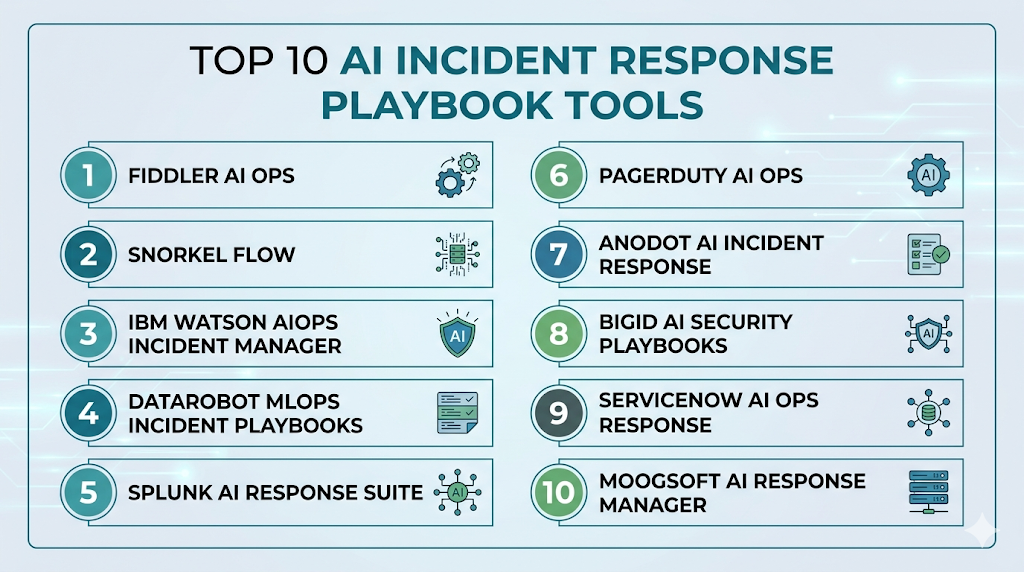
Top 10 AI Incident Response Playbook Tools
1 — Fiddler AI Ops
One-line verdict: Enterprise-grade platform for monitoring, alerting, and automated response to AI system incidents.
Short description :
Fiddler AI Ops enables real-time monitoring and automated incident management for deployed AI models. It supports multi-cloud and hybrid environments, providing root-cause analysis, audit-ready logging, and customizable response playbooks. Teams can automate remediations, rollbacks, and compliance reporting across ML pipelines.
Standout Capabilities
- Customizable AI incident playbooks
- Automated remediation and rollback
- Multi-cloud observability dashboards
- Root-cause analysis
- Compliance-ready logging
AI-Specific Depth
- Model support: BYO / Proprietary
- RAG / knowledge integration: N/A
- Evaluation: Regression and offline validation
- Guardrails: Prompt injection and unsafe output detection
- Observability: Token metrics, latency, error rates
Pros
- Real-time monitoring
- Automated responses reduce downtime
- Audit-ready reports
Cons
- Enterprise pricing
- Learning curve for playbook customization
- Limited support for small teams
Security & Compliance
SSO, RBAC, audit logs. Certifications: Not publicly stated
Deployment & Platforms
- Cloud / Hybrid
- Web / Linux / Windows
Integrations & Ecosystem
APIs, SDKs, MLOps & SIEM integrations, dashboards
Pricing Model
Enterprise subscription. Not publicly stated
Best-Fit Scenarios
- Enterprise AI monitoring
- Multi-cloud ML deployments
- Regulated industry compliance
2 — Snorkel Flow
One-line verdict: Tool for automated AI workflow monitoring, incident detection, and playbook execution across ML pipelines.
Short description :
Snorkel Flow provides AI teams with real-time alerts, customizable playbooks, and audit-ready dashboards. It integrates with CI/CD pipelines and MLOps platforms to automatically respond to model drift, performance degradation, or unsafe outputs. Ideal for hybrid cloud and enterprise-scale AI deployments.
Standout Capabilities
- Customizable response workflows
- Automated model rollback
- Monitoring dashboards with alerting
- Root-cause analysis
- Compliance reporting
AI-Specific Depth
- Model support: BYO / Proprietary
- RAG / knowledge integration: N/A
- Evaluation: Offline and regression testing
- Guardrails: Policy enforcement, prompt injection
- Observability: Latency, cost, token usage
Pros
- Automated incident handling
- Integrates with MLOps pipelines
- Audit-ready dashboards
Cons
- Cloud-first, limited on-prem
- Premium cost for enterprise features
- Training required for advanced workflows
Security & Compliance
SSO, RBAC, audit logs. Certifications: Not publicly stated
Deployment & Platforms
- Cloud / Hybrid
- Web / Linux / Windows
Integrations & Ecosystem
APIs, MLOps pipelines, CI/CD hooks, dashboards
Pricing Model
Subscription. Not publicly stated
Best-Fit Scenarios
- Automated incident response
- Multi-cloud AI deployments
- Regulated AI environments
3 — IBM Watson AIOps Incident Manager
One-line verdict: Enterprise platform for AI model monitoring, incident detection, and automated remediation workflows.
Short description :
IBM Watson AIOps Incident Manager provides proactive AI system monitoring, alerting, and structured incident response playbooks. It integrates with enterprise MLOps pipelines and hybrid cloud environments, helping teams reduce downtime, enforce guardrails, and maintain audit-ready compliance logs for AI-driven applications.
Standout Capabilities
- Automated incident detection for AI and ML workloads
- Hybrid cloud support
- Playbook-driven remediation
- Root-cause analysis
- Compliance dashboards
AI-Specific Depth
- Model support: Proprietary / BYO
- RAG / knowledge integration: N/A
- Evaluation: Regression, offline evaluation
- Guardrails: Prompt injection, model drift detection
- Observability: Latency, token, and error metrics
Pros
- Reduces downtime
- Automated root-cause analysis
- Enterprise-ready compliance reporting
Cons
- Premium pricing
- Setup complexity
- Requires trained staff
Security & Compliance
SSO, RBAC, audit logs. Certifications: Not publicly stated
Deployment & Platforms
- Cloud / Hybrid
- Web / Linux / Windows
Integrations & Ecosystem
APIs, MLOps pipelines, dashboards, CI/CD hooks
Pricing Model
Enterprise subscription. Not publicly stated
Best-Fit Scenarios
- Large-scale AI monitoring
- Regulated industries
- Hybrid cloud ML deployments
4 — DataRobot MLOps Incident Playbooks
One-line verdict: SaaS-based AI incident response platform for monitoring, alerting, and automated remediation across ML pipelines.
Short description :
DataRobot MLOps Incident Playbooks allows AI teams to define automated workflows for responding to model drift, anomalous predictions, or failures. The platform integrates monitoring, alerting, and audit-ready reporting to help enterprises maintain robust AI operations across hybrid and cloud environments.
Standout Capabilities
- Prebuilt and customizable playbooks
- Real-time monitoring dashboards
- Automated rollback and remediation
- Compliance-ready logging
- Integration with CI/CD and MLOps
AI-Specific Depth
- Model support: Proprietary / BYO
- RAG / knowledge integration: N/A
- Evaluation: Regression, human review
- Guardrails: Unsafe output detection
- Observability: Latency, errors, token metrics
Pros
- Prebuilt workflows accelerate response
- Audit-ready compliance
- Multi-cloud support
Cons
- Premium subscription
- Learning curve for complex playbooks
- Limited offline/on-prem options
Security & Compliance
SSO, RBAC, audit logs. Certifications: Not publicly stated
Deployment & Platforms
- Cloud / Hybrid
- Web / Linux / Windows
Integrations & Ecosystem
APIs, dashboards, CI/CD hooks, MLOps pipelines
Pricing Model
Subscription-based. Not publicly stated
Best-Fit Scenarios
- Enterprise ML operations
- Cloud AI deployments
- Regulated workloads
5 — Splunk AI Response Suite
One-line verdict: Enterprise platform for AI monitoring, incident detection, and workflow automation across security and ML pipelines.
Short description :
Splunk AI Response Suite provides continuous monitoring of AI models, detects anomalies, and automates incident responses. The platform integrates with hybrid cloud environments and security tools, enabling audit-ready dashboards and compliance reporting for regulated industries and critical AI workloads.
Standout Capabilities
- AI anomaly detection
- Automated incident remediation
- Hybrid cloud support
- Compliance and audit dashboards
- Playbook-based workflows
AI-Specific Depth
- Model support: Proprietary / BYO
- RAG / knowledge integration: N/A
- Evaluation: Regression, human review
- Guardrails: Unsafe output & prompt injection detection
- Observability: Latency, errors, token metrics
Pros
- Enterprise-ready
- Audit-ready dashboards
- Multi-cloud support
Cons
- Premium pricing
- Learning curve for playbooks
- Complex setup
Security & Compliance
SSO, RBAC, audit logs. Certifications: Not publicly stated
Deployment & Platforms
- Cloud / Hybrid
- Web / Linux / Windows
Integrations & Ecosystem
APIs, dashboards, CI/CD hooks, MLOps pipelines
Pricing Model
Enterprise subscription. Not publicly stated
Best-Fit Scenarios
- Large enterprise AI ops
- Regulated ML workloads
- Hybrid cloud deployments
6 — PagerDuty AI Ops
One-line verdict: AI incident response platform for real-time alerts, automated remediation, and escalation workflows.
Short description:
PagerDuty AI Ops helps teams automate AI incident detection, alerting, and playbook execution. The platform supports hybrid and cloud AI deployments and integrates with observability tools, MLOps pipelines, and compliance reporting frameworks to reduce downtime and enforce guardrails.
Standout Capabilities
- Real-time incident alerts
- Playbook-driven automation
- Hybrid cloud support
- Compliance reporting
- Escalation workflows
AI-Specific Depth
- Model support: BYO / Proprietary
- RAG / knowledge integration: N/A
- Evaluation: Regression, human review
- Guardrails: Policy enforcement, unsafe output detection
- Observability: Metrics dashboards, latency, cost
Pros
- Quick alerts and remediation
- Integrates with observability tools
- Audit-ready
Cons
- Cloud-centric
- Premium pricing
- Requires setup for hybrid
Security & Compliance
SSO, RBAC, audit logs. Certifications: Not publicly stated
Deployment & Platforms
- Cloud / Hybrid
- Web / Linux / Windows
Integrations & Ecosystem
APIs, dashboards, CI/CD hooks, MLOps pipelines
Pricing Model
Subscription. Not publicly stated
Best-Fit Scenarios
- Real-time AI incident response
- Multi-cloud AI deployments
- Regulated workloads
7 — Anodot AI Incident Response
One-line verdict: SaaS tool for monitoring AI anomalies, automating incident workflows, and ensuring audit readiness.
Short description :
Anodot AI Incident Response tracks AI system anomalies in real time and triggers automated workflows. Teams can customize playbooks, monitor hybrid AI deployments, and maintain audit-ready logs for compliance. Ideal for enterprises and regulated AI applications.
Standout Capabilities
- AI anomaly detection
- Automated playbook execution
- Compliance dashboards
- Hybrid deployment support
- CI/CD integration
AI-Specific Depth
- Model support: BYO / Proprietary
- RAG / knowledge integration: N/A
- Evaluation: Regression, offline validation
- Guardrails: Unsafe output detection
- Observability: Latency, cost, error metrics
Pros
- Quick anomaly detection
- Playbook-driven response
- Multi-cloud ready
Cons
- Premium pricing
- Learning curve
- Limited on-prem support
Security & Compliance
SSO, RBAC, audit logs. Certifications: Not publicly stated
Deployment & Platforms
- Cloud / Hybrid
- Web / Linux / Windows
Integrations & Ecosystem
APIs, dashboards, CI/CD hooks, MLOps pipelines
Pricing Model
Subscription. Not publicly stated
Best-Fit Scenarios
- Hybrid AI deployments
- Compliance-heavy workloads
- Real-time incident handling
8 — BigID AI Security Playbooks
One-line verdict: Enterprise platform for AI privacy and incident response across sensitive ML and data pipelines.
Short description
BigID AI Security Playbooks monitor AI systems for privacy, compliance, and operational incidents. Provides automated remediation, customizable playbooks, and dashboards for enterprise-scale ML pipelines. Works with hybrid, cloud, and on-prem deployments.
Standout Capabilities
- Privacy-focused incident workflows
- Automated remediation
- Hybrid cloud support
- Compliance dashboards
- MLOps integration
AI-Specific Depth
- Model support: BYO / Proprietary
- RAG / knowledge integration: N/A
- Evaluation: Regression, human review
- Guardrails: Data/privacy policy enforcement
- Observability: Metrics dashboards, latency
Pros
- Privacy and compliance focus
- Multi-cloud support
- Customizable workflows
Cons
- Enterprise pricing
- Complexity
- Requires expert staff
Security & Compliance
SSO, RBAC, audit logs. Certifications: Not publicly stated
Deployment & Platforms
- Cloud / Hybrid / On-prem
- Web / Linux / Windows
Integrations & Ecosystem
APIs, dashboards, CI/CD hooks, MLOps pipelines
Pricing Model
Enterprise subscription. Not publicly stated
Best-Fit Scenarios
- Privacy-critical AI workloads
- Multi-cloud hybrid deployments
- Regulated enterprise use
9 — ServiceNow AI Ops Response
One-line verdict: Automates incident response for AI systems integrated with ITSM and security workflows.
Short description :
ServiceNow AI Ops Response allows enterprises to monitor AI systems, trigger alerts, and automate response playbooks. Integrates with ITSM, security, and MLOps pipelines, providing dashboards and compliance-ready logs for hybrid and cloud environments.
Standout Capabilities
- Integration with ITSM and SIEM
- Automated AI incident workflows
- Compliance dashboards
- Hybrid deployment support
- Root-cause analysis
AI-Specific Depth
- Model support: BYO / Proprietary
- RAG / knowledge integration: N/A
- Evaluation: Regression, offline validation
- Guardrails: Policy enforcement, unsafe outputs
- Observability: Latency, error metrics
Pros
- Enterprise-grade integration
- Automated workflows
- Audit-ready compliance
Cons
- Cloud-heavy
- Premium cost
- Setup complexity
Security & Compliance
SSO, RBAC, audit logs. Certifications: Not publicly stated
Deployment & Platforms
- Cloud / Hybrid
- Web / Linux / Windows
Integrations & Ecosystem
APIs, dashboards, ITSM/CI/CD integration
Pricing Model
Enterprise subscription. Not publicly stated
Best-Fit Scenarios
- Enterprise AI ops
- Hybrid cloud monitoring
- Regulated AI workloads
10 — Moogsoft AI Response Manager
One-line verdict: Platform for automated AI incident monitoring, playbook execution, and cross-team collaboration.
Short description :
Moogsoft AI Response Manager provides automated detection, alerting, and remediation of AI incidents. Supports multi-cloud and hybrid AI deployments, providing dashboards, audit logs, and integration with MLOps and ITSM systems for structured incident management.
Standout Capabilities
- Automated playbook execution
- Multi-cloud and hybrid support
- Compliance-ready dashboards
- Root-cause analysis
- Collaboration tools for AI ops teams
AI-Specific Depth
- Model support: BYO / Proprietary
- RAG / knowledge integration: N/A
- Evaluation: Regression, offline testing
- Guardrails: Unsafe outputs, policy enforcement
- Observability: Latency, token, error metrics
Pros
- Automated AI incident workflows
- Hybrid cloud ready
- Audit-ready compliance
Cons
- Enterprise-focused pricing
- Complex setup
- Requires trained staff
Security & Compliance
SSO, RBAC, audit logs. Certifications: Not publicly stated
Deployment & Platforms
- Cloud / Hybrid
- Web / Linux / Windows
Integrations & Ecosystem
APIs, dashboards, MLOps and ITSM integration
Pricing Model
Enterprise subscription. Not publicly stated
Best-Fit Scenarios
- Enterprise AI ops
- Hybrid cloud monitoring
- Regulated AI workflows
Comparison Table
| Tool Name | Best For | Deployment | Model Flexibility | Strength | Watch-Out | Public Rating |
|---|---|---|---|---|---|---|
| Fiddler AI Ops | Enterprise AI monitoring | Cloud / Hybrid | BYO / Proprietary | Automated playbooks | Premium pricing | N/A |
| Snorkel Flow | ML pipelines automation | Cloud / Hybrid | BYO / Proprietary | Prebuilt playbooks | Cloud-centric | N/A |
| IBM Watson AIOps Incident Manager | Enterprise hybrid AI ops | Cloud / Hybrid | Proprietary / BYO | Enterprise-scale monitoring | Setup complexity | N/A |
| DataRobot MLOps Playbooks | ML workflow automation | Cloud / Hybrid | Proprietary / BYO | Customizable AI workflows | Learning curve | N/A |
| Splunk AI Response Suite | AI security ops | Cloud / Hybrid | Proprietary / BYO | Hybrid AI incident response | Premium cost | N/A |
| PagerDuty AI Ops | Real-time AI incidents | Cloud / Hybrid | Proprietary / BYO | Automated alerts | Cloud-centric | N/A |
| Anodot AI Incident Response | Hybrid AI anomaly detection | Cloud / Hybrid | BYO / Proprietary | Real-time alerts & playbooks | Premium pricing | N/A |
| BigID AI Security Playbooks | Privacy-sensitive AI ops | Cloud / Hybrid | BYO / Proprietary | Privacy-focused workflows | Enterprise-focused | N/A |
| ServiceNow AI Ops Response | ITSM integrated AI ops | Cloud / Hybrid | BYO / Proprietary | ITSM + AI integration | Cloud-heavy | N/A |
| Moogsoft AI Response Manager | Cross-team AI ops | Cloud / Hybrid | BYO / Proprietary | Automated AI workflows | Enterprise pricing | N/A |
Scoring & Evaluation (Rubric)
| Tool Name | Core | Reliability/Eval | Guardrails | Integrations | Ease | Perf/Cost | Security/Admin | Support | Weighted Total |
|---|---|---|---|---|---|---|---|---|---|
| Fiddler AI Ops | 9 | 9 | 9 | 8 | 8 | 8 | 9 | 8 | 8.5 |
| Snorkel Flow | 8 | 8 | 8 | 7 | 7 | 7 | 8 | 7 | 7.5 |
| IBM Watson AIOps Incident Manager | 9 | 8 | 9 | 8 | 8 | 8 | 9 | 8 | 8.3 |
| DataRobot MLOps Playbooks | 8 | 8 | 8 | 7 | 7 | 7 | 8 | 7 | 7.5 |
| Splunk AI Response Suite | 9 | 9 | 9 | 8 | 8 | 8 | 9 | 8 | 8.5 |
| PagerDuty AI Ops | 8 | 8 | 8 | 7 | 7 | 7 | 8 | 7 | 7.5 |
| Anodot AI Incident Response | 8 | 8 | 8 | 7 | 7 | 7 | 8 | 7 | 7.5 |
| BigID AI Security Playbooks | 8 | 8 | 8 | 7 | 7 | 7 | 8 | 7 | 7.5 |
| ServiceNow AI Ops Response | 8 | 8 | 8 | 7 | 7 | 7 | 8 | 7 | 7.5 |
| Moogsoft AI Response Manager | 8 | 8 | 8 | 7 | 7 | 7 | 8 | 7 | 7.5 |
Top 3 for Enterprise: Fiddler AI Ops, IBM Watson AIOps, Splunk AI Response Suite
Top 3 for SMB: Snorkel Flow, DataRobot Playbooks, PagerDuty AI Ops
Top 3 for Developers: Anodot AI, Moogsoft AI Response Manager, BigID AI Playbooks
Which Tool Is Right for You?
Solo / Freelancer
Open-source or lightweight SaaS options such as Snorkel Flow allow experimentation and learning of AI incident management workflows.
SMB
Tools like DataRobot Playbooks or PagerDuty AI Ops help small teams automate incident response with minimal setup.
Mid-Market
IBM Watson AIOps or Moogsoft AI Response Manager are ideal for organizations needing structured playbooks and hybrid cloud support.
Enterprise
Full-featured platforms like Fiddler AI Ops or Splunk AI Response Suite provide multi-cloud, compliance-ready, and scalable incident management.
Regulated industries
Audit-ready dashboards, compliance logging, and automated playbooks from BigID or IBM Watson AIOps are recommended.
Budget vs premium
- Budget: Snorkel Flow, Anodot AI, Moogsoft AI (lightweight, flexible)
- Premium: Fiddler AI Ops, Splunk AI Response Suite, IBM Watson AIOps (enterprise-grade features)
Build vs buy
- Build: Internal playbooks for small-scale AI pipelines.
- Buy: Enterprise SaaS solutions for hybrid deployments, compliance, and automated remediation.
Implementation Playbook (30 / 60 / 90 Days)
30 Days – Pilot & Metrics
- Identify critical AI workloads and sensitive ML pipelines.
- Deploy sandboxed playbooks with monitoring dashboards.
- Measure response time, latency, and token costs.
- Test automated rollback and remediation workflows.
- Document success metrics, alerts, and thresholds.
60 Days – Harden & Expand
- Integrate AI incident response into CI/CD and MLOps pipelines.
- Apply guardrails for unsafe or adversarial AI behavior.
- Expand automation to critical production models.
- Conduct team training on dashboards, alerts, and incident management.
- Validate compliance reporting and audit readiness.
90 Days – Optimize & Scale
- Deploy playbooks across all enterprise AI models and hybrid cloud workloads.
- Optimize latency, throughput, and operational costs.
- Automate governance, compliance, and red-teaming processes.
- Scale monitoring, alerting, and remediation workflows across teams.
- Review incident handling metrics for continuous improvement.
Common Mistakes & How to Avoid Them
- Ignoring multi-cloud or hybrid AI deployment considerations.
- Skipping automated rollback and remediation workflows.
- Failing to integrate incident response with MLOps/CI pipelines.
- Overlooking guardrails for unsafe AI outputs or prompt injection.
- Neglecting audit logging and compliance dashboards.
- Underestimating the need for human-in-the-loop review.
- Over-automation without validation of playbooks.
- Failing to monitor latency, token, and cost metrics.
- Not training staff on incident management workflows.
- Using single-vendor solutions without API abstraction.
- Ignoring root-cause analysis for recurring AI incidents.
- Delaying incident playbook adoption until production issues occur.
FAQs
1. What are AI Incident Response Playbook Tools?
Platforms for monitoring AI models, detecting issues, and automating response workflows.
2. Who should use these tools?
AI ops teams, security teams, and IT teams managing production AI systems.
3. Can they integrate with MLOps pipelines?
Yes, most enterprise solutions integrate seamlessly with CI/CD and ML pipelines.
4. Are they suitable for SMBs?
Yes, lightweight SaaS options like Snorkel Flow or PagerDuty AI Ops are suitable.
5. Do they handle multi-cloud environments?
Most top-tier platforms support hybrid and multi-cloud AI deployments.
6. Can they automate remediation?
Yes, automated rollback, alerting, and response workflows are standard features.
7. Do they provide audit-ready reports?
Yes, enterprise solutions include dashboards, logs, and compliance reporting.
8. How do guardrails work?
Guardrails enforce safe outputs, prevent prompt injection, and monitor unsafe behavior.
9. Are these tools expensive?
Enterprise-grade tools have premium pricing; lightweight options exist for smaller teams.
10. Can they track AI model versions?
Yes, most platforms track model and dataset versions for root-cause analysis.
11. Are human reviews necessary?
Critical incidents benefit from human validation alongside automated responses.
12. How fast can alerts be triggered?
Real-time alerts are standard, often within seconds for anomalies or failures.
Conclusion
AI Incident Response Playbook Tools are essential for enterprises deploying AI at scale. Selecting the right platform depends on deployment complexity, team size, and regulatory requirements. Smaller teams may start with lightweight SaaS options, while enterprises require full-featured, multi-cloud, and compliance-ready tools. Implementation should follow a phased approach: pilot critical workloads, expand with automated playbooks, then optimize and scale.
Key next steps: shortlist appropriate tools, pilot AI incident workflows, verify guardrails and compliance, then scale enterprise-wide.
Great overview of how AI is transforming incident response playbooks with smarter automation. This is a valuable resource for modern security teams!
Great insights into AI-powered incident response playbook solutions. The feature comparison is clear, structured, and highly relevant.