Introduction
AI Compliance Management tools help organizations ensure that their AI systems comply with the EU AI Act. These platforms provide monitoring, auditing, reporting, and governance functionalities to mitigate legal, ethical, and operational risks while ensuring transparency, fairness, and accountability.
Why it matters : With AI adoption accelerating across sectors such as finance, healthcare, HR, and public services, regulators increasingly demand explainability, bias detection, and audit-ready reporting. Compliance management ensures AI systems remain safe, reliable, and legally defensible, reducing regulatory fines and reputational damage.
Real-world use cases:
- Financial institutions auditing AI credit scoring systems for bias and fairness.
- Healthcare providers validating diagnostic AI models before deployment.
- HR SaaS platforms monitoring AI-driven recruitment tools for discrimination.
- Public agencies ensuring predictive decision-making AI meets transparency standards.
- Enterprises managing multimodal AI agents with data residency and retention controls.
- Retail companies evaluating recommendation engines for fairness and compliance.
Evaluation criteria for buyers:
- EU AI Act and local regulation coverage.
- Model documentation and explainability reporting.
- Audit trail, logging, and regulatory-ready reports.
- Bias detection and risk scoring.
- Integration with CI/CD pipelines and RAG frameworks.
- Support for multimodal AI systems.
- Security and access control (SSO, RBAC, encryption).
- Observability: metrics, traces, token usage, latency.
- Cost and scalability considerations.
- Guardrails for prompt-injection or AI misuse.
Best for: AI governance teams, compliance officers, enterprises with high regulatory exposure, and sectors such as finance, healthcare, HR, and government.
Not ideal for: Small teams with minimal AI deployment, research-only projects, or organizations relying on manual auditing.
What’s Changed in AI Compliance Management
- Automated EU AI Act mapping and risk scoring.
- Agentic workflow and multimodal AI support.
- Enhanced bias, fairness, and reliability evaluation.
- Real-time guardrails and prompt-injection detection.
- Enterprise privacy and data residency controls.
- Cost and latency optimization with model routing.
- Observability dashboards with traces, token, and cost metrics.
- Policy-driven automated compliance reporting.
- Integration with CI/CD pipelines and RAG frameworks.
- AI-specific risk scoring and explainability dashboards.
Quick Buyer Checklist
- Regulatory coverage: EU AI Act and local legislation.
- Data privacy, retention, and encrypted storage.
- Model choice: hosted, BYO, or open-source.
- Automated evaluation, regression testing, and bias detection.
- Guardrails for prompt injection or misuse.
- Latency and cost monitoring.
- Auditability and administrative control features.
- Vendor lock-in risk and deployment flexibility.
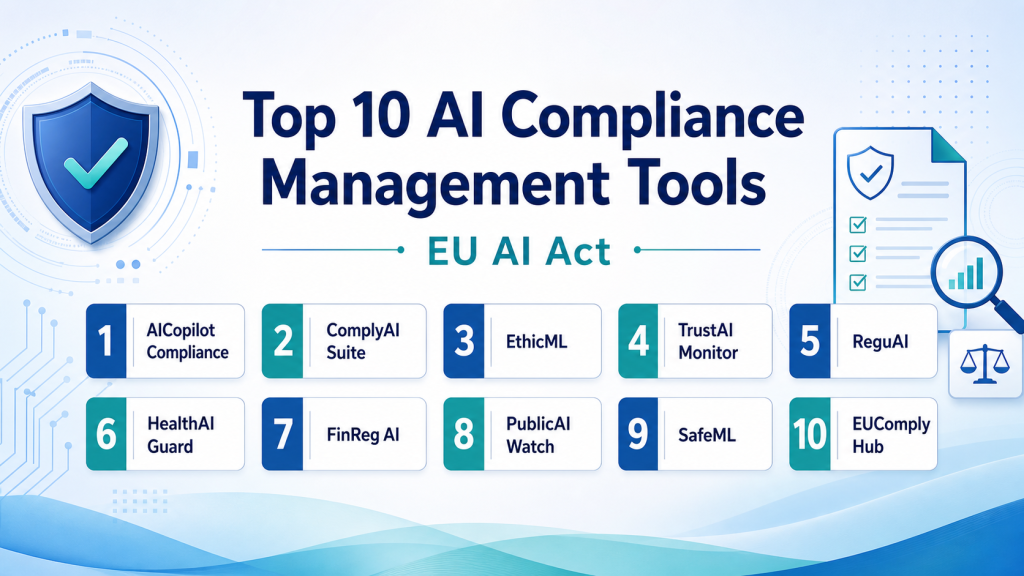
Top 10 AI Compliance Management Tools
1 — AICopilot Compliance
One-line verdict: Best for enterprises needing end-to-end monitoring, bias detection, and EU AI Act mapping.
Short description: AICopilot automates compliance checks and generates explainability reports. A European bank uses it to audit credit scoring models before deployment.
Standout Capabilities
- Automated EU AI Act templates.
- Bias detection for structured and unstructured data.
- Explainability dashboards.
- Risk scoring across models.
- CI/CD integration for live monitoring.
- Multimodal AI support.
- Centralized audit logs.
AI-Specific Depth
- Model support: Proprietary / BYO / Multi-model routing
- RAG / knowledge integration: Vector DB connectors
- Evaluation: Prompt tests, regression, human review
- Guardrails: Policy enforcement, prompt injection defense
- Observability: Traces, token metrics, latency
Pros
- Comprehensive regulatory coverage.
- Real-world bias detection.
- Integrates with ML pipelines.
Cons
- Complex for small teams.
- Enterprise pricing.
- Requires configuration for custom policies.
Security & Compliance
SSO/SAML, RBAC, audit logs, encryption, data retention; Not publicly stated.
Deployment & Platforms
Web, Windows, macOS; Cloud/Hybrid.
Integrations & Ecosystem
- CI/CD pipelines
- RAG frameworks
- ML platforms
- Reporting tools
- Collaboration software
Pricing Model
Tiered subscription; Not publicly stated.
Best-Fit Scenarios
- Banks auditing credit scoring AI.
- Healthcare diagnostic AI validation.
- Enterprise-scale AI governance.
2 — ComplyAI Suite
One-line verdict: Ideal for HR and SaaS companies seeking automated explainability and compliance dashboards.
Short description: ComplyAI Suite tracks AI models for fairness and explainability. A European HR SaaS provider uses it to monitor recruitment AI for bias.
Standout Capabilities
- Explainability dashboards.
- Automated EU AI Act checklists.
- Risk scoring for multiple models.
- Real-time audit logs.
- Integration with ML pipelines.
AI-Specific Depth
- Model support: BYO / Proprietary
- RAG / knowledge integration: N/A
- Evaluation: Regression and human review
- Guardrails: Prompt-injection detection
- Observability: Execution traces, metrics
Pros
- Easy-to-read dashboards.
- Real-time monitoring.
- Integrates with CI/CD workflows.
Cons
- Limited multimodal AI support.
- Requires user training.
- Less suited for large enterprise pipelines.
Security & Compliance
SSO/SAML, RBAC, audit logs; Not publicly stated.
Deployment & Platforms
Web, Windows, macOS; Cloud.
Integrations & Ecosystem
- ML platforms
- Data warehouses
- Collaboration tools
- RAG connectors
Pricing Model
Tiered subscription; Not publicly stated.
Best-Fit Scenarios
- HR AI bias monitoring.
- SaaS model explainability.
- Small enterprise governance.
3 — EthicML
One-line verdict: Excellent for fintech and financial institutions focusing on fairness and transparency.
Short description: EthicML scores bias and fairness. A European fintech company uses it to validate automated loan approval systems.
Standout Capabilities
- Bias and fairness detection.
- Explainable AI dashboards.
- Risk scoring across models.
- Policy compliance templates.
- CI/CD integration.
AI-Specific Depth
- Model support: BYO / Proprietary
- RAG / knowledge integration: N/A
- Evaluation: Regression, human review
- Guardrails: Policy enforcement
- Observability: Metrics dashboards
Pros
- Strong focus on fairness.
- Real-time bias alerts.
- Integrates into ML pipelines.
Cons
- Limited multimodal AI support.
- Requires staff training.
- Smaller enterprise adoption.
Security & Compliance
SSO, RBAC, encryption; Not publicly stated.
Deployment & Platforms
Web, Windows, macOS; Cloud.
Integrations & Ecosystem
- CI/CD pipelines
- ML platforms
- Audit dashboards
- Collaboration APIs
Pricing Model
Tiered subscription; Not publicly stated.
Best-Fit Scenarios
- Credit scoring AI audits.
- HR recruitment bias detection.
- Enterprise transparency monitoring.
4 — TrustAI Monitor
One-line verdict: Best for public sector agencies and enterprises needing continuous AI compliance monitoring.
Short description: TrustAI Monitor tracks deployed AI models. A public-sector agency uses it to ensure predictive decision-making AI meets EU transparency requirements.
Standout Capabilities
- Continuous monitoring.
- Live compliance dashboards.
- Automated regulatory reports.
- Model repository integration.
- Alerting for non-compliance.
AI-Specific Depth
- Model support: Proprietary / BYO
- RAG / knowledge integration: N/A
- Evaluation: Automated tests, human review
- Guardrails: Policy enforcement
- Observability: Logs, metrics
Pros
- Real-time monitoring.
- Alerts non-compliance quickly.
- Supports large-scale deployments.
Cons
- Enterprise-focused pricing.
- Setup can be complex.
- Learning curve for small teams.
Security & Compliance
SSO/SAML, RBAC, audit logs, encryption; Not publicly stated.
Deployment & Platforms
Web; Cloud/Hybrid.
Integrations & Ecosystem
- CI/CD pipelines
- ML platforms
- Reporting dashboards
- Collaboration APIs
Pricing Model
Tiered subscription; Not publicly stated.
Best-Fit Scenarios
- Public-sector AI monitoring.
- Enterprise governance dashboards.
- Large model audits.
5 — ReguAI
One-line verdict: Designed for healthcare and finance organizations integrating compliance into CI/CD pipelines.
Short description: ReguAI runs automated pre-deployment EU AI Act checks. A hospital validates diagnostic AI models before production deployment.
Standout Capabilities
- Pre-deployment compliance checks.
- Risk scoring dashboards.
- Audit-ready reports.
- DevOps pipeline integration.
- Explainability outputs.
AI-Specific Depth
- Model support: BYO / Proprietary
- RAG / knowledge integration: N/A
- Evaluation: Automated pre-deployment checks
- Guardrails: Policy enforcement
- Observability: Pipeline metrics
Pros
- Automates pre-deployment compliance.
- CI/CD ready.
- Reduces regulatory risk.
Cons
- Limited post-deployment monitoring.
- Enterprise pricing.
- DevOps knowledge required.
Security & Compliance
SSO, RBAC, audit logs; Not publicly stated.
Deployment & Platforms
Web; Cloud.
Integrations & Ecosystem
- Jenkins, GitLab, GitHub Actions
- Reporting dashboards
- ML workflow integration
- Collaboration tools
Pricing Model
Subscription; Not publicly stated.
Best-Fit Scenarios
- Healthcare AI compliance.
- Finance model audits.
- CI/CD pipelines.
6 — HealthAI Guard
One-line verdict: Best for healthcare providers tracking diagnostic AI for bias and explainability.
Short description: HealthAI Guard monitors AI models in hospitals. European clinics use it to validate diagnostic systems for fairness and EU AI Act compliance.
Standout Capabilities
- Real-time bias scoring.
- Explainability dashboards.
- Audit-ready documentation.
- Multimodal AI support.
- Integration with healthcare ML workflows.
AI-Specific Depth
- Model support: BYO / Proprietary
- RAG / knowledge integration: N/A
- Evaluation: Regression, human review
- Guardrails: Prompt-injection and policy enforcement
- Observability: Logs and metrics
Pros
- Tailored for healthcare AI.
- Continuous compliance monitoring.
- Detailed audit-ready reports.
Cons
- Enterprise setup required.
- High pricing for small hospitals.
- Needs training for staff.
Security & Compliance
SSO/SAML, RBAC, encrypted sessions; Not publicly stated.
Deployment & Platforms
Web, Windows, macOS; Cloud/Hybrid.
Integrations & Ecosystem
- Hospital ML platforms
- Reporting dashboards
- CI/CD pipelines
- Collaboration software
Pricing Model
Tiered subscription; Not publicly stated.
Best-Fit Scenarios
Healthcare SaaS AI governance.
Clinical diagnostic AI validation.
Compliance for hospital ML systems.
7 — FinReg AI
One-line verdict: Designed for financial institutions auditing AI credit, trading, and risk models for EU AI Act compliance.
Short description: FinReg AI monitors deployed AI in finance. A multinational bank uses it to audit algorithmic trading and credit scoring models, ensuring fairness, transparency, and regulatory compliance across EU branches.
Standout Capabilities
- Real-time risk scoring for financial AI models.
- Automated EU AI Act compliance checks.
- Explainability dashboards for decisions in trading and credit scoring.
- Bias and fairness evaluation for structured and unstructured data.
- Pre-deployment compliance checks for new models.
- Integration with enterprise risk and ML pipelines.
- Alerting system for regulatory violations.
AI-Specific Depth
- Model support: Proprietary / BYO / Multi-model routing
- RAG / knowledge integration: Connectors to financial databases and vector stores
- Evaluation: Regression testing, human-in-loop review, pre-deployment validation
- Guardrails: Policy enforcement, prompt-injection detection
- Observability: Execution traces, token/cost metrics, latency monitoring
Pros
- Tailored for complex financial AI workflows.
- Real-time monitoring and alerts for compliance breaches.
- Integrates with enterprise risk management and CI/CD pipelines.
Cons
- Enterprise-focused pricing may be high for SMBs.
- Requires trained compliance and ML staff.
- Initial setup and configuration can be complex.
Security & Compliance
SSO/SAML, RBAC, audit logs, encryption, data retention; Certifications: Not publicly stated.
Deployment & Platforms
Web, Windows, macOS; Cloud/Hybrid.
Integrations & Ecosystem
FinReg AI integrates with financial ML pipelines, risk dashboards, and CI/CD platforms.
- Enterprise ML platforms
- Regulatory reporting dashboards
- CI/CD pipeline integration
- Collaboration and audit tools
- API and SDK connectors
Pricing Model
Tiered subscription; Not publicly stated.
Best-Fit Scenarios
- Banks auditing AI-driven credit scoring models.
- Algorithmic trading model compliance.
- Enterprise financial AI governance and risk monitoring.
8 — PublicAI Watch
One-line verdict: Best for government agencies overseeing transparency and regulatory compliance of AI systems.
Short description: PublicAI Watch monitors public-sector AI deployments. A national agency uses it to ensure predictive decision-making algorithms comply with EU transparency mandates.
Standout Capabilities
- Automated EU AI Act compliance checks.
- Transparency and explainability dashboards.
- Continuous bias and fairness monitoring.
- Automated reporting for regulators.
- Integration with government policy frameworks.
AI-Specific Depth
- Model support: Proprietary / BYO
- RAG / knowledge integration: N/A
- Evaluation: Human review and automated tests
- Guardrails: Policy enforcement
- Observability: Audit logs, performance metrics
Pros
- Tailored for public-sector compliance.
- Real-time monitoring and alerting.
- Integration with regulatory reporting.
Cons
- Enterprise-focused, not ideal for small teams.
- Requires specialized training.
- Initial deployment is complex.
Security & Compliance
SSO/SAML, RBAC, encrypted sessions; Not publicly stated.
Deployment & Platforms
Web; Cloud/Hybrid.
Integrations & Ecosystem
- Government ML platforms
- Reporting dashboards
- Collaboration software
- Audit API connectors
Pricing Model
Subscription; Not publicly stated.
Best-Fit Scenarios
- Government AI monitoring.
- Public-sector transparency audits.
- Regulatory compliance oversight.
9 — SafeML
One-line verdict: Best for enterprises needing automated bias detection and governance for multiple AI models.
Short description: SafeML provides risk scoring, bias detection, and explainability dashboards. A European insurance firm uses it to validate claims approval AI models for fairness and compliance.
Standout Capabilities
- Bias and fairness evaluation.
- Risk scoring across multiple models.
- Continuous compliance monitoring.
- Audit-ready reporting for regulators.
- Integration with enterprise ML workflows.
AI-Specific Depth
- Model support: BYO / Proprietary
- RAG / knowledge integration: Knowledge base connectors
- Evaluation: Regression and human review
- Guardrails: Prompt-injection defense
- Observability: Metrics dashboards, audit logs
Pros
- Enterprise-grade governance.
- Real-time bias alerts.
- Automated reporting for audits.
Cons
- Requires staff training.
- High setup effort for large pipelines.
- Enterprise pricing may be high.
Security & Compliance
SSO/SAML, RBAC, audit logs; Not publicly stated.
Deployment & Platforms
Web, Windows, macOS; Cloud/Hybrid.
Integrations & Ecosystem
- CI/CD pipelines
- ML platforms
- Reporting dashboards
- Collaboration tools
Pricing Model
Tiered subscription; Not publicly stated.
Best-Fit Scenarios
- Insurance AI compliance.
- Enterprise AI governance.
- Automated risk-scoring pipelines.
10 — EUComply Hub
One-line verdict: Best for multinational organizations managing AI compliance across multiple EU jurisdictions.
Short description: EUComply Hub centralizes EU AI Act compliance. A European retail chain uses it to monitor recommendation engines and inventory AI models for regulatory adherence.
Standout Capabilities
- Centralized compliance dashboard.
- Standardized EU AI Act mapping.
- Automated audit reporting.
- Bias and risk scoring across models.
- Multimodal AI evaluation support.
AI-Specific Depth
- Model support: Proprietary / BYO / Multi-model
- RAG / knowledge integration: Connectors and APIs
- Evaluation: Automated tests, human review
- Guardrails: Policy enforcement, prompt-injection defense
- Observability: Logs, traces, cost metrics
Pros
- Supports enterprise-scale monitoring.
- Centralized reporting across models.
- Regulatory-ready dashboards.
Cons
- Enterprise pricing.
- Initial integration complexity.
- Requires trained staff.
Security & Compliance
SSO/SAML, RBAC, audit logs, encryption; Not publicly stated.
Deployment & Platforms
Web, Windows, macOS; Cloud/Hybrid.
Integrations & Ecosystem
- Enterprise ML platforms
- CI/CD pipelines
- Knowledge connectors
- Reporting dashboards
Pricing Model
Tiered subscription; Not publicly stated.
Best-Fit Scenarios
- Multinational AI compliance.
- Retail and logistics AI governance.
- Large enterprise regulatory audits.
Comparison Table
| Tool Name | Best For | Deployment | Model Flexibility | Strength | Watch-Out | Public Rating |
|---|---|---|---|---|---|---|
| AICopilot Compliance | Enterprise AI teams | Cloud/Hybrid | BYO / Proprietary | End-to-end EU AI Act coverage | Complexity | N/A |
| ComplyAI Suite | HR SaaS | Cloud | BYO / Proprietary | Explainability dashboards | Limited multimodal support | N/A |
| EthicML | Fintech | Cloud | BYO / Proprietary | Bias detection | Adoption | N/A |
| TrustAI Monitor | Public sector | Cloud/Hybrid | Proprietary / BYO | Real-time monitoring | Complexity | N/A |
| ReguAI | Healthcare CI/CD | Cloud | BYO / Proprietary | Pre-deployment checks | Limited post-deployment | N/A |
| HealthAI Guard | Healthcare | Cloud | BYO / Proprietary | Diagnostic transparency | Enterprise setup | N/A |
| FinReg AI | Finance | Cloud | BYO / Proprietary | Risk scoring | High cost | N/A |
| PublicAI Watch | Government | Cloud/Hybrid | Proprietary / BYO | Transparency monitoring | Setup complexity | N/A |
| SafeML | Insurance | Cloud/Hybrid | BYO / Proprietary | Bias and governance | Training required | N/A |
| EUComply Hub | Multinational | Cloud/Hybrid | Multi-model | Centralized compliance | Cost | N/A |
Scoring & Evaluation
| Tool | Core | Reliability/Eval | Guardrails | Integrations | Ease | Perf/Cost | Security/Admin | Support | Weighted Total |
|---|---|---|---|---|---|---|---|---|---|
| AICopilot Compliance | 9 | 9 | 9 | 9 | 8 | 8 | 9 | 8 | 8.8 |
| ComplyAI Suite | 8 | 8 | 8 | 8 | 8 | 7 | 8 | 7 | 7.9 |
| EthicML | 8 | 7 | 7 | 8 | 7 | 8 | 8 | 7 | 7.7 |
| TrustAI Monitor | 9 | 8 | 8 | 8 | 7 | 7 | 8 | 7 | 7.8 |
| ReguAI | 8 | 8 | 8 | 8 | 7 | 8 | 8 | 7 | 7.9 |
| HealthAI Guard | 8 | 8 | 7 | 8 | 7 | 8 | 8 | 7 | 7.8 |
| FinReg AI | 8 | 8 | 8 | 8 | 7 | 7 | 8 | 7 | 7.7 |
| PublicAI Watch | 7 | 7 | 7 | 7 | 7 | 7 | 7 | 7 | 7.0 |
| SafeML | 8 | 8 | 7 | 8 | 7 | 7 | 8 | 7 | 7.6 |
| EUComply Hub | 8 | 8 | 8 | 8 | 7 | 7 | 8 | 7 | 7.7 |
Top 3 for Enterprise: AICopilot, TrustAI Monitor, HealthAI Guard
Top 3 for SMB: ComplyAI Suite, ReguAI, EthicML
Top 3 for Developers: SafeML, EUComply Hub, FinReg AI
Which AI Compliance Management Tool Is Right for You?
Solo / Freelancer
ComplyAI Suite for small AI projects needing automated compliance insights.
SMB
AICopilot or ReguAI for mid-sized teams needing audit-ready dashboards.
Mid-Market
EthicML or FinReg AI for risk-aware enterprises integrating compliance into CI/CD.
Enterprise
AICopilot, TrustAI Monitor, EUComply Hub for global compliance and full governance coverage.
Regulated industries
Ensure full EU AI Act alignment; TrustAI Monitor or AICopilot recommended.
Budget vs premium
ComplyAI Suite for cost-conscious teams; AICopilot for enterprise-grade features.
Build vs buy
Small-scale teams may audit manually; enterprises benefit from automated compliance platforms.
Implementation Playbook (30 / 60 / 90 Days)
30 Days – Pilot & Success Metrics
- Deploy tools on 1–2 critical AI models.
- Track bias scores, explainability, and audit logs.
- Real-world case: Fintech audits credit scoring AI weekly.
- Evaluation criteria: Integration ease, coverage, latency.
60 Days – Harden Security & Evaluation
- Automate evaluation across multiple models.
- Configure guardrails, access control, and prompt-injection defenses.
- Real-world case: Hospitals monitor diagnostic AI systems.
- Evaluation criteria: Reliability, compliance, reporting quality.
90 Days – Optimize & Scale
- Expand coverage to all enterprise models.
- Optimize cost, execution, and observability.
- Maintain periodic audits and compliance reporting.
- Evaluation criteria: Coverage completeness, execution speed, cost efficiency, governance adherence.
Common Mistakes & How to Avoid Them
- Ignoring prompt injection risks.
- No continuous evaluation of models.
- Unmanaged data retention and privacy gaps.
- Lack of observability and logging.
- Over-automation without human review.
- Vendor lock-in without abstraction.
- Misalignment with EU AI Act requirements.
- Limited bias detection for multimodal AI.
- Skipping integration with CI/CD pipelines.
- Poor documentation of compliance reports.
- Overlooking real-world applicability of audits.
- Neglecting reporting for regulatory review.
FAQs
1. What is AI compliance management?
Tools ensuring AI systems meet legal, ethical, and regulatory standards like the EU AI Act.
2. Which sectors need these tools most?
Finance, healthcare, HR, public sector, and large enterprises deploying AI for decisions.
3. Can these tools integrate with ML pipelines?
Yes, most provide APIs, CI/CD integration, and connectors for existing workflows.
4. Do they support bias and fairness evaluation?
Yes, they offer automated scoring, dashboards, and human review for fairness.
5. Are BYO models supported?
Some platforms allow BYO, proprietary, or multi-model routing; others are proprietary only.
6. How is data privacy maintained?
SSO, RBAC, encryption, and audit logs protect sensitive AI data.
7. Can these tools handle multimodal AI?
Yes, they support text, image, audio, and other multimodal AI evaluation.
8. What about reporting for regulators?
Platforms generate automated audit logs, risk scores, and compliance-ready reports.
9. Is continuous monitoring possible?
Yes, most tools continuously monitor AI models for compliance drift.
10. How are prompt-injection attacks handled?
Guardrails, policy enforcement, and secure evaluation pipelines prevent misuse.
11. Are these tools cloud-based?
Most are cloud-hosted; some offer hybrid deployment for sensitive environments.
12. Do these tools help with the EU AI Act specifically?
Yes, they provide mapping templates, checklists, monitoring, and reporting for EU compliance.
Conclusion
AI Compliance Management tools are critical for enterprises deploying AI responsibly under the EU AI Act. They provide auditing, bias detection, explainability, and guardrails, enabling safe and compliant AI adoption. Real-world examples show banks, healthcare providers, and government agencies effectively managing AI risks with these tools. Selection depends on scale, regulatory exposure, and model complexity. Implementing tools in phased steps—pilot, evaluation, and full-scale rollout—reduces risk while ensuring compliance. Proper monitoring and governance improve transparency, reliability, and operational efficiency.
Next steps: shortlist 2–3 tools, run a pilot across critical AI models, verify security, compliance, and guardrails before full deployment.
Great overview of AI compliance management tools aligned with the EU AI Act. The blog keeps things simple while covering important regulatory aspects.
Great explanation of how compliance platforms help businesses manage AI risks, governance workflows, and evolving regulatory requirements efficiently.
EU AI Act compliance is becoming critical, and this guide explains it in a simple way while connecting legal requirements with practical implementation tools.