Introduction
AI ESG Data Extraction Tools are software solutions that use artificial intelligence, machine learning, document processing, natural-language processing, and automation to collect and extract environmental, social, and governance data from reports, invoices, spreadsheets, filings, policies, supplier documents, websites, and other business records.
Instead of manually searching hundreds of pages for metrics such as greenhouse-gas emissions, energy consumption, workforce statistics, board composition, safety incidents, or governance indicators, AI can identify relevant information, structure it into datasets, and help sustainability teams prepare the information for analysis and repESG teams, sustainability professionals, investment teams, compliance departments, corporate reporting teams, consultants, financial institutions, procurement teams, and enterprises processing large volumes of ESG document Small organizations with only a few documents to review may find manual extraction or standard spreadsheet workflows sufficient. AI extraction should also not be treated as a substitute for expert validation when extracted information is material to regulatory, investment, or corporate reporting decisions.
What’s Changed in AI ESG Data Extraction
- AI can process increasingly diverse ESG information sources, including PDFs, spreadsheets, reports, filings, and structured databases.
- Multimodal models can help interpret tables, charts, scanned documents, and text together.
- Document AI can extract ESG metrics while retaining their surrounding context.
- AI-assisted classification can map extracted information to ESG categories.
- Large language models can help identify disclosures expressed using different terminology.
- Automated extraction can reduce repetitive manual data-entry work.
- Companies increasingly need traceability from an extracted metric back to its source document and page.
- Human-in-the-loop review is becoming more important for material ESG information.
- Data-quality checks can identify missing units, inconsistent reporting periods, and unusual values.
- AI can help compare ESG disclosures across companies with different reporting structures.
- Privacy and security are important when ESG workflows contain confidential corporate or employee information.
- Evaluation should measure extraction accuracy rather than assuming an AI system is reliable because it produces fluent answers.
- Guardrails are increasingly important when AI systems process untrusted documents that may contain malicious or misleading instructions.
- API-based extraction makes it easier to integrate ESG information into data warehouses, reporting platforms, and internal applications.
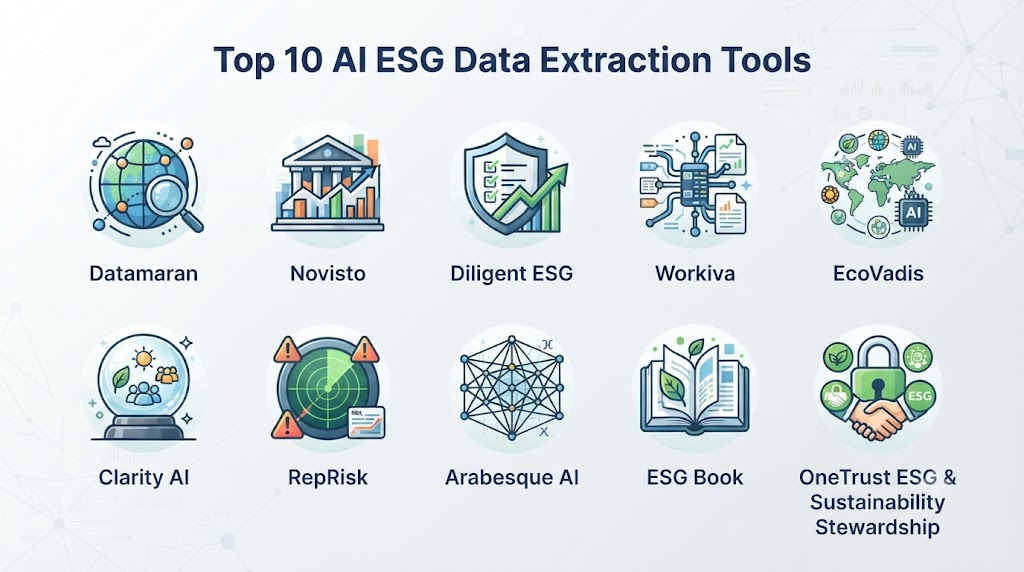
Top 10 AI ESG Data Extraction Tools
1 — Datamaran
One-line verdict: Best for enterprises seeking AI-powered ESG intelligence, risk analysis, and structured sustainability information across large information sources.
Short description:
Datamaran is an ESG intelligence platform designed to help organizations monitor sustainability-related risks, regulations, trends, and external information. Its capabilities can support teams that need to turn large amounts of ESG information into actionable intelligence.
Standout Capabilities
- ESG intelligence.
- Sustainability-risk monitoring.
- External data analysis.
- Regulatory monitoring.
- Materiality analysis.
- Trend identification.
- ESG risk assessment.
- Enterprise sustainability workflows.
AI-Specific Depth
- Model support: Proprietary AI and analytics; exact underlying model architecture is not publicly stated.
- RAG / knowledge integration: Knowledge and external-information analysis are central to the platform; exact implementation is not publicly stated.
- Evaluation: Platform-specific data-quality and analytical processes; detailed AI evaluation methodology is not publicly stated.
- Guardrails: Enterprise governance controls vary by deployment.
- Observability: ESG intelligence and monitoring capabilities.
Pros
- Strong ESG specialization.
- Useful for monitoring large volumes of sustainability information.
- Designed for enterprise ESG and risk workflows.
Cons
- Broader ESG intelligence scope than simple document extraction.
- May be more than smaller teams need.
- Pricing is not publicly stated.
Security & Compliance
Security, access controls, data retention, and certifications should be verified with the vendor for the specific deployment.
Deployment & Platforms
- Deployment: Cloud.
- Web: Available.
- Windows/macOS/Linux: Browser-based.
- Self-hosted: Not publicly stated.
- Hybrid: Varies.
Integrations & Ecosystem
Datamaran is designed for ESG intelligence and enterprise workflows.
- ESG data.
- Regulatory information.
- Corporate information.
- Risk systems.
- Sustainability workflows.
- Enterprise analytics.
Pricing Model
Not publicly stated.
Best-Fit Scenarios
- Enterprise ESG teams.
- Sustainability-risk monitoring.
- Large-scale ESG intelligence.
2 — ESG Book
One-line verdict: Best for organizations requiring structured ESG data and sustainability intelligence for research, investment, and benchmarking.
Short description:
ESG Book provides sustainability data and analytics that can support investors, financial institutions, and organizations analyzing corporate ESG performance.
Standout Capabilities
- ESG datasets.
- Corporate sustainability information.
- ESG analytics.
- Company benchmarking.
- Research workflows.
- Sustainability indicators.
- Data normalization.
- Investment analysis.
AI-Specific Depth
- Model support: Proprietary data and analytical technologies; exact AI models are not publicly stated.
- RAG / knowledge integration: Not a primary product description.
- Evaluation: Data-quality and normalization processes; detailed AI evaluation methodology is not publicly stated.
- Guardrails: Data and platform governance vary.
- Observability: Data-quality and analytics monitoring vary.
Pros
- Strong focus on structured ESG information.
- Useful for investment and comparative analysis.
- Can reduce manual ESG-data research.
Cons
- More focused on ESG data than general-purpose document extraction.
- Data availability can vary by company and metric.
- Pricing is not publicly stated.
Security & Compliance
Specific security controls, certifications, and retention policies should be verified according to the selected service.
Deployment & Platforms
- Deployment: Cloud.
- Web: Available.
- Self-hosted: Not publicly stated.
- Hybrid: Varies.
Integrations & Ecosystem
- ESG datasets.
- Investment workflows.
- Research platforms.
- Corporate data.
- Analytics systems.
- Data interfaces.
Pricing Model
Not publicly stated.
Best-Fit Scenarios
- Investment research.
- ESG benchmarking.
- Institutional ESG analysis.
3 — Clarity AI
One-line verdict: Best for financial institutions seeking automated ESG data, sustainability analytics, screening, and investment-focused intelligence.
Short description:
Clarity AI provides sustainability technology and data analytics for investors and organizations evaluating environmental and social factors. Its platform combines data, analytics, and technology to support sustainability-related decision-making.
Standout Capabilities
- ESG data.
- Sustainability analytics.
- Investment screening.
- Impact measurement.
- ESG scoring.
- Portfolio analysis.
- Sustainability reporting.
- Data automation.
AI-Specific Depth
- Model support: Proprietary AI and machine-learning approaches; exact model architecture is not publicly stated.
- RAG / knowledge integration: Not central to the core ESG-data workflow.
- Evaluation: Data-quality and analytical methodologies; detailed AI evaluation is not publicly stated.
- Guardrails: Platform governance and controls vary.
- Observability: Data and portfolio analytics.
Pros
- Strong financial-services orientation.
- Useful for ESG investment workflows.
- Combines data with analytics.
Cons
- More investment-focused than general document extraction.
- Some capabilities may be unnecessary for corporate sustainability teams.
- Pricing is not publicly stated.
Security & Compliance
Enterprise security capabilities vary by implementation. Specific certifications should be verified before procurement.
Deployment & Platforms
- Deployment: Cloud.
- Web: Available.
- Self-hosted: Not publicly stated.
- Hybrid: Varies.
Integrations & Ecosystem
- Investment data.
- Portfolio systems.
- ESG datasets.
- Financial platforms.
- Reporting systems.
- APIs.
Pricing Model
Not publicly stated.
Best-Fit Scenarios
- Asset managers.
- Banks and financial institutions.
- ESG investment research.
4 — Databricks
One-line verdict: Best for technical teams building custom ESG document-extraction pipelines across large corporate data environments.
Short description:
Databricks provides data engineering, machine learning, AI, and analytics capabilities that can be used to build custom ESG extraction workflows. It is particularly useful when organizations need to process large document collections and integrate extracted data into enterprise data platforms.
Standout Capabilities
- Large-scale data processing.
- Document AI workflows.
- Machine learning.
- Generative AI.
- Data engineering.
- Model management.
- Structured data pipelines.
- Enterprise governance.
AI-Specific Depth
- Model support: Multi-model capabilities with support for different AI and machine-learning approaches.
- RAG / knowledge integration: Strong support for retrieval and knowledge-based AI architectures.
- Evaluation: Model and AI evaluation capabilities vary by implementation.
- Guardrails: Governance and security capabilities.
- Observability: Data and model monitoring capabilities vary.
Pros
- Highly flexible.
- Excellent for large data volumes.
- Strong integration with enterprise data infrastructure.
Cons
- Requires technical expertise.
- ESG extraction workflows must generally be designed and configured.
- Platform costs depend on workload.
Security & Compliance
Enterprise access control, governance, auditing, and security capabilities are available. Specific certifications and configurations should be verified for the selected deployment.
Deployment & Platforms
- Deployment: Cloud.
- Web: Available.
- Self-hosted: Not the primary model.
- Hybrid: Supports integration with broader enterprise environments.
Integrations & Ecosystem
- Data lakes.
- Data warehouses.
- Document repositories.
- Machine-learning pipelines.
- APIs.
- BI tools.
- Enterprise applications.
Pricing Model
Usage-based cloud/platform pricing.
Best-Fit Scenarios
- Large ESG document repositories.
- Data-engineering teams.
- Custom ESG extraction platforms.
5 — Microsoft Azure AI Document Intelligence
One-line verdict: Best for developers building custom ESG document extraction using OCR, document analysis, and enterprise AI services.
Short description:
Azure AI Document Intelligence provides document-processing capabilities that can extract text, tables, fields, and structured information from documents. It can be used as a foundation for custom ESG extraction workflows.
Standout Capabilities
- OCR.
- Document parsing.
- Table extraction.
- Structured field extraction.
- Custom document models.
- AI-assisted document processing.
- API-based workflows.
- Enterprise cloud integration.
AI-Specific Depth
- Model support: Microsoft-hosted document AI models and custom capabilities.
- RAG / knowledge integration: Can be integrated with broader Azure AI architectures.
- Evaluation: Custom extraction workflows can be evaluated against labeled datasets.
- Guardrails: Azure security and AI governance capabilities vary by service.
- Observability: Azure monitoring and operational telemetry.
Pros
- Strong document-processing capabilities.
- API-first approach.
- Useful for building custom ESG extraction systems.
Cons
- Requires development work for ESG-specific classification.
- Cloud usage costs depend on processing volume.
- Not a dedicated ESG application.
Security & Compliance
Microsoft provides enterprise identity, access management, security, and governance capabilities. Exact certifications and controls depend on the service and deployment.
Deployment & Platforms
- Deployment: Cloud.
- Web: API and cloud service.
- Self-hosted: Varies by associated architecture.
- Hybrid: Can integrate with hybrid environments.
Integrations & Ecosystem
- Azure AI.
- Azure Storage.
- Databases.
- Data warehouses.
- APIs.
- Machine-learning systems.
- Business applications.
Pricing Model
Usage-based cloud pricing.
Best-Fit Scenarios
- Developer teams.
- Custom ESG extraction applications.
- Microsoft-centric organizations.
6 — Google Document AI
One-line verdict: Best for organizations developing scalable document-processing pipelines for ESG reports, filings, invoices, and sustainability documents.
Short description:
Google Document AI provides document-processing and extraction capabilities for converting unstructured documents into structured data. It can serve as a foundation for ESG data-extraction applications.
Standout Capabilities
- OCR.
- Document parsing.
- Table extraction.
- Form processing.
- Document classification.
- Custom extraction.
- API access.
- Cloud data integration.
AI-Specific Depth
- Model support: Google-hosted document AI models and customizable approaches.
- RAG / knowledge integration: Can integrate with broader Google Cloud AI architectures.
- Evaluation: Custom extraction systems can be evaluated using labeled datasets.
- Guardrails: Google Cloud security and AI governance capabilities vary.
- Observability: Cloud monitoring and service telemetry.
Pros
- Strong document-processing infrastructure.
- Useful for large-scale extraction.
- Flexible API-based architecture.
Cons
- ESG-specific workflows require customization.
- Requires technical expertise.
- Costs depend on document volume and processing configuration.
Security & Compliance
Google Cloud provides enterprise security, identity, governance, and auditing capabilities. Specific certifications and configurations should be verified for the intended deployment.
Deployment & Platforms
- Deployment: Cloud.
- Web: Cloud/API.
- Self-hosted: N/A for the core managed service.
- Hybrid: Can connect to hybrid enterprise environments.
Integrations & Ecosystem
- Cloud Storage.
- BigQuery.
- Machine-learning platforms.
- Data warehouses.
- APIs.
- Document repositories.
- Enterprise applications.
Pricing Model
Usage-based cloud pricing.
Best-Fit Scenarios
- Large document collections.
- Developer-led ESG data pipelines.
- Google Cloud environments.
7 — AWS Textract
One-line verdict: Best for developers needing scalable OCR and document extraction as part of a custom ESG data pipeline.
Short description:
AWS Textract extracts text, forms, tables, and other structured information from documents. Organizations can combine it with AWS AI and data services to create customized ESG extraction workflows.
Standout Capabilities
- OCR.
- Text extraction.
- Table extraction.
- Form extraction.
- Document analysis.
- API access.
- Cloud integration.
- Large-scale processing.
AI-Specific Depth
- Model support: AWS-managed document AI capabilities.
- RAG / knowledge integration: Can connect with broader AWS AI architectures.
- Evaluation: Custom pipelines can be evaluated using labeled datasets.
- Guardrails: AWS identity and security controls.
- Observability: AWS monitoring and logging services.
Pros
- Scalable document processing.
- Strong developer ecosystem.
- Useful for custom automation.
Cons
- Does not provide a complete ESG-specific extraction workflow by itself.
- Requires engineering.
- Total cost depends on usage and connected AWS services.
Security & Compliance
AWS provides extensive identity, access, encryption, logging, and governance capabilities. Exact security configuration depends on implementation.
Deployment & Platforms
- Deployment: Cloud.
- Web: API/service.
- Self-hosted: N/A for the managed service.
- Hybrid: Integrates with hybrid environments.
Integrations & Ecosystem
- S3.
- AWS Lambda.
- Databases.
- Data warehouses.
- Machine-learning services.
- APIs.
- Analytics services.
Pricing Model
Usage-based cloud pricing.
Best-Fit Scenarios
- AWS-based organizations.
- Custom ESG document pipelines.
- High-volume document processing.
8 — Workiva
One-line verdict: Best for organizations connecting ESG data collection, reporting, controls, and disclosure workflows in one environment.
Short description:
Workiva provides connected reporting and compliance technology used for financial, ESG, and other enterprise reporting workflows. It can help organizations organize and manage sustainability information used in formal reporting processes.
Standout Capabilities
- ESG reporting.
- Data collection.
- Reporting workflows.
- Document collaboration.
- Data management.
- Controls.
- Audit trails.
- Disclosure management.
AI-Specific Depth
- Model support: AI capabilities vary across Workiva offerings; specific underlying models are not publicly stated.
- RAG / knowledge integration: Varies by AI functionality.
- Evaluation: Reporting and data controls; detailed AI evaluation methodology is not publicly stated.
- Guardrails: Governance, permissions, and workflow controls.
- Observability: Reporting and data-management monitoring.
Pros
- Strong reporting orientation.
- Useful for audit and disclosure workflows.
- Connects data with reporting processes.
Cons
- Broader reporting platform rather than a pure extraction tool.
- May require implementation expertise.
- Pricing is not publicly stated.
Security & Compliance
Enterprise security, access controls, and governance features are available. Specific certifications and configurations should be verified.
Deployment & Platforms
- Deployment: Cloud.
- Web: Available.
- Self-hosted: Not publicly stated.
- Hybrid: Varies.
Integrations & Ecosystem
- ESG data sources.
- Financial systems.
- Reporting workflows.
- Enterprise applications.
- APIs.
- Data-management platforms.
Pricing Model
Not publicly stated.
Best-Fit Scenarios
- ESG reporting teams.
- Public-company reporting workflows.
- Organizations requiring controlled disclosure processes.
9 — Diligent ESG
One-line verdict: Best for organizations that need ESG information collection alongside governance, risk, compliance, and reporting processes.
Short description:
Diligent ESG provides technology for managing ESG information, reporting, governance, and sustainability workflows. It can help organizations centralize ESG data and connect it with broader governance processes.
Standout Capabilities
- ESG data management.
- Sustainability reporting.
- Governance workflows.
- Risk management.
- Compliance processes.
- Data collection.
- Reporting dashboards.
- Collaboration.
AI-Specific Depth
- Model support: AI capabilities vary; exact models are not publicly stated.
- RAG / knowledge integration: Varies.
- Evaluation: Data and workflow validation; detailed AI evaluation is not publicly stated.
- Guardrails: Governance and access controls.
- Observability: ESG-data and reporting monitoring varies.
Pros
- Strong governance orientation.
- Useful for organizations combining ESG and risk workflows.
- Enterprise collaboration capabilities.
Cons
- Not exclusively focused on document extraction.
- Detailed extraction capabilities depend on configuration.
- Pricing is not publicly stated.
Security & Compliance
Security and governance capabilities vary by deployment. Specific certifications should be verified.
Deployment & Platforms
- Deployment: Cloud.
- Web: Available.
- Self-hosted: Not publicly stated.
- Hybrid: Varies.
Integrations & Ecosystem
- ESG data.
- Governance systems.
- Risk systems.
- Reporting platforms.
- Enterprise applications.
- APIs.
Pricing Model
Not publicly stated.
Best-Fit Scenarios
- Enterprise ESG teams.
- Governance-heavy organizations.
- ESG reporting and risk management.
10 — AlphaSense
One-line verdict: Best for research teams extracting ESG and sustainability information from large collections of corporate and market documents.
Short description:
AlphaSense provides AI-powered search and research capabilities across business information. It can help analysts find, analyze, and compare sustainability-related information contained in corporate documents and other research materials.
Standout Capabilities
- AI-powered search.
- Document analysis.
- Natural-language queries.
- Corporate research.
- Earnings and filing analysis.
- Market intelligence.
- Document comparison.
- Research workflows.
AI-Specific Depth
- Model support: Proprietary AI and search technologies; exact model architecture is not publicly stated.
- RAG / knowledge integration: Retrieval and document-grounded research are central to the platform.
- Evaluation: Platform-specific search and answer-quality processes; detailed methodology is not publicly stated.
- Guardrails: Enterprise access and data controls; detailed AI-specific guardrails are not publicly stated.
- Observability: Research and search analytics vary by deployment.
Pros
- Strong document-search experience.
- Useful for ESG research and competitive analysis.
- Helps analysts work across large information collections.
Cons
- More research-oriented than dedicated ESG accounting software.
- Extraction may require analyst validation.
- Pricing is not publicly stated.
Security & Compliance
Enterprise security and access controls are available, but exact certifications and retention policies should be verified.
Deployment & Platforms
- Deployment: Cloud.
- Web: Available.
- Self-hosted: Not publicly stated.
- Hybrid: Varies.
Integrations & Ecosystem
- Corporate filings.
- Research content.
- Enterprise data.
- Search workflows.
- APIs and integrations.
- Analytics systems.
Pricing Model
Not publicly stated.
Best-Fit Scenarios
- Investment research.
- ESG research.
- Competitive intelligence.
Comparison Table
| Tool Name | Best For | Deployment | Model Flexibility | Strength | Watch-Out | Public Rating |
|---|---|---|---|---|---|---|
| Datamaran | ESG intelligence | Cloud | Platform AI | ESG specialization | Broader than extraction | N/A |
| ESG Book | Structured ESG data | Cloud | Platform AI | ESG datasets | Data availability varies | N/A |
| Clarity AI | Investment ESG analysis | Cloud | Platform AI/ML | Financial ESG analytics | Investment-oriented | N/A |
| Databricks | Custom ESG pipelines | Cloud | Multi-model | Flexibility | Requires engineering | N/A |
| Microsoft Azure AI Document Intelligence | Custom extraction | Cloud | Hosted/custom | Document AI | Requires ESG customization | N/A |
| Google Document AI | Large-scale document extraction | Cloud | Hosted/custom | Document processing | Requires development | N/A |
| AWS Textract | Developer workflows | Cloud | AWS AI | OCR and extraction | Not ESG-specific | N/A |
| Workiva | ESG reporting | Cloud | Platform AI | Disclosure workflows | Broader reporting scope | N/A |
| Diligent ESG | ESG governance | Cloud | Platform AI | Governance integration | Extraction depth varies | N/A |
| AlphaSense | ESG research | Cloud | Proprietary AI | Document research | Less accounting-focused | N/A |
Scoring & Evaluation
These scores are comparative editorial assessments, not independent benchmark results. A document-extraction system that performs well on one ESG document type may perform differently on another, particularly when documents contain complex tables, charts, scanned pages, or inconsistent terminology.
Buyers should validate extraction accuracy using their own ESG reports and documents before production deployment.
| Tool | Core | Reliability/Eval | Guardrails | Integrations | Ease | Perf/Cost | Security/Admin | Support | Weighted Total |
|---|---|---|---|---|---|---|---|---|---|
| Datamaran | 9 | 9 | 9 | 9 | 8 | 8 | 9 | 9 | 8.85 |
| ESG Book | 9 | 9 | 8 | 9 | 8 | 8 | 9 | 9 | 8.65 |
| Clarity AI | 9 | 9 | 9 | 9 | 8 | 8 | 9 | 9 | 8.80 |
| Databricks | 10 | 10 | 9 | 10 | 6 | 8 | 10 | 10 | 9.20 |
| Microsoft Azure AI Document Intelligence | 9 | 9 | 9 | 10 | 8 | 9 | 10 | 10 | 9.15 |
| Google Document AI | 9 | 9 | 9 | 10 | 8 | 9 | 10 | 9 | 9.05 |
| AWS Textract | 9 | 8 | 9 | 10 | 8 | 9 | 10 | 10 | 9.00 |
| Workiva | 9 | 9 | 9 | 10 | 8 | 8 | 10 | 10 | 9.10 |
| Diligent ESG | 8 | 8 | 9 | 9 | 8 | 8 | 10 | 9 | 8.65 |
| AlphaSense | 9 | 9 | 8 | 9 | 9 | 8 | 9 | 9 | 8.80 |
Top 3 for Enterprise
- Databricks
- Microsoft Azure AI Document Intelligence
- Workiva
Top 3 for SMB
- AlphaSense
- Diligent ESG
- ESG Book
Top 3 for Developers
- Databricks
- Microsoft Azure AI Document Intelligence
- Google Document AI
Which AI ESG Data Extraction Tool Is Right for You?
Solo / Freelancer
Individuals and small consulting teams should prioritize usability and document-search speed.
Look for:
- Easy document uploads.
- Reliable PDF extraction.
- Table handling.
- Search.
- Export capabilities.
- Simple APIs if automation is required.
A large enterprise data platform is usually unnecessary unless the consultant is building extraction infrastructure for clients.
SMB
SMBs should focus on reducing manual ESG-data collection without introducing excessive implementation complexity.
Prioritize:
- Automated document processing.
- Standard ESG fields.
- Simple reporting.
- Human review.
- Reasonable processing costs.
- Data exports.
Mid-Market
Mid-market organizations should look for platforms that can connect extraction with ESG reporting.
Important requirements include:
- Batch processing.
- Structured output.
- APIs.
- Data validation.
- Source traceability.
- Document versioning.
- Role-based access.
- Integration with sustainability systems.
Enterprise
Enterprises need to treat ESG extraction as a data architecture problem rather than simply an AI search task.
Evaluate:
- Document ingestion at scale.
- Multimodal extraction.
- Structured ESG taxonomies.
- Source-level traceability.
- Human review.
- Model evaluation.
- Data lineage.
- Security.
- Access control.
- API integration.
- Data warehouse compatibility.
Databricks, Microsoft Azure AI Document Intelligence, Google Document AI, Workiva, and specialized ESG platforms can fit different enterprise architectures.
Regulated Industries
Financial institutions, public companies, and other highly regulated organizations should emphasize:
- Source-document traceability.
- Audit trails.
- Data lineage.
- Calculation transparency.
- Human approval.
- Access controls.
- Data retention.
- Privacy.
- Evidence preservation.
An AI system should make it easy to answer where a number came from, how it was extracted, when it was extracted, and who approved it.
Budget vs Premium
Budget-conscious teams should first automate the highest-volume extraction tasks rather than attempting to automate every ESG workflow.
Premium platforms become more attractive when organizations process:
- Thousands of documents.
- Multiple reporting frameworks.
- Large supplier datasets.
- Global sustainability disclosures.
- Large research collections.
Build vs Buy
Buy when:
- You need a ready-made ESG workflow.
- You lack ML engineering resources.
- You want faster implementation.
- Standard extraction requirements are sufficient.
Build when:
- You have specialized ESG taxonomies.
- You process proprietary documents.
- You require custom extraction logic.
- You already operate a mature AI/data platform.
A hybrid approach can work particularly well: use document-AI infrastructure for extraction while maintaining ESG-specific validation and business rules internally.
Implementation Playbook
First 30 Days: Pilot + Success Metrics
Start with a representative document collection.
- Collect sustainability reports.
- Collect annual reports.
- Collect regulatory filings.
- Include difficult PDFs.
- Include tables.
- Include scanned documents.
- Define the ESG fields to extract.
- Establish expected values for a test sample.
- Create an evaluation dataset.
- Define acceptable error rates.
Measure:
- Extraction accuracy.
- Table accuracy.
- Field completeness.
- Unit accuracy.
- Reporting-period accuracy.
- Source-reference accuracy.
- Processing time.
Days 31–60: Security + Evaluation + Rollout
During this stage:
- Configure access controls.
- Define document-retention policies.
- Test sensitive-document handling.
- Establish human review.
- Evaluate extraction errors.
- Test ambiguous terminology.
- Test documents with complex tables.
- Test scanned pages.
- Introduce confidence thresholds.
- Establish exception workflows.
Create an evaluation harness that compares extracted values against verified ground truth.
For example, test whether the system correctly identifies:
- Emissions.
- Energy consumption.
- Water use.
- Employee counts.
- Diversity percentages.
- Safety metrics.
- Governance information.
- Reporting years.
- Measurement units.
Days 61–90: Optimize + Govern + Scale
Once extraction quality is acceptable:
- Expand document coverage.
- Automate ingestion.
- Connect extracted data to data warehouses.
- Add ESG validation rules.
- Monitor extraction accuracy.
- Track model or workflow changes.
- Reduce unnecessary processing.
- Establish recurring quality reviews.
- Create audit-ready data lineage.
- Expand to additional ESG categories.
AI governance should include:
- Model/version tracking.
- Prompt/version control where applicable.
- Human approval for material information.
- Extraction-error monitoring.
- Incident handling.
- Data-access monitoring.
- Periodic red-team testing.
Common Mistakes & How to Avoid Them
- Trusting AI output without source verification: Always preserve the original document reference.
- Ignoring tables: Many ESG metrics are presented in tables rather than ordinary paragraphs.
- Losing units: A value without its measurement unit can be misleading.
- Ignoring reporting periods: Do not confuse current-year and prior-year metrics.
- Missing negative values: Extraction systems should correctly interpret reductions, losses, and negative figures.
- Ignoring footnotes: ESG numbers may depend on important methodological qualifications.
- Extracting estimates as verified facts: Clearly distinguish reported, calculated, and estimated values.
- Skipping evaluation: Measure extraction accuracy on representative documents.
- Ignoring OCR errors: Scanned reports require additional validation.
- Failing to preserve provenance: Every important value should remain traceable to its source.
- Using one prompt for every document: ESG reports vary significantly in structure and terminology.
- Ignoring prompt injection: Untrusted documents can contain text designed to manipulate AI systems.
- Over-automating material reporting: Human review should remain part of important disclosure workflows.
- Ignoring data privacy: ESG documents can contain confidential corporate and employee information.
FAQs
What are AI ESG data extraction tools?
They are AI-powered systems that identify, extract, structure, and organize ESG information from documents and other data sources.
What ESG information can AI extract?
Depending on the system, AI can extract emissions, energy, water, waste, employee metrics, diversity data, governance information, safety statistics, supplier information, and other sustainability indicators.
Can AI extract ESG data from PDFs?
Yes. Modern document-AI systems can process PDFs, although extraction accuracy varies depending on layout, tables, scans, image quality, and document complexity.
Can AI extract tables from sustainability reports?
Many document-processing platforms can extract tables. However, complex tables should be tested carefully because merged cells, multi-level headers, units, and footnotes can cause errors.
Can AI extract ESG data from annual reports?
Yes. AI search and document-processing systems can identify relevant sustainability disclosures within annual reports and other corporate filings.
How accurate is AI ESG data extraction?
Accuracy varies by tool, document type, field, and implementation. Organizations should test the system using their own documents rather than relying only on general AI benchmarks.
Should extracted ESG data be reviewed by humans?
For material reporting, investment, regulatory, or compliance information, human review is strongly advisable. AI extraction should generally assist the review process rather than eliminate accountability.
Can these tools extract Scope 1, 2, and 3 emissions?
Yes, depending on the platform. Extraction systems can identify reported emissions information, while carbon-accounting platforms can perform additional calculations and classification.
What is the difference between ESG extraction and ESG analytics?
Extraction converts unstructured information into structured data. Analytics uses that structured data to calculate metrics, compare organizations, identify trends, create scores, or support decisions.
Can AI extract data from scanned documents?
OCR-enabled systems can process scanned documents, but accuracy depends on image quality, typography, layout, and scanning quality.
Does AI ESG extraction require RAG?
No. RAG is useful for document-grounded question answering and research, but traditional structured extraction can work without a RAG architecture.
Can these tools use custom ESG taxonomies?
This depends on the platform. Developer-oriented document-AI systems generally provide more flexibility for custom schemas, while specialized ESG platforms may offer predefined sustainability taxonomies.
Can AI extract ESG data in multiple languages?
Some AI and document-processing systems support multilingual documents, but language coverage varies. Organizations with global reporting requirements should test their specific languages.
How should ESG extraction accuracy be evaluated?
Create a representative benchmark containing verified ESG values. Measure field-level accuracy, table accuracy, units, reporting periods, provenance, completeness, and error rates.
Is ESG document data confidential?
It can be. Corporate reports, supplier documents, employee information, and internal ESG records may contain confidential information. Data handling and retention policies should therefore be reviewed carefully.
Can AI replace ESG analysts?
AI can reduce repetitive extraction and research work, but ESG professionals remain important for interpreting disclosures, validating information, resolving ambiguity, assessing materiality, and making reporting decisions.
What is the biggest advantage of AI ESG extraction?
The biggest advantage is reducing the time required to turn large volumes of unstructured sustainability information into structured, searchable, and analyzable data.
Conclusion
AI ESG Data Extraction Tools can significantly reduce the manual effort involved in collecting sustainability information from corporate reports, filings, supplier documents, financial records, and other unstructured sources.Specialized platforms such as Datamaran, ESG Book, Clarity AI, and Workiva can be particularly useful when ESG intelligence, structured sustainability data, or reporting workflows are the primary requirement. For organizations building customized extraction infrastructure, Databricks, Microsoft Azure AI Document Intelligence, Google Document AI, and AWS Textract provide greater technical flexibility.The most important consideration is not simply whether a product uses AI. Buyers should evaluate extraction accuracy, table handling, multimodal support, source traceability, data lineage, evaluation, security, privacy, integrations, and human-review workflows.A strong implementation should make every important extracted metric easy to trace back to its original evidence. AI can accelerate ESG data collection, but trustworthy ESG reporting still requires validation, governance, and accountability.