Introduction
AI Fraud/Abuse Detection for Support refers to intelligent systems that automatically identify and prevent fraudulent or abusive behavior in customer interactions. These tools leverage machine learning, behavioral analytics, and anomaly detection to protect support teams, reduce financial losses, and maintain a safe customer experience.
Why it Matters
- Rising online abuse: Support teams face increasing fraudulent and abusive behavior.
- Financial risk: Fraudulent refunds, chargebacks, and account takeovers are costly.
- Operational efficiency: Automated detection reduces manual review and escalations.
- Customer trust: Detecting fraud maintains platform integrity and user confidence.
- Compliance: Tools help enforce data privacy, regulatory policies, and auditability.
- Scalability: AI allows monitoring high-volume interactions without adding headcount.
Real-world use cases include:
- Detecting fraudulent account logins and identity theft attempts.
- Identifying abusive messages in chat, email, or voice channels.
- Monitoring suspicious refund or transaction requests.
- Detecting abnormal ticket submission patterns or multiple accounts.
- Protecting AI self-service systems from prompt injection or manipulation.
- Reducing operational risk and enabling regulatory compliance.
Evaluation criteria for buyers:
- Real-time monitoring and anomaly detection
- Accuracy and false-positive mitigation
- Integration with CRM, helpdesk, and ticketing systems
- Multi-channel support (chat, email, voice)
- Guardrails for compliance and policy enforcement
- Scalability for high-volume operations
- Data privacy, retention controls, and security
- Model explainability and auditability
- Latency, performance, and cost efficiency
- Deployment flexibility (cloud, hybrid, on-premise)
Best for: mid-to-large enterprises, online marketplaces, fintech support, and customer service teams handling high-risk interactions.
Not ideal for: small teams with low-risk operations or organizations relying solely on manual moderation.
What’s Changed in AI Fraud/Abuse Detection
- Multimodal detection: text, voice, images, and transaction patterns.
- Automated agent workflows for blocking or escalating suspicious interactions.
- Advanced evaluation pipelines to reduce false positives.
- Real-time guardrails for prompt injection, phishing, and abusive content.
- Enterprise privacy standards: on-prem, regional cloud, strict retention policies.
- Cost and latency optimization through dynamic model routing.
- Observability dashboards for alerts, token metrics, and incidents.
- Support for BYO or open-source models.
- Behavioral anomaly detection.
- Integration with external fraud intelligence feeds.
- Compliance and governance policies embedded in detection.
- Predictive analytics for emerging fraud patterns.
Quick Buyer Checklist
- ✅ Real-time detection of fraudulent or abusive behavior
- ✅ Multi-channel support: chat, email, voice, social media
- ✅ Integration with CRM, helpdesk, ticketing, and payment systems
- ✅ Data privacy, retention, and compliance controls
- ✅ AI model choice: hosted, BYO, or open-source
- ✅ Evaluation pipelines for false-positive mitigation
- ✅ Guardrails for bias, abusive content, and compliance
- ✅ Latency, performance, and cost metrics
- ✅ Auditability and explainable AI outputs
- ✅ Behavioral and transactional anomaly detection
- ✅ Scalability for enterprise/high-volume support
- ✅ Red-teaming to simulate attacks or abuse
- ✅ Alert prioritization and automatic escalation
- ✅ Integration with fraud intelligence feeds
- ✅ Staff training and onboarding
- ✅ Multi-channel reporting dashboards
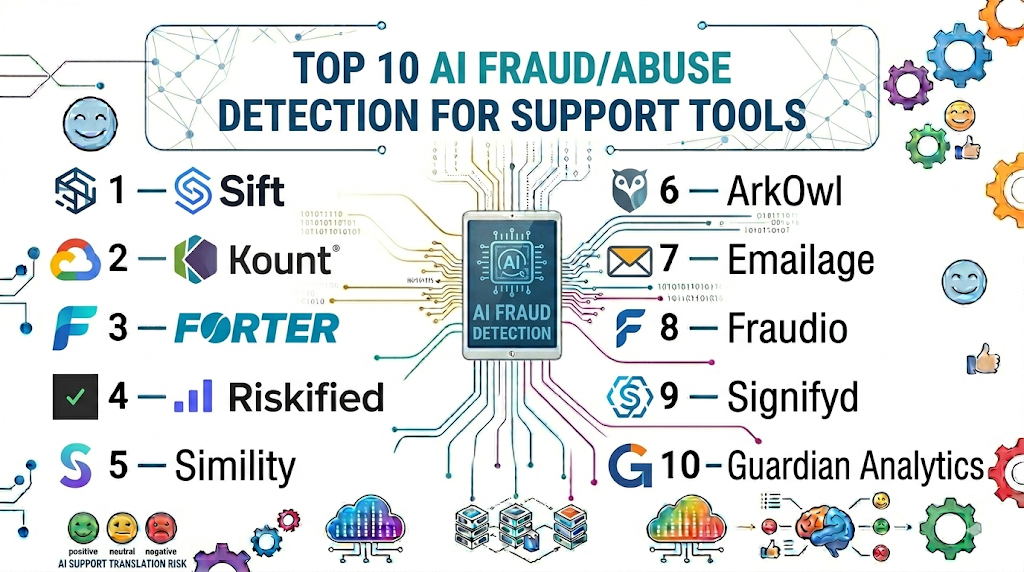
Top 10 AI Fraud/Abuse Detection for Support Tools
1 — Sift
One-line verdict: Best for large enterprises and SaaS companies needing real-time fraud and abuse prevention.
Short description:
Sift uses AI to detect fraudulent and abusive behavior across support interactions, payments, and accounts.It monitors activity in real time to prevent financial losses.
Ideal for e-commerce, SaaS, and marketplace support teams.
Supports automated alerts and ticket escalation.
Standout Capabilities
- Behavioral fingerprinting for fraud detection
- Real-time alerts and automated escalations
- Integration with CRM and support platforms
- Adaptive machine learning for evolving threats
- Multi-channel monitoring (chat, email, voice)
AI-Specific Depth
- Model support: Proprietary
- RAG / knowledge integration: N/A
- Evaluation: Regression testing, human review
- Guardrails: Policy enforcement, abuse detection
- Observability: Alerts, latency, cost metrics
Pros
- Accurate real-time detection
- Reduces manual review workload
- Seamless workflow integration
Cons
- Premium pricing
- Limited offline detection
- Setup complexity
Security & Compliance
SSO, RBAC, encryption; Not publicly stated certifications
Deployment & Platforms
Web, Cloud
Integrations & Ecosystem
- CRM and helpdesk systems
- Payment gateways
- Webhooks and APIs
- Analytics dashboards
Pricing Model
Subscription; usage-based tiers
Best-Fit Scenarios
- High-risk e-commerce operations
- SaaS platforms with global support
- Customer service teams handling high-value accounts
2 — Kount
One-line verdict: Suited for organizations needing AI fraud detection integrated with payment and support workflows.
Short description
Kount detects payment fraud, account takeovers, and abusive support interactions.
It evaluates risk and automates decisions in real time.
Suitable for fintech, marketplaces, and SMB to mid-market support teams.
Integrates with CRM and helpdesk systems.
Standout Capabilities
- AI-powered risk scoring
- Real-time fraud prevention
- Automated decision workflows
- Integration with payment processors
- Behavioral analytics dashboards
AI-Specific Depth
- Model support: Proprietary
- RAG / knowledge integration: N/A
- Evaluation: Human-in-loop, offline testing
- Guardrails: Fraud policy enforcement
- Observability: Risk metrics, latency, cost
Pros
- Scalable for high-volume operations
- Reduces chargebacks and fraud losses
- Customizable risk rules
Cons
- Enterprise pricing
- Requires integration expertise
- Limited outside payment fraud
Security & Compliance
Encryption, audit logs; Not publicly stated certifications
Deployment & Platforms
Web, Cloud
Integrations & Ecosystem
- CRM connectors
- Payment platforms
- Analytics dashboards
- API access
Pricing Model
Subscription; enterprise tiers
Best-Fit Scenarios
- Fintech support operations
- Marketplaces with high transaction volumes
- SaaS customer support teams
3 — Forter
One-line verdict: Best for e-commerce platforms seeking end-to-end fraud prevention and account protection.
Short description :
Forter uses AI to monitor transactions and support interactions for fraudulent behavior.
It provides real-time alerts and automated decision-making.
Ideal for online retailers and marketplaces.
Reduces chargebacks and operational risk.
Standout Capabilities
- Real-time fraud monitoring
- Automated account and transaction protection
- Risk scoring and decisioning
- Integration with CRM and support systems
- Adaptive machine learning for new fraud patterns
AI-Specific Depth
- Model support: Proprietary
- RAG / knowledge integration: N/A
- Evaluation: Human review and regression testing
- Guardrails: Policy enforcement, abuse detection
- Observability: Alerts, latency metrics
Pros
- Accurate fraud detection
- Reduces financial losses
- Integrates with support workflows
Cons
- Enterprise-focused pricing
- Setup and customization required
- Limited for non-e-commerce operations
Security & Compliance
SSO, encryption; Not publicly stated certifications
Deployment & Platforms
Web, Cloud
Integrations & Ecosystem
- Payment gateways
- CRM systems
- Helpdesk platforms
- Analytics dashboards
Pricing Model
Subscription-based; enterprise tiers
Best-Fit Scenarios
- Marketplaces and online retail
- Support teams handling high-value accounts
- Enterprises with high transaction volume
4 — Riskified
One-line verdict: Ideal for marketplaces and online retailers needing fraud and chargeback protection.
Short description :
Riskified protects transactions and support channels from fraudulent activity.
AI evaluates risk and automates approval or rejection decisions.
Suitable for e-commerce and marketplace support teams.
Helps prevent chargebacks and fraudulent claims.
Standout Capabilities
- AI-based transaction risk scoring
- Real-time fraud detection
- Automated decisioning workflows
- Integration with payment gateways
- Behavioral analytics
AI-Specific Depth
- Model support: Proprietary
- RAG / knowledge integration: N/A
- Evaluation: Human review, regression testing
- Guardrails: Policy and compliance checks
- Observability: Metrics dashboards
Pros
- Reduces chargebacks
- Real-time monitoring
- Supports high-volume operations
Cons
- Enterprise cost
- Limited flexibility outside marketplaces
- Setup complexity
Security & Compliance
Encryption, audit logs; Not publicly stated certifications
Deployment & Platforms
Web, Cloud
Integrations & Ecosystem
- CRM and helpdesk
- Payment processor connectors
- Analytics and reporting dashboards
- API support
Pricing Model
Subscription; enterprise tiers
Best-Fit Scenarios
- Online marketplaces
- E-commerce platforms
- Support teams handling payment transactions
5 — Simility
One-line verdict: Suited for mid-market to large support teams needing behavioral analytics and anomaly detection.
Short description :
Simility detects abnormal behavior and fraudulent activity in customer interactions.
It uses AI to analyze support tickets, transactions, and account patterns.
Ideal for fintech, e-commerce, and enterprise support teams.
Supports automated alerts and workflow integration.
Standout Capabilities
- Behavioral analytics for customer interactions
- Anomaly detection in real time
- Risk scoring and alert prioritization
- Integration with CRM and payment systems
- Multi-channel support monitoring
AI-Specific Depth
- Model support: Proprietary
- RAG / knowledge integration: N/A
- Evaluation: Human-in-loop review, regression testing
- Guardrails: Policy enforcement and compliance
- Observability: Latency, cost, and risk dashboards
Pros
- Detects subtle fraudulent patterns
- Multi-channel coverage
- Scalable for enterprise needs
Cons
- Setup complexity
- Premium pricing
- Requires technical expertise
Security & Compliance
Encryption, RBAC; Not publicly stated certifications
Deployment & Platforms
Web, Cloud
Integrations & Ecosystem
- CRM and ticketing systems
- Payment gateways
- Analytics dashboards
- API access
Pricing Model
Subscription; enterprise tiers
Best-Fit Scenarios
- Enterprise fintech support
- High-volume ticket monitoring
- Multi-channel customer service
6 — ArkOwl
One-line verdict: Best for email fraud detection and suspicious account monitoring in support channels.
Short description :
ArkOwl validates emails and identifies potential fraud across support interactions.
It protects account creation, login, and email-based communications.
Suitable for SaaS, marketplaces, and online service support teams.
Helps reduce phishing attacks and account takeovers.
Standout Capabilities
- Email validation and verification
- Detects suspicious account activity
- Real-time fraud alerting
- Integration with CRM and support systems
- Multi-layer verification for accounts
AI-Specific Depth
- Model support: Proprietary
- RAG / knowledge integration: N/A
- Evaluation: Human review of alerts
- Guardrails: Policy enforcement for abusive accounts
- Observability: Dashboard with detection metrics
Pros
- Accurate email fraud detection
- Easy integration with support platforms
- Reduces account-related fraud
Cons
- Limited to email-based fraud
- Requires CRM integration for full workflow
- Premium pricing for enterprise features
Security & Compliance
Encryption, audit logs; Not publicly stated certifications
Deployment & Platforms
Web, Cloud
Integrations & Ecosystem
- CRM and ticketing platforms
- Email gateways
- Analytics dashboards
- API for automated workflows
Pricing Model
Subscription; enterprise tiers
Best-Fit Scenarios
- SaaS platforms with email-based support
- Marketplaces requiring email verification
- Online service providers handling sensitive accounts
7 — Emailage
One-line verdict: Ideal for customer support teams managing payment and account-related fraud.
Short description:
Emailage evaluates risk using email and behavioral analytics across support channels.
It detects fraud in payment requests, account access, and support tickets.
Ideal for fintech, e-commerce, and enterprise support teams.
Integrates seamlessly with CRM and payment workflows.
Standout Capabilities
- AI risk scoring based on email and behavior
- Real-time fraud detection
- Automated alerting and workflow integration
- Supports multi-channel monitoring
- Analytics dashboards for risk assessment
AI-Specific Depth
- Model support: Proprietary
- RAG / knowledge integration: N/A
- Evaluation: Regression testing, human review
- Guardrails: Fraud policy enforcement
- Observability: Metrics dashboards for alerts and latency
Pros
- Reduces fraud losses
- Real-time detection
- Integrates with CRM and payments
Cons
- Premium pricing
- Limited to email-centric fraud
- Requires integration expertise
Security & Compliance
Encryption and audit logs; Not publicly stated certifications
Deployment & Platforms
Web, Cloud
Integrations & Ecosystem
- CRM connectors
- Payment gateways
- Analytics dashboards
- API access
Pricing Model
Subscription; enterprise tiers
Best-Fit Scenarios
- Fintech payment monitoring
- High-risk e-commerce support
- Global support teams with email focus
8 — Fraudio
One-line verdict: Suited for fintech companies needing real-time detection of payment and account fraud.
Short description :
Fraudio monitors transactions and support interactions for suspicious activity using AI.
It flags anomalies and potential fraud in real time.
Ideal for digital banking and high-risk financial services.
Supports automated alerts, escalation, and reporting.
Standout Capabilities
- Real-time anomaly detection
- Transaction and account monitoring
- Risk scoring and alert prioritization
- Behavioral analytics for high-volume support
- Multi-channel fraud detection
AI-Specific Depth
- Model support: Proprietary
- RAG / knowledge integration: N/A
- Evaluation: Human-in-loop review
- Guardrails: Policy enforcement and fraud rules
- Observability: Latency, risk metrics, dashboards
Pros
- Accurate detection for financial fraud
- Real-time alerting
- Supports high-volume transactions
Cons
- Enterprise pricing
- Requires technical setup
- Focused mainly on fintech
Security & Compliance
Encryption, RBAC; Not publicly stated certifications
Deployment & Platforms
Web, Cloud
Integrations & Ecosystem
- CRM systems
- Payment gateways
- Analytics dashboards
- API support
Pricing Model
Subscription; enterprise tiers
Best-Fit Scenarios
- Digital banking
- Fintech support operations
- High-volume payment monitoring
9 — Signifyd
One-line verdict: Best for e-commerce support teams needing end-to-end fraud prevention.
Short description :
Signifyd combines AI and automation to prevent fraud across support and payment workflows.
It flags high-risk interactions and validates transactions.
Ideal for online retailers and marketplaces.
Reduces chargebacks and improves operational efficiency.
Standout Capabilities
- AI-powered transaction monitoring
- Automated fraud detection workflows
- Real-time risk scoring
- Integration with CRM and support systems
- Multi-channel monitoring
AI-Specific Depth
- Model support: Proprietary
- RAG / knowledge integration: N/A
- Evaluation: Human review, regression tests
- Guardrails: Policy and compliance enforcement
- Observability: Metrics dashboards for alerts and latency
Pros
- End-to-end protection
- Real-time detection
- Supports multi-channel operations
Cons
- Premium pricing
- Limited non-e-commerce features
- Requires technical expertise
Security & Compliance
Encryption, audit logs; Not publicly stated certifications
Deployment & Platforms
Web, Cloud
Integrations & Ecosystem
- CRM and ticketing systems
- Payment processors
- Analytics dashboards
- API integration
Pricing Model
Subscription; enterprise tiers
Best-Fit Scenarios
- Online marketplaces
- E-commerce support teams
- High-volume transaction monitoring
10 — Guardian Analytics
One-line verdict: Ideal for banking and fintech companies requiring transaction and account monitoring.
Short description :
Guardian Analytics monitors transactions and support interactions for fraudulent patterns.
It uses AI and behavioral analytics to detect abuse in real time.
Suitable for banks, fintechs, and enterprise support teams.
Provides automated alerts and workflow integration.
Standout Capabilities
- Behavioral analytics for account monitoring
- Real-time fraud detection
- Risk scoring and alert prioritization
- Integration with CRM and payment systems
- Compliance reporting dashboards
AI-Specific Depth
- Model support: Proprietary
- RAG / knowledge integration: N/A
- Evaluation: Human-in-loop review, regression testing
- Guardrails: Policy enforcement
- Observability: Latency, metrics dashboards
Pros
- Accurate detection for banking and finance
- Real-time alerts
- Scalable for large support teams
Cons
- Enterprise cost
- Requires technical setup
- Focused mainly on financial institutions
Security & Compliance
SSO, encryption, RBAC; Not publicly stated certifications
Deployment & Platforms
Web, Cloud
Integrations & Ecosystem
- CRM and support platforms
- Payment gateways
- Analytics dashboards
- API access
Pricing Model
Subscription; enterprise tiers
Best-Fit Scenarios
- Banking and fintech support
- High-risk transaction monitoring
- Enterprise financial operations
Comparison Table
| Tool Name | Best For | Deployment | Model Flexibility | Strength | Watch-Out | Public Rating |
|---|---|---|---|---|---|---|
| Sift | Enterprise SaaS support | Cloud | Proprietary | Real-time detection | Premium cost | N/A |
| Kount | Payment & support | Cloud | Proprietary | Risk scoring | Enterprise focus | N/A |
| Forter | E-commerce platforms | Cloud | Proprietary | End-to-end fraud | Limited non-ecommerce use | N/A |
| Riskified | Online marketplaces | Cloud | Proprietary | Chargeback protection | Setup complexity | N/A |
| Simility | Large support teams | Cloud | Proprietary | Behavioral analytics | Integration effort | N/A |
| ArkOwl | Email fraud detection | Cloud | Proprietary | Email validation | Limited channels | N/A |
| Emailage | Payment fraud & support | Cloud | Proprietary | Identity verification | Enterprise cost | N/A |
| Fraudio | Fintech fraud | Cloud | Proprietary | Transaction detection | High volume scaling | N/A |
| Signifyd | E-commerce support | Cloud | Proprietary | Automated fraud | Limited customizability | N/A |
| Guardian Analytics | Banking & fintech | Cloud | Proprietary | Transaction monitoring | Enterprise complexity | N/A |
Scoring & Evaluation (Transparent Rubric)
| Tool | Core (20%) | Reliability/Eval (15%) | Guardrails (10%) | Integrations (15%) | Ease (10%) | Perf/Cost (15%) | Security/Admin (10%) | Support (5%) | Weighted Total |
|---|---|---|---|---|---|---|---|---|---|
| Sift | 9 | 9 | 9 | 8 | 8 | 8 | 8 | 8 | 8.5 |
| Kount | 8 | 8 | 8 | 8 | 8 | 8 | 8 | 7 | 8.0 |
| Forter | 8 | 8 | 8 | 8 | 7 | 8 | 8 | 7 | 7.9 |
| Riskified | 8 | 7 | 8 | 7 | 7 | 8 | 7 | 7 | 7.5 |
| Simility | 7 | 7 | 7 | 7 | 7 | 7 | 7 | 7 | 7.0 |
| ArkOwl | 7 | 7 | 6 | 6 | 8 | 7 | 7 | 6 | 6.9 |
| Emailage | 7 | 7 | 7 | 7 | 7 | 7 | 7 | 7 | 7.0 |
| Fraudio | 8 | 8 | 7 | 7 | 7 | 8 | 7 | 7 | 7.5 |
| Signifyd | 8 | 8 | 8 | 8 | 7 | 8 | 7 | 7 | 7.8 |
| Guardian Analytics | 8 | 8 | 8 | 7 | 7 | 8 | 8 | 7 | 7.8 |
Top 3 for Enterprise: Sift, Kount, Signifyd
Top 3 for SMB: Forter, Riskified, Fraudio
Top 3 for Developers: Simility, ArkOwl, Emailage
Which AI Fraud/Abuse Detection Tool Is Right for You?
Solo / Freelancer
- Sift or Kount (trial tiers): Ideal for freelancers managing small e-commerce stores or niche marketplaces.
- Focus on tools that are easy to integrate with payment gateways and support systems.
- Monitor alerts manually initially, then automate as confidence in AI predictions grows.
SMB
- Forter, Riskified, or ArkOwl: Best for small-to-medium businesses handling moderate transaction volumes.
- Use automated fraud scoring to reduce manual intervention.
- Integrate with existing CRM or helpdesk for streamlined alert handling.
Mid-Market
- Simility, Emailage, Fraudio: Suitable for mid-market enterprises with multiple support channels.
- Focus on anomaly detection, multi-channel monitoring, and escalation workflows.
- Invest in evaluation pipelines and human-in-loop reviews to reduce false positives.
Enterprise
- Sift, Kount, Signifyd, Guardian Analytics: Best for large enterprises with high transaction volume and global operations.
- Prioritize real-time fraud detection, risk scoring, and automated escalation.
- Ensure observability dashboards, compliance reports, and guardrails are fully implemented.
Regulated industries (finance/healthcare/public sector)
- Fraudio, Guardian Analytics, Kount: Ideal for strict regulatory requirements.
- Ensure encryption, RBAC, SSO, and audit logs are fully implemented.
- Focus on compliance with GDPR, PCI DSS, HIPAA, or local regulations.
Budget vs Premium
- Budget: Sift or ArkOwl for limited scope, entry-level AI fraud detection.
- Premium: Kount, Signifyd, Guardian Analytics for enterprise-grade multi-channel coverage.
- Consider total cost of ownership vs. feature depth.
Build vs Buy
- Build/DIY: Open-source or BYO models for specialized detection workflows (Simility).
- Buy: SaaS solutions for immediate deployment, compliance, and full support.
- Use BYO models if you have existing internal datasets to train for specific fraud patterns.
Implementation Playbook
30 Days – Pilot & Metrics
- Select 1–2 high-risk channels for pilot.
- Define KPIs: fraud detection rate, false positives, latency.
- Integrate with CRM and ticketing systems.
- Train agents on alerts and escalation.
- Implement basic guardrails for sensitive content.
- Monitor initial alerts and validate accuracy.
- Document baseline performance for scaling.
60 Days – Harden & Integrate
- Expand to more channels and workflows.
- Apply advanced AI rules and model tuning.
- Integrate behavioral analytics and anomaly detection.
- Introduce evaluation pipeline: regression, human review.
- Monitor token usage, latency, cost.
- Refine risk scoring and escalation policies.
- Conduct team training and review dashboards.
90 Days – Optimize & Scale
- Roll out detection across all teams and regions.
- Optimize alerting and workflow automation.
- Red-team test for new attack/abuse patterns.
- Continuous evaluation and model retraining.
- Analyze ROI, SLA compliance, incident resolution.
- Enforce privacy, retention, and compliance.
Common Mistakes & How to Avoid Them
- Ignoring prompt injection or AI manipulation risks – always implement guardrails.
- Skipping evaluation and testing pipelines – leads to high false positives or missed fraud.
- Unmanaged data retention – ensure privacy and compliance policies are followed.
- Lack of observability – monitor latency, alerts, cost, and incident timelines.
- Unexpected cost overruns – track usage and token metrics carefully.
- Over-automation without human review – always include human-in-loop for critical decisions.
- Vendor lock-in without abstraction – use APIs or hybrid integrations to reduce dependency.
- Ignoring multi-channel monitoring – fraud can occur across chat, email, and voice simultaneously.
- Neglecting staff training – agents need onboarding to understand alerts and escalation protocols.
- Overlooking regional and industry-specific compliance – ensure GDPR, PCI DSS, HIPAA adherence.
- Failure to continuously retrain models – fraud patterns evolve; AI needs periodic updates.
- Ignoring integration with fraud intelligence feeds – external data improves detection accuracy.
- Not prioritizing alerts – high false positives can overwhelm support teams.
- Relying solely on manual review – AI-human balance is critical for scale.
FAQs
- How do these tools detect fraud in support?
AI monitors behavior, transactions, and communications, flagging suspicious activity in real time.
Detection uses machine learning and anomaly detection for accuracy. - Can I integrate with my CRM?
Yes, most tools offer APIs or connectors for seamless CRM and ticketing integration. - Are these tools suitable for small teams?
Yes, but simpler platforms may suffice; enterprise tools are optimized for high-volume operations. - Do they monitor multiple channels?
Yes, including chat, email, voice, and social media. - How are false positives managed?
Evaluation pipelines and human-in-loop reviews reduce unnecessary alerts. - Can models be customized?
Some tools allow BYO models or parameter tuning; others are fully proprietary. - Do they support automated escalation?
Yes, alerts can trigger automatic ticket routing or account restrictions. - Is real-time monitoring possible?
Yes, most platforms provide real-time dashboards for alerts and metrics. - Are these tools secure?
Yes, enterprise-grade encryption, SSO, and RBAC are commonly included. - How scalable are these solutions?
Cloud-based architecture supports high-volume, multi-region operations. - Can they detect abuse vs. fraud?
Yes, behavior and language models differentiate harassment, spam, and financial fraud. - Is training required for support teams?
Yes, agents need onboarding to interpret alerts and act on escalations.
Conclusion
AI Fraud/Abuse Detection tools are critical to safeguarding support teams, reducing financial losses, and ensuring customer trust. Selection depends on organization size, risk exposure, and integration requirements. Enterprises benefit from real-time detection, anomaly monitoring, and automated escalation, while SMBs can adopt simpler workflows. Prioritize guardrails, evaluation pipelines, observability, and scalability when selecting a solution.
Next steps:
- Shortlist tools based on workflow and risk exposure.
- Pilot detection workflows, monitor KPIs, and refine models.
- Validate guardrails, compliance, and scalability before full deployment.
Excellent breakdown of AI fraud and abuse detection tools for modern support teams. The comparison makes it much easier to understand which platforms fit different operational needs.
Great insights into how AI is strengthening fraud and abuse detection in modern customer support systems. The real-time detection approach is especially impressive.