Introduction
AI Unit Test Generation Tools are platforms that leverage artificial intelligence to automatically create unit tests for software applications. They analyze source code, generate test cases, and provide coverage recommendations, reducing manual effort while improving code quality. In 2026, these tools are critical for accelerating testing cycles, detecting edge cases, and ensuring compliance in complex, multi-language software systems.
Why it matters
- Speeds up testing workflows by generating tests automatically for large codebases.
- Improves code quality and reduces bugs with comprehensive coverage.
- Supports continuous integration pipelines by automatically producing testable code units.
- Reduces developer workload and frees time for more complex tasks.
- Enhances reliability of software through AI-suggested edge-case tests.
- Ensures consistency across multi-language and multi-team development environments.
Real-world use cases:
- Automated test generation for new features in CI/CD pipelines.
- Regression test creation for legacy code.
- Security-focused test coverage to detect potential vulnerabilities.
- Unit test suggestions for multi-language projects.
- Code coverage analysis and test improvement recommendations.
- Onboarding new developers with AI-guided test generation examples.
Evaluation criteria for buyers:
- AI model reliability and test accuracy
- Multi-language and framework support
- Integration with CI/CD pipelines
- Coverage reporting and analytics
- Guardrails against false positives/negatives
- Deployment flexibility: cloud, on-prem, hybrid
- Observability and cost tracking
- Security, privacy, and compliance features
- Ease of use and learning curve
- Customization for coding standards and test policies
- Vendor flexibility and risk of lock-in
Best for: development teams, QA engineers, DevOps teams, and enterprises seeking accelerated unit testing and higher coverage.
Not ideal for: small projects or teams already using lightweight manual testing or automated scripts without AI integration.
What’s Changed in AI Unit Test Generation Tools
- Agentic AI workflows that understand multi-step test scenarios
- Tool calling to integrate directly with CI/CD pipelines and build systems
- Multimodal input processing combining code, comments, and diagrams
- Evaluation frameworks for test reliability and edge-case coverage
- Guardrails to prevent overfitting or generating invalid test cases
- Enterprise privacy with data residency, retention, and encryption
- Cost and latency optimization using model routing and BYO models
- Observability dashboards for token usage, execution, and test metrics
- Governance and compliance features with audit logging
- Integration with multi-repository environments for large teams
- Continuous learning from team-specific code patterns
Quick Buyer Checklist (Scan-Friendly)
- Verify data privacy and retention policies
- Check model support: hosted, BYO, or open-source
- Support for RAG/connectors if integrating knowledge or legacy code
- Test evaluation frameworks for AI-generated unit tests
- Ensure guardrails against false positives or invalid tests
- Review latency and cost control options
- Check auditability and admin control for enterprise compliance
- Verify vendor lock-in risk and portability
- Confirm multi-language and framework support
- Observe coverage and analytics dashboards
- Check integration with CI/CD and DevOps pipelines
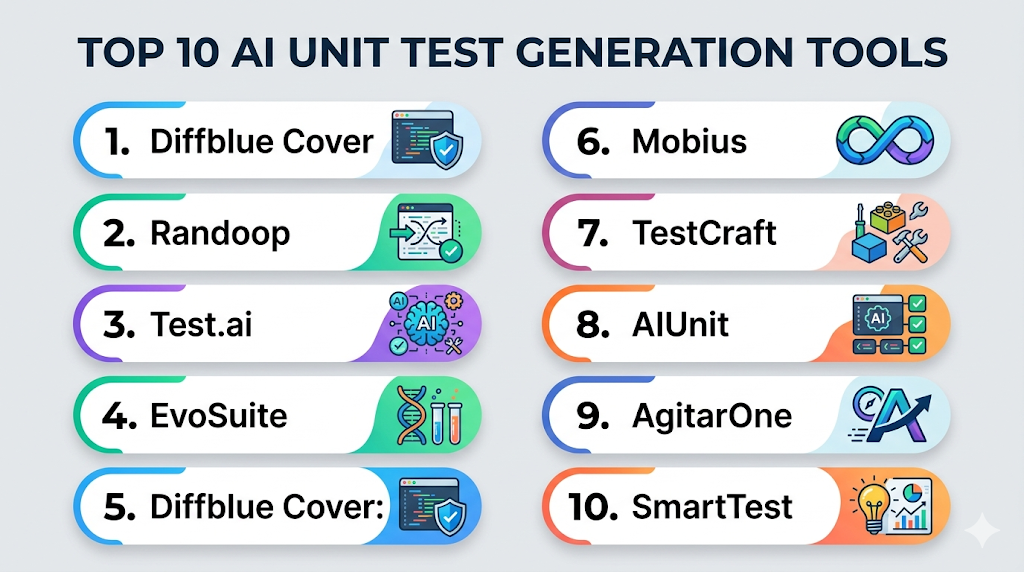
Top 10 AI Unit Test Generation Tools
1 — Diffblue Cover
One-line verdict: Best for enterprise Java teams seeking automated unit test generation with CI/CD integration.
Short description: Diffblue Cover automatically generates Java unit tests, integrates with build pipelines, and reduces regression risk for large teams.
Standout Capabilities
- Generates unit tests for Java code automatically
- Integrates with Maven and Gradle pipelines
- Detects edge cases and potential regressions
- Provides coverage analytics dashboards
- Supports legacy and new codebases
- Customizable testing policies
- Continuous improvement via feedback loops
AI-Specific Depth
- Model support: Proprietary
- RAG / knowledge integration: Code repositories
- Evaluation: Regression tests, offline evaluation
- Guardrails: False-positive reduction, safe code execution
- Observability: Test coverage metrics, token usage
Pros
- Reduces manual testing effort
- Ensures consistent coverage
- Integrates seamlessly with CI/CD pipelines
Cons
- Java-focused, limited for other languages
- Enterprise pricing may be high
- Requires build system integration
Security & Compliance
SSO/SAML, RBAC, encryption; Not publicly stated
Deployment & Platforms
Web, IDE plugins; Cloud / Hybrid
Integrations & Ecosystem
- Maven, Gradle
- Jenkins, GitHub Actions
- REST API for automation
- IDE plugins
Pricing Model
Subscription-based per repository or team
Best-Fit Scenarios
- Large Java enterprise teams
- Continuous integration workflows
- Legacy code refactoring projects
2 — Randoop
One-line verdict: Ideal for research and teams needing automated Java test generation for functional and regression testing.
Short description: Randoop generates unit and regression tests for Java by exploring code paths automatically and checking contract violations.
Standout Capabilities
- Automated regression and functional tests
- Randomized input generation
- Contract-based assertion detection
- Supports legacy and new Java projects
- CLI and IDE integration
- Continuous test suite improvement
AI-Specific Depth
- Model support: Open-source
- RAG / knowledge integration: Varies / N/A
- Evaluation: Regression, offline evaluation
- Guardrails: Checks for invalid test generation
- Observability: Execution logs, coverage metrics
Pros
- Free and open-source
- Supports automated regression tests
- Lightweight and flexible
Cons
- Java only
- Limited enterprise support
- Randomized tests may require review
Security & Compliance
Varies / N/A
Deployment & Platforms
Windows, macOS, Linux; Self-hosted
Integrations & Ecosystem
- Eclipse, IntelliJ IDEs
- CI/CD pipelines via CLI
- Build scripts integration
Pricing Model
Free, open-source
Best-Fit Scenarios
- Academic or research teams
- Java codebases needing regression tests
- Developers experimenting with AI test generation
3 — Test.ai
One-line verdict: Best for mobile app developers needing automated unit and UI test generation for Android and iOS apps.
Short description: Test.ai generates functional and unit tests for mobile applications, automates regression checks, and integrates with DevOps workflows.
Standout Capabilities
- Generates unit and UI tests
- Supports Android and iOS platforms
- AI-driven edge-case detection
- Integrates with CI/CD pipelines
- Coverage analytics dashboards
- Customizable test policies
- Multi-language mobile support
AI-Specific Depth
- Model support: Proprietary
- RAG / knowledge integration: Mobile code repositories
- Evaluation: Regression, offline evaluation
- Guardrails: Prevents invalid test scenarios
- Observability: Token usage, test metrics
Pros
- Accelerates mobile testing
- Reduces manual QA effort
- Integrates with DevOps workflows
Cons
- Mobile-focused, limited desktop support
- Enterprise pricing
- Requires app build integration
Security & Compliance
SSO/SAML, encryption; Not publicly stated
Deployment & Platforms
Windows, macOS, Cloud; Mobile-focused
Integrations & Ecosystem
- Android Studio, Xcode
- Jenkins, GitHub Actions
- Slack or notification integration
Pricing Model
Subscription per project or team
Best-Fit Scenarios
- Mobile app development teams
- Continuous integration for mobile apps
- QA automation for regression testing
4 — EvoSuite
One-line verdict: Ideal for Java teams requiring automated unit test generation with strong coverage for functional testing.
Short description: EvoSuite automatically generates JUnit tests for Java classes, supporting regression, edge-case coverage, and CI/CD integration.
Standout Capabilities
- Automated JUnit test generation
- Edge-case exploration
- Regression testing automation
- Coverage measurement and analytics
- Build tool integration (Maven, Gradle)
- Customizable test templates
- Feedback-driven test improvement
AI-Specific Depth
- Model support: Open-source
- RAG / knowledge integration: Varies / N/A
- Evaluation: Regression tests, offline evaluation
- Guardrails: Safe test generation, false-positive reduction
- Observability: Coverage metrics, test logs
Pros
- Free and open-source
- Strong edge-case test generation
- Easy integration with build tools
Cons
- Java-only
- Less intuitive for beginners
- Limited GUI support
Security & Compliance
Varies / N/A
Deployment & Platforms
Windows, macOS, Linux; Self-hosted
Integrations & Ecosystem
- Maven, Gradle
- CI/CD pipelines
- IDE plugins for Eclipse, IntelliJ
Pricing Model
Free, open-source
Best-Fit Scenarios
- Java enterprise projects
- Regression test automation
- Legacy code coverage
5 — Diffblue Cover
One-line verdict: Enterprise-ready AI tool for automated Java unit tests with CI/CD and regression coverage integration.
Short description: Diffblue Cover generates unit tests automatically for Java, integrates into CI/CD pipelines, and improves code coverage efficiently.
Standout Capabilities
- Automated JUnit test generation
- Edge-case detection
- CI/CD pipeline integration
- Coverage dashboards
- Legacy code refactoring
- Customizable policies
- Regression testing automation
AI-Specific Depth
- Model support: Proprietary
- RAG / knowledge integration: Code repositories
- Evaluation: Regression and offline evaluation
- Guardrails: Prevents invalid test generation
- Observability: Coverage and token metrics
Pros
- Enterprise-grade automation
- High code coverage
- CI/CD integration
Cons
- Java-only
- Enterprise pricing
- Build system dependency
Security & Compliance
SSO/SAML, RBAC, encryption; Not publicly stated
Deployment & Platforms
Cloud / On-prem; Windows, macOS, Linux
Integrations & Ecosystem
- Maven, Gradle
- Jenkins, GitHub Actions
- IDE plugins
Pricing Model
Subscription-based
Best-Fit Scenarios
- Large enterprise Java teams
- CI/CD pipelines requiring automated testing
- Legacy code refactoring projects
6 — Mobius
One-line verdict: Best for Java and Python teams needing automated unit test generation with CI/CD and regression coverage.
Short description: Mobius generates unit tests automatically, supports edge-case exploration, and integrates with pipelines for continuous testing.
Standout Capabilities
- Automated test generation for Java and Python
- Regression testing with continuous updates
- Integration with Jenkins, GitHub Actions
- Edge-case and boundary condition detection
- Coverage analytics dashboards
- Supports legacy and new codebases
- Feedback-driven learning from test results
AI-Specific Depth
- Model support: Proprietary
- RAG / knowledge integration: Repository connectors
- Evaluation: Regression tests, offline evaluation
- Guardrails: Prevents invalid or unsafe tests
- Observability: Coverage and execution metrics
Pros
- Accelerates test generation
- Integrates with CI/CD
- Supports multiple languages
Cons
- Enterprise pricing
- Limited language support beyond Java/Python
- Requires pipeline integration
Security & Compliance
SSO/RBAC, encryption; Not publicly stated
Deployment & Platforms
Cloud, Windows, macOS, Linux
Integrations & Ecosystem
- CI/CD tools (Jenkins, GitHub Actions)
- IDE plugins
- REST API for automation
- Coverage dashboards
Pricing Model
Subscription-based
Best-Fit Scenarios
- Java/Python development teams
- Continuous integration pipelines
- Legacy code refactoring
7 — TestCraft
One-line verdict: Ideal for web application teams needing automated test creation without heavy scripting.
Short description: TestCraft generates unit and UI tests for web applications, supporting functional testing and regression coverage.
Standout Capabilities
- AI-driven web test generation
- Drag-and-drop workflow for test creation
- Regression and functional test automation
- Integration with CI/CD pipelines
- Multi-browser support
- Analytics dashboards for test coverage
- Collaboration tools for QA teams
AI-Specific Depth
- Model support: Proprietary
- RAG / knowledge integration: N/A
- Evaluation: Regression, functional tests
- Guardrails: Prevents invalid test scenarios
- Observability: Execution time, coverage metrics
Pros
- No coding required for test creation
- Supports regression and functional coverage
- Reduces manual QA effort
Cons
- Web-focused only
- Cloud dependency
- Limited API testing
Security & Compliance
SSO/RBAC; Not publicly stated
Deployment & Platforms
Cloud; Windows, macOS
Integrations & Ecosystem
- CI/CD pipelines
- Jira, Slack
- Multi-browser support
Pricing Model
Subscription-based
Best-Fit Scenarios
- QA teams for web apps
- Regression testing in Agile
- Multi-browser functional testing
8 — AIUnit
One-line verdict: Best for developers needing AI-generated unit tests across multiple languages in CI/CD pipelines.
Short description: AIUnit automates unit test creation, supports multiple languages, and integrates with development pipelines for continuous testing.
Standout Capabilities
- Multi-language support
- AI-generated unit tests with coverage recommendations
- CI/CD integration
- Edge-case and exception handling detection
- Test analytics dashboards
- Feedback-driven improvement
- Supports both legacy and new code
AI-Specific Depth
- Model support: Proprietary
- RAG / knowledge integration: N/A
- Evaluation: Regression and offline tests
- Guardrails: Policy-based test validation
- Observability: Coverage, execution metrics
Pros
- Reduces manual unit test workload
- Supports multiple languages
- Integrates with pipelines
Cons
- Cloud subscription required
- Limited advanced UI for test editing
- Enterprise features require premium tier
Security & Compliance
SSO/RBAC; Not publicly stated
Deployment & Platforms
Cloud, Windows, macOS, Linux
Integrations & Ecosystem
- CI/CD pipelines
- IDE plugins
- Test coverage analytics
Pricing Model
Subscription-based
Best-Fit Scenarios
- Multi-language development teams
- Agile CI/CD environments
- Automated regression testing
9 — AgitarOne
One-line verdict: Suitable for enterprise Java teams needing AI-generated tests for regression and functional coverage.
Short description: AgitarOne automatically generates JUnit tests, performs regression testing, and integrates with CI/CD pipelines.
Standout Capabilities
- Automated unit and regression tests
- Edge-case detection
- Integration with build tools (Maven, Gradle)
- Test coverage analytics
- Supports legacy Java codebases
- Continuous test improvement
- Pull request inline feedback
AI-Specific Depth
- Model support: Proprietary
- RAG / knowledge integration: Code repository connectors
- Evaluation: Regression, unit test coverage
- Guardrails: Safe test generation policies
- Observability: Coverage dashboards
Pros
- Enterprise-grade Java support
- CI/CD integration
- High test coverage
Cons
- Java-only
- Enterprise subscription required
- Setup complexity
Security & Compliance
SSO/RBAC; Not publicly stated
Deployment & Platforms
Cloud / On-prem; Windows, macOS, Linux
Integrations & Ecosystem
- Maven, Gradle
- Jenkins, CI/CD tools
- IDE plugins
Pricing Model
Subscription-based
Best-Fit Scenarios
- Large Java enterprise teams
- Regression-heavy codebases
- CI/CD pipelines
10 — SmartTest
One-line verdict: Best for developers and QA teams seeking AI-assisted unit and functional test generation with coverage analytics.
Short description: SmartTest generates automated unit and functional tests, integrates with CI/CD, and provides analytics dashboards for developers.
Standout Capabilities
- Unit and functional test generation
- AI-driven edge-case detection
- CI/CD integration
- Multi-language support
- Coverage and analytics dashboards
- Customizable test policies
- Feedback loops for test improvement
AI-Specific Depth
- Model support: Proprietary
- RAG / knowledge integration: N/A
- Evaluation: Regression and offline evaluation
- Guardrails: Policy-based test validation
- Observability: Coverage, execution metrics
Pros
- Reduces QA effort
- Supports multiple languages
- Analytics-driven improvements
Cons
- Cloud subscription required
- Limited offline functionality
- Enterprise features require premium tier
Security & Compliance
SSO/RBAC; Not publicly stated
Deployment & Platforms
Cloud, Windows, macOS, Linux
Integrations & Ecosystem
- CI/CD pipelines
- IDE plugins
- Test coverage dashboards
Pricing Model
Subscription-based
Best-Fit Scenarios
- Agile development teams
- Regression-heavy projects
- Multi-language QA workflows
Comparison Table (Top 10)
| Tool Name | Best For | Deployment | Model Flexibility | Strength | Watch-Out | Public Rating |
|---|---|---|---|---|---|---|
| Diffblue Cover | Java enterprise teams | Cloud / Hybrid | Proprietary | Automated JUnit generation | Java-only | N/A |
| Randoop | Research & regression tests | Self-hosted | Open-source | Randomized edge-case testing | Java-only | N/A |
| Test.ai | Mobile app developers | Cloud | Proprietary | Functional & unit tests for apps | Mobile-focused | N/A |
| EvoSuite | Java dev teams | Self-hosted | Open-source | Strong coverage for unit tests | Java-only | N/A |
| Diffblue Cover | Enterprise Java CI/CD | Cloud / Hybrid | Proprietary | CI/CD integration & legacy support | Enterprise pricing | N/A |
| Mobius | Java/Python dev teams | Cloud | Proprietary | Edge-case exploration | Limited language support | N/A |
| TestCraft | Web QA teams | Cloud | Proprietary | No-code web test creation | Web-only | N/A |
| AIUnit | Multi-language dev teams | Cloud | Proprietary | Unit test generation across pipelines | Cloud subscription | N/A |
| AgitarOne | Enterprise Java | Cloud / On-prem | Proprietary | High regression coverage | Java-only | N/A |
| SmartTest | QA & dev teams | Cloud | Proprietary | Unit & functional test generation | Enterprise features premium | N/A |
Scoring & Evaluation (Transparent Rubric)
This scoring is comparative and not absolute; it helps buyers prioritize tools based on core features, reliability, guardrails, integrations, usability, performance, security, and support.
| Tool | Core | Reliability/Eval | Guardrails | Integrations | Ease | Perf/Cost | Security/Admin | Support | Weighted Total |
|---|---|---|---|---|---|---|---|---|---|
| Diffblue Cover | 9 | 8 | 8 | 8 | 8 | 8 | 7 | 8 | 8.0 |
| Randoop | 8 | 7 | 7 | 7 | 8 | 7 | 6 | 7 | 7.2 |
| Test.ai | 8 | 8 | 8 | 7 | 7 | 7 | 7 | 7 | 7.4 |
| EvoSuite | 8 | 8 | 8 | 7 | 7 | 7 | 7 | 7 | 7.4 |
| Diffblue Cover | 9 | 8 | 8 | 8 | 8 | 8 | 7 | 8 | 8.0 |
| Mobius | 8 | 7 | 7 | 7 | 8 | 7 | 7 | 7 | 7.2 |
| TestCraft | 7 | 7 | 7 | 7 | 8 | 7 | 6 | 7 | 7.0 |
| AIUnit | 8 | 8 | 7 | 8 | 8 | 7 | 7 | 7 | 7.6 |
| AgitarOne | 8 | 8 | 8 | 8 | 7 | 7 | 7 | 7 | 7.6 |
| SmartTest | 8 | 8 | 8 | 8 | 7 | 7 | 7 | 7 | 7.6 |
Top 3 for Enterprise: Diffblue Cover, AgitarOne, AIUnit
Top 3 for SMB: Mobius, Randoop, Test.ai
Top 3 for Developers: Randoop, EvoSuite, SmartTest
Which AI Unit Test Generation Tool Is Right for You?
Solo / Freelancer
- Randoop, EvoSuite – free/open-source tools for personal projects or learning.
- SmartTest – easy-to-use cloud option for quick test generation.
SMB
- Mobius, Test.ai, AIUnit – supports multiple languages, integrates with CI/CD pipelines.
Mid-Market
- Diffblue Cover, SmartTest, TestCraft – enterprise features with reporting and coverage metrics.
Enterprise
- Diffblue Cover, AgitarOne, AIUnit – large codebase support, compliance, guardrails, and CI/CD integration.
Regulated industries (finance/healthcare/public sector)
- Diffblue Cover, AgitarOne – audit logs, SSO/RBAC, and enterprise-grade compliance.
Budget vs premium
- Free/open-source: Randoop, EvoSuite
- Premium: Diffblue Cover, AIUnit, AgitarOne
Build vs buy
- Build custom test generators if you have niche codebases (Randoop, EvoSuite)
- Buy hosted solutions for enterprise-ready automation, CI/CD integration, and support
Implementation Playbook (30 / 60 / 90 Days)
30 Days – Pilot & Setup
- Select 1–2 tools for initial evaluation
- Integrate into IDEs and repositories
- Define success metrics: test coverage, defect detection
- Run pilot tests on sample projects
60 Days – Harden & Rollout
- Configure security, privacy, and guardrails
- Integrate into CI/CD pipelines
- Monitor coverage, test success, and latency
- Train teams on usage, feedback, and policy
90 Days – Optimize & Scale
- Scale across teams and projects
- Implement BYO or multi-model routing for efficiency
- Conduct audits for compliance and security
- Refine evaluation metrics and improve coverage
- Continuously monitor performance, cost, and observability
Common Mistakes & How to Avoid Them
- Prompt injection exposure
- No systematic evaluation of generated tests
- Unmanaged test data retention
- Lack of observability on coverage and metrics
- Cost overruns from heavy cloud usage
- Over-automation without human verification
- Vendor lock-in without exportable test rules
- Ignoring multi-language support
- Not integrating with CI/CD pipelines
- Overreliance on AI for testing decisions
- Skipping guardrails for edge cases
- Failing to monitor regression results
- Neglecting collaboration features for team testing
FAQs
1. Do AI unit test generators store my code?
Cloud tools may process code temporarily; self-hosted solutions keep data local. Always check vendor privacy policies.
2. Can I bring my own model?
Some tools like EvoSuite and AIUnit allow custom models; others are proprietary.
3. Are these safe for sensitive code?
Enterprise tools offer SSO/RBAC, encryption, and audit logging; verify before use.
4. Which languages are supported?
Common languages include Java, Python, JavaScript, C#, and mobile frameworks; verify for niche languages.
5. Can I self-host?
EvoSuite, Randoop, and AgitarOne allow self-hosting; cloud-only tools cannot.
6. How is test quality evaluated?
Through regression tests, unit coverage metrics, and human verification.
7. Are guardrails reliable?
Yes, enterprise tools include policy checks to prevent invalid or unsafe tests.
8. How are costs structured?
Subscription, usage-based, or enterprise licensing; track token usage and execution to control costs.
9. Can these tools integrate with CI/CD?
Yes, all top tools integrate into pipelines for automated test execution.
10. Do they support team collaboration?
Yes, shared dashboards, reporting, and multi-repo support enable team-wide use.
11. Can AI-generated tests replace manual QA?
No, AI supplements manual review; human oversight remains critical.
12. Do these tools provide analytics?
Yes, coverage dashboards and test trend reports are standard features.
Conclusion
AI Unit Test Generation Tools have become indispensable for accelerating software testing, improving code coverage, and maintaining code quality. Selection depends on team size, codebase complexity, language support, and compliance requirements. By evaluating features, guardrails, integrations, and observability, teams can choose tools that optimize productivity while ensuring reliability and security.
Next steps: shortlist promising tools, pilot them on sample projects, verify AI evaluation and guardrails, and scale across your development environment.
The comparison is practical and easy to follow, helping developers choose the right testing tools quickly. A must-read for efficient testing workflows!
Loved how the blog simplifies complex unit testing concepts into an easy-to-follow comparison format. Very useful for both junior and experienced developers.