Introduction
AI-Based Code Review Tools are advanced software platforms that use artificial intelligence to automatically analyze, evaluate, and optimize code. They go beyond traditional static analysis by offering context-aware suggestions, identifying potential bugs, enforcing coding standards, and detecting security vulnerabilities. These tools are critical for accelerating development workflows, maintaining high-quality software, and supporting multi-team collaboration across diverse programming environments.
Why it matters
- Improves code quality by identifying bugs, inconsistencies, and security risks automatically.
- Accelerates code review cycles and reduces manual effort for engineering teams.
- Ensures coding standards are followed consistently across teams and repositories.
- Supports compliance and audit requirements in regulated industries.
- Enhances developer productivity by providing actionable, inline feedback.
- Facilitates onboarding of new developers through AI-guided reviews.
Real-world use cases:
- Automated pull request reviews to detect errors before merging.
- Security scanning for vulnerabilities and compliance violations.
- Code refactoring suggestions for readability and maintainability.
- Enforcement of team style guides across large codebases.
- Knowledge sharing via AI-driven explanations and best practices.
- Monitoring of code health metrics over time for continuous improvement.
Evaluation criteria for buyers:
- Accuracy of code analysis and bug detection
- AI model reliability and evaluation framework
- Guardrails for preventing unsafe or insecure code
- Integrations with IDEs, CI/CD, and version control
- Ease of use and adoption for engineering teams
- Performance and cost efficiency
- Security, privacy, and compliance capabilities
- Multi-language and multi-platform support
- Observability, tracing, and audit logging
- Customization for team standards and policies
- Vendor flexibility and lock-in considerations
Best for: development teams of all sizes, CTOs, DevOps engineers, and enterprises in regulated industries seeking faster, safer, and more consistent code reviews.
Not ideal for: very small teams or solo developers that rely on lightweight manual reviews or minimal code complexity.
What’s Changed in AI-Based Code Review Tools
- Agentic workflows with multi-step code analysis.
- Integration of tool calling and multi-modal inputs in IDEs.
- Advanced evaluation frameworks for hallucinations and reliability testing.
- Guardrails and prompt-injection defenses for AI code suggestions.
- Enterprise-grade privacy controls with data residency and retention options.
- Cost and latency optimization via model routing and BYO models.
- Observability with token usage, latency, and error metrics.
- Governance and compliance features integrated with audits.
- Multi-repository analysis for cross-team collaboration.
- Adaptive learning from team-specific codebases.
- Integration with CI/CD pipelines for automated enforcement.
Quick Buyer Checklist (Scan-Friendly)
- Data privacy and retention policies
- Hosted vs BYO vs open-source AI models
- RAG / knowledge connectors for context-aware code review
- Built-in evaluation and testing frameworks
- Guardrails for unsafe code or insecure patterns
- Latency and cost optimization mechanisms
- Auditability and admin controls
- Multi-language and multi-platform support
- Integration with IDEs and CI/CD pipelines
- Vendor lock-in and flexibility
- Observability metrics and dashboards
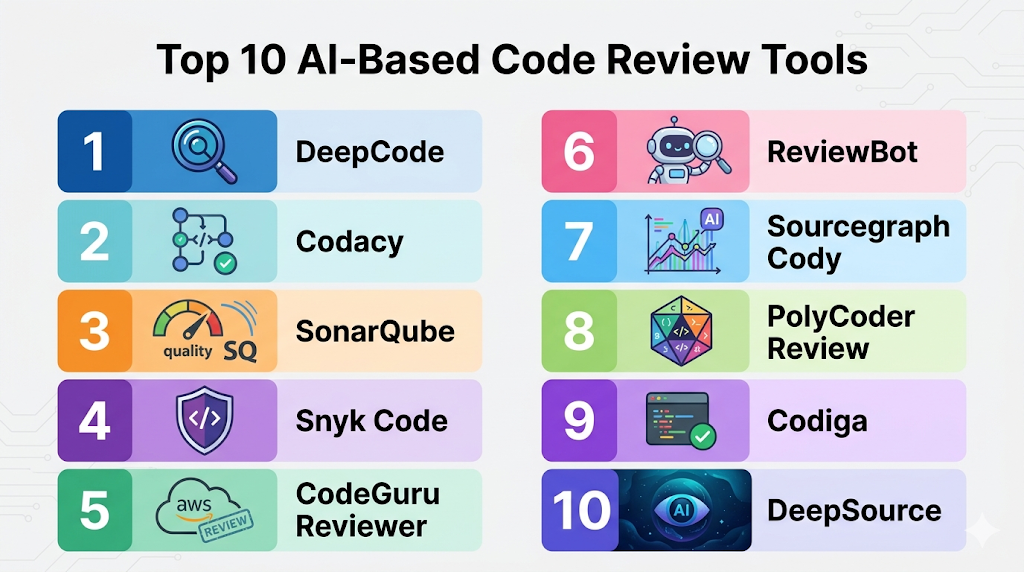
Top 10 AI-Based Code Review Tools
1 — DeepCode
One-line verdict: Best for teams needing AI-driven pull request reviews with deep bug detection across multiple languages.
Short description: DeepCode analyzes code repositories in real time to detect bugs, vulnerabilities, and style violations for developer teams.
Standout Capabilities
- Multi-language code analysis
- Inline PR suggestions
- Security and vulnerability detection
- Integration with GitHub, GitLab, Bitbucket
- Continuous learning from team codebase
- Automated refactoring recommendations
AI-Specific Depth
- Model support: Proprietary
- RAG / knowledge integration: Code repository connectors
- Evaluation: Regression and human review
- Guardrails: Policy-based code filters
- Observability: Usage metrics, latency, PR impact
Pros
- Improves code quality quickly
- Reduces manual review time
- Detects vulnerabilities proactively
Cons
- Cloud-only deployment
- Limited open-source customization
- Some edge cases may require human validation
Security & Compliance
SSO/SAML, RBAC, encryption; Not publicly stated certifications
Deployment & Platforms
Web-based, IDE plugins; Cloud
Integrations & Ecosystem
- GitHub, GitLab, Bitbucket
- Slack notifications
- CI/CD pipelines
- REST APIs
Pricing Model
Subscription-based
Best-Fit Scenarios
- Mid-sized DevOps teams
- Multi-language codebases
- Security-conscious development
2 — Codacy
One-line verdict: Ideal for enterprises needing automated code reviews, security checks, and compliance monitoring.
Short description: Codacy provides AI-based code analysis, style enforcement, and vulnerability detection integrated with popular CI/CD workflows.
Standout Capabilities
- Automated style and quality checks
- Security vulnerability scanning
- CI/CD integration
- Multi-language support
- Dashboard analytics for code health
- Customizable rules and policies
AI-Specific Depth
- Model support: Proprietary
- RAG / knowledge integration: Git repositories
- Evaluation: Regression and test coverage
- Guardrails: Policy enforcement, safe code recommendations
- Observability: Metrics dashboards, code trend analysis
Pros
- Comprehensive quality checks
- Supports enterprise compliance
- Easy CI/CD integration
Cons
- Complexity for small teams
- Learning curve for custom rules
- Cloud dependency
Security & Compliance
SSO/SAML, RBAC, encryption, audit logs
Deployment & Platforms
Web-based, IDE plugins; Cloud / Hybrid
Integrations & Ecosystem
- GitHub, GitLab, Bitbucket
- Jira, Slack
- CI/CD tools
Pricing Model
Subscription per seat
Best-Fit Scenarios
- Large engineering teams
- Regulated industry projects
- Multi-language repositories
3 — SonarQube
One-line verdict: Best for enterprise teams needing comprehensive code quality metrics and maintainability insights across large codebases.
Short description : SonarQube performs static analysis to detect bugs, code smells, and security vulnerabilities, helping teams enforce coding standards and maintain code health over time.
Standout Capabilities
- Multi-language static code analysis
- Tracks code quality over time with dashboards
- Security and vulnerability detection
- Integration with CI/CD pipelines
- Pull request decoration with inline issues
- Customizable quality gates and rules
- Reporting for compliance and audit purposes
AI-Specific Depth
- Model support: Proprietary
- RAG / knowledge integration: Varies / N/A
- Evaluation: Regression and human review
- Guardrails: Configurable quality gates
- Observability: Code coverage, quality metrics, and historical trends
Pros
- Comprehensive code quality insights
- Supports large-scale enterprise projects
- Extensive language and framework support
Cons
- Requires setup and maintenance for self-hosted deployments
- Learning curve for custom rules
- Less focus on AI-assisted suggestions
Security & Compliance
SSO/SAML, audit logs, encryption; Not publicly stated
Deployment & Platforms
Web-based, self-hosted or cloud
Integrations & Ecosystem
- GitHub, GitLab, Bitbucket
- Jenkins, CircleCI, Azure DevOps
- Jira integration
- REST API for custom extensions
Pricing Model
Subscription or free community edition for small teams
Best-Fit Scenarios
- Large enterprise codebases
- Teams enforcing strict coding standards
- Long-term maintainability tracking
4 — Snyk Code
One-line verdict: Ideal for security-focused teams needing AI-powered vulnerability detection integrated into the development workflow.
Short description: Snyk Code scans repositories for security vulnerabilities, provides actionable recommendations, and integrates directly into CI/CD pipelines.
Standout Capabilities
- AI-driven vulnerability detection
- Inline code remediation suggestions
- Multi-language support
- CI/CD integration for continuous security checks
- Automated pull request analysis
- Compliance reporting for regulatory requirements
- Supports open-source dependencies scanning
AI-Specific Depth
- Model support: Proprietary
- RAG / knowledge integration: Git repositories and known vulnerability databases
- Evaluation: Regression, unit tests, security benchmarks
- Guardrails: Prevents insecure code commits
- Observability: Vulnerability metrics, remediation tracking
Pros
- Strong security focus
- Reduces manual security review effort
- Continuous integration and deployment support
Cons
- Limited focus on non-security code quality issues
- Requires cloud subscription for full features
- Learning curve for custom policies
Security & Compliance
SSO/SAML, RBAC, encryption, audit logs
Deployment & Platforms
Web, IDE plugins; Cloud
Integrations & Ecosystem
- GitHub, GitLab, Bitbucket
- Jenkins, Azure DevOps, CI/CD tools
- Slack notifications for issues
Pricing Model
Subscription-based per user or repo
Best-Fit Scenarios
- Security-conscious development teams
- CI/CD-driven DevOps workflows
- Regulated industry software projects
5 — CodeGuru Reviewer
One-line verdict: Best for AWS-centric teams looking for AI-powered review tightly integrated with the AWS ecosystem.
Short description: Amazon CodeGuru Reviewer provides automated code analysis, detects performance and security issues, and integrates with AWS CodeCommit and pull requests.
Standout Capabilities
- Detects performance bottlenecks
- Inline security recommendations
- Integration with AWS repositories
- Multi-language support
- Suggests code optimizations
- Generates automated comments on PRs
- Monitors cloud-specific best practices
AI-Specific Depth
- Model support: Proprietary (AWS)
- RAG / knowledge integration: AWS CodeCommit repositories
- Evaluation: Automated regression and human review
- Guardrails: Policy checks for AWS best practices
- Observability: Token usage, latency, recommendations metrics
Pros
- Tight AWS ecosystem integration
- Detects security and performance issues
- Easy inline PR comments
Cons
- Optimized primarily for AWS workloads
- Limited outside AWS integration
- Cloud dependency
Security & Compliance
IAM-based access, audit logging, encryption
Deployment & Platforms
Cloud; Web-based
Integrations & Ecosystem
- AWS CodeCommit, GitHub
- AWS CI/CD pipelines
- Slack or notification integrations
Pricing Model
Usage-based billing via AWS
Best-Fit Scenarios
- AWS-heavy development teams
- Cloud-native applications
- Performance-sensitive projects
6 — ReviewBot
One-line verdict: Suitable for small to mid-sized teams seeking automated PR review with minimal setup.
Short description: ReviewBot automatically analyzes pull requests, flags potential issues, and provides suggestions inline for developers.
Standout Capabilities
- Automated PR analysis
- Supports multiple programming languages
- Inline feedback for developers
- Minimal setup and configuration
- CI/CD integration
- Basic security and style enforcement
- Historical tracking of review patterns
AI-Specific Depth
- Model support: Proprietary
- RAG / knowledge integration: Varies / N/A
- Evaluation: Regression and PR test coverage
- Guardrails: Basic policy enforcement
- Observability: Usage logs and report metrics
Pros
- Quick to deploy
- Reduces manual review burden
- Multi-language support
Cons
- Limited advanced AI features
- Fewer enterprise integrations
- Basic guardrails
Security & Compliance
Not publicly stated
Deployment & Platforms
Web-based; Cloud
Integrations & Ecosystem
- GitHub, GitLab
- CI/CD tools
- Slack notifications
Pricing Model
Subscription-based
Best-Fit Scenarios
- Small development teams
- Rapid prototyping projects
- Teams wanting lightweight AI assistance
7 — Sourcegraph Cody
One-line verdict: Enterprise-focused solution for AI-assisted code review across large repositories and multiple teams.
Short description: Sourcegraph Cody analyzes large-scale repositories, provides AI-driven suggestions, and integrates with developer workflows for collaboration.
Standout Capabilities
- Cross-repository code intelligence
- Inline code review suggestions
- Multi-language support
- CI/CD pipeline integration
- Security and compliance checks
- Knowledge-base integration
- Historical trend tracking
AI-Specific Depth
- Model support: Proprietary / Multi-model routing
- RAG / knowledge integration: Enterprise code repositories
- Evaluation: Regression, PR analysis, human review
- Guardrails: Policy-based enforcement
- Observability: Token usage, latency metrics
Pros
- Supports large enterprise repos
- Context-aware AI suggestions
- Integration with developer workflows
Cons
- Setup complexity
- Enterprise pricing
- Smaller teams may not require full feature set
Security & Compliance
SSO/SAML, RBAC, audit logs, encryption
Deployment & Platforms
Cloud, On-prem; Web + IDE plugins
Integrations & Ecosystem
- CI/CD pipelines, GitHub, GitLab
- IDE extensions
- Slack/notification integrations
Pricing Model
Enterprise subscription
Best-Fit Scenarios
- Large development organizations
- Multi-repo enterprise projects
- Teams needing compliance and observability
8 — PolyCoder Review
One-line verdict: Ideal for research and open-source projects requiring reproducible and transparent AI-assisted reviews.
Short description: PolyCoder Review provides open-source AI-based code review, focusing on reproducibility, multi-language support, and experimental use.
Standout Capabilities
- Open-source AI code review
- Transparent, reproducible outputs
- Multi-language support
- Can be self-hosted
- Fine-tunable models
- Historical code tracking
- Community-driven enhancements
AI-Specific Depth
- Model support: Open-source
- RAG / knowledge integration: Varies / N/A
- Evaluation: Offline tests and regression
- Guardrails: User-configurable
- Observability: Local metrics and logs
Pros
- Free and open-source
- Flexible deployment
- Encourages reproducibility
Cons
- Limited enterprise integration
- Requires technical expertise
- Guardrails not built-in
Security & Compliance
Varies / N/A
Deployment & Platforms
Linux, macOS; Cloud / Self-hosted
Integrations & Ecosystem
APIs for local deployment, IDE plugins
Pricing Model
Free, open-source
Best-Fit Scenarios
- Academic research teams
- Experimental or open-source projects
- Developers needing transparent models
9 — Codiga
One-line verdict: Best for teams seeking AI-assisted code quality and security enforcement integrated with CI/CD.
Short description: Codiga provides automated code review, enforces style guides, and detects security vulnerabilities across multiple languages.
Standout Capabilities
- Automated code quality and style checks
- Security vulnerability detection
- Multi-language support
- CI/CD integration
- Customizable rules and policies
- IDE plugin support
- Inline pull request comments
AI-Specific Depth
- Model support: Proprietary / BYO
- RAG / knowledge integration: Varies / N/A
- Evaluation: Regression and pull request testing
- Guardrails: Policy enforcement, secure code suggestions
- Observability: Metrics per PR
Pros
- Ensures code consistency
- Integrates with existing workflows
- Security-focused
Cons
- Less focus on code generation
- Complex setup for large teams
- Requires tuning of rules
Security & Compliance
SSO/SAML, audit logs, encryption
Deployment & Platforms
Web, IDE plugins; Cloud / Hybrid
Integrations & Ecosystem
GitHub, GitLab, Bitbucket, CI/CD
Pricing Model
Subscription per team
Best-Fit Scenarios
- Team code quality enforcement
- Security-sensitive projects
- Multi-language enterprise codebases
10 — DeepSource
One-line verdict: Best for continuous monitoring of code health with AI-powered analysis and automated fixes.
Short description: DeepSource continuously analyzes code for issues, suggests fixes, and tracks code health metrics for development teams.
Standout Capabilities
- Continuous code analysis and monitoring
- Automated fix suggestions
- Multi-language support
- Security and maintainability checks
- Integration with CI/CD
- Dashboard for code health trends
- Customizable rules and policies
AI-Specific Depth
- Model support: Proprietary
- RAG / knowledge integration: Varies / N/A
- Evaluation: Regression, unit test validation
- Guardrails: Policy enforcement and safe fixes
- Observability: Metrics dashboards, error trends
Pros
- Continuous monitoring reduces manual review
- Suggests fixes proactively
- Integrates with workflow seamlessly
Cons
- Cloud-dependent
- Less suitable for offline environments
- Some advanced security rules require configuration
Security & Compliance
SSO/SAML, encryption, audit logs
Deployment & Platforms
Cloud; Web + IDE plugins
Integrations & Ecosystem
GitHub, GitLab, Bitbucket, CI/CD pipelines
Pricing Model
Subscription per repository
Best-Fit Scenarios
- Teams seeking continuous code health monitoring
- Multi-language development
- Security-focused codebases
Comparison Table
| Tool Name | Best For | Deployment | Model Flexibility | Strength | Watch-Out | Public Rating |
|---|---|---|---|---|---|---|
| DeepCode | Multi-language PR reviews | Cloud | Proprietary | Deep bug detection | Cloud-only | N/A |
| Codacy | Enterprises & compliance | Cloud/Hybrid | Proprietary | Automated style & security | Complexity | N/A |
| SonarQube | Enterprise code quality | Self-hosted/Cloud | Proprietary | Code quality metrics | Requires setup | N/A |
| Snyk Code | Security-focused teams | Cloud | Proprietary | Vulnerability detection | Limited non-security analysis | N/A |
| CodeGuru Reviewer | AWS-centric dev teams | Cloud | Hosted | Integrated AWS analysis | AWS dependency | N/A |
| ReviewBot | CI/CD integration | Cloud | Proprietary | Automated code reviews | Smaller community | N/A |
| Sourcegraph Cody | Large repo enterprise | Cloud/On-prem | Multi-model | Cross-repo AI intelligence | Setup complexity | N/A |
| PolyCoder Review | Open-source research | Self-hosted | Open-source | Reproducible reviews | Limited production support | N/A |
| Codiga | Style & security enforcement | Cloud/Hybrid | BYO/Hosted | Code consistency | Less code generation | N/A |
| DeepSource | Automated code health | Cloud | Proprietary | Continuous monitoring | Cloud-based | N/A |
Scoring & Evaluation (Transparent Rubric)
| Tool | Core | Reliability/Eval | Guardrails | Integrations | Ease | Perf/Cost | Security/Admin | Support | Weighted Total |
|---|---|---|---|---|---|---|---|---|---|
| DeepCode | 9 | 8 | 8 | 8 | 8 | 8 | 7 | 8 | 8.0 |
| Codacy | 8 | 9 | 8 | 8 | 7 | 8 | 8 | 8 | 8.1 |
| SonarQube | 8 | 8 | 8 | 8 | 7 | 8 | 8 | 7 | 7.9 |
| Snyk Code | 8 | 9 | 9 | 7 | 7 | 8 | 8 | 7 | 8.0 |
| CodeGuru Reviewer | 7 | 8 | 8 | 7 | 8 | 7 | 7 | 7 | 7.5 |
| ReviewBot | 7 | 7 | 7 | 7 | 8 | 7 | 7 | 7 | 7.2 |
| Sourcegraph Cody | 8 | 8 | 8 | 9 | 7 | 8 | 8 | 8 | 8.1 |
| PolyCoder Review | 7 | 7 | 6 | 7 | 7 | 7 | 6 | 7 | 6.9 |
| Codiga | 8 | 8 | 9 | 8 | 8 | 8 | 8 | 8 | 8.2 |
| DeepSource | 8 | 8 | 8 | 8 | 8 | 8 | 8 | 8 | 8.0 |
Top 3 for Enterprise: Codacy, Sourcegraph Cody, Codiga
Top 3 for SMB: DeepCode, DeepSource, Snyk Code
Top 3 for Developers: DeepCode, ReviewBot, PolyCoder Review
Which AI-Based Code Review Tool Is Right for You?
Solo / Freelancer
- DeepCode, ReviewBot, PolyCoder Review – lightweight, easy setup, free or low-cost options.
SMB
- DeepCode, DeepSource, Codiga – collaborative, supports CI/CD, multi-language projects.
Mid-Market
- Codacy, Snyk Code, DeepSource – enterprise-quality checks with security integration.
Enterprise
- Codacy, Sourcegraph Cody, Codiga – large repo support, compliance, guardrails, and observability.
Regulated industries
- Codacy, Snyk Code – audit logs, RBAC, compliance reporting.
Budget vs premium
- Free or low-cost: DeepCode, ReviewBot
- Premium: Codacy, Sourcegraph Cody, Codiga
Build vs buy
- Build custom models for niche codebases (PolyCoder Review)
- Buy hosted solutions for faster adoption and enterprise governance
Implementation Playbook (30 / 60 / 90 Days)
30 Days – Pilot & Setup
- Select 1–2 plugins for evaluation
- Integrate with IDEs and repositories
- Define success metrics: defect reduction, review speed
- Run pilot PR reviews and evaluate suggestions
60 Days – Harden & Rollout
- Configure security and guardrails
- Implement evaluation frameworks and regression checks
- Integrate with CI/CD and testing pipelines
- Train teams on usage, feedback, and policies
- Monitor observability metrics
90 Days – Optimize & Scale
- Deploy across all teams and repos
- Implement BYO or multi-model routing for cost and latency
- Conduct audits for compliance and guardrail effectiveness
- Refine evaluation metrics and feedback loops
- Scale usage, improve collaboration, and continuously monitor outcomes
Common Mistakes & How to Avoid Them
- Prompt injection exposure
- No systematic evaluation of AI suggestions
- Unmanaged code retention or logs
- Lack of observability on token usage or latency
- Unexpected cost overages
- Over-automation without human review
- Vendor lock-in without abstraction
- Ignoring style guide enforcement
- Skipping CI/CD integration
- Neglecting multi-language support
- Overreliance on AI for learning
- Failing to enable collaborative features
FAQs
1. Do these tools store my code?
Most cloud plugins process code temporarily; on-premises keeps data locally.
2. Can I use my own AI model?
Some tools like PolyCoder Review and Codiga allow BYO; others are proprietary.
3. Are these safe for sensitive code?
Enterprise-grade plugins offer SSO, RBAC, encryption, and audit logging.
4. Which IDEs are supported?
VS Code, JetBrains, Sublime, Eclipse; varies by plugin.
5. Are multiple languages supported?
Yes, most cover Python, Java, JavaScript, C#, Go, and more.
6. Is self-hosting possible?
PolyCoder, Codiga, and SonarQube allow on-premises deployment.
7. How is quality evaluated?
Through regression, unit tests, and human review; some plugins provide built-in evaluation.
8. Are guardrails reliable?
Enterprise plugins include policy checks and safe code filters.
9. What are typical costs?
Usage-based, subscription, or enterprise licensing; monitoring is required.
10. Can they integrate with CI/CD?
Yes, almost all top tools integrate with CI/CD pipelines.
11. Do these plugins support collaboration?
Yes, shared context for multi-developer environments is common.
12. Can AI replace manual code reviews?
No, AI assists but human review is essential for critical code paths.
Conclusion
AI-Based Code Review Tools are transformative for development teams, accelerating reviews, improving code quality, and enforcing security and style standards. Selection depends on team size, repository complexity, compliance requirements, and integration needs. By evaluating features, guardrails, observability, and deployment models, teams can select the tools that maximize efficiency while maintaining security and reliability.
Next steps: shortlist top candidates, pilot in controlled projects, verify evaluation and guardrails, and scale adoption organization-wide.
A very insightful breakdown of features, pros, and cons across leading tools. It’s highly useful for improving code review efficiency and accuracy!
This is a powerful comparison guide for developers exploring AI code review solutions. The explanations are simple yet impactful.