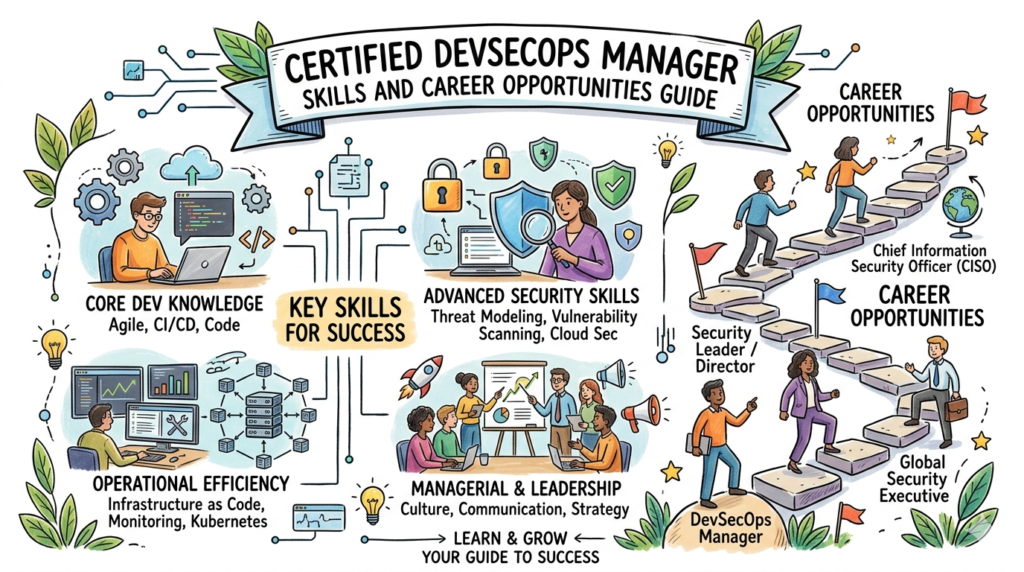
Modern software teams push code to production multiple times a day. Security teams are expected to keep up with this speed, handle growing attack surfaces, and still ensure compliance. The Certified DevSecOps Manager certification exists to prepare you for exactly this reality. In this guide, you’ll learn what the certification is, who it is for, what skills you’ll gain, how to prepare, and how it fits into wider DevOps, SRE, AIOps/MLOps, DataOps, and FinOps career paths. We’ll also cover training options, FAQs, and a simple roadmap you can follow.
Certification tracks and learning table
| Track | Level | Who it’s for | Prerequisites | Skills covered | Recommended order |
|---|---|---|---|---|---|
| DevOps | Associate | Beginners, junior engineers | Basic IT, Linux, Git, scripting | CI/CD basics, containers, version control, simple automation, cloud basics | 1 |
| DevOps | Expert | Senior DevOps / Platform | 2+ years DevOps or SysAdmin experience | IaC (Terraform/CloudFormation), orchestration, advanced CI/CD, scaling, cloud strategy | 2 |
| DevSecOps | Master | Leads, managers, architects | 3–5 years Dev/DevOps/Security | Governance, risk, policy as code, compliance, security leadership | 3 |
| SRE | Specialist | SRE / Reliability engineers | Coding + systems fundamentals | SLOs, error budgets, incident response, reliability patterns, observability | 2–3 |
| AIOps/MLOps | Specialist | ML / Data leads & architects | Python, cloud, ML fundamentals | ML pipelines, model deployment, monitoring, anomaly detection, automation | 3–4 |
| DataOps | Specialist | Data engineers / architects | SQL, ETL, data pipeline basics | Data pipeline reliability, governance, data quality, lineage, observability | 3–4 |
| FinOps | Specialist | Cloud cost / finance owners | Cloud basics, finance fundamentals | Cost allocation, budgets, optimization, showback/chargeback, governance | 2–3 |
Deep dive: Certified DevSecOps Manager
What it is
The Certified DevSecOps Manager is a capstone-style certification that validates your ability to lead and manage DevSecOps initiatives at scale. It stitches together technical understanding, governance frameworks, risk management, and leadership skills.
You are evaluated on how you think about secure delivery, how you design solutions, and how you drive change across teams, not just on how many tools you know.
Who should take it
You should strongly consider this certification if:
- You are a DevOps, SRE, or Platform Engineer moving into lead or managerial responsibilities and want to add security to your leadership profile.
- You are a Security Engineer or Application Security specialist who wants to go beyond manual reviews and become responsible for security automation and pipeline integration.
- You are an Engineering Manager or Technical Manager who owns delivery outcomes and wants to ensure your teams can ship fast without failing audits or exposing the company to unnecessary risk.
- You are a Cloud or Solution Architect and your designs now need to meet strict compliance and security requirements, especially in regulated industries.
Skills you’ll gain
By the end of this certification, you can expect to gain skills in:
- Security leadership and culture
Learning how to make security everyone’s responsibility, not just the security team’s. You will know how to create guidelines, rituals (like threat modeling sessions), and incentives that encourage developers and operations teams to think about security early. - Risk management and risk-based prioritization
Understanding the basics of risk calculations, impact vs. likelihood, and how to apply these ideas to vulnerability management. You will be able to build risk registers and rank issues according to business impact instead of only CVSS scores. - Policy as code and governance automation
Turning policies into automated controls that run inside your pipelines. You’ll learn how to gate deployments when certain conditions are not met, such as missing tests, open critical vulnerabilities, or non-compliant configurations. - Compliance as code
Mapping compliance requirements (ISO, SOC2, GDPR, PCI, etc.) to technical controls and automating checks where possible. This reduces manual audit work and ensures that compliance is not just a one-time activity. - Secure SDLC and secure pipeline design
Understanding where to place checks like SAST, DAST, SCA, container scanning, and secret scanning. You’ll also learn how to integrate these tools without making pipelines unbearably slow. - Security metrics, dashboards, and reporting
Choosing meaningful metrics (for example, mean time to remediate vulnerabilities, number of pipelines with security checks, % of critical issues fixed within SLA) and presenting them clearly to stakeholders. - Stakeholder management and collaboration
Managing expectations between product teams who want speed, security teams who want strict controls, and leadership who wants reduced risk and fewer incidents. You’ll practice ways to negotiate and align these perspectives.
Real-world projects you should handle after it
Once you finish this certification, you should be able to lead and deliver projects like:
- Designing and rolling out a secure CI/CD pipeline
For example, taking an existing Jenkins or GitLab CI pipeline and adding stages for SAST, DAST, SCA, secrets scanning, container image scanning, and policy checks. You should be able to define acceptance criteria and handle exceptions. - Implementing policy-as-code for deployments
Choosing or recommending tools and patterns that enforce security rules on Kubernetes manifests, Terraform, Helm charts, or other infrastructure-as-code assets. You’ll know how to prevent misconfigurations from reaching production. - Creating a DevSecOps maturity model and roadmap
Assessing the current maturity of your organization in areas like security automation, governance, training, and culture. Then building a roadmap that shows how to move from basic to advanced maturity over several quarters. - Leading a shift from manual to automated governance
Planning and executing a transition where security checks move from spreadsheets and manual sign-offs to automated gates and dashboards, with clear communication and training for all impacted teams. - Defining and tracking security KPIs
Choosing KPIs, setting targets, and integrating them into regular reviews. For example, decreasing the number of critical vulnerabilities older than 30 days, or increasing the percentage of services covered by security scans.
Preparation plan
7–14 days: Fast-track plan
Best for professionals who already understand DevOps, CI/CD, and basic security concepts.
- Day 1–2: Understand the exam
Go through the official syllabus and exam structure. Note down each topic and quickly self-rate your comfort level (Strong / Medium / Weak). Focus your time on weak or medium areas. - Day 3–5: Governance and frameworks
Read about common frameworks (ISO 27001, NIST CSF, SOC2). Instead of memorizing, think practically: “How would I show this control in a CI/CD pipeline?” Make quick notes with examples. - Day 6–9: Policy-as-code, risk, and case studies
Study real or sample case studies where organizations implemented DevSecOps. Focus on how they handled resistance, tool sprawl, and performance concerns. - Day 10–14: Mock tests and revision
Take practice questions if available, and simulate the exam environment. Review mistakes and create a summary sheet with the most important concepts and patterns.
30 days: Balanced plan
Good for most working engineers and managers.
- Week 1: DevOps + security refresher
Review how your current or past projects move from code to production. Map each step and list where security checks exist or are missing. This forces you to think practically, not just theoretically. - Week 2: Tools, patterns, and integration
Study SAST, DAST, SCA, secrets management, container security, and cloud security basics. You don’t need to be an expert in each tool, but understand when and where to use them. - Week 3: Governance, risk, and leadership
Focus on frameworks, risk registers, and communication patterns. Think about how you would convince teams to change their process or adopt new security gates. - Week 4: Practice and capstone
Create a sample DevSecOps strategy document for a realistic application (maybe from your work or an open-source project). Use this as your personal “capstone” and revise the theory around it.
60 days: Career transition plan
Best if you are shifting from pure development, operations, or security roles and lack strong exposure to DevOps and DevSecOps.
- Month 1: Build strong foundations
Focus on DevOps concepts (CI/CD, containers, cloud, Git, testing) and basic security knowledge (OWASP Top 10, common misconfigurations, basic network security). Use simple labs or demo projects. - Month 2: DevSecOps + leadership focus
Gradually shift to DevSecOps patterns: what changes when you embed security into DevOps? Then learn governance, risk, and compliance topics. Try to connect them to your Month 1 labs by adding security steps. - Ongoing: Weekly project time
Every week, spend a couple of hours improving a small demo pipeline. Add one new security control each week, and document the change.
Common mistakes to avoid
- Over-focusing on tools and ignoring leadership
Many candidates spend all their time learning specific tools. The exam and real roles expect you to think about people, process, and culture as much as tools. - Treating frameworks as checklists only
It’s not enough to memorize what ISO or NIST say. You must know how to translate a requirement like “access control” into actual pipeline checks, IAM configurations, and monitoring. - Ignoring change management
DevSecOps often fails because teams feel blocked or overloaded. You need to learn how to introduce changes gradually, communicate clearly, and gather feedback. - Forgetting non-application security
Application code is only one part of the picture. You must consider infrastructure, configuration, container images, cloud services, and third-party components. - Not practicing scenario-based questions
Real-world scenarios are messy. You should practice questions where multiple options seem correct and you must choose the “best” given constraints like budget, timelines, and team skills.
Best next certification after this
Once you complete Certified DevSecOps Manager, you can choose your next step based on your career goals:
- Same track (DevSecOps practitioner-level)
Choose a hands-on DevSecOps or security engineering certification that focuses heavily on labs. This will deepen your ability to implement the strategies you design. - Cross-track (SRE / Observability)
Moving into SRE or observability certifications helps you connect security with reliability, incident response, and performance. This is useful if you are responsible for production operations. - Leadership / architecture
Consider cloud or security architecture certifications that emphasize system-wide design and governance. This strengthens your profile for senior leadership or architect roles.
Choose your path: 6 learning paths
1. DevOps path
This path is for those who start with infrastructure, CI/CD, or general automation.
- Step 1: Learn Linux, Git, shell scripting, and a programming language.
- Step 2: Study CI/CD tools, containers, and basic cloud services.
- Step 3: Get a DevOps Associate-level certification to validate your knowledge.
- Step 4: Work towards DevOps Expert-level skills (IaC, orchestration, scaling).
- Step 5: Add Certified DevSecOps Manager to own secure delivery as a whole.
2. DevSecOps path
For those who want to specialize in security within DevOps environments.
- Step 1: Build strong DevOps basics—pipelines, containers, cloud.
- Step 2: Learn application security fundamentals (OWASP, secure coding).
- Step 3: Take a DevSecOps Engineer/Professional certification focused on hands-on labs.
- Step 4: Move up to Certified DevSecOps Manager to lead strategy, governance, and culture.
3. SRE path
For reliability-focused engineers who care about uptime, SLIs, and SLOs.
- Step 1: Learn systems engineering, observability, and incident response.
- Step 2: Pursue an SRE-specific certification or learning track.
- Step 3: Deepen your skills with performance engineering and capacity planning.
- Step 4: Add Certified DevSecOps Manager to integrate security into production practices and incident workflows.
4. AIOps / MLOps path
For those working with machine learning systems and data-heavy pipelines.
- Step 1: Learn ML basics, Python, and key data tools.
- Step 2: Study MLOps and AIOps concepts (model deployment, monitoring, automation).
- Step 3: Work on pipelines that train, test, and deploy models.
- Step 4: Use Certified DevSecOps Manager concepts to secure ML pipelines, manage model governance, and handle compliance for data and models.
5. DataOps path
For data engineers who want to improve reliability and security of data pipelines.
- Step 1: Learn SQL, ETL, data warehousing, and big data tools.
- Step 2: Focus on DataOps concepts—quality, observability, lineage, and governance.
- Step 3: Implement data pipelines with strong testing and monitoring.
- Step 4: Apply DevSecOps Manager skills to enforce access control, auditability, and privacy rules in data workflows.
6. FinOps path
For people responsible for cloud costs and financial governance.
- Step 1: Understand cloud pricing models and billing.
- Step 2: Learn FinOps principles—cost allocation, showback, and budgeting.
- Step 3: Implement dashboards and optimization practices.
- Step 4: Combine FinOps and DevSecOps: justify security investments using cost and risk, and align budgets with security priorities.
Role → Recommended certifications mapping
| Role | Recommended certifications (sequence) |
|---|---|
| DevOps Engineer | DevOps Associate → DevOps Expert → DevSecOps Professional → Certified DevSecOps Manager |
| SRE | DevOps Associate → SRE Specialist → Observability Master → Certified DevSecOps Manager |
| Platform Engineer | DevOps Associate → DevOps Expert → Cloud/Kubernetes Architect → Certified DevSecOps Manager |
| Cloud Engineer | Cloud Associate → DevOps Associate → Cloud Security / DevSecOps Professional → Certified DevSecOps Manager |
| Security Engineer | Security Fundamentals → Application/Cloud Security Specialist → DevSecOps Professional → Certified DevSecOps Manager |
| Data Engineer | Data Engineering / DataOps Certification → Cloud Data Platform Certification → Certified DevSecOps Manager (for governance and data security) |
| FinOps Practitioner | Cloud Fundamentals → FinOps Practitioner → Cloud Governance Certification → Certified DevSecOps Manager |
| Engineering Manager | DevOps / Cloud Fundamentals → Agile / Leadership Certification → Certified DevSecOps Manager → SRE or FinOps (based on responsibility) |
Top institutions for training + certification support (expanded)
Here is more context for each one you listed:
- DevOpsSchool
DevOpsSchool offers multi-day DevSecOps and DevOps training programs, including instructor-led courses, labs, and real-world case studies. They typically cater to working professionals with weekend or evening batches and often integrate certification preparation into their courses. - Cotocus
Cotocus acts as both a consulting and training partner for enterprises. They focus on DevOps, SRE, and DevSecOps transformations, which means they can help teams adopt practices in real environments, not just teach theory. - ScmGalaxy
ScmGalaxy is known for community-driven learning and hands-on workshops. It covers a wide range of DevOps and DevSecOps topics and helps learners connect theory with real tools and pipelines. - BestDevOps
BestDevOps functions as a knowledge and content hub. It aggregates articles, case studies, and training offers, helping professionals discover the right programs and stay up to date with the latest DevOps and DevSecOps trends. - devsecopsschool.com
This is the official home for the Certified DevSecOps Manager certification. It provides detailed syllabus information, exam details, and aligned training options, making it a key reference if you are planning to attempt the exam. - sreschool.com
SRESchool focuses on SRE training and certifications. If your role mixes reliability, performance, and security, combining SRE programs from here with DevSecOps Manager is a strong combination. - aiopsschool.com
AIOpsSchool offers trainings in AIOps and MLOps, teaching how to use automation and machine learning for operations. For organizations that use AI to manage systems, understanding DevSecOps alongside AIOps is increasingly important. - dataopsschool.com
DataOpsSchool targets data engineers and DataOps practitioners. It focuses on pipeline quality, governance, and observability—areas that pair well with DevSecOps when handling sensitive or regulated data. - finopsschool.com
FinOpsSchool specializes in cloud cost management education. When you pair FinOps knowledge with DevSecOps governance, you can optimize both security and cost, which is crucial for leadership roles.
FAQs
1. How difficult is the Certified DevSecOps Manager certification?
The difficulty is moderate to high because it tests real-world decision making, not just theory. It expects you to understand DevOps, security concepts, and how to balance speed with risk in practical scenarios.
2. How much time do I need to prepare for this certification?
Most working professionals need around 4–6 weeks with 1–2 hours of focused study per day. If you are new to DevSecOps or governance topics, plan closer to 8 weeks to build strong fundamentals first.
3. Do I need hands-on DevOps experience before attempting it?
Yes, you should have some real experience with CI/CD, cloud, or modern software delivery practices. Without this background, many of the scenarios and questions will feel abstract and hard to relate to.
4. Is this certification suitable for beginners or freshers?
This certification is not ideal for complete beginners. It is designed for mid-level or senior engineers, leads, and managers who already understand how software is built, tested, and deployed in real organizations.
5. What are the minimum prerequisites to get value from this certification?
At a minimum, you should understand CI/CD pipelines, basic security concepts (like OWASP Top 10), and how your current organization moves code to production. Having 3–5 years in Dev, Ops, Security, or SRE roles makes the learning curve much smoother.
6. In what order should I take related certifications?
A common sequence is:
DevOps/Cloud fundamentals → Practitioner-level DevOps or DevSecOps → Certified DevSecOps Manager → Optional SRE, Architecture, or FinOps certifications. This way, you build hands-on skills first and then move into strategy and leadership.
7. What is the real value of the Certified DevSecOps Manager certification?
The main value is that it positions you as someone who can own secure delivery across teams, not just operate individual tools. It signals that you understand governance, risk, compliance, and culture change in addition to technical topics.
8. How does this certification impact my career growth?
It can help you move from senior engineer to roles like DevSecOps Manager, Security Engineering Manager, Platform Lead, or Cloud Security Lead. It also strengthens your profile for leadership roles that require both technical and governance responsibility.
9. Will this certification help if I want to move into management?
Yes, it is especially useful if you are a tech lead or senior engineer moving into engineering management or security leadership. It gives you language, frameworks, and patterns you can use in meetings with directors, CISO, or product leaders.
10. Is it worth doing if I already have a DevOps or cloud certification?
Yes, because DevOps and cloud certifications typically focus on delivery and platform skills. Certified DevSecOps Manager adds the missing layer of security, governance, and risk management, which is critical for senior roles.
11. How does this certification fit into a long-term learning roadmap?
Think of it as a mid-to-advanced milestone. First, you build strong DevOps / cloud / security skills, then you use this certification to move into more strategic roles. After that, you can extend into specialized tracks like SRE, architecture, or FinOps depending on your interests.
12. Can this certification help me switch domains (for example, from pure development or testing)?
Yes, if you already understand software development or testing, this certification can help you pivot into DevSecOps-focused roles. You will, however, need to invest extra time in learning CI/CD, cloud, and security tooling to make the switch smooth.
FAQs specific to Certified DevSecOps Manager
- What exactly does the Certified DevSecOps Manager cover?
It covers the full lifecycle of DevSecOps: assessment of current practices, strategy design, risk and compliance alignment, automation of controls, stakeholder management, and continuous improvement. You’ll learn both technical and non-technical aspects of leading DevSecOps. - Do I need prior DevSecOps certifications?
They are not mandatory, but having at least one practitioner-level DevSecOps or cloud security certification makes this program easier. It ensures you’re not seeing basic concepts like SAST/DAST or CI/CD for the first time. - Is there a lot of compliance theory?
Yes, compliance and governance are important parts, but not in a dry, academic way. The focus is on how to convert compliance requirements into pipeline controls, dashboards, and automated checks. - Is the exam more technical or managerial?
The exam sits in the middle: you must understand technical details well enough to design realistic solutions, but the questions often test your judgment, prioritization, and leadership mindset. - What tools should I know before attempting it?
You should be familiar with at least one CI/CD tool, container platform, code repository, and a few security tools (like scanners or secret detection). You don’t have to master all tools, but you should know where they fit in the pipeline. - Can this certification help me move into leadership?
Yes. It is very suitable for senior engineers or tech leads who want to move into security, platform, or DevSecOps management roles, because it builds both technical and strategic credibility. - How should I use mock exams?
Use mock exams to identify knowledge gaps and get used to thinking in scenarios. After each mock, spend time understanding why the correct answer is right and how you would explain that decision in a real-world meeting. - What should I build as a capstone project?
A good capstone is a detailed DevSecOps strategy and roadmap for a real application or platform. Include current-state assessment, target-state architecture, security controls at each stage, metrics, and a phased rollout plan.
Next Certifications to Take After Certified DevSecOps Manager
1. Same track: DevSecOps (hands-on practitioner)
If you want to go deeper in the DevSecOps track, your next step should be a highly hands-on practitioner-level certification.
Look for a program that focuses on building and operating secure CI/CD pipelines, integrating SAST/DAST/SCA, secrets management, container and cloud security, and running end-to-end labs. This will strengthen your ability to implement in detail the strategies you design as a DevSecOps Manager.
2. Cross-track: SRE / Observability / Cloud Security
If you want to broaden your profile, choose a cross-track certification that connects DevSecOps with reliability and operations:
- SRE or Site Reliability Engineering certification (SLOs, error budgets, incident response).
- Observability / Monitoring specialist certification (logs, metrics, traces, security signals).
- Cloud Security Specialist certification focused on hardening cloud-native architectures.
This combination is powerful when you are responsible for both secure and reliable production systems.
3. Leadership / Architecture: Security or Cloud Architect
If your goal is to move into senior leadership or architecture, aim for:
- Security Architect or Cloud Security Architect certification, focusing on enterprise design, risk, and governance.
- Cloud Architect certification from a major cloud provider if you work heavily in a specific ecosystem.
- An advanced governance/strategy program that deepens your ability to influence policies and budgets.
These help you position DevSecOps as a core part of overall technology and business strategy, not just a practice inside engineering.
Conclusion
The Certified DevSecOps Manager certification is an excellent choice if you want to move from individual technical contributions to owning secure delivery strategies across teams and platforms. It helps you combine DevOps, security, governance, and leadership into a single, powerful career path. If you plan your preparation properly and connect the concepts to your current work, this certification can open doors to roles like DevSecOps Manager, Security Engineering Manager, Platform Lead, or Cloud Security Lead.
Excellent content! The focus on integrating security from the beginning of development rather than treating it as a final step is very relevant in today’s IT landscape.
Useful breakdown of the Certified DevSecOps Manager role, highlighting key skills and the growing career opportunities in secure DevOps leadership.