Introduction
Robotics Perception Frameworks are software frameworks, libraries, and development platforms that help robots understand their physical surroundings using cameras, LiDAR, radar, depth sensors, IMUs, tactile sensors, microphones, and other sources of sensor data. They provide the algorithms and infrastructure required to transform raw sensor inputs into useful information such as object locations, depth, motion, maps, poses, obstacles, and semantic understanding.
Perception is one of the most important layers in modern robotics. A mobile robot cannot navigate reliably if it cannot determine where obstacles are. A warehouse robot needs to recognize pallets and people. An autonomous vehicle needs to understand lanes, vehicles, pedestrians, and road conditions. Manipulators need perception systems capable of identifying objects and estimating their positions before grasping them.
Modern perception stacks increasingly combine classical computer vision, 3D geometry, deep learning, foundation models, multimodal AI, and GPU acceleration. In 2026, developers are also paying greater attention to edge inference, simulation, model evaluation, safety, latency, data privacy, and deployment reproducibility.
Best for: Robotics engineers, autonomous-system developers, research teams, industrial automation companies, warehouse robotics companies, autonomous vehicle teams, drone developers, universities, and organizations building perception-heavy robotic systems.
Not ideal for: Simple automation systems that do not require environmental understanding, robots with very limited sensing requirements, or teams looking for a complete plug-and-play robotics product rather than a development framework.
What’s Changed in Robotics Perception Frameworks
- Foundation models are entering robotics perception: Vision-language and multimodal models can provide semantic understanding beyond traditional object detectors.
- 3D perception is becoming more important: Robots increasingly combine RGB, depth, LiDAR, and spatial representations.
- Edge AI is critical: Perception frequently needs low-latency inference directly on the robot.
- GPU acceleration is becoming standard: Modern perception pipelines increasingly depend on accelerated inference and tensor processing.
- Multimodal sensor fusion is expanding: Cameras, LiDAR, radar, IMUs, and tactile sensors can be combined for more robust environmental understanding.
- Synthetic data is becoming useful for training: Simulation can provide large quantities of labeled perception data.
- Simulation-to-real workflows are improving: Teams increasingly validate perception pipelines in virtual environments before deployment.
- AI evaluation is becoming more sophisticated: Accuracy alone is insufficient; developers also need latency, robustness, calibration, failure-rate, and edge-case testing.
- Vision-language-action systems are emerging: Perception is increasingly connected directly to planning and robot control.
- Model optimization matters more: Quantization, pruning, TensorRT-style acceleration, and hardware-specific optimization can significantly affect real-world performance.
- Privacy is increasingly important: Robots operating in homes, hospitals, offices, and public environments may process sensitive visual and audio data.
- Observability is becoming essential: Developers need visibility into inference latency, sensor failures, model confidence, dropped frames, and perception drift.
- Safety boundaries matter: Perception uncertainty should be communicated to downstream planning and control rather than hidden behind a simple confidence score.
Quick Buyer Checklist
Use this checklist when evaluating robotics perception frameworks:
- Does it support your required sensors?
- Does it support RGB cameras?
- Does it support depth cameras?
- Does it support LiDAR?
- Does it support radar where required?
- Does it support IMUs and sensor fusion?
- Does it integrate with ROS 2?
- Does it support GPU acceleration?
- Can models run at the edge?
- Does it support real-time inference?
- Are Python and C++ APIs available?
- Does it support object detection?
- Does it support segmentation?
- Does it support pose estimation?
- Does it support SLAM or localization?
- Does it support 3D point-cloud processing?
- Can you integrate your own models?
- Can you use open-source models?
- Does it support multimodal or vision-language models?
- Are evaluation tools available?
- Can you monitor latency and model performance?
- Does it support simulation?
- Can perception pipelines be tested automatically?
- Are datasets and annotations easy to manage?
- Is the licensing model compatible with commercial deployment?
- Can you avoid unnecessary vendor lock-in?
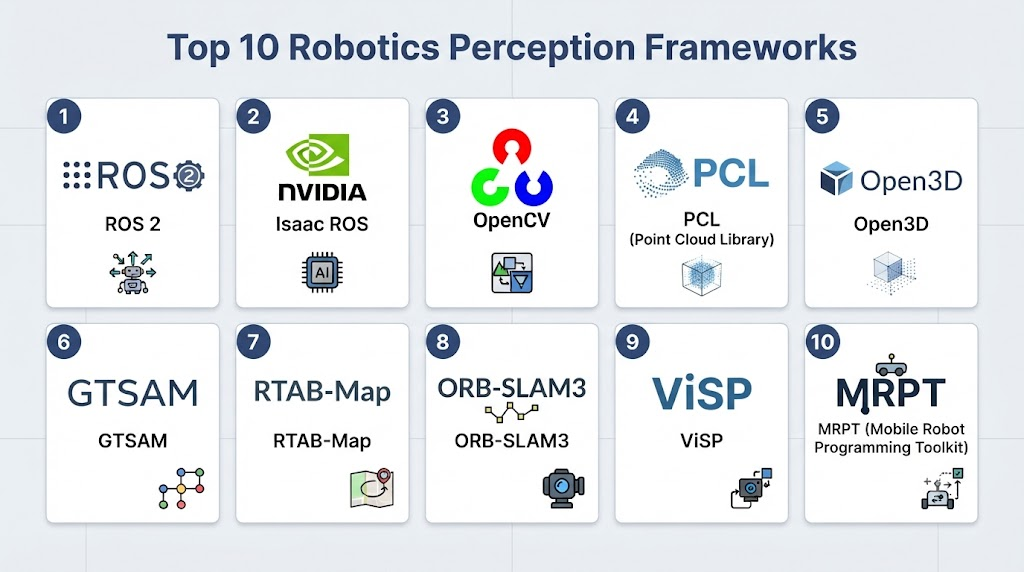
Top 10 Robotics Perception Frameworks
1 — ROS 2
One-line verdict: Best general-purpose robotics middleware for building modular perception pipelines across sensors, algorithms, robots, and computing platforms.
Short description:
ROS 2 is not a single perception algorithm but a robotics middleware ecosystem that provides communication, lifecycle management, tooling, and integration infrastructure for perception components. Developers can combine camera drivers, LiDAR processing, SLAM, object detection, localization, and custom AI models into larger robotic systems.
Standout Capabilities
- Modular perception architecture
- Sensor-driver ecosystem
- Distributed robotics communication
- Real-time-oriented capabilities
- C++ and Python development
- Integration with simulation environments
- Large robotics developer ecosystem
- Support for custom perception pipelines
AI-Specific Depth
- Model support: Framework-agnostic; supports proprietary, open-source, and custom models
- RAG / knowledge integration: N/A
- Evaluation: Depends on integrated perception packages and developer tooling
- Guardrails: Application-specific; ROS 2 itself is not an AI safety framework
- Observability: ROS 2 tooling, logging, topics, diagnostics, and system monitoring
Pros
- Extremely flexible
- Large robotics ecosystem
- Works across many hardware platforms
Cons
- Requires engineering expertise
- Perception capabilities depend heavily on selected packages
- Production architecture requires careful system design
Security & Compliance
ROS 2 includes security mechanisms such as authentication, encryption, and access-control capabilities through its DDS-based architecture. Exact implementation depends on configuration and middleware selection. Specific certifications vary by deployment.
Deployment & Platforms
- Deployment: Edge, robot, cloud-connected, and hybrid
- Linux: Strong support
- Windows: Supported
- macOS: Development support varies
- Mobile: Not the primary target
Integrations & Ecosystem
ROS 2 can connect virtually every layer of a perception system.
- Cameras
- LiDAR
- Depth sensors
- IMUs
- Navigation systems
- SLAM packages
- AI inference engines
- Simulation platforms
Pricing Model
Open-source software with no standard license fee for the core framework.
Best-Fit Scenarios
- Research robotics
- Commercial robot development
- Multi-sensor autonomous systems
2 — NVIDIA Isaac ROS
One-line verdict: Best for GPU-accelerated robotic perception requiring high-performance AI inference and NVIDIA hardware integration.
Short description:
NVIDIA Isaac ROS provides GPU-accelerated robotics packages and tools designed to accelerate perception, navigation, visual processing, and other robotics workloads. It integrates closely with ROS 2 and NVIDIA’s robotics computing ecosystem.
Standout Capabilities
- GPU-accelerated perception
- ROS 2 integration
- Computer vision pipelines
- Stereo and depth processing
- Visual SLAM
- Object detection
- DNN inference acceleration
- NVIDIA hardware optimization
AI-Specific Depth
- Model support: NVIDIA-optimized models plus supported custom models
- RAG / knowledge integration: N/A
- Evaluation: Developer testing and benchmarking capabilities; exact evaluation features vary by package
- Guardrails: Application-specific
- Observability: ROS 2 tooling plus NVIDIA performance and inference profiling
Pros
- Excellent performance on NVIDIA hardware
- Strong robotics AI ecosystem
- Useful prebuilt accelerated components
Cons
- Strong dependency on NVIDIA hardware
- Can require advanced GPU knowledge
- Hardware optimization can increase platform coupling
Security & Compliance
Security depends on the underlying robot, operating system, ROS 2 configuration, and deployment architecture. Certification scope varies by application.
Deployment & Platforms
- Deployment: Edge robotics and cloud-connected environments
- Linux: Primary robotics environment
- Windows/macOS: Development capabilities vary
- Mobile: N/A
Integrations & Ecosystem
- ROS 2
- NVIDIA Jetson
- NVIDIA GPUs
- Cameras
- LiDAR
- Depth sensors
- Simulation platforms
Pricing Model
Core software components are available through NVIDIA’s robotics ecosystem; hardware and enterprise services may have separate costs.
Best-Fit Scenarios
- Autonomous mobile robots
- AI-heavy perception
- GPU-powered robotic platforms
3 — OpenCV
One-line verdict: Best foundational computer-vision library for developers building custom robotic perception algorithms and image-processing pipelines.
Short description:
OpenCV is one of the most widely used open-source computer-vision libraries. It provides algorithms for image processing, feature detection, geometric vision, calibration, tracking, and machine-learning integration.
Standout Capabilities
- Image processing
- Feature detection
- Camera calibration
- Object tracking
- Optical flow
- Stereo vision
- Geometric computer vision
- Extensive language bindings
AI-Specific Depth
- Model support: Supports integration with deep-learning frameworks and pretrained models
- RAG / knowledge integration: N/A
- Evaluation: Developer-controlled testing
- Guardrails: N/A as a general computer-vision library
- Observability: Application-specific logging and metrics
Pros
- Mature and widely adopted
- Large ecosystem
- Excellent for custom computer-vision work
Cons
- Not a complete robotics middleware framework
- Developers must build much of the robotics architecture
- Advanced AI workflows require additional frameworks
Security & Compliance
Security depends primarily on the application and deployment architecture. Specific certifications are not inherent to the library.
Deployment & Platforms
- Deployment: Edge, desktop, server, and embedded
- Linux: Supported
- Windows: Supported
- macOS: Supported
- Mobile: Supported through relevant bindings/platform integrations
Integrations & Ecosystem
- ROS/ROS 2
- Python
- C++
- Deep-learning frameworks
- Camera SDKs
- GPU acceleration frameworks
- Robotics applications
Pricing Model
Open-source.
Best-Fit Scenarios
- Custom robotic vision
- Research projects
- Embedded computer vision
4 — PCL (Point Cloud Library)
One-line verdict: Best for advanced 3D perception, point-cloud processing, segmentation, registration, and geometric robotics applications.
Short description:
The Point Cloud Library is an open-source framework focused on processing 3D point clouds. It provides algorithms for filtering, segmentation, feature estimation, registration, surface reconstruction, and 3D object processing.
Standout Capabilities
- Point-cloud filtering
- 3D segmentation
- Point-cloud registration
- Feature extraction
- Surface reconstruction
- 3D visualization
- Object recognition
- Geometric processing
AI-Specific Depth
- Model support: Primarily geometric; can integrate with external AI models
- RAG / knowledge integration: N/A
- Evaluation: Algorithm-level testing
- Guardrails: N/A
- Observability: Developer-controlled metrics and visualization
Pros
- Excellent 3D processing capabilities
- Mature robotics ecosystem
- Strong complement to LiDAR-based perception
Cons
- Primarily a point-cloud library rather than complete AI framework
- Requires additional components for deep learning
- Can require significant C++ expertise
Security & Compliance
Security is primarily determined by the application and infrastructure.
Deployment & Platforms
- Deployment: Edge and server
- Linux: Supported
- Windows: Supported
- macOS: Supported
Integrations & Ecosystem
- LiDAR
- ROS 2
- OpenCV
- CUDA-based workflows
- Depth cameras
- 3D scanners
- Robotics platforms
Pricing Model
Open-source.
Best-Fit Scenarios
- LiDAR robotics
- 3D mapping
- Industrial inspection
5 — Open3D
One-line verdict: Best modern open-source toolkit for 3D data processing, visualization, reconstruction, and AI-assisted robotics perception.
Short description:
Open3D provides tools for 3D data processing and machine-learning-oriented workflows. It is useful for point clouds, meshes, RGB-D data, reconstruction, registration, and visualization.
Standout Capabilities
- Point-cloud processing
- RGB-D processing
- 3D reconstruction
- Registration
- 3D visualization
- Mesh processing
- Tensor-based computation
- Machine-learning integration
AI-Specific Depth
- Model support: Supports integration with deep-learning workflows
- RAG / knowledge integration: N/A
- Evaluation: Developer-controlled benchmarking and testing
- Guardrails: N/A
- Observability: Visualization and application-level metrics
Pros
- Modern 3D development experience
- Strong Python support
- Useful for research and production prototypes
Cons
- Not complete robotics middleware
- Requires integration with robot systems
- Advanced deployment may need additional infrastructure
Security & Compliance
Security depends on the application.
Deployment & Platforms
- Deployment: Edge, desktop, and server
- Linux: Supported
- Windows: Supported
- macOS: Supported
Integrations & Ecosystem
- Python
- C++
- ROS 2
- LiDAR
- RGB-D cameras
- Deep-learning frameworks
- 3D datasets
Pricing Model
Open-source.
Best-Fit Scenarios
- 3D robotics research
- LiDAR processing
- Reconstruction and mapping
6 — NVIDIA DeepStream
One-line verdict: Best for high-throughput, real-time multi-camera perception and video analytics on NVIDIA hardware.
Short description:
NVIDIA DeepStream is a streaming analytics framework designed for real-time video and sensor-data processing. Robotics developers can use it to construct efficient camera-based perception pipelines with AI inference and GPU acceleration.
Standout Capabilities
- Real-time video analytics
- Multi-camera processing
- GPU-accelerated inference
- Object detection
- Object tracking
- Video pipelines
- Sensor-data processing
- AI model integration
AI-Specific Depth
- Model support: Supports NVIDIA inference ecosystems and custom models
- RAG / knowledge integration: N/A
- Evaluation: Performance profiling and application testing
- Guardrails: Application-specific
- Observability: Pipeline performance, frame rates, inference metrics, and system monitoring
Pros
- Excellent video-processing performance
- Strong GPU acceleration
- Suitable for high-camera-count systems
Cons
- NVIDIA ecosystem dependency
- More focused on streaming perception than full robotics
- Requires additional robotics middleware
Security & Compliance
Depends on the application and infrastructure.
Deployment & Platforms
- Deployment: Edge and server
- Linux: Primary
- Windows/macOS: Limited or development-specific
- Mobile: N/A
Integrations & Ecosystem
- NVIDIA GPUs
- Jetson
- ROS 2
- Cameras
- RTSP/video sources
- AI models
- Cloud systems
Pricing Model
Software availability and hardware costs vary by NVIDIA platform and deployment.
Best-Fit Scenarios
- Autonomous robots with multiple cameras
- Security robotics
- Industrial vision
7 — PyTorch
One-line verdict: Best deep-learning framework for training and deploying custom neural perception models for robotics research and production.
Short description:
PyTorch is a machine-learning framework widely used for developing neural networks. In robotics, it can power object detection, segmentation, depth estimation, pose estimation, visual representation learning, and multimodal perception models.
Standout Capabilities
- Deep-learning model development
- Computer vision
- Transformer architectures
- Custom training
- GPU acceleration
- Model experimentation
- Transfer learning
- Research ecosystem
AI-Specific Depth
- Model support: Highly flexible; open-source and custom models
- RAG / knowledge integration: Possible through external components
- Evaluation: Extensive developer-controlled evaluation options
- Guardrails: Application-specific
- Observability: Training metrics, inference metrics, profiling, and experiment tracking through external tools
Pros
- Extremely flexible
- Large AI ecosystem
- Excellent for custom perception models
Cons
- Not a complete robotics framework
- Production deployment requires additional tools
- Requires machine-learning expertise
Security & Compliance
Depends on application and infrastructure.
Deployment & Platforms
- Deployment: Edge, cloud, server, and embedded
- Linux: Strong support
- Windows: Supported
- macOS: Supported
Integrations & Ecosystem
- ROS 2
- CUDA
- TensorRT
- OpenCV
- ONNX
- Robotics datasets
- Simulation environments
Pricing Model
Open-source.
Best-Fit Scenarios
- Robotics AI research
- Custom perception models
- Vision-language robotics
8 — NVIDIA Isaac Sim
One-line verdict: Best for simulation-based perception development, synthetic data generation, testing, and sim-to-real robotics workflows.
Short description:
NVIDIA Isaac Sim is a robotics simulation platform that can help developers build, test, and evaluate perception systems in physically simulated environments. It is particularly useful for generating synthetic sensor data and testing robots before physical deployment.
Standout Capabilities
- Robotics simulation
- Synthetic sensor data
- Camera simulation
- LiDAR simulation
- Synthetic data generation
- Scenario testing
- Digital-twin workflows
- Sim-to-real development
AI-Specific Depth
- Model support: Supports integration with AI and robotics models
- RAG / knowledge integration: N/A
- Evaluation: Simulation-based testing and scenario evaluation
- Guardrails: Developer-controlled simulation constraints
- Observability: Simulation telemetry and robotics performance metrics
Pros
- Powerful perception testing environment
- Reduces dependence on physical testing
- Useful for rare and dangerous scenarios
Cons
- Requires powerful computing hardware
- Simulation can be complex
- Simulated environments may not perfectly represent reality
Security & Compliance
Deployment security depends on infrastructure.
Deployment & Platforms
- Deployment: Workstation/server/cloud environments
- Linux: Primary
- Windows: Supported depending on version and configuration
- macOS: Not the primary target
Integrations & Ecosystem
- ROS 2
- NVIDIA Omniverse
- Isaac ROS
- Synthetic-data tools
- AI models
- Robotics hardware
Pricing Model
Availability and licensing vary by NVIDIA offering and use case.
Best-Fit Scenarios
- Autonomous robotics development
- Synthetic perception datasets
- Sim-to-real validation
9 — Ultralytics YOLO
One-line verdict: Best for developers needing fast, practical object detection and computer-vision models for robotic perception.
Short description:
Ultralytics YOLO provides modern computer-vision models and tooling for object detection and related tasks. Robotics developers can integrate YOLO-style models into perception pipelines for identifying people, vehicles, tools, objects, and other classes.
Standout Capabilities
- Object detection
- Image classification
- Instance segmentation
- Pose estimation
- Real-time inference
- Custom model training
- Edge deployment
- Camera-based perception
AI-Specific Depth
- Model support: YOLO-family models with custom training capabilities
- RAG / knowledge integration: N/A
- Evaluation: Standard computer-vision evaluation metrics and model validation
- Guardrails: Application-specific
- Observability: Inference performance and confidence metrics
Pros
- Fast and practical
- Easy to prototype
- Strong developer adoption
Cons
- Object detection is only one perception layer
- Robotics integration is developer responsibility
- Licensing should be reviewed carefully for commercial deployments
Security & Compliance
Application-dependent. Commercial users should review the applicable software license and deployment requirements.
Deployment & Platforms
- Deployment: Edge, server, desktop, and embedded environments
- Linux: Supported
- Windows: Supported
- macOS: Supported
- Mobile: Deployment depends on model/export workflow
Integrations & Ecosystem
- Python
- OpenCV
- ROS 2
- NVIDIA hardware
- TensorRT
- ONNX
- Robotics cameras
Pricing Model
Software licensing depends on the applicable Ultralytics offering and usage scenario.
Best-Fit Scenarios
- Object-detection robotics
- Edge AI
- Rapid perception prototyping
10 — Intel OpenVINO
One-line verdict: Best for optimizing and deploying AI perception models across Intel-powered edge and computing environments.
Short description:
OpenVINO is an open-source toolkit for optimizing and deploying AI models across Intel hardware. Robotics developers can use it to improve inference performance for computer vision, object detection, classification, segmentation, and other perception tasks.
Standout Capabilities
- Model optimization
- Edge inference
- CPU acceleration
- GPU acceleration on supported hardware
- Computer vision
- Model conversion
- Quantization
- Deployment optimization
AI-Specific Depth
- Model support: Supports models from common AI frameworks through supported conversion workflows
- RAG / knowledge integration: N/A
- Evaluation: Performance benchmarking and inference testing
- Guardrails: Application-specific
- Observability: Inference performance and runtime metrics
Pros
- Strong edge deployment capabilities
- Useful for Intel hardware
- Helps optimize existing AI models
Cons
- Hardware optimization is ecosystem-dependent
- Not a complete robotics framework
- Developers still need robotics middleware and sensor integration
Security & Compliance
Security depends on the host system and application architecture.
Deployment & Platforms
- Deployment: Edge, desktop, server
- Linux: Supported
- Windows: Supported
- macOS: Limited/varies
Integrations & Ecosystem
- ROS 2
- OpenCV
- PyTorch
- ONNX
- Intel CPUs
- Intel GPUs
- Edge devices
Pricing Model
Open-source toolkit.
Best-Fit Scenarios
- Intel-based robots
- Edge AI deployment
- Computer-vision optimization
Comparison Table
| Tool | Best For | Deployment | Model Flexibility | Strength | Watch-Out | Public Rating |
|---|---|---|---|---|---|---|
| ROS 2 | Complete robotics architecture | Edge/Cloud/Hybrid | Very High | Robotics integration | Requires engineering | N/A |
| NVIDIA Isaac ROS | GPU robotics perception | Edge/Cloud | High | GPU acceleration | NVIDIA dependency | N/A |
| OpenCV | Computer vision | Edge/Cloud | High | Mature vision tools | Not complete robotics middleware | N/A |
| PCL | 3D perception | Edge/Server | High | Point-cloud processing | C++ complexity | N/A |
| Open3D | Modern 3D processing | Edge/Server | High | 3D workflows | Requires robotics integration | N/A |
| NVIDIA DeepStream | Video perception | Edge/Server | High | High-throughput vision | NVIDIA dependency | N/A |
| PyTorch | Custom AI models | Edge/Cloud | Very High | Deep learning | Production integration needed | N/A |
| NVIDIA Isaac Sim | Simulation | Workstation/Cloud | High | Synthetic data/testing | Resource intensive | N/A |
| Ultralytics YOLO | Object detection | Edge/Cloud | High | Fast detection | Limited perception scope | N/A |
| OpenVINO | Intel edge inference | Edge/Server | High | Model optimization | Intel-oriented | N/A |
Scoring & Evaluation
The following scoring is comparative rather than absolute. A robotics perception framework may score highly for research but poorly for turnkey deployment, or vice versa. Scores reflect practical considerations such as perception capabilities, AI flexibility, ecosystem maturity, deployment performance, and developer usability.
| Tool | Core | Reliability/Eval | Guardrails | Integrations | Ease | Perf/Cost | Security/Admin | Support | Weighted Total |
|---|---|---|---|---|---|---|---|---|---|
| ROS 2 | 10 | 9 | 8 | 10 | 7 | 9 | 8 | 10 | 9.0 |
| NVIDIA Isaac ROS | 9.5 | 9 | 8 | 9.5 | 8 | 10 | 8 | 9.5 | 9.1 |
| OpenCV | 9 | 9 | 7 | 10 | 9 | 9.5 | 8 | 10 | 9.1 |
| PCL | 9 | 9 | 7 | 9.5 | 7.5 | 9 | 8 | 9 | 8.7 |
| Open3D | 8.8 | 9 | 7 | 9 | 9 | 9 | 8 | 9 | 8.8 |
| NVIDIA DeepStream | 9 | 9 | 8 | 9 | 8 | 10 | 8 | 9 | 8.9 |
| PyTorch | 10 | 10 | 7 | 10 | 7.5 | 9.5 | 8 | 10 | 9.2 |
| NVIDIA Isaac Sim | 9 | 9.5 | 8 | 9.5 | 7.5 | 8 | 8 | 9.5 | 8.8 |
| Ultralytics YOLO | 8.5 | 9 | 7 | 9 | 9.5 | 9.5 | 7.5 | 9 | 8.8 |
| OpenVINO | 8.5 | 9 | 7 | 9 | 9 | 10 | 8 | 9 | 8.9 |
Top 3 for Enterprise
- ROS 2 — Best overall foundation for modular enterprise robotics systems.
- NVIDIA Isaac ROS — Strong choice for GPU-intensive perception.
- NVIDIA DeepStream — Excellent for high-volume real-time visual perception.
Top 3 for SMB
- OpenCV — Flexible and cost-effective foundation.
- Ultralytics YOLO — Practical for rapid object-detection deployments.
- Open3D — Useful for organizations developing 3D perception.
Top 3 for Developers
- PyTorch — Excellent flexibility for custom AI research.
- ROS 2 — Best ecosystem for connecting perception to complete robots.
- OpenCV — Essential building block for custom computer vision.
Which Robotics Perception Framework Is Right for You?
Solo / Freelancer
For individual developers, avoid building an unnecessarily complex perception stack.
A practical combination can be:
- ROS 2 for robotics communication
- OpenCV for image processing
- YOLO for object detection
- Open3D or PCL for 3D processing
This approach keeps development flexible without requiring a large infrastructure investment.
SMB
Small robotics companies should prioritize:
- Developer productivity
- Open-source components
- Hardware compatibility
- Low inference latency
- Easy deployment
- Model portability
A combination of ROS 2, OpenCV, YOLO, and an optimized inference runtime can cover many early-stage robotics applications.
Mid-Market
Mid-market organizations should build a modular perception architecture.
Recommended layers include:
- Sensor drivers
- ROS 2 middleware
- Preprocessing
- AI inference
- Sensor fusion
- Localization
- Perception evaluation
- Monitoring
- Fleet deployment
NVIDIA Isaac ROS becomes particularly attractive when NVIDIA hardware is already part of the architecture.
Enterprise
Enterprise robotics organizations should prioritize long-term maintainability.
Look for:
- Hardware abstraction
- Model portability
- Fleet-wide deployment
- Security
- CI/CD for robotics
- Data governance
- Simulation
- Observability
- Automated evaluation
- Version control
ROS 2 combined with specialized AI and perception frameworks is often more flexible than relying on one monolithic platform.
Regulated Industries
Robotics used in healthcare, logistics, public infrastructure, manufacturing, or safety-sensitive environments needs additional controls.
Prioritize:
- Data protection
- Auditability
- Model validation
- Human oversight
- Sensor-failure handling
- Cybersecurity
- Deterministic fallback behavior
- Version management
- Incident recording
Budget vs Premium
Open-source tools such as ROS 2, OpenCV, PCL, Open3D, and PyTorch can significantly reduce licensing costs.
However, open source does not mean zero total cost. Organizations still need to budget for:
- Engineering
- Hardware
- GPU infrastructure
- Data collection
- Annotation
- Testing
- Integration
- Maintenance
- Security
- Support
Premium commercial ecosystems can reduce development time when hardware and software integration are already available.
Build vs Buy
Build your perception stack when:
- Perception is a core competitive advantage
- You have ML and robotics engineers
- Your sensor configuration is unusual
- You need custom models
- You have proprietary datasets
Buy or use packaged components when:
- Time-to-market is critical
- Standard sensors are sufficient
- The perception problem is well understood
- You lack specialized ML infrastructure
A hybrid architecture is often the most practical choice.
Implementation Playbook: 30 / 60 / 90 Days
First 30 Days: Pilot + Success Metrics
Start with one robot and a narrowly defined perception problem.
- Select sensors
- Define target objects
- Collect representative data
- Establish annotation guidelines
- Build a baseline model
- Measure inference latency
- Measure detection accuracy
- Test different lighting conditions
- Test sensor dropouts
- Establish hardware constraints
- Define safety boundaries
Create an evaluation dataset that includes normal scenarios and difficult edge cases.
Days 31–60: Harden Security + Evaluation + Rollout
- Integrate perception into ROS 2
- Establish model version control
- Add automated tests
- Measure CPU/GPU utilization
- Test model failures
- Test sensor failures
- Perform adversarial testing
- Validate input data
- Establish logging
- Monitor inference latency
- Add confidence thresholds
- Implement fallback behavior
- Test under simulated conditions
For multimodal AI systems, specifically evaluate:
- Hallucinations
- Incorrect object identification
- Prompt injection
- Tool misuse
- Unexpected model outputs
- Unsafe downstream actions
Days 61–90: Optimize Cost, Latency + Governance
- Optimize models
- Quantize where appropriate
- Benchmark different hardware
- Reduce unnecessary sensor processing
- Improve frame-processing efficiency
- Monitor perception drift
- Automate dataset evaluation
- Expand simulation testing
- Establish deployment pipelines
- Define rollback procedures
- Create security documentation
- Expand to additional robots
The objective is to move from a successful prototype to a repeatable perception-engineering process.
Common Mistakes & How to Avoid Them
- Choosing a framework before defining the perception problem: Start with requirements rather than technology preferences.
- Training only on clean data: Real robots encounter blur, glare, occlusion, dust, darkness, reflections, and unusual objects.
- Ignoring latency: A highly accurate model can still be unsuitable if it responds too slowly.
- Using a single sensor unnecessarily: Sensor fusion can improve robustness.
- Ignoring calibration: Poor camera or LiDAR calibration can corrupt downstream perception.
- No evaluation dataset: Production perception requires repeatable benchmarks.
- No edge-case testing: Rare failures can become safety-critical.
- Overusing foundation models: Large multimodal models may be unnecessary for simple detection tasks.
- Ignoring compute constraints: Models designed for cloud GPUs may not run effectively on embedded hardware.
- No observability: Developers need to know when perception quality deteriorates.
- Ignoring model drift: Environments can change after deployment.
- No fallback behavior: Robots should have safe responses when perception becomes uncertain.
- Ignoring privacy: Cameras and microphones may capture sensitive information.
- Hard-coding vendor dependencies: Maintain abstraction layers where practical.
- Skipping simulation: Simulation can expose failures before physical deployment.
FAQs
What is a robotics perception framework?
It is a software framework or library used to process sensor data and convert it into information that a robot can use for navigation, manipulation, localization, and decision-making.
What is the most widely used robotics perception framework?
ROS 2 is one of the most widely used foundations for robotics software, but it is middleware rather than a single perception algorithm. Developers commonly combine it with specialized vision and AI libraries.
Is ROS 2 a perception framework?
ROS 2 provides the communication and architecture needed to build perception systems. Actual perception algorithms usually come from additional packages and frameworks.
Which framework is best for computer vision?
OpenCV is an excellent general-purpose computer-vision foundation. For deep-learning-based detection, frameworks such as PyTorch and YOLO can be added.
Which framework is best for LiDAR perception?
PCL and Open3D are strong choices for point-cloud processing. ROS 2 and specialized GPU tools can then be used to connect those algorithms to a robot.
Can robotics perception frameworks use AI agents?
Yes, but agentic systems should generally sit above lower-level perception rather than directly replacing deterministic safety-critical sensor processing.
Can foundation models be used in robotics perception?
Yes. Vision-language and multimodal models can provide semantic understanding, object descriptions, scene interpretation, and higher-level reasoning.
Are foundation models always better than traditional computer vision?
No. Traditional models can be faster, cheaper, easier to validate, and more deterministic for well-defined tasks such as object detection.
Can perception frameworks run on edge devices?
Yes. Many frameworks support embedded GPU, CPU, and accelerator deployments. Hardware selection should be based on required latency, power consumption, model size, and sensor throughput.
How important is GPU acceleration?
It depends on the workload. Deep-learning perception, high-resolution cameras, multiple video streams, and 3D processing can benefit substantially from GPU acceleration.
How should robotics perception models be evaluated?
Measure accuracy, precision, recall, latency, throughput, memory use, robustness, calibration, failure rates, and performance under unusual environmental conditions.
What is sensor fusion?
Sensor fusion combines information from multiple sensors to create a more reliable representation of the environment. Examples include camera-plus-LiDAR or camera-plus-IMU systems.
What is sim-to-real?
Sim-to-real is the process of developing and testing robotic systems in simulation and then transferring them to physical robots. It can reduce development cost and make dangerous scenarios easier to test.
How important is cybersecurity for robotics perception?
It is extremely important for connected robots. Compromised sensors, models, networks, or software components can cause incorrect environmental interpretation and unsafe behavior.
Should I use an open-source framework or commercial platform?
Open source provides flexibility and lower licensing costs but requires more engineering. Commercial platforms can provide integrated hardware, support, and deployment tooling.
Can one framework handle all robotics perception requirements?
Usually not. Modern robotics systems often combine middleware, computer vision, 3D processing, AI inference, sensor fusion, simulation, and monitoring tools.
What is the future of robotics perception?
The field is moving toward multimodal perception, 3D foundation models, vision-language-action systems, edge AI, synthetic data, real-time sensor fusion, and increasingly capable autonomous robots.
Conclusion
Robotics perception is becoming one of the most important layers in modern autonomous systems. The industry is moving beyond simple camera-based object detection toward multimodal systems that combine vision, LiDAR, depth, radar, inertial sensing, 3D representations, machine learning, and foundation models.There is no single framework that is ideal for every robot.ROS 2 is an excellent foundation for connecting robotic components. NVIDIA Isaac ROS is particularly valuable for GPU-accelerated perception. OpenCV remains a strong computer-vision building block, while PCL and Open3D are highly useful for 3D perception. PyTorch provides flexibility for developing custom AI models, while DeepStream, OpenVINO, and specialized tools such as YOLO help optimize real-world inference.The right architecture depends on the robot, sensors, compute platform, safety requirements, and perception problem.