Introduction
AI Smart Meter Anomaly Detection refers to software that uses artificial intelligence, machine learning, statistical analysis, and pattern recognition to identify unusual behavior in electricity, gas, water, or other smart-meter data. Instead of relying only on fixed thresholds, AI can learn normal consumption patterns and flag unexpected changes, potential meter problems, abnormal usage, data-quality issues, or suspicious consumption behavior.
These platforms matter because smart-meter networks generate large volumes of time-series data that can be difficult to review manually. AI can help utilities and energy teams detect anomalies earlier and prioritize investigations based on severity and potential Electricity and utility companies, energy retailers, smart-grid operators, large commercial energy managers, metering-service providers, and organizations managing large fleets of smart mete Small organizations with only a few meters or limited historical data may find conventional monitoring and threshold-based alerts more practical. AI is also less useful when meter data is highly incomplete or unreliable.
What’s Changed in AI Smart Meter Anomaly Detection
- AI models are increasingly designed for large-scale time-series data rather than isolated meter readings.
- Unsupervised and semi-supervised methods can identify anomalies without requiring every abnormal event to be manually labeled.
- Consumption patterns can be evaluated against weather, seasonality, holidays, occupancy, and customer behavior.
- AI can distinguish between ordinary consumption variability and potentially meaningful anomalies.
- Advanced systems can prioritize alerts based on severity instead of producing large volumes of undifferentiated warnings.
- Utilities are combining meter anomaly detection with energy-theft and non-technical-loss analysis.
- Edge and near-edge processing can reduce the amount of raw data that must continuously move through centralized systems.
- Streaming analytics can help identify unusual events sooner.
- Explainability is becoming more important because investigators need to understand why a meter was flagged.
- AI-generated investigation summaries can help analysts process large alert queues.
- Privacy controls are increasingly important because detailed meter data can reveal behavioral patterns.
- Model monitoring is becoming essential as customer behavior, tariffs, weather patterns, and grid conditions change.
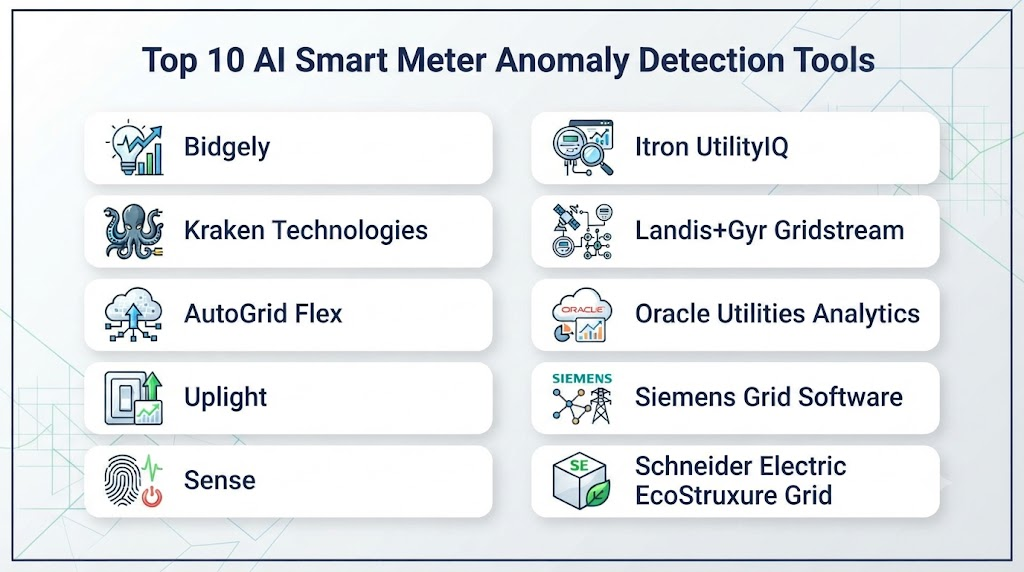
Top 10 AI Smart Meter Anomaly Detection Tools
1 — Bidgely
One-line verdict: Best for utilities using AI-powered customer energy analytics, consumption insights, and abnormal usage detection.
Short description:
Bidgely provides AI-based energy analytics for utilities and energy providers. Its technology analyzes smart-meter consumption patterns to derive insights about customer behavior, energy usage, and potentially unusual consumption.
Standout Capabilities
- AI-powered energy analytics.
- Smart-meter data analysis.
- Consumption-pattern recognition.
- Customer energy intelligence.
- Load disaggregation capabilities.
- Utility analytics.
- Energy-efficiency insights.
- Customer segmentation.
AI-Specific Depth
- Model support: Proprietary AI/ML models.
- RAG / knowledge integration: N/A.
- Evaluation: Analytics and model-performance processes vary by deployment.
- Guardrails: Utility data and operational controls; detailed AI-specific guardrails are not publicly stated.
- Observability: Energy-consumption analytics and operational reporting.
Pros
- Strong utility focus.
- Designed for large volumes of energy-consumption data.
- Useful for understanding unusual consumption behavior.
Cons
- Primarily oriented toward utility and energy-provider use cases.
- Enterprise implementation can require substantial integration.
- Pricing is not publicly stated.
Security & Compliance
Security, access controls, and data-governance capabilities vary by deployment. Specific certifications and retention policies should be verified during procurement.
Deployment & Platforms
- Deployment: Cloud-based enterprise platform.
- Web: Available.
- Windows/macOS/Linux: Browser-dependent.
- Self-hosted: Not publicly stated.
- Hybrid: Varies.
Integrations & Ecosystem
Bidgely is designed to work with utility and smart-meter data environments.
- Smart-meter data.
- Utility customer systems.
- Energy-management platforms.
- Analytics systems.
- Customer-engagement applications.
- Data platforms.
Pricing Model
Not publicly stated.
Best-Fit Scenarios
- Utility companies.
- Energy retailers.
- Large smart-meter deployments.
2 — Oracle Utilities Analytics
One-line verdict: Best for utilities wanting smart-meter analytics within a broader enterprise utility-data ecosystem.
Short description:
Oracle Utilities provides analytics capabilities designed for energy and utility organizations. Its broader ecosystem can support analysis of customer, meter, grid, and operational data.
Standout Capabilities
- Utility data analytics.
- Smart-meter analysis.
- Customer analytics.
- Grid analytics.
- Operational reporting.
- Data integration.
- Utility enterprise workflows.
- Large-scale data processing.
AI-Specific Depth
- Model support: Oracle analytics and AI capabilities.
- RAG / knowledge integration: Varies by implementation.
- Evaluation: Analytics and model evaluation vary by solution.
- Guardrails: Enterprise governance and security controls vary by implementation.
- Observability: Analytics and operational monitoring.
Pros
- Broad utility ecosystem.
- Suitable for enterprise-scale deployments.
- Can integrate multiple utility data sources.
Cons
- May be broader than a dedicated anomaly-detection system.
- Implementation can require specialist expertise.
- Pricing is not publicly stated.
Security & Compliance
Enterprise security capabilities are available across Oracle’s ecosystem. Exact controls and certifications should be verified for the selected service.
Deployment & Platforms
- Deployment: Cloud and enterprise environments.
- Web: Available.
- Self-hosted/Hybrid: Varies.
Integrations & Ecosystem
Typical utility integrations can include:
- Smart-meter systems.
- Meter-data management.
- Customer-information systems.
- Grid systems.
- Data warehouses.
- Analytics platforms.
- Enterprise applications.
Pricing Model
Not publicly stated.
Best-Fit Scenarios
- Large utilities.
- Multi-system utility environments.
- Organizations already using Oracle utility technology.
3 — SAS Analytics for Utilities
One-line verdict: Best for utilities requiring advanced analytics, anomaly detection, forecasting, and enterprise data-science capabilities.
Short description:
SAS provides advanced analytics and machine-learning capabilities that can be applied to utility and smart-meter data. It is particularly suitable for organizations with mature analytics teams that need flexible modeling capabilities.
Standout Capabilities
- Machine learning.
- Anomaly detection.
- Time-series analytics.
- Forecasting.
- Customer analytics.
- Data preparation.
- Model management.
- Enterprise analytics.
AI-Specific Depth
- Model support: Multiple statistical and machine-learning approaches.
- RAG / knowledge integration: Not a primary smart-meter capability.
- Evaluation: Strong analytics and model-validation capabilities.
- Guardrails: Governance and model-management capabilities vary.
- Observability: Model and analytics monitoring capabilities vary by deployment.
Pros
- Strong analytical flexibility.
- Suitable for complex utility datasets.
- Useful for advanced data-science teams.
Cons
- Requires analytical expertise.
- May involve more implementation effort than specialized applications.
- Pricing is not publicly stated.
Security & Compliance
Enterprise security and governance capabilities are available, but exact configurations depend on deployment.
Deployment & Platforms
- Deployment: Cloud, on-premises, and hybrid options vary.
- Web: Available.
- Self-hosted: Available for applicable SAS deployments.
- Hybrid: Available.
Integrations & Ecosystem
SAS can work with diverse enterprise data sources.
- Smart-meter data.
- Data warehouses.
- Utility databases.
- IoT data.
- Machine-learning pipelines.
- APIs.
- Enterprise analytics systems.
Pricing Model
Not publicly stated.
Best-Fit Scenarios
- Large utilities with data-science teams.
- Advanced anomaly-detection projects.
- Complex utility analytics environments.
4 — Palantir Foundry
One-line verdict: Best for utility organizations building customized anomaly-detection workflows across multiple operational data sources.
Short description:
Palantir Foundry provides an enterprise data and AI platform that can integrate, model, analyze, and operationalize complex datasets. Utilities can use such capabilities to build customized smart-meter anomaly-detection workflows.
Standout Capabilities
- Data integration.
- Time-series analytics.
- AI workflows.
- Machine-learning pipelines.
- Operational applications.
- Data modeling.
- Workflow automation.
- Enterprise governance.
AI-Specific Depth
- Model support: Multi-model and configurable AI capabilities.
- RAG / knowledge integration: Available through broader platform capabilities.
- Evaluation: Model and workflow evaluation capabilities vary by implementation.
- Guardrails: Enterprise governance and access controls.
- Observability: Data and workflow monitoring; AI-specific observability varies.
Pros
- Highly customizable.
- Strong data integration capabilities.
- Useful for complex operational workflows.
Cons
- Can require significant engineering resources.
- May be excessive for straightforward anomaly detection.
- Pricing is not publicly stated.
Security & Compliance
Enterprise security, permissions, governance, and auditability are major platform capabilities. Exact certifications and controls should be verified for the specific deployment.
Deployment & Platforms
- Deployment: Cloud and enterprise environments.
- Web: Available.
- Self-hosted/Hybrid: Deployment options vary.
Integrations & Ecosystem
The platform can connect many operational data sources.
- Smart-meter systems.
- Data warehouses.
- IoT platforms.
- Utility applications.
- APIs.
- Machine-learning systems.
- Operational workflows.
Pricing Model
Not publicly stated.
Best-Fit Scenarios
- Large utility organizations.
- Complex smart-grid environments.
- Teams building customized AI workflows.
5 — DataRobot
One-line verdict: Best for organizations building custom machine-learning models for smart-meter anomaly detection and forecasting.
Short description:
DataRobot provides an AI and machine-learning platform for developing, evaluating, deploying, and monitoring predictive models. Utilities can apply it to smart-meter time-series data and anomaly-detection problems.
Standout Capabilities
- Automated machine learning.
- Predictive modeling.
- Anomaly detection workflows.
- Model evaluation.
- Model deployment.
- Model monitoring.
- Data preparation.
- AI governance.
AI-Specific Depth
- Model support: Multiple machine-learning models and configurable approaches.
- RAG / knowledge integration: Available for broader AI workflows; not central to meter anomaly detection.
- Evaluation: Strong model evaluation and comparison capabilities.
- Guardrails: AI governance capabilities vary by implementation.
- Observability: Model-performance and operational monitoring capabilities.
Pros
- Strong machine-learning workflow.
- Useful for custom models.
- Model evaluation is a major strength.
Cons
- Requires good data preparation.
- Not a purpose-built smart-meter application.
- Pricing is not publicly stated.
Security & Compliance
Enterprise security and governance capabilities vary by plan and deployment. Specific certifications should be verified.
Deployment & Platforms
- Deployment: Cloud and enterprise options.
- Web: Available.
- Self-hosted/Hybrid: Varies.
Integrations & Ecosystem
DataRobot can connect with data and enterprise systems.
- Data warehouses.
- Cloud storage.
- Databases.
- APIs.
- Machine-learning pipelines.
- Utility data platforms.
Pricing Model
Not publicly stated.
Best-Fit Scenarios
- Utilities with data-science teams.
- Custom anomaly-detection models.
- Organizations requiring model governance.
6 — AWS IoT SiteWise
One-line verdict: Best for organizations building scalable industrial and energy-data anomaly-detection pipelines on AWS.
Short description:
AWS IoT SiteWise is designed to collect, organize, monitor, and analyze industrial equipment data. While it is not exclusively a smart-meter anomaly-detection application, it can serve as part of an architecture for energy and equipment analytics.
Standout Capabilities
- Industrial data ingestion.
- Time-series data.
- Asset modeling.
- Monitoring.
- Data processing.
- Cloud analytics.
- Integration with AWS AI services.
- Scalable architecture.
AI-Specific Depth
- Model support: Can integrate with multiple AWS AI/ML services.
- RAG / knowledge integration: N/A for core SiteWise functionality.
- Evaluation: Depends on connected AI/ML services.
- Guardrails: AWS security and access-control mechanisms.
- Observability: Cloud monitoring and operational metrics.
Pros
- Strong cloud scalability.
- Flexible architecture.
- Broad AWS ecosystem.
Cons
- Requires engineering work for a complete anomaly-detection solution.
- Not a turnkey smart-meter application.
- Costs depend on usage and architecture.
Security & Compliance
AWS provides extensive security and identity capabilities, but the exact security posture depends on configuration.
Deployment & Platforms
- Deployment: Cloud.
- Web: Available through AWS services.
- Self-hosted: N/A for core service.
- Hybrid: Can integrate with edge and on-premises environments.
Integrations & Ecosystem
- IoT devices.
- Energy systems.
- AWS data services.
- Machine-learning services.
- Databases.
- APIs.
- Edge systems.
Pricing Model
Usage-based cloud pricing.
Best-Fit Scenarios
- AWS-centric organizations.
- Industrial energy monitoring.
- Custom smart-meter analytics architectures.
7 — Microsoft Azure IoT Operations
One-line verdict: Best for organizations building smart-meter anomaly detection using Azure’s IoT, data, analytics, and AI ecosystem.
Short description:
Microsoft’s IoT and data ecosystem can support the collection and analysis of telemetry from connected assets. Utilities can use Azure services to construct anomaly-detection pipelines for smart-meter data.
Standout Capabilities
- IoT data ingestion.
- Edge processing.
- Time-series analytics.
- Cloud data platforms.
- Machine learning.
- AI integration.
- Data visualization.
- Enterprise identity.
AI-Specific Depth
- Model support: Azure AI and machine-learning ecosystem.
- RAG / knowledge integration: Available through broader Azure AI capabilities.
- Evaluation: Depends on selected AI and ML services.
- Guardrails: Microsoft security and AI governance capabilities vary by service.
- Observability: Azure monitoring and application telemetry.
Pros
- Broad enterprise ecosystem.
- Strong cloud and IoT integration.
- Flexible custom architecture.
Cons
- Requires solution engineering.
- Not a turnkey meter-anomaly product.
- Overall cost depends on architecture and usage.
Security & Compliance
Azure provides extensive identity, security, governance, and auditing capabilities, with exact features depending on selected services.
Deployment & Platforms
- Deployment: Cloud and edge.
- Web: Available.
- Self-hosted/Hybrid: Supported across applicable Azure architectures.
Integrations & Ecosystem
- Smart meters.
- IoT devices.
- Azure Machine Learning.
- Data platforms.
- APIs.
- Power BI.
- Edge environments.
Pricing Model
Primarily usage-based cloud pricing across services.
Best-Fit Scenarios
- Microsoft-centric utilities.
- Custom AI projects.
- Large IoT deployments.
8 — Google Cloud Vertex AI
One-line verdict: Best for data-science teams developing customized smart-meter anomaly-detection models using Google Cloud AI infrastructure.
Short description:
Vertex AI provides machine-learning and AI development capabilities that can be used to build custom anomaly-detection systems. It is particularly suitable for organizations that want direct control over modeling, evaluation, and deployment.
Standout Capabilities
- Machine-learning development.
- Model training.
- Model deployment.
- Model monitoring.
- Data integration.
- Time-series modeling.
- Generative AI capabilities.
- AI governance.
AI-Specific Depth
- Model support: Multiple hosted and customizable model options.
- RAG / knowledge integration: Available through broader Google Cloud AI capabilities.
- Evaluation: Model evaluation capabilities.
- Guardrails: AI safety and governance capabilities vary by service.
- Observability: Model monitoring and cloud observability.
Pros
- Flexible machine-learning environment.
- Strong data-science tooling.
- Scalable cloud infrastructure.
Cons
- Requires technical expertise.
- Not specifically designed as a smart-meter anomaly application.
- Pricing depends on usage and architecture.
Security & Compliance
Google Cloud provides enterprise identity, security, governance, and audit capabilities. Exact configurations should be evaluated for the deployment.
Deployment & Platforms
- Deployment: Cloud.
- Web: Available.
- Self-hosted: N/A for Vertex AI itself.
- Hybrid: Can integrate with hybrid data environments.
Integrations & Ecosystem
- Smart-meter data.
- BigQuery.
- Cloud Storage.
- Machine-learning pipelines.
- APIs.
- IoT and data platforms.
Pricing Model
Usage-based cloud pricing.
Best-Fit Scenarios
- Data-science teams.
- Google Cloud users.
- Custom AI anomaly-detection systems.
9 — H2O.ai
One-line verdict: Best for organizations wanting flexible machine-learning capabilities for customized energy and smart-meter anomaly detection.
Short description:
H2O.ai provides machine-learning and AI technologies that can be applied to structured time-series and operational datasets. Its capabilities can support custom anomaly-detection and predictive analytics projects.
Standout Capabilities
- Machine learning.
- Anomaly detection.
- Predictive analytics.
- Model development.
- Model deployment.
- Model interpretability.
- Automated machine learning.
- Enterprise AI.
AI-Specific Depth
- Model support: Multiple machine-learning approaches.
- RAG / knowledge integration: Available through broader AI capabilities; not central to meter analytics.
- Evaluation: Model evaluation and validation capabilities.
- Guardrails: Governance capabilities vary.
- Observability: Model monitoring capabilities vary by deployment.
Pros
- Flexible modeling.
- Suitable for data-science teams.
- Can support custom anomaly-detection approaches.
Cons
- Requires technical implementation.
- Not a turnkey utility meter platform.
- Pricing is not publicly stated.
Security & Compliance
Security and governance capabilities vary by deployment. Specific certifications should be verified.
Deployment & Platforms
- Deployment: Cloud, enterprise, and applicable self-managed environments.
- Web: Available.
- Self-hosted: Available for applicable offerings.
- Hybrid: Varies.
Integrations & Ecosystem
- Databases.
- Data warehouses.
- Cloud storage.
- APIs.
- Machine-learning pipelines.
- Enterprise data platforms.
Pricing Model
Not publicly stated.
Best-Fit Scenarios
- Advanced analytics teams.
- Custom anomaly detection.
- Energy-data science projects.
10 — Databricks Data Intelligence Platform
One-line verdict: Best for organizations processing massive smart-meter datasets and building customized AI analytics pipelines.
Short description:
Databricks provides a data and AI platform for ingesting, processing, analyzing, and modeling large datasets. Utilities can use it to build smart-meter anomaly-detection pipelines using time-series analytics and machine learning.
Standout Capabilities
- Large-scale data processing.
- Machine learning.
- Data engineering.
- Streaming analytics.
- Model management.
- Data governance.
- AI development.
- Enterprise analytics.
AI-Specific Depth
- Model support: Multiple model and AI approaches.
- RAG / knowledge integration: Available through broader platform capabilities.
- Evaluation: AI and machine-learning evaluation capabilities vary by implementation.
- Guardrails: Governance and security capabilities.
- Observability: Data and model monitoring capabilities vary.
Pros
- Excellent for large datasets.
- Strong data-engineering capabilities.
- Flexible AI architecture.
Cons
- Requires experienced engineering teams.
- Not a turnkey smart-meter application.
- Pricing depends on workload and architecture.
Security & Compliance
Enterprise governance, identity, access control, and auditing capabilities are available. Exact certifications and controls should be verified for the selected deployment.
Deployment & Platforms
- Deployment: Cloud.
- Web: Available.
- Self-hosted: Not typically the primary deployment model.
- Hybrid: Supports integration with hybrid data environments.
Integrations & Ecosystem
- Smart-meter databases.
- Data lakes.
- Data warehouses.
- Streaming platforms.
- Machine-learning tools.
- APIs.
- Enterprise applications.
Pricing Model
Usage-based cloud and platform pricing.
Best-Fit Scenarios
- Large utilities.
- Massive smart-meter datasets.
- Advanced data-engineering teams.
Comparison Table
| Tool Name | Best For | Deployment | Model Flexibility | Strength | Watch-Out | Public Rating |
|---|---|---|---|---|---|---|
| Bidgely | Utility consumption analytics | Cloud | Proprietary AI/ML | Energy intelligence | Utility-focused | N/A |
| Oracle Utilities Analytics | Enterprise utility analytics | Cloud / Enterprise | Oracle AI/ML | Utility ecosystem | Implementation complexity | N/A |
| SAS Analytics | Advanced utility analytics | Cloud / Hybrid | Multi-model | Analytical flexibility | Requires expertise | N/A |
| Palantir Foundry | Custom operational AI | Cloud / Enterprise | Multi-model | Custom workflows | High implementation effort | N/A |
| DataRobot | Custom ML models | Cloud / Hybrid | Multi-model | Model development | Requires data expertise | N/A |
| AWS IoT SiteWise | IoT energy architecture | Cloud / Edge | Multi-service | Scalable infrastructure | Requires engineering | N/A |
| Microsoft Azure IoT | Enterprise IoT + AI | Cloud / Edge | Multi-model | Microsoft ecosystem | Architecture complexity | N/A |
| Google Vertex AI | Custom ML | Cloud | Multi-model | AI development | Not turnkey | N/A |
| H2O.ai | Custom analytics | Cloud / Hybrid | Multi-model | Flexible ML | Requires technical skills | N/A |
| Databricks | Large-scale data + AI | Cloud | Multi-model | Massive data processing | Engineering overhead | N/A |
Scoring & Evaluation
These scores are comparative editorial assessments rather than independently measured product benchmarks. A utility should validate performance using its own meter population and historical data.
The most important factors are not simply model sophistication but also data quality, integration, explainability, scalability, security, and operational usability.
| Tool | Core | Reliability/Eval | Guardrails | Integrations | Ease | Perf/Cost | Security/Admin | Support | Weighted Total |
|---|---|---|---|---|---|---|---|---|---|
| Bidgely | 10 | 9 | 8 | 9 | 9 | 9 | 8 | 9 | 8.90 |
| Oracle Utilities Analytics | 10 | 9 | 9 | 10 | 7 | 8 | 10 | 9 | 9.00 |
| SAS Analytics | 10 | 10 | 9 | 9 | 7 | 8 | 10 | 9 | 9.05 |
| Palantir Foundry | 10 | 9 | 10 | 10 | 6 | 8 | 10 | 9 | 9.05 |
| DataRobot | 9 | 10 | 9 | 9 | 8 | 8 | 9 | 9 | 9.00 |
| AWS IoT SiteWise | 8 | 8 | 9 | 10 | 7 | 9 | 10 | 9 | 8.80 |
| Microsoft Azure IoT | 9 | 9 | 9 | 10 | 7 | 9 | 10 | 10 | 9.15 |
| Google Vertex AI | 9 | 10 | 9 | 10 | 7 | 9 | 10 | 9 | 9.20 |
| H2O.ai | 9 | 9 | 8 | 9 | 8 | 9 | 9 | 9 | 8.90 |
| Databricks | 10 | 9 | 9 | 10 | 7 | 9 | 10 | 10 | 9.35 |
Top 3 for Enterprise
- Databricks
- Google Vertex AI
- Microsoft Azure IoT
Top 3 for SMB
- Bidgely
- DataRobot
- H2O.ai
Top 3 for Developers
- Google Vertex AI
- Databricks
- DataRobot
Which AI Smart Meter Anomaly Detection Tool Is Right for You?
Solo / Freelancer
For an individual developer or consultant, a full utility platform is usually unnecessary.
Cloud AI and machine-learning platforms can be more practical for building prototypes. Focus on:
- Simple data ingestion.
- Python and API support.
- Time-series modeling.
- Model evaluation.
- Low initial infrastructure requirements.
SMB
Smaller energy organizations should prioritize ease of implementation rather than building a complex AI stack.
A specialized energy analytics platform may be preferable to assembling multiple cloud services.
Mid-Market
Mid-market utilities should look for platforms that combine:
- Smart-meter ingestion.
- Automated anomaly detection.
- Alert prioritization.
- Data-quality monitoring.
- Investigation workflows.
- API integration.
- Model monitoring.
A solution should be able to grow with the meter population.
Enterprise
Large utilities should evaluate architecture rather than only application features.
Important requirements include:
- High-volume processing.
- Streaming analytics.
- Data governance.
- Model management.
- Role-based access.
- Auditability.
- Security.
- API availability.
- Multi-system integration.
Databricks, Google Cloud, Microsoft Azure, SAS, Oracle, and Palantir can be relevant for enterprise architectures, depending on the organization’s existing technology stack.
Regulated Industries
Utilities handling detailed customer energy information should carefully assess:
- Data residency.
- Data retention.
- Encryption.
- Access control.
- Audit logs.
- Identity management.
- Privacy requirements.
- Third-party access.
- Model governance.
Consumption data can potentially reveal behavioral patterns, so privacy should be treated as an architectural requirement rather than an afterthought.
Budget vs Premium
A specialized application may provide better economics when the objective is a clearly defined meter-anomaly workflow.
A cloud AI platform can make more sense when the organization needs multiple AI applications beyond anomaly detection.
Build vs Buy
Buy when:
- You need production-ready utility workflows.
- Your team has limited ML expertise.
- You want faster deployment.
- Standard anomaly-detection use cases are sufficient.
Build when:
- You have a strong data-science team.
- Your anomaly definitions are highly specialized.
- You need complete model control.
- You already operate a mature cloud-data platform.
A hybrid strategy is often practical: use an established data platform while developing domain-specific anomaly models.
Implementation Playbook
First 30 Days: Pilot + Success Metrics
Begin with a controlled subset of meters.
- Identify available meter data.
- Determine sampling frequency.
- Analyze missing values.
- Identify duplicate readings.
- Establish normal consumption profiles.
- Segment meters by customer or asset type.
- Define anomaly categories.
- Establish baseline false-positive rates.
- Create an initial evaluation dataset.
Useful metrics include:
- Precision.
- Recall.
- False-positive rate.
- Detection latency.
- Investigation time.
- Number of actionable alerts.
- Meter-data completeness.
Days 31–60: Security + Evaluation + Rollout
During this stage:
- Implement access controls.
- Establish data-retention rules.
- Validate model behavior.
- Test seasonal changes.
- Test abnormal weather periods.
- Compare AI alerts with historical incidents.
- Introduce analyst review.
- Create model-version controls.
- Establish incident-handling procedures.
- Document anomaly definitions.
For AI-specific testing, build an evaluation harness that measures performance against known examples.
Days 61–90: Optimize + Govern + Scale
Once the model performs reliably:
- Optimize inference costs.
- Improve streaming performance.
- Reduce false positives.
- Prioritize high-impact anomalies.
- Monitor model drift.
- Automate investigation workflows.
- Integrate field-service systems.
- Expand the meter population.
- Establish governance reviews.
Maintain ongoing monitoring for:
- Model accuracy.
- Data drift.
- Consumption-pattern changes.
- Alert volume.
- False positives.
- Detection latency.
- Infrastructure costs.
Common Mistakes & How to Avoid Them
- Using poor-quality meter data: Establish data-quality checks before training models.
- Treating every unusual reading as fraud: An anomaly is not automatically evidence of theft.
- Ignoring seasonality: Consumption patterns naturally change throughout the year.
- Using only static thresholds: Combine rules with statistical and ML techniques where appropriate.
- Failing to explain alerts: Investigators need understandable reasons for flagged meters.
- Ignoring false positives: Excessive alerts can overwhelm utility analysts.
- Skipping model evaluation: Measure performance using historical and labeled cases.
- Ignoring missing readings: Data gaps can appear as false anomalies.
- Failing to monitor model drift: Customer behavior and grid conditions change.
- Ignoring privacy: Detailed energy consumption can reveal sensitive behavioral patterns.
- Connecting AI directly to operational systems without safeguards: Maintain appropriate human review and control boundaries.
- Ignoring cybersecurity: Smart-meter analytics systems can interact with critical utility infrastructure.
- Building a complex platform too early: Start with a focused pilot.
- Ignoring infrastructure costs: Large meter populations can generate substantial data-processing workloads.
FAQs
What is AI smart-meter anomaly detection?
It is the use of AI and machine learning to identify unusual patterns in smart-meter readings that may indicate data problems, equipment issues, abnormal consumption, or other events requiring investigation.
Can AI detect electricity theft?
AI can help identify consumption patterns associated with potential non-technical losses or suspicious activity. However, an AI alert should generally be treated as an investigation signal rather than definitive proof of theft.
What types of anomalies can AI detect?
Depending on the system, AI can detect sudden spikes, unexpected drops, unusual load profiles, missing readings, abnormal seasonal behavior, meter-data inconsistencies, and potentially suspicious consumption patterns.
Does anomaly detection require historical data?
Historical data is usually very valuable because many AI approaches need to learn normal consumption behavior. The amount required depends on the model and use case.
Can AI detect faulty smart meters?
AI can help identify meter behavior that differs significantly from expected patterns. A field inspection or technical test may still be required to confirm an actual meter fault.
Can these systems process millions of meters?
Scalable cloud and utility analytics platforms can be designed to process very large meter populations. Actual scalability depends on architecture, data frequency, and implementation.
Can anomaly detection work in real time?
Yes. Streaming architectures can analyze meter data as it arrives, although the achievable detection latency depends on the data pipeline and system design.
Does smart-meter anomaly detection use generative AI?
Traditional anomaly detection primarily relies on statistical methods and machine learning rather than generative AI. Generative AI can be useful for investigation summaries, natural-language querying, and analyst assistance.
Can organizations use their own AI models?
Yes. Platforms such as cloud AI and machine-learning environments can support custom models. Specialized utility applications may offer less model-level flexibility.
Is RAG important for smart-meter anomaly detection?
RAG is usually not central to the core anomaly-detection model. It can become useful when analysts want AI to combine anomaly results with manuals, historical incidents, investigation procedures, or operational documentation.
How can false positives be reduced?
Use better data-quality checks, customer segmentation, seasonal models, contextual information, alert prioritization, and continuous evaluation against real investigation outcomes.
Can AI work with missing meter readings?
Some models can tolerate or impute missing data, but missing readings should be explicitly identified because data-quality problems can otherwise create false anomalies.
How much does smart-meter anomaly detection cost?
Pricing varies substantially. Specialized platforms may use enterprise contracts, while cloud-based systems generally involve usage-based infrastructure and AI costs.
Is cloud deployment required?
No. Depending on the platform and architecture, cloud, hybrid, edge, or self-managed approaches may be possible.
Is smart-meter data private?
Smart-meter data can contain detailed information about consumption patterns. Organizations should therefore apply appropriate privacy, security, retention, and access controls.
Should anomaly alerts automatically trigger field inspections?
Not necessarily. High-confidence alerts can be prioritized, but automated field actions should generally incorporate appropriate business rules and human oversight.
What is the most important metric?
There is no single universal metric. Precision, recall, false-positive rate, detection latency, investigation efficiency, and actual business impact should all be evaluated.
Conclusion
AI Smart Meter Anomaly Detection can help utilities move from reactive meter monitoring toward proactive identification of unusual consumption and data behavior. The technology is particularly valuable when organizations manage hundreds of thousands or millions of smart meters and cannot rely on manual analysis.Bidgely is strongly aligned with utility energy analytics, while Oracle Utilities Analytics provides a broader utility ecosystem. SAS is well suited to organizations with mature analytics teams, while Palantir Foundry can support highly customized operational AI workflows.For organizations building their own AI infrastructure, Databricks, Google Vertex AI, Microsoft Azure, AWS IoT SiteWise, DataRobot, and H2O.ai provide different approaches to data processing, machine learning, deployment, and model management.The right solution ultimately depends on whether the priority is a ready-made utility application or a flexible AI architecture.The most effective approach is to start with a focused meter population, establish a trustworthy baseline, evaluate detection quality, control false positives, protect customer data, and validate the system against real operational outcomes.