Introduction
AI Tax Compliance Risk Scoring uses artificial intelligence, machine learning, anomaly detection, statistical analysis, and rules-based analytics to identify tax returns, transactions, entities, or cases that may require additional review.
Tax authorities and large organizations process enormous amounts of financial information. Traditional compliance programs can struggle to identify complex patterns across income, deductions, transactions, entities, jurisdictions, and historical filings. AI can help prioritize cases by identifying unusual patterns and estimating relative complianceTax authorities, government revenue departments, large enterprises, accounting organizations, financial institutions, and tax-administration teams handling high volumes of compliance data Small organizations with simple tax structures, low transaction volumes, or teams whose compliance needs can be adequately handled through conventional rules, spreadsheets, and professional review.
What Is AI Tax Compliance Risk Scoring?
Tax compliance risk scoring is a method of assigning a relative risk level to a taxpayer, return, transaction, business, or case.
A traditional system might use a rule such as:
Flag a return when a deduction exceeds a predefined threshold.
An AI-enabled system can evaluate many signals simultaneously.
These may include:
- Filing history
- Reported income
- Deductions
- Transaction patterns
- Industry benchmarks
- Refund activity
- Changes from previous periods
- Related-party relationships
- Invoice information
- Payment information
- Cross-system inconsistencies
The output may be a risk score or priority ranking that helps compliance teams determine which cases deserve closer examination.
Importantly, a risk score is not the same thing as proof of non-compliance.
A responsible implementation should provide investigators with evidence, contributing factors, confidence information, and appropriate review workflows.
Why AI Tax Compliance Risk Scoring Matters
Tax administrations face a difficult operational challenge.
They need to:
- Detect non-compliance
- Reduce tax leakage
- Identify sophisticated schemes
- Process large numbers of filings
- Minimize unnecessary audits
- Improve voluntary compliance
- Protect taxpayer information
- Maintain fairness and public trust
AI can help organizations move from purely reactive investigations toward more targeted risk-based compliance.
Instead of treating every filing equally, organizations can prioritize resources based on patterns and available evidence.
Major Use Cases
Tax Return Risk Assessment
AI can evaluate returns against historical patterns and relevant taxpayer characteristics to identify unusual cases.
Deduction Anomaly Detection
Models can identify deductions that appear unusual compared with a taxpayer’s history or relevant peer groups.
Refund Fraud Detection
AI can analyze refund requests for unusual combinations of identity, filing, payment, and transaction signals.
VAT and Sales Tax Monitoring
Machine learning can identify unusual invoice, transaction, filing, or refund behavior.
Underreporting Detection
Systems can compare information across authorized datasets to identify discrepancies that may warrant review.
Audit Case Prioritization
Risk scoring can help tax authorities prioritize limited audit resources.
Related-Party Risk Analysis
Entity-resolution and graph analytics can identify relationships between companies and individuals that may require further examination.
Transaction Monitoring
AI can identify unusual transaction patterns that are difficult to detect using individual rules.
How AI Tax Compliance Risk Scoring Works
A typical architecture can be represented as:
Data Sources → Data Quality → Feature Engineering → Rules + ML → Risk Scoring → Explainability → Human Review → Investigation → Feedback
Potential data sources include:
- Tax returns
- Invoices
- Payment records
- Filing history
- Business registrations
- Authorized third-party information
- Customs information
- Payroll information
- Transaction records
- Previous audit outcomes
The system converts relevant information into analytical signals and produces risk scores or case priorities.
Important AI Technologies
Machine Learning
Supervised learning can use historical investigation outcomes where reliable labels exist.
Anomaly Detection
Unsupervised or semi-supervised techniques can identify unusual behavior without requiring every fraud pattern to be known in advance.
Graph Analytics
Graph models can reveal relationships among taxpayers, businesses, addresses, accounts, transactions, and other entities.
Natural Language Processing
NLP can help analyze tax documents, correspondence, audit notes, regulations, and other textual material.
Generative AI
LLMs can support investigators by summarizing case information and helping navigate large volumes of documentation. They should be governed carefully when used with sensitive taxpayer information.
What to Evaluate Before Choosing a Tool
Organizations should evaluate:
- Risk-scoring capabilities
- Machine-learning support
- Anomaly detection
- Explainability
- Rules integration
- Entity resolution
- Graph analytics
- Data integration
- Case management
- Model monitoring
- Human-review workflows
- Auditability
- Privacy controls
- Data retention
- Access management
- API availability
- Batch and real-time processing
- Model governance
- Bias and fairness monitoring
- Cost and scalability
What Has Changed in AI Tax Compliance Risk Scoring?
- AI-assisted compliance workflows are becoming more sophisticated: Risk scoring is increasingly integrated with investigation and case-management processes.
- Graph analytics is increasingly valuable: Tax risks can involve networks of related entities rather than isolated taxpayers.
- Anomaly detection complements traditional rules: AI can help identify patterns that were not explicitly encoded into rule systems.
- Generative AI is entering investigator workflows: LLMs can help summarize records and explain case histories, subject to appropriate controls.
- Explainability is becoming critical: High-impact compliance decisions require understandable reasons behind risk classifications.
- Human oversight remains important: Automated risk scores should generally support—not blindly replace—professional judgment.
- Privacy requirements are becoming more important: Tax data can contain highly sensitive financial and personal information.
- Data lineage matters: Compliance teams increasingly need to know where analytical inputs originated.
- Model monitoring is essential: Tax behavior, regulations, economic conditions, and fraud techniques can change over time.
- Bias testing deserves greater attention: Models can unintentionally reproduce biases contained in historical enforcement data.
- Model governance is becoming operational: Version control, validation, approvals, and change management should be part of the deployment process.
- Cost and latency matter: Large-scale scoring systems must balance model sophistication with practical processing requirements.
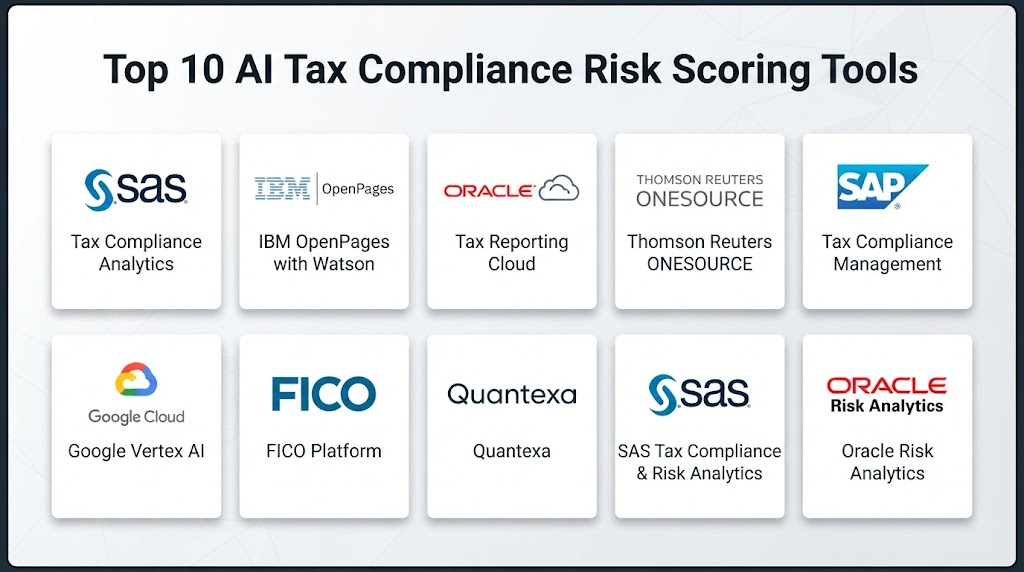
Top 10 AI Tax Compliance Risk Scoring Tools
1 — SAS Viya
One-line verdict: Best for tax organizations requiring advanced analytics, machine learning, explainability, and enterprise-scale risk modeling.
Short description:
SAS Viya is an enterprise analytics and AI platform that can support sophisticated risk-scoring, predictive modeling, anomaly detection, and analytical workflows. Tax organizations can use such capabilities to build customized compliance-risk models.
Standout Capabilities
- Machine learning
- Predictive analytics
- Anomaly detection
- Model development
- Risk scoring
- Explainable analytics
- Data preparation
- Model governance
AI-Specific Depth
- Model support: Multiple machine-learning and statistical modeling approaches.
- RAG / knowledge integration: Available through broader data and AI architectures; exact implementation varies.
- Evaluation: Model validation and analytical evaluation capabilities.
- Guardrails: Governance and controlled model workflows.
- Observability: Model and analytical monitoring capabilities vary by implementation.
Pros
- Strong analytical depth
- Suitable for customized tax-risk models
- Enterprise-oriented governance capabilities
Cons
- Can require specialized analytics expertise
- Implementation may be complex
- Pricing is generally not publicly standardized
Security & Compliance
Security, access controls, retention, encryption, residency, and certifications depend on deployment and configuration. Verify current requirements before procurement.
Deployment & Platforms
- Deployment: Cloud / hybrid / enterprise options vary
- Platforms: Enterprise applications
- Self-hosted: Varies
Integrations & Ecosystem
- Data warehouses
- Databases
- APIs
- Data integration tools
- Machine-learning workflows
- Enterprise applications
- Analytics systems
Pricing Model
Enterprise commercial pricing; exact pricing varies.
Best-Fit Scenarios
- Large tax administrations
- Customized risk-scoring systems
- Enterprise analytics teams
2 — IBM watsonx
One-line verdict: Best for organizations building governed AI and analytics workflows around complex tax compliance data.
Short description:
IBM watsonx provides AI and data capabilities that can support predictive analytics, machine learning, generative AI, governance, and enterprise AI workflows. It can form part of a customized tax compliance risk architecture.
Standout Capabilities
- Machine learning
- Generative AI
- AI governance
- Data management
- Model development
- Risk analytics
- Enterprise integration
- Workflow automation
AI-Specific Depth
- Model support: Supports different AI models depending on the selected components and architecture.
- RAG / knowledge integration: Can support retrieval and enterprise knowledge workflows.
- Evaluation: AI and model evaluation capabilities vary by product configuration.
- Guardrails: Governance and AI-control capabilities.
- Observability: Monitoring capabilities vary by component.
Pros
- Broad enterprise AI ecosystem
- Strong governance orientation
- Flexible architecture
Cons
- Not a tax-specific product
- Implementation requires architecture work
- Product selection can be complex
Security & Compliance
Controls and certifications vary by product, region, and deployment. Verify current details during procurement.
Deployment & Platforms
- Deployment: Cloud / hybrid options
- Platforms: Enterprise applications
- Self-hosted: Varies by component
Integrations & Ecosystem
- Databases
- Data warehouses
- APIs
- AI models
- Enterprise applications
- Analytics systems
- Governance platforms
Pricing Model
Commercial pricing varies by product and usage.
Best-Fit Scenarios
- Enterprise tax analytics
- Governed AI implementations
- Customized compliance systems
3 — Microsoft Azure Machine Learning
One-line verdict: Best for technical teams building customized tax-risk models using cloud machine-learning infrastructure.
Short description:
Azure Machine Learning provides infrastructure for developing, evaluating, deploying, and monitoring machine-learning models. It can support custom tax compliance risk-scoring applications.
Standout Capabilities
- Model development
- Machine learning
- Model deployment
- Experiment tracking
- Model monitoring
- Data integration
- MLOps
- Custom AI workflows
AI-Specific Depth
- Model support: Multiple frameworks and model approaches.
- RAG / knowledge integration: Can support retrieval architectures through the broader Azure ecosystem.
- Evaluation: Model evaluation and experiment tracking.
- Guardrails: Governance and security capabilities vary by architecture.
- Observability: Model monitoring and operational monitoring capabilities.
Pros
- Flexible development environment
- Strong cloud ecosystem
- Suitable for custom models
Cons
- Requires technical expertise
- Not a ready-made tax compliance product
- Costs depend heavily on architecture and usage
Security & Compliance
Security and compliance depend on the Azure configuration, services, and region selected. Verify current requirements for the intended deployment.
Deployment & Platforms
- Deployment: Cloud
- Platforms: Web, APIs, enterprise applications
- Self-hosted: Varies
Integrations & Ecosystem
- Data warehouses
- Databases
- APIs
- ML frameworks
- Cloud storage
- BI systems
- Enterprise applications
Pricing Model
Usage-based cloud pricing.
Best-Fit Scenarios
- Custom tax-risk models
- Technical tax analytics teams
- Large data environments
4 — Google Vertex AI
One-line verdict: Best for organizations developing scalable machine-learning and generative-AI tax compliance workflows.
Short description:
Google Vertex AI provides tools for machine learning, model development, generative AI, evaluation, deployment, and monitoring. Tax organizations can use it as an infrastructure layer for customized compliance-risk systems.
Standout Capabilities
- Machine learning
- Generative AI
- Model evaluation
- Model deployment
- Data integration
- MLOps
- AI monitoring
- Enterprise AI development
AI-Specific Depth
- Model support: Multiple model and machine-learning approaches.
- RAG / knowledge integration: Supports retrieval-oriented architectures through the broader Google Cloud ecosystem.
- Evaluation: Model and generative-AI evaluation capabilities.
- Guardrails: AI safety and governance capabilities vary.
- Observability: Model and application monitoring capabilities.
Pros
- Strong AI development ecosystem
- Flexible model architecture
- Suitable for large-scale data workloads
Cons
- Requires technical implementation
- Not purpose-built for tax compliance
- Cloud costs can vary considerably
Security & Compliance
Security and compliance depend on service configuration and region. Verify current requirements before deployment.
Deployment & Platforms
- Deployment: Cloud
- Platforms: APIs, web applications, enterprise systems
- Self-hosted: Generally not the primary model
Integrations & Ecosystem
- Big data systems
- Data warehouses
- APIs
- ML frameworks
- Analytics
- Cloud storage
- Enterprise applications
Pricing Model
Usage-based cloud pricing.
Best-Fit Scenarios
- Large tax datasets
- Custom AI development
- AI-enabled compliance applications
5 — AWS SageMaker
One-line verdict: Best for engineering teams building custom tax compliance models with flexible machine-learning infrastructure.
Short description:
AWS SageMaker provides infrastructure for building, training, deploying, and monitoring machine-learning models. It can support custom tax-risk scoring systems integrated with broader AWS data architectures.
Standout Capabilities
- Machine learning
- Model deployment
- Model monitoring
- Data processing
- MLOps
- Custom models
- Experimentation
- Scalable infrastructure
AI-Specific Depth
- Model support: Multiple frameworks and model approaches.
- RAG / knowledge integration: Can support retrieval architectures through AWS services.
- Evaluation: Model evaluation capabilities vary by implementation.
- Guardrails: Security and governance controls depend on architecture.
- Observability: Monitoring capabilities are available across supported workflows.
Pros
- Flexible architecture
- Strong cloud ecosystem
- Suitable for custom risk models
Cons
- Requires engineering expertise
- Not tax-specific
- Cost management can become complicated
Security & Compliance
AWS provides extensive security capabilities, but the exact controls and certifications applicable to a deployment depend on the services and region selected.
Deployment & Platforms
- Deployment: Cloud
- Platforms: APIs and enterprise applications
- Self-hosted: Varies
Integrations & Ecosystem
- Data lakes
- Databases
- APIs
- Analytics
- ML frameworks
- Cloud storage
- Enterprise applications
Pricing Model
Usage-based cloud pricing.
Best-Fit Scenarios
- Custom compliance models
- Large tax datasets
- Cloud-native analytics teams
6 — Palantir Foundry
One-line verdict: Best for complex tax-risk environments requiring connected data, entity analysis, investigations, and operational workflows.
Short description:
Palantir Foundry provides a data and operational platform that can be used to combine multiple data sources, construct analytical models, build risk workflows, and support investigators.
Standout Capabilities
- Data integration
- Entity modeling
- Graph analysis
- Machine learning
- Operational workflows
- AI-assisted applications
- Risk analysis
- Investigation support
AI-Specific Depth
- Model support: Configurable machine-learning and AI architectures.
- RAG / knowledge integration: Can support enterprise retrieval and knowledge architectures.
- Evaluation: Depends on model and workflow implementation.
- Guardrails: Strong permission and governance architecture.
- Observability: Platform and workflow monitoring capabilities vary.
Pros
- Strong data integration
- Excellent for complex relationships
- Highly customizable
Cons
- Significant implementation effort
- Enterprise-oriented
- Requires specialized teams
Security & Compliance
Security and compliance depend on deployment. Verify current certifications, encryption, retention, access controls, and residency requirements.
Deployment & Platforms
- Deployment: Cloud / hybrid / specialized environments
- Platforms: Enterprise applications
- Self-hosted: Varies
Integrations & Ecosystem
- Data warehouses
- Databases
- APIs
- ML platforms
- Graph data
- Case-management workflows
- Enterprise applications
Pricing Model
Enterprise commercial pricing.
Best-Fit Scenarios
- Large tax administrations
- Cross-entity risk analysis
- Complex compliance investigations
7 — Dataiku
One-line verdict: Best for analytics teams that need collaborative model development, governance, and repeatable tax-risk workflows.
Short description:
Dataiku provides an enterprise AI and analytics platform for preparing data, developing models, deploying analytical workflows, and managing AI projects.
Standout Capabilities
- Data preparation
- Machine learning
- Model development
- Explainability
- MLOps
- Collaboration
- Governance
- Analytics workflows
AI-Specific Depth
- Model support: Multiple machine-learning approaches and frameworks.
- RAG / knowledge integration: AI and data workflows can support knowledge integration depending on implementation.
- Evaluation: Model evaluation and comparison capabilities.
- Guardrails: Governance and controlled AI workflows.
- Observability: Model and workflow monitoring capabilities.
Pros
- Collaborative environment
- Strong analytics workflow
- Suitable for mixed technical teams
Cons
- Not tax-specific
- Requires implementation
- Enterprise pricing can vary
Security & Compliance
Verify current certifications, security controls, residency, and retention options for the chosen deployment.
Deployment & Platforms
- Deployment: Cloud / hybrid options vary
- Platforms: Enterprise applications
- Self-hosted: Options vary
Integrations & Ecosystem
- Databases
- Cloud storage
- Data warehouses
- ML frameworks
- APIs
- BI tools
- Enterprise applications
Pricing Model
Commercial enterprise pricing.
Best-Fit Scenarios
- Tax analytics teams
- Collaborative model development
- Enterprise AI governance
8 — DataRobot
One-line verdict: Best for organizations wanting an enterprise machine-learning platform for developing and operationalizing tax-risk models.
Short description:
DataRobot provides automated and enterprise machine-learning capabilities that can help organizations develop, evaluate, deploy, and manage predictive models.
Standout Capabilities
- Automated machine learning
- Model comparison
- Predictive analytics
- Model deployment
- Model monitoring
- Explainability
- MLOps
- Governance
AI-Specific Depth
- Model support: Multiple machine-learning approaches.
- RAG / knowledge integration: Varies / N/A for traditional risk modeling.
- Evaluation: Model evaluation and comparison capabilities.
- Guardrails: Governance capabilities vary by implementation.
- Observability: Model monitoring and operational analytics.
Pros
- Speeds up model development
- Strong model-management capabilities
- Useful for predictive risk scoring
Cons
- Not tax-specific
- Complex projects still require data expertise
- Commercial pricing varies
Security & Compliance
Verify current security controls and certifications for the selected deployment.
Deployment & Platforms
- Deployment: Cloud / enterprise options vary
- Platforms: APIs and enterprise applications
- Self-hosted: Varies
Integrations & Ecosystem
- Databases
- Data warehouses
- APIs
- ML systems
- BI platforms
- Cloud environments
- Enterprise applications
Pricing Model
Commercial enterprise pricing.
Best-Fit Scenarios
- Predictive tax risk scoring
- Enterprise ML teams
- Rapid model experimentation
9 — H2O.ai
One-line verdict: Best for organizations seeking flexible machine-learning capabilities for customized compliance-risk scoring and predictive analytics.
Short description:
H2O.ai provides machine-learning technologies that can be used to build predictive models, classification systems, anomaly detection workflows, and other AI applications.
Standout Capabilities
- Machine learning
- Predictive modeling
- Automated ML
- Explainability
- Model deployment
- Anomaly detection
- Model management
- AI application development
AI-Specific Depth
- Model support: Multiple machine-learning approaches.
- RAG / knowledge integration: Available through broader AI architectures; implementation varies.
- Evaluation: Model validation and performance evaluation.
- Guardrails: Governance capabilities vary.
- Observability: Deployment and model monitoring capabilities vary.
Pros
- Flexible ML ecosystem
- Suitable for custom models
- Strong predictive analytics capabilities
Cons
- Requires technical expertise
- Not a tax-specific solution
- Enterprise deployment requires planning
Security & Compliance
Verify current controls, certifications, retention, residency, and access management for the selected deployment.
Deployment & Platforms
- Deployment: Cloud / hybrid options vary
- Platforms: APIs and enterprise applications
- Self-hosted: Options vary
Integrations & Ecosystem
- Databases
- Data warehouses
- APIs
- ML frameworks
- Analytics platforms
- Cloud systems
Pricing Model
Commercial and deployment-dependent pricing.
Best-Fit Scenarios
- Custom tax models
- Predictive risk scoring
- Data-science-led organizations
10 — KNIME
One-line verdict: Best for teams wanting flexible, visual data workflows for building customized tax-risk analytics without excessive platform complexity.
Short description:
KNIME provides a visual analytics and data-science environment that can be used for data preparation, machine learning, anomaly detection, and repeatable analytical workflows.
Standout Capabilities
- Visual workflows
- Data preparation
- Machine learning
- Analytics
- Model experimentation
- Data integration
- Automation
- Extensibility
AI-Specific Depth
- Model support: Multiple machine-learning approaches and integrations.
- RAG / knowledge integration: Possible through extensions and integrations; varies.
- Evaluation: Model evaluation can be built into workflows.
- Guardrails: Workflow governance depends on deployment.
- Observability: Monitoring varies by architecture.
Pros
- Flexible workflow design
- Accessible to mixed technical teams
- Strong data-processing capabilities
Cons
- Requires organizations to build their own tax-risk logic
- Less turnkey than specialized platforms
- Governance depends on deployment
Security & Compliance
Security and enterprise controls depend on the selected edition and deployment. Verify current requirements.
Deployment & Platforms
- Deployment: Desktop / server / cloud options vary
- Platforms: Windows, macOS, Linux availability varies by component
- Self-hosted: Available in relevant enterprise configurations
Integrations & Ecosystem
- Databases
- APIs
- Data warehouses
- Python
- R
- Machine-learning libraries
- Business intelligence tools
Pricing Model
Community and commercial options vary.
Best-Fit Scenarios
- Tax analytics teams
- Prototype risk models
- Custom compliance workflows
Comparison Table
| Tool | Best For | Deployment | Model Flexibility | Strength | Watch-Out | Public Rating |
|---|---|---|---|---|---|---|
| SAS Viya | Enterprise tax analytics | Cloud / Hybrid | Multi-model | Advanced analytics | Complexity | N/A |
| IBM watsonx | Governed enterprise AI | Cloud / Hybrid | Multi-model | AI governance | Broad platform | N/A |
| Azure Machine Learning | Custom ML | Cloud | Multi-model | MLOps | Requires engineering | N/A |
| Google Vertex AI | Scalable AI | Cloud | Multi-model | AI ecosystem | Cloud complexity | N/A |
| AWS SageMaker | Custom ML infrastructure | Cloud | Multi-model | Flexibility | Architecture effort | N/A |
| Palantir Foundry | Complex risk operations | Cloud / Hybrid | Multi-model | Connected data | High implementation effort | N/A |
| Dataiku | Collaborative analytics | Cloud / Hybrid | Multi-model | Workflow management | Implementation | N/A |
| DataRobot | Enterprise ML | Cloud / Enterprise | Multi-model | Automated ML | Cost varies | N/A |
| H2O.ai | Custom predictive models | Cloud / Hybrid | Multi-model | ML flexibility | Technical expertise | N/A |
| KNIME | Flexible analytics workflows | Desktop / Cloud / Hybrid | Multi-model | Visual workflows | Requires customization | N/A |
Scoring & Evaluation
The following scores are comparative editorial estimates based on the capabilities and typical positioning of these platforms, not independently measured tax-compliance benchmarks.
| Tool | Core | Reliability/Eval | Guardrails | Integrations | Ease | Perf/Cost | Security/Admin | Support | Weighted Total |
|---|---|---|---|---|---|---|---|---|---|
| SAS Viya | 10 | 9 | 9 | 9 | 7 | 8 | 10 | 9 | 8.95 |
| IBM watsonx | 9 | 9 | 10 | 9 | 7 | 8 | 10 | 9 | 8.95 |
| Azure Machine Learning | 9 | 9 | 9 | 10 | 7 | 8 | 10 | 10 | 9.00 |
| Google Vertex AI | 9 | 9 | 9 | 10 | 8 | 8 | 9 | 9 | 8.95 |
| AWS SageMaker | 9 | 9 | 9 | 10 | 7 | 8 | 10 | 10 | 9.00 |
| Palantir Foundry | 10 | 9 | 10 | 10 | 6 | 7 | 10 | 9 | 9.00 |
| Dataiku | 9 | 9 | 9 | 9 | 8 | 8 | 9 | 9 | 8.85 |
| DataRobot | 9 | 9 | 9 | 9 | 8 | 8 | 9 | 9 | 8.80 |
| H2O.ai | 9 | 9 | 8 | 9 | 7 | 9 | 8 | 8 | 8.60 |
| KNIME | 8 | 8 | 7 | 9 | 9 | 9 | 8 | 9 | 8.35 |
Top 3 for Enterprise
- SAS Viya
- Palantir Foundry
- IBM watsonx
Top 3 for SMB
- KNIME
- Dataiku
- H2O.ai
Top 3 for Developers
- AWS SageMaker
- Azure Machine Learning
- Google Vertex AI
Which AI Tax Compliance Risk Scoring Tool Is Right for You?
Solo / Freelancer
A full enterprise platform is generally unnecessary for an individual tax professional.
Start with:
- Spreadsheet-based analytics
- Rules-based checks
- Statistical analysis
- Lightweight machine learning
- Existing tax software
AI becomes more useful when the volume and complexity of data increase.
SMB
Small and medium-sized tax teams should prioritize simplicity.
Look for:
- Easy data import
- Explainable models
- Automated anomaly detection
- Basic dashboards
- API support
- Low operational overhead
KNIME, Dataiku, and similar flexible platforms can be useful when customization is needed without building a complete AI platform from scratch.
Mid-Market
Mid-market organizations should consider combining:
Rules + Predictive Models + Anomaly Detection + Human Review
Focus heavily on data quality and explainability before expanding the model across all taxpayers or transactions.
Enterprise
Large organizations should consider enterprise platforms that support:
- Large-scale data processing
- MLOps
- Model governance
- Entity resolution
- Graph analytics
- Case management
- Audit trails
- Role-based access
- Data lineage
- Model monitoring
The architecture should separate risk detection from final compliance decisions where appropriate.
Regulated Industries
Tax systems contain sensitive financial and personal information.
Organizations should evaluate:
- Data minimization
- Encryption
- Retention
- Residency
- Access controls
- Auditability
- Model explainability
- Bias testing
- Human oversight
Security should be designed into the architecture rather than added after deployment.
Budget vs Premium
A budget implementation can begin with:
- Rules
- SQL analytics
- Statistical anomaly detection
- Basic machine learning
Premium platforms make more sense when organizations need:
- Massive data volumes
- Complex entity relationships
- Advanced MLOps
- Enterprise governance
- Real-time scoring
- Investigation workflows
Build vs Buy
Build when:
- Tax-risk patterns are highly specialized.
- The organization has strong data-science resources.
- Existing systems already provide excellent data infrastructure.
- Full control over models is strategically important.
Buy when:
- Deployment speed matters.
- Internal ML expertise is limited.
- Governance requirements are extensive.
- The organization needs enterprise support.
- The compliance workflow is too complex for a basic internal model.
Implementation Playbook
First 30 Days: Pilot and Define Success
Select one narrowly defined use case.
Examples:
- Refund risk
- Deduction anomalies
- VAT inconsistencies
- Filing anomalies
- Related-party risk
Build a representative dataset.
Establish baseline metrics:
- Precision
- Recall
- False-positive rate
- Alert volume
- Investigator workload
- Detection latency
- Financial impact
Do not begin with full automation.
Days 31–60: Security, Evaluation and Hardening
Implement:
- Data access controls
- Encryption
- Retention policies
- Audit logging
- Model version control
- Evaluation datasets
- Threshold testing
- Explainability workflows
Create an evaluation harness that tests the model against:
- Known compliance cases
- Legitimate unusual cases
- Edge cases
- Historical cases
- Changing economic conditions
Perform red-team testing where appropriate.
Days 61–90: Governance and Scale
Connect the risk-scoring system to appropriate operational workflows.
Introduce:
- Case prioritization
- Investigator feedback
- Model monitoring
- Drift detection
- Incident management
- Governance reviews
- Cost monitoring
Create clear procedures for changing model thresholds or deploying new versions.
Common Mistakes and How to Avoid Them
- Treating risk scores as proof: Risk scoring should prioritize review rather than automatically establish wrongdoing.
- Ignoring false positives: Excessive alerts can overwhelm compliance teams.
- Using historical enforcement data without scrutiny: Historical data can contain inconsistencies and biases.
- Ignoring model drift: Tax behavior and economic conditions change.
- Relying entirely on machine learning: Known compliance rules remain valuable.
- Relying entirely on static rules: New patterns can escape predefined logic.
- Ignoring explainability: Investigators need to understand why a case was flagged.
- Poor data lineage: Analysts should know where important signals originated.
- Weak privacy controls: Tax data requires careful handling.
- No model versioning: Organizations need to know which model produced a risk score.
- No evaluation framework: Accuracy should be measured continuously.
- Overusing generative AI: LLMs should not make unsupported compliance conclusions.
- No human oversight: High-impact actions need appropriate review.
- Ignoring vendor lock-in: Keep data, models, and workflows portable where practical.
FAQs
What is AI tax compliance risk scoring?
It is the use of AI, machine learning, statistical analysis, anomaly detection, and rules to identify tax filings, transactions, or entities that may warrant additional compliance review.
Does a high tax-risk score mean someone is violating tax law?
No. A risk score indicates that a case may deserve additional examination. It should not automatically be treated as evidence of wrongdoing.
Can AI detect tax underreporting?
AI can help identify discrepancies and unusual patterns that may indicate potential underreporting, provided the organization has appropriate data and legal authority to use it.
Can AI detect unusual deductions?
Yes. Machine-learning and anomaly-detection techniques can compare deductions against historical patterns, relevant groups, and other available signals.
Can tax authorities use AI to select audit cases?
AI can support audit-case prioritization by ranking cases according to defined risk factors. Appropriate legal, governance, and human-review requirements still apply.
What data does tax-risk AI need?
Depending on the use case, systems may use tax returns, filing histories, invoices, authorized financial information, payment data, business records, and other legally available datasets.
Can organizations build their own tax-risk model?
Yes. Platforms such as machine-learning development environments can be used to create custom models. Building internally requires data engineering, model development, validation, security, and ongoing maintenance.
Can AI tax-risk systems be self-hosted?
Some AI and analytics platforms provide self-hosted or hybrid options, while others are primarily cloud-based. Availability depends on the specific product and deployment.
How important is explainability?
Very important. Compliance teams need to understand why a model generated a particular risk score, particularly when the result can influence an investigation or other consequential action.
Can generative AI be used for tax compliance?
Yes, generative AI can assist with document analysis, case summarization, research, and investigator workflows. Sensitive or consequential applications require strong governance and verification.
How can organizations prevent AI bias in tax-risk scoring?
Use representative evaluation datasets, test outcomes across relevant groups, monitor model performance, document features, review historical labels, and maintain appropriate human oversight.
How much does AI tax compliance risk scoring cost?
There is no universal price. Costs depend on data volume, platform choice, model complexity, deployment architecture, users, integrations, and support requirements.
What is better: rules or machine learning?
The strongest systems often combine both. Rules are effective for known conditions, while machine learning can help discover complex patterns and prioritize unusual cases.
How often should a tax-risk model be evaluated?
Evaluation should be continuous rather than a one-time exercise. Organizations should monitor performance, false positives, drift, and operational outcomes and reassess models after significant data or policy changes.
Can AI completely automate tax compliance?
It can automate portions of data analysis and workflow management, but fully automated high-impact decisions require careful consideration of legal, ethical, operational, and governance requirements.
Conclusion
AI Tax Compliance Risk Scoring can transform how organizations identify and prioritize potential compliance risks across large volumes of tax and financial data.The most effective implementations combine machine learning, anomaly detection, rules, entity resolution, graph analytics, explainability, human investigation, and strong governance rather than relying on a single AI model.The technology should be evaluated not only by predictive performance but also by its ability to provide understandable risk factors, protect sensitive taxpayer information, control false positives, support investigators, and remain reliable as tax behavior and compliance environments change.There is no universal best platform. A government tax administration with massive datasets may need a sophisticated enterprise analytics environment, while a smaller tax team may benefit more from a flexible machine-learning or workflow platform.