Introduction
AI Contract Review Tools are software platforms that use artificial intelligence to analyze contracts, identify potentially risky clauses, summarize agreements, compare language, extract important terms, and help legal or business teams review documents faster. Instead of manually reading every clause from beginning to end, users can use AI to surface issues that deserve closer attention.
These tools are increasingly useful for legal departments, law firms, procurement teams, sales organizations, finance teams, and businesses handling large contract volumes. Modern platforms can assist with reviewing agreements such as NDAs, MSAs, employment contracts, vendor agreements, SaaS agreements, leases, and other commercial Legal departments, law firms, procurement teams, sales operations, finance teams, contract managers, and organizations that review contracts freIndividuals reviewing only a few simple contracts, organizations without defined review policies, or teams expecting AI to make final legal decisions without human review.
What Are AI Contract Review Tools?
AI Contract Review Tools use technologies such as natural-language processing, machine learning, document intelligence, and generative AI to understand contractual language.
A traditional contract review might require a lawyer to manually inspect:
- Parties
- Definitions
- Term and renewal
- Payment obligations
- Termination rights
- Liability
- Indemnification
- Confidentiality
- Intellectual property
- Data protection
- Insurance
- Dispute resolution
- Governing law
AI can help identify and organize these elements automatically.
For example, a user might ask:
Identify clauses that create unlimited liability for our company.
The system can review the document, locate potentially relevant language, explain why it may matter, and in some products compare it with predefined company positions.
The goal is not to replace legal professionals. Instead, AI contract review should reduce repetitive analysis and allow professionals to focus on negotiation strategy and higher-value legal judgment.
How AI Contract Review Works
1. Document Ingestion
The platform receives a contract or connects to a supported document repository.
2. Document Understanding
AI analyzes the document’s structure, clauses, definitions, and relationships between provisions.
3. Clause Identification
The system identifies contractual provisions such as:
- Termination
- Liability
- Indemnification
- Confidentiality
- Intellectual property
- Governing law
- Payment
- Renewal
4. Risk Detection
The platform compares contractual language against rules, policies, playbooks, or AI-generated analysis.
5. Explanation
AI may explain why a clause could require attention and highlight the relevant language.
6. Suggested Action
Depending on the platform, the system may suggest:
- Review
- Accept
- Reject
- Negotiate
- Replace
- Escalate
7. Human Review
A lawyer or authorized contract professional makes the final decision.
Why AI Contract Review Matters
Contract volume has increased across many organizations. Legal teams are frequently expected to review agreements faster while maintaining consistency.
Manual review creates several challenges:
- Repetitive work
- Long review cycles
- Inconsistent analysis
- Difficulty tracking deviations
- Limited legal-team capacity
- Missed provisions
- Slow negotiations
AI can help create a more standardized first-pass review process.
The greatest value often comes from combining AI with a contract playbook that defines what acceptable and unacceptable language looks like.
Key Features to Evaluate
When evaluating AI Contract Review Tools, consider:
- Clause detection
- Risk identification
- Contract summarization
- Policy-based review
- Playbook support
- Clause comparison
- Redlining assistance
- Contract metadata extraction
- Obligation extraction
- Negotiation support
- Document comparison
- AI explanations
- Citation or source highlighting
- Microsoft Word integration
- Contract lifecycle management
- Repository integrations
- Data privacy
- Access controls
- Auditability
- AI evaluation capabilities
What Has Changed in AI Contract Review
- Generative AI has expanded beyond simple clause extraction: Modern tools can explain provisions and summarize entire agreements.
- Natural-language review is becoming more common: Users can ask questions instead of manually searching documents.
- Playbook-driven AI is increasingly important: Businesses can define preferred language and risk positions.
- AI can support negotiation workflows: Some systems can help identify deviations and propose alternative language.
- Contract intelligence is becoming more contextual: Tools increasingly analyze relationships between clauses rather than isolated sentences.
- Multimodal document processing is improving: Systems can increasingly process complex document structures and scanned content.
- Privacy is a major buying criterion: Contracts often contain commercially sensitive information and personal data.
- Human-in-the-loop workflows remain essential: High-impact contract decisions require professional review.
- AI evaluation is becoming critical: Organizations should test the tool using their own contracts and known outcomes.
- Observability is gaining importance: Enterprise buyers increasingly want to understand usage, performance, errors, and AI costs.
- Model flexibility can reduce vendor lock-in: Some organizations prefer platforms capable of supporting different AI models or architectures.
- Contract review is becoming part of broader legal operations: AI review increasingly connects with CLM, procurement, sales, and document-management workflows.
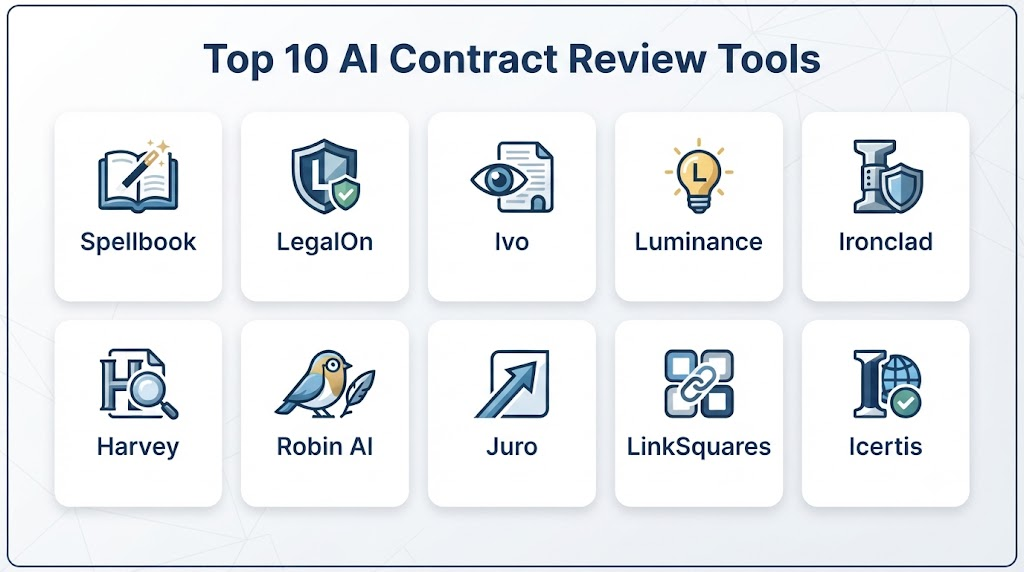
Top 10 AI Contract Review Tools
1 — Harvey
One-line verdict: Best for sophisticated legal teams using AI across contract analysis, drafting, research, and broader legal workflows.
Short description:
Harvey is an enterprise AI platform designed for professional-services and legal workflows. Its capabilities can support contract analysis, drafting, document review, and complex legal reasoning.
Standout Capabilities
- Contract analysis
- Document review
- AI-assisted drafting
- Legal research
- Matter-specific workflows
- Organization-specific knowledge
- Professional-services workflows
- Enterprise AI capabilities
AI-Specific Depth
- Model support: Managed multi-model approach; exact current model configuration varies.
- RAG / knowledge integration: Supports organizational and legal knowledge workflows.
- Evaluation: Enterprise evaluation capabilities vary by implementation.
- Guardrails: Enterprise controls and workflow safeguards; detailed internal architecture is not publicly stated.
- Observability: Enterprise monitoring capabilities vary.
Pros
- Broad legal AI functionality
- Useful for complex contract workflows
- Strong enterprise orientation
Cons
- Primarily designed for professional organizations
- Implementation can require planning
- Exact pricing is not publicly stated
Security & Compliance
Enterprise security capabilities are available, but specific certifications, retention policies, and contractual controls should be verified for the relevant offering.
Deployment & Platforms
- Deployment: Cloud
- Platforms: Web
- Self-hosted: Varies / N/A
Integrations & Ecosystem
Harvey can fit into broader enterprise legal workflows.
- Legal documents
- Contract workflows
- Legal research
- Organizational knowledge
- Enterprise systems
- Professional-services workflows
Pricing Model
Enterprise pricing; exact pricing is not publicly stated.
Best-Fit Scenarios
- Large law firms
- Enterprise legal departments
- Complex contract analysis
2 — Spellbook
One-line verdict: Best for lawyers who want AI-powered contract review and drafting directly within familiar document workflows.
Short description:
Spellbook focuses heavily on contract drafting and review. It is designed to help lawyers analyze agreements, identify potential issues, and work more efficiently with contractual language.
Standout Capabilities
- Contract review
- Contract drafting
- Clause analysis
- Risk identification
- Document comparison
- AI-assisted drafting
- Legal language suggestions
- Microsoft Word-oriented workflows
AI-Specific Depth
- Model support: Managed generative AI; exact models may vary.
- RAG / knowledge integration: Contract and legal-document workflows.
- Evaluation: Product-specific evaluation methodology is not publicly stated.
- Guardrails: Legal workflow safeguards; detailed internal guardrail architecture is not publicly stated.
- Observability: Detailed model-level telemetry is not publicly stated.
Pros
- Strong contract focus
- Convenient for transactional lawyers
- Useful drafting assistance
Cons
- Less focused on complete contract lifecycle management
- AI suggestions require professional review
- Advanced functionality may depend on plan
Security & Compliance
Security controls vary by offering. Specific certifications should be verified with the vendor.
Deployment & Platforms
- Deployment: Cloud
- Platforms: Web and supported document workflows
- Self-hosted: Not publicly stated
Integrations & Ecosystem
- Microsoft Word
- Contract documents
- Legal drafting
- Clause analysis
- Document review
- Legal workflows
Pricing Model
Subscription-based pricing; exact pricing varies.
Best-Fit Scenarios
- Transactional law firms
- In-house legal departments
- Contract drafting teams
3 — Luminance
One-line verdict: Best for organizations handling large contract volumes and requiring AI-powered document review and contract intelligence.
Short description:
Luminance provides AI-powered contract analysis and legal document workflows. It is particularly relevant to organizations processing large numbers of agreements.
Standout Capabilities
- Contract review
- Document analysis
- Contract classification
- Due diligence
- Contract management
- Risk identification
- Document extraction
- Legal operations
AI-Specific Depth
- Model support: Vendor-managed AI; exact models are not publicly stated.
- RAG / knowledge integration: Organizational documents and legal information.
- Evaluation: Enterprise evaluation capabilities vary.
- Guardrails: Workflow permissions and controls.
- Observability: Platform monitoring varies by implementation.
Pros
- Strong document-analysis capabilities
- Useful for high-volume review
- Enterprise-oriented workflows
Cons
- Implementation can require planning
- More enterprise-oriented
- Exact pricing is not publicly stated
Security & Compliance
Security and compliance capabilities vary by offering. Specific certifications should be verified directly.
Deployment & Platforms
- Deployment: Cloud
- Platforms: Web
- Self-hosted: Varies / N/A
Integrations & Ecosystem
- Contract repositories
- Document management
- Due diligence
- Legal operations
- Contract workflows
- Enterprise systems
Pricing Model
Enterprise pricing; exact pricing is not publicly stated.
Best-Fit Scenarios
- Large legal departments
- Contract-heavy businesses
- Due-diligence teams
4 — LegalOn
One-line verdict: Best for legal and business teams seeking practical AI assistance for contract review and risk identification.
Short description:
LegalOn provides AI-powered contract review capabilities designed to help professionals identify potentially problematic clauses and improve contract-review efficiency.
Standout Capabilities
- Contract review
- Clause analysis
- Risk identification
- Contract summaries
- Document comparison
- AI explanations
- Legal workflow support
- Business-oriented review
AI-Specific Depth
- Model support: Managed AI; specific models are not publicly stated.
- RAG / knowledge integration: Contract and legal-document knowledge.
- Evaluation: Internal evaluation methodology is not publicly stated.
- Guardrails: Legal workflow controls; detailed architecture is not publicly stated.
- Observability: Model-level telemetry is not publicly stated.
Pros
- Practical contract review
- Accessible workflow
- Useful for repetitive analysis
Cons
- More contract-focused than broad legal research
- AI results require review
- Availability can vary by region
Security & Compliance
Specific security controls and certifications should be verified with the vendor for the applicable offering.
Deployment & Platforms
- Deployment: Cloud
- Platforms: Web and supported document workflows
- Self-hosted: Not publicly stated
Integrations & Ecosystem
- Contract documents
- Legal review
- Business workflows
- Document management
- Legal operations
Pricing Model
Subscription or enterprise pricing may apply; exact pricing varies.
Best-Fit Scenarios
- Contract review
- In-house legal teams
- Business contract operations
5 — Ironclad AI
One-line verdict: Best for organizations combining AI contract analysis with broader contract lifecycle management and operational workflows.
Short description:
Ironclad provides contract lifecycle management capabilities alongside AI-powered contract workflows. Its platform is designed to help organizations manage contracts from creation through execution and beyond.
Standout Capabilities
- AI contract analysis
- Contract lifecycle management
- Contract creation
- Workflow automation
- Clause analysis
- Contract search
- Repository management
- Business collaboration
AI-Specific Depth
- Model support: Vendor-managed AI; exact models vary.
- RAG / knowledge integration: Contract repositories and organizational contract data.
- Evaluation: Product-specific evaluation methodology is not publicly stated.
- Guardrails: Workflow permissions and organizational controls.
- Observability: Platform-level activity and analytics vary.
Pros
- Strong CLM integration
- Good for enterprise contract workflows
- Combines AI with operational processes
Cons
- Broader CLM implementation may be more than a small team needs
- Configuration can require planning
- Exact pricing varies
Security & Compliance
Enterprise security controls are available; current certifications and contractual details should be verified for the specific offering.
Deployment & Platforms
- Deployment: Cloud
- Platforms: Web
- Self-hosted: Not publicly stated
Integrations & Ecosystem
- CRM systems
- Business applications
- Contract repositories
- Workflow automation
- Legal operations
- Enterprise systems
Pricing Model
Subscription and enterprise licensing; exact pricing varies.
Best-Fit Scenarios
- Enterprise legal teams
- Sales operations
- Contract lifecycle management
6 — Evisort
One-line verdict: Best for organizations wanting AI-powered contract intelligence combined with contract lifecycle management capabilities.
Short description:
Evisort provides contract lifecycle management and AI-powered contract intelligence. Its platform can help organizations extract information from contracts and manage contract-related workflows.
Standout Capabilities
- AI contract analysis
- Contract repository
- Metadata extraction
- Contract search
- Obligation tracking
- Contract lifecycle management
- Document intelligence
- Workflow automation
AI-Specific Depth
- Model support: Vendor-managed AI; exact models are not publicly stated.
- RAG / knowledge integration: Contract repositories and organizational information.
- Evaluation: Product-specific evaluation methodology is not publicly stated.
- Guardrails: Enterprise access and workflow controls.
- Observability: Platform-level analytics vary.
Pros
- Combines AI with CLM
- Strong contract data extraction
- Useful for large repositories
Cons
- May be more functionality than small organizations need
- Implementation requires process planning
- Pricing varies
Security & Compliance
Security controls and certifications vary by current offering and contract.
Deployment & Platforms
- Deployment: Cloud
- Platforms: Web
- Self-hosted: Not publicly stated
Integrations & Ecosystem
- Contract repositories
- CRM
- Procurement
- Legal operations
- Enterprise applications
- Workflow automation
Pricing Model
Enterprise subscription and licensing models vary.
Best-Fit Scenarios
- Enterprise CLM
- Contract data extraction
- Large contract repositories
7 — DocJuris
One-line verdict: Best for legal and procurement teams focused on negotiating, reviewing, and standardizing commercial contracts.
Short description:
DocJuris focuses on contract review and negotiation workflows. It can help teams compare agreements against playbooks, identify deviations, and streamline negotiation processes.
Standout Capabilities
- Contract review
- Negotiation workflows
- Playbook-based review
- Clause analysis
- Redlining
- Contract comparison
- Risk identification
- Procurement workflows
AI-Specific Depth
- Model support: Managed AI; exact model configuration is not publicly stated.
- RAG / knowledge integration: Contract playbooks and organizational contract knowledge.
- Evaluation: Product-specific evaluation details are not publicly stated.
- Guardrails: Playbook and workflow controls.
- Observability: Detailed model telemetry is not publicly stated.
Pros
- Strong negotiation orientation
- Useful for procurement
- Playbook-driven workflows
Cons
- Less focused on general legal research
- Requires well-defined organizational policies
- Exact capabilities vary by plan
Security & Compliance
Security controls should be confirmed with the vendor based on the specific enterprise offering.
Deployment & Platforms
- Deployment: Cloud
- Platforms: Web and supported document workflows
- Self-hosted: Not publicly stated
Integrations & Ecosystem
- Procurement
- Contract management
- Microsoft Word
- Legal workflows
- Playbooks
- Business systems
Pricing Model
Enterprise/subscription pricing; exact pricing varies.
Best-Fit Scenarios
- Procurement teams
- Commercial legal teams
- Contract negotiation
8 — Robin AI
One-line verdict: Best for businesses seeking AI-assisted contract review, drafting, and negotiation support.
Short description:
Robin AI provides AI-powered legal technology focused on contracts. Its capabilities support contract review, drafting, negotiation, and related legal workflows.
Standout Capabilities
- Contract review
- Contract drafting
- Negotiation support
- Legal document analysis
- Clause analysis
- AI-assisted workflows
- Contract automation
- Legal operations
AI-Specific Depth
- Model support: Managed AI; specific models vary.
- RAG / knowledge integration: Contract and organizational information.
- Evaluation: Detailed internal evaluation methodology is not publicly stated.
- Guardrails: Workflow and enterprise controls vary.
- Observability: Detailed model telemetry is not publicly stated.
Pros
- Contract-centric AI
- Useful across review and drafting
- Supports legal operations
Cons
- Exact functionality varies
- AI output requires professional review
- Enterprise implementation may require planning
Security & Compliance
Current security and certification details should be confirmed for the applicable offering.
Deployment & Platforms
- Deployment: Cloud
- Platforms: Web and supported workflows
- Self-hosted: Not publicly stated
Integrations & Ecosystem
- Contract management
- Document workflows
- Legal operations
- Procurement
- Drafting workflows
- Enterprise applications
Pricing Model
Subscription or enterprise pricing; exact pricing is not publicly stated.
Best-Fit Scenarios
- Corporate legal departments
- Contract negotiation
- Commercial legal teams
9 — Juro
One-line verdict: Best for teams combining AI contract workflows with collaborative contract creation and lifecycle management.
Short description:
Juro provides a contract management platform designed to support contract creation, collaboration, approval, signing, and management. AI capabilities can assist with contract-related workflows.
Standout Capabilities
- Contract creation
- Contract review
- AI-assisted contract workflows
- Collaboration
- Approval workflows
- Contract repository
- E-signature workflows
- Contract management
AI-Specific Depth
- Model support: Vendor-managed AI; exact models vary.
- RAG / knowledge integration: Contract repository and organizational data.
- Evaluation: Specific internal evaluation methodology is not publicly stated.
- Guardrails: Workflow permissions and administrative controls.
- Observability: Platform analytics vary.
Pros
- Collaborative contract workflows
- Strong lifecycle orientation
- Useful for business teams
Cons
- Not primarily a legal research platform
- Advanced requirements may need configuration
- Pricing varies
Security & Compliance
Security and compliance details vary by plan and contract. Verify current certifications and controls directly.
Deployment & Platforms
- Deployment: Cloud
- Platforms: Web
- Self-hosted: Not publicly stated
Integrations & Ecosystem
- CRM
- E-signature
- Contract repositories
- Collaboration
- Workflow automation
- Business systems
Pricing Model
Subscription-based and enterprise options; exact pricing varies.
Best-Fit Scenarios
- Growing businesses
- Sales teams
- Legal operations
10 — ContractPodAi
One-line verdict: Best for enterprises seeking AI-powered contract lifecycle management and large-scale legal operations.
Short description:
ContractPodAi combines contract lifecycle management with AI-powered capabilities designed to support legal and business teams across contract processes.
Standout Capabilities
- AI contract analysis
- Contract lifecycle management
- Contract repository
- Contract automation
- Legal operations
- Document intelligence
- Workflow management
- Enterprise contract data
AI-Specific Depth
- Model support: Managed AI; exact model configuration varies.
- RAG / knowledge integration: Contract repositories and organizational knowledge.
- Evaluation: Enterprise evaluation capabilities vary.
- Guardrails: Enterprise workflow and access controls.
- Observability: Platform analytics vary by implementation.
Pros
- Enterprise-oriented CLM
- AI plus workflow automation
- Useful for large contract portfolios
Cons
- Implementation can be complex
- May be excessive for small teams
- Pricing is generally enterprise-oriented
Security & Compliance
Security and compliance capabilities vary by offering. Specific certifications should be verified with the vendor.
Deployment & Platforms
- Deployment: Cloud
- Platforms: Web
- Self-hosted: Varies / N/A
Integrations & Ecosystem
- CRM
- Procurement
- ERP
- Document repositories
- Legal operations
- Enterprise applications
Pricing Model
Enterprise licensing; exact pricing is not publicly stated.
Best-Fit Scenarios
- Enterprise legal departments
- Large contract repositories
- Contract lifecycle management
Comparison Table
| Tool | Best For | Deployment | Model Flexibility | Strength | Watch-Out | Public Rating |
|---|---|---|---|---|---|---|
| Harvey | Enterprise legal AI | Cloud | Managed / Multi-model | Broad legal workflows | Enterprise-oriented | N/A |
| Spellbook | Contract review and drafting | Cloud | Hosted | Lawyer-focused contract workflows | Requires review | N/A |
| Luminance | High-volume document analysis | Cloud | Managed | Contract intelligence | Implementation effort | N/A |
| LegalOn | Practical contract review | Cloud | Hosted | Risk identification | Contract-focused | N/A |
| Ironclad AI | CLM + AI | Cloud | Managed | Contract lifecycle workflows | Broader implementation | N/A |
| Evisort | Contract intelligence | Cloud | Managed | Repository analysis | Enterprise focus | N/A |
| DocJuris | Negotiation | Cloud | Managed | Playbook workflows | Requires policies | N/A |
| Robin AI | Contract workflows | Cloud | Managed | Review + drafting | Exact capabilities vary | N/A |
| Juro | Collaborative CLM | Cloud | Managed | Contract lifecycle | Less research-focused | N/A |
| ContractPodAi | Enterprise CLM | Cloud | Managed | AI + lifecycle management | Implementation complexity | N/A |
Scoring & Evaluation
The scores below are comparative editorial assessments, not official vendor ratings. They are intended to provide a consistent framework for evaluating general strengths across contract review, AI reliability, integrations, usability, performance, security, and support.
| Tool | Core | Reliability/Eval | Guardrails | Integrations | Ease | Perf/Cost | Security/Admin | Support | Weighted Total |
|---|---|---|---|---|---|---|---|---|---|
| Harvey | 9 | 9 | 9 | 9 | 8 | 7 | 10 | 9 | 8.75 |
| Spellbook | 9 | 8 | 8 | 9 | 9 | 8 | 8 | 8 | 8.40 |
| Luminance | 9 | 9 | 9 | 9 | 8 | 7 | 9 | 8 | 8.65 |
| LegalOn | 8 | 8 | 8 | 8 | 9 | 8 | 8 | 8 | 8.15 |
| Ironclad AI | 9 | 8 | 9 | 10 | 8 | 7 | 9 | 9 | 8.60 |
| Evisort | 9 | 8 | 9 | 9 | 8 | 7 | 9 | 8 | 8.40 |
| DocJuris | 8 | 8 | 9 | 9 | 8 | 8 | 8 | 8 | 8.30 |
| Robin AI | 8 | 8 | 8 | 8 | 8 | 8 | 8 | 8 | 8.00 |
| Juro | 8 | 8 | 8 | 9 | 9 | 8 | 8 | 9 | 8.35 |
| ContractPodAi | 9 | 9 | 9 | 9 | 7 | 7 | 9 | 9 | 8.55 |
Top 3 for Enterprise
- Harvey
- Luminance
- ContractPodAi
Top 3 for SMB
- LegalOn
- Spellbook
- Juro
Top 3 for Developers
- Harvey
- Ironclad AI
- Evisort
Which AI Contract Review Tool Is Right for You?
Solo / Freelancer
Solo professionals should focus on simplicity rather than buying an oversized CLM platform.
Prioritize:
- Fast contract analysis
- Clear clause explanations
- Easy document upload
- Affordable licensing
- Reliable risk identification
- Human review
A lightweight AI review platform may be sufficient for occasional agreements.
SMB
Small and medium-sized businesses should consider:
- Contract review
- Contract repository
- Standard playbooks
- Approval workflows
- CRM integration
- Procurement workflows
For SMBs, ease of deployment can be just as important as advanced AI capabilities.
Mid-Market
Mid-market organizations should begin formalizing contract governance.
Important capabilities include:
- Centralized repository
- AI clause analysis
- Playbook management
- Approval workflows
- Contract metadata
- Obligation tracking
- Integration with business systems
Enterprise
Large organizations should evaluate the platform as part of their broader legal technology architecture.
Prioritize:
- SSO
- RBAC
- Audit logging
- Data retention controls
- Enterprise security
- Contract repositories
- Workflow automation
- API availability
- AI governance
- Vendor risk management
- Model evaluation
Regulated Industries
Regulated organizations should pay particular attention to:
- Confidentiality
- Data residency
- Encryption
- Access management
- Retention policies
- Auditability
- Vendor security
- Human approval
- Data-processing agreements
Never assume that a generic AI tool is appropriate for confidential contracts simply because it offers contract analysis.
Budget vs Premium
A lower-cost solution can make sense when:
- Contract volume is low
- Agreements are relatively simple
- There are few reviewers
- Advanced workflow automation is unnecessary
Premium enterprise systems become more attractive when:
- Contract volume is high
- Multiple departments participate
- Legal risk is significant
- A central contract repository is needed
- Integration is important
Build vs Buy
Buy when:
- You need a production-ready contract platform.
- You need rapid deployment.
- Your team lacks AI engineering resources.
- You need contract workflows and administration.
- You need vendor support.
Build when:
- You have unique contractual policies.
- You have strong internal engineering capabilities.
- You need highly customized document workflows.
- You need private internal knowledge integration.
For many companies, a hybrid approach is practical: use a commercial contract platform while integrating internal policies and knowledge through controlled systems.
Implementation Playbook: 30 / 60 / 90 Days
First 30 Days: Pilot
Select a limited set of contract types.
For example:
- NDAs
- Vendor agreements
- SaaS agreements
- MSAs
Define measurable KPIs:
- Review time
- Issue detection rate
- False-positive rate
- Lawyer acceptance rate
- Contract cycle time
- Manual review hours
Create a representative evaluation dataset.
Days 31–60: Security and Evaluation
Develop a formal AI evaluation process.
Test:
- Standard contracts
- Difficult clauses
- Ambiguous language
- Missing clauses
- Unusual provisions
- Long documents
- Poor-quality scans
- Adversarial instructions embedded in documents
Check whether the system can:
- Identify the correct clause
- Explain the issue
- Follow the playbook
- Avoid unsupported claims
- Preserve document context
Also establish:
- Access controls
- Retention rules
- Incident procedures
- Prompt/version control
- Human-review requirements
Days 61–90: Scale
After successful testing:
- Expand departments
- Integrate contract repositories
- Connect procurement or CRM systems
- Establish governance
- Monitor usage
- Track AI performance
- Monitor costs
- Review false positives
- Improve playbooks
- Train users
AI performance should be periodically reevaluated because models, workflows, and contract patterns change over time.
Common Mistakes and How to Avoid Them
- Treating AI recommendations as legal advice: Use AI as an assistant, not the final decision-maker.
- Using AI without a contract playbook: Define acceptable and unacceptable positions first.
- Failing to verify risk findings: Review the original clause before escalating.
- Ignoring false positives: Too many unnecessary alerts can reduce trust.
- Uploading confidential contracts without checking data policies: Understand storage and processing practices.
- Ignoring prompt injection: Contract documents may contain text designed to manipulate AI systems.
- Failing to test unusual clauses: Standard contracts alone are not enough for evaluation.
- Ignoring context between clauses: A limitation clause may depend on definitions elsewhere in the contract.
- Using one policy for every business unit: Different departments may have different risk tolerances.
- Skipping human review: High-risk legal decisions should remain under qualified professional control.
- Ignoring outdated playbooks: Contract policies need regular review.
- Failing to monitor AI performance: Track errors, false positives, and missed issues.
- Ignoring integration requirements: A standalone tool can create additional manual work.
- Overlooking vendor lock-in: Consider data portability and API capabilities.
- Choosing based on a demo alone: Test the platform against real contracts.
- Focusing only on AI features: Workflow, security, administration, and usability can determine real-world value.
FAQs
What is an AI Contract Review Tool?
An AI Contract Review Tool uses artificial intelligence to analyze contracts, identify clauses, highlight potential risks, summarize agreements, and support legal review workflows.
Can AI replace a contract lawyer?
No. AI can automate repetitive analysis, but lawyers remain responsible for legal interpretation, negotiation strategy, and final decisions.
Can AI identify risky contract clauses?
Yes. Many tools can identify provisions that may require attention, especially when configured with organizational rules or playbooks.
Can AI review contracts against a company playbook?
Many modern contract platforms support playbook-based or policy-based review, although the exact implementation varies between products.
Can AI summarize a contract?
Yes. AI can summarize parties, obligations, important clauses, dates, risks, and other contractual information.
Can AI extract contract obligations?
Many contract intelligence platforms can identify obligations, dates, parties, renewal terms, payment requirements, and other metadata.
Are AI Contract Review Tools secure?
Security varies by vendor and configuration. Organizations should verify encryption, access controls, retention, data processing, auditability, and applicable certifications before deployment.
Can AI Contract Review Tools work with confidential contracts?
Potentially, but organizations should first understand how the vendor stores, processes, retains, and protects uploaded information.
Do these tools support Microsoft Word?
Many contract review platforms provide Word-oriented workflows, but the exact integration depends on the product.
Can AI suggest contract language?
Yes. Some AI tools can suggest alternative wording, revisions, or drafting language based on the context and configured policies.
Can AI review contracts in different languages?
Some platforms support multilingual contracts, but language coverage and accuracy vary. Organizations should test the specific languages they require.
How should a company test an AI Contract Review Tool?
Use a representative collection of real contracts with known outcomes. Measure clause detection, false positives, missed issues, explanations, and review time.
What is the biggest risk of AI contract review?
One major risk is missing a legally significant provision or incorrectly classifying a contractual term. Human verification remains important for material agreements.
Can AI tools integrate with contract lifecycle management systems?
Yes. Many enterprise contract platforms either include CLM capabilities or integrate with broader contract-management ecosystems.
Are AI Contract Review Tools useful for procurement teams?
Yes. Procurement teams can use them to identify deviations from approved commercial terms, compare supplier agreements, and accelerate contract negotiations.
Should small businesses buy an enterprise contract platform?
Not necessarily. Small businesses should prioritize their contract volume, complexity, workflow requirements, budget, and integration needs before choosing a platform.
Can organizations build their own AI contract review system?
Yes. Organizations with appropriate engineering and legal expertise can build systems using document extraction, retrieval, language models, and rule-based review. However, maintaining accuracy, security, and governance can be demanding.
Conclusion
AI Contract Review Tools are changing how organizations analyze, negotiate, and manage agreements. Their biggest advantage is not simply reading contracts faster. The real value comes from combining AI-powered document understanding with company-specific policies, contract playbooks, workflow automation, and human legal judgment.For broad enterprise legal workflows, Harvey can be attractive. Spellbook is particularly relevant to contract drafting and review. Luminance focuses strongly on document intelligence, while LegalOn provides practical contract-review capabilities. Ironclad AI, Evisort, Juro, and ContractPodAi become particularly relevant when contract review needs to connect with broader contract lifecycle management.