Introduction
AI Compliance Workflow Automation refers to software that uses artificial intelligence, automation, rules, and workflow orchestration to help organizations manage compliance activities with less manual effort. These platforms can automate tasks such as evidence collection, control monitoring, policy management, risk assessment, compliance checks, audit preparation, employee questionnaires, and remediation tracking.
Instead of relying on spreadsheets, email reminders, and manually collected evidence, compliance teams can connect their business systems to a centralized workflow. AI can then help interpret documents, classify evidence, identify potential gaps, summarize findings, prioritize tasks, and route work to the appropriate Compliance teams, security teams, GRC professionals, startups, SaaS companies, regulated enterprises, IT departments, and organizations managing multiple compliance frameVery small businesses with minimal compliance requirements, teams that only perform occasional manual audits, or organizations whose requirements are so specialized that a highly customized internal workflow is more appropriate.
What Is AI Compliance Workflow Automation?
AI Compliance Workflow Automation combines compliance management with workflow automation and AI-assisted analysis.
Traditional compliance often requires teams to:
- Identify applicable requirements.
- Define controls.
- Collect evidence.
- Review evidence.
- Identify gaps.
- Assign remediation tasks.
- Track progress.
- Prepare audit documentation.
- Respond to questionnaires.
- Repeat the process periodically.
Automation can reduce repetitive work by connecting directly to systems that already contain relevant information.
For example, instead of asking employees to manually provide screenshots showing access controls, an automated compliance platform may connect with identity, cloud, HR, ticketing, and security systems to collect evidence automatically.
AI can then assist with:
- Evidence classification
- Document summarization
- Control mapping
- Risk identification
- Questionnaire responses
- Policy analysis
- Gap detection
- Workflow prioritization
- Natural-language search
- Compliance reporting
The objective is not to remove humans from compliance. The objective is to allow compliance professionals to spend less time on repetitive administration and more time on judgment, risk management, and remediation.
Why AI Compliance Workflow Automation Matters
Compliance programs become increasingly difficult to manage as organizations add:
- More employees
- More cloud services
- More vendors
- More regulations
- More compliance frameworks
- More geographic markets
- More customer security questionnaires
- More AI systems
A company may need to maintain overlapping requirements across security, privacy, risk, and governance frameworks.
A well-designed automation platform can create a centralized compliance operating model where evidence, controls, policies, risks, and remediation tasks are connected.
Key Features to Evaluate
When comparing AI compliance workflow automation platforms, consider:
- Framework coverage
- Automated evidence collection
- Control monitoring
- AI-assisted evidence analysis
- Risk management
- Policy management
- Vendor risk management
- Questionnaire automation
- Workflow customization
- Task assignment
- Remediation tracking
- Audit trails
- Reporting
- API availability
- Integrations
- Role-based access
- SSO
- Data retention controls
- AI governance
- Pricing scalability
What Has Changed in AI Compliance Workflow Automation
- AI-assisted evidence analysis: Platforms can increasingly help classify and interpret large amounts of compliance evidence.
- Continuous monitoring: Compliance is moving away from periodic spreadsheet-based checks toward continuously monitored controls.
- AI governance: Organizations increasingly need workflows specifically designed to govern internal and third-party AI systems.
- Automated questionnaire handling: AI can help organizations respond to repetitive security and compliance questionnaires using approved organizational information.
- Natural-language compliance search: Users can increasingly ask questions about controls, evidence, risks, and requirements using conversational interfaces.
- Intelligent task prioritization: AI can help prioritize remediation based on risk, deadlines, and organizational context.
- Cross-framework mapping: Organizations can reduce duplicate work by mapping related requirements across multiple frameworks.
- Agentic workflows: AI agents can potentially perform multi-step compliance tasks, but consequential actions should remain subject to approval and governance.
- Better data lineage: Compliance teams increasingly need to understand where evidence came from and how an AI-generated conclusion was reached.
- Privacy-aware automation: Sensitive compliance information requires clear retention, access, residency, and processing controls.
- AI-specific risk controls: Organizations increasingly need to monitor model use, AI vendors, data exposure, human oversight, and AI-related incidents.
- Integration-first compliance: Modern platforms increasingly connect compliance workflows with cloud infrastructure, identity systems, HR applications, ticketing platforms, and security tools.
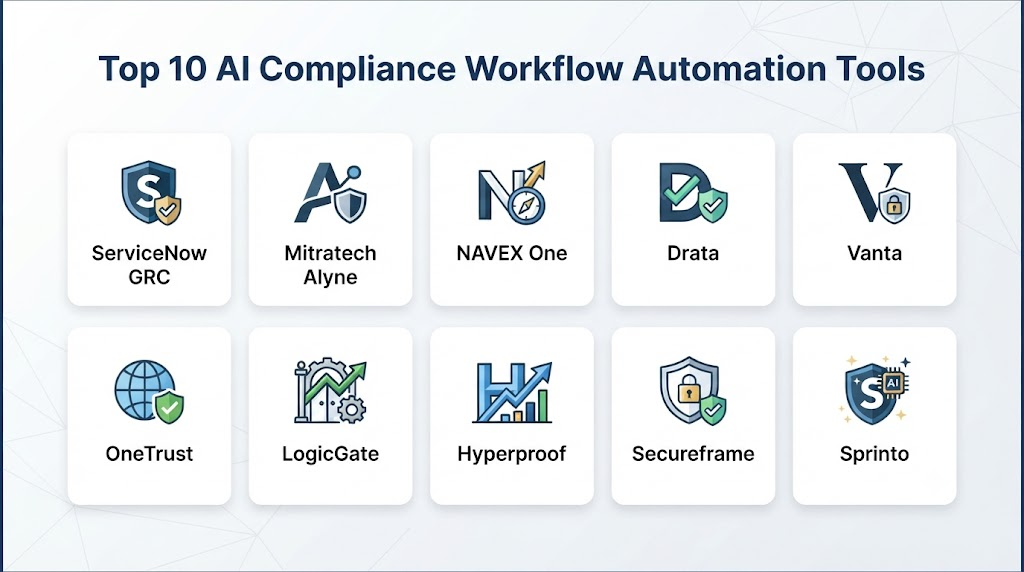
Top 10 AI Compliance Workflow Automation Tools
1 — Vanta
One-line verdict: Best for organizations wanting automated compliance monitoring, evidence collection, security workflows, and AI-assisted compliance operations.
Short description:
Vanta is a compliance and trust-management platform focused on automating security and compliance processes. It connects with business and technical systems to automate evidence collection and help teams manage controls, risks, and compliance programs.
Standout Capabilities
- Automated evidence collection
- Continuous compliance monitoring
- Framework management
- Security and compliance workflows
- Risk management
- Vendor management
- Questionnaire assistance
- Trust management
AI-Specific Depth
- Model support: Managed AI capabilities; exact underlying models are not publicly stated.
- RAG / knowledge integration: Uses organizational compliance and evidence context where supported.
- Evaluation: Product-specific AI evaluation methodology is not publicly stated.
- Guardrails: Workflow and organizational access controls; AI-specific protections vary.
- Observability: Platform reporting is available; detailed model telemetry is not publicly stated.
Pros
- Strong compliance automation
- Broad integrations
- Useful for growing organizations
Cons
- Can become complex as requirements expand
- More focused on compliance operations than pure AI workflow development
- Advanced capabilities may require higher-tier offerings
Security & Compliance
Vanta provides security and administrative capabilities appropriate for compliance workflows. Specific certifications, controls, and configurations should be verified for the applicable product and deployment.
Deployment & Platforms
- Deployment: Cloud
- Platforms: Web
- Self-hosted: Not publicly stated
Integrations & Ecosystem
Vanta connects compliance workflows with organizational systems.
- Cloud platforms
- Identity providers
- HR systems
- Security tools
- Ticketing platforms
- Developer tools
- APIs
Pricing Model
Subscription and enterprise pricing; exact pricing varies by organization and configuration.
Best-Fit Scenarios
- SaaS compliance
- Security compliance automation
- Growing companies managing multiple frameworks
2 — Drata
One-line verdict: Best for organizations seeking automated compliance operations, continuous control monitoring, evidence collection, and audit readiness.
Short description:
Drata provides compliance automation capabilities for security and privacy programs. It connects technical and business systems to collect evidence and monitor controls while helping teams manage compliance activities.
Standout Capabilities
- Automated evidence collection
- Continuous control monitoring
- Compliance framework management
- Risk management
- Policy management
- Audit preparation
- Trust management
- Workflow automation
AI-Specific Depth
- Model support: AI capabilities vary; exact model details are not publicly stated.
- RAG / knowledge integration: Organizational evidence and compliance context.
- Evaluation: Exact AI evaluation methodology is not publicly stated.
- Guardrails: Access and workflow controls; AI-specific protections vary.
- Observability: Platform reporting; detailed AI telemetry is not publicly stated.
Pros
- Strong compliance automation
- Useful evidence workflows
- Broad security and compliance functionality
Cons
- Requires implementation effort
- Can be more than smaller companies need
- AI capabilities vary by workflow
Security & Compliance
Drata provides enterprise security and compliance capabilities. Specific certifications and controls should be verified against current product documentation and contractual requirements.
Deployment & Platforms
- Deployment: Cloud
- Platforms: Web
- Self-hosted: Not publicly stated
Integrations & Ecosystem
- Cloud infrastructure
- Identity providers
- HR systems
- Security tools
- Ticketing systems
- Collaboration tools
- APIs
Pricing Model
Subscription and enterprise pricing; exact pricing varies.
Best-Fit Scenarios
- SOC compliance
- Continuous monitoring
- Multi-framework compliance programs
3 — Secureframe
One-line verdict: Best for security-focused teams combining compliance automation, evidence collection, risk management, and policy workflows.
Short description:
Secureframe helps organizations automate security compliance processes, including evidence collection, control monitoring, policy management, risk management, and audit preparation.
Standout Capabilities
- Compliance automation
- Automated evidence collection
- Control monitoring
- Risk management
- Policy management
- Security workflows
- Employee compliance
- Audit readiness
AI-Specific Depth
- Model support: AI capabilities vary; exact models are not publicly stated.
- RAG / knowledge integration: Compliance and organizational information depending on workflow.
- Evaluation: Not publicly stated.
- Guardrails: Security and compliance workflow controls.
- Observability: Platform-level reporting; AI-specific telemetry is not publicly stated.
Pros
- Strong security orientation
- Automated compliance workflows
- Useful evidence management
Cons
- Primarily compliance-focused
- Advanced configurations may require implementation work
- AI capabilities vary across features
Security & Compliance
Security features and certifications should be verified for the specific service, plan, and deployment.
Deployment & Platforms
- Deployment: Cloud
- Platforms: Web
- Self-hosted: Not publicly stated
Integrations & Ecosystem
- Cloud providers
- Identity platforms
- HR systems
- Security applications
- Development tools
- Ticketing systems
- APIs
Pricing Model
Subscription and enterprise pricing; exact pricing varies.
Best-Fit Scenarios
- Security compliance
- SaaS businesses
- Automated evidence management
4 — AuditBoard
One-line verdict: Best for larger organizations connecting compliance workflows with internal audit, risk management, and enterprise governance.
Short description:
AuditBoard provides an enterprise platform for risk, audit, compliance, and controls management. Its workflow capabilities can help organizations coordinate compliance processes across multiple departments.
Standout Capabilities
- Internal audit workflows
- Risk management
- Compliance management
- Controls management
- Evidence workflows
- Audit planning
- Reporting
- Enterprise governance
AI-Specific Depth
- Model support: AI functionality varies by product; exact models are not publicly stated.
- RAG / knowledge integration: Organizational governance and compliance content.
- Evaluation: Product-specific AI evaluation details are not publicly stated.
- Guardrails: Enterprise workflow and permission controls.
- Observability: Platform reporting; detailed model telemetry varies.
Pros
- Strong enterprise GRC capabilities
- Good audit integration
- Supports complex organizational workflows
Cons
- Enterprise-oriented
- Implementation can be substantial
- May be excessive for small compliance teams
Security & Compliance
Security and administrative capabilities are available, but organizations should verify exact controls, certifications, retention options, and data residency requirements.
Deployment & Platforms
- Deployment: Cloud
- Platforms: Web
- Self-hosted: Varies / N/A
Integrations & Ecosystem
- ERP systems
- Risk platforms
- Compliance systems
- Business applications
- Data sources
- APIs
Pricing Model
Enterprise pricing; exact pricing is not publicly standardized.
Best-Fit Scenarios
- Enterprise compliance
- Internal audit
- Integrated risk management
5 — OneTrust
One-line verdict: Best for enterprises combining privacy, compliance, risk, governance, and automated workflows in one broad platform.
Short description:
OneTrust provides a large governance ecosystem spanning privacy, security, compliance, risk, data governance, and AI governance. Its workflow capabilities can support complex enterprise compliance programs.
Standout Capabilities
- Privacy management
- Compliance management
- Risk management
- Policy workflows
- Data governance
- AI governance
- Vendor risk
- Enterprise automation
AI-Specific Depth
- Model support: AI capabilities vary by product.
- RAG / knowledge integration: Governance and organizational content depending on workflow.
- Evaluation: Varies by AI-enabled feature.
- Guardrails: Governance controls and workflow permissions.
- Observability: Product-specific reporting; model-level telemetry varies.
Pros
- Very broad governance capabilities
- Strong privacy focus
- Suitable for complex enterprises
Cons
- Platform complexity
- Multiple modules may be required
- Can require significant implementation
Security & Compliance
OneTrust offers enterprise security and administrative controls. Specific certifications and features should be verified for the selected products.
Deployment & Platforms
- Deployment: Cloud
- Platforms: Web
- Self-hosted: Varies / N/A
Integrations & Ecosystem
- Privacy tools
- Security platforms
- GRC systems
- Data platforms
- Identity systems
- Enterprise applications
- APIs
Pricing Model
Enterprise and module-based pricing; exact pricing varies.
Best-Fit Scenarios
- Enterprise privacy compliance
- AI governance
- Global compliance programs
6 — LogicGate Risk Cloud
One-line verdict: Best for organizations needing customizable compliance workflows connected to enterprise risk and governance processes.
Short description:
LogicGate Risk Cloud is a configurable risk and compliance platform that enables organizations to create workflows for risk, compliance, controls, and governance.
Standout Capabilities
- Configurable workflows
- Risk management
- Compliance management
- Control tracking
- Policy processes
- Reporting
- Governance
- Workflow automation
AI-Specific Depth
- Model support: Varies / N/A.
- RAG / knowledge integration: Varies / N/A.
- Evaluation: Varies / N/A.
- Guardrails: Workflow permissions and governance controls.
- Observability: Platform reporting; AI-specific telemetry varies.
Pros
- Highly configurable
- Strong workflow capabilities
- Useful for GRC teams
Cons
- Configuration requires expertise
- Not primarily an AI-native platform
- Implementation can take time
Security & Compliance
Enterprise security and access-management capabilities are available; exact controls should be verified for the selected deployment.
Deployment & Platforms
- Deployment: Cloud
- Platforms: Web
- Self-hosted: Not publicly stated
Integrations & Ecosystem
- GRC systems
- Enterprise applications
- Identity platforms
- Compliance tools
- Risk systems
- APIs
Pricing Model
Enterprise platform pricing; exact pricing varies.
Best-Fit Scenarios
- Custom GRC workflows
- Complex compliance processes
- Enterprise risk management
7 — Hyperproof
One-line verdict: Best for teams seeking centralized compliance operations, evidence management, control monitoring, and streamlined audit workflows.
Short description:
Hyperproof is a compliance operations platform designed to help teams manage controls, evidence, risks, frameworks, and audit activities.
Standout Capabilities
- Compliance operations
- Evidence management
- Control monitoring
- Risk management
- Framework management
- Audit workflows
- Policy management
- Reporting
AI-Specific Depth
- Model support: AI functionality varies; exact models are not publicly stated.
- RAG / knowledge integration: Compliance content and organizational evidence.
- Evaluation: Not publicly stated.
- Guardrails: Platform access and workflow controls.
- Observability: Compliance reporting; detailed AI telemetry is not publicly stated.
Pros
- Compliance-focused
- Centralized evidence
- Useful framework management
Cons
- Less focused on general AI development
- Advanced workflows require configuration
- AI capabilities vary
Security & Compliance
Security and compliance capabilities are available; organizations should verify specific controls and certifications for their intended use.
Deployment & Platforms
- Deployment: Cloud
- Platforms: Web
- Self-hosted: Not publicly stated
Integrations & Ecosystem
- Cloud services
- Security tools
- Identity systems
- HR applications
- Ticketing platforms
- Business applications
Pricing Model
Subscription and enterprise pricing; exact pricing varies.
Best-Fit Scenarios
- Compliance operations
- Audit preparation
- Multi-framework management
8 — Sprinto
One-line verdict: Best for growing technology companies seeking automated security compliance, evidence collection, and audit-readiness workflows.
Short description:
Sprinto focuses on security compliance automation for growing organizations. It can automate evidence collection and compliance processes while helping teams prepare for audits.
Standout Capabilities
- Compliance automation
- Evidence collection
- Security controls
- Risk management
- Policy workflows
- Employee compliance
- Audit readiness
- Continuous monitoring
AI-Specific Depth
- Model support: AI capabilities vary; exact models are not publicly stated.
- RAG / knowledge integration: Compliance information and organizational evidence where supported.
- Evaluation: Not publicly stated.
- Guardrails: Compliance and access controls.
- Observability: Platform reporting; detailed AI telemetry is not publicly stated.
Pros
- Designed for growing businesses
- Compliance automation
- Security-oriented workflows
Cons
- Less suitable for very complex enterprise GRC programs
- AI-specific capabilities vary
- Advanced customization may require vendor involvement
Security & Compliance
Specific security controls and certifications should be verified against current product documentation and organizational requirements.
Deployment & Platforms
- Deployment: Cloud
- Platforms: Web
- Self-hosted: Not publicly stated
Integrations & Ecosystem
- Cloud platforms
- Identity providers
- HR systems
- Security tools
- Development systems
- Ticketing tools
Pricing Model
Subscription-based; exact pricing varies.
Best-Fit Scenarios
- Startup compliance
- SaaS security programs
- Audit preparation
9 — Thoropass
One-line verdict: Best for companies combining compliance software with audit and compliance support services.
Short description:
Thoropass combines compliance technology with professional compliance and audit services. It can help organizations manage evidence, controls, policies, and audit-readiness activities.
Standout Capabilities
- Compliance automation
- Evidence management
- Audit support
- Compliance frameworks
- Policy workflows
- Control management
- Risk management
- Compliance services
AI-Specific Depth
- Model support: AI capabilities vary; exact models are not publicly stated.
- RAG / knowledge integration: Compliance and organizational evidence depending on workflow.
- Evaluation: Not publicly stated.
- Guardrails: Workflow and access controls.
- Observability: Platform reporting; AI-specific telemetry is not publicly stated.
Pros
- Combines technology and services
- Useful for audit preparation
- Compliance-oriented workflows
Cons
- Service-oriented model may not suit every organization
- AI capabilities vary
- May be unnecessary for mature internal compliance teams
Security & Compliance
Specific security features and certifications should be verified according to the selected services and deployment.
Deployment & Platforms
- Deployment: Cloud
- Platforms: Web
- Self-hosted: Not publicly stated
Integrations & Ecosystem
- Cloud platforms
- HR systems
- Identity providers
- Security tools
- Business applications
- Compliance workflows
Pricing Model
Subscription and service-based pricing; exact pricing varies.
Best-Fit Scenarios
- Audit preparation
- Startup compliance
- Organizations needing compliance support
10 — StandardFusion
One-line verdict: Best for organizations wanting structured GRC workflows for managing controls, risks, policies, and compliance activities.
Short description:
StandardFusion is a GRC platform that supports compliance, risk, policy, control, and audit management. It is suited to organizations that need structured compliance workflows rather than only AI-assisted document generation.
Standout Capabilities
- Compliance management
- Risk management
- Policy management
- Control management
- Audit workflows
- Framework mapping
- Reporting
- GRC workflows
AI-Specific Depth
- Model support: AI-specific capabilities are not publicly stated.
- RAG / knowledge integration: N/A.
- Evaluation: N/A.
- Guardrails: Platform access and workflow controls.
- Observability: Platform reporting; AI-specific telemetry is N/A.
Pros
- Structured GRC workflows
- Broad governance functionality
- Useful for policy and control management
Cons
- Not primarily AI-first
- AI capabilities are limited or not publicly stated
- Requires configuration
Security & Compliance
Security and compliance capabilities should be verified against the organization’s specific requirements.
Deployment & Platforms
- Deployment: Cloud / deployment options vary
- Platforms: Web
- Self-hosted: Varies / N/A
Integrations & Ecosystem
- GRC systems
- Compliance frameworks
- Risk management
- Document repositories
- Business applications
- APIs
Pricing Model
Subscription or enterprise pricing; exact pricing varies.
Best-Fit Scenarios
- GRC teams
- Compliance management
- Control and policy workflows
Comparison Table
| Tool | Best For | Deployment | Model Flexibility | Strength | Watch-Out | Public Rating |
|---|---|---|---|---|---|---|
| Vanta | Automated compliance | Cloud | Hosted / managed | Evidence automation | Can become complex | N/A |
| Drata | Continuous compliance | Cloud | Hosted / managed | Control monitoring | Implementation effort | N/A |
| Secureframe | Security compliance | Cloud | Hosted / managed | Security workflows | AI varies | N/A |
| AuditBoard | Enterprise GRC | Cloud | Varies | Audit and risk | Enterprise complexity | N/A |
| OneTrust | Privacy and governance | Cloud | Varies | Broad governance | Multiple modules | N/A |
| LogicGate Risk Cloud | Custom GRC | Cloud | Varies | Workflow flexibility | Configuration | N/A |
| Hyperproof | Compliance operations | Cloud | Managed / varies | Evidence management | AI depth varies | N/A |
| Sprinto | Startup compliance | Cloud | Managed / varies | Compliance automation | Enterprise depth | N/A |
| Thoropass | Compliance + audit | Cloud | Managed / varies | Software + services | Service model | N/A |
| StandardFusion | Structured GRC | Cloud / varies | Varies | Control management | Less AI-focused | N/A |
Scoring & Evaluation
The following scores are comparative estimates based on the platforms’ general positioning and capabilities, not independent laboratory benchmarks. Buyers should validate them against their own requirements.
| Tool | Core | Reliability/Eval | Guardrails | Integrations | Ease | Perf/Cost | Security/Admin | Support | Weighted Total |
|---|---|---|---|---|---|---|---|---|---|
| Vanta | 9 | 8 | 9 | 10 | 9 | 8 | 9 | 9 | 8.85 |
| Drata | 9 | 8 | 9 | 10 | 8 | 8 | 9 | 9 | 8.75 |
| Secureframe | 9 | 8 | 9 | 9 | 9 | 8 | 9 | 9 | 8.75 |
| AuditBoard | 10 | 8 | 9 | 10 | 7 | 7 | 10 | 9 | 8.85 |
| OneTrust | 10 | 8 | 10 | 10 | 7 | 7 | 10 | 9 | 9.00 |
| LogicGate Risk Cloud | 9 | 8 | 9 | 10 | 7 | 7 | 9 | 9 | 8.60 |
| Hyperproof | 9 | 8 | 9 | 9 | 8 | 8 | 9 | 9 | 8.70 |
| Sprinto | 8 | 8 | 9 | 9 | 9 | 8 | 9 | 9 | 8.55 |
| Thoropass | 8 | 8 | 9 | 8 | 8 | 7 | 9 | 10 | 8.35 |
| StandardFusion | 8 | 7 | 9 | 8 | 7 | 7 | 9 | 8 | 8.00 |
Top 3 for Enterprise
- OneTrust
- AuditBoard
- Vanta
Top 3 for SMB
- Vanta
- Sprinto
- Secureframe
Top 3 for Developers
- Vanta
- Drata
- Secureframe
Which AI Compliance Workflow Automation Tool Is Right for You?
Solo / Freelancer
A freelancer or independent consultant typically does not need a large GRC platform.
Focus on:
- Simple compliance checklists
- Document automation
- Basic evidence collection
- Easy reporting
- Low administrative overhead
A general-purpose AI assistant combined with structured spreadsheets or lightweight workflow software may be sufficient.
SMB
SMBs should prioritize automation that eliminates repetitive compliance administration.
Look for:
- Automated evidence collection
- Cloud integrations
- Security questionnaires
- Policy management
- Risk workflows
- Employee compliance
- Audit preparation
Vanta, Sprinto, and Secureframe are particularly relevant categories to evaluate.
Mid-Market
Mid-market organizations often have enough complexity to require a dedicated compliance platform.
Prioritize:
- Multiple frameworks
- Control mapping
- Automated evidence
- Vendor risk
- Risk registers
- Policy workflows
- Custom workflows
- Audit trails
- Integrations
Enterprise
Enterprise organizations need compliance automation to work across multiple business units and systems.
Prioritize:
- Centralized GRC
- Multiple frameworks
- Advanced RBAC
- SSO
- Audit trails
- Workflow customization
- Regulatory mapping
- Risk management
- Vendor risk
- AI governance
- APIs
- Enterprise integrations
OneTrust and AuditBoard are strong categories to investigate for broad enterprise governance requirements.
Regulated Industries
For finance, healthcare, government, insurance, and other regulated industries, automation should never come at the expense of auditability.
Prioritize:
- Evidence provenance
- Human review
- Strong access controls
- Data residency
- Retention controls
- Regulatory mappings
- Segregation of duties
- Detailed audit history
- Controlled AI processing
Budget vs Premium
Budget-conscious organizations should start with a narrowly defined compliance workflow rather than purchasing a broad platform with features they will not use.
Premium platforms make more sense when you need:
- Multiple frameworks
- Large evidence volumes
- Enterprise workflows
- Vendor risk
- Continuous monitoring
- Complex audit requirements
- Cross-functional governance
Build vs Buy
Build when:
- Your compliance workflows are highly specialized.
- You have experienced engineering resources.
- You require unusual integrations.
- You need complete control over the AI layer.
- Existing GRC platforms cannot represent your processes.
Buy when:
- You need compliance automation quickly.
- Your requirements fit established frameworks.
- You need maintained integrations.
- You require audit-ready workflows.
- Your team does not want to maintain custom infrastructure.
For many companies, a hybrid strategy works well: use a commercial GRC platform for the system of record while building specialized AI workflows around it.
Implementation Playbook: 30 / 60 / 90 Days
First 30 Days: Pilot
Choose one compliance program and a limited number of controls.
Document:
- Current evidence sources
- Manual compliance tasks
- Control owners
- Review frequency
- Existing integrations
- Audit requirements
Select measurable success criteria:
- Evidence collection time
- Manual tasks eliminated
- Evidence accuracy
- Control coverage
- Remediation time
- Questionnaire response time
Days 31–60: Harden Security and Evaluation
Connect the platform to selected systems.
Establish:
- RBAC
- SSO
- Audit logging
- Data retention
- Access reviews
- Evidence ownership
- Approval processes
For AI features, create an evaluation set covering:
- Correct classification
- Incorrect evidence
- Missing evidence
- Conflicting evidence
- Sensitive information
- Prompt injection
- Ambiguous compliance requirements
Require human approval for high-impact decisions.
Days 61–90: Optimize and Scale
Expand automation to additional controls and frameworks.
Connect:
- Cloud infrastructure
- Identity systems
- HR platforms
- Ticketing systems
- Security tools
- Vendor-management systems
- Document repositories
Then optimize:
- Workflow latency
- AI usage
- Automation rates
- False positives
- Manual review
- Cost per compliance workflow
Establish governance for AI model changes, prompt changes, integrations, and automated actions.
Common Mistakes and How to Avoid Them
- Automating broken processes: Simplify the process before automating it.
- Trusting AI classifications blindly: Require review for ambiguous evidence.
- No evidence provenance: Always know where compliance evidence originated.
- Ignoring data retention: Define how long sensitive compliance data should remain available.
- No AI evaluation: Test AI workflows against representative compliance cases.
- Weak access controls: Restrict sensitive compliance information by role.
- Over-automation: Keep human approval for consequential compliance decisions.
- No prompt-injection testing: Treat external documents and connected content as potentially untrusted.
- Ignoring false positives: Measure AI-generated findings before enabling automated remediation.
- No cost monitoring: Track AI usage and workflow costs.
- Creating duplicate controls: Map overlapping requirements across frameworks.
- Ignoring vendor risk: Evaluate the compliance platform itself as a third-party service.
- Poor integration design: Avoid connecting unnecessary systems to sensitive workflows.
- No incident process: Establish procedures for incorrect AI recommendations or automated actions.
- Vendor lock-in: Maintain export and migration capabilities.
- Measuring automation instead of outcomes: Focus on compliance quality and risk reduction rather than the number of automated tasks.
FAQs
What is AI compliance workflow automation?
It is the use of AI, automation, rules, integrations, and workflow systems to reduce manual work involved in compliance management.
Can AI automate compliance evidence collection?
Yes. Many compliance platforms connect with cloud, identity, HR, security, and business systems to collect evidence automatically.
Can AI replace a compliance team?
No. AI can reduce repetitive work, but compliance still requires human judgment, accountability, risk assessment, and oversight.
Can AI monitor compliance continuously?
Depending on the platform and integrations, automated systems can continuously monitor selected controls and notify teams when conditions change.
Is AI compliance automation suitable for regulated industries?
Yes, but regulated organizations should apply stronger governance, validation, access control, data-retention, auditability, and human-review requirements.
Does AI compliance automation support multiple frameworks?
Many GRC platforms support multiple compliance frameworks and can map related requirements to shared controls. Exact framework coverage varies by product.
Can these platforms automatically answer security questionnaires?
Some platforms provide questionnaire-management or AI-assisted response capabilities. Responses should still be reviewed before being submitted externally.
Can I use my own AI model?
Model flexibility varies significantly. Some platforms manage the AI layer themselves, while others may provide integrations or configurable AI capabilities.
Can compliance workflow platforms be self-hosted?
Most mainstream compliance platforms are primarily cloud-based. Self-hosting availability varies and should be confirmed for each vendor.
How does AI improve compliance workflows?
AI can classify evidence, summarize documents, identify potential gaps, assist with questionnaire responses, prioritize tasks, and help users search compliance information.
How much does AI compliance automation cost?
Pricing varies according to company size, frameworks, integrations, users, automation requirements, and enterprise features. Exact pricing is typically vendor-specific.
What data should not be sent to an AI compliance system?
Organizations should carefully evaluate whether sensitive personal, financial, security, legal, customer, or confidential business information can be processed by the platform.
What is the difference between GRC software and AI compliance automation?
GRC software provides structured governance, risk, and compliance management. AI compliance automation adds AI-assisted analysis and automation to those workflows.
Should AI automatically remediate compliance failures?
Generally, high-impact remediation should require appropriate human approval. Automated remediation is safer when the action is well-defined, reversible, and thoroughly tested.
How do I evaluate an AI compliance platform?
Run a pilot using real workflows. Measure evidence accuracy, automation rate, false positives, integration reliability, security, auditability, usability, cost, and human review requirements.
Conclusion
AI Compliance Workflow Automation is transforming compliance from a heavily manual activity into a more connected and continuously managed operational process. The strongest platforms combine automated evidence collection, control monitoring, risk management, policy workflows, integrations, reporting, and AI-assisted analysis.For growing companies, platforms such as Vanta, Drata, Secureframe, and Sprinto can help reduce the operational burden associated with security compliance. Larger organizations may benefit more from broader GRC platforms such as OneTrust, AuditBoard, LogicGate Risk Cloud, and Hyperproof.The right platform depends on the complexity of your compliance program. A startup may prioritize fast evidence collection and audit readiness, while a multinational enterprise may require sophisticated governance, multiple frameworks, vendor risk, privacy management, and extensive workflow customization.