Introduction
AI Personalized Streaming Recommendations use artificial intelligence and machine learning to suggest movies, TV shows, music, podcasts, videos, live content, or other media based on individual user behavior and preferences. Instead of showing every viewer the same catalog, recommendation systems attempt to determine what each person is most likely to watch, listen to, or engage with next.
Modern recommendation engines can analyze viewing history, searches, clicks, completion rates, likes, skips, session behavior, content metadata, and contextual signals. More advanced systems can combine these signals with embeddings, deep learning, reinforcement learning, and real-time personalizati OTT platforms, streaming services, broadcasters, music platforms, podcast applications, media companies, gaming platforms, publishers, and businesses with large content catalogSmall websites with limited content, products with very little user interaction data, or businesses where recommendations are not important to the customer experience. In those cases, curated collections or simple popularity-based recommendations may be more practical.
What Are AI Personalized Streaming Recommendations?
A streaming recommendation system attempts to answer a simple question:
“What should this user see or listen to next?”
The underlying technology is much more complicated.
A typical system can combine:
User behavior + Content metadata + Context + AI models → Candidate generation → Ranking → Personalization → Recommendation
For example, suppose a viewer frequently watches:
- Science documentaries.
- Space-related content.
- Technology interviews.
- Short educational programs.
The recommendation engine can identify relationships between those behaviors and recommend relevant content that the user has not yet watched.
Modern systems can also consider contextual information such as:
- Time of day.
- Device.
- Session history.
- Current viewing activity.
- Location at an appropriate level.
- Content popularity.
- Recently released content.
- Subscription tier.
- Language preferences.
The goal is not simply to recommend the most popular content. It is to recommend the most relevant content for a particular person at a particular moment.
Why AI Personalized Recommendations Matter
Streaming platforms often have enormous content catalogs.
A viewer may have thousands or millions of potential choices, creating a discovery problem.
Without personalization, users may experience:
- Choice overload.
- Difficulty finding relevant content.
- Repeatedly seeing content they do not want.
- Lower engagement.
- Poor discovery of less-known content.
Personalization can help reduce that friction.
For streaming businesses, recommendation systems can also influence:
- Watch time.
- Session length.
- Content discovery.
- Retention.
- Conversion.
- Engagement.
- Content consumption across categories.
However, recommendation systems should not optimize only for engagement.
An algorithm that maximizes clicks at any cost can create poor user experiences. Effective systems balance relevance with diversity, freshness, quality, safety, business objectives, and user control.
How AI Streaming Recommendation Systems Work
A modern recommendation architecture often contains several stages.
1. Data Collection
The system collects behavioral signals such as:
- Views.
- Clicks.
- Searches.
- Likes.
- Dislikes.
- Skips.
- Completion rates.
- Watch duration.
- Playlist additions.
- Shares.
- Saves.
2. User Representation
Machine-learning models create representations of users based on historical and real-time behavior.
These representations may include interests, preferences, and behavioral patterns.
3. Content Representation
Content can also be represented using:
- Genre.
- Language.
- Actors.
- Directors.
- Topics.
- Descriptions.
- Tags.
- Audio characteristics.
- Visual characteristics.
- Embeddings.
4. Candidate Generation
Instead of ranking the entire content catalog, the system first identifies a smaller group of potentially relevant items.
5. Ranking
A ranking model determines which candidates are most appropriate for the current user and context.
6. Business and Safety Rules
The final recommendation may also be affected by:
- Availability.
- Subscription rights.
- Age restrictions.
- Regional licensing.
- Content policies.
- Editorial priorities.
7. Continuous Learning
The system evaluates how users respond to recommendations and uses those signals to improve future recommendations.
Key Features to Evaluate
When evaluating AI personalized streaming recommendation platforms, consider:
- Real-time personalization: Can recommendations adapt during a session?
- Cold-start handling: Can the system recommend content for new users?
- Content embeddings: Can content be represented semantically?
- Behavioral modeling: Can the system understand complex user behavior?
- Candidate generation: How efficiently can it search large catalogs?
- Ranking: Does it support advanced ranking models?
- Context awareness: Can recommendations consider device, session, time, and availability?
- Diversity: Can the system avoid repetitive recommendations?
- Exploration: Can it introduce users to new content?
- A/B testing: Can teams test recommendation strategies?
- Real-time events: Can models react quickly to new activity?
- Explainability: Can users understand why something was recommended?
- Privacy: How are user signals stored and processed?
- Governance: Can administrators control recommendation behavior?
- Observability: Can teams monitor recommendation quality and performance?
- Scalability: Can the platform handle large catalogs and user populations?
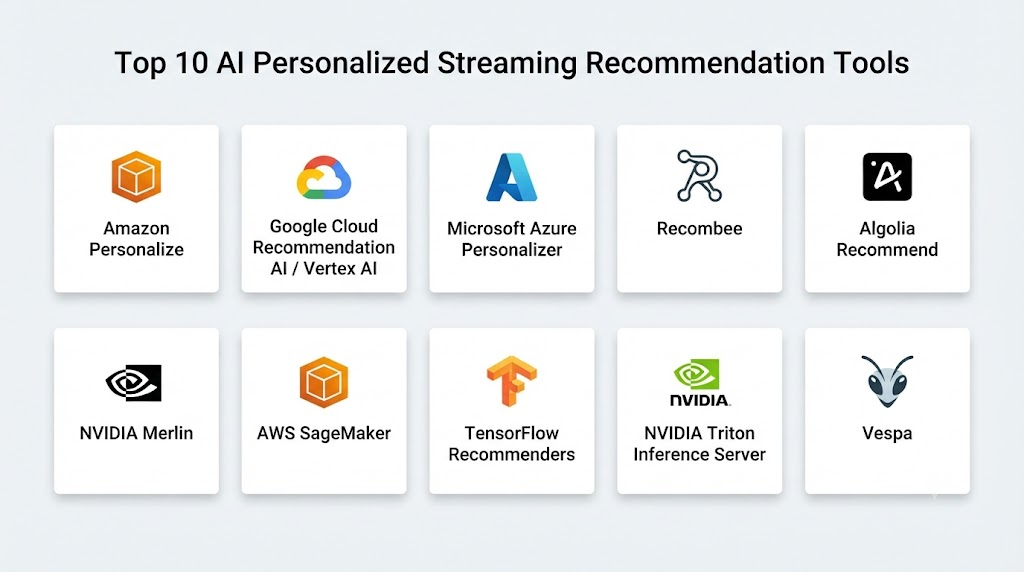
Top 10 AI Personalized Streaming Recommendation Tools
1. Amazon Personalize
One-line verdict: Best for teams wanting managed machine-learning personalization without building a recommendation engine from scratch.
Short description:
Amazon Personalize is a managed machine-learning service designed to help developers create personalized recommendations. It can be integrated into applications where recommendations need to respond to user behavior and catalog data.
Standout Capabilities
- Personalized recommendations.
- User-behavior modeling.
- Item recommendation.
- Real-time personalization.
- Managed ML infrastructure.
- API-based integration.
- Event-driven personalization.
- AWS ecosystem integration.
AI-Specific Depth
- Model support: Managed recommendation models; customization options depend on the service capabilities.
- RAG / knowledge integration: N/A for traditional recommendation workflows.
- Evaluation: Recommendation metrics and testing capabilities vary by implementation.
- Guardrails: Application-level rules and AWS controls.
- Observability: AWS monitoring and application-level recommendation metrics.
Pros
- Managed recommendation infrastructure.
- Strong AWS integration.
- Reduces the need to build models from scratch.
Cons
- Best suited to AWS-oriented architectures.
- Requires data and ML workflow planning.
- Advanced customization may require additional engineering.
Security & Compliance
AWS provides IAM, encryption, logging, networking, and other security controls. Specific compliance requirements should be validated against the service and deployment configuration.
Deployment & Platforms
- Deployment: Cloud.
- Self-hosted: No.
- Hybrid: Possible through surrounding application architecture.
- API: Supported.
Integrations & Ecosystem
Amazon Personalize can integrate into broader application and data architectures.
- AWS data services.
- APIs.
- Application backends.
- Event streams.
- Analytics systems.
- AWS identity and security services.
Pricing Model
Usage-based cloud pricing.
Best-Fit Scenarios
- OTT platforms running on AWS.
- Media applications.
- Personalized content discovery.
2. Google Recommendations AI / Vertex AI Recommendation Systems
One-line verdict: Best for organizations building sophisticated recommendation systems within the Google Cloud and AI ecosystem.
Short description:
Google Cloud provides recommendation capabilities through its AI and data infrastructure. Organizations can combine recommendation systems with customer data, machine learning, analytics, and cloud services.
Standout Capabilities
- Personalized recommendations.
- Machine-learning ranking.
- Real-time personalization workflows.
- Google Cloud integration.
- Data pipeline integration.
- AI infrastructure.
- Experimentation support.
- Large-scale deployment.
AI-Specific Depth
- Model support: Managed Google recommendation technologies; capabilities vary by current product configuration.
- RAG / knowledge integration: Not a core requirement for conventional recommendations.
- Evaluation: Recommendation performance can be evaluated using relevant ranking and engagement metrics.
- Guardrails: Cloud IAM and application-level controls.
- Observability: Google Cloud monitoring and analytics capabilities.
Pros
- Strong ML ecosystem.
- Powerful cloud data infrastructure.
- Suitable for large recommendation workloads.
Cons
- Can require substantial cloud engineering.
- Product capabilities can evolve over time.
- Best suited to teams comfortable with Google Cloud.
Security & Compliance
Google Cloud provides enterprise identity, access, encryption, logging, and governance controls. Specific certification applicability should be verified for the chosen services and region.
Deployment & Platforms
- Deployment: Cloud.
- Self-hosted: Varies / generally cloud-oriented.
- Hybrid: Possible through broader architecture.
Integrations & Ecosystem
- BigQuery.
- Google Cloud data services.
- Vertex AI.
- Cloud storage.
- APIs.
- Analytics systems.
Pricing Model
Usage-based cloud pricing.
Best-Fit Scenarios
- Large OTT platforms.
- Media companies using Google Cloud.
- Data-intensive recommendation systems.
3. Microsoft Azure Personalizer
One-line verdict: Best for organizations using Microsoft’s cloud ecosystem that need contextual personalization capabilities.
Short description:
Azure Personalizer was designed around contextual decision-making and personalization scenarios. Microsoft’s broader Azure AI ecosystem can also be used to build customized recommendation architectures.
Standout Capabilities
- Contextual personalization.
- Machine-learning decision systems.
- Real-time interaction.
- API-driven workflows.
- Azure integration.
- Event-based architectures.
- Custom recommendation pipelines.
- Enterprise cloud infrastructure.
AI-Specific Depth
- Model support: Managed ML capabilities and Azure AI services vary.
- RAG / knowledge integration: N/A for conventional recommendation workflows.
- Evaluation: Requires measurement through recommendation and business metrics.
- Guardrails: Azure identity and application controls.
- Observability: Azure monitoring capabilities.
Pros
- Strong Microsoft ecosystem.
- Enterprise cloud capabilities.
- Useful for contextual decision-making.
Cons
- Product direction and availability should be checked before starting a new implementation.
- Requires Azure expertise for complex systems.
- Recommendation architecture may need multiple services.
Security & Compliance
Azure provides identity, access management, encryption, monitoring, and governance capabilities. Specific compliance requirements depend on the selected architecture.
Deployment & Platforms
- Deployment: Cloud.
- Self-hosted: Varies.
- Hybrid: Supported through Azure architecture.
Integrations & Ecosystem
- Azure AI.
- Azure data services.
- Microsoft identity.
- Analytics.
- APIs.
- Event-driven applications.
Pricing Model
Cloud usage-based pricing varies by service.
Best-Fit Scenarios
- Microsoft-focused enterprises.
- Personalized content applications.
- Context-aware applications.
4. Recombee
One-line verdict: Best for teams seeking a dedicated recommendation API for personalized content and product discovery.
Short description:
Recombee provides recommendation technology through APIs designed for applications that need personalized ranking and discovery. It can be used for media, content, commerce, and other recommendation scenarios.
Standout Capabilities
- Recommendation APIs.
- Personalized ranking.
- Real-time recommendation workflows.
- Content discovery.
- Behavioral modeling.
- Recommendation scenarios.
- Developer integration.
- Large-scale personalization.
AI-Specific Depth
- Model support: Managed recommendation models.
- RAG / knowledge integration: Not primarily a RAG platform.
- Evaluation: Recommendation performance measurement varies by implementation.
- Guardrails: Business rules and filtering capabilities can be configured depending on workflow.
- Observability: Recommendation analytics and application metrics vary.
Pros
- Recommendation-focused platform.
- API-driven architecture.
- Useful for different content types.
Cons
- Requires integration work.
- Less suitable if you want to control every model component.
- Advanced personalization still requires good behavioral data.
Security & Compliance
Enterprise security and compliance details should be validated against the current plan and deployment.
Deployment & Platforms
- Deployment: Cloud.
- Self-hosted: Varies.
- API: Supported.
Integrations & Ecosystem
- REST/API workflows.
- Application databases.
- Event streams.
- Content catalogs.
- Analytics.
- Custom applications.
Pricing Model
Usage-based and/or subscription-based models may apply.
Best-Fit Scenarios
- Media platforms.
- Content marketplaces.
- Personalized discovery applications.
5. Algolia Recommend
One-line verdict: Best for teams wanting recommendation capabilities alongside search and discovery infrastructure.
Short description:
Algolia provides search and discovery infrastructure with recommendation capabilities. This combination can be useful for streaming and media applications where users need both personalized discovery and fast search.
Standout Capabilities
- Personalized recommendations.
- Search.
- Discovery.
- Behavioral data.
- Ranking.
- API-first integration.
- Search and recommendation combination.
- Developer-friendly architecture.
AI-Specific Depth
- Model support: Managed search and recommendation technologies.
- RAG / knowledge integration: Not a core streaming recommendation requirement.
- Evaluation: Search and recommendation analytics vary by product configuration.
- Guardrails: Filtering and business rules.
- Observability: Search and recommendation analytics.
Pros
- Strong search and discovery combination.
- Developer-friendly APIs.
- Useful for large catalogs.
Cons
- Recommendation is part of a broader discovery ecosystem.
- Advanced personalization requires appropriate data.
- Costs can scale with usage.
Security & Compliance
Security capabilities depend on product and plan.
Deployment & Platforms
- Deployment: Cloud.
- Self-hosted: Varies by product.
- API: Supported.
Integrations & Ecosystem
- Search APIs.
- Recommendation APIs.
- Analytics.
- Application databases.
- Content catalogs.
- Frontend frameworks.
Pricing Model
Usage-based and subscription models may apply.
Best-Fit Scenarios
- Streaming search.
- Media discovery.
- Large content catalogs.
6. NVIDIA Merlin
One-line verdict: Best for engineering teams that want an open and GPU-accelerated foundation for building advanced recommendation systems.
Short description:
NVIDIA Merlin is a collection of open-source and GPU-accelerated technologies designed for recommender-system development. It is particularly relevant for organizations that want more control over models, training pipelines, and infrastructure.
Standout Capabilities
- GPU-accelerated recommendation workflows.
- Feature engineering.
- Deep-learning recommendation models.
- Large-scale training.
- Inference optimization.
- Open-source components.
- Custom model development.
- High-performance infrastructure.
AI-Specific Depth
- Model support: Open-source and customizable.
- RAG / knowledge integration: N/A for conventional recommender systems.
- Evaluation: Customizable offline and online evaluation.
- Guardrails: Application/model-level controls.
- Observability: Customizable through ML and infrastructure tooling.
Pros
- High degree of customization.
- GPU acceleration.
- Strong fit for ML engineering teams.
Cons
- Requires experienced ML engineers.
- Infrastructure management can be significant.
- More complex than managed recommendation APIs.
Security & Compliance
Security depends on deployment and cloud infrastructure.
Deployment & Platforms
- Deployment: Self-hosted/cloud/hybrid.
- Linux: Strong support.
- GPU: Central to many workloads.
Integrations & Ecosystem
- PyTorch.
- TensorFlow.
- GPU infrastructure.
- Kubernetes.
- Data pipelines.
- ML platforms.
Pricing Model
Open-source components are available; infrastructure and enterprise costs vary.
Best-Fit Scenarios
- Large recommendation teams.
- Custom streaming platforms.
- GPU-based ML infrastructure.
7. AWS SageMaker
One-line verdict: Best for organizations building custom recommendation models rather than relying exclusively on managed recommendation APIs.
Short description:
Amazon SageMaker provides infrastructure for developing, training, deploying, and monitoring machine-learning models. Recommendation teams can use it to build customized ranking and personalization systems.
Standout Capabilities
- Model training.
- Custom recommendation models.
- Feature engineering.
- Model deployment.
- Experimentation.
- Monitoring.
- Real-time inference.
- AWS integration.
AI-Specific Depth
- Model support: BYO models and multiple ML frameworks.
- RAG / knowledge integration: Not central to recommendation systems.
- Evaluation: Custom offline and online evaluation.
- Guardrails: Model/application controls.
- Observability: Model and infrastructure monitoring.
Pros
- Highly customizable.
- Strong ML ecosystem.
- Suitable for advanced recommendation teams.
Cons
- Requires ML expertise.
- More engineering than managed recommendation products.
- Cloud costs require active management.
Security & Compliance
AWS security capabilities include IAM, encryption, logging, networking, and governance features. Specific compliance requirements depend on implementation.
Deployment & Platforms
- Deployment: Cloud.
- Self-hosted: No.
- Hybrid: Possible through broader architecture.
Integrations & Ecosystem
- S3.
- Feature stores.
- Data processing.
- ML frameworks.
- APIs.
- Monitoring systems.
Pricing Model
Usage-based cloud pricing.
Best-Fit Scenarios
- Custom OTT recommendation engines.
- Large ML teams.
- Advanced ranking systems.
8. TensorFlow Recommenders
One-line verdict: Best for developers building custom recommendation models using TensorFlow and deep-learning techniques.
Short description:
TensorFlow Recommenders is an open-source framework for building recommendation systems. It provides tools for developing retrieval, ranking, and other recommender-system components.
Standout Capabilities
- Recommendation model development.
- Retrieval models.
- Ranking models.
- Deep learning.
- Custom training.
- TensorFlow integration.
- Research flexibility.
- Open-source ecosystem.
AI-Specific Depth
- Model support: Open-source/custom models.
- RAG / knowledge integration: N/A.
- Evaluation: Custom offline evaluation and ranking metrics.
- Guardrails: Developer-controlled.
- Observability: Developer-controlled.
Pros
- Highly customizable.
- Open-source.
- Strong research and engineering flexibility.
Cons
- Requires ML expertise.
- Infrastructure must be designed separately.
- Not a turnkey managed recommendation service.
Security & Compliance
Depends entirely on the deployment architecture.
Deployment & Platforms
- Deployment: Self-hosted/cloud/hybrid.
- Linux: Supported.
- Cloud: Can run across major cloud platforms.
Integrations & Ecosystem
- TensorFlow.
- Python.
- Data pipelines.
- Cloud ML infrastructure.
- Custom databases.
- Serving infrastructure.
Pricing Model
Open-source; infrastructure costs apply.
Best-Fit Scenarios
- ML research.
- Custom recommendation engines.
- Engineering-led startups.
9. NVIDIA Triton Inference Server
One-line verdict: Best for high-performance teams deploying custom recommendation models at production scale.
Short description:
NVIDIA Triton Inference Server is an inference platform rather than a dedicated recommendation engine. It can serve recommendation and ranking models efficiently as part of a larger personalization architecture.
Standout Capabilities
- Model serving.
- GPU acceleration.
- Real-time inference.
- Multi-model deployment.
- High-throughput serving.
- Model versioning.
- Production ML infrastructure.
- Custom recommendation support.
AI-Specific Depth
- Model support: Multiple model frameworks.
- RAG / knowledge integration: N/A.
- Evaluation: External evaluation infrastructure required.
- Guardrails: Application-level controls.
- Observability: Inference performance metrics and monitoring capabilities.
Pros
- High-performance inference.
- Flexible model serving.
- Suitable for sophisticated ML architectures.
Cons
- Not a complete recommendation system.
- Requires engineering expertise.
- Additional infrastructure is needed for training and candidate generation.
Security & Compliance
Depends on deployment architecture and surrounding infrastructure.
Deployment & Platforms
- Deployment: Self-hosted/cloud/hybrid.
- GPU: Strong support.
- Kubernetes: Common deployment environment.
Integrations & Ecosystem
- TensorFlow.
- PyTorch.
- ONNX.
- Kubernetes.
- NVIDIA GPUs.
- ML pipelines.
Pricing Model
Open-source software with infrastructure costs.
Best-Fit Scenarios
- Large ML platforms.
- Real-time recommendation systems.
- GPU-based inference.
10. Vespa
One-line verdict: Best for developers building sophisticated search, retrieval, recommendation, and real-time ranking systems.
Short description:
Vespa is an open-source platform for serving applications involving search, retrieval, recommendation, and machine-learned ranking. It is useful when organizations need control over large-scale personalized retrieval and ranking systems.
Standout Capabilities
- Search.
- Recommendation.
- Machine-learned ranking.
- Vector search.
- Real-time data.
- Distributed serving.
- Custom ranking expressions.
- Large-scale retrieval.
AI-Specific Depth
- Model support: Multiple model approaches and custom ranking.
- RAG / knowledge integration: Vector retrieval and semantic search capabilities.
- Evaluation: Custom ranking evaluation and experimentation.
- Guardrails: Application-defined controls.
- Observability: Operational and query-level monitoring capabilities.
Pros
- Powerful retrieval and ranking capabilities.
- Open-source.
- Good fit for real-time systems.
Cons
- Requires engineering expertise.
- More infrastructure responsibility.
- Learning curve can be significant.
Security & Compliance
Depends on deployment architecture and operational controls.
Deployment & Platforms
- Deployment: Self-hosted/cloud/hybrid.
- Linux: Supported.
- Kubernetes: Common deployment approach.
Integrations & Ecosystem
- APIs.
- Vector search.
- ML models.
- Data pipelines.
- Cloud infrastructure.
- Search systems.
Pricing Model
Open-source software; hosted and enterprise options may vary.
Best-Fit Scenarios
- Large-scale streaming platforms.
- Custom recommendation engines.
- Search and recommendation products.
Comparison Table
| Tool | Best For | Deployment | Model Flexibility | Strength | Watch-Out | Public Rating |
|---|---|---|---|---|---|---|
| Amazon Personalize | Managed recommendations | Cloud | Managed | Fast implementation | AWS dependency | N/A |
| Google Cloud recommendation stack | Large-scale personalization | Cloud | Managed/custom | Google AI ecosystem | Engineering complexity | N/A |
| Azure personalization stack | Microsoft environments | Cloud/Hybrid | Managed/custom | Enterprise integration | Architecture complexity | N/A |
| Recombee | Recommendation APIs | Cloud | Managed | Recommendation focus | Requires integration | N/A |
| Algolia Recommend | Search + discovery | Cloud | Managed | Fast discovery | Broader platform | N/A |
| NVIDIA Merlin | Custom recommender ML | Cloud/Self-hosted | Open/custom | GPU acceleration | ML expertise required | N/A |
| AWS SageMaker | Custom recommendation models | Cloud | BYO/multi-framework | Flexibility | Engineering effort | N/A |
| TensorFlow Recommenders | ML developers | Cloud/Self-hosted | Open/custom | Model flexibility | Infrastructure required | N/A |
| NVIDIA Triton | Model inference | Cloud/Self-hosted | Multi-framework | High-performance serving | Not complete recommender | N/A |
| Vespa | Retrieval + ranking | Cloud/Self-hosted | Open/custom | Real-time ranking | Learning curve | N/A |
Scoring & Evaluation
The scoring below is comparative and focuses specifically on building or operating AI-powered streaming recommendation systems. It is not an official rating from the vendors.
| Tool | Core | Reliability/Eval | Guardrails | Integrations | Ease | Perf/Cost | Security/Admin | Support | Weighted Total |
|---|---|---|---|---|---|---|---|---|---|
| Amazon Personalize | 9 | 8 | 8 | 10 | 9 | 9 | 9 | 9 | 8.90 |
| Google Cloud | 10 | 9 | 8 | 10 | 8 | 9 | 10 | 9 | 9.10 |
| Azure | 9 | 8 | 8 | 10 | 8 | 8 | 10 | 9 | 8.85 |
| Recombee | 9 | 8 | 8 | 9 | 9 | 9 | 8 | 8 | 8.60 |
| Algolia Recommend | 9 | 8 | 8 | 10 | 9 | 8 | 9 | 9 | 8.80 |
| NVIDIA Merlin | 10 | 10 | 9 | 10 | 6 | 10 | 8 | 9 | 9.00 |
| AWS SageMaker | 10 | 10 | 9 | 10 | 6 | 9 | 10 | 10 | 9.15 |
| TensorFlow Recommenders | 9 | 10 | 9 | 9 | 6 | 9 | 8 | 9 | 8.70 |
| NVIDIA Triton | 9 | 9 | 9 | 10 | 6 | 10 | 8 | 9 | 8.80 |
| Vespa | 10 | 10 | 9 | 10 | 6 | 9 | 8 | 9 | 8.95 |
Top 3 for Enterprise
- AWS SageMaker
- Google Cloud recommendation technologies
- Amazon Personalize
Top 3 for SMB
- Amazon Personalize
- Recombee
- Algolia Recommend
Top 3 for Developers
- NVIDIA Merlin
- Vespa
- TensorFlow Recommenders
Which AI Personalized Streaming Recommendations Tool Is Right for You?
Solo / Freelancer
A solo developer usually should not build an entire recommendation platform from scratch.
A managed recommendation API is usually easier.
Prioritize:
- Simple APIs.
- Low operational overhead.
- Easy data ingestion.
- Basic personalization.
- Predictable costs.
Managed services such as Amazon Personalize or specialized recommendation APIs can be easier starting points.
SMB
SMBs should focus on getting useful personalization into production quickly.
Prioritize:
- Simple integration.
- Good default models.
- Analytics.
- Easy experimentation.
- Reasonable infrastructure costs.
Recombee, Algolia Recommend, and managed cloud services can be good candidates.
Mid-Market
Mid-market streaming platforms may benefit from more sophisticated architectures.
Consider:
Event tracking → Feature processing → Candidate generation → Ranking → Business rules → Recommendation API
At this stage, experimentation and evaluation become increasingly important.
Enterprise
Large streaming platforms often need multiple recommendation layers.
For example:
Candidate generators → Retrieval → Ranking → Re-ranking → Policy filters → Personalization → Delivery
Enterprise systems may also require:
- Real-time inference.
- Multi-region infrastructure.
- High availability.
- Model versioning.
- Experimentation.
- Detailed observability.
- Strong governance.
Custom ML platforms such as SageMaker, NVIDIA Merlin, or Vespa may provide greater flexibility.
Regulated Industries
Streaming recommendation systems can involve substantial behavioral data.
Organizations should carefully evaluate:
- Data collection.
- Consent.
- Data minimization.
- Retention.
- User controls.
- Profiling.
- Explainability.
- Regional processing.
- Access controls.
Sensitive recommendation decisions require additional governance.
Budget vs Premium
Managed services typically reduce engineering overhead.
Custom systems can provide more control but introduce:
- Infrastructure costs.
- ML engineering costs.
- Monitoring costs.
- Model maintenance.
- Data pipeline complexity.
The correct comparison is therefore total cost of ownership, not just API pricing.
Build vs Buy
Buy when:
- You need personalization quickly.
- Your recommendation requirements are conventional.
- You have limited ML resources.
- You want managed infrastructure.
Build when:
- Recommendation quality is a core competitive advantage.
- Your catalog or behavior data is unique.
- You require specialized ranking.
- You need complete model control.
- You operate at very large scale.
Implementation Playbook
30 Days: Pilot + Success Metrics
Begin with one recommendation surface.
For example:
“Because you watched…”
Do not immediately personalize the entire application.
Define measurable goals:
- Click-through rate.
- Content completion.
- Session length.
- Recommendation acceptance.
- Discovery of new content.
- Diversity.
- Repeat usage.
Create a simple baseline using popularity or editorial recommendations.
Then compare the AI system against that baseline.
60 Days: Harden Security + Evaluation
Build an evaluation framework.
Include:
- Offline ranking tests.
- Online A/B tests.
- New-user testing.
- New-content testing.
- Diversity measurements.
- Coverage measurements.
- Long-tail discovery.
- Recommendation freshness.
Test for unwanted behavior such as:
- Repetition.
- Filter bubbles.
- Over-personalization.
- Popularity bias.
- Content monopolization.
Also establish:
- Data retention rules.
- Model version control.
- Feature governance.
- Access controls.
- Incident procedures.
90 Days: Optimize Cost + Scale
Once the system performs reliably:
- Optimize candidate generation.
- Improve ranking latency.
- Cache stable recommendations.
- Introduce real-time features selectively.
- Optimize inference infrastructure.
- Monitor model drift.
- Improve exploration.
- Expand personalization surfaces.
- Automate model evaluation.
At scale, monitor the entire recommendation pipeline rather than only model accuracy.
Common Mistakes & How to Avoid Them
- Optimizing only for clicks: Engagement should not be the only objective.
- Ignoring new users: Cold-start handling is essential.
- Ignoring new content: New releases need opportunities to be discovered.
- Recommending the same titles repeatedly: Add diversity controls.
- Over-personalizing: Users should still discover unexpected content.
- Ignoring context: A user’s preferences can change by session and situation.
- Using stale data: Real-time signals can improve relevance.
- Ignoring recommendation latency: Slow recommendations can damage user experience.
- Not running A/B tests: Offline metrics alone are insufficient.
- Ignoring bias: Popular content can dominate recommendations.
- Ignoring privacy: Behavioral data should be governed carefully.
- Failing to explain recommendations: Clear explanations can improve user trust.
- Ignoring business rules: Licensing and availability must be incorporated.
- Overengineering too early: Start with a measurable recommendation surface.
- Failing to monitor model drift: User preferences and content catalogs change.
- Ignoring long-tail content: Personalization should help users discover more than the most popular titles.
FAQs
What are AI personalized streaming recommendations?
They are AI-powered systems that analyze user behavior, content information, and context to recommend media that a particular user is likely to enjoy.
How do streaming recommendation systems work?
They typically collect behavioral data, represent users and content, generate candidate items, rank those candidates, apply business rules, and deliver personalized recommendations.
What data is used for recommendations?
Common signals include viewing history, clicks, searches, likes, skips, completion rates, content metadata, and session behavior.
Can AI recommend content to new users?
Yes, but new-user personalization is more difficult because there is limited behavioral history. Systems can use popularity, context, onboarding preferences, and content metadata to address cold-start problems.
Can AI recommend newly released content?
Yes. Recommendation systems can incorporate content metadata and exploration strategies so that new titles have opportunities to reach users.
Are AI recommendations always accurate?
No. Recommendation systems make predictions based on available data. User preferences can change, and models can make incorrect assumptions.
What is the difference between recommendation and search?
Search generally responds to an explicit query, while recommendation attempts to proactively identify content a user may want without requiring a specific search.
Can streaming recommendations work in real time?
Yes. Real-time systems can update recommendations based on new interactions, although the required architecture depends on latency requirements.
Can businesses build their own recommendation system?
Yes. Companies can build systems using frameworks such as TensorFlow Recommenders, NVIDIA technologies, Vespa, or custom ML infrastructure.
Is a managed recommendation service better than building from scratch?
It depends. Managed services are usually faster to deploy, while custom systems provide greater control and flexibility.
What is a recommendation cold start?
Cold start occurs when the system has insufficient information about a new user, new content item, or new interaction pattern.
How should recommendation quality be measured?
Useful metrics include click-through rate, completion rate, watch time, catalog coverage, diversity, novelty, retention, and long-term user satisfaction.
Can recommendation systems use generative AI?
Yes. Generative AI can help create explanations, semantic content representations, conversational discovery interfaces, and other recommendation experiences.
What role do embeddings play in recommendations?
Embeddings can represent users, content, or interactions in numerical vector spaces, making it possible to identify semantic or behavioral similarity.
Are recommendation systems expensive?
Costs vary. Major expenses can include data processing, model training, inference, storage, infrastructure, monitoring, and engineering.
Can AI recommendations create filter bubbles?
They can. Systems that optimize too heavily for previous behavior may repeatedly show similar content. Diversity and exploration mechanisms can reduce this risk.
How important is privacy?
Privacy is critical because recommendation engines often process detailed behavioral information. Organizations should carefully control collection, retention, access, and usage.
Can users control AI recommendations?
Yes. Good recommendation experiences can provide controls such as dislike, hide, reset-history, preference settings, or feedback mechanisms.
What is the biggest advantage of AI recommendations?
The main advantage is helping users discover relevant content within large catalogs without requiring them to manually search through everything.
What is the biggest limitation?
AI can infer preferences incorrectly and may over-optimize measurable behavior instead of understanding a user’s deeper intent.
Conclusion
AI Personalized Streaming Recommendations are becoming an important part of modern digital media platforms because they help users navigate increasingly large catalogs while giving businesses a way to create more relevant discovery experiences.For organizations that want managed personalization, Amazon Personalize, Google Cloud recommendation technologies, Recombee, and Algolia Recommend are useful options to evaluate. Teams building highly customized systems may prefer AWS SageMaker, NVIDIA Merlin, TensorFlow Recommenders, or Vespa.The strongest systems also avoid treating personalization as a simple “predict what the user will click” problem. Modern recommendation engines need to balance relevance, diversity, freshness, discovery, safety, privacy, business rules, latency, and long-term user satisfaction.