Introduction
AI Emergency Call Triage Assistants are artificial intelligence systems designed to help emergency communications centers manage incoming calls more efficiently. These platforms can assist with real-time transcription, call summarization, translation, information extraction, incident categorization, non-emergency call handling, and other tasks that traditionally require significant manual effort from telecommunicators.
Emergency call centers operate in environments where every second matters. During large incidents, severe weather, accidents, fires, public safety emergencies, or other crises, call volumes can increase rapidly while dispatchers must process large amounts of information under pressure. AI can help organize that information and reduce repetitive administrative centers, public safety answering points, police departments, fire departments, EMS agencies, municipalities, emergency communications centers, and large organizations managing high-volume emergency communicatio Very small organizations with minimal call volumes or organizations that lack the technical infrastructure, governance processes, and human oversight required to safely deploy AI in high-consequence environments.
What Are AI Emergency Call Triage Assistants?
AI Emergency Call Triage Assistants combine speech recognition, natural language processing, machine learning, generative AI, and workflow automation to assist emergency communications personnel.
A traditional emergency call can require the telecommunicator to listen carefully, ask questions, identify the caller’s location, determine the incident type, capture relevant information, enter data into CAD, and communicate information to dispatchers.
An AI assistant can support some of these activities automatically.
For example, the system may:
- Convert speech into text.
- Identify important details.
- Summarize the conversation.
- Translate another language.
- Extract locations.
- Highlight potentially urgent information.
- Identify repetitive or duplicate calls.
- Help route non-emergency requests.
- Prepare structured information for downstream systems.
The goal is generally assistance rather than replacing the human telecommunicator.
Emergency communication is a high-consequence environment. AI-generated information can be incomplete, incorrect, or misunderstood. Human validation remains an important part of responsible implementation.
Why AI Emergency Call Triage Matters
Emergency communications centers face several operational challenges.
These include:
- Increasing call volumes
- Staffing shortages
- Dispatcher workload
- Multilingual communication
- Repetitive calls
- Manual documentation
- Information overload
- Complex incidents
- Multiple simultaneous emergencies
AI can help reduce some of the repetitive workload.
Instead of requiring a telecommunicator to manually type every piece of information, AI can create a live transcript. Instead of manually creating a lengthy post-call summary, AI can produce a structured summary that the operator reviews.
During major incidents, AI can potentially help organize information across many calls and identify recurring details.
The value is not simply automation. The larger opportunity is reducing cognitive load while improving information availability.
Major Use Cases
Emergency Call Triage
AI can analyze incoming calls and help categorize incidents according to predefined workflows.
Possible categories include:
- Medical emergency
- Fire
- Traffic accident
- Crime
- Missing person
- Public safety threat
- Welfare check
- Non-emergency request
The final response decision should remain aligned with agency policies and human judgment.
Real-Time Transcription
Speech-to-text technology can generate a live transcript while the call is taking place.
This can help telecommunicators:
- Review previous statements.
- Capture details.
- Reduce manual typing.
- Search the conversation.
- Prepare incident summaries.
Call Summarization
AI can create structured summaries containing relevant details from the conversation.
A useful summary may include:
- Incident type
- Location
- People involved
- Caller information
- Important observations
- Requested assistance
- Relevant circumstances
The telecommunicator should verify the summary before it becomes part of an official workflow.
Translation
AI translation can help emergency centers communicate with callers who speak different languages.
However, emergency translation requires especially careful testing because small translation errors can alter important information.
Non-Emergency Call Handling
AI assistants can handle certain routine requests and transfer callers when human assistance is required.
This can potentially reduce unnecessary pressure on emergency call-takers.
Duplicate Call Identification
A major incident may generate dozens or hundreds of calls describing the same event.
AI can help identify similarities between calls and provide additional context to operators.
Information Extraction
AI can extract useful information such as:
- Addresses
- Locations
- Names
- Vehicle descriptions
- Number of people
- Medical information
- Incident descriptions
- Potential hazards
Dispatcher Assistance
AI can organize information for dispatchers and help them understand the incident without repeatedly reviewing raw call audio.
Quality Assurance
AI can help analyze calls after the event for:
- Documentation quality
- Procedure adherence
- Training opportunities
- Communication issues
- Call handling patterns
Multimodal Emergency Intelligence
Future-focused emergency AI systems can combine:
- Voice
- Text
- Video
- Location
- Sensors
- Connected devices
- Vehicle information
- Radio communications
This can provide a broader incident picture than a telephone call alone.
What to Evaluate Before Choosing a Tool
Organizations should evaluate:
- Real-time transcription
- Call triage
- Translation
- Call summarization
- Non-emergency automation
- CAD integration
- Location intelligence
- Duplicate-call detection
- Human review
- Model accuracy
- False-positive rates
- False-negative rates
- Latency
- Reliability
- Security
- Data retention
- Privacy
- Auditability
- Integration capabilities
- Disaster recovery
- High availability
- API support
- AI governance
- Cost scalability
What Has Changed in AI Emergency Call Triage?
- AI is moving beyond simple transcription toward complete call-assistance workflows.
- Real-time summaries can reduce documentation workloads.
- Translation is becoming increasingly important for multilingual emergency communications.
- AI can help identify and organize information across large call volumes.
- Non-emergency call automation can reduce pressure on human operators.
- Multimodal AI can combine voice, video, text, location, and sensor information.
- AI assistants can support dispatchers as well as call-takers.
- Evaluation is becoming more important as agencies move from experimentation to production.
- Human-in-the-loop controls remain essential for high-consequence decisions.
- Privacy and retention controls are increasingly important because emergency calls may contain highly sensitive information.
- Organizations need better controls around model changes, testing, and AI-generated outputs.
- Cost and latency must be measured continuously rather than only during initial deployment.
- AI systems need resilience against outages and degraded network conditions.
- Agencies increasingly need auditability for AI-assisted decisions.
- Vendor lock-in should be considered before committing to a large-scale deployment.
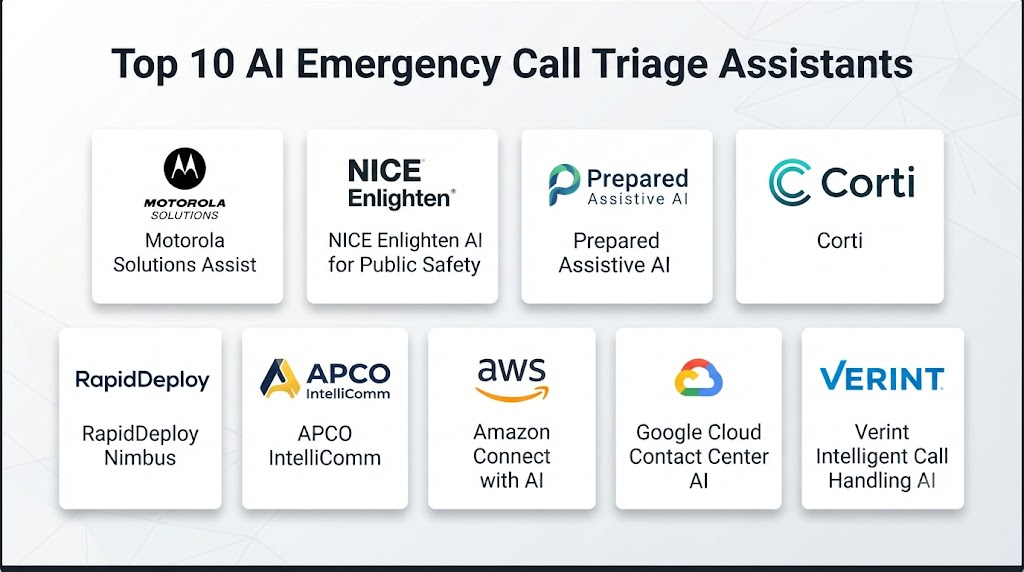
Top 10 AI Emergency Call Triage Assistants
#1 — Prepared
One-line verdict: Best for emergency communications centers seeking purpose-built AI assistance across call-taking, triage, translation, and quality assurance.
Short description:
Prepared is focused on emergency communications and provides AI-assisted capabilities for call-taking and emergency-response workflows. Its technology can support transcription, translation, call assistance, non-emergency triage, and quality assurance.
Standout Capabilities
- Emergency call assistance
- Real-time transcription
- Call summarization
- Translation
- Non-emergency triage
- Dispatcher assistance
- Quality assurance
- Training support
AI-Specific Depth
- Model support: Vendor-managed AI; exact underlying models are not publicly stated.
- RAG / knowledge integration: Agency-specific information and workflows may be supported; exact implementation varies.
- Evaluation: Quality-assurance and call-review functionality.
- Guardrails: Human-in-the-loop workflows.
- Observability: Operational analytics vary by deployment.
Pros
- Purpose-built for emergency communications
- Supports multiple call-center workflows
- Reduces repetitive administrative work
Cons
- Primarily designed for public-safety organizations
- Integration may require implementation work
- Pricing varies by deployment
Security & Compliance
Specific security architecture, certifications, retention policies, encryption, residency, and access controls should be verified during procurement.
Deployment & Platforms
- Deployment: Cloud-oriented
- Platforms: Web-based emergency communications workflows
- Self-hosted: Not publicly stated
Integrations & Ecosystem
Prepared is designed to integrate with emergency communications workflows and related public-safety systems.
- CAD workflows
- Emergency call systems
- Dispatch workflows
- Text communications
- Multimedia
- Analytics
- Agency systems
Pricing Model
Commercial enterprise pricing. Exact pricing is not publicly stated.
Best-Fit Scenarios
- 911 centers
- High-volume emergency communications
- Agencies seeking AI-assisted call handling
#2 — RapidSOS Harmony
One-line verdict: Best for emergency communications centers that need AI assistance combined with broad emergency data and incident intelligence.
Short description:
RapidSOS Harmony is an AI-focused component of the broader RapidSOS emergency communications ecosystem. It can support call transcription, summarization, translation, information processing, and emergency-response workflows.
Standout Capabilities
- AI call transcription
- Call summarization
- Translation
- Incident intelligence
- Emergency data integration
- Connected-device information
- AI-assisted workflows
- Quality assurance
AI-Specific Depth
- Model support: Vendor-managed AI; exact models are not publicly stated.
- RAG / knowledge integration: Contextual emergency information integration varies by implementation.
- Evaluation: Operational and quality-assurance capabilities.
- Guardrails: Human oversight remains important.
- Observability: Operational analytics vary by product and deployment.
Pros
- Broad emergency-data ecosystem
- Useful for reducing information overload
- Strong focus on emergency-response context
Cons
- Can require broader ecosystem integration
- Enterprise implementation can be complex
- Pricing is not publicly stated
Security & Compliance
Organizations should verify applicable security controls, certifications, retention policies, encryption, and data residency requirements.
Deployment & Platforms
- Deployment: Cloud
- Platforms: Web and emergency communications environments
- Self-hosted: Not publicly stated
Integrations & Ecosystem
- CAD systems
- Connected devices
- Emergency communications
- Text
- Video
- Location
- Vehicle information
Pricing Model
Commercial enterprise pricing.
Best-Fit Scenarios
- Large emergency communications centers
- Connected emergency-data environments
- Multi-source incident intelligence
#3 — Carbyne
One-line verdict: Best for PSAPs looking for modern emergency communications with AI-assisted call triage and multilingual support.
Short description:
Carbyne provides emergency communications technology designed for public-safety organizations. Its platform supports AI-assisted call triage, translation, summarization, and emergency communications workflows.
Standout Capabilities
- Emergency call triage
- Call summarization
- Translation
- AI-assisted call handling
- Emergency communications
- Incident information
- Call analysis
- Workflow automation
AI-Specific Depth
- Model support: Vendor-managed AI; exact models are not publicly stated.
- RAG / knowledge integration: Agency information integration varies.
- Evaluation: Product-specific evaluation capabilities vary.
- Guardrails: Human review remains part of emergency workflows.
- Observability: Operational capabilities vary by deployment.
Pros
- Purpose-built for emergency communications
- Strong call-triage focus
- Supports multilingual environments
Cons
- Primarily enterprise/public-sector focused
- Implementation may require integrations
- Pricing is not publicly stated
Security & Compliance
Security, encryption, retention, access controls, residency, and certifications should be validated for the specific deployment.
Deployment & Platforms
- Deployment: Cloud
- Platforms: Emergency communications systems
- Self-hosted: Not publicly stated
Integrations & Ecosystem
- CAD
- Emergency call systems
- Text
- Video
- Location
- Public-safety applications
Pricing Model
Commercial enterprise pricing.
Best-Fit Scenarios
- High-volume PSAPs
- Emergency call triage
- Multilingual emergency communications
#4 — Motorola Solutions Assist
One-line verdict: Best for public-safety agencies seeking AI assistance integrated across emergency communications, dispatch, and response workflows.
Short description:
Motorola Solutions applies AI across multiple public-safety workflows. Its Assist capabilities can support emergency call handling, dispatch, translation, radio information, location intelligence, and broader incident workflows.
Standout Capabilities
- Dispatcher assistance
- Emergency call support
- Transcription
- Translation
- Radio information analysis
- Location assistance
- Incident intelligence
- Responder support
AI-Specific Depth
- Model support: Vendor-managed AI; exact models are not publicly stated.
- RAG / knowledge integration: Integrates information across public-safety systems.
- Evaluation: Product-specific operational testing varies.
- Guardrails: Human confirmation is important for consequential workflows.
- Observability: Varies by Assist product.
Pros
- Broad public-safety ecosystem
- Strong integration potential
- Covers more than basic call triage
Cons
- Platform complexity
- Better suited to larger organizations
- Pricing is not publicly stated
Security & Compliance
Organizations should verify current security controls, encryption, RBAC, retention, residency, audit logging, and applicable certifications.
Deployment & Platforms
- Deployment: Cloud, hybrid, or product-dependent
- Platforms: Public-safety systems
- Self-hosted: Varies
Integrations & Ecosystem
- CAD
- Radio systems
- 911 systems
- Mobile applications
- Video
- Sensors
- Public-safety databases
Pricing Model
Commercial enterprise pricing.
Best-Fit Scenarios
- Large public-safety agencies
- Integrated dispatch operations
- Existing Motorola environments
#5 — CentralSquare CitizenLink AI
One-line verdict: Best for agencies wanting AI-assisted non-emergency call handling and integration with public-safety communications workflows.
Short description:
CentralSquare CitizenLink AI is designed to help public-safety agencies handle selected routine or non-emergency calls using conversational AI and automated workflows.
Standout Capabilities
- AI voice assistance
- Non-emergency call handling
- Caller information collection
- Call routing
- Agency information
- Call transfer
- Queue management
- Public-safety integration
AI-Specific Depth
- Model support: Vendor-managed AI; exact models are not publicly stated.
- RAG / knowledge integration: Agency-specific information can support selected workflows.
- Evaluation: Product-specific.
- Guardrails: Human escalation and transfer workflows.
- Observability: Depends on deployment.
Pros
- Can reduce routine call workload
- Useful for high-volume environments
- Designed around public-safety workflows
Cons
- Strongest fit may be existing ecosystem customers
- More focused on routine/non-emergency interactions
- Pricing is not publicly stated
Security & Compliance
Verify security, encryption, retention, access control, residency, and certification requirements during procurement.
Deployment & Platforms
- Deployment: Cloud-integrated
- Platforms: Public-safety communications environments
- Self-hosted: Not publicly stated
Integrations & Ecosystem
- CAD
- NG911 environments
- Telephony
- Agency knowledge
- Call queues
- Transfer workflows
Pricing Model
Commercial pricing.
Best-Fit Scenarios
- High non-emergency call volumes
- Public-safety agencies
- Organizations seeking routine-call automation
#6 — Axon 911
One-line verdict: Best for agencies seeking unified emergency communications and AI assistance across call-taking, dispatch, and quality workflows.
Short description:
Axon 911 combines emergency communications technology with AI-assisted capabilities. It is designed to support call-takers, dispatchers, supervisors, and quality-assurance teams.
Standout Capabilities
- AI call assistance
- Call transcription
- Translation
- Non-emergency triage
- Dispatch assistance
- Quality assurance
- Multimedia support
- Unified workflows
AI-Specific Depth
- Model support: Vendor-managed AI; exact models are not publicly stated.
- RAG / knowledge integration: Agency workflow integration varies.
- Evaluation: Quality-assurance capabilities.
- Guardrails: Human-in-the-loop workflow.
- Observability: Operational analytics vary.
Pros
- Broad emergency communications scope
- Strong workflow integration potential
- Useful for agencies seeking a unified platform
Cons
- May involve broader platform decisions
- Enterprise implementation can be complex
- Pricing is not publicly stated
Security & Compliance
Verify security architecture, encryption, access control, retention, residency, audit logging, and applicable certifications for the selected deployment.
Deployment & Platforms
- Deployment: Cloud-oriented
- Platforms: Web and public-safety applications
- Self-hosted: Not publicly stated
Integrations & Ecosystem
- CAD
- Dispatch
- Emergency calls
- Multimedia
- Responder workflows
- QA
- Public-safety applications
Pricing Model
Commercial enterprise pricing.
Best-Fit Scenarios
- Large 911 centers
- Agencies seeking unified workflows
- Existing Axon environments
#7 — Amazon Connect
One-line verdict: Best for technically capable organizations building customized AI-assisted emergency communication workflows.
Short description:
Amazon Connect is a cloud contact-center platform rather than a specialized emergency call-triage product. Organizations can combine it with AI, speech, analytics, databases, and custom applications to build specialized workflows.
Standout Capabilities
- Cloud contact center
- Voice workflows
- Call routing
- AI integration
- APIs
- Workflow automation
- Analytics
- Custom applications
AI-Specific Depth
- Model support: Depends on the selected AI services.
- RAG / knowledge integration: Can be implemented using appropriate cloud services.
- Evaluation: Depends on the application architecture.
- Guardrails: Must be designed into the solution.
- Observability: Cloud monitoring and application telemetry can support monitoring.
Pros
- Highly programmable
- Large cloud ecosystem
- Flexible for custom applications
Cons
- Not purpose-built for emergency triage
- Requires engineering
- Emergency resilience must be carefully designed
Security & Compliance
Security capabilities depend on selected services and configuration. Agencies must evaluate the complete application architecture.
Deployment & Platforms
- Deployment: Cloud
- Platforms: APIs, web applications, telephony
- Self-hosted: Not the primary model
Integrations & Ecosystem
- Telephony
- AI services
- Databases
- APIs
- Analytics
- Contact-center systems
- Custom applications
Pricing Model
Usage-based cloud pricing.
Best-Fit Scenarios
- Custom emergency communication solutions
- Engineering-led organizations
- Existing cloud environments
#8 — Google Cloud AI
One-line verdict: Best for organizations developing customized AI-powered call workflows using a broad cloud AI ecosystem.
Short description:
Google Cloud provides speech, conversational AI, translation, analytics, machine learning, and application-development services that can support custom emergency communications solutions.
Standout Capabilities
- Speech recognition
- Conversational AI
- Translation
- Call analytics
- Machine learning
- APIs
- Cloud infrastructure
- Custom application development
AI-Specific Depth
- Model support: Multiple AI services and model options.
- RAG / knowledge integration: Supported through appropriate cloud AI architectures.
- Evaluation: Available depending on selected AI services.
- Guardrails: Application and platform controls.
- Observability: Cloud monitoring and logging.
Pros
- Broad AI ecosystem
- Strong speech capabilities
- Flexible development environment
Cons
- Not a turnkey emergency call platform
- Requires custom development
- Emergency reliability must be engineered
Security & Compliance
Security and compliance depend on services, region, architecture, and configuration.
Deployment & Platforms
- Deployment: Cloud
- Platforms: APIs and web applications
- Self-hosted: Varies
Integrations & Ecosystem
- Speech
- Translation
- AI models
- Databases
- APIs
- Analytics
- Cloud infrastructure
Pricing Model
Usage-based cloud pricing.
Best-Fit Scenarios
- Custom emergency AI
- Cloud-native organizations
- Engineering teams
#9 — Microsoft Azure AI
One-line verdict: Best for enterprise teams building customized emergency call intelligence within a broader Microsoft technology environment.
Short description:
Azure provides speech, translation, AI, machine learning, analytics, application development, and data services that can be combined to create emergency call assistance solutions.
Standout Capabilities
- Speech recognition
- Translation
- AI application development
- Machine learning
- Conversational AI
- Analytics
- APIs
- Enterprise integration
AI-Specific Depth
- Model support: Multiple AI services and model options.
- RAG / knowledge integration: Supported through Azure AI architectures.
- Evaluation: Available depending on selected services.
- Guardrails: Platform and application-level controls.
- Observability: Azure monitoring and telemetry capabilities.
Pros
- Strong enterprise AI ecosystem
- Flexible development options
- Broad integration capabilities
Cons
- Requires development expertise
- Not a dedicated emergency call-triage platform
- Emergency resilience requires careful engineering
Security & Compliance
Azure provides broad security and compliance capabilities, but organizations must validate the exact services, configurations, and requirements applicable to their deployment.
Deployment & Platforms
- Deployment: Cloud / hybrid
- Platforms: APIs, enterprise applications, web
- Self-hosted: Varies
Integrations & Ecosystem
- Speech
- Translation
- AI models
- Databases
- APIs
- Analytics
- Enterprise applications
Pricing Model
Usage-based cloud pricing.
Best-Fit Scenarios
- Enterprise AI development
- Custom emergency applications
- Microsoft-centric organizations
#10 — NVIDIA AI Enterprise
One-line verdict: Best for technically advanced organizations building customized and controlled AI infrastructure for emergency communication workloads.
Short description:
NVIDIA AI Enterprise provides software and infrastructure for developing and deploying AI applications. It is not a complete emergency-call triage product, but it can support organizations building specialized AI systems.
Standout Capabilities
- AI development
- Speech processing
- Generative AI
- Machine learning
- Model deployment
- GPU acceleration
- Enterprise AI infrastructure
- Custom applications
AI-Specific Depth
- Model support: Broad model ecosystem depending on implementation.
- RAG / knowledge integration: Supports retrieval-based AI architectures.
- Evaluation: Depends on the application.
- Guardrails: Must be implemented through the application architecture.
- Observability: Depends on the deployment environment.
Pros
- Strong AI infrastructure
- Flexible architecture
- Suitable for private AI environments
Cons
- Requires significant technical expertise
- Not a turnkey emergency platform
- Infrastructure costs can become significant
Security & Compliance
Security and compliance depend on the deployment architecture and selected technologies. Specific certifications should be verified for the intended environment.
Deployment & Platforms
- Deployment: Cloud / self-hosted / hybrid
- Platforms: GPU-enabled infrastructure
- Self-hosted: Supported
Integrations & Ecosystem
- AI models
- Speech systems
- GPUs
- Kubernetes
- APIs
- Data platforms
- Custom applications
Pricing Model
Commercial enterprise licensing and infrastructure costs vary.
Best-Fit Scenarios
- Custom emergency AI
- Private AI infrastructure
- Advanced engineering teams
Comparison Table
| Tool Name | Best For | Deployment | Model Flexibility | Strength | Watch-Out | Public Rating |
|---|---|---|---|---|---|---|
| Prepared | 911 call assistance | Cloud | Vendor-managed | Purpose-built emergency AI | Enterprise implementation | |
| RapidSOS Harmony | Emergency intelligence | Cloud | Vendor-managed | Connected emergency data | Ecosystem complexity | |
| Carbyne | Call triage | Cloud | Vendor-managed | Emergency communications | Enterprise focus | |
| Motorola Solutions Assist | Public-safety AI | Cloud / Hybrid | Vendor-managed | Broad public-safety ecosystem | Platform complexity | |
| CentralSquare CitizenLink AI | Non-emergency calls | Cloud | Vendor-managed | Call workload reduction | Ecosystem dependency | |
| Axon 911 | Unified 911 workflows | Cloud | Vendor-managed | Integrated workflow | Platform adoption | |
| Amazon Connect | Custom systems | Cloud | Multi-model ecosystem | Programmability | Requires development | |
| Google Cloud AI | Custom AI | Cloud | Multi-model | AI ecosystem | Not turnkey | |
| Microsoft Azure AI | Enterprise custom AI | Cloud / Hybrid | Multi-model | Enterprise flexibility | Requires engineering | |
| NVIDIA AI Enterprise | Private/custom AI | Cloud / Hybrid / Self-hosted | Multi-model | AI infrastructure | Technical complexity |
Scoring & Evaluation
The following scores are comparative rather than absolute. They should be treated as a starting framework for vendor evaluation rather than a substitute for a real-world agency pilot.
The scoring emphasizes emergency-specific functionality, AI reliability, integrations, safety, cost, security, and operational support.
| Tool | Core | Reliability/Eval | Guardrails | Integrations | Ease | Perf/Cost | Security/Admin | Support | Weighted Total |
|---|---|---|---|---|---|---|---|---|---|
| Prepared | 10 | 9 | 9 | 9 | 9 | 8 | 9 | 9 | 9.00 |
| RapidSOS Harmony | 10 | 9 | 9 | 10 | 8 | 8 | 9 | 9 | 8.95 |
| Carbyne | 10 | 9 | 9 | 9 | 8 | 8 | 9 | 9 | 8.85 |
| Motorola Solutions Assist | 10 | 9 | 10 | 10 | 7 | 8 | 10 | 10 | 9.15 |
| CentralSquare CitizenLink AI | 8 | 8 | 9 | 9 | 9 | 9 | 9 | 9 | 8.70 |
| Axon 911 | 10 | 9 | 9 | 10 | 8 | 8 | 10 | 10 | 9.10 |
| Amazon Connect | 7 | 8 | 8 | 10 | 7 | 8 | 10 | 10 | 8.25 |
| Google Cloud AI | 7 | 9 | 9 | 10 | 7 | 8 | 10 | 10 | 8.55 |
| Microsoft Azure AI | 7 | 9 | 9 | 10 | 7 | 8 | 10 | 10 | 8.55 |
| NVIDIA AI Enterprise | 8 | 9 | 8 | 9 | 6 | 9 | 9 | 9 | 8.30 |
Top 3 for Enterprise
- Motorola Solutions Assist
- Axon 911
- RapidSOS Harmony
Top 3 for SMB
- Prepared
- CentralSquare CitizenLink AI
- Carbyne
Top 3 for Developers
- Microsoft Azure AI
- Google Cloud AI
- NVIDIA AI Enterprise
Which AI Emergency Call Triage Assistant Is Right for You?
Solo / Freelancer
Most specialized emergency call-triage platforms are not designed for individual users.
For experimentation or application development, a developer may instead use general-purpose speech recognition, AI, translation, and analytics technologies.
However, real emergency-call data should never be used casually for experimentation.
Prioritize:
- Synthetic datasets
- Secure development environments
- Speech recognition
- Translation
- APIs
- Evaluation frameworks
- Data protection
SMB
Smaller emergency communications organizations should focus on simplicity.
Look for:
- Easy deployment
- Existing CAD integration
- Transcription
- Translation
- Non-emergency automation
- Human escalation
- Simple administration
- Predictable operating costs
Avoid selecting a platform solely because it offers the largest number of AI features.
Mid-Market
Mid-market agencies should evaluate how the technology performs across multiple teams, locations, and call types.
Important considerations include:
- Multiple PSAPs
- Shared dispatch
- Call volume
- Multilingual requirements
- CAD integration
- Security
- Data retention
- Quality assurance
- AI monitoring
Start with assistive features and expand gradually.
Enterprise
Enterprise organizations should evaluate the entire emergency communications architecture.
Prioritize:
- High availability
- Disaster recovery
- Multi-center support
- CAD integration
- Security
- Data governance
- AI monitoring
- Auditability
- Model governance
- Integration flexibility
Procurement should involve IT, emergency communications leadership, cybersecurity, privacy, legal, dispatch, and procurement teams.
Regulated Industries and Public Sector
Emergency communications involve sensitive personal information and potentially life-critical decisions.
Organizations should evaluate:
- Data minimization
- Encryption
- Access controls
- Retention
- Data residency
- Audit logs
- Vendor access
- AI governance
- Human oversight
- Incident response
- Business continuity
Budget vs Premium
A lower-cost approach may begin with:
- Transcription
- Basic summaries
- Translation
- Call analytics
Premium systems can offer:
- Emergency-specific workflows
- CAD integration
- Advanced triage
- Multimodal intelligence
- Connected data
- Dispatch assistance
- Enterprise support
Build vs Buy
Build when:
- You have a strong engineering team.
- Your workflows are highly specialized.
- You require deep architectural control.
- Existing products cannot meet your integration requirements.
Buy when:
- Reliability is critical.
- You need emergency-specific functionality.
- You want existing CAD integrations.
- Internal AI expertise is limited.
- You need vendor support.
For emergency communications, building an AI system is significantly more complicated than simply connecting a speech-to-text API to a language model.
Implementation Playbook: 30 / 60 / 90 Days
First 30 Days: Pilot + Success Metrics
Start with lower-risk assistive capabilities.
Good pilot areas include:
- Transcription
- Summarization
- Translation
- Information extraction
Define measurable metrics such as:
- Transcription accuracy
- Summary accuracy
- Translation quality
- Critical information capture
- False positives
- False negatives
- Latency
- Operator satisfaction
- Time saved
Create an evaluation dataset using authorized and appropriately protected information.
Days 31–60: Security + Evaluation + Rollout
Implement:
- Access controls
- Encryption
- Data retention rules
- Audit logging
- Model versioning
- Prompt/version management
- AI incident procedures
- Human escalation procedures
Test difficult conditions such as:
- Background noise
- Multiple speakers
- Accents
- Emotional callers
- Poor-quality audio
- Different languages
- Medical terminology
- Incomplete information
- Conflicting information
The system should be tested against realistic emergency conditions rather than ideal laboratory conditions.
Days 61–90: Optimize + Govern + Scale
After successful pilot validation:
- Optimize latency.
- Tune alert thresholds.
- Reduce unnecessary notifications.
- Improve CAD integration.
- Monitor AI performance.
- Track infrastructure costs.
- Establish model-change procedures.
- Build operational dashboards.
- Create AI incident-response procedures.
- Expand gradually to additional workflows.
Human operators should continue to control consequential decisions.
Common Mistakes and How to Avoid Them
- Treating AI output as fact: Always validate important AI-generated information.
- Automating too quickly: Start with assistive workflows.
- Ignoring false negatives: Missing an important emergency detail can be dangerous.
- Ignoring false positives: Excessive alerts can increase dispatcher workload.
- Testing only clean audio: Emergency calls often contain noise and interruptions.
- Ignoring accents: Speech recognition should be tested across representative caller populations.
- Ignoring multilingual quality: Translation errors can materially change emergency information.
- Poor data governance: Emergency calls may contain highly sensitive personal information.
- Weak CAD integration: Disconnected AI tools can create more work instead of less.
- Ignoring outages: Emergency systems require strong resilience.
- No human override: Operators need control over AI-generated recommendations.
- No evaluation framework: Production AI should be tested continuously.
- No model monitoring: Performance may change after model updates.
- No version control: Agencies should know what model and configuration produced an output.
- No auditability: Important AI-assisted actions should be traceable.
- Ignoring vendor lock-in: Evaluate portability before adopting a platform deeply.
FAQs
What is an AI Emergency Call Triage Assistant?
An AI Emergency Call Triage Assistant uses artificial intelligence to help emergency communications personnel process calls, extract information, summarize conversations, translate languages, and support call categorization.
Can AI replace emergency call operators?
AI should generally be viewed as an assistant rather than a replacement for trained emergency telecommunicators. Human judgment remains essential for high-consequence decisions.
Can AI automatically prioritize emergency calls?
Some platforms provide AI-assisted triage and categorization. Agencies should determine the appropriate level of automation based on testing, policies, and operational requirements.
Can AI transcribe emergency calls in real time?
Yes. Real-time speech transcription is one of the most common capabilities associated with AI emergency call assistance.
Can AI translate emergency calls?
Yes. AI-powered translation can assist with multilingual emergency communications. Agencies should test translation quality with the languages, terminology, and audio conditions they actually encounter.
Can AI handle non-emergency calls?
Yes. Some AI assistants can handle selected routine requests, collect information, provide approved responses, or transfer callers to human operators.
What information can AI extract from an emergency call?
Depending on the system, AI can identify information such as locations, names, incident descriptions, people involved, vehicles, medical details, hazards, and other relevant information.
Is AI emergency call triage secure?
Security varies between vendors and implementations. Organizations should evaluate encryption, access control, data retention, audit logging, data residency, vendor access, and overall system architecture.
Can AI Emergency Call Triage Assistants be self-hosted?
Some underlying AI technologies can be deployed on private infrastructure, but specialized emergency communications products often use managed or cloud deployments. Exact options vary by platform.
How should an agency evaluate an AI emergency call system?
The agency should conduct a controlled pilot using representative and properly authorized data. Evaluation should include accuracy, latency, false positives, false negatives, operator workload, security, reliability, and integration performance.
How much do AI Emergency Call Triage Assistants cost?
There is no single standard price. Costs can depend on call volume, number of users, AI processing, integrations, deployment architecture, support, and contractual requirements.
What is the difference between AI transcription and AI call triage?
Transcription converts spoken conversation into text. Call triage goes further by helping categorize calls, identify relevant information, and support emergency communication workflows.
Can AI identify duplicate emergency calls?
Some AI systems can compare calls and identify similarities that may indicate multiple reports of the same incident. Agencies should validate accuracy before using this capability operationally.
Can these tools integrate with CAD systems?
Many specialized public-safety platforms are designed to integrate with CAD and dispatch workflows. The exact integration capabilities depend on the product and the agency’s existing CAD environment.
Why is human oversight important?
Emergency communications involve high-consequence decisions. AI can make mistakes, misunderstand callers, or produce incomplete information, so trained human operators should retain appropriate control.
Conclusion
AI Emergency Call Triage Assistants are evolving from basic speech-to-text tools into broader AI-powered emergency communications systems.he best solution depends on the organization’s size, call volume, CAD environment, staffing, languages, security requirements, technical capabilities, and desired level of automation.Purpose-built platforms such as Prepared, RapidSOS Harmony, Carbyne, Motorola Solutions Assist, CentralSquare CitizenLink AI, and Axon 911 are particularly relevant for agencies looking for emergency-specific functionality. Organizations with substantial engineering resources may instead build specialized solutions using cloud AI or private AI infrastructure.