Introduction
AI Language Learning Conversation Bots are AI-powered learning tools that let students practice speaking, listening, vocabulary, grammar, and everyday communication through interactive conversations. Instead of completing only static exercises, learners can communicate with an AI character or tutor that responds dynamically and provides opportunities to practice realistic situations.
These tools are especially useful for learners who have limited access to native speakers or feel uncomfortable making mistakes in front of other people. AI conversation partners can simulate situations such as ordering food, attending an interview, traveling, meeting someone, or participating in a classroom discussion.
Best for: Language learners, students, travelers, professionals, immigrants, international students, schools, language tutors, and organizations providing language training.
Not ideal for: Learners who need highly specialized human pronunciation coaching, formal certification assessment, or situations where AI-generated corrections must be guaranteed to be linguistically perfect.
What Are AI Language Learning Conversation Bots?
AI Language Learning Conversation Bots use conversational AI to simulate interactions between a learner and an artificial conversation partner.
Traditional language-learning applications often rely on:
- Flashcards
- Grammar exercises
- Vocabulary lists
- Multiple-choice questions
- Pre-recorded dialogues
Conversation bots add an interactive layer.
A learner can type or speak something such as:
“I’d like to book a room for two nights.”
The AI may respond as a hotel receptionist and continue the conversation.
The learner can then practice naturally instead of simply selecting a predefined answer.
Modern systems can also adapt conversations to:
- Language level
- Vocabulary
- Subject
- Professional context
- Learning goals
- Previous mistakes
- Conversation difficulty
How AI Language Conversation Bots Work
Speech Recognition
When the learner speaks, the system converts the audio into text.
Language Understanding
The AI interprets the learner’s meaning and determines an appropriate response.
Conversation Generation
A language model generates the next response based on the context.
Pronunciation Analysis
Some platforms analyze speech and provide feedback on pronunciation or fluency.
Correction
The system can identify possible:
- Grammar errors
- Vocabulary mistakes
- Awkward expressions
- Pronunciation issues
- Sentence-structure problems
Adaptive Difficulty
Advanced systems can increase or reduce conversation complexity according to learner performance.
Why AI Conversation Bots Matter
Speaking practice is one of the most difficult parts of language learning to access consistently.
A learner may understand grammar and vocabulary but still struggle to produce language spontaneously.
AI conversation bots can provide a low-pressure environment where learners can repeatedly practice.
Potential benefits include:
- More speaking opportunities
- Immediate feedback
- Flexible practice
- Lower anxiety
- Personalized conversations
- Vocabulary reinforcement
- Realistic role-play
- Better conversational confidence
The most important benefit is repetition. Learners can practice the same type of interaction multiple times without needing to coordinate with another person.
Key Features to Look For
When evaluating AI language conversation tools, consider:
- Voice conversations
- Text conversations
- Real-time responses
- Pronunciation feedback
- Grammar correction
- Vocabulary suggestions
- Role-play scenarios
- Adjustable difficulty
- Multiple languages
- Accent support
- Conversation history
- Personalized lessons
- Progress tracking
- Speech recognition
- Translation
- Custom topics
- AI characters
- Human tutor integration
- Mobile applications
- Web access
- Privacy controls
- Data retention
- Offline functionality
Major Use Cases
Everyday Conversation
Learners can practice greetings, introductions, shopping, restaurants, travel, and social situations.
Travel Preparation
AI can simulate airport, hotel, restaurant, transportation, and emergency conversations.
Job Interviews
Learners can practice answering common interview questions in another language.
Business Language
Professionals can rehearse presentations, meetings, negotiations, and workplace conversations.
Pronunciation Practice
Voice-based systems allow learners to repeatedly practice difficult words and phrases.
Exam Preparation
Conversation bots can simulate oral-language practice and question-answer scenarios.
Children and Students
Educational conversation systems can provide additional practice outside classroom hours.
Immersion
Learners can create frequent conversational practice without living in a country where the target language is spoken.
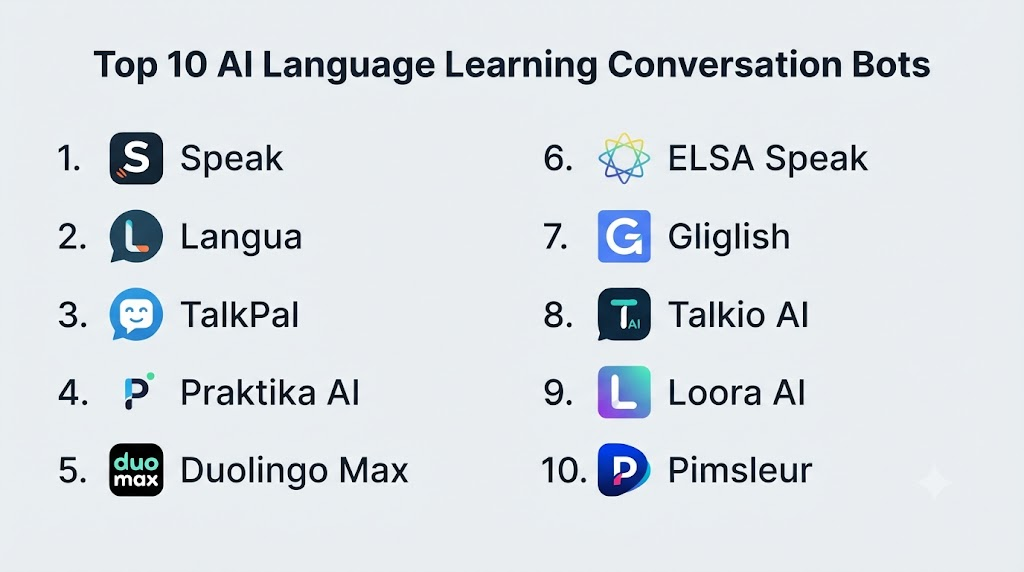
Top 10 AI Language Learning Conversation Bots
1. Duolingo Max
One-line verdict: Best for learners who want conversational AI practice integrated into a mainstream language-learning curriculum.
Short description:
Duolingo combines structured language lessons with AI-powered features in its higher-tier learning experience. Its AI capabilities can provide conversational practice and explanations while keeping learners within the broader Duolingo learning environment.
Standout Capabilities
- AI-supported conversation practice
- Role-play experiences
- Grammar explanations
- Structured lessons
- Vocabulary development
- Speaking exercises
- Interactive learning
- Progress tracking
AI-Specific Depth
- Model support: Managed AI capabilities.
- RAG / knowledge integration: Primarily integrated with the Duolingo learning environment.
- Evaluation: Learner performance and exercise results support progression.
- Guardrails: Platform-level educational and safety controls vary.
- Observability: Learning progress and activity tracking.
Pros
- Combines AI conversation with structured lessons
- Beginner-friendly experience
- Strong gamification and engagement
Cons
- Advanced AI features may require a specific subscription
- Conversation practice is part of a broader ecosystem rather than a standalone tutor
- Language and feature availability vary
Security & Compliance
Privacy and account controls vary by product and region. Organizations should review current policies before using the platform for institutional learning.
Deployment & Platforms
- Deployment: Cloud
- Platforms: Web, iOS, Android
- Self-hosted: Not publicly stated
Integrations & Ecosystem
- Language courses
- Mobile applications
- Speaking exercises
- AI role-play
- Progress tracking
- Learning activities
Pricing Model
Free and subscription-based offerings vary.
Best-Fit Scenarios
- Beginner language learning
- Daily speaking practice
- Casual conversational practice
2. Speak
One-line verdict: Best for learners who want intensive AI-powered speaking practice with real-time conversational feedback.
Short description:
Speak focuses heavily on speaking practice and conversational language learning. Learners can interact with AI through voice-based scenarios and receive feedback designed to improve spoken communication.
Standout Capabilities
- AI speaking practice
- Voice conversations
- Real-time interaction
- Role-play
- Pronunciation practice
- Vocabulary reinforcement
- Personalized lessons
- Conversation feedback
AI-Specific Depth
- Model support: Managed conversational AI.
- RAG / knowledge integration: Learning context and lesson material integration.
- Evaluation: Speech and learning performance provide feedback.
- Guardrails: Platform-level controls vary.
- Observability: Learner progress and activity tracking.
Pros
- Strong speaking focus
- Interactive voice experience
- Useful real-world scenarios
Cons
- Primarily focused on speaking
- Language availability varies
- AI feedback should not replace expert pronunciation coaching when precision is critical
Security & Compliance
Review current privacy and data-retention practices before using it for sensitive institutional programs.
Deployment & Platforms
- Deployment: Cloud
- Platforms: Web and mobile
- Self-hosted: Not publicly stated
Integrations & Ecosystem
- Voice learning
- AI conversations
- Mobile apps
- Speaking exercises
- Personalized lessons
Pricing Model
Subscription-based options vary.
Best-Fit Scenarios
- Speaking fluency
- Travel preparation
- Everyday conversation
3. Praktika
One-line verdict: Best for learners who prefer AI avatars and immersive conversational scenarios for practical language speaking practice.
Short description:
Praktika provides AI-powered language-learning experiences centered around virtual characters and interactive conversations. Learners can practice speaking through simulated real-world situations.
Standout Capabilities
- AI avatars
- Voice conversations
- Role-play
- Pronunciation practice
- Conversational exercises
- Personalized feedback
- Scenario-based learning
- Language practice
AI-Specific Depth
- Model support: Managed AI capabilities.
- RAG / knowledge integration: Learning and scenario context.
- Evaluation: Conversation and speaking performance feedback.
- Guardrails: Platform controls vary.
- Observability: Learner progress tracking varies.
Pros
- Immersive conversation experience
- Engaging AI characters
- Good for repeated speaking practice
Cons
- Avatar-based learning may not appeal to everyone
- AI feedback can contain limitations
- Advanced institutional controls may vary
Security & Compliance
Review current data-processing and privacy policies before institutional deployment.
Deployment & Platforms
- Deployment: Cloud
- Platforms: Mobile and supported environments
- Self-hosted: Not publicly stated
Integrations & Ecosystem
- AI avatars
- Voice interaction
- Mobile learning
- Conversation scenarios
- Language lessons
Pricing Model
Subscription and plan availability vary.
Best-Fit Scenarios
- Conversational practice
- Beginner and intermediate learners
- Immersive learning
4. TalkPal
One-line verdict: Best for flexible AI conversation practice across multiple languages and everyday learning situations.
Short description:
TalkPal provides AI-powered language practice through interactive conversations and role-play. Learners can use text and voice-based interactions to practice language in different contexts.
Standout Capabilities
- AI conversations
- Voice practice
- Role-play
- Multiple languages
- Personalized topics
- Pronunciation practice
- Grammar correction
- Learning activities
AI-Specific Depth
- Model support: Managed conversational AI.
- RAG / knowledge integration: Learning context varies.
- Evaluation: Conversation and language feedback.
- Guardrails: Platform controls vary.
- Observability: Progress tracking varies.
Pros
- Flexible conversation topics
- Supports multiple languages
- Accessible conversational practice
Cons
- AI corrections require independent verification for advanced learners
- Feature availability varies by language
- Not a replacement for formal instruction
Security & Compliance
Verify current privacy and data-retention information before sharing sensitive information during conversations.
Deployment & Platforms
- Deployment: Cloud
- Platforms: Web and mobile
- Self-hosted: Not publicly stated
Integrations & Ecosystem
- Voice
- Text
- AI role-play
- Mobile apps
- Language learning
- Conversation practice
Pricing Model
Free and paid options vary.
Best-Fit Scenarios
- Casual practice
- Travel language
- Intermediate learners
5. Loora
One-line verdict: Best for learners seeking AI English-speaking practice with conversational feedback and confidence-building exercises.
Short description:
Loora focuses on AI-powered English speaking practice. Learners can have conversations with an AI partner and receive feedback intended to improve spoken communication.
Standout Capabilities
- English conversation
- Voice interaction
- Pronunciation practice
- Grammar feedback
- Vocabulary
- Conversation scenarios
- Personalized practice
- Speaking confidence
AI-Specific Depth
- Model support: Managed AI.
- RAG / knowledge integration: Learning context varies.
- Evaluation: Speech and conversation feedback.
- Guardrails: Platform controls vary.
- Observability: Learning progress varies.
Pros
- Focused English speaking experience
- Convenient practice
- Useful for confidence building
Cons
- Primarily English-focused
- AI feedback is not equivalent to expert instruction
- Feature availability may change
Security & Compliance
Review current privacy and data-use policies before using it with sensitive personal or institutional information.
Deployment & Platforms
- Deployment: Cloud
- Platforms: Web and mobile
- Self-hosted: Not publicly stated
Integrations & Ecosystem
- Voice conversations
- English practice
- AI feedback
- Mobile learning
- Personalized scenarios
Pricing Model
Subscription options vary.
Best-Fit Scenarios
- English speaking
- Job-interview practice
- Daily conversation
6. ELSA Speak
One-line verdict: Best for English learners who want detailed pronunciation and speaking-focused AI feedback.
Short description:
ELSA Speak is focused on English pronunciation and speaking improvement. It uses speech technology to evaluate learner pronunciation and provide targeted practice.
Standout Capabilities
- Pronunciation analysis
- Speaking practice
- AI feedback
- Vocabulary
- Speech recognition
- Personalized exercises
- Conversation practice
- Progress tracking
AI-Specific Depth
- Model support: Managed speech and AI technology.
- RAG / knowledge integration: Primarily learning-content based.
- Evaluation: Speech recognition and pronunciation assessment.
- Guardrails: Platform controls vary.
- Observability: Learner progress and speaking performance.
Pros
- Strong pronunciation focus
- Useful English speaking practice
- Detailed speech-oriented feedback
Cons
- Primarily focused on English
- Pronunciation scores should be interpreted as guidance rather than absolute linguistic judgments
- Advanced conversation needs may require additional tools
Security & Compliance
Review current privacy and data-processing information before institutional deployment.
Deployment & Platforms
- Deployment: Cloud
- Platforms: Web and mobile
- Self-hosted: Not publicly stated
Integrations & Ecosystem
- Speech recognition
- Pronunciation exercises
- Mobile learning
- AI feedback
- Speaking practice
Pricing Model
Free and subscription options vary.
Best-Fit Scenarios
- English pronunciation
- Speaking improvement
- Accent practice
7. Memrise
One-line verdict: Best for learners combining AI conversational practice with vocabulary, phrases, and practical language-learning content.
Short description:
Memrise combines language-learning content with conversational and AI-supported practice. Its approach emphasizes useful phrases and practical communication alongside vocabulary development.
Standout Capabilities
- AI conversation
- Vocabulary learning
- Phrase practice
- Listening
- Speaking
- Real-world language content
- Personalized learning
- Progress tracking
AI-Specific Depth
- Model support: Managed AI capabilities.
- RAG / knowledge integration: Learning-content context.
- Evaluation: Practice performance and learning progress.
- Guardrails: Platform-level controls vary.
- Observability: Progress tracking.
Pros
- Practical vocabulary
- Conversational learning
- Useful for travel and everyday situations
Cons
- AI conversation is part of a broader learning platform
- Language capabilities vary
- AI-generated feedback should be reviewed
Security & Compliance
Verify current privacy and retention practices for institutional use.
Deployment & Platforms
- Deployment: Cloud
- Platforms: Web and mobile
- Self-hosted: Not publicly stated
Integrations & Ecosystem
- Vocabulary
- Video content
- Speaking
- AI conversations
- Mobile applications
- Language courses
Pricing Model
Free and paid plans vary.
Best-Fit Scenarios
- Travel preparation
- Vocabulary building
- Everyday communication
8. Langua
One-line verdict: Best for learners who want AI-driven conversational immersion and realistic speaking scenarios across multiple languages.
Short description:
Langua focuses on conversational language practice with AI. Learners can interact through realistic scenarios designed to encourage spontaneous communication rather than only memorized responses.
Standout Capabilities
- AI conversation
- Voice interaction
- Role-play
- Scenario-based practice
- Vocabulary assistance
- Conversation correction
- Multiple languages
- Immersion
AI-Specific Depth
- Model support: Managed conversational AI.
- RAG / knowledge integration: Learning context and conversation history.
- Evaluation: Conversation performance and corrections.
- Guardrails: Platform controls vary.
- Observability: Learner activity and progress vary.
Pros
- Strong immersion focus
- Natural conversation practice
- Useful for intermediate learners
Cons
- AI conversation quality can vary
- Advanced learners may require human feedback
- Feature availability varies
Security & Compliance
Review current privacy and data-handling policies before sharing personal or sensitive information.
Deployment & Platforms
- Deployment: Cloud
- Platforms: Web and supported mobile environments
- Self-hosted: Not publicly stated
Integrations & Ecosystem
- Voice
- AI characters
- Role-play
- Conversation history
- Language learning
Pricing Model
Subscription options vary.
Best-Fit Scenarios
- Intermediate speaking
- Immersion practice
- Travel preparation
9. Univerbal
One-line verdict: Best for learners who want AI-powered conversation practice designed around practical everyday speaking situations.
Short description:
Univerbal provides AI-based conversational language practice. It is designed to let learners practice conversations without requiring a human conversation partner for every session.
Standout Capabilities
- AI conversation
- Voice practice
- Role-play
- Personalized scenarios
- Multiple languages
- Vocabulary support
- Conversation feedback
- Speaking practice
AI-Specific Depth
- Model support: Managed AI.
- RAG / knowledge integration: Conversation context varies.
- Evaluation: Language feedback and conversation performance.
- Guardrails: Platform controls vary.
- Observability: Learning progress varies.
Pros
- Convenient conversation partner
- Practical role-play
- Flexible practice
Cons
- AI feedback requires judgment
- Language support varies
- Less suitable for formal assessment
Security & Compliance
Review current privacy and data policies before institutional use.
Deployment & Platforms
- Deployment: Cloud
- Platforms: Web/mobile availability varies
- Self-hosted: Not publicly stated
Integrations & Ecosystem
- Voice conversations
- Role-play
- Language practice
- AI feedback
- Learning workflows
Pricing Model
Pricing and availability vary.
Best-Fit Scenarios
- Everyday speaking
- Travel practice
- Conversational confidence
10. ChatGPT
One-line verdict: Best for flexible conversational practice, role-play, explanations, and customized language-learning interactions.
Short description:
ChatGPT can function as a flexible AI language conversation partner when configured with a clear learning goal. Learners can ask it to role-play situations, correct grammar, explain vocabulary, conduct mock interviews, or maintain conversations at a chosen difficulty level.
Standout Capabilities
- Open-ended conversations
- Role-play
- Grammar explanations
- Vocabulary practice
- Translation
- Writing correction
- Speaking workflows
- Customized learning exercises
AI-Specific Depth
- Model support: Managed AI models.
- RAG / knowledge integration: Capabilities vary by product and configuration.
- Evaluation: Learners can request corrections, quizzes, and structured feedback.
- Guardrails: Platform safety controls apply.
- Observability: Usage and account capabilities vary.
Pros
- Extremely flexible
- Can adapt to many learning goals
- Useful for role-play and explanations
Cons
- Requires good prompting for consistent learning workflows
- AI corrections can occasionally be imperfect
- Not specifically designed as a language-learning curriculum
Security & Compliance
Privacy and organizational controls depend on the specific ChatGPT product and account configuration.
Deployment & Platforms
- Deployment: Cloud
- Platforms: Web, desktop, and mobile
- Self-hosted: Not generally applicable
Integrations & Ecosystem
- Text conversations
- Voice interactions
- File-based learning
- Customized instructions
- Educational workflows
- AI tutoring
Pricing Model
Free and paid offerings vary.
Best-Fit Scenarios
- Personalized conversation practice
- Role-playing
- Advanced language learning
Comparison Table
| Tool | Best For | Deployment | Model Flexibility | Strength | Watch-Out | Public Rating |
|---|---|---|---|---|---|---|
| Duolingo Max | Structured AI language learning | Cloud | Managed | Curriculum + AI | Feature availability varies | N/A |
| Speak | Speaking practice | Cloud | Managed | Voice conversations | Language availability varies | N/A |
| Praktika | AI avatar practice | Cloud | Managed | Immersive role-play | AI feedback limitations | N/A |
| TalkPal | Multilingual conversation | Cloud | Managed | Flexible practice | Accuracy varies | N/A |
| Loora | English speaking | Cloud | Managed | Speaking confidence | Primarily English | N/A |
| ELSA Speak | Pronunciation | Cloud | Managed | Speech feedback | English-focused | N/A |
| Memrise | Practical language | Cloud | Managed | Vocabulary + conversation | Feature availability varies | N/A |
| Langua | Conversational immersion | Cloud | Managed | Realistic scenarios | Human review still useful | N/A |
| Univerbal | Everyday speaking | Cloud | Managed | Practical role-play | Language support varies | N/A |
| ChatGPT | Flexible language practice | Cloud | Managed | Custom conversations | Requires structured prompts | N/A |
Scoring & Evaluation
The scores below are comparative editorial assessments rather than official vendor ratings. Language quality can vary significantly according to the language, accent, learner level, speech-recognition conditions, and type of feedback required.
| Tool | Core | Reliability/Eval | Guardrails | Integrations | Ease | Perf/Cost | Security/Admin | Support | Weighted Total |
|---|---|---|---|---|---|---|---|---|---|
| Duolingo Max | 10 | 9 | 9 | 9 | 10 | 9 | 9 | 9 | 9.25 |
| Speak | 9 | 9 | 9 | 8 | 9 | 9 | 8 | 9 | 8.85 |
| Praktika | 9 | 8 | 8 | 8 | 9 | 8 | 8 | 8 | 8.25 |
| TalkPal | 9 | 8 | 8 | 8 | 9 | 9 | 8 | 8 | 8.40 |
| Loora | 8 | 9 | 9 | 8 | 10 | 9 | 8 | 8 | 8.65 |
| ELSA Speak | 9 | 9 | 9 | 8 | 9 | 9 | 8 | 9 | 8.90 |
| Memrise | 9 | 9 | 9 | 9 | 9 | 9 | 8 | 9 | 8.95 |
| Langua | 9 | 8 | 8 | 8 | 9 | 8 | 8 | 8 | 8.30 |
| Univerbal | 8 | 8 | 8 | 8 | 9 | 9 | 8 | 8 | 8.20 |
| ChatGPT | 10 | 9 | 9 | 10 | 9 | 9 | 9 | 10 | 9.35 |
Top 3 for Enterprise
- Duolingo Max
- ChatGPT
- ELSA Speak
Top 3 for SMB
- Speak
- Duolingo Max
- Memrise
Top 3 for Developers
- ChatGPT
- TalkPal
- Langua
Which AI Language Learning Conversation Bot Is Right for You?
Solo / Freelancer
Individual learners should focus on:
- Speaking quality
- Ease of use
- Voice interaction
- Language availability
- Feedback quality
- Cost
Speak, ELSA Speak, ChatGPT, and Praktika can be strong choices depending on whether the learner prioritizes pronunciation, general conversation, or immersive role-play.
SMB
Language schools and training organizations should evaluate:
- Student management
- Progress tracking
- Conversation scenarios
- Teacher oversight
- Reporting
- Privacy
- Multiple languages
A conversational bot should complement rather than completely replace human instruction.
Mid-Market
Organizations should consider:
- Integration
- Centralized accounts
- Usage analytics
- Curriculum alignment
- AI evaluation
- Data governance
- Teacher dashboards
Pilot conversations with real learners before deploying widely.
Enterprise
Large organizations should evaluate:
- SSO
- RBAC
- Data retention
- Administrative controls
- Auditability
- Privacy
- Data residency
- API access
- Integration
- Model governance
For corporate language training, organizations should also evaluate whether the AI can simulate industry-specific scenarios.
Regulated Industries
If language-learning systems are deployed in schools, healthcare organizations, government agencies, or other sensitive environments, review:
- Student or employee data
- Voice recordings
- Transcripts
- Retention
- Access controls
- Encryption
- Data residency
- Vendor data usage
- Deletion procedures
Voice data deserves particular attention because it can contain information beyond the actual language exercise.
Budget vs Premium
Budget tools can work well for:
- Daily practice
- Vocabulary
- Basic conversation
- Travel preparation
Premium solutions may be worthwhile for:
- Intensive speaking practice
- Pronunciation analysis
- Professional language training
- Institutional administration
- Advanced personalization
Build vs Buy
Buy when:
- You need a ready-made language tutor.
- You want mobile applications.
- You need speech recognition.
- You want immediate deployment.
- Standard conversation scenarios are sufficient.
Build when:
- You need industry-specific conversations.
- You require a private AI environment.
- You need custom pronunciation assessment.
- You want proprietary curriculum integration.
- You have specialized language requirements.
A custom platform could combine speech recognition, conversational AI, pronunciation analysis, learner profiles, and adaptive lesson planning.
Implementation Playbook: 30 / 60 / 90 Days
First 30 Days: Pilot
Select a small group of learners.
Test:
- Beginner users
- Intermediate users
- Advanced users
- Different accents
- Different languages
- Voice and text interaction
Measure:
- Conversation completion
- Speaking time
- Vocabulary growth
- Correction quality
- Response latency
- User satisfaction
Days 31–60: Improve Learning Quality
Create structured conversation scenarios.
Examples:
- Restaurant
- Hotel
- Airport
- Job interview
- Business meeting
- Doctor appointment
- Classroom discussion
Evaluate whether AI responses are:
- Grammatically appropriate
- Contextually relevant
- Culturally reasonable
- At the correct difficulty
- Consistent with the learning objective
Add human review for high-value educational programs.
Days 61–90: Scale
After validating the pilot:
- Add personalized learning paths.
- Track learner progress.
- Integrate with existing learning systems.
- Establish privacy policies.
- Monitor AI quality.
- Create teacher dashboards.
- Review conversation transcripts.
- Measure learning outcomes.
- Optimize AI usage and costs.
Common Mistakes and How to Avoid Them
- Treating AI as a perfect native speaker: AI can produce incorrect or unnatural language.
- Ignoring pronunciation differences: Accent variation makes pronunciation assessment complex.
- Using only text conversations: Speaking practice requires actual voice interaction.
- No structured learning objective: Random conversation does not automatically produce effective learning.
- Ignoring learner level: Beginners may become overwhelmed by unrestricted conversations.
- No correction strategy: Learners need useful, understandable feedback rather than constant interruption.
- Overcorrecting every sentence: Excessive correction can reduce conversational confidence.
- Ignoring cultural context: Grammatically correct language can still be socially inappropriate.
- No evaluation: Measure whether conversation practice improves real-world communication.
- Ignoring privacy: Voice recordings and transcripts may contain sensitive personal information.
- No human interaction: AI should complement opportunities to speak with real people.
- Ignoring latency: Slow voice responses can make conversations unnatural.
- Using the same scenarios repeatedly: Learners benefit from varied contexts.
- Not verifying advanced language feedback: Complex grammar and idiomatic expressions require additional review.
FAQs
What are AI Language Learning Conversation Bots?
They are AI-powered conversation partners that allow learners to practice languages through text or voice interactions.
Can AI conversation bots help improve speaking?
Yes. They provide repeated opportunities to produce language and can offer feedback on grammar, vocabulary, pronunciation, and fluency.
Can AI correct my grammar while I speak?
Many tools can provide grammar corrections after or during a conversation, although the exact feedback method varies.
Can AI help with pronunciation?
Yes. Some platforms use speech recognition and pronunciation analysis to identify potential pronunciation problems.
Are AI language conversation bots suitable for beginners?
Yes. Beginners can benefit when the conversation difficulty is controlled and the AI uses simple vocabulary and sentence structures.
Can AI simulate real-life conversations?
Yes. Many platforms offer scenarios such as restaurants, hotels, travel, job interviews, and everyday social interactions.
Can AI teach multiple languages?
Some tools support multiple languages, while others focus primarily on one language such as English.
Can AI replace a human language teacher?
Not completely. AI can provide frequent practice and immediate feedback, but teachers provide deeper context, motivation, cultural knowledge, and expert judgment.
Are AI language corrections always accurate?
No. AI can occasionally misunderstand context or provide questionable corrections, particularly with advanced grammar, dialects, slang, and idiomatic language.
Is speaking with AI better than using flashcards?
They serve different purposes. Flashcards are excellent for vocabulary retention, while conversational practice develops language production and communication skills.
Can AI help prepare for a job interview in another language?
Yes. Learners can practice common interview questions, professional vocabulary, introductions, and role-play scenarios.
Are voice conversations with AI private?
Privacy depends on the provider and account configuration. Users should review recording, transcript, retention, and data-use policies before sharing sensitive information.
Can AI conversation bots work offline?
Most advanced conversational systems rely on cloud-based AI services, although some applications may provide limited offline functionality.
Can schools use AI conversation bots?
Yes, but schools should evaluate age-appropriate design, privacy, teacher oversight, data retention, and educational effectiveness before deployment.
Conclusion
AI Language Learning Conversation Bots are changing language practice by making interactive speaking opportunities available whenever learners need them.Instead of simply memorizing vocabulary or completing grammar exercises, learners can practice communicating in realistic situations:Tools such as Duolingo Max are useful when learners want structured lessons combined with AI conversation. Speak and ELSA Speak are particularly relevant for speaking and pronunciation practice, while Praktika and Langua offer immersive conversational experiences. ChatGPT provides a highly flexible option for learners who want customized role-play, explanations, and conversational exercises.However, AI conversation should be treated as a supplement to genuine human communication rather than a complete replacement for it.