Introduction
AI Fraud Detection for Benefits Programs uses artificial intelligence, machine learning, anomaly detection, graph analytics, and automated risk scoring to identify potentially fraudulent, abusive, or improper claims and applications.
Benefits programs can involve enormous volumes of applications, transactions, eligibility records, provider information, household data, payments, and supporting documents. Reviewing everything manually is expensive and can delay legitimate assistance. AI helps organizations prioritize suspicious cases while allowing routine claims to move through normal wo Government agencies, public-benefit administrators, insurers, healthcare programs, social-service organizations, and large organizations managing high-volume benefits or assistance programsSmall programs with very low transaction volumes, organizations without sufficient historical data, or workflows where a simple rules-based review process is already effective.
What Is AI Fraud Detection for Benefits Programs?
Traditional benefits fraud detection often relies on predefined rules.
For example:
Flag applications where the same bank account is associated with an unusually large number of beneficiaries.
AI-based systems can go beyond individual rules by identifying patterns across many variables.
A machine-learning system might identify that several apparently unrelated applications share unusual combinations of:
- Address information
- Device characteristics
- Payment details
- Contact information
- Provider relationships
- Application timing
- Document patterns
- Historical activity
The objective is not simply to label someone as fraudulent.
A responsible system should instead help investigators answer:
- Why was this case flagged?
- Which signals contributed to the risk score?
- How unusual is the activity?
- Are similar cases present?
- What evidence should an investigator review?
- Is the model sufficiently confident?
- Could the same pattern represent legitimate behavior?
This makes explainability, human review, and governance critical components of benefits fraud detection.
Why AI Fraud Detection Matters
Benefits programs operate under a difficult balance.
They must:
- Prevent fraud
- Protect public resources
- Process legitimate applications quickly
- Minimize wrongful denials
- Protect sensitive personal information
- Maintain public trust
A system that detects more suspicious activity but incorrectly blocks legitimate beneficiaries can create serious consequences.
AI therefore works best as a decision-support and investigation-prioritization layer, rather than an unquestioned automated decision-maker.
Major Use Cases
Application Fraud Detection
AI can identify unusual application patterns and relationships that may require additional investigation.
Duplicate Claim Detection
Models can identify potentially duplicated claims, submissions, or transactions.
Identity Anomaly Detection
Systems can identify unusual combinations of identity, contact, payment, or application information.
Provider Fraud Detection
Healthcare and other provider-based programs can analyze provider behavior and identify unusual billing or utilization patterns.
Network Fraud Detection
Graph analytics can identify relationships among people, organizations, addresses, accounts, devices, and transactions.
Payment Anomaly Detection
AI can identify unusual payment frequency, amounts, destinations, or changes.
Document Fraud Detection
Computer vision and document AI can help identify inconsistencies in submitted documents.
Investigator Case Prioritization
Instead of reviewing cases randomly, investigators can receive prioritized queues based on risk and available evidence.
How AI Fraud Detection Works
A typical architecture can look like:
Data Sources → Data Quality → Feature Engineering → Risk Models → Rules → Network Analysis → Risk Score → Human Review → Investigation → Feedback
Data may come from:
- Applications
- Claims
- Payment systems
- Eligibility records
- Provider databases
- Historical investigations
- Documents
- Communication records
- Transaction histories
The system then generates signals that investigators can use to determine whether further action is warranted.
What to Evaluate Before Choosing a Tool
Organizations should evaluate:
- Detection accuracy
- False-positive rate
- Explainability
- Case management
- Network analysis
- Real-time detection
- Batch processing
- Rules integration
- Historical data support
- Model monitoring
- Human review
- Auditability
- Privacy controls
- Access management
- Data retention
- API integration
- Workflow automation
- Model governance
- Bias monitoring
- Cost and scalability
What Has Changed in AI Fraud Detection?
- Graph analytics is increasingly important: Fraud often involves relationships among multiple entities rather than isolated transactions.
- AI combines rules and machine learning: Mature systems generally do not require organizations to abandon existing fraud rules.
- Real-time scoring is becoming more practical: Suspicious transactions can increasingly be evaluated before payment or immediately afterward.
- Generative AI can support investigators: LLM-based systems can summarize case histories and organize evidence, but should not replace investigation controls.
- Agentic workflows require stronger governance: Automated systems that retrieve information or trigger actions need explicit permissions and audit trails.
- Multimodal fraud detection is expanding: Text, documents, images, transactions, and relationship data can be analyzed together.
- Explainability matters more: Investigators need understandable reasons for alerts.
- False positives are receiving greater attention: High alert volumes can overwhelm investigative teams.
- Privacy is critical: Benefits systems can contain extremely sensitive personal information.
- Feedback loops are becoming valuable: Investigator outcomes can improve model performance when carefully governed.
- Adversarial behavior is evolving: Fraudsters can adapt once they understand detection patterns.
- Model monitoring is essential: Detection performance can change as fraud patterns evolve.
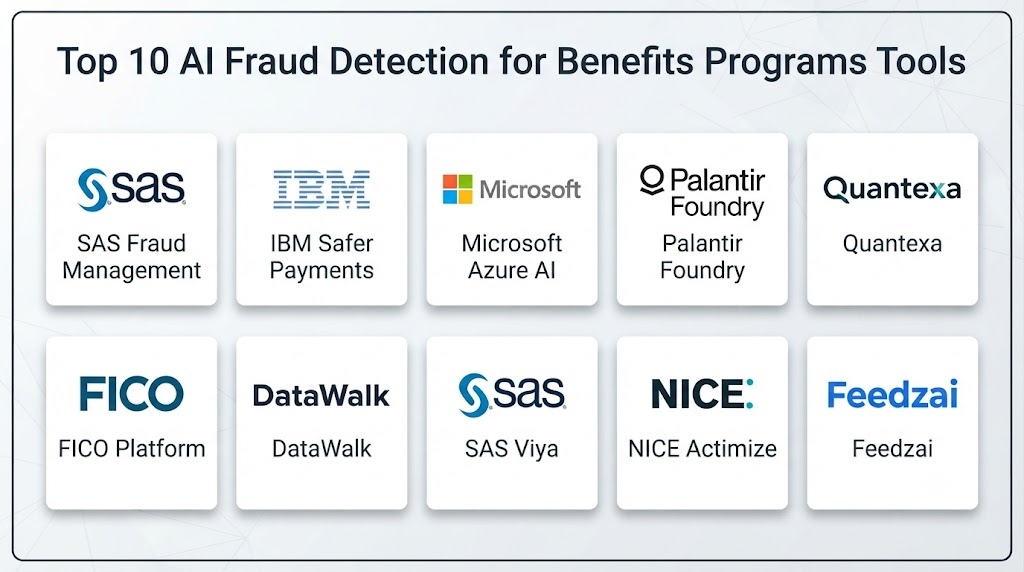
Top 10 AI Fraud Detection for Benefits Programs Tools
1 — SAS Fraud Management
One-line verdict: Best for large organizations requiring sophisticated fraud analytics, rules, modeling, and enterprise investigation workflows.
Short description:
SAS provides fraud and risk analytics technologies designed for organizations handling complex transactional and investigative environments. Its broader analytics ecosystem can support fraud detection programs requiring advanced modeling and governance.
Standout Capabilities
- Fraud analytics
- Machine-learning models
- Rules-based detection
- Anomaly detection
- Risk scoring
- Investigation support
- Model management
- Enterprise analytics
AI-Specific Depth
- Model support: SAS analytics and machine-learning capabilities.
- RAG / knowledge integration: Not a primary fraud-detection requirement; integration can be built into broader architectures.
- Evaluation: Model validation and performance monitoring capabilities vary by implementation.
- Guardrails: Governance and controlled analytics workflows can support responsible deployment.
- Observability: Analytics monitoring and model-performance capabilities vary.
Pros
- Strong analytics capabilities
- Enterprise-oriented
- Suitable for complex fraud environments
Cons
- Can require specialist expertise
- Enterprise implementations can be complex
- Pricing is not typically transparent
Security & Compliance
Security, identity, encryption, retention, residency, and certifications depend on the selected deployment and products. Verify current requirements during procurement.
Deployment & Platforms
- Deployment: Cloud / hybrid / enterprise options vary
- Platforms: Enterprise applications and APIs
- Self-hosted: Varies
Integrations & Ecosystem
- Databases
- APIs
- Data warehouses
- Enterprise applications
- Case-management systems
- Analytics platforms
- Data integration tools
Pricing Model
Enterprise commercial pricing; exact pricing varies.
Best-Fit Scenarios
- Large government programs
- Complex fraud analytics
- High-volume benefits operations
2 — IBM Safer Payments
One-line verdict: Best for organizations needing enterprise fraud analytics across complex payment and transaction environments.
Short description:
IBM Safer Payments is designed for fraud detection and prevention across payment environments. Its analytical capabilities can be relevant to benefits programs where suspicious payment behavior must be detected.
Standout Capabilities
- Transaction monitoring
- Fraud detection
- Machine learning
- Real-time analytics
- Rules
- Risk scoring
- Behavioral analysis
- Case investigation support
AI-Specific Depth
- Model support: IBM-provided analytical and machine-learning capabilities.
- RAG / knowledge integration: N/A as a core fraud capability.
- Evaluation: Model performance can be evaluated through fraud-management workflows.
- Guardrails: Rules and controlled decisioning support governance.
- Observability: Monitoring capabilities vary by implementation.
Pros
- Enterprise-grade transaction analysis
- Real-time fraud capabilities
- Strong fit for payment-centric programs
Cons
- Can be complex to implement
- Better suited to larger organizations
- Requires integration with existing systems
Security & Compliance
Security and compliance depend on architecture and deployment. Current certifications and specific controls should be verified before procurement.
Deployment & Platforms
- Deployment: Enterprise / cloud / hybrid options vary
- Platforms: Enterprise systems
- Self-hosted: Varies
Integrations & Ecosystem
- Payment systems
- Databases
- APIs
- Case management
- Analytics
- Enterprise applications
Pricing Model
Enterprise pricing; exact pricing varies.
Best-Fit Scenarios
- Large payment programs
- Government benefit payments
- High-volume transaction monitoring
3 — FICO Falcon Fraud Manager
One-line verdict: Best for organizations seeking mature transaction fraud analytics and behavioral risk scoring capabilities.
Short description:
FICO provides fraud and decision-management technologies that analyze transaction and behavioral information to identify suspicious activity.
Standout Capabilities
- Fraud scoring
- Behavioral analytics
- Machine learning
- Transaction monitoring
- Risk-based decisioning
- Rules
- Analytics
- Fraud strategy management
AI-Specific Depth
- Model support: FICO fraud analytics and machine-learning capabilities.
- RAG / knowledge integration: N/A as a core fraud function.
- Evaluation: Fraud-model performance measurement and strategy evaluation.
- Guardrails: Rule and decision controls.
- Observability: Monitoring capabilities vary.
Pros
- Mature fraud analytics
- Strong behavioral modeling
- Useful for high-volume transactions
Cons
- Primarily associated with financial transaction environments
- Enterprise implementation requirements
- Pricing varies
Security & Compliance
Verify current security, privacy, retention, residency, access controls, and certifications for the specific product configuration.
Deployment & Platforms
- Deployment: Cloud / enterprise options vary
- Platforms: APIs and enterprise applications
- Self-hosted: Varies
Integrations & Ecosystem
- Payment platforms
- APIs
- Databases
- Case management
- Analytics systems
- Enterprise applications
Pricing Model
Enterprise commercial pricing.
Best-Fit Scenarios
- Benefits payment monitoring
- High-volume transactions
- Behavioral fraud detection
4 — Feedzai
One-line verdict: Best for organizations looking for AI-driven fraud detection with real-time risk decisioning and network intelligence.
Short description:
Feedzai provides AI-powered risk and fraud-management technologies focused on detecting suspicious transactions and behavioral patterns.
Standout Capabilities
- Machine-learning fraud detection
- Risk scoring
- Real-time monitoring
- Behavioral analytics
- Network intelligence
- Rules
- Case management
- Decision automation
AI-Specific Depth
- Model support: Vendor-managed machine-learning and AI capabilities.
- RAG / knowledge integration: N/A as a primary fraud-detection function.
- Evaluation: Fraud-model performance and operational monitoring.
- Guardrails: Rules and decision controls.
- Observability: Risk and fraud monitoring capabilities.
Pros
- Strong AI focus
- Real-time detection
- Network-based intelligence
Cons
- Strongest historical fit is financial services
- Enterprise implementation may be required
- Commercial pricing varies
Security & Compliance
Verify current security and compliance details based on deployment and use case.
Deployment & Platforms
- Deployment: Cloud / enterprise options vary
- Platforms: APIs and web-based enterprise systems
- Self-hosted: Varies
Integrations & Ecosystem
- Payment systems
- APIs
- Data platforms
- Case management
- Analytics
- Enterprise applications
Pricing Model
Enterprise pricing; exact pricing varies.
Best-Fit Scenarios
- Real-time benefit payments
- Complex transaction networks
- Large fraud operations
5 — NICE Actimize
One-line verdict: Best for large organizations requiring fraud detection, investigation workflows, analytics, and financial-crime capabilities.
Short description:
NICE Actimize provides fraud and financial-crime management technologies, including analytics, monitoring, investigation, and case-management capabilities.
Standout Capabilities
- Fraud detection
- Behavioral analytics
- Transaction monitoring
- Case management
- Risk scoring
- Investigation workflows
- Analytics
- Alert management
AI-Specific Depth
- Model support: Vendor-managed AI and analytics capabilities.
- RAG / knowledge integration: N/A as a core function.
- Evaluation: Model and alert performance monitoring varies.
- Guardrails: Rules, workflows, and controlled investigations.
- Observability: Operational monitoring and analytics.
Pros
- Broad fraud-management ecosystem
- Strong investigation workflows
- Enterprise focus
Cons
- Complex for smaller organizations
- Primarily known for financial-crime use cases
- Implementation may be substantial
Security & Compliance
Verify current controls and certifications according to the selected product and deployment.
Deployment & Platforms
- Deployment: Cloud / hybrid options vary
- Platforms: Enterprise applications
- Self-hosted: Varies
Integrations & Ecosystem
- Transaction systems
- APIs
- Data platforms
- Case management
- Analytics
- Enterprise systems
Pricing Model
Enterprise pricing.
Best-Fit Scenarios
- Large benefit administrators
- Complex investigations
- Multi-channel fraud detection
6 — Featurespace
One-line verdict: Best for organizations emphasizing adaptive behavioral analytics and detection of unusual transaction behavior.
Short description:
Featurespace develops behavioral analytics technology designed to detect unusual transaction behavior and identify potentially fraudulent activity.
Standout Capabilities
- Behavioral analytics
- Machine learning
- Anomaly detection
- Transaction monitoring
- Adaptive risk modeling
- Fraud scoring
- Real-time analysis
- Analytics
AI-Specific Depth
- Model support: Vendor-managed AI and machine-learning capabilities.
- RAG / knowledge integration: N/A.
- Evaluation: Detection performance can be evaluated using historical and operational outcomes.
- Guardrails: Decision controls and rules vary by deployment.
- Observability: Fraud analytics and monitoring capabilities.
Pros
- Strong behavioral approach
- Adaptive detection
- Suitable for high-volume transactions
Cons
- More focused on transaction fraud
- Benefits-specific capabilities may require customization
- Pricing is not typically public
Security & Compliance
Verify applicable controls, certifications, data handling, and deployment requirements.
Deployment & Platforms
- Deployment: Cloud / enterprise options vary
- Platforms: APIs and enterprise systems
- Self-hosted: Varies
Integrations & Ecosystem
- Payment systems
- APIs
- Data platforms
- Fraud workflows
- Analytics
- Case management
Pricing Model
Enterprise commercial pricing.
Best-Fit Scenarios
- Payment anomaly detection
- Behavioral fraud monitoring
- High-volume benefits transactions
7 — DataVisor
One-line verdict: Best for organizations wanting unsupervised machine learning and anomaly detection for emerging fraud patterns.
Short description:
DataVisor focuses on fraud and risk detection using machine-learning approaches designed to identify suspicious patterns and coordinated activity.
Standout Capabilities
- Unsupervised machine learning
- Anomaly detection
- Fraud scoring
- Risk analytics
- Network analysis
- Real-time detection
- Rules
- Investigation support
AI-Specific Depth
- Model support: Vendor-managed machine-learning approaches.
- RAG / knowledge integration: N/A.
- Evaluation: Fraud detection performance can be assessed using historical outcomes.
- Guardrails: Rules and decision policies.
- Observability: Fraud monitoring and analytics.
Pros
- Useful for unknown fraud patterns
- Strong anomaly-detection orientation
- Network-based analysis
Cons
- Benefits-specific workflows may require integration
- Enterprise deployment can require expertise
- Pricing varies
Security & Compliance
Verify current security and compliance information during procurement.
Deployment & Platforms
- Deployment: Cloud / enterprise options vary
- Platforms: APIs and applications
- Self-hosted: Varies
Integrations & Ecosystem
- APIs
- Data warehouses
- Transaction platforms
- Case management
- Analytics
- Enterprise applications
Pricing Model
Enterprise commercial pricing.
Best-Fit Scenarios
- Emerging fraud detection
- Coordinated fraud
- High-volume applications
8 — Sift
One-line verdict: Best for teams seeking automated risk decisions and behavioral signals across digital user and transaction journeys.
Short description:
Sift provides digital trust and fraud-management capabilities focused on identifying suspicious behavior across online interactions and transactions.
Standout Capabilities
- Behavioral analysis
- Risk scoring
- Fraud detection
- Account monitoring
- Automated decisions
- Digital identity signals
- Machine learning
- Workflow integration
AI-Specific Depth
- Model support: Vendor-managed machine-learning capabilities.
- RAG / knowledge integration: N/A.
- Evaluation: Performance monitoring and fraud outcomes.
- Guardrails: Risk policies and configurable decisions.
- Observability: Risk and fraud analytics.
Pros
- Strong digital behavior signals
- Automated risk decisions
- API-oriented ecosystem
Cons
- Stronger fit for digital commerce environments
- Benefits use cases may require customization
- Pricing varies
Security & Compliance
Verify current security and privacy requirements for the intended implementation.
Deployment & Platforms
- Deployment: Cloud
- Platforms: APIs and web applications
- Self-hosted: N/A
Integrations & Ecosystem
- APIs
- Web applications
- Identity systems
- Payment systems
- Data platforms
- Business applications
Pricing Model
Commercial pricing; exact pricing varies.
Best-Fit Scenarios
- Online benefits applications
- Digital identity risk
- Account abuse detection
9 — Quantexa
One-line verdict: Best for complex fraud investigations where entity resolution and network relationships are central to detection.
Short description:
Quantexa focuses heavily on contextual decision intelligence, entity resolution, and network analytics. These capabilities can be valuable for identifying relationships that are difficult to detect by analyzing records independently.
Standout Capabilities
- Entity resolution
- Network analytics
- Fraud detection
- Contextual intelligence
- Risk analytics
- Data integration
- Investigation support
- Decision intelligence
AI-Specific Depth
- Model support: Vendor-managed AI and analytics capabilities.
- RAG / knowledge integration: Knowledge and data integration are central to contextual analytics.
- Evaluation: Model and analytical performance can be evaluated using operational datasets.
- Guardrails: Governance and decision controls vary by deployment.
- Observability: Analytics and decision monitoring capabilities vary.
Pros
- Excellent for relationship analysis
- Strong entity-resolution capabilities
- Useful for complex investigations
Cons
- Can require sophisticated data integration
- May be excessive for simple fraud rules
- Enterprise-oriented
Security & Compliance
Verify current certifications and deployment-specific controls during procurement.
Deployment & Platforms
- Deployment: Cloud / hybrid options vary
- Platforms: Enterprise applications and APIs
- Self-hosted: Varies
Integrations & Ecosystem
- Data warehouses
- Databases
- APIs
- Graph technologies
- Case-management systems
- Analytics platforms
- Enterprise applications
Pricing Model
Enterprise pricing; exact pricing varies.
Best-Fit Scenarios
- Organized fraud
- Network analysis
- Cross-program investigations
10 — Palantir Foundry
One-line verdict: Best for organizations building highly customized fraud investigations across connected data sources and operational workflows.
Short description:
Palantir Foundry provides a data and operational platform that can be used to build customized fraud analytics, entity-resolution, investigation, and decision workflows.
Standout Capabilities
- Data integration
- Entity modeling
- Graph-oriented analysis
- Machine learning
- Investigation workflows
- Operational applications
- Analytics
- AI-assisted workflows
AI-Specific Depth
- Model support: Supports configurable AI and machine-learning architectures depending on deployment.
- RAG / knowledge integration: Can support enterprise knowledge and retrieval architectures.
- Evaluation: Model evaluation and workflow testing depend on implementation.
- Guardrails: Strong emphasis on permissions, governance, and controlled workflows.
- Observability: Platform-level monitoring and operational controls vary.
Pros
- Highly customizable
- Strong data integration
- Suitable for complex investigations
Cons
- Significant implementation effort
- Enterprise-oriented
- Requires strong technical and data teams
Security & Compliance
Security controls depend on deployment and configuration. Verify current certifications, access controls, encryption, residency, and retention requirements.
Deployment & Platforms
- Deployment: Cloud / hybrid / specialized environments vary
- Platforms: Enterprise applications
- Self-hosted: Varies
Integrations & Ecosystem
- Databases
- Data warehouses
- APIs
- Machine-learning systems
- Case-management workflows
- Enterprise applications
- External data sources
Pricing Model
Enterprise commercial pricing.
Best-Fit Scenarios
- Government fraud programs
- Complex investigations
- Cross-system fraud analytics
Comparison Table
| Tool | Best For | Deployment | Model Flexibility | Strength | Watch-Out | Public Rating |
|---|---|---|---|---|---|---|
| SAS Fraud Management | Enterprise fraud analytics | Cloud / Hybrid | Multi-model varies | Advanced analytics | Complex implementation | N/A |
| IBM Safer Payments | Payment fraud | Cloud / Hybrid | Hosted / configurable | Transaction monitoring | Enterprise complexity | N/A |
| FICO Falcon | Behavioral transaction fraud | Cloud / Enterprise | Hosted | Fraud scoring | Financial-services orientation | N/A |
| Feedzai | Real-time fraud detection | Cloud / Enterprise | Hosted | AI risk scoring | Integration effort | N/A |
| NICE Actimize | Fraud investigation | Cloud / Hybrid | Hosted | Case management | Complexity | N/A |
| Featurespace | Behavioral analytics | Cloud / Enterprise | Hosted | Adaptive detection | Transaction focus | N/A |
| DataVisor | Emerging fraud patterns | Cloud | Hosted | Unsupervised detection | Custom integration | N/A |
| Sift | Digital fraud | Cloud | Hosted | Behavioral signals | Digital-commerce orientation | N/A |
| Quantexa | Network fraud | Cloud / Hybrid | Varies | Entity resolution | Data integration effort | N/A |
| Palantir Foundry | Custom fraud operations | Cloud / Hybrid | Multi-model | Data and workflow flexibility | High implementation effort | N/A |
Scoring & Evaluation
The following scores are a comparative buying framework rather than independent laboratory measurements. Actual performance can change substantially depending on data quality, program design, historical fraud labels, integrations, and implementation quality.
| Tool | Core | Reliability/Eval | Guardrails | Integrations | Ease | Perf/Cost | Security/Admin | Support | Weighted Total |
|---|---|---|---|---|---|---|---|---|---|
| SAS Fraud Management | 10 | 9 | 9 | 9 | 7 | 8 | 10 | 9 | 9.00 |
| IBM Safer Payments | 10 | 9 | 9 | 9 | 7 | 8 | 10 | 9 | 8.95 |
| FICO Falcon | 10 | 9 | 9 | 9 | 8 | 8 | 10 | 9 | 9.05 |
| Feedzai | 10 | 9 | 9 | 9 | 8 | 9 | 9 | 9 | 9.05 |
| NICE Actimize | 10 | 9 | 9 | 9 | 7 | 8 | 10 | 9 | 8.95 |
| Featurespace | 9 | 9 | 8 | 8 | 8 | 9 | 9 | 8 | 8.60 |
| DataVisor | 9 | 9 | 8 | 8 | 8 | 9 | 8 | 8 | 8.45 |
| Sift | 9 | 8 | 8 | 9 | 9 | 9 | 8 | 8 | 8.60 |
| Quantexa | 10 | 9 | 9 | 10 | 7 | 7 | 10 | 9 | 8.95 |
| Palantir Foundry | 10 | 9 | 10 | 10 | 6 | 7 | 10 | 9 | 9.00 |
Top 3 for Enterprise
- SAS Fraud Management
- FICO Falcon
- Palantir Foundry
Top 3 for SMB
- Sift
- DataVisor
- Featurespace
Top 3 for Developers
- Palantir Foundry
- Quantexa
- Feedzai
Which AI Fraud Detection Tool Is Right for You?
Solo / Freelancer
Most individual operators do not need a sophisticated benefits-fraud platform.
A lightweight rules engine, anomaly-detection framework, or existing case-management system may be sufficient.
Prioritize:
- Low implementation cost
- Simple analytics
- Explainability
- Minimal infrastructure
- Easy data export
SMB
Smaller benefits administrators should focus on practical detection rather than building a large AI ecosystem.
Prioritize:
- API access
- Automated risk scoring
- Simple case workflows
- Low operational overhead
- Clear alert explanations
Avoid platforms that require extensive data-science teams unless fraud volume justifies the investment.
Mid-Market
Mid-market programs can benefit from combining:
- Rules
- Machine learning
- Anomaly detection
- Entity resolution
- Case management
- Human investigation
This approach can reduce investigator workload while preserving human oversight.
Enterprise
Large benefits programs should consider a layered architecture.
A typical implementation can combine:
Rules + ML + Graph Analytics + Entity Resolution + Case Management + Human Investigation
Enterprise buyers should also evaluate:
- Model governance
- Data lineage
- Explainability
- Privacy
- Access controls
- Audit logs
- Integration architecture
- Disaster recovery
- Model monitoring
Regulated Industries
Benefits and public-service systems frequently handle highly sensitive personal information.
Organizations should assess:
- Data minimization
- Encryption
- Retention
- Data residency
- Access controls
- Auditability
- Human review
- Bias monitoring
- Model transparency
A high-risk automated decision should not be implemented merely because a model produces a high score.
Budget vs Premium
Budget implementations can begin with:
- Rules
- Basic anomaly detection
- SQL-based analytics
- Simple risk scoring
Premium platforms become valuable when organizations require:
- Real-time scoring
- Network analysis
- Large-scale machine learning
- Complex case management
- Advanced entity resolution
- Enterprise governance
Build vs Buy
Build when:
- Your program has unique fraud patterns.
- You have a strong engineering and data-science team.
- You require customized data models.
- Existing systems are highly specialized.
- You need complete control over the architecture.
Buy when:
- You need proven fraud capabilities quickly.
- Your organization lacks specialized fraud-ML expertise.
- Case-management functionality is important.
- You need enterprise support.
- Integration and governance requirements are extensive.
Implementation Playbook
First 30 Days: Pilot
Start with a clearly defined fraud problem.
Examples:
- Duplicate applications
- Suspicious payments
- Identity anomalies
- Provider anomalies
- Coordinated applications
Create a representative dataset containing both legitimate and previously investigated cases.
Define metrics such as:
- Precision
- Recall
- False-positive rate
- Alert volume
- Investigator workload
- Detection latency
- Financial impact
- Legitimate-case handling time
Days 31–60: Harden Security and Evaluation
Implement:
- Access controls
- Data minimization
- Encryption
- Retention policies
- Audit logging
- Model versioning
- Evaluation datasets
- Human-review workflows
Test the system against adversarial and unusual scenarios.
Conduct red-team exercises where appropriate.
Also test whether seemingly legitimate population characteristics are acting as inappropriate proxies for protected characteristics.
Days 61–90: Scale and Govern
Connect fraud detection to:
- Case management
- Payment systems
- Eligibility systems
- Data warehouses
- Investigation tools
- Reporting systems
Create governance procedures for:
- Model updates
- Threshold changes
- New fraud patterns
- False-positive analysis
- Incident response
- Investigator feedback
- Model drift
Common Mistakes and How to Avoid Them
- Treating risk scores as proof of fraud: A score should support investigation, not automatically establish wrongdoing.
- Over-automating decisions: High-impact decisions should have appropriate human oversight.
- Ignoring false positives: Excessive alerts can overwhelm investigators and harm legitimate beneficiaries.
- Using poor-quality training data: Historical investigation outcomes can contain bias or inconsistent labeling.
- Ignoring data drift: Fraud patterns change continuously.
- Relying only on rules: Rules can miss new or coordinated patterns.
- Relying only on machine learning: Rules remain useful for known, high-confidence scenarios.
- Ignoring network relationships: Fraud may involve groups rather than isolated actors.
- No explainability: Investigators need understandable reasons for alerts.
- Weak privacy controls: Benefits systems often contain highly sensitive information.
- No model monitoring: Detection quality can deteriorate without warning.
- No audit trail: Investigative decisions should be traceable.
- Ignoring adversarial behavior: Fraudsters can adapt to detection mechanisms.
- No human feedback loop: Investigator outcomes can provide valuable signals for model improvement.
FAQs
What is AI fraud detection for benefits programs?
It is the use of machine learning, anomaly detection, rules, graph analytics, and related AI technologies to identify potentially suspicious activity in benefits applications, claims, payments, or provider activity.
Can AI automatically determine whether someone committed fraud?
AI can identify risk signals, but a high-risk score is not necessarily proof of fraud. Appropriate human investigation and due process are important for consequential decisions.
What types of benefits fraud can AI detect?
Potential use cases include duplicate claims, identity anomalies, suspicious payments, provider anomalies, coordinated activity, document inconsistencies, and unusual behavioral patterns.
Can AI detect organized fraud networks?
Yes. Graph analytics and entity-resolution technologies can help identify relationships among people, organizations, accounts, addresses, devices, and transactions.
Does AI replace fraud investigators?
Usually, the strongest implementations support investigators rather than completely replacing them. AI can prioritize cases and summarize evidence while investigators make appropriate decisions.
How does AI reduce false positives?
Models can combine more signals than simple rules and rank cases by risk. Human feedback and continuous evaluation can also help improve detection quality.
Can benefits fraud detection work in real time?
Yes, some fraud platforms support real-time transaction or event scoring. Whether real-time detection is appropriate depends on the program architecture and business process.
Can organizations use their own data to train fraud models?
Many enterprise platforms support model development or customization, but the exact approach varies. Organizations should verify data-training and model-customization options with each vendor.
Is self-hosted fraud detection available?
Some enterprise technologies support private or hybrid deployments, while others are primarily cloud-based. Deployment options vary by platform.
What data is needed for AI fraud detection?
Potential inputs include applications, claims, transactions, payment information, provider records, historical investigations, identity information, documents, and relationship data.
How much does AI fraud detection cost?
Costs vary according to transaction volume, deployment model, integrations, number of users, model complexity, and enterprise requirements. Exact pricing is often negotiated.
Is AI fraud detection suitable for government benefits?
Yes, it can be valuable for large government programs, but public-sector implementations require particularly strong attention to privacy, fairness, explainability, auditability, and human oversight.
How should organizations evaluate a fraud model?
Use real historical data and measure precision, recall, false positives, investigation workload, financial impact, detection latency, and outcomes across relevant populations.
What is the difference between rules and AI fraud detection?
Rules explicitly define known suspicious conditions. AI can learn statistical or behavioral patterns and identify anomalies that may not have been anticipated when the rules were written.
Can generative AI be used in benefits fraud investigations?
Generative AI can assist with case summaries, document analysis, investigator assistance, and evidence organization. It should be carefully controlled when used with sensitive information or consequential decisions.
Conclusion
AI Fraud Detection for Benefits Programs can help organizations identify suspicious applications, payments, claims, providers, and coordinated activity at a scale that is difficult to achieve through manual review alone.The strongest approach is not simply to deploy a machine-learning model and automatically reject high-risk cases. Effective programs combine rules, machine learning, anomaly detection, entity resolution, graph analytics, human investigation, and strong governance.Organizations should also treat privacy, fairness, explainability, and auditability as core system requirements rather than optional features.The right platform depends on the program’s size, transaction volume, fraud patterns, data environment, technical capabilities, and regulatory requirements.