Introduction
AI Scholarship Matching Tools are platforms that use artificial intelligence, automation, search, and data matching to help students discover scholarships that may fit their education, background, interests, academic goals, location, and eligibility criteria. Instead of manually searching through hundreds of scholarship listings, students can provide information about themselves and receive a more targeted list of potential opportunities.
These tools can be especially useful because scholarship information is often spread across universities, foundations, nonprofit organizations, companies, government programs, professional associations, and private organizations. An effective matching platform can reduce the time spent searching and help students identify opportunities they might otherwise oveHigh-school students, college students, graduate students, parents, counselors, schools, universities, and organizations supporting students with financial-aid searches Students looking for guaranteed scholarship awards, organizations that require highly specialized scholarship databases, or users who expect AI matching to replace careful eligibility verification.
What Are AI Scholarship Matching Tools?
AI Scholarship Matching Tools combine scholarship databases with algorithms, search technology, user profiles, recommendation systems, and increasingly AI-powered interfaces.
A traditional scholarship search may require a student to enter dozens of filters manually.
An AI-assisted platform can instead analyze information such as:
- Academic level
- Field of study
- Location
- GPA or academic performance
- Career interests
- Extracurricular activities
- Demographic eligibility where relevant
- Financial circumstances where applicable
- Application deadlines
- Scholarship requirements
The platform then identifies opportunities that appear relevant.
The important distinction is that a match is not the same as eligibility. Students should always read the official scholarship requirements and verify current deadlines before applying.
How AI Scholarship Matching Works
1. Student Profile Creation
The student provides information about their educational background, interests, goals, and relevant eligibility criteria.
2. Scholarship Database Analysis
The platform compares the student’s profile against available scholarship listings.
3. Eligibility Matching
Matching systems look for relevant requirements and characteristics.
4. Recommendation
Potentially relevant scholarships are presented to the student.
5. Prioritization
Some platforms can help students identify opportunities based on factors such as eligibility, deadline, or relevance.
6. Application Support
Depending on the platform, students may receive reminders, application guidance, essay assistance, or organizational tools.
Why AI Matters for Scholarship Discovery
Scholarship searching can become overwhelming because students may encounter:
- Thousands of listings
- Different eligibility rules
- Different application deadlines
- Varying award amounts
- Repeated application questions
- Different documentation requirements
- Local and national opportunities
- Scholarships with very narrow eligibility criteria
AI and recommendation technology can make this process more personalized.
Instead of asking:
“What scholarships are available?”
A student can ask:
“Which scholarships appear relevant to my computer science studies, academic profile, location, and extracurricular interests?”
That shift from broad search to personalized discovery is where AI-powered matching can provide meaningful value.
What to Look for in an AI Scholarship Matching Tool
Before choosing a platform, evaluate:
- Scholarship database size and quality
- Matching accuracy
- Eligibility filtering
- Search functionality
- Deadline tracking
- Personalized recommendations
- Scholarship freshness
- Duplicate listing detection
- Application organization
- Essay assistance
- Notifications
- Student privacy
- Data retention
- Mobile accessibility
- Counselor features
- School administration tools
- Application tracking
- Search transparency
- AI explanation quality
- Pricing
What Has Changed in AI Scholarship Matching
- Personalized recommendations are becoming more conversational: Students can describe their goals in natural language instead of relying exclusively on filters.
- AI can interpret unstructured eligibility requirements: Scholarship descriptions often contain nuanced language that traditional keyword search can miss.
- Recommendation quality is increasingly important: A large database is less useful if many recommended scholarships are irrelevant.
- Freshness matters: Expired scholarship listings can waste valuable student time.
- AI-generated application assistance is expanding: Some platforms can help students brainstorm or improve application materials.
- Human verification remains important: AI should not be treated as the final authority on scholarship eligibility.
- Privacy is increasingly important: Scholarship profiles may contain sensitive educational and personal information.
- Explainable matching is valuable: Students should understand why a scholarship was recommended.
- Deadline management is becoming more important: Matching is only useful if students can act before deadlines.
- AI can reduce search friction: Conversational search can make scholarship discovery easier for students who do not know what keywords to use.
- Education organizations can use analytics: Schools and counseling programs can potentially identify search and application patterns.
- Automation creates new risks: Incorrect AI interpretation of eligibility criteria can lead students toward unsuitable opportunities.
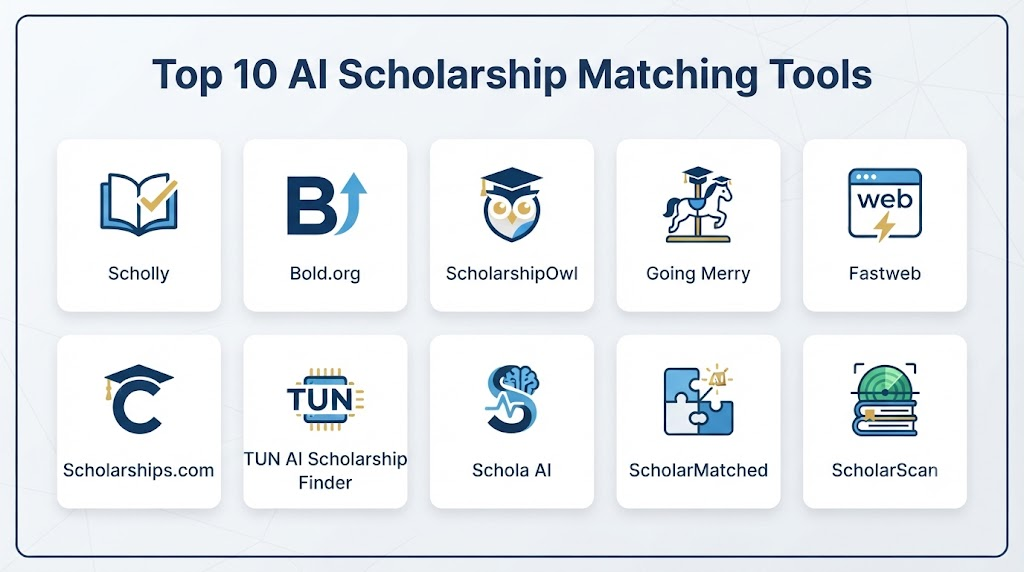
Top 10 AI Scholarship Matching Tools
1 — Bold.org
One-line verdict: Best for students seeking a broad scholarship marketplace with personalized discovery and scholarship application opportunities.
Short description:
Bold.org is a scholarship platform focused on helping students discover and apply for scholarships. It provides a large collection of scholarship opportunities across different education levels, interests, and eligibility categories.
Standout Capabilities
- Scholarship discovery
- Personalized scholarship search
- Student profiles
- Scholarship categories
- Application opportunities
- Deadline-oriented discovery
- Scholarship marketplace
- Student-focused interface
AI-Specific Depth
- Model support: Managed recommendation/search technology; specific underlying AI models are not publicly stated.
- RAG / knowledge integration: Scholarship database and listing information.
- Evaluation: Matching quality depends on available profile and scholarship data; detailed internal evaluation methodology is not publicly stated.
- Guardrails: Platform-level safety and eligibility practices vary.
- Observability: User-facing matching and application activity may be available; model-level token and latency metrics are not publicly stated.
Pros
- Large scholarship discovery ecosystem
- Student-focused experience
- Useful personalized search capabilities
Cons
- Students still need to verify eligibility
- Scholarship availability changes over time
- Some opportunities may be highly competitive
Security & Compliance
Specific current certifications and enterprise security controls are not publicly stated here. Users should review the platform’s current privacy and security documentation before entering sensitive information.
Deployment & Platforms
- Deployment: Cloud
- Platforms: Web
- Self-hosted: Not publicly stated
Integrations & Ecosystem
The platform centers on scholarship discovery and applications.
- Scholarship database
- Student profiles
- Search
- Applications
- Notifications
- Scholarship listings
Pricing Model
Student scholarship search and application access may be available without a traditional subscription; current commercial terms vary.
Best-Fit Scenarios
- High-school scholarship searches
- College scholarship discovery
- Students seeking multiple opportunities
2 — Scholly
One-line verdict: Best for personalized scholarship discovery designed to reduce the time students spend searching for financial-aid opportunities.
Short description:
Scholly is a scholarship search platform designed around personalized scholarship recommendations. It uses student information to identify scholarship opportunities that may fit their profile.
Standout Capabilities
- Personalized scholarship matching
- Student profiles
- Scholarship discovery
- Eligibility-oriented search
- Scholarship recommendations
- Application organization
- Financial-aid discovery
AI-Specific Depth
- Model support: Recommendation technology; exact underlying models are not publicly stated.
- RAG / knowledge integration: Scholarship database.
- Evaluation: Matching and recommendation quality varies; detailed evaluation methodology is not publicly stated.
- Guardrails: Eligibility information should be independently verified.
- Observability: User-facing recommendation activity may vary.
Pros
- Personalized discovery
- Designed specifically around scholarship search
- Reduces manual filtering
Cons
- Recommendations are not guarantees of eligibility
- Database freshness is important
- Exact AI architecture is not publicly stated
Security & Compliance
Specific current certifications are not publicly stated.
Deployment & Platforms
- Deployment: Cloud
- Platforms: Web and supported mobile experiences
- Self-hosted: Not publicly stated
Integrations & Ecosystem
- Scholarship database
- Student profiles
- Matching
- Search
- Application support
Pricing Model
Pricing and availability vary by offering.
Best-Fit Scenarios
- Personalized scholarship searches
- Students with limited search time
- Scholarship application planning
3 — Going Merry
One-line verdict: Best for simplifying scholarship discovery and applications through a student-focused scholarship platform.
Short description:
Going Merry provides scholarship discovery and application services intended to make the scholarship process more accessible to students.
Standout Capabilities
- Scholarship search
- Scholarship applications
- Student profiles
- Application management
- Scholarship discovery
- Personalized opportunities
- Deadline awareness
AI-Specific Depth
- Model support: Specific AI model configuration is not publicly stated.
- RAG / knowledge integration: Scholarship listings and application data.
- Evaluation: Matching methodology is not publicly stated.
- Guardrails: Platform controls vary.
- Observability: Application and user activity may be available; model-level telemetry is not publicly stated.
Pros
- Streamlined scholarship applications
- Student-friendly approach
- Reduces application friction for participating scholarships
Cons
- Not every scholarship is available through one platform
- Students still need to verify requirements
- Scholarship availability changes
Security & Compliance
Specific current certifications are not publicly stated.
Deployment & Platforms
- Deployment: Cloud
- Platforms: Web
- Self-hosted: Not publicly stated
Integrations & Ecosystem
- Scholarship listings
- Applications
- Student accounts
- Financial-aid discovery
- Educational organizations
Pricing Model
Student access and scholarship application pricing vary by service.
Best-Fit Scenarios
- Students applying to multiple scholarships
- High-school seniors
- College financial-aid searches
4 — Scholarships.com
One-line verdict: Best for broad scholarship research with extensive searchable categories and student-oriented financial-aid resources.
Short description:
Scholarships.com provides a scholarship search database and educational financial-aid resources. Students can search opportunities based on different criteria.
Standout Capabilities
- Scholarship search
- Scholarship database
- Eligibility filters
- Student profiles
- Financial-aid resources
- Scholarship categories
- Search tools
- Application discovery
AI-Specific Depth
- Model support: Specific AI model use is not publicly stated.
- RAG / knowledge integration: Scholarship database and educational resources.
- Evaluation: Search and matching methodology varies.
- Guardrails: Eligibility information requires user verification.
- Observability: User-facing search activity varies.
Pros
- Broad scholarship search
- Useful financial-aid resources
- Multiple search criteria
Cons
- Large databases can require significant filtering
- Students should verify listing freshness
- Not all scholarship opportunities are necessarily represented
Security & Compliance
Specific current certifications are not publicly stated.
Deployment & Platforms
- Deployment: Cloud
- Platforms: Web
- Self-hosted: Not publicly stated
Integrations & Ecosystem
- Scholarship database
- Search
- Student resources
- Financial-aid information
- Scholarship categories
Pricing Model
Scholarship search availability and other services vary.
Best-Fit Scenarios
- Broad scholarship research
- Students beginning their search
- Financial-aid exploration
5 — Fastweb
One-line verdict: Best for students looking for personalized scholarship discovery alongside broader college and financial-aid resources.
Short description:
Fastweb provides scholarship search and college-related resources. Its personalized approach helps students identify scholarship opportunities based on information in their profiles.
Standout Capabilities
- Personalized scholarship search
- Student profiles
- Scholarship database
- College resources
- Financial-aid information
- Scholarship alerts
- Search filters
- Student planning
AI-Specific Depth
- Model support: Specific AI models are not publicly stated.
- RAG / knowledge integration: Scholarship and educational databases.
- Evaluation: Recommendation methodology is not fully publicly stated.
- Guardrails: Eligibility should be independently verified.
- Observability: User-facing activity varies.
Pros
- Established scholarship-search ecosystem
- Personalized discovery
- Broader college-planning resources
Cons
- Students may need to filter many opportunities
- Scholarship eligibility can change
- AI architecture is not publicly stated
Security & Compliance
Specific current certifications are not publicly stated.
Deployment & Platforms
- Deployment: Cloud
- Platforms: Web
- Self-hosted: Not publicly stated
Integrations & Ecosystem
- Scholarship database
- College resources
- Student profiles
- Alerts
- Search
Pricing Model
Scholarship-search access and services vary.
Best-Fit Scenarios
- College-bound students
- Scholarship planning
- Financial-aid research
6 — Niche
One-line verdict: Best for students seeking a scholarship search platform that can surface opportunities based on personalized student characteristics.
Short description:
Niche provides education-related discovery services, including scholarship information and personalized resources for students evaluating colleges and financial opportunities.
Standout Capabilities
- Scholarship discovery
- College search
- Student profiles
- Personalized recommendations
- Education research
- Scholarship information
- College planning
AI-Specific Depth
- Model support: Specific model architecture is not publicly stated.
- RAG / knowledge integration: Education and scholarship information.
- Evaluation: Internal recommendation methodology is not publicly stated.
- Guardrails: Eligibility verification remains important.
- Observability: User-facing analytics vary.
Pros
- Combines college and scholarship discovery
- Broad education ecosystem
- Personalized search
Cons
- Not solely focused on scholarships
- Recommendations require verification
- AI implementation details are limited publicly
Security & Compliance
Specific current certifications are not publicly stated.
Deployment & Platforms
- Deployment: Cloud
- Platforms: Web
- Self-hosted: Not publicly stated
Integrations & Ecosystem
- College discovery
- Scholarship resources
- Student profiles
- Education information
- Search tools
Pricing Model
Student access and services vary.
Best-Fit Scenarios
- College research
- Scholarship discovery
- Students comparing educational options
7 — Appily
One-line verdict: Best for students combining college discovery, scholarship research, and personalized education planning.
Short description:
Appily is an education platform that combines college discovery, scholarships, admissions-related information, and student planning.
Standout Capabilities
- College search
- Scholarship discovery
- Personalized recommendations
- Student profiles
- Admissions information
- Financial-aid resources
- College planning
AI-Specific Depth
- Model support: Specific AI models are not publicly stated.
- RAG / knowledge integration: College and scholarship information.
- Evaluation: Recommendation methodology is not publicly stated.
- Guardrails: Eligibility and admissions information should be independently verified.
- Observability: User-facing recommendation functionality varies.
Pros
- Combines several college-planning workflows
- Personalized discovery
- Useful for college-bound students
Cons
- Broader than scholarship matching alone
- Information changes over time
- AI architecture is not fully public
Security & Compliance
Specific certifications are not publicly stated.
Deployment & Platforms
- Deployment: Cloud
- Platforms: Web
- Self-hosted: Not publicly stated
Integrations & Ecosystem
- College database
- Scholarship information
- Student profiles
- Admissions resources
- Education planning
Pricing Model
Pricing and availability vary.
Best-Fit Scenarios
- College planning
- Scholarship discovery
- High-school students
8 — College Board BigFuture
One-line verdict: Best for students who want scholarship and college-planning resources from a major education-focused organization.
Short description:
BigFuture provides college planning resources, scholarship information, financial-aid guidance, and tools intended to help students navigate postsecondary education.
Standout Capabilities
- Scholarship search
- College planning
- Financial-aid information
- Student profiles
- College comparisons
- Educational planning
- Personalized resources
AI-Specific Depth
- Model support: Specific AI model support is not publicly stated.
- RAG / knowledge integration: College and scholarship information.
- Evaluation: Recommendation methodology is not publicly stated.
- Guardrails: Education-focused guidance and information controls.
- Observability: User-level analytics vary.
Pros
- Strong education ecosystem
- Useful financial-aid resources
- College and scholarship planning together
Cons
- Not exclusively an AI scholarship matching system
- Students still need to verify eligibility
- AI-specific functionality may be limited compared with dedicated AI platforms
Security & Compliance
Specific certifications are not publicly stated.
Deployment & Platforms
- Deployment: Cloud
- Platforms: Web
- Self-hosted: Not publicly stated
Integrations & Ecosystem
- College planning
- Scholarship search
- Financial-aid resources
- Student tools
- Education information
Pricing Model
Many planning resources are available without traditional software subscription pricing.
Best-Fit Scenarios
- High-school students
- College planning
- Financial-aid research
9 — CareerOneStop Scholarship Finder
One-line verdict: Best for students seeking a government-supported resource for exploring scholarships and education funding opportunities.
Short description:
CareerOneStop provides career and education resources, including scholarship and financial-aid information. It can serve as a useful additional source when researching funding opportunities.
Standout Capabilities
- Scholarship search
- Career planning
- Education resources
- Training information
- Financial-aid discovery
- Government-supported information
- Search tools
AI-Specific Depth
- Model support: Specific AI matching models are not publicly stated.
- RAG / knowledge integration: Structured scholarship and career information.
- Evaluation: Search methodology is publicly oriented but AI-specific evaluation is not publicly stated.
- Guardrails: Government information practices apply.
- Observability: Model-level telemetry is not publicly stated.
Pros
- Useful public resource
- Combines education and career planning
- Additional scholarship discovery source
Cons
- Less AI-centric than dedicated matching products
- Interface may feel more informational than personalized
- Students may need to conduct more manual research
Security & Compliance
Specific AI-related certifications are not publicly stated.
Deployment & Platforms
- Deployment: Web
- Platforms: Browser
- Self-hosted: Not applicable
Integrations & Ecosystem
- Career resources
- Education information
- Scholarship information
- Training resources
- Government resources
Pricing Model
Generally available as a public resource.
Best-Fit Scenarios
- Public scholarship research
- Career planning
- Students seeking additional funding sources
10 — InternationalScholarships.com
One-line verdict: Best for students researching scholarships and funding opportunities across international education destinations.
Short description:
InternationalScholarships.com focuses on scholarship and financial-aid information for students interested in educational opportunities, including international study.
Standout Capabilities
- Scholarship search
- International education information
- Financial-aid resources
- Study-abroad opportunities
- Student search
- Scholarship categories
- Educational resources
AI-Specific Depth
- Model support: Specific AI model support is not publicly stated.
- RAG / knowledge integration: Scholarship and education listings.
- Evaluation: AI matching methodology is not publicly stated.
- Guardrails: Eligibility must be verified against the scholarship provider.
- Observability: Model-level telemetry is not publicly stated.
Pros
- Useful international scholarship information
- Supports broader education research
- Can supplement domestic scholarship databases
Cons
- AI capabilities are less clearly defined
- Listing freshness needs verification
- Not a substitute for official scholarship-provider information
Security & Compliance
Specific certifications are not publicly stated.
Deployment & Platforms
- Deployment: Web
- Platforms: Browser
- Self-hosted: Not publicly stated
Integrations & Ecosystem
- Scholarship listings
- International education
- Study-abroad resources
- Student information
- Search tools
Pricing Model
Pricing is not publicly stated.
Best-Fit Scenarios
- International students
- Study-abroad planning
- Global scholarship research
Comparison Table
| Tool | Best For | Deployment | Model Flexibility | Strength | Watch-Out | Public Rating |
|---|---|---|---|---|---|---|
| Bold.org | Broad scholarship discovery | Cloud | Hosted/Managed | Large scholarship marketplace | Verify eligibility | N/A |
| Scholly | Personalized matching | Cloud | Hosted/Managed | Personalized discovery | Matching is not guaranteed eligibility | N/A |
| Going Merry | Application discovery | Cloud | Hosted/Managed | Streamlined applications | Coverage varies | N/A |
| Scholarships.com | Broad research | Cloud | N/A | Large searchable database | Requires filtering | N/A |
| Fastweb | College + scholarships | Cloud | Hosted/Managed | Personalized student resources | Listings change | N/A |
| Niche | College + scholarships | Cloud | Hosted/Managed | Education ecosystem | Not scholarship-only | N/A |
| Appily | College planning | Cloud | Hosted/Managed | Integrated education discovery | Broader than scholarships | N/A |
| BigFuture | College and financial aid | Cloud | N/A | Education resources | AI depth varies | N/A |
| CareerOneStop | Public scholarship research | Cloud | N/A | Government resource | Less AI-centric | N/A |
| InternationalScholarships.com | International scholarships | Cloud | N/A | Global opportunities | Verify listings | N/A |
Scoring & Evaluation
The scores below are comparative editorial assessments, not official vendor ratings. They evaluate how useful each platform can be for scholarship discovery, personalization, administration, and AI-assisted workflows.
| Tool | Core | Reliability/Eval | Guardrails | Integrations | Ease | Perf/Cost | Security/Admin | Support | Weighted Total |
|---|---|---|---|---|---|---|---|---|---|
| Bold.org | 9 | 8 | 8 | 8 | 9 | 9 | 8 | 8 | 8.45 |
| Scholly | 9 | 8 | 8 | 8 | 9 | 8 | 8 | 8 | 8.30 |
| Going Merry | 9 | 8 | 8 | 8 | 9 | 9 | 8 | 8 | 8.40 |
| Scholarships.com | 9 | 8 | 8 | 7 | 8 | 9 | 8 | 8 | 8.15 |
| Fastweb | 9 | 8 | 8 | 8 | 9 | 9 | 8 | 9 | 8.45 |
| Niche | 8 | 8 | 8 | 8 | 9 | 9 | 8 | 9 | 8.35 |
| Appily | 8 | 8 | 8 | 8 | 9 | 9 | 8 | 8 | 8.25 |
| BigFuture | 9 | 9 | 9 | 8 | 9 | 9 | 9 | 10 | 9.00 |
| CareerOneStop | 8 | 9 | 9 | 7 | 8 | 10 | 9 | 9 | 8.60 |
| InternationalScholarships.com | 8 | 7 | 7 | 7 | 8 | 9 | 7 | 7 | 7.55 |
Top 3 for Enterprise
- BigFuture
- Fastweb
- Bold.org
Top 3 for SMB
- Bold.org
- Fastweb
- Going Merry
Top 3 for Individual Students
- Bold.org
- Scholly
- Fastweb
Which AI Scholarship Matching Tool Is Right for You?
Solo Student
Individual students should prioritize:
- Easy profile creation
- Personalized recommendations
- Scholarship freshness
- Deadline tracking
- Simple application organization
Start with a broad scholarship platform and compare recommendations across at least two sources.
High-School Students
High-school students should consider platforms that combine:
- Scholarship search
- College planning
- Financial-aid education
- Deadline tracking
- Student profiles
BigFuture, Fastweb, Bold.org, and similar services can be useful starting points.
College Students
College students should search beyond general scholarship databases.
Look for opportunities offered by:
- Universities
- Professional associations
- Local organizations
- Employers
- Foundations
- Community groups
- Academic departments
AI matching can help discover opportunities, but students should still search their institution’s own scholarship resources.
Graduate Students
Graduate students often need more specialized searches.
Prioritize:
- Field-specific scholarships
- Research funding
- Fellowships
- Departmental awards
- Professional associations
- Industry-sponsored opportunities
International Students
International students should pay special attention to eligibility.
Check whether the scholarship accepts:
- International applicants
- Specific nationalities
- Students studying in particular countries
- Particular visa categories
- Specific academic programs
A recommendation engine should never be treated as final proof of eligibility.
Schools and Counselors
Schools should prioritize:
- Group student management
- Administrative controls
- Privacy
- Reporting
- Deadline management
- Student progress
- Counselor workflows
- Data protection
The best institutional solution is not necessarily the platform with the largest scholarship database. Workflow and student support can matter just as much.
Budget vs Premium
Students with limited budgets should begin with free scholarship-search resources and public databases.
Premium services may be worthwhile when they provide meaningful additional value such as:
- Advanced matching
- Application management
- Personalized assistance
- Automated reminders
- Counselor support
Avoid paying for a service merely because it claims to use AI.
Build vs Buy
Buy when:
- You need immediate access to scholarship data.
- You do not have a recommendation-engineering team.
- You want a ready-to-use student interface.
- You need application workflows.
Build when:
- You operate a large university.
- You have a proprietary scholarship database.
- You need specialized eligibility rules.
- You need deep integration with an existing student-information system.
A university could potentially build a matching layer on top of its own scholarship database while using external AI services for natural-language search and recommendation explanations.
Implementation Playbook: 30 / 60 / 90 Days
First 30 Days: Pilot
Start with a small student group.
Define:
- Number of scholarships discovered
- Number of relevant matches
- Application completion rate
- Student search time
- Number of expired listings encountered
- Application deadlines met
Create a standardized student profile format.
Days 31–60: Improve Matching Quality
Evaluate the recommendations.
Check:
- False matches
- Missed opportunities
- Incorrect eligibility assumptions
- Outdated scholarships
- Duplicate listings
- Incomplete requirements
Create an evaluation set containing real student profiles and known scholarship eligibility requirements.
Days 61–90: Scale
Introduce:
- Counselor workflows
- Deadline reminders
- Student dashboards
- Reporting
- Privacy policies
- AI usage guidelines
- Data-retention controls
- Scholarship verification processes
Monitor recommendation quality continuously.
Common Mistakes and How to Avoid Them
- Treating an AI match as guaranteed eligibility: Always verify the scholarship’s official requirements.
- Using outdated scholarship databases: Check deadlines and current application status.
- Ignoring scholarship-specific requirements: Read the complete eligibility criteria.
- Entering excessive personal information: Provide only information necessary for matching.
- Relying on one platform: Search across multiple credible sources.
- Ignoring local scholarships: Community opportunities can be less competitive.
- Applying only to large awards: Smaller awards can accumulate significantly.
- Missing deadlines: Use a calendar or application tracker.
- Assuming AI understands every eligibility rule: Complex requirements require human verification.
- Paying for unnecessary services: Compare the actual benefit against free resources.
- Ignoring scams: Never assume a scholarship is legitimate simply because it appears in a search platform.
- Using AI to fabricate application information: All essays and applications should remain truthful.
- Ignoring privacy policies: Scholarship profiles can contain sensitive personal information.
- Failing to track applications: Maintain a record of submissions, requirements, and deadlines.
FAQs
What are AI Scholarship Matching Tools?
They are digital platforms that use search, recommendation algorithms, automation, and sometimes generative AI to help students discover scholarships that may match their profiles.
How does AI match students with scholarships?
The system can compare information in a student profile with scholarship eligibility requirements, fields of study, locations, deadlines, and other criteria.
Are AI scholarship matches guaranteed to be eligible?
No. A recommendation indicates potential relevance, not guaranteed eligibility. Students should always verify the official scholarship requirements.
Are AI scholarship matching tools free?
Some offer free scholarship search, while others may provide optional paid services or premium features. Pricing varies by platform.
Can AI find scholarships based on a student’s major?
Yes. Many scholarship-search platforms allow students to search or filter opportunities by academic subject, major, career interest, or field of study.
Can AI help international students find scholarships?
Yes, but international students should pay particular attention to nationality, residency, study-location, and visa-related eligibility requirements.
Can scholarship tools track deadlines?
Some platforms provide deadline information, saved opportunities, reminders, or application tracking. Exact functionality varies.
Is it safe to enter personal information into a scholarship platform?
Students should review the platform’s privacy practices before submitting personal information. Avoid providing unnecessary sensitive data.
Can AI write scholarship essays?
Some AI-enabled platforms may provide writing assistance. Students should use such tools responsibly and ensure applications accurately represent their own experiences and comply with scholarship rules.
Can AI scholarship tools replace a school counselor?
No. They can reduce search effort and provide recommendations, but counselors can offer context, strategy, application guidance, and personalized human support.
How accurate are AI scholarship recommendations?
Accuracy varies. It depends on the quality of the scholarship database, student profile, matching algorithm, and freshness of eligibility information.
Should students use more than one scholarship platform?
Yes. Using multiple credible sources can increase discovery because no single database is guaranteed to contain every relevant scholarship.
How can schools evaluate an AI scholarship platform?
Schools should assess matching accuracy, database freshness, privacy, security, administrative features, reporting, student outcomes, integrations, and total cost.
Can universities build their own scholarship matching system?
Yes. Universities with strong technical teams can build matching systems around their own scholarship databases and student-information systems.
What is the biggest limitation of AI scholarship matching?
The biggest limitation is that AI cannot reliably replace verification of official eligibility requirements. Scholarship rules and deadlines can change, and automated recommendations can be imperfect.
Conclusion
AI Scholarship Matching Tools can make scholarship discovery faster and more personalized by connecting student profiles with potentially relevant funding opportunities. They can reduce repetitive searching, surface opportunities based on individual characteristics, organize scholarship research, and help students manage a complicated application process.The strongest approach is to combine AI-powered recommendations with careful human verification. Students should confirm requirements directly with scholarship providers, check deadlines, avoid suspicious opportunities, and never provide false information in an application.