Introduction
AI Legal Research Assistants are software tools that use artificial intelligence to help lawyers, legal researchers, law firms, corporate legal teams, and law students find, analyze, summarize, and work with legal information. Instead of manually reviewing large volumes of cases, statutes, regulations, filings, contracts, and secondary sources, users can use AI-assisted search and natural-language queries to identify potentially relevant authorities and extract useful insights.
Modern legal research tools increasingly combine traditional legal databases with generative AI, semantic search, document analysis, citation checking, and workflow automation. The most useful systems are designed to accelerate research while keeping lawyers in control of legal judgment and final verifica Law firms, solo attorneys, corporate legal departments, litigation teams, legal researchers, compliance professionals, government legal teams, and law students People looking for definitive legal advice without professional review, users who only conduct occasional basic searches, or organizations that cannot validate AI-generated legal research against authoritative sources.
What Are AI Legal Research Assistants?
AI Legal Research Assistants combine legal databases, search technologies, machine learning, natural-language processing, and generative AI to make legal research more efficient.
Traditional legal research often requires carefully constructed keyword searches. AI-assisted research allows users to describe a legal question conversationally.
For example, instead of searching several variations of:
breach of contract material breach damages jurisdiction
a lawyer might ask:
What cases in this jurisdiction discuss whether repeated nonperformance constitutes a material breach of contract?
The system can then identify potentially relevant authorities and, depending on the product, provide summaries, citations, explanations, or links to underlying legal sources.
The key principle is that AI-assisted legal research should accelerate research, not replace legal judgment.
Attorneys should verify important authorities, quotations, procedural histories, citations, and legal conclusions against authoritative sources.
How AI Legal Research Assistants Work
1. Natural-Language Query
The lawyer enters a legal question using ordinary language.
2. Semantic Retrieval
The system searches for concepts and legal relationships rather than relying only on exact keyword matches.
3. Authority Identification
Relevant cases, statutes, regulations, filings, and secondary materials may be identified.
4. AI Analysis
Generative AI can summarize documents, compare authorities, identify relevant passages, and explain relationships between sources.
5. Citation Support
Some platforms provide citations or source references that allow users to verify the underlying material.
6. Human Review
The lawyer validates the authorities and decides how they should affect the legal analysis.
Why AI Matters for Legal Research
Legal professionals regularly deal with information-intensive workflows. A single research assignment may require reviewing:
- Hundreds of judicial opinions
- Statutes and regulations
- Administrative materials
- Court filings
- Contracts
- Legal commentary
- Historical authorities
- Related cases
- Citation relationships
AI can reduce the time required to locate and organize this information.
The biggest value is not simply generating text. It is helping lawyers move more quickly from a broad legal question to a structured set of potentially relevant authorities and arguments.
Key Capabilities to Evaluate
When evaluating AI legal research software, consider:
- Primary-law coverage
- Jurisdictional coverage
- Case-law search
- Natural-language search
- Citation accuracy
- Source verification
- Legal summarization
- Document analysis
- Statutory research
- Regulatory research
- Litigation research
- Secondary-source coverage
- Research history
- Collaboration
- Data privacy
- Security controls
- Auditability
- Administrative controls
- Integrations
- Pricing and licensing
What Has Changed in AI Legal Research Assistants
- Conversational legal research is becoming mainstream: Lawyers can increasingly ask research questions in natural language rather than relying entirely on Boolean searches.
- Generative AI is moving beyond summarization: Modern systems can help synthesize multiple authorities and identify relationships between cases.
- Citation grounding matters more: Legal users need to know exactly where an AI-generated statement came from.
- Hallucination prevention is critical: Fabricated cases, quotations, citations, and legal propositions can have serious consequences.
- Primary-source verification is becoming a core requirement: AI output should be connected to underlying authorities whenever possible.
- Document analysis is expanding: Research assistants increasingly work with uploaded legal documents and case files.
- Multimodal workflows are emerging: Systems may increasingly handle scanned documents, tables, exhibits, and other non-text material.
- Privacy requirements are becoming stricter: Law firms need clear controls over how confidential client information is handled.
- Enterprise governance is becoming more important: Legal departments increasingly require access controls, auditability, retention policies, and administrative oversight.
- AI evaluation is becoming essential: Firms should test accuracy using real legal research questions rather than relying only on vendor demonstrations.
- Workflow integration matters: Research assistants are increasingly valuable when connected to document management, case management, drafting, and knowledge systems.
- Human-in-the-loop workflows remain essential: AI can accelerate legal research but does not eliminate professional responsibility.
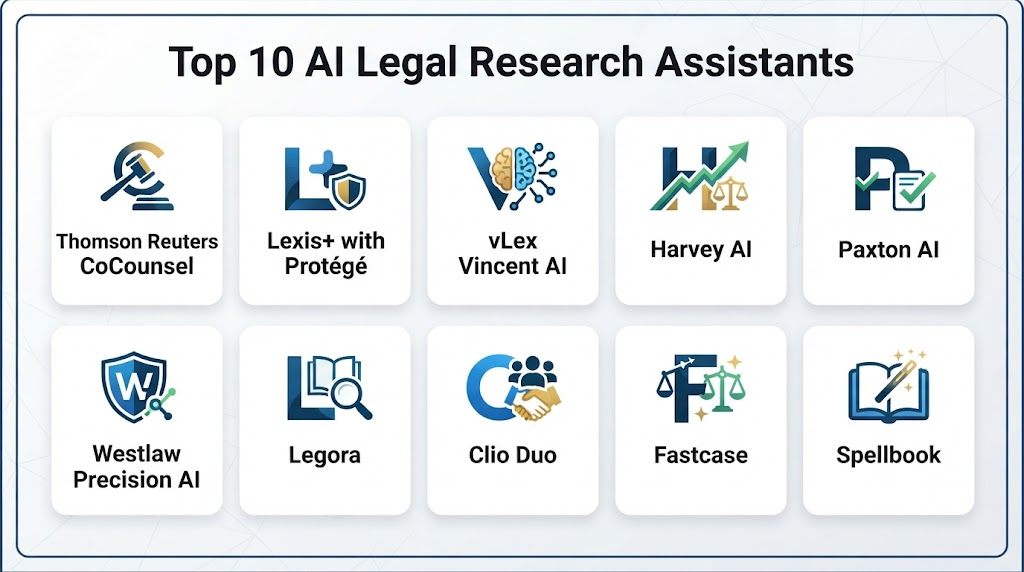
Top 10 AI Legal Research Assistants
1 — Westlaw Precision AI
One-line verdict: Best for legal professionals needing advanced research capabilities combined with a comprehensive legal information ecosystem.
Short description:
Westlaw Precision AI combines legal research capabilities with AI-assisted workflows designed to help professionals research legal questions, identify relevant authorities, and analyze legal information.
Standout Capabilities
- AI-assisted legal research
- Natural-language legal questions
- Case-law research
- Statutory research
- Legal authority discovery
- Research summarization
- Citation-oriented workflows
- Integration with a broader legal research ecosystem
AI-Specific Depth
- Model support: Vendor-managed AI; specific underlying model configuration varies and is not fully publicly stated.
- RAG / knowledge integration: Legal research databases and underlying legal content.
- Evaluation: Legal-source grounding and product-specific evaluation capabilities vary.
- Guardrails: Designed around legal research workflows and source-based answers; exact internal guardrail architecture is not publicly stated.
- Observability: User-facing research history and workflow capabilities vary; model-level token metrics are not publicly stated.
Pros
- Strong legal research ecosystem
- Designed for professional legal workflows
- Access to extensive legal information
Cons
- Enterprise-oriented pricing can be significant
- Requires training for best results
- AI output still requires professional verification
Security & Compliance
Enterprise security capabilities and administrative controls vary by product and contract. Specific certifications should be confirmed directly with the vendor for the relevant offering.
Deployment & Platforms
- Deployment: Cloud
- Platforms: Web
- Self-hosted: Not publicly stated
Integrations & Ecosystem
The product is part of a broader legal research ecosystem.
- Legal databases
- Research tools
- Citation workflows
- Document workflows
- Enterprise administration
- Legal technology integrations
Pricing Model
Typically subscription or enterprise licensing. Exact pricing varies by plan and organization.
Best-Fit Scenarios
- Large law firms
- Litigation research
- Corporate legal departments
- High-volume legal research
2 — Lexis+ AI
One-line verdict: Best for legal teams seeking AI-assisted research across a large established legal information ecosystem.
Short description:
Lexis+ AI combines generative AI with legal research capabilities. It is designed to help legal professionals conduct research, summarize information, and work with legal authorities.
Standout Capabilities
- Conversational legal research
- Legal document summarization
- Case-law research
- Legal authority discovery
- Generative AI assistance
- Citation-supported research
- Legal drafting assistance
- Enterprise legal workflows
AI-Specific Depth
- Model support: Vendor-managed generative AI; exact model configuration varies.
- RAG / knowledge integration: Legal content and research databases.
- Evaluation: Product-specific evaluation and accuracy controls vary.
- Guardrails: Legal-source grounding and product controls are designed for professional use.
- Observability: Research history and user workflow features vary; detailed model telemetry is not publicly stated.
Pros
- Broad legal information ecosystem
- Natural-language research
- Strong professional workflow orientation
Cons
- Enterprise pricing may be substantial
- Requires careful verification
- AI features may require user training
Security & Compliance
Enterprise security and administrative features vary by offering and contract. Specific certifications should be verified for the current plan.
Deployment & Platforms
- Deployment: Cloud
- Platforms: Web
- Self-hosted: Not publicly stated
Integrations & Ecosystem
- Legal research
- Case databases
- Document analysis
- Legal drafting
- Enterprise workflows
- Research history
Pricing Model
Subscription and enterprise licensing models vary.
Best-Fit Scenarios
- Large legal departments
- Law firms
- Complex legal research
- Litigation teams
3 — CoCounsel
One-line verdict: Best for legal professionals wanting AI assistance across research, document review, analysis, and broader legal workflows.
Short description:
CoCounsel is an AI legal assistant designed to help professionals perform research and knowledge-intensive legal tasks. It combines generative AI with legal workflows and source material.
Standout Capabilities
- Legal research
- Document analysis
- Legal summarization
- Contract analysis
- Drafting assistance
- Litigation support
- Knowledge-intensive workflows
- AI-assisted legal tasks
AI-Specific Depth
- Model support: Uses managed AI models; exact model availability can change.
- RAG / knowledge integration: Legal information and user-provided documents.
- Evaluation: Legal-task evaluation is central to the product, although detailed internal benchmarks vary.
- Guardrails: Professional-use controls and source-based workflows.
- Observability: User-level workflow tracking may vary; detailed model telemetry is not publicly stated.
Pros
- Broad legal workflow coverage
- Useful document analysis
- Strong focus on professional legal work
Cons
- Requires careful review of generated work
- Enterprise implementation may require planning
- Exact functionality can vary by plan
Security & Compliance
Security controls vary by offering. Specific certifications and retention arrangements should be verified with the vendor.
Deployment & Platforms
- Deployment: Cloud
- Platforms: Web
- Self-hosted: Not publicly stated
Integrations & Ecosystem
- Legal research
- Document workflows
- Enterprise legal systems
- AI-assisted analysis
- Litigation workflows
- Knowledge management
Pricing Model
Typically subscription or enterprise licensing; exact pricing varies.
Best-Fit Scenarios
- Law firms
- Corporate legal departments
- Document-heavy legal work
4 — Harvey
One-line verdict: Best for sophisticated legal teams seeking AI-assisted workflows across research, drafting, analysis, and complex professional services.
Short description:
Harvey is an AI platform designed for professional services, with strong adoption and functionality around legal workflows. It can assist with legal research, document analysis, drafting, and other knowledge-intensive work.
Standout Capabilities
- Legal research
- Document analysis
- Legal drafting
- Matter-specific workflows
- Enterprise AI
- Professional-services workflows
- Knowledge processing
- AI-assisted reasoning
AI-Specific Depth
- Model support: Multi-model capabilities have been part of the platform’s approach; exact current model configuration varies.
- RAG / knowledge integration: Supports organization-specific and legal knowledge workflows.
- Evaluation: Enterprise evaluation capabilities vary by deployment.
- Guardrails: Enterprise controls and workflow safeguards are provided; detailed internal architecture is not publicly stated.
- Observability: Enterprise monitoring capabilities vary.
Pros
- Strong enterprise AI positioning
- Broad professional-services applications
- Useful for complex legal workflows
Cons
- Primarily oriented toward professional organizations
- Enterprise implementation can require substantial planning
- Exact pricing is not publicly stated
Security & Compliance
Enterprise security features are available, but specific certifications and contractual controls should be verified for the current offering.
Deployment & Platforms
- Deployment: Cloud
- Platforms: Web
- Self-hosted: Varies / N/A
Integrations & Ecosystem
- Enterprise data
- Legal workflows
- Document analysis
- Research
- Drafting
- AI models
- Professional-services systems
Pricing Model
Enterprise-oriented pricing; exact pricing is not publicly stated.
Best-Fit Scenarios
- Large law firms
- Corporate legal teams
- Complex legal research
- Professional-services organizations
5 — vLex Vincent AI
One-line verdict: Best for legal research involving global legal information and AI-assisted analysis of legal authorities.
Short description:
Vincent AI is vLex’s AI-powered legal research and analysis capability. It is designed to help legal professionals investigate legal questions, analyze authorities, and work with legal information.
Standout Capabilities
- AI legal research
- Global legal research
- Case analysis
- Legal document analysis
- Citation discovery
- Natural-language questions
- Legal summarization
- Cross-jurisdiction research
AI-Specific Depth
- Model support: Vendor-managed AI; exact models are not publicly stated.
- RAG / knowledge integration: vLex legal content and legal databases.
- Evaluation: Legal-source grounding and evaluation capabilities vary.
- Guardrails: Source-oriented legal workflows; detailed internal guardrail architecture is not publicly stated.
- Observability: User-level research features vary; detailed model telemetry is not publicly stated.
Pros
- Strong international research potential
- AI-assisted legal analysis
- Broad legal information ecosystem
Cons
- Coverage quality varies by jurisdiction
- AI outputs require verification
- Enterprise features may require higher-tier plans
Security & Compliance
Specific current certifications and controls vary by offering and should be confirmed with the vendor.
Deployment & Platforms
- Deployment: Cloud
- Platforms: Web
- Self-hosted: Not publicly stated
Integrations & Ecosystem
- Legal databases
- Global authorities
- Research tools
- Document analysis
- Citation workflows
- Enterprise legal systems
Pricing Model
Subscription and enterprise pricing models vary.
Best-Fit Scenarios
- International legal research
- Multijurisdictional firms
- Corporate legal departments
6 — Casetext
One-line verdict: Best for lawyers familiar with AI-assisted legal research and workflows built around modern natural-language search.
Short description:
Casetext became known for AI-assisted legal research and its CARA technology before becoming part of Thomson Reuters. Its technology and capabilities have been integrated into the broader legal AI ecosystem.
Standout Capabilities
- AI-assisted legal research
- Natural-language queries
- Case analysis
- Litigation research
- Document analysis
- Legal authority discovery
- AI-powered research workflows
AI-Specific Depth
- Model support: Managed AI; exact current configuration varies.
- RAG / knowledge integration: Legal research content.
- Evaluation: Legal research evaluation capabilities vary.
- Guardrails: Source-based legal workflows.
- Observability: User-facing workflow features vary.
Pros
- Strong history in AI legal research
- Natural-language approach
- Litigation-oriented capabilities
Cons
- Product availability and positioning have evolved after acquisition
- Exact standalone capabilities may vary
- Professional verification remains essential
Security & Compliance
Current security and compliance details depend on the applicable Thomson Reuters offering.
Deployment & Platforms
- Deployment: Cloud
- Platforms: Web
- Self-hosted: Not publicly stated
Integrations & Ecosystem
- Legal research
- Case analysis
- Litigation workflows
- Legal databases
- Thomson Reuters ecosystem
Pricing Model
Current pricing depends on the applicable product offering.
Best-Fit Scenarios
- Litigation research
- AI-assisted legal research
- Existing Thomson Reuters environments
7 — Clio Duo
One-line verdict: Best for law firms seeking AI assistance integrated into broader legal practice-management workflows.
Short description:
Clio provides legal practice-management software and AI capabilities designed to support law firm workflows. Its AI features can help with tasks around firm information, client work, and practice operations.
Standout Capabilities
- AI-assisted legal workflows
- Practice management
- Matter information
- Client management
- Document workflows
- Administrative automation
- Legal productivity
- Workflow integration
AI-Specific Depth
- Model support: Vendor-managed AI; exact model configuration varies.
- RAG / knowledge integration: Can work with information available through supported Clio workflows.
- Evaluation: Product-specific evaluation methodology is not publicly stated.
- Guardrails: Platform permissions and workflow controls apply.
- Observability: Application-level activity may be available; model-level telemetry is not publicly stated.
Pros
- Integrated practice-management environment
- Useful for law firm workflows
- Reduces context switching
Cons
- More practice-management-oriented than pure legal research
- AI capabilities depend on the broader Clio environment
- Not necessarily a replacement for comprehensive legal research databases
Security & Compliance
Security and administrative controls vary by Clio product and plan.
Deployment & Platforms
- Deployment: Cloud
- Platforms: Web and supported applications
- Self-hosted: Not publicly stated
Integrations & Ecosystem
- Practice management
- Client management
- Document management
- Billing
- Calendaring
- Legal workflows
Pricing Model
Subscription-based legal software pricing; AI availability varies by plan.
Best-Fit Scenarios
- Small law firms
- Mid-sized practices
- Firms already using Clio
8 — Spellbook
One-line verdict: Best for transactional lawyers who want AI assistance primarily inside contract drafting and review workflows.
Short description:
Spellbook focuses on AI-powered legal work, particularly contract drafting, review, and analysis. It is designed to assist legal professionals working with transactional documents.
Standout Capabilities
- Contract review
- Contract drafting
- Clause analysis
- Legal document analysis
- AI-assisted drafting
- Microsoft Word-oriented workflows
- Legal language suggestions
- Document comparison
AI-Specific Depth
- Model support: Managed generative AI; exact models vary.
- RAG / knowledge integration: Legal document and clause workflows.
- Evaluation: Product-specific evaluation methodology is not publicly stated.
- Guardrails: Legal document safeguards and review workflows; exact architecture is not publicly stated.
- Observability: User-facing activity varies; token-level telemetry is not publicly stated.
Pros
- Strong contract workflow focus
- Convenient for transactional lawyers
- Reduces repetitive drafting work
Cons
- Less suitable for broad legal research
- AI suggestions require lawyer review
- Exact capabilities vary by plan
Security & Compliance
Specific current certifications should be verified with the vendor. Security controls vary by product and contract.
Deployment & Platforms
- Deployment: Cloud
- Platforms: Web and supported document workflows
- Self-hosted: Not publicly stated
Integrations & Ecosystem
- Microsoft Word workflows
- Contract documents
- Legal drafting
- Clause analysis
- Document review
Pricing Model
Subscription-based pricing; exact pricing varies.
Best-Fit Scenarios
- Contract lawyers
- In-house legal teams
- Transactional practices
9 — Luminance
One-line verdict: Best for legal teams focused on AI-assisted contract review, document analysis, and large-scale legal operations.
Short description:
Luminance provides AI-powered legal document analysis and contract-management capabilities. It is particularly relevant to legal departments and organizations processing large volumes of documents.
Standout Capabilities
- Contract analysis
- Document review
- Legal document classification
- Contract management
- AI-assisted review
- Due diligence
- Document extraction
- Legal operations workflows
AI-Specific Depth
- Model support: Vendor-managed AI; exact model architecture varies.
- RAG / knowledge integration: Legal documents and organizational knowledge.
- Evaluation: Enterprise evaluation capabilities vary.
- Guardrails: Enterprise workflow controls and permissions.
- Observability: Platform-level monitoring varies.
Pros
- Strong document-processing capabilities
- Useful for high-volume legal work
- Enterprise-oriented workflows
Cons
- More document-centric than pure legal research
- Implementation may require planning
- Pricing is generally enterprise-oriented
Security & Compliance
Specific current certifications should be verified with the vendor for the relevant offering.
Deployment & Platforms
- Deployment: Cloud
- Platforms: Web
- Self-hosted: Varies / N/A
Integrations & Ecosystem
- Contract management
- Document repositories
- Legal operations
- Due diligence
- Enterprise workflows
- APIs and integrations
Pricing Model
Enterprise pricing; exact pricing is not publicly stated.
Best-Fit Scenarios
- Corporate legal departments
- Contract-heavy organizations
- Due-diligence projects
10 — LegalOn
One-line verdict: Best for businesses seeking AI assistance with contract review and practical legal document workflows.
Short description:
LegalOn provides AI-powered contract review and legal document assistance. It is designed to help legal and business teams identify potential issues and improve contract-review workflows.
Standout Capabilities
- AI contract review
- Clause analysis
- Risk identification
- Contract summaries
- Legal document assistance
- Review workflows
- Contract comparison
- Business-oriented legal support
AI-Specific Depth
- Model support: Managed AI; specific models are not publicly stated.
- RAG / knowledge integration: Contract and legal-document knowledge.
- Evaluation: Internal evaluation methodology is not publicly stated.
- Guardrails: Legal workflow controls are provided; detailed architecture is not publicly stated.
- Observability: Model-level metrics are not publicly stated.
Pros
- Practical contract-review workflows
- Accessible for business users
- Reduces repetitive document review
Cons
- More contract-focused than broad legal research
- AI output requires professional review
- Availability and capabilities vary by region and plan
Security & Compliance
Specific certifications and security controls should be verified with the vendor for the current offering.
Deployment & Platforms
- Deployment: Cloud
- Platforms: Web and supported document workflows
- Self-hosted: Not publicly stated
Integrations & Ecosystem
- Contract documents
- Legal review
- Document workflows
- Business teams
- Legal operations
Pricing Model
Subscription or enterprise pricing may apply; exact pricing varies.
Best-Fit Scenarios
- Contract review
- In-house legal teams
- Business legal operations
Comparison Table
| Tool | Best For | Deployment | Model Flexibility | Strength | Watch-Out | Public Rating |
|---|---|---|---|---|---|---|
| Westlaw Precision AI | Professional legal research | Cloud | Hosted | Broad legal research ecosystem | Requires verification | N/A |
| Lexis+ AI | Legal research and analysis | Cloud | Hosted | Large legal information ecosystem | Enterprise cost | N/A |
| CoCounsel | Broad legal workflows | Cloud | Hosted | Research + document analysis | Requires review | N/A |
| Harvey | Enterprise legal AI | Cloud | Multi-model/Managed | Complex legal workflows | Enterprise-oriented | N/A |
| vLex Vincent AI | Global legal research | Cloud | Hosted | International research | Coverage varies | N/A |
| Casetext | AI-assisted research | Cloud | Hosted | Natural-language research | Product evolution | N/A |
| Clio Duo | Practice management + AI | Cloud | Hosted | Integrated workflows | Not pure research | N/A |
| Spellbook | Contract drafting | Cloud | Hosted | Transactional workflows | Research depth | N/A |
| Luminance | Document analysis | Cloud | Managed | High-volume document review | Implementation complexity | N/A |
| LegalOn | Contract review | Cloud | Hosted | Practical contract analysis | Contract-focused | N/A |
Scoring & Evaluation
The following scores are comparative editorial assessments rather than official vendor ratings. They are intended to help buyers compare general strengths across legal research, AI reliability, integrations, usability, and enterprise readiness.
| Tool | Core | Reliability/Eval | Guardrails | Integrations | Ease | Perf/Cost | Security/Admin | Support | Weighted Total |
|---|---|---|---|---|---|---|---|---|---|
| Westlaw Precision AI | 10 | 9 | 9 | 10 | 8 | 7 | 9 | 9 | 8.95 |
| Lexis+ AI | 10 | 9 | 9 | 10 | 8 | 7 | 9 | 9 | 8.95 |
| CoCounsel | 9 | 9 | 9 | 9 | 9 | 7 | 9 | 9 | 8.80 |
| Harvey | 9 | 9 | 9 | 9 | 8 | 7 | 10 | 9 | 8.75 |
| vLex Vincent AI | 9 | 9 | 9 | 9 | 8 | 8 | 9 | 8 | 8.75 |
| Casetext | 8 | 8 | 8 | 8 | 9 | 8 | 8 | 8 | 8.15 |
| Clio Duo | 8 | 8 | 8 | 10 | 9 | 8 | 9 | 9 | 8.55 |
| Spellbook | 8 | 8 | 8 | 9 | 9 | 8 | 8 | 8 | 8.30 |
| Luminance | 9 | 9 | 9 | 9 | 8 | 7 | 9 | 8 | 8.65 |
| LegalOn | 8 | 8 | 8 | 8 | 9 | 8 | 8 | 8 | 8.15 |
Top 3 for Enterprise
- Westlaw Precision AI
- Lexis+ AI
- Harvey
Top 3 for SMB
- Clio Duo
- Spellbook
- LegalOn
Top 3 for Developers
- Harvey
- CoCounsel
- vLex Vincent AI
Which AI Legal Research Assistant Is Right for You?
Solo / Freelancer
Solo attorneys should prioritize:
- Ease of use
- Research accuracy
- Predictable pricing
- Fast search
- Citation verification
- Document analysis
A large enterprise platform may be unnecessary if research volume is low. The better choice is often a tool that integrates naturally into the lawyer’s existing workflow.
SMB Law Firm
Small and mid-sized firms should look for:
- Research capabilities
- Document analysis
- Collaboration
- Secure client-data handling
- Administrative controls
- Practice-management integration
The ideal platform should reduce repetitive work without creating a complicated technology stack.
Mid-Market
Mid-market firms may benefit from combining legal research AI with:
- Document management
- Matter management
- Contract workflows
- Knowledge management
- Internal precedent libraries
- AI governance
At this stage, integration becomes increasingly important.
Enterprise
Large legal organizations should evaluate:
- SSO
- RBAC
- Auditability
- Data retention
- Privacy
- Enterprise contracts
- Model governance
- Vendor risk
- Integration capabilities
- Evaluation frameworks
Large firms should also test the system using their own legal research scenarios.
Regulated Industries
Financial services, healthcare, government, and other regulated organizations should pay particular attention to:
- Confidentiality
- Data residency
- Retention
- Encryption
- Access control
- Audit logging
- Vendor risk
- Human review
- Regulatory obligations
Legal AI should never be deployed into a sensitive environment without understanding exactly how organizational and client data are processed.
Budget vs Premium
Budget-conscious firms should start with a clearly defined research problem.
For example:
- Case discovery
- Contract review
- Document summarization
- Citation research
Premium platforms can make sense when legal research is frequent, complex, and high-value.
Build vs Buy
Buy when:
- You need authoritative legal content.
- You need production-ready legal research.
- You lack an internal AI engineering team.
- You want vendor-supported legal workflows.
Build when:
- You have proprietary legal knowledge.
- You need highly customized workflows.
- You require internal document retrieval.
- You need specialized jurisdictional or organizational knowledge.
A hybrid architecture can be attractive: use a commercial legal research platform for external authorities while building a private internal knowledge assistant for organizational documents.
Implementation Playbook: 30 / 60 / 90 Days
First 30 Days: Pilot
Choose two or three high-value workflows.
Examples:
- Case-law research
- Contract analysis
- Legal memorandum preparation
- Regulatory research
Create measurable success criteria:
- Research time
- Relevant authority discovery
- Citation accuracy
- Lawyer acceptance rate
- Verification time
- Error rate
Days 31–60: Harden Security and Evaluation
Create a legal AI evaluation set.
Include:
- Realistic legal questions
- Difficult jurisdictional questions
- Ambiguous fact patterns
- Citation verification tasks
- Long-document questions
- Adversarial prompts
- Confidential-information scenarios
Test the assistant for:
- Hallucinated cases
- Incorrect quotations
- Wrong jurisdictions
- Missing authorities
- Misinterpretation of statutes
- Unsupported conclusions
Days 61–90: Scale
Once the system passes evaluation:
- Expand user access
- Introduce governance policies
- Monitor usage
- Review AI outputs
- Track costs
- Improve prompts
- Establish incident procedures
- Create approved workflows
- Train lawyers and staff
Maintain human approval for high-risk legal decisions.
Common Mistakes and How to Avoid Them
- Trusting AI-generated case citations: Verify every important authority.
- Failing to check quotations: Confirm quotations against the underlying document.
- Ignoring jurisdiction: A legally relevant case in one jurisdiction may be irrelevant in another.
- Uploading confidential information without reviewing data practices: Understand how information is stored and processed.
- Using AI without evaluation: Test the system using realistic legal questions.
- Treating summaries as complete legal analysis: Read the underlying authorities.
- Ignoring outdated information: Confirm that authorities remain current.
- Automating final legal decisions: Keep qualified professionals in control.
- Not monitoring AI usage: Establish governance and audit processes.
- Using one model for every task: Different research and document tasks may benefit from different AI approaches.
- Ignoring prompt injection: Uploaded documents can contain instructions designed to manipulate an AI system.
- Failing to separate client data: Apply appropriate access controls.
- Ignoring vendor lock-in: Maintain portable documents, prompts, and internal knowledge where practical.
- Choosing based only on demonstrations: Evaluate products using your own legal workflows.
- Assuming AI understands context: Provide sufficient factual and jurisdictional context.
- Ignoring professional responsibility: Lawyers remain responsible for the work product they submit.
FAQs
What is an AI Legal Research Assistant?
It is software that uses AI to help legal professionals search, analyze, summarize, compare, and organize legal information and authorities.
Can AI replace legal researchers?
AI can automate portions of legal research, but it does not replace legal judgment, source verification, strategic analysis, or professional responsibility.
Can AI Legal Research Assistants find case law?
Yes. Many platforms can search case law using natural-language queries and identify potentially relevant authorities.
Can AI generate legal citations?
Some systems can provide citations alongside generated research. Lawyers should still verify every important citation against the underlying authority.
Can AI hallucinate legal cases?
Yes. Generative AI systems can produce incorrect or fabricated legal authorities if safeguards are insufficient. Source verification is therefore essential.
Are AI Legal Research Assistants safe for confidential client information?
Safety depends on the specific platform, configuration, contract, and data-handling policies. Firms should review privacy, retention, security, and access controls before using confidential information.
Can these tools analyze uploaded legal documents?
Many modern legal AI platforms can analyze uploaded documents, although supported formats, document sizes, and capabilities vary.
Can AI perform statutory research?
Yes. Legal research platforms may help locate, summarize, and analyze statutes and regulations, but current authoritative versions should be verified.
Do AI Legal Research Assistants support multiple jurisdictions?
Many professional platforms support multiple jurisdictions, but coverage differs significantly. Always verify the jurisdictions relevant to your practice.
Can small law firms use AI legal research tools?
Yes. Smaller firms can use AI to accelerate research, document review, contract analysis, and administrative work. The best solution depends on budget and workflow requirements.
How should law firms evaluate AI legal research accuracy?
Use a test set of real-world legal questions and compare AI results against attorney-verified answers, authorities, citations, and source documents.
Can AI help write legal memoranda?
Yes. AI can assist with organizing research, summarizing authorities, outlining arguments, and drafting preliminary material. Final legal work should be reviewed by a qualified professional.
What is RAG in legal AI?
RAG, or retrieval-augmented generation, connects an AI model to a controlled collection of information so responses can be grounded in retrieved documents or legal authorities.
Can legal AI work with private firm knowledge?
Some enterprise systems can work with organizational documents or private knowledge sources. The exact architecture, permissions, and data-handling practices vary by platform.
Is self-hosted legal AI available?
Self-hosting is possible with some general AI technologies, but many commercial legal research platforms are delivered as cloud services. Availability varies by vendor.
How much do AI Legal Research Assistants cost?
Pricing varies considerably. Some products use subscriptions, while enterprise platforms may use negotiated licensing. Exact pricing should be obtained for the specific organization and use case.
What is the biggest risk of legal AI?
A major risk is confidently presenting incorrect legal information. Hallucinated authorities, inaccurate summaries, and outdated law can create serious professional and business consequences.
Conclusion
AI Legal Research Assistants are becoming important productivity tools for modern legal teams. They can accelerate case-law discovery, summarize complex authorities, analyze documents, support contract review, and help lawyers navigate large amounts of legal information.The best platform depends heavily on the type of legal work being performed.For comprehensive legal research, established legal research ecosystems can be attractive. For broader legal workflows, platforms such as CoCounsel and Harvey can be useful. For contract-focused teams, specialized products such as Spellbook, Luminance, and LegalOn may be more appropriate. Practice-management users may benefit from AI capabilities integrated into platforms such as Clio.