Introduction
AI Homework Helper Apps use artificial intelligence to help students understand homework questions, solve problems, review lessons, generate explanations, and practice difficult concepts. Instead of simply searching for an answer, students can interact with an AI-powered system that explains a problem, provides hints, breaks complex tasks into smaller steps, or recommends additional practice.
These apps are increasingly useful across mathematics, science, languages, writing, programming, history, and other academic subjects. Some specialize in a particular area, while others provide broader homework assistance through conversational AI, image recognition, document analysis, or step-by-step problem so School and university students, independent learners, parents supporting homework, tutors, and educators looking for supplementary learning assist Students who need intensive human tutoring, assignments requiring original fieldwork, high-stakes assessment environments where AI assistance is prohibited, or learners who use AI only to copy answers without understanding the underlying concepts.
What Are AI Homework Helper Apps?
AI Homework Helper Apps are software applications that use AI to assist learners with academic work.
Traditional homework applications often work from predefined exercises. AI homework helpers can handle more flexible questions because they can interpret natural language, images, documents, mathematical notation, and sometimes voice input.
For example, a student might photograph an algebra problem and ask:
“Can you explain how to solve this without giving me the final answer?”
An AI homework helper can potentially identify the problem, explain the relevant concept, provide a sequence of hints, and ask the student to complete each step.
This makes AI homework assistance different from a conventional answer-search tool.
A good homework helper should ideally encourage understanding rather than answer copying.
How AI Homework Helper Apps Work
Modern homework assistants can combine several AI technologies.
Natural-Language Processing
Students can ask questions using ordinary language rather than following rigid commands.
Computer Vision
Image-capable systems can analyze:
- Handwritten equations.
- Printed textbook questions.
- Diagrams.
- Charts.
- Worksheets.
- Photographed homework.
Large Language Models
LLMs can generate:
- Explanations.
- Examples.
- Hints.
- Summaries.
- Practice questions.
- Writing feedback.
Mathematical Solvers
Specialized mathematical engines can improve reliability for certain types of calculations and symbolic problems.
Retrieval-Augmented Generation
Some systems can retrieve information from connected educational resources before generating an answer.
Personalization
An AI helper can adapt explanations according to:
- Student level.
- Previous questions.
- Learning objectives.
- Difficulty.
- Preferred explanation depth.
Why AI Homework Helper Apps Matter
Homework is one of the areas where students frequently encounter learning bottlenecks.
A student may understand most of a lesson but become stuck on one concept. Waiting until the next class can interrupt the learning process.
AI homework helpers can provide immediate assistance.
They can also allow students to ask unlimited follow-up questions:
- “Why did you use this formula?”
- “Can you explain this in simpler language?”
- “Show me another example.”
- “Give me a similar problem.”
- “Don’t give me the answer yet.”
- “Where did I make a mistake?”
This conversational capability is one of the biggest differences between AI homework assistance and traditional search.
However, the educational value depends heavily on how the tool is used.
Key Features to Look For
Before selecting an AI homework helper, evaluate:
- Step-by-step explanations.
- Image and camera input.
- Mathematical problem recognition.
- Multiple subject support.
- Personalized explanations.
- Practice-question generation.
- Writing assistance.
- Citation or source support.
- Document analysis.
- Voice interaction.
- Accuracy.
- Hallucination controls.
- Privacy.
- Data retention.
- Age-appropriate safeguards.
- Teacher or parent controls.
- Mobile availability.
- Offline functionality.
- Cost.
- Accessibility.
- Integration with learning platforms.
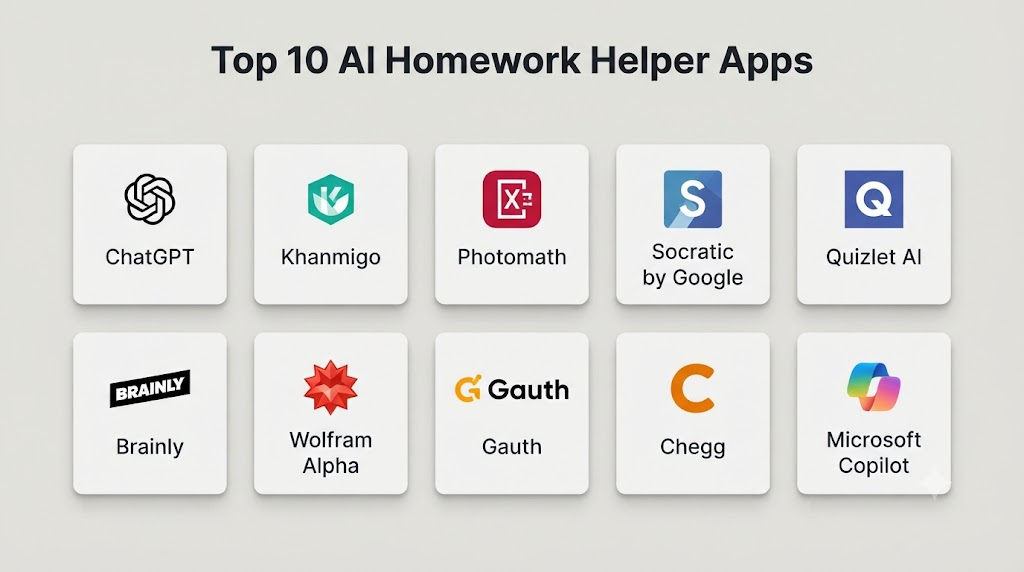
Top 10 AI Homework Helper Apps
1. Photomath
One-line verdict: Best for students who need step-by-step assistance with mathematics homework using camera-based problem recognition.
Short description:
Photomath is a mathematics-focused homework application that allows learners to capture mathematical problems and receive explanations and solution steps. It is particularly useful for algebra and other school-level mathematics tasks.
Standout Capabilities
- Camera-based math problem recognition.
- Step-by-step solutions.
- Mathematical explanations.
- Printed problem scanning.
- Handwritten problem support in supported cases.
- Multiple mathematical topics.
- Interactive learning.
- Mobile-first homework assistance.
AI-Specific Depth
- Model support: Proprietary technology; exact underlying architecture is not publicly stated.
- RAG / knowledge integration: Not a primary capability.
- Evaluation: Mathematical solution checking and structured problem solving.
- Guardrails: Educational and application-level controls.
- Observability: Not publicly stated.
Pros
- Excellent focus on mathematics.
- Very convenient for photographed homework.
- Step-by-step solutions can support understanding.
Cons
- Primarily focused on mathematics.
- Students may become dependent on solution generation.
- Difficult or unusual problems may still require human verification.
Security & Compliance
Specific enterprise security and compliance details are not publicly stated for all use cases.
Deployment & Platforms
- Deployment: Cloud-supported application.
- Platforms: Mobile and web availability varies.
- Self-hosted: N/A.
Integrations & Ecosystem
Photomath primarily operates as a standalone mathematics-learning experience.
- Camera input.
- Mathematical recognition.
- Step-by-step solutions.
- Mobile applications.
- Mathematics practice.
Pricing Model
Free and subscription-based functionality varies.
Best-Fit Scenarios
- Algebra homework.
- Mathematics revision.
- Students who prefer visual problem input.
2. Brainly
One-line verdict: Best for students seeking broad homework assistance combined with AI features and a large educational question-and-answer ecosystem.
Short description:
Brainly combines AI-assisted homework support with community-driven educational resources. Students can ask questions across multiple academic subjects and explore explanations and learning material.
Standout Capabilities
- AI homework assistance.
- Question answering.
- Multiple subject coverage.
- Explanations.
- Community answers.
- Study resources.
- Mobile learning.
- Personalized homework support.
AI-Specific Depth
- Model support: Managed AI capabilities.
- RAG / knowledge integration: Uses platform educational content and resources.
- Evaluation: Varies by question and content.
- Guardrails: Platform safety controls.
- Observability: Not publicly stated in detail.
Pros
- Broad academic coverage.
- Combines AI and community learning.
- Useful for homework questions.
Cons
- Quality can vary by question.
- Community answers should be checked.
- Not a substitute for structured classroom teaching.
Security & Compliance
Specific controls vary by account and product configuration.
Deployment & Platforms
- Deployment: Cloud.
- Platforms: Web and mobile.
- Self-hosted: N/A.
Integrations & Ecosystem
- Web platform.
- Mobile apps.
- Community questions.
- AI assistance.
- Educational resources.
Pricing Model
Freemium and subscription features vary.
Best-Fit Scenarios
- General homework assistance.
- Secondary-school learners.
- Quick explanations.
3. Quizlet
One-line verdict: Best for homework-related studying, flashcards, practice questions, and preparing for tests across many subjects.
Short description:
Quizlet is primarily a digital learning and study platform, but its AI-powered features can help students transform study material into practice activities and receive learning assistance.
Standout Capabilities
- AI-powered study assistance.
- Flashcards.
- Practice questions.
- Study guides.
- Explanations.
- Test preparation.
- Personalized review.
- Large educational content ecosystem.
AI-Specific Depth
- Model support: Managed AI capabilities.
- RAG / knowledge integration: Uses study materials and platform content.
- Evaluation: Practice and assessment functionality.
- Guardrails: Platform-level controls.
- Observability: Learning analytics vary.
Pros
- Excellent for revision.
- Supports multiple subjects.
- Combines AI with established study workflows.
Cons
- Not primarily a step-by-step homework solver.
- User-generated study materials may vary in quality.
- Some advanced features require paid access.
Security & Compliance
Security and administrative controls vary by product and account type.
Deployment & Platforms
- Deployment: Cloud.
- Platforms: Web and mobile.
- Self-hosted: N/A.
Integrations & Ecosystem
- Flashcards.
- Practice tests.
- Study guides.
- Mobile apps.
- Web learning.
- Educational content.
Pricing Model
Freemium and subscription-based functionality varies.
Best-Fit Scenarios
- Exam preparation.
- Homework revision.
- Vocabulary and concept memorization.
4. Google Gemini
One-line verdict: Best for students wanting broad conversational AI assistance across homework, research, writing, and multimodal learning tasks.
Short description:
Google Gemini is a general-purpose AI system that can assist students with explanations, brainstorming, summarization, research, image understanding, and other academic tasks. It is not limited to one subject.
Standout Capabilities
- Conversational homework help.
- Multimodal input.
- Writing assistance.
- Summarization.
- Research support.
- Explanations.
- Brainstorming.
- Document and image analysis in supported experiences.
AI-Specific Depth
- Model support: Google-managed models.
- RAG / knowledge integration: Supported connected Google experiences can provide additional context.
- Evaluation: Varies by task.
- Guardrails: Google-managed safety mechanisms.
- Observability: User-facing observability is limited compared with developer platforms.
Pros
- Broad subject coverage.
- Strong multimodal capabilities.
- Useful beyond homework.
Cons
- General-purpose AI rather than a dedicated homework tutor.
- Answers can require verification.
- Students need guidance on responsible use.
Security & Compliance
Controls vary according to product and account type.
Deployment & Platforms
- Deployment: Cloud.
- Platforms: Web and mobile.
- Self-hosted: N/A for the consumer experience.
Integrations & Ecosystem
- Google ecosystem.
- Documents.
- Images.
- Search-related workflows.
- Mobile devices.
- Education environments.
Pricing Model
Free and paid offerings vary.
Best-Fit Scenarios
- Cross-subject homework.
- Research assistance.
- Writing and summarization.
5. Microsoft Copilot
One-line verdict: Best for students and learners already working inside Microsoft’s productivity ecosystem.
Short description:
Microsoft Copilot provides general-purpose AI assistance for writing, research, summarization, brainstorming, and productivity. It can support homework workflows when students work with Microsoft documents and related educational environments.
Standout Capabilities
- Conversational assistance.
- Writing support.
- Research.
- Summarization.
- Document assistance.
- Brainstorming.
- Productivity.
- Microsoft ecosystem integration.
AI-Specific Depth
- Model support: Microsoft-managed AI models and integrations.
- RAG / knowledge integration: Supported Microsoft-connected experiences.
- Evaluation: Task-dependent.
- Guardrails: Product and organizational controls.
- Observability: Administrative capabilities vary.
Pros
- Strong Microsoft ecosystem integration.
- Useful for writing and research.
- Supports many academic workflows.
Cons
- Not designed exclusively as a homework application.
- Students need to verify generated answers.
- Capabilities vary by product and account.
Security & Compliance
Security and administrative capabilities depend on the specific Microsoft product and account configuration.
Deployment & Platforms
- Deployment: Cloud.
- Platforms: Web, desktop, and supported Microsoft environments.
- Self-hosted: Varies by product.
Integrations & Ecosystem
- Microsoft 365.
- Word.
- PowerPoint.
- OneDrive.
- Teams.
- Education workflows.
- Developer APIs in supported products.
Pricing Model
Varies by account, product, and licensing model.
Best-Fit Scenarios
- Essay assistance.
- Research.
- Students using Microsoft 365.
6. Socratic
One-line verdict: Best for students who want accessible explanations and homework guidance across several academic subjects.
Short description:
Socratic is designed to help students understand questions and discover educational resources. It can be useful for homework assistance, particularly when learners need explanations rather than only final answers.
Standout Capabilities
- Homework questions.
- Educational explanations.
- Multiple subjects.
- Image-based questions.
- Learning resources.
- Mobile accessibility.
- Concept support.
- Guided learning.
AI-Specific Depth
- Model support: Google-managed technology.
- RAG / knowledge integration: Educational resources.
- Evaluation: Varies by subject.
- Guardrails: Platform controls.
- Observability: Not publicly stated.
Pros
- Easy to use.
- Supports multiple subjects.
- Helpful for quick explanations.
Cons
- Not a full institutional tutoring system.
- Feature depth is narrower than broader AI platforms.
- Students should verify important answers.
Security & Compliance
Detailed current compliance information is not publicly stated across all use cases.
Deployment & Platforms
- Deployment: Cloud.
- Platforms: Mobile-focused.
- Self-hosted: N/A.
Integrations & Ecosystem
- Mobile devices.
- Educational resources.
- Question recognition.
- Study content.
Pricing Model
Availability may vary.
Best-Fit Scenarios
- Homework questions.
- Quick explanations.
- Independent study.
7. Wolfram Alpha
One-line verdict: Best for computational homework involving mathematics, science, engineering, statistics, and quantitative problem solving.
Short description:
Wolfram Alpha is a computational knowledge engine that can calculate and explain many mathematical and scientific problems. It is particularly useful when reliable computation is more important than open-ended conversation.
Standout Capabilities
- Mathematical computation.
- Symbolic calculations.
- Statistics.
- Scientific calculations.
- Graphing.
- Unit conversion.
- Structured factual queries.
- Computational problem solving.
AI-Specific Depth
- Model support: Computational and AI-assisted capabilities vary.
- RAG / knowledge integration: Structured computational knowledge system.
- Evaluation: Strong computational validation for supported problems.
- Guardrails: Query and platform controls.
- Observability: Not primarily positioned as an AI observability platform.
Pros
- Strong quantitative capabilities.
- Useful for mathematics and science.
- Computational approach can reduce certain types of generative errors.
Cons
- Less conversational than general-purpose AI.
- Can encourage answer seeking if used without explanation.
- Advanced capabilities may require paid access.
Security & Compliance
Not primarily positioned as an enterprise AI governance platform.
Deployment & Platforms
- Deployment: Cloud.
- Platforms: Web and mobile.
- Self-hosted: N/A for standard user experience.
Integrations & Ecosystem
- Web.
- Mobile.
- Computational tools.
- Mathematical notation.
- APIs in supported offerings.
Pricing Model
Free and paid functionality varies.
Best-Fit Scenarios
- Mathematics.
- Physics.
- Engineering calculations.
8. Chegg Study
One-line verdict: Best for students seeking structured homework solutions, explanations, and academic study resources.
Short description:
Chegg provides educational resources and homework assistance across multiple subjects. Its services have traditionally combined expert-created educational material with digital study tools and increasingly AI-assisted experiences.
Standout Capabilities
- Homework assistance.
- Study resources.
- Explanations.
- Practice.
- Multiple academic subjects.
- Writing support.
- Educational content.
- AI-assisted study features.
AI-Specific Depth
- Model support: Managed AI capabilities; exact architecture varies.
- RAG / knowledge integration: Educational content and platform resources.
- Evaluation: Depends on feature.
- Guardrails: Platform-level controls.
- Observability: Not publicly stated in detail.
Pros
- Broad academic coverage.
- Large educational resource ecosystem.
- Useful for structured study.
Cons
- Subscription model may not suit every student.
- Students should distinguish learning support from copying solutions.
- Exact AI functionality varies.
Security & Compliance
Current product-specific security and compliance details should be verified for the applicable service.
Deployment & Platforms
- Deployment: Cloud.
- Platforms: Web and mobile.
- Self-hosted: N/A.
Integrations & Ecosystem
- Study resources.
- Homework assistance.
- Mobile applications.
- Web platform.
- Educational content.
Pricing Model
Subscription-based offerings vary.
Best-Fit Scenarios
- College homework.
- Study support.
- Multi-subject learning.
9. Photomath-style Specialized Math Assistants
One-line verdict: Best for learners who prefer specialized mathematical assistance over general-purpose conversational AI.
Short description:
Specialized mathematics assistants focus on equation recognition, calculations, explanations, graphs, and structured mathematical reasoning. They can be useful when students want a dedicated tool rather than a general AI chatbot.
Standout Capabilities
- Equation solving.
- Mathematical recognition.
- Step-by-step explanations.
- Graphing.
- Algebra support.
- Geometry support.
- Calculus assistance.
- Numerical computation.
AI-Specific Depth
- Model support: Varies / N/A.
- RAG / knowledge integration: Varies / N/A.
- Evaluation: Mathematical validation varies.
- Guardrails: Varies by platform.
- Observability: Varies / N/A.
Pros
- Specialized subject experience.
- Stronger mathematical workflows.
- Often easier to use for equations.
Cons
- Not appropriate for general homework.
- Quality varies considerably between products.
- Some advanced capabilities may require subscriptions.
Security & Compliance
Varies / N/A.
Deployment & Platforms
- Deployment: Usually cloud-based.
- Platforms: Web and mobile depending on product.
- Self-hosted: Varies / N/A.
Integrations & Ecosystem
- Mathematics engines.
- Mobile applications.
- Web tools.
- Graphing.
- Equation input.
Pricing Model
Varies / N/A.
Best-Fit Scenarios
- Mathematics homework.
- STEM practice.
- Quantitative problem solving.
10. Khanmigo
One-line verdict: Best for students who want guided AI learning rather than simply receiving completed homework answers.
Short description:
Khanmigo is designed around AI-assisted learning and tutoring. Its educational approach emphasizes helping students reason through problems and interact with learning material.
Standout Capabilities
- AI tutoring.
- Guided problem solving.
- Interactive explanations.
- Writing support.
- Coding assistance.
- Learning conversations.
- Teacher tools.
- Educational content integration.
AI-Specific Depth
- Model support: Managed AI.
- RAG / knowledge integration: Strong relationship with Khan Academy educational content.
- Evaluation: Guided educational interactions and learning workflows.
- Guardrails: Education-oriented safeguards.
- Observability: Capabilities vary by account and product.
Pros
- Strong learning-oriented approach.
- Encourages students to reason through problems.
- Connected to structured educational content.
Cons
- Not primarily a traditional homework answer engine.
- Availability can vary by region and user type.
- Organizations may require additional institutional controls.
Security & Compliance
Privacy and safety controls depend on the applicable product and user configuration.
Deployment & Platforms
- Deployment: Cloud.
- Platforms: Web-based.
- Self-hosted: N/A.
Integrations & Ecosystem
- Khan Academy content.
- Student learning.
- Teacher tools.
- AI tutoring.
- Writing.
- Coding.
Pricing Model
Availability and pricing vary by offering and user type.
Best-Fit Scenarios
- Guided homework help.
- Independent learners.
- Students who want explanations instead of answers.
Comparison Table
| Tool | Best For | Deployment | Model Flexibility | Strength | Watch-Out |
|---|---|---|---|---|---|
| Photomath | Math homework | Cloud/App | Managed | Visual math solving | Math-focused |
| Brainly | General homework | Cloud/App | Managed | AI + community | Content quality varies |
| Quizlet | Study and revision | Cloud/App | Managed | Practice ecosystem | Not a full solver |
| Google Gemini | General homework | Cloud | Hosted | Multimodal AI | Requires verification |
| Microsoft Copilot | Writing/research | Cloud | Hosted | Productivity ecosystem | General-purpose |
| Socratic | Student questions | Cloud/App | Managed | Simple explanations | Limited advanced controls |
| Wolfram Alpha | STEM calculations | Cloud/App | Computational | Quantitative accuracy | Less conversational |
| Chegg Study | Academic study | Cloud/App | Managed | Educational resources | Subscription model |
| Specialized Math Assistants | Mathematics | Cloud/App | Varies | Subject specialization | Limited subject coverage |
| Khanmigo | Guided learning | Cloud | Managed | Learning-focused AI | Ecosystem dependence |
Scoring & Evaluation
These scores are comparative editorial assessments rather than official vendor ratings. They consider how effectively each product supports homework assistance, learning, usability, safety, and broader educational workflows.
| Tool | Core | Reliability/Eval | Guardrails | Integrations | Ease | Perf/Cost | Security/Admin | Support | Weighted Total |
|---|---|---|---|---|---|---|---|---|---|
| Photomath | 9 | 9 | 8 | 7 | 10 | 9 | 7 | 8 | 8.55 |
| Brainly | 8 | 7 | 7 | 8 | 9 | 8 | 7 | 8 | 7.75 |
| Quizlet | 9 | 8 | 8 | 9 | 10 | 9 | 8 | 8 | 8.80 |
| Google Gemini | 9 | 8 | 9 | 10 | 9 | 8 | 9 | 9 | 8.90 |
| Microsoft Copilot | 9 | 8 | 9 | 10 | 9 | 8 | 10 | 9 | 9.00 |
| Socratic | 8 | 8 | 8 | 8 | 10 | 9 | 7 | 8 | 8.20 |
| Wolfram Alpha | 9 | 10 | 8 | 8 | 9 | 8 | 8 | 9 | 8.80 |
| Chegg Study | 9 | 8 | 8 | 8 | 9 | 7 | 8 | 9 | 8.30 |
| Specialized Math Assistants | 9 | 9 | 8 | 7 | 9 | 8 | 7 | 8 | 8.25 |
| Khanmigo | 9 | 9 | 9 | 9 | 9 | 8 | 8 | 9 | 8.80 |
Top 3 for Enterprise
- Microsoft Copilot
- Google Gemini
- Khanmigo
Top 3 for SMB
- Khanmigo
- Quizlet
- Chegg Study
Top 3 for Developers
- Google Gemini
- Microsoft Copilot
- Wolfram Alpha
Which AI Homework Helper App Is Right for You?
Solo Student
Choose a tool according to the subject you need help with.
For mathematics, a specialized mathematics application may be more useful than a general chatbot.
For essays, research, or multiple subjects, a general AI assistant may provide broader capabilities.
For exam revision, a study platform such as Quizlet may be more useful.
SMB Education Provider
Tutoring businesses and smaller education organizations should prioritize:
- Student management.
- Teacher oversight.
- Privacy.
- Reporting.
- Content controls.
- Curriculum alignment.
- Cost.
Avoid deploying a consumer AI tool to an entire student population without testing its privacy and administrative capabilities.
Mid-Market Education Organization
A larger organization should consider:
- LMS integration.
- SSO.
- Role-based permissions.
- Student data management.
- Auditability.
- Content grounding.
- AI evaluation.
- Teacher dashboards.
Enterprise / University
Universities and large education systems should establish an AI governance framework before widespread adoption.
Important areas include:
- Data privacy.
- Identity management.
- AI evaluation.
- Student safety.
- Model governance.
- Retention policies.
- Incident response.
- Vendor contracts.
- Accessibility.
- Academic integrity.
Regulated or Sensitive Environments
When homework systems process student information, organizations should minimize unnecessary data collection.
Pay attention to:
- Student identity data.
- Conversation histories.
- Uploaded assignments.
- Images.
- Voice data.
- Retention.
- Third-party model providers.
- Data residency.
- Administrative access.
Budget vs Premium
Free tools can be sufficient for occasional homework assistance.
Premium solutions can make sense when students need:
- More advanced problem solving.
- Larger document handling.
- Better study workflows.
- Structured learning.
- Institutional controls.
Build vs Buy
Buy when:
- You need a solution quickly.
- Your needs are relatively standard.
- You want mobile applications.
- You don’t have an AI development team.
Build when:
- Your curriculum is highly specialized.
- You require proprietary educational content.
- You need custom data controls.
- You need deep LMS integration.
- You want control over models and infrastructure.
Implementation Playbook: 30 / 60 / 90 Days
First 30 Days: Pilot
Start with a small group of students and one or two subjects.
Define success metrics such as:
- Homework completion.
- Learning improvement.
- Accuracy.
- Student satisfaction.
- Teacher workload.
- Cost per learner.
- Response time.
Compare AI-assisted learning with the existing process.
Days 31–60: Security and Evaluation
Develop an evaluation set containing:
- Easy questions.
- Difficult questions.
- Ambiguous questions.
- Curriculum-specific questions.
- Adversarial prompts.
- Incorrect student reasoning.
- Sensitive requests.
Test for:
- Hallucinations.
- Incorrect calculations.
- Unsafe responses.
- Prompt injection.
- Inappropriate content.
- Overconfident answers.
Teachers should review representative conversations.
Days 61–90: Scale
After successful validation:
- Expand to more subjects.
- Integrate learning systems.
- Establish student policies.
- Train teachers.
- Monitor AI quality.
- Track costs.
- Review privacy.
- Create incident-response procedures.
- Establish periodic evaluation.
Common Mistakes & How to Avoid Them
- Using AI as an answer machine: Encourage hints and explanations.
- Ignoring hallucinations: Verify important academic information.
- Skipping teacher involvement: Teachers should remain part of the learning process.
- Allowing unrestricted student data: Apply data minimization.
- Ignoring academic integrity: Define acceptable AI usage clearly.
- Failing to test image recognition: Photograph quality can affect results.
- Ignoring mathematical errors: Use specialized computational verification when appropriate.
- No evaluation framework: Continuously test AI responses.
- Overusing AI: Students still need independent problem-solving practice.
- Ignoring prompt injection: Treat student inputs as untrusted.
- No cost monitoring: Usage can increase quickly at scale.
- Ignoring accessibility: Support students with different learning needs.
- Using generic AI for specialized curriculum: Ground responses in approved materials.
- No incident-response process: Define how teachers handle harmful or incorrect AI responses.
FAQs
What is an AI homework helper?
An AI homework helper is an application that uses artificial intelligence to assist students with academic questions, explanations, practice, and problem solving.
Can AI homework helpers solve mathematics problems?
Yes. Several applications specialize in mathematics and can recognize equations, perform calculations, and provide step-by-step explanations.
Can AI homework helpers work from photographs?
Some applications support image input and can analyze photographed worksheets, textbook questions, diagrams, or mathematical equations.
Are AI homework helpers accurate?
Accuracy varies by application and subject. Students should verify important information rather than assuming every AI-generated answer is correct.
Can AI homework helpers explain answers?
Yes. Many systems can explain concepts, show intermediate steps, provide hints, and offer alternative explanations.
Can AI homework helpers help with essays?
General-purpose AI assistants can help with brainstorming, outlining, editing, summarization, and feedback. Students should follow their institution’s academic-integrity policies.
Are AI homework helpers suitable for children?
They can be useful, but child-focused deployments require stronger attention to privacy, age appropriateness, content safety, and parental or teacher oversight.
Can AI homework apps replace tutors?
They can provide supplementary assistance, but human tutors remain valuable for personalized instruction, motivation, nuanced feedback, and complex learning needs.
Do AI homework helpers store student questions?
Some services may retain interactions or other data. Students and institutions should review the applicable privacy and retention policies before using a platform.
Can schools use AI homework helper apps?
Yes, but schools should establish policies covering privacy, academic integrity, student safety, teacher oversight, and acceptable AI use.
Can AI homework apps use my own documents?
Some general-purpose AI systems can analyze uploaded documents. Support for persistent knowledge bases or institutional content varies by product.
What is RAG in homework assistance?
RAG allows an AI system to retrieve information from a trusted knowledge source before generating a response, which can improve grounding for curriculum-specific questions.
Can AI homework helpers generate practice questions?
Yes. Many AI systems can generate exercises based on a subject, topic, difficulty level, or learner requirements.
Are AI homework helpers useful for exam preparation?
Yes. They can generate practice questions, explain concepts, identify weak areas, summarize lessons, and simulate study sessions.
What is the best AI homework helper?
There is no universal winner. The best option depends on the subject, learner, budget, required features, and whether the priority is solving, studying, or guided learning.
Are specialized homework apps better than general AI?
For certain subjects, yes. Mathematics applications can provide specialized calculation and equation-solving capabilities, while general AI tools may be more flexible across subjects.
Can AI homework helpers be used for programming assignments?
General AI assistants can explain programming concepts, debug code, and provide examples. Students should ensure their use complies with their course’s academic-integrity requirements.
How much do AI homework helper apps cost?
Pricing varies widely. Some provide free functionality, while others use subscriptions, premium features, or institution-specific licensing.
What is the biggest risk of AI homework helpers?
The biggest educational risk is replacing learning with answer copying. Incorrect AI responses and over-reliance can also undermine learning outcomes.
Conclusion
AI Homework Helper Apps are changing how students approach homework by making explanations, problem solving, practice, and study assistance available on demand.The most useful choice depends on what the learner actually needs. Photomath is particularly suited to mathematics, Wolfram Alpha is valuable for computational and quantitative work, Quizlet is strong for study and revision, Brainly combines AI with a broader learning community, and Khanmigo emphasizes guided learning. General-purpose systems such as Google Gemini and Microsoft Copilot can provide broader support across writing, research, documents, images, and multiple subjects.A high-quality homework workflow should encourage students to understand the concept, attempt the problem, review feedback, correct mistakes, and practice independently.