Introduction
AI Regulatory Change Monitoring with NLP uses artificial intelligence and natural language processing to track changes in laws, regulations, regulatory guidance, enforcement information, and compliance requirements. Instead of manually checking hundreds of government publications, regulatory websites, legal updates, and policy documents, organizations can use these platforms to identify relevant changes and turn them into actionable compliance tasks.
These tools are especially useful for organizations operating across multiple jurisdictions where regulatory requirements can change frequently. NLP helps systems classify documents, detect changes, identify relevant obligations, compare versions, and surface updates that may affect specific business activ Compliance teams, legal departments, risk professionals, financial institutions, healthcare organizations, technology companies, insurers, multinational corporations, and regulated busines Very small organizations operating in one low-change regulatory environment, businesses that only need occasional legal research, or teams expecting AI to automatically determine the legal meaning of every regulatory change without human review.
What Is AI Regulatory Change Monitoring with NLP?
AI Regulatory Change Monitoring with NLP combines regulatory intelligence databases with technologies such as:
- Natural language processing
- Machine learning
- Semantic search
- Document classification
- Entity extraction
- Text comparison
- Generative AI
- Automated summarization
- Workflow automation
The basic objective is simple: find regulatory changes that matter to an organization and help people understand what they need to do about them.
For example, a financial institution may need to monitor changes affecting:
- Anti-money laundering
- Consumer protection
- Data privacy
- Cybersecurity
- Capital requirements
- Reporting obligations
- Financial crime controls
A healthcare company may instead monitor:
- Patient privacy
- Medical-device requirements
- Clinical regulations
- Healthcare data
- Pharmaceutical requirements
- Safety obligations
The value of NLP is that it can analyze regulatory language at scale and identify relationships that simple keyword alerts might miss.
How AI Regulatory Change Monitoring Works
1. Regulatory Data Collection
The platform collects information from relevant regulatory sources.
Depending on the provider, this can include:
- Government publications
- Regulatory agencies
- Consultation papers
- Enforcement announcements
- Guidance
- Legislative documents
- Regulatory notices
2. Document Processing
NLP systems process large volumes of legal and regulatory text.
They may identify:
- Topics
- Organizations
- Jurisdictions
- Dates
- Obligations
- Regulatory references
- Affected business areas
3. Change Detection
AI can compare previous and updated versions of documents to identify meaningful changes.
4. Relevance Classification
Not every regulatory change matters to every organization. AI can categorize updates according to:
- Business unit
- Geography
- Industry
- Regulatory topic
- Risk category
- Compliance obligation
5. Impact Analysis
Some platforms can help determine which policies, controls, procedures, or business processes may need attention.
6. Workflow Assignment
Relevant changes can be routed to compliance, legal, risk, or operational teams for review.
7. Human Validation
Compliance professionals should verify important regulatory interpretations before making business decisions.
Why Regulatory Change Monitoring Matters
Regulatory teams often face a difficult combination of growing regulatory complexity and limited resources.
Traditional monitoring can require employees to:
- Check regulatory websites
- Read lengthy publications
- Compare document versions
- Track deadlines
- Determine applicability
- Update internal policies
- Communicate changes
AI can reduce repetitive work and help teams focus on interpretation and decision-making.
The goal is not simply to generate more alerts. A useful platform should help answer:
What changed?
Does it apply to us?
What is the impact?
What action is required?
Who should review it?
Key Features to Evaluate
When selecting an AI regulatory monitoring platform, evaluate:
- Regulatory source coverage
- Geographic coverage
- Industry coverage
- Change detection
- NLP classification
- Semantic search
- Regulatory mapping
- Impact analysis
- Obligation management
- Alert customization
- Workflow automation
- Regulatory calendars
- Audit trails
- AI-generated summaries
- Human-review workflows
- Data freshness
- API availability
- Integration capabilities
- Security controls
- Data retention policies
What Has Changed in AI Regulatory Change Monitoring
- Generative AI is improving regulatory summaries: Teams can obtain concise explanations of lengthy regulatory publications while retaining access to underlying source material.
- Semantic monitoring is becoming more important: Modern systems can identify regulatory concepts even when terminology changes.
- AI-powered impact analysis is expanding: Platforms increasingly attempt to connect regulatory changes with business processes, policies, risks, and controls.
- Regulatory intelligence is becoming more proactive: Organizations can monitor emerging proposals and consultations instead of waiting for finalized requirements.
- Multijurisdiction monitoring is increasingly valuable: Global businesses need systems that can track regulatory developments across countries and regions.
- AI governance is becoming part of compliance monitoring: Organizations increasingly need to track regulations and guidance affecting AI systems themselves.
- Explainability matters: Compliance professionals need to understand why an alert was generated and what source material supports it.
- False-positive reduction is becoming critical: Too many irrelevant alerts can overwhelm compliance teams.
- Human-in-the-loop workflows remain essential: Regulatory interpretation should not be fully automated for high-risk decisions.
- Data provenance is increasingly important: Users need confidence that monitoring information comes from authoritative and current sources.
- API-driven workflows are expanding: Regulatory intelligence can increasingly connect with GRC, legal, risk, and ticketing systems.
- Continuous monitoring is replacing periodic reviews: Organizations can move from scheduled manual research toward ongoing regulatory intelligence.
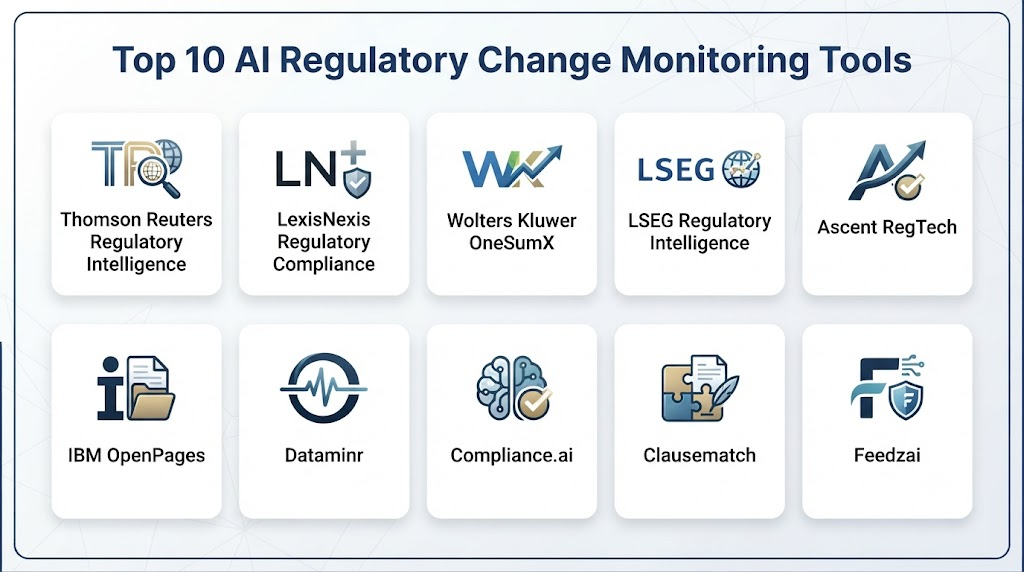
Top 10 AI Regulatory Change Monitoring Tools
1 — RegASK
One-line verdict: Best for organizations seeking AI-assisted regulatory intelligence and compliance research across complex global regulatory environments.
Short description:
RegASK provides regulatory intelligence capabilities designed to help organizations monitor, understand, and manage regulatory developments. Its AI-oriented approach can support research and regulatory analysis.
Standout Capabilities
- Regulatory intelligence
- AI-assisted regulatory research
- Regulatory monitoring
- Compliance analysis
- Global regulatory information
- Regulatory questions and answers
- Regulatory change identification
- Compliance workflows
AI-Specific Depth
- Model support: Proprietary and managed AI capabilities; exact underlying models are not publicly stated.
- RAG / knowledge integration: Regulatory knowledge sources and organizational context depending on workflow.
- Evaluation: Human and regulatory review workflows; detailed internal evaluation methodology is not publicly stated.
- Guardrails: Domain-specific workflows and source-oriented analysis.
- Observability: Detailed model-level token and latency metrics are not publicly stated.
Pros
- Strong regulatory intelligence focus
- Useful for complex compliance questions
- Designed for professional compliance teams
Cons
- Enterprise-oriented
- Exact AI methodology is not fully public
- Regulatory coverage should be verified for specific requirements
Security & Compliance
Security controls and certifications vary by offering and contract. Organizations should verify SSO, RBAC, audit logs, encryption, retention, and residency requirements directly.
Deployment & Platforms
- Deployment: Cloud
- Platforms: Web
- Self-hosted: Not publicly stated
Integrations & Ecosystem
The platform is designed around regulatory intelligence and compliance workflows.
- Regulatory research
- Regulatory monitoring
- Compliance teams
- Regulatory data
- AI analysis
- Enterprise workflows
Pricing Model
Enterprise-oriented pricing; exact pricing is not publicly standardized.
Best-Fit Scenarios
- Global regulatory monitoring
- Complex compliance research
- Regulatory intelligence teams
2 — CUBE
One-line verdict: Best for financial institutions seeking automated regulatory intelligence, obligation mapping, and compliance change management.
Short description:
CUBE focuses on regulatory intelligence and compliance automation, particularly for financial services organizations. It helps businesses monitor regulatory requirements and connect changes with compliance obligations.
Standout Capabilities
- Regulatory intelligence
- Regulatory change management
- Obligation management
- Regulatory data
- Compliance automation
- Regulatory mapping
- Financial-services focus
- Workflow support
AI-Specific Depth
- Model support: Proprietary AI and regulatory technology; exact models are not publicly stated.
- RAG / knowledge integration: Regulatory data and organizational compliance information.
- Evaluation: Regulatory data validation and compliance workflows; detailed AI evaluation methodology is not publicly stated.
- Guardrails: Compliance-oriented workflows and controls.
- Observability: Workflow monitoring; detailed AI telemetry is not publicly stated.
Pros
- Strong financial-services orientation
- Regulatory data focus
- Useful for compliance automation
Cons
- Best suited to regulated organizations
- Implementation can require significant configuration
- Coverage should be validated for specific jurisdictions
Security & Compliance
Enterprise security capabilities are available, but specific certifications and configuration details should be verified.
Deployment & Platforms
- Deployment: Cloud
- Platforms: Web
- Self-hosted: Not publicly stated
Integrations & Ecosystem
- GRC systems
- Regulatory data
- Compliance workflows
- Risk management
- Enterprise systems
- APIs
Pricing Model
Enterprise pricing; exact pricing is not publicly standardized.
Best-Fit Scenarios
- Banking
- Financial services compliance
- Regulatory change management
3 — Regology
One-line verdict: Best for organizations needing AI-assisted regulatory intelligence, obligation tracking, and compliance monitoring across jurisdictions.
Short description:
Regology provides regulatory intelligence and compliance management capabilities designed to help organizations monitor regulatory requirements and understand changes that may affect operations.
Standout Capabilities
- Regulatory monitoring
- Compliance management
- Regulatory intelligence
- Obligation management
- Regulatory mapping
- AI-assisted analysis
- Change alerts
- Compliance workflows
AI-Specific Depth
- Model support: Managed/proprietary AI; exact model configuration is not publicly stated.
- RAG / knowledge integration: Regulatory content and organizational compliance context.
- Evaluation: Compliance review workflows; detailed AI evaluation methodology is not publicly stated.
- Guardrails: Compliance workflow controls.
- Observability: Detailed model telemetry is not publicly stated.
Pros
- Regulatory-focused platform
- Supports ongoing monitoring
- Useful for compliance teams
Cons
- Coverage varies by geography and industry
- Enterprise setup may require configuration
- AI outputs still require professional validation
Security & Compliance
Security and compliance controls vary by deployment and contract. Verify required certifications and data controls.
Deployment & Platforms
- Deployment: Cloud
- Platforms: Web
- Self-hosted: Not publicly stated
Integrations & Ecosystem
- Regulatory databases
- Compliance workflows
- Obligation management
- Risk systems
- Regulatory monitoring
- Enterprise integrations
Pricing Model
Not publicly standardized.
Best-Fit Scenarios
- Regulatory monitoring
- Compliance obligation management
- Multijurisdiction organizations
4 — C2P
One-line verdict: Best for enterprises managing regulatory change, compliance obligations, and workflow across multiple jurisdictions.
Short description:
C2P is a regulatory compliance platform designed to help organizations monitor regulatory changes and manage compliance obligations.
Standout Capabilities
- Regulatory change management
- Compliance obligations
- Regulatory alerts
- Compliance workflows
- Regulatory mapping
- Risk management
- Global monitoring
- Compliance reporting
AI-Specific Depth
- Model support: Proprietary/managed technology; exact AI models are not publicly stated.
- RAG / knowledge integration: Regulatory content and compliance information.
- Evaluation: Human compliance review and workflow validation.
- Guardrails: Compliance workflows and permission controls.
- Observability: Workflow-level reporting; detailed AI telemetry is not publicly stated.
Pros
- Comprehensive regulatory workflow
- Enterprise-oriented
- Strong compliance management focus
Cons
- May be more than smaller organizations need
- Configuration can be complex
- Exact AI capabilities vary
Security & Compliance
Enterprise controls are available depending on deployment. Specific certifications should be verified directly.
Deployment & Platforms
- Deployment: Cloud
- Platforms: Web
- Self-hosted: Varies / N/A
Integrations & Ecosystem
- GRC platforms
- Compliance systems
- Regulatory content
- Workflow systems
- Reporting
- APIs
Pricing Model
Enterprise licensing; exact pricing varies.
Best-Fit Scenarios
- Global compliance programs
- Regulatory change management
- Enterprise risk teams
5 — Thomson Reuters Regulatory Intelligence
One-line verdict: Best for established compliance teams requiring broad regulatory intelligence and authoritative legal and regulatory information.
Short description:
Thomson Reuters Regulatory Intelligence provides regulatory information and monitoring capabilities for organizations that need to track developments across jurisdictions and regulatory areas.
Standout Capabilities
- Regulatory intelligence
- Regulatory monitoring
- Regulatory research
- Multi-jurisdiction coverage
- Compliance information
- Regulatory alerts
- Legal information
- Compliance workflows
AI-Specific Depth
- Model support: AI capabilities vary across products; exact model architecture is not publicly stated.
- RAG / knowledge integration: Extensive regulatory and legal information.
- Evaluation: Source-based professional research.
- Guardrails: Source-oriented legal and regulatory workflows.
- Observability: Detailed AI telemetry is not publicly stated.
Pros
- Broad regulatory information ecosystem
- Established legal and compliance focus
- Strong research capabilities
Cons
- Large product ecosystem can be complex
- Pricing can vary substantially
- Not every workflow is AI-first
Security & Compliance
Enterprise security and administrative capabilities vary by product and contract. Verify specific requirements before procurement.
Deployment & Platforms
- Deployment: Cloud
- Platforms: Web
- Self-hosted: Varies / N/A
Integrations & Ecosystem
- Regulatory information
- Legal research
- Compliance systems
- Enterprise workflows
- Regulatory alerts
- Data services
Pricing Model
Subscription and enterprise licensing; exact pricing varies.
Best-Fit Scenarios
- Financial services
- Global compliance
- Regulatory research
6 — Wolters Kluwer OneSumX for Regulatory Change
One-line verdict: Best for financial institutions seeking regulatory change management integrated with broader risk and compliance operations.
Short description:
OneSumX provides financial regulatory and risk-management technology. Its regulatory change capabilities can help financial organizations manage changing regulatory requirements.
Standout Capabilities
- Regulatory change management
- Financial regulatory content
- Risk management
- Compliance workflows
- Regulatory reporting
- Data management
- Regulatory analysis
- Financial-services workflows
AI-Specific Depth
- Model support: Managed technology; exact AI model architecture is not publicly stated.
- RAG / knowledge integration: Regulatory and financial information.
- Evaluation: Regulatory and compliance validation workflows.
- Guardrails: Enterprise risk and compliance controls.
- Observability: Platform reporting; detailed model telemetry is not publicly stated.
Pros
- Strong financial-services orientation
- Broad regulatory ecosystem
- Useful for large institutions
Cons
- Complex for smaller companies
- Implementation can be substantial
- Primarily enterprise-oriented
Security & Compliance
Security and compliance capabilities vary across deployment and product configurations. Verify specific requirements.
Deployment & Platforms
- Deployment: Cloud / enterprise configurations
- Platforms: Web
- Self-hosted: Varies / N/A
Integrations & Ecosystem
- Risk systems
- Regulatory reporting
- Compliance systems
- Financial data
- Enterprise platforms
- APIs
Pricing Model
Enterprise licensing; exact pricing varies.
Best-Fit Scenarios
- Banks
- Financial institutions
- Enterprise regulatory programs
7 — Ascent RegTech
One-line verdict: Best for compliance teams that need structured regulatory intelligence and obligation management tailored to specific business requirements.
Short description:
Ascent provides regulatory intelligence and compliance technology focused on helping organizations identify applicable requirements and manage regulatory obligations.
Standout Capabilities
- Regulatory intelligence
- Obligation identification
- Regulatory monitoring
- Applicability analysis
- Compliance workflows
- Regulatory content
- Change management
- Risk support
AI-Specific Depth
- Model support: Proprietary technology and AI-assisted analysis; exact models are not publicly stated.
- RAG / knowledge integration: Regulatory content and organization-specific compliance context.
- Evaluation: Regulatory content and compliance review processes.
- Guardrails: Applicability and compliance workflows.
- Observability: Detailed AI telemetry is not publicly stated.
Pros
- Strong applicability focus
- Useful for compliance teams
- Regulatory obligations are central to the workflow
Cons
- Primarily compliance-focused
- Coverage varies by regulatory domain
- Requires configuration for complex organizations
Security & Compliance
Enterprise security capabilities should be confirmed according to organizational requirements.
Deployment & Platforms
- Deployment: Cloud
- Platforms: Web
- Self-hosted: Not publicly stated
Integrations & Ecosystem
- GRC platforms
- Regulatory databases
- Compliance workflows
- Risk systems
- APIs
- Enterprise applications
Pricing Model
Enterprise pricing; exact pricing is not publicly standardized.
Best-Fit Scenarios
- Regulatory obligation management
- Compliance monitoring
- Financial services
8 — Compliance.ai
One-line verdict: Best for financial and regulated organizations needing automated regulatory content monitoring and compliance intelligence.
Short description:
Compliance.ai focuses on regulatory intelligence and automated monitoring of regulatory content. Its platform is designed to help compliance professionals identify and manage relevant regulatory developments.
Standout Capabilities
- Regulatory monitoring
- Regulatory intelligence
- Change detection
- Regulatory alerts
- Compliance workflows
- Regulatory content
- AI-assisted analysis
- Financial-services support
AI-Specific Depth
- Model support: Proprietary AI capabilities; exact model architecture is not publicly stated.
- RAG / knowledge integration: Regulatory content and compliance information.
- Evaluation: Regulatory review and content validation.
- Guardrails: Compliance-oriented workflow controls.
- Observability: Detailed AI telemetry is not publicly stated.
Pros
- Regulatory monitoring focus
- Useful for compliance teams
- Automation can reduce manual monitoring
Cons
- Regulatory coverage should be verified
- AI-generated interpretation requires review
- Enterprise deployment may require configuration
Security & Compliance
Security and compliance controls depend on the product configuration and agreement.
Deployment & Platforms
- Deployment: Cloud
- Platforms: Web
- Self-hosted: Not publicly stated
Integrations & Ecosystem
- Regulatory content
- Compliance workflows
- GRC systems
- APIs
- Alerts
- Regulatory research
Pricing Model
Not publicly standardized.
Best-Fit Scenarios
- Regulatory monitoring
- Financial compliance
- Compliance intelligence
9 — Clausematch
One-line verdict: Best for organizations connecting regulatory change monitoring with policy management and controlled compliance documentation.
Short description:
Clausematch focuses on policy management and regulatory compliance workflows. It can help organizations manage policies and connect regulatory developments with internal documentation.
Standout Capabilities
- Policy management
- Regulatory compliance
- Document collaboration
- Policy lifecycle
- Compliance workflows
- Change management
- Governance
- Controlled documentation
AI-Specific Depth
- Model support: AI capabilities vary; exact models are not publicly stated.
- RAG / knowledge integration: Regulatory and policy information depending on workflow.
- Evaluation: Human policy review and approval.
- Guardrails: Workflow permissions and controlled document processes.
- Observability: Policy workflow tracking; detailed AI telemetry is not publicly stated.
Pros
- Strong policy-management orientation
- Useful for compliance documentation
- Supports controlled workflows
Cons
- Not solely a regulatory intelligence platform
- Prediction and interpretation capabilities vary
- Requires integration into compliance processes
Security & Compliance
Security capabilities vary by deployment and contract. Specific certifications should be verified.
Deployment & Platforms
- Deployment: Cloud
- Platforms: Web
- Self-hosted: Not publicly stated
Integrations & Ecosystem
- Policy management
- Compliance workflows
- Regulatory content
- Document management
- Enterprise systems
- APIs
Pricing Model
Enterprise or subscription-based pricing; exact pricing varies.
Best-Fit Scenarios
- Policy management
- Regulatory change workflows
- Compliance governance
10 — Certa
One-line verdict: Best for organizations combining regulatory monitoring with broader third-party, compliance, risk, and workflow management.
Short description:
Certa provides technology for managing third-party and compliance processes. Its broader workflow capabilities can complement regulatory monitoring and compliance management.
Standout Capabilities
- Compliance workflows
- Third-party risk
- Regulatory processes
- Risk management
- Workflow automation
- Data collection
- Compliance monitoring
- Enterprise integrations
AI-Specific Depth
- Model support: AI capabilities vary; exact models are not publicly stated.
- RAG / knowledge integration: Organizational and third-party information.
- Evaluation: Workflow validation; detailed AI evaluation methodology is not publicly stated.
- Guardrails: Enterprise workflow and access controls.
- Observability: Workflow reporting; detailed model telemetry is not publicly stated.
Pros
- Strong workflow capabilities
- Useful beyond regulatory monitoring
- Enterprise-oriented
Cons
- Not a dedicated regulatory intelligence database
- Broader than necessary for simple monitoring
- Implementation may require configuration
Security & Compliance
Enterprise security controls vary by configuration and contract. Verify required controls and certifications.
Deployment & Platforms
- Deployment: Cloud
- Platforms: Web
- Self-hosted: Not publicly stated
Integrations & Ecosystem
- Third-party systems
- GRC
- Compliance workflows
- Risk platforms
- APIs
- Enterprise applications
Pricing Model
Enterprise pricing; exact pricing is not publicly standardized.
Best-Fit Scenarios
- Third-party compliance
- Enterprise risk
- Workflow automation
Comparison Table
| Tool | Best For | Deployment | Model Flexibility | Strength | Watch-Out | Public Rating |
|---|---|---|---|---|---|---|
| RegASK | AI regulatory intelligence | Cloud | Managed AI | Regulatory research | Coverage verification | N/A |
| CUBE | Financial regulation | Cloud | Managed AI | Regulatory change management | Enterprise complexity | N/A |
| Regology | Compliance monitoring | Cloud | Managed AI | Obligation management | Coverage varies | N/A |
| C2P | Enterprise compliance | Cloud / varies | Managed | Regulatory workflows | Implementation complexity | N/A |
| Thomson Reuters Regulatory Intelligence | Regulatory research | Cloud | Managed AI / varies | Regulatory information | Large ecosystem | N/A |
| Wolters Kluwer OneSumX | Financial regulation | Cloud / varies | Managed / varies | Financial compliance | Enterprise complexity | N/A |
| Ascent RegTech | Regulatory obligations | Cloud | Managed AI | Applicability analysis | Configuration required | N/A |
| Compliance.ai | Automated monitoring | Cloud | Managed AI | Regulatory content | Coverage verification | N/A |
| Clausematch | Policy management | Cloud | Managed / varies | Policy lifecycle | Not monitoring-only | N/A |
| Certa | Compliance workflows | Cloud | Managed / varies | Enterprise workflows | Broader than monitoring | N/A |
Scoring & Evaluation
The following scores are comparative estimates based on category fit, breadth of functionality, workflow orientation, AI capabilities, and enterprise suitability. They are not independent benchmark results or guarantees of product performance.
| Tool | Core | Reliability/Eval | Guardrails | Integrations | Ease | Perf/Cost | Security/Admin | Support | Weighted Total |
|---|---|---|---|---|---|---|---|---|---|
| RegASK | 9 | 9 | 9 | 8 | 8 | 8 | 9 | 8 | 8.60 |
| CUBE | 10 | 9 | 9 | 9 | 8 | 8 | 10 | 9 | 9.00 |
| Regology | 9 | 8 | 9 | 9 | 8 | 8 | 9 | 8 | 8.55 |
| C2P | 10 | 8 | 9 | 9 | 7 | 7 | 10 | 9 | 8.65 |
| Thomson Reuters Regulatory Intelligence | 10 | 9 | 9 | 10 | 8 | 7 | 10 | 10 | 9.10 |
| Wolters Kluwer OneSumX | 10 | 9 | 9 | 10 | 7 | 7 | 10 | 9 | 8.95 |
| Ascent RegTech | 9 | 9 | 9 | 9 | 8 | 8 | 9 | 9 | 8.85 |
| Compliance.ai | 9 | 8 | 9 | 8 | 8 | 8 | 9 | 8 | 8.45 |
| Clausematch | 8 | 8 | 9 | 9 | 9 | 8 | 9 | 8 | 8.50 |
| Certa | 8 | 8 | 9 | 10 | 8 | 8 | 9 | 9 | 8.55 |
Top 3 for Enterprise
- Thomson Reuters Regulatory Intelligence
- Wolters Kluwer OneSumX
- CUBE
Top 3 for SMB
- Regology
- Clausematch
- Compliance.ai
Top 3 for Developers
- CUBE
- Regology
- Certa
Which AI Regulatory Change Monitoring Tool Is Right for You?
Solo / Freelancer
Independent consultants and small compliance practices usually do not need a large enterprise regulatory architecture.
Prioritize:
- Relevant jurisdiction coverage
- Simple alerts
- Search
- Regulatory summaries
- Source visibility
- Affordable licensing
- Easy exports
The most important consideration is avoiding unnecessary alert volume.
SMB
SMBs should prioritize tools that provide useful regulatory monitoring without requiring a large compliance-technology implementation.
Look for:
- Automated alerts
- Regulatory classification
- Industry-specific monitoring
- Simple workflows
- Policy management
- Basic integrations
Mid-Market
Mid-market organizations typically benefit from connecting regulatory intelligence to internal compliance processes.
Prioritize:
- Regulatory mapping
- Obligation management
- Impact assessment
- Workflow assignment
- Audit trails
- GRC integration
- Multi-jurisdiction coverage
Enterprise
Large organizations should consider regulatory monitoring as part of an integrated compliance architecture.
Important requirements include:
- Broad jurisdiction coverage
- Regulatory source quality
- Automated change detection
- Obligation mapping
- Business-unit relevance
- Workflow automation
- GRC integration
- APIs
- RBAC
- Audit logs
- Data governance
- AI governance
Regulated Industries
Financial services, healthcare, insurance, energy, telecommunications, and public-sector organizations should prioritize:
- Authoritative regulatory sources
- Industry-specific coverage
- Regulatory applicability
- Data residency
- Access controls
- Auditability
- Retention policies
- Human approval
- Regulatory evidence
- Change history
Budget vs Premium
Budget-conscious organizations should focus on the smallest monitoring scope that covers their actual obligations.
Premium platforms become more attractive when an organization needs:
- Multiple jurisdictions
- Multiple regulatory domains
- Obligation mapping
- Enterprise integrations
- Workflow automation
- Large-scale compliance operations
Build vs Buy
Build when:
- You have highly specialized regulatory requirements.
- You possess internal regulatory datasets.
- You have engineering and compliance expertise.
- You require custom workflows.
- You need full control over data processing.
Buy when:
- You need broad regulatory coverage.
- You need professionally maintained regulatory content.
- You want rapid deployment.
- Your compliance team lacks extensive engineering resources.
- You need ongoing regulatory updates.
Building an NLP monitoring system may appear straightforward, but maintaining authoritative source coverage, document normalization, change detection, jurisdiction mapping, relevance classification, and regulatory interpretation is a significant long-term undertaking.
Implementation Playbook: 30 / 60 / 90 Days
First 30 Days: Pilot
Select one regulatory domain and a limited number of jurisdictions.
Define:
- Regulatory sources
- Business units
- Compliance owners
- Alert categories
- Risk categories
- Escalation paths
Create success metrics such as:
- Relevant alerts identified
- False-positive rate
- Time saved
- Time from publication to alert
- Accuracy of classification
- Quality of AI summaries
Create a small evaluation dataset containing previously reviewed regulatory changes.
Days 31–60: Security and Evaluation
Build an evaluation process for AI outputs.
Test:
- Regulatory classification
- Change detection
- Summarization accuracy
- Source attribution
- Applicability analysis
- False negatives
- False positives
Conduct security reviews covering:
- Sensitive data
- Access permissions
- Data retention
- API security
- Cross-tenant data isolation
- Prompt injection
- Unauthorized data exposure
Establish:
- Human approval workflows
- Prompt/version control
- AI output logging
- Incident procedures
- Escalation policies
Days 61–90: Scale
Expand monitoring to additional regulatory domains and jurisdictions.
Integrate the platform with:
- GRC systems
- Ticketing systems
- Policy management
- Risk platforms
- Internal knowledge systems
Establish ongoing governance for:
- AI performance
- Regulatory coverage
- Data quality
- Alert quality
- Cost
- Model changes
- Regulatory source changes
Common Mistakes and How to Avoid Them
- Monitoring too many sources: Start with sources that directly affect the business.
- Alert overload: Configure relevance filters instead of sending every regulatory update to everyone.
- Ignoring false negatives: Missing an important regulatory change can be more serious than generating extra alerts.
- Trusting AI summaries blindly: Always provide access to the original regulatory material.
- No human review: High-impact compliance decisions require qualified review.
- Ignoring data provenance: Know where regulatory information originates.
- Using outdated regulatory data: Establish source freshness requirements.
- Ignoring jurisdiction differences: A requirement in one jurisdiction may not apply elsewhere.
- Failing to map regulations to obligations: Knowing that something changed is not enough.
- Ignoring policy dependencies: Regulatory changes may require updates across multiple internal documents.
- No evaluation framework: Test AI outputs using real historical regulatory changes.
- Uncontrolled data retention: Establish clear retention and deletion policies.
- Ignoring prompt injection: Regulatory documents and connected content can contain untrusted text.
- No audit trail: Compliance teams should be able to reconstruct how an alert was generated and reviewed.
- Over-automating interpretation: AI should support compliance professionals rather than independently determine legal obligations.
- Vendor lock-in: Prefer platforms that provide exports and integration options.
FAQs
What is AI regulatory change monitoring?
AI regulatory change monitoring uses NLP, machine learning, and regulatory intelligence to identify new or modified laws, regulations, guidance, and compliance requirements relevant to an organization.
How does NLP help regulatory monitoring?
NLP can classify regulatory documents, identify relevant concepts, compare language, extract obligations, and determine whether content may be relevant to particular business activities.
Can AI automatically determine whether a regulation applies to my company?
AI can help assess applicability, but important regulatory decisions should be reviewed by qualified compliance or legal professionals.
Can these tools monitor multiple countries?
Many regulatory intelligence platforms support multiple jurisdictions, but coverage varies significantly by vendor, industry, and regulatory domain.
Can AI detect changes between two regulations?
Yes. NLP and document-comparison technologies can identify additions, deletions, modifications, and semantic changes between versions.
Can regulatory monitoring tools reduce false alerts?
Yes. Relevance classification, topic filtering, jurisdiction filters, business-context rules, and AI-based prioritization can help reduce unnecessary alerts.
Can these platforms integrate with GRC systems?
Many enterprise regulatory platforms provide integrations or APIs for connecting regulatory information with GRC, compliance, risk, workflow, and ticketing systems.
Do regulatory monitoring platforms use generative AI?
Some platforms incorporate generative AI for tasks such as summarization, question answering, classification, and regulatory analysis. Exact capabilities vary.
Can organizations use their own AI models?
BYO-model capabilities vary. Many platforms manage the AI infrastructure themselves, while some enterprise architectures may support integration with external AI services.
Can regulatory monitoring tools be self-hosted?
Deployment options vary. Many regulatory intelligence services are cloud-based, while self-hosted availability depends on the provider and product.
How much do AI regulatory monitoring tools cost?
Pricing varies based on jurisdictions, regulatory coverage, users, data volume, workflows, integrations, and enterprise requirements. Exact pricing is often contract-based.
Can AI replace compliance professionals?
No. AI can automate monitoring and assist with analysis, but compliance professionals remain responsible for interpreting requirements, assessing risk, and making appropriate decisions.
What should I evaluate before buying?
Focus on regulatory coverage, source quality, change detection, applicability, AI accuracy, explainability, data security, integrations, workflow support, auditability, and total cost.
Is regulatory monitoring the same as legal research?
No. Regulatory monitoring focuses on identifying relevant regulatory developments and changes, while legal research generally involves deeper analysis of legal authorities and specific legal questions.
What is the biggest risk of AI regulatory monitoring?
One of the biggest risks is missing or incorrectly interpreting an important regulatory development. Organizations should therefore combine automation with authoritative sources, evaluation, and human review.
Conclusion
AI Regulatory Change Monitoring with NLP can transform how organizations track an increasingly complex regulatory environment. Instead of relying entirely on manual searches and periodic reviews, compliance teams can use AI to continuously monitor regulatory content, detect meaningful changes, classify information, summarize developments, and route relevant issues to the right teams.The best platform depends heavily on organizational requirements. Financial institutions may prioritize specialized regulatory intelligence and obligation management, while multinational enterprises may need broad jurisdiction coverage and sophisticated workflows. Smaller organizations may benefit more from focused monitoring and straightforward alerts.Tools such as RegASK, CUBE, Regology, C2P, Thomson Reuters Regulatory Intelligence, Wolters Kluwer OneSumX, Ascent RegTech, Compliance.ai, Clausematch, and Certa represent different approaches to regulatory intelligence and compliance automation.