Introduction
AI Legal Billing Anomaly Detection tools help law firms, corporate legal departments, and legal operations teams identify unusual, inconsistent, duplicate, excessive, or potentially non-compliant billing activity. Instead of relying entirely on manual invoice reviews, these systems can analyze billing data, time entries, matter information, billing guidelines, historical patterns, and invoice structures to highlight transactions that deserve closer attention.
Legal invoices can contain thousands of line items across multiple matters, attorneys, vendors, and jurisdictions. Reviewing every entry manually can consume substantial time, particularly for organizations managing large outside-counsel Corporate legal departments, legal operations teams, procurement groups, large law firms, insurance organizations, financial institutions, and enterprises managing significant outside-counsel spending.Small firms with simple billing structures, organizations processing only a few invoices each month, or teams where manual review is already inexpensive and sufficient.
What Is AI Legal Billing Anomaly Detection?
AI legal billing anomaly detection uses machine learning, statistical analysis, rules, natural-language processing, and increasingly generative AI to examine legal billing information and identify transactions that differ from expected patterns.
A traditional invoice review might check whether:
- The hourly rate matches the agreed rate.
- The invoice contains the correct matter number.
- Time entries follow billing guidelines.
- Expenses are permitted.
- Discounts were applied correctly.
An AI-assisted system can go further by looking for relationships and patterns across large datasets.
For example, it may identify that:
- An attorney consistently records unusually long administrative entries.
- Similar tasks are repeatedly billed by multiple attorneys.
- A matter’s spending suddenly increases.
- A timekeeper’s billing behavior differs significantly from peers.
- Several invoices contain potentially duplicated entries.
- An invoice contains unusual descriptions compared with previous submissions.
The purpose is generally to surface exceptions for human review, not automatically accuse a lawyer or law firm of misconduct.
Why AI Legal Billing Anomaly Detection Matters
Legal spend is often distributed across numerous law firms, individual attorneys, matters, practice areas, and jurisdictions.
This creates several challenges:
- High invoice volumes
- Complex billing guidelines
- Different rate structures
- Inconsistent invoice formats
- Manual review workloads
- Duplicate entries
- Administrative billing
- Unclear descriptions
- Changing outside-counsel relationships
- Difficulty comparing historical spending
AI can help legal operations teams focus human attention where it is most useful.
Instead of asking reviewers to inspect every invoice equally, anomaly detection can create a prioritized review queue.
A useful workflow is:
Invoice received → Data extracted → Rules checked → AI pattern analysis → Anomalies identified → Reviewer validates → Adjustment/dispute → Approved invoice → Analytics
What Should You Evaluate Before Choosing a Platform?
Organizations should evaluate:
- Invoice ingestion
- Legal billing guideline support
- Time-entry analysis
- Duplicate detection
- Rate validation
- Expense analysis
- Anomaly scoring
- Historical benchmarking
- Matter-level analytics
- Outside-counsel management
- Invoice review workflows
- Human review controls
- Reporting
- API access
- Accounting integrations
- Legal practice management integrations
- Data privacy
- Security
- Auditability
- Custom rules
- AI explainability
- False-positive management
- Scalability
- Cost
What Has Changed in AI Legal Billing Anomaly Detection?
- AI-assisted invoice review is becoming more sophisticated: Systems can combine rules with statistical and machine-learning techniques.
- Anomaly detection is moving beyond simple rule matching: Historical billing patterns can provide additional context.
- Generative AI can improve invoice interpretation: Unstructured descriptions can potentially be analyzed more effectively than with rigid rules alone.
- Human-in-the-loop review remains important: An unusual entry is not automatically an incorrect entry.
- Matter context matters more: A billing pattern that is unusual for one matter may be completely reasonable for another.
- Peer benchmarking can improve detection: Organizations can compare timekeeper or firm behavior against appropriate historical groups.
- Privacy is critical: Legal billing data can reveal confidential client, litigation, transactional, and strategic information.
- Explainability is increasingly important: Reviewers need to know why a particular invoice line was flagged.
- Cost optimization matters: AI analysis should reduce review costs rather than introduce an unpredictable AI-processing bill.
- Integration is becoming more important: Billing analysis works best when connected to matter-management, accounting, procurement, and legal operations systems.
- AI governance is becoming part of legal operations: Organizations need policies around model usage, data retention, access, and human approval.
- Prompt-injection risks should not be ignored: If AI processes free-text billing descriptions, malicious or misleading text must not be allowed to control system behavior.
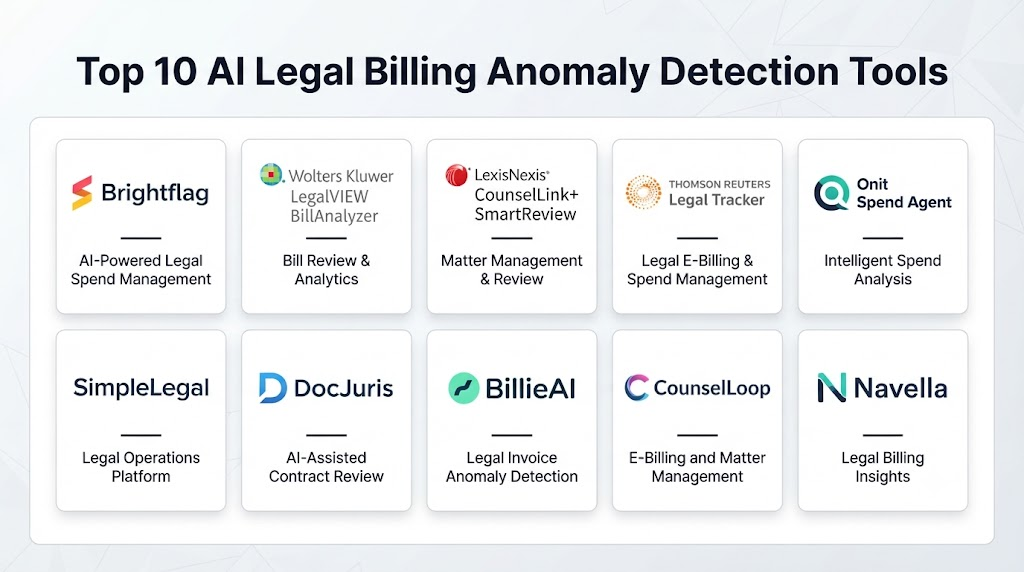
Top 10 AI Legal Billing Anomaly Detection Tools
1 — Brightflag
One-line verdict: Best for corporate legal departments seeking automated invoice review, legal spend management, and outside-counsel billing control.
Short description:
Brightflag is a legal operations platform focused on legal spend management, invoice review, matter management, and outside-counsel workflows. It is particularly relevant for organizations looking to automate repetitive billing-review activities.
Standout Capabilities
- Legal invoice review
- Outside-counsel management
- Legal spend analytics
- Billing guideline enforcement
- Invoice workflow automation
- Matter management
- Reporting
- Legal operations analytics
AI-Specific Depth
- Model support: AI capabilities vary by product and implementation; specific underlying models are not publicly stated.
- RAG / knowledge integration: Matter and billing information can provide contextual inputs; exact vector database architecture is not publicly stated.
- Evaluation: AI-specific evaluation methodology is not publicly stated.
- Guardrails: Workflow and permission controls; detailed AI guardrail architecture is not publicly stated.
- Observability: Legal spend and workflow analytics; model-level token and trace metrics are not publicly stated.
Pros
- Strong legal spend focus
- Designed for corporate legal teams
- Useful for automated invoice review
Cons
- Enterprise-oriented implementation
- Exact AI architecture is not publicly disclosed
- Pricing is not generally standardized publicly
Security & Compliance
Security capabilities vary by deployment and service. Organizations should verify current SSO, RBAC, encryption, audit logging, retention, residency, and certifications during procurement.
Deployment & Platforms
- Deployment: Cloud
- Platforms: Web
- Self-hosted: Varies / N/A
Integrations & Ecosystem
Brightflag can connect legal billing processes with broader legal operations workflows.
- Matter management
- Accounting systems
- ERP systems
- E-billing
- APIs
- Reporting tools
- Enterprise workflows
Pricing Model
Enterprise subscription; exact pricing is not publicly stated.
Best-Fit Scenarios
- Corporate legal departments
- High-volume invoice review
- Outside-counsel spend management
2 — Onit
One-line verdict: Best for enterprises requiring configurable legal operations, e-billing, matter management, and legal spend workflows.
Short description:
Onit provides legal operations technology covering areas such as legal spend, matter management, workflow automation, and enterprise legal processes.
Standout Capabilities
- E-billing
- Legal spend management
- Matter management
- Workflow automation
- Legal operations
- Reporting
- Configurable workflows
- Enterprise integrations
AI-Specific Depth
- Model support: Varies by product and configuration.
- RAG / knowledge integration: Varies / N/A.
- Evaluation: Specific AI evaluation capabilities are not publicly stated.
- Guardrails: Enterprise permissions and workflow controls.
- Observability: Workflow and spend analytics.
Pros
- Broad legal operations coverage
- Enterprise integration capabilities
- Configurable workflows
Cons
- Can require significant implementation
- Broad platform may be more than a small team needs
- AI-specific details vary
Security & Compliance
Verify current security controls and certifications for the specific modules and deployment.
Deployment & Platforms
- Deployment: Cloud
- Platforms: Web
- Self-hosted: Varies / N/A
Integrations & Ecosystem
- ERP
- Accounting
- Matter management
- E-billing
- APIs
- Enterprise applications
Pricing Model
Enterprise subscription; exact pricing varies.
Best-Fit Scenarios
- Large legal departments
- Complex legal operations
- Integrated legal spend programs
3 — Legal Tracker
One-line verdict: Best for legal departments managing outside counsel, matter spending, invoices, and legal operations at scale.
Short description:
Legal Tracker is a legal department management platform associated with matter management, legal spend management, and outside-counsel processes.
Standout Capabilities
- Matter management
- Legal spend management
- Invoice workflows
- Outside-counsel management
- Reporting
- Budget tracking
- Legal operations
- Analytics
AI-Specific Depth
- Model support: Specific model information is not publicly stated.
- RAG / knowledge integration: N/A / varies.
- Evaluation: AI-specific evaluation is not publicly stated.
- Guardrails: Workflow and access controls.
- Observability: Spend and matter analytics.
Pros
- Strong legal department orientation
- Useful spend-management capabilities
- Suitable for larger legal operations teams
Cons
- Not solely focused on AI
- AI capabilities should be validated
- Implementation may require configuration
Security & Compliance
Organizations should verify current SSO, RBAC, encryption, audit logs, retention, residency, and certification information.
Deployment & Platforms
- Deployment: Cloud
- Platforms: Web
- Self-hosted: Varies / N/A
Integrations & Ecosystem
- E-billing
- Accounting
- Matter systems
- ERP
- APIs
- Reporting
Pricing Model
Commercial subscription; exact pricing varies.
Best-Fit Scenarios
- Corporate legal departments
- Outside-counsel management
- Legal spend analysis
4 — LegalVIEW BillAnalyzer
One-line verdict: Best for organizations seeking legal invoice review and benchmarking based on extensive legal billing data.
Short description:
LegalVIEW BillAnalyzer is associated with legal invoice analysis and benchmarking. It can help organizations identify potentially problematic billing entries and understand legal spending patterns.
Standout Capabilities
- Invoice analysis
- Legal billing review
- Benchmarking
- Billing guideline analysis
- Spend analytics
- Invoice auditing
- Outside-counsel analysis
- Reporting
AI-Specific Depth
- Model support: Specific underlying models are not publicly stated.
- RAG / knowledge integration: N/A / varies.
- Evaluation: AI-specific evaluation details are not publicly stated.
- Guardrails: Workflow and reviewer controls vary.
- Observability: Spend analytics and reporting.
Pros
- Strong legal billing specialization
- Benchmarking can provide useful context
- Suitable for high-volume invoice analysis
Cons
- Primarily specialized around legal billing
- AI architecture is not fully public
- Integration requirements vary
Security & Compliance
Verify current security, privacy, retention, access controls, and certifications applicable to the service.
Deployment & Platforms
- Deployment: Cloud / managed service
- Platforms: Web / varies
- Self-hosted: Varies / N/A
Integrations & Ecosystem
- E-billing
- Legal operations
- Accounting
- Matter management
- Reporting
- Data feeds
Pricing Model
Commercial/enterprise model; exact pricing is not publicly stated.
Best-Fit Scenarios
- High-volume invoice auditing
- Legal spend benchmarking
- Outside-counsel review
5 — LegalSpend
One-line verdict: Best for legal teams wanting centralized visibility into legal spending, billing, budgets, and outside-counsel performance.
Short description:
Legal spend management platforms can centralize invoices, budgets, matter information, and outside-counsel performance data to support better financial control.
Standout Capabilities
- Legal spend tracking
- Invoice management
- Budget monitoring
- Matter-level analysis
- Outside-counsel analytics
- Reporting
- Billing review
- Forecasting
AI-Specific Depth
- Model support: Varies / N/A.
- RAG / knowledge integration: Varies / N/A.
- Evaluation: Not publicly stated.
- Guardrails: Workflow permissions and approval processes.
- Observability: Financial and matter analytics.
Pros
- Useful spend visibility
- Helps centralize legal financial data
- Supports budgeting
Cons
- AI functionality varies
- May require integration with billing systems
- Exact pricing varies
Security & Compliance
Verify product-specific controls before handling confidential legal billing information.
Deployment & Platforms
- Deployment: Cloud / varies
- Platforms: Web
- Self-hosted: Varies / N/A
Integrations & Ecosystem
- Accounting
- ERP
- E-billing
- Matter management
- APIs
- Reporting
Pricing Model
Commercial subscription; exact pricing varies.
Best-Fit Scenarios
- Legal spend visibility
- Budget management
- Outside-counsel analysis
6 — SimpleLegal
One-line verdict: Best for corporate legal departments seeking modern legal spend management, e-billing, matter management, and reporting.
Short description:
SimpleLegal provides legal operations technology focused on legal spend, e-billing, matter management, and related workflows.
Standout Capabilities
- E-billing
- Legal spend management
- Matter management
- Budget tracking
- Invoice processing
- Reporting
- Outside-counsel management
- Legal operations
AI-Specific Depth
- Model support: Specific models are not publicly stated.
- RAG / knowledge integration: Varies / N/A.
- Evaluation: AI-specific evaluation details are not publicly stated.
- Guardrails: Workflow and access controls.
- Observability: Spend and workflow analytics.
Pros
- Legal operations focus
- Broad spend-management functionality
- Useful for corporate legal teams
Cons
- AI-specific functionality varies
- Requires configuration for complex programs
- Pricing is not standardized publicly
Security & Compliance
Verify current security and compliance details for the selected deployment.
Deployment & Platforms
- Deployment: Cloud
- Platforms: Web
- Self-hosted: Varies / N/A
Integrations & Ecosystem
- Accounting
- ERP
- E-billing
- Matter management
- APIs
- Reporting systems
Pricing Model
Commercial subscription; exact pricing varies.
Best-Fit Scenarios
- Corporate legal operations
- Legal spend control
- Invoice management
7 — Mitratech TeamConnect
One-line verdict: Best for enterprises needing configurable legal operations, matter management, billing, and workflow automation.
Short description:
TeamConnect is an enterprise legal management platform that supports legal departments with matter management, legal operations, workflow, and related processes.
Standout Capabilities
- Matter management
- Legal spend
- Workflow automation
- Reporting
- Legal operations
- Configurable processes
- Enterprise integrations
- Analytics
AI-Specific Depth
- Model support: Varies by product and implementation.
- RAG / knowledge integration: Varies / N/A.
- Evaluation: AI-specific evaluation details are not publicly stated.
- Guardrails: Enterprise workflow and access controls.
- Observability: Operational and legal analytics.
Pros
- Enterprise-grade legal operations
- Highly configurable workflows
- Broad integration possibilities
Cons
- Implementation can be complex
- Requires administrative expertise
- AI-specific capabilities vary
Security & Compliance
Verify current SSO, RBAC, encryption, audit logging, retention, residency, and certification information.
Deployment & Platforms
- Deployment: Cloud / varies
- Platforms: Web
- Self-hosted: Varies / N/A
Integrations & Ecosystem
- ERP
- Accounting
- E-billing
- Matter systems
- APIs
- Enterprise platforms
Pricing Model
Enterprise subscription; exact pricing varies.
Best-Fit Scenarios
- Large legal departments
- Complex legal operations
- Enterprise workflow automation
8 — CounselLink
One-line verdict: Best for organizations managing large outside-counsel networks, legal invoices, rates, and legal spend.
Short description:
CounselLink supports corporate legal departments with outside-counsel management, legal invoice processing, spend management, and related legal operations.
Standout Capabilities
- Outside-counsel management
- Invoice processing
- Legal spend
- Rate management
- Matter management
- Billing guidelines
- Reporting
- Legal operations
AI-Specific Depth
- Model support: Specific models are not publicly stated.
- RAG / knowledge integration: N/A / varies.
- Evaluation: AI-specific evaluation is not publicly stated.
- Guardrails: Billing rules and workflow controls.
- Observability: Legal spend analytics.
Pros
- Strong outside-counsel orientation
- Useful invoice workflows
- Legal spend visibility
Cons
- AI capabilities should be verified
- Enterprise-oriented
- Configuration can be required
Security & Compliance
Verify security, privacy, retention, encryption, SSO, RBAC, audit logs, and certification details.
Deployment & Platforms
- Deployment: Cloud
- Platforms: Web
- Self-hosted: Varies / N/A
Integrations & Ecosystem
- E-billing
- Accounting
- ERP
- Matter management
- APIs
- Reporting
Pricing Model
Enterprise subscription; exact pricing varies.
Best-Fit Scenarios
- Large outside-counsel programs
- High-volume invoice processing
- Legal spend management
9 — Brightflag AI
One-line verdict: Best for legal teams wanting AI-assisted invoice review and broader automation across legal spend operations.
Short description:
Brightflag’s AI-assisted capabilities can help legal departments automate aspects of invoice review and legal spend management while connecting review processes with broader legal operations.
Standout Capabilities
- AI-assisted invoice review
- Billing analysis
- Legal spend management
- Matter management
- Outside-counsel workflows
- Invoice automation
- Reporting
- Spend analytics
AI-Specific Depth
- Model support: Specific underlying models are not publicly stated.
- RAG / knowledge integration: Matter and billing context may be used; architecture is not publicly stated.
- Evaluation: Vendor-specific AI evaluation methodology is not publicly stated.
- Guardrails: Human review and workflow controls.
- Observability: Spend and operational analytics; model-level token metrics are not publicly stated.
Pros
- AI is directly relevant to invoice review
- Strong legal spend focus
- Useful automation potential
Cons
- Enterprise-focused
- AI architecture is not fully public
- Pricing varies
Security & Compliance
Verify current security controls and certifications during procurement.
Deployment & Platforms
- Deployment: Cloud
- Platforms: Web
- Self-hosted: Varies / N/A
Integrations & Ecosystem
- Accounting
- ERP
- E-billing
- Matter management
- APIs
- Reporting
Pricing Model
Enterprise subscription; exact pricing is not publicly stated.
Best-Fit Scenarios
- AI-assisted invoice review
- Large legal departments
- Outside-counsel billing programs
10 — Legal Tracker
One-line verdict: Best for legal teams requiring established matter management, invoice control, budgets, and legal spend visibility.
Short description:
Legal Tracker supports corporate legal departments with legal matter management, spending, invoice processes, and outside-counsel administration.
Standout Capabilities
- Matter management
- Legal spend tracking
- Invoice workflows
- Budget management
- Outside-counsel management
- Reporting
- Legal operations
- Analytics
AI-Specific Depth
- Model support: Not publicly stated.
- RAG / knowledge integration: Varies / N/A.
- Evaluation: Not publicly stated.
- Guardrails: Workflow and access controls.
- Observability: Legal spend and matter analytics.
Pros
- Established legal operations use case
- Strong matter-management functionality
- Useful financial visibility
Cons
- AI-specific capabilities should be validated
- Broad functionality may require configuration
- Pricing varies
Security & Compliance
Verify current security, encryption, SSO, RBAC, retention, audit logging, residency, and certification information.
Deployment & Platforms
- Deployment: Cloud
- Platforms: Web
- Self-hosted: Varies / N/A
Integrations & Ecosystem
- E-billing
- Accounting
- ERP
- Matter management
- APIs
- Reporting
Pricing Model
Commercial subscription; exact pricing varies.
Best-Fit Scenarios
- Corporate legal departments
- Matter management
- Legal spend monitoring
Comparison Table
| Tool | Best For | Deployment | Model Flexibility | Strength | Watch-Out | Public Rating |
|---|---|---|---|---|---|---|
| Brightflag | AI-assisted invoice review | Cloud | Hosted / varies | Invoice automation | Enterprise implementation | N/A |
| Onit | Enterprise legal operations | Cloud | Varies | Configurable workflows | Implementation complexity | N/A |
| Legal Tracker | Corporate legal departments | Cloud | Hosted / varies | Matter and spend management | AI depth varies | N/A |
| LegalVIEW BillAnalyzer | Invoice auditing | Cloud / managed | Varies | Billing analysis | Specialized scope | N/A |
| LegalSpend | Spend visibility | Cloud / varies | Varies | Financial analytics | Integration needs | N/A |
| SimpleLegal | Legal operations | Cloud | Hosted / varies | E-billing and spend | AI depth varies | N/A |
| TeamConnect | Enterprise legal management | Cloud / varies | Varies | Configurability | Implementation effort | N/A |
| CounselLink | Outside-counsel management | Cloud | Hosted / varies | Legal billing | Enterprise focus | N/A |
| Brightflag AI | AI invoice analysis | Cloud | Hosted / varies | AI-assisted review | AI architecture not public | N/A |
| Legal Tracker | Legal spend and matters | Cloud | Hosted / varies | Legal operations | Broad platform | N/A |
Scoring & Evaluation
The following scores are comparative editorial estimates for category fit rather than independent product benchmarks. Actual results depend heavily on configuration, data quality, billing rules, integrations, and implementation.
| Tool | Core | Reliability/Eval | Guardrails | Integrations | Ease | Perf/Cost | Security/Admin | Support | Weighted Total |
|---|---|---|---|---|---|---|---|---|---|
| Brightflag | 10 | 9 | 9 | 9 | 9 | 8 | 10 | 9 | 9.10 |
| Onit | 9 | 8 | 9 | 10 | 7 | 7 | 10 | 9 | 8.65 |
| Legal Tracker | 9 | 8 | 9 | 9 | 8 | 8 | 10 | 9 | 8.70 |
| LegalVIEW BillAnalyzer | 10 | 9 | 9 | 8 | 8 | 8 | 9 | 9 | 8.85 |
| LegalSpend | 8 | 7 | 8 | 8 | 9 | 9 | 8 | 8 | 8.10 |
| SimpleLegal | 9 | 8 | 9 | 9 | 9 | 8 | 9 | 9 | 8.75 |
| TeamConnect | 9 | 8 | 9 | 10 | 7 | 7 | 10 | 9 | 8.65 |
| CounselLink | 9 | 8 | 9 | 9 | 8 | 8 | 10 | 9 | 8.70 |
| Brightflag AI | 10 | 9 | 9 | 9 | 9 | 8 | 10 | 9 | 9.10 |
| Legal Tracker | 9 | 8 | 9 | 9 | 8 | 8 | 10 | 9 | 8.70 |
Top 3 for Enterprise
- Brightflag
- Onit
- TeamConnect
Top 3 for SMB
- SimpleLegal
- LegalSpend
- Legal Tracker
Top 3 for Developers
- Onit
- TeamConnect
- Brightflag
Which AI Legal Billing Anomaly Detection Tool Is Right for You?
Solo / Freelancer
Most solo lawyers do not need sophisticated AI anomaly-detection infrastructure.
A basic billing application combined with clear time-entry procedures may be enough.
The priority should be:
- Accurate time tracking
- Correct rates
- Clear descriptions
- Duplicate prevention
- Consistent invoice formatting
- Secure financial records
AI becomes more useful when billing volume grows or billing complexity increases.
SMB
Small and midsize legal departments should prioritize ease of implementation.
Look for:
- Automated invoice ingestion
- Billing guideline checks
- Duplicate detection
- Rate validation
- Simple dashboards
- Matter budgets
- Human review
Avoid buying an extremely complex enterprise system if the legal team does not have the resources to administer it.
Mid-Market
Mid-market organizations can benefit from combining automated rules with machine-learning anomaly detection.
A useful workflow could identify:
- Unusual attorney billing
- Excessive administrative time
- Unexpected matter spending
- Duplicate entries
- Rate deviations
- Billing guideline violations
Enterprise
Large organizations should look beyond invoice checking.
A mature architecture should connect:
Invoice → Validation → AI anomaly analysis → Risk score → Human review → Adjustment → Approval → Spend analytics
Enterprise buyers should also prioritize:
- Multi-entity support
- Multiple currencies
- Global billing
- Outside-counsel management
- Complex rate structures
- Data residency
- RBAC
- SSO
- Auditability
- API integrations
- Governance
Regulated Industries
Financial institutions, healthcare companies, insurers, government organizations, and other regulated enterprises should pay particular attention to:
- Confidentiality
- Legal privilege
- Access controls
- Encryption
- Data retention
- Data residency
- Audit trails
- Vendor risk
- AI governance
- Human oversight
Budget vs Premium
Budget-conscious organizations should start with rule-based invoice validation.
Premium platforms become more valuable when the organization has:
- High invoice volumes
- Thousands of timekeepers
- Many outside-counsel firms
- Complex billing guidelines
- Large legal budgets
- Significant historical data
- Multiple jurisdictions
Build vs Buy
Build when:
- Your billing data is highly specialized.
- You have strong engineering resources.
- You need custom anomaly models.
- You already have a centralized legal data platform.
- Your legal operations team can maintain AI infrastructure.
Buy when:
- You need implementation quickly.
- You want established e-billing workflows.
- You need legal-specific billing expertise.
- You want vendor-supported integrations.
- You do not want to maintain AI infrastructure.
For many organizations, a hybrid strategy is practical: use an established legal billing platform and develop custom analytics around its data rather than building the entire billing system.
Implementation Playbook: 30 / 60 / 90 Days
First 30 Days: Establish the Baseline
Collect historical billing information.
Define:
- Billing guidelines
- Approved rates
- Matter structures
- Timekeeper classifications
- Expense policies
- Review procedures
- Escalation thresholds
Create baseline metrics such as:
- Average invoice review time
- Number of invoices reviewed
- Number of adjustments
- Average adjustment value
- Duplicate-entry frequency
- Billing-guideline violation rate
Do not begin by automating everything.
Start with a small pilot.
Days 31–60: Deploy AI-Assisted Detection
Introduce anomaly detection alongside existing review processes.
Test:
- Duplicate detection
- Rate anomalies
- Unusual time entries
- Block billing
- Administrative work
- Matter spending anomalies
- Unexpected changes in timekeeper behavior
Require reviewers to confirm whether AI alerts are correct.
Track:
- Precision
- Recall
- False positives
- False negatives
- Reviewer agreement
- Savings identified
Days 61–90: Optimize and Govern
Once the model demonstrates useful performance, introduce more advanced workflows.
Add:
- Matter-specific baselines
- Firm-specific rules
- Timekeeper benchmarking
- Automated routing
- Spend forecasting
- Executive dashboards
Establish governance for:
- Model changes
- Prompt changes
- AI-generated explanations
- Data retention
- Access controls
- Incident response
- Human overrides
Common Mistakes and How to Avoid Them
- Treating every anomaly as an error: Unusual does not necessarily mean incorrect.
- Ignoring matter context: Litigation, M&A, regulatory work, and routine matters have different billing patterns.
- Using only historical averages: Historical patterns can themselves contain problematic behavior.
- Failing to establish billing rules: AI works better when organizational policies are clearly defined.
- Ignoring false positives: Too many alerts can create reviewer fatigue.
- Ignoring false negatives: Missed billing anomalies can be more costly than excessive alerts.
- Automatically rejecting invoices: High-impact financial decisions should have appropriate human review.
- Ignoring confidential information: Legal invoices can contain sensitive client and matter information.
- Failing to protect privileged information: Billing descriptions may reveal strategic legal details.
- No audit trail: Keep records of alerts, reviewer decisions, and invoice adjustments.
- Ignoring data quality: Poor invoice formatting can reduce detection accuracy.
- Using one benchmark for every matter: Different legal matters require different expectations.
- No model evaluation: AI detection should be measured against validated historical cases.
- Ignoring integration costs: A strong anomaly engine is less useful if invoice and matter data cannot reach it reliably.
FAQs
What is AI legal billing anomaly detection?
It is technology that analyzes legal invoices and billing data to identify unusual, duplicate, excessive, or potentially non-compliant billing activity.
Can AI detect duplicate legal billing entries?
Yes, duplicate detection is one of the practical applications. Systems can compare descriptions, dates, timekeepers, amounts, matters, and other available information.
Can AI determine whether a lawyer overbilled?
AI can identify potentially unusual billing patterns, but it cannot automatically establish that overbilling occurred. Human review is needed to understand the circumstances.
Can these tools check billing guidelines?
Many legal spend and e-billing platforms support billing rules and guideline validation. Exact capabilities vary by product and configuration.
Can AI detect unusual hourly rates?
Yes. A system can compare billed rates with approved rates, historical rates, matter-specific arrangements, or other configured benchmarks.
Can AI analyze time-entry descriptions?
Depending on the platform, natural-language processing can analyze descriptions for patterns such as administrative work, vague entries, block billing, duplication, or other configured concerns.
Is legal billing data safe to use with AI?
It can be, but organizations should carefully evaluate data processing, retention, encryption, access controls, data residency, vendor policies, and confidentiality requirements before deployment.
Can AI review privileged legal information?
Potentially, but this requires careful architecture and governance. Organizations should understand exactly where data is processed, who can access it, how long it is retained, and whether it is used for model training.
Can these systems work with existing e-billing platforms?
Many legal spend platforms are designed to work with e-billing and legal operations systems. Exact integrations depend on the selected product.
Should AI automatically reject suspicious invoices?
Generally, organizations should be cautious about fully automated rejection. AI alerts should usually create a review workflow rather than automatically determine misconduct or payment denial.
How should anomaly detection accuracy be measured?
Useful metrics include precision, recall, false-positive rate, false-negative rate, reviewer agreement, confirmed billing adjustments, and financial impact.
Does anomaly detection replace legal operations professionals?
No. It is better viewed as an augmentation technology that reduces repetitive review and helps professionals focus on unusual or higher-value cases.
Can smaller legal teams use AI billing analysis?
Yes, but the business case depends on invoice volume and complexity. Smaller teams may benefit from simpler rule-based billing controls before adopting advanced AI.
Can organizations build their own legal billing anomaly model?
Yes. A custom model can be built using historical billing data, billing rules, and matter information, but maintaining data quality, security, evaluation, and governance requires significant resources.
What is the biggest risk with AI legal billing anomaly detection?
A major risk is confusing an unusual transaction with an incorrect transaction. Poorly calibrated systems can generate excessive false positives or miss important anomalies.
Conclusion
AI Legal Billing Anomaly Detection can significantly improve the way legal departments review outside-counsel invoices and manage legal spending.The most useful systems combine traditional billing rules with data analysis and AI-assisted pattern recognition. Instead of replacing legal operations professionals, they help reviewers identify potentially problematic entries faster and focus their attention on cases that require judgment.Brightflag, Onit, Legal Tracker, LegalVIEW BillAnalyzer, SimpleLegal, TeamConnect, CounselLink, and other legal spend platforms can address different parts of the legal billing lifecycle. The right choice depends on invoice volume, matter complexity, outside-counsel relationships, existing technology, security requirements, and available legal operations resources.