Introduction
AI Open Data Quality Automation tools use artificial intelligence, machine learning, rules engines, statistical analysis, and automated data-quality workflows to improve the accuracy, completeness, consistency, validity, and reliability of publicly available datasets.
Open data is widely used by governments, researchers, journalists, businesses, universities, developers, and civic-technology organizations. However, public datasets frequently contain problems such as missing values, duplicate records, inconsistent formats, outdated information, invalid entries, incorrect classifications, and schema changes.
What Is AI Open Data Quality Automation?
AI Open Data Quality Automation refers to the use of AI and automated technologies to monitor, assess, clean, validate, and improve the quality of open or publicly accessible datasets.
A typical system can inspect datasets and identify:
- Missing values
- Duplicate records
- Invalid values
- Formatting inconsistencies
- Broken relationships
- Outliers
- Schema changes
- Inconsistent categories
- Data freshness problems
- Referential integrity issues
Instead of requiring analysts to manually inspect every dataset, automated systems can continuously evaluate data and alert teams when quality problems appear.
Why Open Data Quality Matters
Open datasets often come from multiple departments, agencies, databases, APIs, and external sources.
This can create problems such as:
- Different date formats
- Different naming conventions
- Missing fields
- Duplicate entities
- Conflicting records
- Outdated records
- Incomplete metadata
- Inconsistent geographic information
Poor-quality open data can lead to incorrect research, unreliable dashboards, inaccurate public services, and flawed analytical models.
Automated data-quality tools help establish repeatable quality controls.
Key Capabilities of AI Open Data Quality Automation
Automated Data Profiling
AI can analyze datasets and automatically identify:
- Column types
- Value distributions
- Missing values
- Unique values
- Frequency patterns
- Statistical characteristics
Anomaly Detection
Machine-learning models can identify unusual values or patterns that traditional validation rules may miss.
Duplicate Detection
AI can identify records that represent the same entity even when their values are not exactly identical.
Data Standardization
Systems can normalize:
- Names
- Addresses
- Dates
- Categories
- Codes
- Units
- Geographic information
Schema Monitoring
Automated monitoring can identify changes to:
- Columns
- Data types
- Field names
- Record structures
- Dataset relationships
Data Freshness Monitoring
Tools can detect when public datasets stop updating according to their expected schedule.
Automated Validation
Quality checks can validate data against predefined rules and statistical expectations.
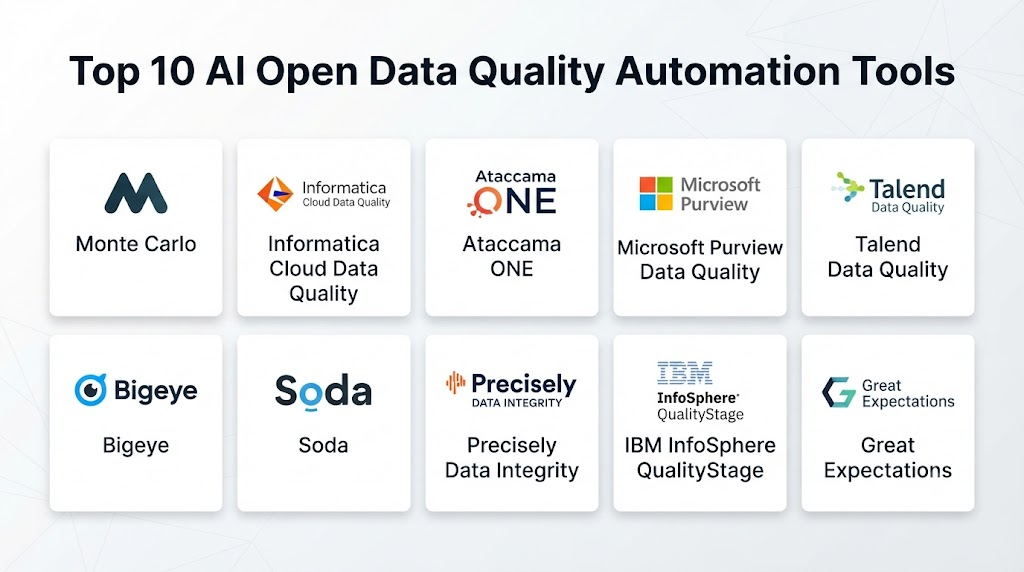
Top 10 AI Open Data Quality Automation Tools
1. Great Expectations
Best for: Automated data validation and quality testing.
Great Expectations is widely used for defining and executing expectations against datasets.
Key Features
- Data validation
- Automated testing
- Data profiling
- Documentation
- Quality checks
- Pipeline integration
AI and Automation Capabilities
Although primarily a data-quality framework rather than an AI-only platform, it can be incorporated into automated data-quality pipelines alongside machine-learning and AI systems.
Pros
- Flexible validation framework
- Strong developer ecosystem
- Useful for automated testing
- Works across modern data pipelines
Cons
- Requires technical expertise
- Rule creation can require effort
- Advanced AI functionality is not its primary focus
Best For
- Data engineers
- Analytics teams
- Open-data projects
- Data-platform teams
2. Soda
Best for: Data quality monitoring and observability.
Soda provides tools for monitoring data quality and identifying problems in data pipelines.
Key Features
- Data quality checks
- Monitoring
- Anomaly detection
- Data observability
- Automated alerts
- Pipeline integration
Pros
- Strong data-quality monitoring
- Useful automated checks
- Good observability capabilities
- Supports modern data stacks
Cons
- Advanced deployments may require technical expertise
- Some features are more suitable for enterprise environments
- Configuration is required for complex datasets
Best For
- Data engineering teams
- Analytics teams
- Data-platform teams
- Organizations managing multiple datasets
3. Monte Carlo
Best for: Data observability and automated data-quality monitoring.
Monte Carlo focuses on monitoring data reliability across data platforms and pipelines.
Key Features
- Data observability
- Anomaly detection
- Pipeline monitoring
- Incident detection
- Data lineage
- Quality monitoring
AI Capabilities
Machine learning can help identify unusual data behavior and potential quality incidents.
Pros
- Strong observability
- Automated anomaly detection
- Useful lineage capabilities
- Suitable for large data environments
Cons
- Primarily enterprise-oriented
- Can require integration work
- May be more than small open-data projects need
Best For
- Large organizations
- Data-platform teams
- Enterprise analytics
- Government data infrastructure
4. Databricks Data Quality
Best for: Data quality within large-scale data platforms.
Databricks provides data engineering, analytics, machine-learning, and governance capabilities that can be used to automate data-quality processes.
Key Features
- Data validation
- Data monitoring
- Data pipelines
- Data governance
- Anomaly detection
- Data profiling
- Data lineage
AI Capabilities
AI and machine-learning capabilities can be integrated into data-quality workflows.
Pros
- Strong data-engineering ecosystem
- Scalable
- Supports complex pipelines
- Useful for large datasets
- Strong analytics integration
Cons
- Can be complex for smaller teams
- Requires platform expertise
- Cost can increase with scale
Best For
- Government agencies
- Enterprises
- Research organizations
- Large open-data platforms
5. Informatica Data Quality
Best for: Enterprise data quality and data management.
Informatica provides extensive capabilities for profiling, cleansing, matching, and monitoring data.
Key Features
- Data profiling
- Data cleansing
- Data matching
- Data validation
- Data governance
- Metadata management
- Data quality monitoring
AI Capabilities
AI and machine-learning capabilities can support automated data management and quality processes.
Pros
- Comprehensive data-quality capabilities
- Strong enterprise functionality
- Supports complex data environments
- Strong governance features
Cons
- Can be complex
- Enterprise implementation may require specialist expertise
- Cost may be higher than lightweight tools
Best For
- Government organizations
- Large enterprises
- Data-governance teams
- Complex open-data programs
6. Talend Data Quality
Best for: Data profiling, cleansing, and quality management.
Talend provides tools for improving data quality across diverse data sources.
Key Features
- Data profiling
- Data cleansing
- Data matching
- Data validation
- Data integration
- Data standardization
AI and Automation Capabilities
Automated profiling, matching, and cleansing can reduce manual data-quality work.
Pros
- Strong data-integration capabilities
- Useful profiling tools
- Good data-cleansing functionality
- Supports heterogeneous datasets
Cons
- Requires technical configuration
- Enterprise deployments can be complex
- Advanced use cases may require specialist skills
Best For
- Data integration teams
- Government data projects
- Enterprises
- Analytics organizations
7. IBM watsonx.data
Best for: Enterprise data management and AI-ready data environments.
IBM watsonx.data supports data management, governance, analytics, and AI workloads.
Key Features
- Data management
- Data governance
- Data integration
- Data quality
- Data cataloging
- Analytics
AI Capabilities
AI can be incorporated into data analysis, monitoring, governance, and quality workflows.
Pros
- Strong enterprise capabilities
- AI ecosystem integration
- Supports diverse data environments
- Useful for large organizations
Cons
- Enterprise complexity
- Requires skilled implementation
- May be excessive for small datasets
Best For
- Governments
- Enterprises
- Research institutions
- Large data programs
8. AWS Glue Data Quality
Best for: Cloud-based automated data quality.
AWS Glue Data Quality provides automated data-quality capabilities within AWS data environments.
Key Features
- Data-quality rules
- Automated evaluation
- Data profiling
- Quality monitoring
- Pipeline integration
- Data validation
Pros
- Strong cloud integration
- Scalable
- Useful for large datasets
- Integrates with AWS data services
Cons
- Best suited to AWS environments
- Requires cloud expertise
- Costs can increase with usage
Best For
- Government cloud projects
- Enterprises
- Cloud data teams
- Large open-data platforms
9. Azure Data Quality and Fabric
Best for: Microsoft-based data environments.
Microsoft’s data platform ecosystem provides capabilities for data integration, analytics, governance, monitoring, and quality management.
Key Features
- Data integration
- Data profiling
- Data validation
- Data governance
- Data monitoring
- Analytics
AI Capabilities
Microsoft’s AI ecosystem can support automated analysis and anomaly detection across data workflows.
Pros
- Strong Microsoft ecosystem
- Enterprise scalability
- Good integration capabilities
- Suitable for large data environments
Cons
- Can be complex
- Best suited to organizations already using Microsoft technologies
- Configuration may require specialists
Best For
- Government organizations
- Enterprises
- Microsoft-based data teams
- Research institutions
10. OpenRefine
Best for: Open-data cleaning and transformation.
OpenRefine is a popular tool for cleaning and transforming messy datasets.
Key Features
- Data cleaning
- Clustering
- Transformation
- Duplicate identification
- Standardization
- Dataset exploration
AI and Automation Capabilities
Its automated clustering and transformation features can help identify similar values and improve consistency, although it is not primarily an AI platform.
Pros
- Excellent for messy open datasets
- Accessible to researchers and data professionals
- Strong transformation capabilities
- Useful for duplicate and value normalization
Cons
- Not a full enterprise data-observability platform
- Requires manual configuration for complex workflows
- Advanced machine-learning capabilities are limited
Best For
- Researchers
- Journalists
- Civic-tech organizations
- Open-data teams
- Data analysts
AI Open Data Quality Automation Scoring Table
| No. | Tool | AI & Automation /10 | Data Validation /10 | Anomaly Detection /10 | Data Cleansing /10 | Scalability /10 | Ease of Use /10 | Overall Score /10 |
|---|---|---|---|---|---|---|---|---|
| 1 | Great Expectations | 8.5 | 10.0 | 8.0 | 7.5 | 9.0 | 8.0 | 8.5 |
| 2 | Soda | 9.0 | 9.0 | 9.5 | 7.5 | 9.0 | 8.5 | 8.8 |
| 3 | Monte Carlo | 9.5 | 9.0 | 10.0 | 7.0 | 10.0 | 8.5 | 9.0 |
| 4 | Databricks Data Quality | 9.5 | 9.5 | 9.5 | 8.5 | 10.0 | 7.5 | 9.1 |
| 5 | Informatica Data Quality | 9.0 | 10.0 | 9.0 | 10.0 | 9.5 | 7.5 | 9.2 |
| 6 | Talend Data Quality | 8.5 | 9.5 | 8.5 | 9.5 | 9.0 | 8.0 | 8.8 |
| 7 | IBM watsonx.data | 9.5 | 9.0 | 9.0 | 8.5 | 9.5 | 7.5 | 8.8 |
| 8 | AWS Glue Data Quality | 9.0 | 9.5 | 8.5 | 8.0 | 10.0 | 8.0 | 8.8 |
| 9 | Azure Data Quality & Fabric | 9.0 | 9.0 | 8.5 | 8.5 | 10.0 | 8.0 | 8.8 |
| 10 | OpenRefine | 7.0 | 8.5 | 7.0 | 10.0 | 7.5 | 9.5 | 8.3 |
Pros and Cons Comparison
| No. | Tool | Pros | Cons |
|---|---|---|---|
| 1 | Great Expectations | Flexible validation, strong testing framework, developer-friendly | Requires technical knowledge |
| 2 | Soda | Strong monitoring, anomaly detection, modern observability | Complex environments require configuration |
| 3 | Monte Carlo | Excellent observability, anomaly detection, lineage | Enterprise-oriented |
| 4 | Databricks Data Quality | Scalable, strong analytics ecosystem, powerful pipelines | Can be complex for smaller teams |
| 5 | Informatica Data Quality | Comprehensive profiling, cleansing, matching, governance | Expensive and complex for smaller organizations |
| 6 | Talend Data Quality | Strong integration and cleansing | Requires technical configuration |
| 7 | IBM watsonx.data | Enterprise AI and data ecosystem | Implementation complexity |
| 8 | AWS Glue Data Quality | Scalable and AWS-integrated | Best suited to AWS environments |
| 9 | Azure Data Quality & Fabric | Strong Microsoft integration and scalability | Can require specialist expertise |
| 10 | OpenRefine | Excellent open-data cleaning, clustering, transformation | Limited enterprise observability and AI capabilities |
AI Open Data Quality Automation Use Cases
Government Open Data
Government agencies publish datasets covering:
- Transportation
- Healthcare
- Education
- Environment
- Public finance
- Population
- Housing
- Infrastructure
Automated quality checks can help agencies ensure that datasets remain consistent and usable.
Public Transportation Data
AI can identify:
- Missing route information
- Invalid coordinates
- Duplicate stops
- Inconsistent schedules
- Incorrect vehicle records
Environmental Data
Environmental datasets may contain readings from thousands of sensors.
Automated systems can identify:
- Sensor anomalies
- Missing measurements
- Impossible values
- Timestamp problems
- Location inconsistencies
Healthcare Open Data
Healthcare datasets can contain sensitive and complex information.
Quality automation can identify:
- Missing fields
- Invalid codes
- Duplicate records
- Inconsistent categories
- Data-format problems
Privacy and security controls remain essential.
Financial Open Data
Automated quality systems can validate:
- Financial figures
- Reporting periods
- Account categories
- Currency information
- Transaction records
Research Data
Researchers can use quality automation to validate datasets before analysis or publication.
This can reduce errors caused by:
- Missing observations
- Duplicate records
- Incorrect data types
- Inconsistent labels
- Statistical anomalies
Benefits of AI Open Data Quality Automation
Faster Data Validation
Automation can analyze millions of records much faster than manual inspection.
Continuous Monitoring
Data quality can be checked repeatedly instead of only during periodic reviews.
Reduced Manual Work
Automated systems reduce repetitive data-quality tasks.
Better Consistency
Standardized quality checks can be applied across multiple datasets.
Early Problem Detection
Teams can detect problems before they affect downstream applications.
Improved Public Trust
Higher-quality open datasets can improve confidence among researchers, developers, journalists, and citizens.
Challenges
Data Complexity
Public datasets often come from different systems and departments.
Inconsistent Standards
Different organizations may use different formats and definitions.
Missing Metadata
A dataset without sufficient metadata can be difficult to interpret correctly.
Data Drift
Data characteristics may change over time.
False Alerts
Automated systems can flag unusual but legitimate values.
Model Limitations
AI models can miss certain data-quality problems.
Governance
Organizations need clear ownership of data-quality issues.
How to Choose an AI Open Data Quality Tool
Consider the following factors:
- Dataset size
- Number of data sources
- Data formats
- Cloud environment
- Data-quality requirements
- AI capabilities
- Anomaly detection
- Validation support
- Data cleansing
- Data matching
- Monitoring
- Data lineage
- Governance
- API support
- Integration
- Security
- Cost
- Technical expertise
Best Tools by Use Case
Best for Enterprise Data Quality
Informatica Data Quality
A comprehensive option for profiling, cleansing, matching, governance, and enterprise data-quality workflows.
Best for Large-Scale Data Engineering
Databricks Data Quality
Well suited to organizations managing large analytical and engineering environments.
Best for Data Observability
Monte Carlo
Strong for detecting data incidents and unusual changes across complex data environments.
Best for Data Quality Monitoring
Soda
Useful for automated quality checks, monitoring, and anomaly detection.
Best for Open-Data Cleaning
OpenRefine
A practical option for researchers, analysts, journalists, and civic-data teams working with messy datasets.
Best for Data Validation
Great Expectations
Useful when organizations need flexible, test-driven data validation.
Best for AWS Environments
AWS Glue Data Quality
Strong for organizations already building open-data infrastructure on AWS.
Best for Microsoft Environments
Azure Data Quality & Fabric
Suitable for organizations using Microsoft’s data and analytics ecosystem.
Future of AI Open Data Quality Automation
AI will increasingly move data-quality systems from static rules toward adaptive monitoring.
Future systems may automatically:
- Learn normal data patterns
- Detect unusual records
- Recommend quality rules
- Identify schema changes
- Suggest data corrections
- Detect duplicate entities
- Generate validation tests
- Predict quality incidents
- Explain anomalies
- Automate remediation
Generative AI may also make it easier for nontechnical users to describe quality requirements using natural language.
For example, an analyst could specify:
“Flag datasets where more than 5% of records have missing geographic coordinates.”
The system could potentially translate that requirement into an automated quality check.
FAQs
What is AI Open Data Quality Automation?
It is the use of AI and automated technologies to profile, validate, monitor, clean, and improve the quality of open and publicly available datasets.
Why is data quality important for open data?
Poor-quality data can produce inaccurate analysis, unreliable applications, incorrect reports, and misleading public information.
Can AI automatically clean open datasets?
Some systems can automate standardization, duplicate detection, transformations, and other cleaning activities, although human review is often necessary for complex corrections.
What types of problems can AI detect?
AI and automated quality systems can identify missing values, duplicates, anomalies, inconsistent formats, schema changes, invalid values, and unusual patterns.
What is data observability?
Data observability is the practice of continuously monitoring data systems to understand data health, detect problems, and investigate incidents.
Is Great Expectations an AI tool?
Great Expectations is primarily a data-validation and testing framework rather than a pure AI platform. It can, however, be incorporated into AI-enabled data-quality workflows.
What is the best tool for enterprise data quality?
Informatica Data Quality is a strong enterprise-oriented option because it supports profiling, cleansing, matching, governance, and quality management.
What is the best tool for open-data cleaning?
OpenRefine is particularly useful for cleaning and transforming messy datasets and is widely applicable to open-data projects.
Can AI detect duplicate records?
Yes. AI and machine-learning techniques can identify records that likely represent the same entity even when values differ slightly.
Can AI detect data anomalies?
Yes. Machine-learning and statistical techniques can identify values and patterns that differ significantly from expected behavior.
Can AI monitor data continuously?
Yes. Data-observability platforms can continuously monitor pipelines, datasets, schemas, and quality metrics.
Does AI eliminate the need for data engineers?
No. AI can automate repetitive tasks, but data engineers and data stewards remain important for defining standards, investigating complex issues, and managing governance.
Can government agencies use AI for open-data quality?
Yes. Government agencies can use automated data-quality systems to validate and monitor datasets before and after publication.
How is AI different from traditional data-quality rules?
Traditional systems typically rely heavily on predefined rules. AI and machine-learning approaches can identify patterns and anomalies that may not have been explicitly defined in advance.
What is the future of AI data-quality automation?
The future will likely involve adaptive monitoring, automated rule generation, anomaly explanation, intelligent data cleansing, predictive quality management, and natural-language data-quality workflows.
Conclusion
AI Open Data Quality Automation can significantly improve how organizations manage public and open datasets. Instead of relying exclusively on manual inspection and static validation rules, organizations can combine automated testing, machine learning, anomaly detection, data observability, and intelligent data cleansing.Tools such as Informatica Data Quality, Databricks Data Quality, Monte Carlo, Soda, Great Expectations, Talend Data Quality, AWS Glue Data Quality, Azure Data Quality & Fabric, IBM watsonx.data, and OpenRefine offer different approaches to solving data-quality challenges.