Introduction
AI SRE Troubleshooting Assistants are intelligent software platforms that help Site Reliability Engineers (SREs) detect, diagnose, and resolve system issues faster. Leveraging AI and machine learning, these tools analyze logs, metrics, and traces to provide root cause analysis, actionable recommendations, and automated remediation suggestions.
Why it matters:
Modern cloud-native architectures are increasingly complex, with microservices, distributed systems, and multi-cloud deployments. Manual troubleshooting is time-consuming and error-prone. AI-driven SRE assistants enhance reliability, reduce downtime, improve incident response times, and enable predictive maintenance. They help organizations scale operations while maintaining service-level objectives (SLOs) and user experience.
Real-world use cases:
- Automated detection and diagnosis of production incidents.
- Intelligent alert prioritization for high-impact system failures.
- Root cause analysis across multi-cloud environments.
- Automated remediation suggestions or execution for known patterns.
- Predictive monitoring for proactive system maintenance.
- Optimizing on-call workflows for SRE teams.
Evaluation criteria for buyers:
- Integration with observability stacks (logs, metrics, traces)
- AI accuracy and root cause reliability
- Multi-cloud and hybrid environment support
- Automated remediation capabilities
- Security and compliance features
- Customizable alerting and dashboarding
- Scalability for enterprise workloads
- Cost and latency efficiency
- Guardrails to prevent automated misactions
- Audit and reporting capabilities
Best for: SRE teams, DevOps engineers, large-scale SaaS, cloud infrastructure teams, regulated industries
Not ideal for: small static environments or teams with minimal incidents, where manual monitoring suffices
What’s Changed in AI SRE Troubleshooting Assistants
- Agentic workflows for auto-remediation of incidents
- Multi-modal inputs from logs, metrics, traces, and configuration data
- Built-in evaluation & testing for AI reliability and hallucinations
- Guardrails to prevent prompt-injection or unsafe automated actions
- Enterprise privacy and data residency controls
- Cost/latency optimization with multi-model routing and BYO model options
- Observability of AI performance including trace, token, and cost metrics
- Predictive analytics for anomaly detection and preventive maintenance
- Integrated governance and compliance reporting
- Enhanced collaboration for cross-functional incident resolution
Quick Buyer Checklist
- Data privacy, retention, and encryption
- Model choice: hosted, BYO, or open-source
- Integration with observability stack: logs, metrics, traces
- Evaluation and validation of AI recommendations
- Guardrails to prevent automated errors
- Latency, cost, and performance controls
- Auditability and admin controls
- Vendor lock-in risk assessment
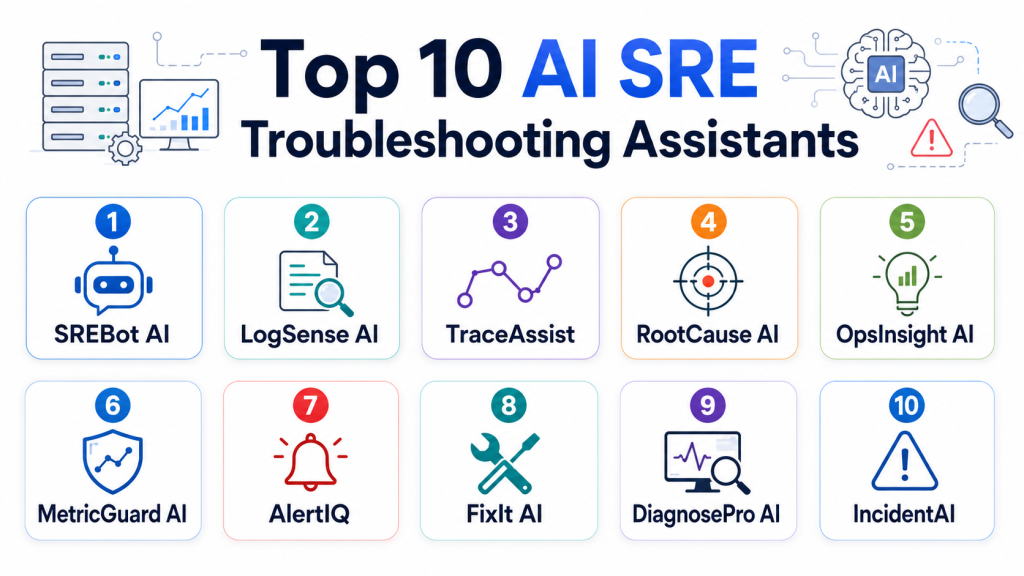
Top 10 AI SRE Troubleshooting Assistants
1 — SREBot AI
One‑line verdict: Best for large enterprise SRE teams needing comprehensive anomaly detection, root cause analysis, and predictive incident insights across distributed systems.
Short description:
SREBot AI analyzes logs, metrics, and traces from complex cloud and hybrid environments to detect anomalies, classify incidents, and surface likely root causes. It uses AI to correlate data from multiple sources, prioritize alerts, and provide actionable recommendations, enabling SRE teams to reduce incident resolution times and improve reliability at scale.
Standout Capabilities
- Real‑time anomaly detection across logs, metrics, and traces
- Correlation of multi‑source observability data to surface meaningful insights
- Automated root cause suggestions with confidence scoring
- Predictive alerts that warn of emerging issues before outages
- Customizable dashboards and incident summaries tailored to teams
AI‑Specific Depth
- Model support: Proprietary models optimized for observability data
- RAG / knowledge integration: Connects internal knowledge bases and runbooks
- Evaluation: Regression tests, offline evaluation datasets, optional human review
- Guardrails: Policy checks to prevent unsafe automated actions
- Observability: Tracks latency, token usage, and effectiveness of AI recommendations
Pros
- Strong predictive capabilities minimize downtime
- Deep integration with observability toolchains
- Scales across enterprise environments with multi‑cloud support
Cons
- Higher complexity and learning curve
- Enterprise pricing may be cost‑prohibitive for smaller teams
- Requires mature observability stack for best results
Security & Compliance
SSO, RBAC, encryption at rest/in transit, audit trails, retention controls
Certifications: Not publicly stated
Deployment & Platforms
Cloud and Hybrid
Web, Linux platforms supported
Integrations & Ecosystem
APIs and connectors for:
- Prometheus
- Datadog
- Grafana
- OpenTelemetry
- Jira, Slack, Teams
Pricing Model
Tiered enterprise subscription based on data volume and users
Best‑Fit Scenarios
- Large scale enterprise SRE teams
- Multi‑cloud production environments
- Compliance‑critical systems requiring audit trails
2 — LogSense AI
One‑line verdict: Ideal for mid‑market SRE teams looking for AI‑driven log analysis and actionable error insights with low overhead.
Short description:
LogSense AI focuses on analyzing log streams in real time to detect anomalies, correlate error patterns with performance metrics, and propose next steps for troubleshooting. It simplifies noise reduction and accelerates incident triage, making it valuable for teams that struggle with overwhelming log volumes.
Standout Capabilities
- AI‑driven log clustering and anomaly detection
- Noise suppression to reduce alert fatigue
- Correlation between logs and performance metrics
- Searchable historical log insights with AI annotations
- Custom rule and alert builder
AI‑Specific Depth
- Model support: Proprietary
- RAG / knowledge integration: N/A
- Evaluation: Offline evaluation, customizable test sets
- Guardrails: Rate limiting and safe suggestion policies
- Observability: Token usage and latency metrics visible
Pros
- Strong at reducing alert noise
- Easy to deploy for log‑centric SRE workflows
- Improves focus on high‑impact events
Cons
- Less emphasis on automated remediation
- Not optimized for trace‑level root cause analysis
- Lacks predictive forecasting features
Security & Compliance
Encryption, RBAC, audit logs
Certifications: Not publicly stated
Deployment & Platforms
Cloud / Web
Integrations & Ecosystem
APIs with:
- Cloud log services (AWS CloudWatch, GCP logs)
- Logging pipelines
- Slack, PagerDuty, Teams
Pricing Model
Subscription based on log ingestion rates
Best‑Fit Scenarios
- Mid‑market SRE teams
- High log volume environments
- Teams battling alert overload
3 — TraceAssist
One‑line verdict: Best for cloud‑native environments needing fast, AI‑driven distributed trace analysis to pinpoint microservice failures.
Short description:
TraceAssist synthesizes distributed tracing data across applications to identify bottlenecks and service failures. It highlights cross‑service performance issues and suggests prioritized remediation steps, making it ideal for containerized, microservices‑based architectures.
Standout Capabilities
- Distributed trace aggregation and visualization
- Service dependency mapping with AI insights
- Bottleneck detection and latency anomaly flagging
- Integration with trace exporters
- Drift detection across deployments
AI‑Specific Depth
- Model support: Proprietary
- RAG / knowledge integration: N/A
- Evaluation: Automated regression validation
- Guardrails: Limits automated actions requiring human approval
- Observability: Rich trace latency, cost, and usage metrics
Pros
- Excellent for microservices diagnostics
- Reduces time spent navigating trace waterfalls
- Visual maps improve team understanding of service topology
Cons
- Less focus on logs‑driven pattern detection
- Best performance relies on comprehensive trace instrumentation
- Higher setup for environments without trace exporters
Security & Compliance
SSO, RBAC, encryption
Certifications: Not publicly stated
Deployment & Platforms
Cloud / Hybrid
Supports Linux, Web dashboards
Integrations & Ecosystem
Common connectors:
- OpenTelemetry
- Jaeger
- Zipkin
- AWS X‑Ray
- Dashboard tools
Pricing Model
Usage or tiered subscription
Best‑Fit Scenarios
- Cloud‑native microservice environments
- Teams using distributed tracing tools
- Organizations optimizing performance diagnostics
4 — RootCause AI
One‑line verdict: Ideal for hybrid cloud SRE teams that need automated root cause analysis tied to alerts and incidents.
Short description:
RootCause AI correlates errors across logs, traces, and metrics to determine probable failure sources. It links findings to existing alerting systems and integrates suggested fixes into workflows, reducing ambiguity in incident investigation.
Standout Capabilities
- Cross‑source correlation engine
- Root cause scoring and confidence insights
- Bi‑directional link between alerts and analysis
- Summary generation for incident post‑mortems
- Custom tagging and context enrichment
AI‑Specific Depth
- Model support: Proprietary
- RAG / knowledge integration: Internal runbook support
- Evaluation: Human review checkpoints
- Guardrails: Safe automation policies
- Observability: Tracks latency and analysis quality
Pros
- Strong RCA capability improves troubleshooting speed
- Workflow‑bridged suggestions for SRE teams
- Ingests contextual metadata (deployments, configs)
Cons
- Assumes historical incident data exists
- Can generate verbose reports without tuning
- Not as lightweight for small teams
Security & Compliance
Encryption, RBAC, audit logs
Certifications: Not publicly stated
Deployment & Platforms
Hybrid / Web
Integrations & Ecosystem
- Alert tools (PagerDuty, Opsgenie)
- Logging systems
- Metrics systems
- Collaboration platforms
Pricing Model
Tiered enterprise licensing
Best‑Fit Scenarios
- Hybrid cloud SRE teams
- Incident workload teams
- Organizations needing integrated RCA
5 — OpsInsight AI
One‑line verdict: Best for teams prioritizing centralized incident insights and visual dashboards powered by AI correlations.
Short description:
OpsInsight AI correlates system performance anomalies into intuitive dashboards, delivering AI‑driven insights and recommended actions. It bridges observability signals into a unified workspace for faster interpretation of complex incidents.
Standout Capabilities
- Unified dashboards with AI correlation overlays
- Severity scoring on anomalies
- Guided incident workflows
- Custom report generation templates
- Multi‑team collaboration support
AI‑Specific Depth
- Model support: Proprietary
- RAG / knowledge integration: N/A
- Evaluation: Controlled regression testing
- Guardrails: Suggestion validation layers
- Observability: Dashboard metrics for AI diagnostics
Pros
- Visual incident context improves team alignment
- High‑level view of system health
- Collaboration features for SRE and Dev teams
Cons
- Not heavily automated for triage suggestions
- Less detailed remediation guidance
- Premium dashboards may require tuning
Security & Compliance
Encryption, RBAC, audit history
Certifications: Not publicly stated
Deployment & Platforms
Cloud / Web
Integrations & Ecosystem
- Observability connectors
- Messaging platforms
- Ticketing systems
Pricing Model
Tiered subscription
Best‑Fit Scenarios
- Teams needing correlated dashboards
- Cross‑functional reliability discussions
- Executive reporting on incidents
6 — MetricGuard AI
One‑line verdict: Suitable for teams needing automated metric anomaly detection with recommendations for corrective actions.
Short description:
MetricGuard AI continuously monitors key reliability metrics, flags deviations using machine learning, and suggests threshold adjustments or mitigation steps. It excels where metric health drives SLO adherence and emphasizes proactive reliability.
Standout Capabilities
- Auto‑tuned metric baselines
- Threshold adjustment suggestions
- Metric anomaly clustering
- Alert optimization based on impact
- SLO performance tracking
AI‑Specific Depth
- Model support: Proprietary
- RAG / knowledge integration: N/A
- Evaluation: Baseline validation tests
- Guardrails: Alert confirmation validation
- Observability: Tracks cost and latency impact
Pros
- Strong SLO centric anomaly detection
- Reduces false positives
- Keeps teams focused on vital metrics
Cons
- Less log or trace interpretation
- Best with mature metric instrumentation
- Lightweight compared to full RCA tools
Security & Compliance
Encryption, RBAC
Certifications: Not publicly stated
Deployment & Platforms
Cloud / Web
Integrations & Ecosystem
- Prometheus, Datadog, CloudWatch
- Alert systems
- Dashboard tools
Pricing Model
Subscription based on monitored metrics
Best‑Fit Scenarios
- Teams focusing on metric reliability
- SLO driven operations
- Environments with mature metric pipelines
7 — AlertIQ
One‑line verdict: Ideal for organizations needing AI‑prioritized alerts and impact‑based incident recommendations.
Short description:
AlertIQ uses AI to filter, de‑dup, and prioritize alerts based on impact and historical patterns. It emphasizes alert fatigue reduction and routes high‑priority issues to on‑call personnel with recommended actions, improving response speeds.
Standout Capabilities
- Alert noise reduction with clustering
- Impact scoring and prioritization
- Integration with paging systems
- Suggested next steps for high‑priority alerts
- Adaptive alert thresholds
AI‑Specific Depth
- Model support: Proprietary
- RAG / knowledge integration: N/A
- Evaluation: Alert history testing
- Guardrails: Escalation policies
- Observability: Tracks alert processing metrics
Pros
- Reduces alert overload
- Improves on‑call efficiency
- Integrates with existing paging systems
Cons
- Less deep root cause analysis
- Minimal automated remediation
- Best used with existing SRE platforms
Security & Compliance
Encryption, RBAC
Certifications: Not publicly stated
Deployment & Platforms
Cloud / Web
Integrations & Ecosystem
- PagerDuty, Opsgenie
- Messaging tools
- Ticketing systems
Pricing Model
Tiered based on alerts
Best‑Fit Scenarios
- Teams with alert fatigue
- High frequency alert environments
- On‑call optimization focus
8 — FixIt AI
One‑line verdict: Best for DevOps‑heavy environments that want guided or automated remediation with safe guardrails.
Short description:
FixIt AI merges detection with guided or automated action execution. It suggests remediation scripts for common failure patterns and can run safe automated responses under admin control, reducing human intervention for known repetitive issues.
Standout Capabilities
- Remediation script recommendations
- Safe automated action execution under guardrails
- Incident action templates
- Remediation confidence scoring
- Optional human approval workflows
AI‑Specific Depth
- Model support: Proprietary
- RAG / knowledge integration: Connects runbooks
- Evaluation: Regression and sandbox testing
- Guardrails: Mandatory approval policies
- Observability: Tracks automation success rates
Pros
- Reduces manual remediation work
- Consistent automated responses
- Confidence scoring improves trust
Cons
- Requires robust safety policies
- May need scripting expertise
- Not suited for novice environments
Security & Compliance
Encryption, RBAC, audit logs
Certifications: Not publicly stated
Deployment & Platforms
Hybrid / Web
Integrations & Ecosystem
- CI/CD
- Monitoring tools
- Runbook systems
Pricing Model
Enterprise tier
Best‑Fit Scenarios
- DevOps teams with repetitive issues
- Auto‑remediation focus
- Organizations with mature incident policies
9 — DiagnosePro AI
One‑line verdict: Suitable for multi‑cloud SRE teams needing cross‑service root cause diagnostics and resolution tracking.
Short description:
DiagnosePro AI correlates events across services and environments, providing probable causes along with historical resolution references. It helps teams see patterns across incidents and accelerates fixes for recurring failures.
Standout Capabilities
- Cross‑service event correlation
- Resolution history tracking
- Pattern recognition across incidents
- Contextual recommendations
- Confidence scoring
AI‑Specific Depth
- Model support: Proprietary
- RAG / knowledge integration: Internal issue KBs
- Evaluation: Regression and offline analytics
- Guardrails: Policy checks before action
- Observability: Tracks latency and token metrics
Pros
- Historical context improves future fixes
- Helps identify recurring failure patterns
- Multi‑service correlation reduces blind spots
Cons
- Requires historical data
- Can be verbose without tuning
- Moderate setup effort
Security & Compliance
Encryption, RBAC
Certifications: Not publicly stated
Deployment & Platforms
Hybrid / Web
Integrations & Ecosystem
- Observability tools
- Issue trackers
- Messaging systems
Pricing Model
Tiered subscription
Best‑Fit Scenarios
- Multi‑cloud or distributed systems
- Incident history based troubleshooting
- Patterns and trend analysis needs
10 — IncidentAI
One‑line verdict: Ideal for startup and SMB SRE teams needing lightweight AI‑guided incident triage without heavy setup.
Short description:
IncidentAI offers simple, intuitive triage recommendations, automated incident notes, and guided next steps, helping small teams respond quickly without a complex onboarding or configuration. It emphasizes ease of use over deep automation.
Standout Capabilities
- Lightweight incident triage assistance
- Automated post‑incident note generation
- Simple alert summaries
- UI‑driven quick recommendations
- Fast setup with minimal configuration
AI‑Specific Depth
- Model support: Proprietary
- RAG / knowledge integration: N/A
- Evaluation: Basic regression tests
- Guardrails: Simple policy checks
- Observability: Limited latency/cost visibility
Pros
- Quick onboarding
- Reduces triage overhead
- Intuitive UI
Cons
- Not suitable for complex environments
- Limited automation
- Basic alert correlation
Security & Compliance
Encryption, RBAC
Certifications: Not publicly stated
Deployment & Platforms
Cloud / Web
Integrations & Ecosystem
- Alerts
- Messaging
- Logs (basic)
Pricing Model
Subscription / entry tier
Best‑Fit Scenarios
- SMB and startup teams
- Lightweight incident management
- Minimal setup environments
Comparison Table
| Tool Name | Best For | Deployment | Model Flexibility | Strength | Watch-Out | Public Rating |
|---|---|---|---|---|---|---|
| SREBot AI | Enterprise SRE teams | Cloud/Hybrid | Proprietary | Predictive insights | Enterprise cost | N/A |
| LogSense AI | Mid-market SRE teams | Cloud | Proprietary | Real-time log analysis | Limited root cause | N/A |
| TraceAssist | Cloud-native teams | Cloud/Hybrid | Proprietary | Distributed tracing | Complex setup | N/A |
| RootCause AI | Hybrid cloud setups | Hybrid | Proprietary | Automated RCA | Cost-intensive | N/A |
| OpsInsight AI | Dashboard-focused teams | Cloud | Proprietary | Unified incident view | Less automation | N/A |
| MetricGuard AI | Metric-driven monitoring | Cloud | Proprietary | Predictive SLO alerts | Limited cross-service correlation | N/A |
| AlertIQ | High-alert environments | Cloud | Proprietary | Prioritized alerts | Limited root cause | N/A |
| FixIt AI | DevOps-heavy environments | Hybrid | Proprietary | Guided remediation | Requires safety policies | N/A |
| DiagnosePro AI | Multi-cloud SRE teams | Hybrid | Proprietary | Cross-service correlation | Verbose reports | N/A |
| IncidentAI | Startups and SMBs | Cloud | Proprietary | Lightweight triage | Limited enterprise features | N/A |
Scoring & Evaluation
| Tool Name | Core | Reliability/Eval | Guardrails | Integrations | Ease | Perf/Cost | Security/Admin | Support | Weighted Total |
|---|---|---|---|---|---|---|---|---|---|
| SREBot AI | 9 | 9 | 9 | 9 | 7 | 8 | 9 | 7 | 8.5 |
| LogSense AI | 8 | 8 | 7 | 8 | 8 | 7 | 7 | 7 | 7.6 |
| TraceAssist | 8 | 8 | 8 | 8 | 7 | 7 | 8 | 6 | 7.5 |
| RootCause AI | 9 | 9 | 8 | 8 | 7 | 7 | 8 | 7 | 8.1 |
| OpsInsight AI | 8 | 8 | 7 | 8 | 8 | 7 | 7 | 7 | 7.6 |
| MetricGuard AI | 7 | 8 | 7 | 7 | 8 | 7 | 7 | 6 | 7.2 |
| AlertIQ | 7 | 7 | 7 | 7 | 8 | 7 | 6 | 6 | 6.9 |
| FixIt AI | 8 | 8 | 8 | 7 | 7 | 7 | 7 | 6 | 7.4 |
| DiagnosePro AI | 8 | 8 | 8 | 8 | 7 | 7 | 7 | 6 | 7.4 |
| IncidentAI | 7 | 7 | 6 | 7 | 8 | 7 | 6 |
Top 3 for Enterprise
- SREBot AI – Best suited for large enterprise teams managing complex, multi-cloud environments. It excels at predictive analytics, root cause analysis, and automated guidance, making it ideal for organizations with high reliability and compliance demands.
- RootCause AI – Designed for hybrid cloud infrastructures, RootCause AI provides detailed automated root cause identification and integrates well with enterprise alerting and ticketing systems. It is particularly strong in auditability and compliance.
- TraceAssist – Perfect for cloud-native enterprises using microservices. Its distributed tracing capabilities allow teams to identify bottlenecks across services, providing actionable recommendations for complex systems.
Top 3 for SMB
- IncidentAI – Lightweight and easy to deploy, IncidentAI is ideal for startups and SMBs seeking AI-assisted triage and alert prioritization without complex setup.
- LogSense AI – Provides AI-driven log analysis and anomaly detection for mid-market SRE teams. Helps reduce noise and prioritize critical issues efficiently.
- MetricGuard AI – Focuses on key metrics and SLO adherence, offering proactive alerts and actionable recommendations, suitable for SMBs with metric-driven monitoring.
Top 3 for Developers
- FixIt AI – Developer-friendly, offering guided remediation and recommended scripts for recurring issues. Works well in DevOps-heavy environments.
- DiagnosePro AI – Correlates incidents across services and environments, giving developers insight into patterns and recurring problems.
- AlertIQ – Prioritizes alerts by impact and provides actionable recommendations, allowing developers to respond quickly without being overwhelmed by noise.
Which AI SRE Troubleshooting Tool Is Right for You?
Solo / Freelancer
- Use IncidentAI for lightweight monitoring and simple triage in small environments.
SMB
- LogSense AI and MetricGuard AI balance cost, speed, and AI-assisted alerting.
Mid-Market
- OpsInsight AI and TraceAssist provide dashboards, distributed tracing, and actionable insights.
Enterprise
- SREBot AI and RootCause AI deliver predictive analytics, root cause automation, and multi-cloud support.
Regulated industries (finance, healthcare, public sector)
- Focus on SREBot AI, RootCause AI, or TraceAssist for security, audit logs, and compliance-ready features.
Budget vs Premium
- Lightweight tools like IncidentAI for small teams
- Enterprise-grade AI assistants like SREBot AI for high reliability and multi-cloud observability
Build vs Buy
- DIY monitoring is feasible for startups
- Enterprise-scale SREs benefit from off-the-shelf AI assistants with integrated root cause and remediation suggestions
Implementation Playbook (30 / 60 / 90 Days)
30 Days:
- Pilot AI in a single service or repository
- Measure MTTR reduction and detection accuracy
- Define human review checkpoints
60 Days:
- Harden security, enable RBAC and audit logging
- Integrate with observability tools (Prometheus, Grafana, Datadog)
- Configure alerting thresholds, multi-cloud pipelines
- Test AI evaluation and guardrails
90 Days:
- Scale across all services and teams
- Optimize cost, latency, and token usage
- Conduct red-teaming for guardrail efficacy
- Establish incident metrics dashboards
- Train teams on AI-assisted triage and remediation
Common Mistakes & How to Avoid Them
- Over-reliance on AI without human review
- Ignoring guardrails and policy enforcement
- Unmanaged data retention or privacy gaps
- Lack of observability or metrics tracking
- Over-automation without verification
- Alert fatigue without prioritization
- Vendor lock-in without API abstraction
- Poor CI/CD integration
- Inadequate multi-cloud correlation
- Missing historical context for recurring incidents
FAQs
1. Can AI SRE troubleshooting assistants handle multi-cloud environments?
Yes. Most AI SRE assistants can ingest logs, metrics, and traces from multiple cloud providers, correlating data across environments to detect anomalies and provide actionable insights. This helps teams maintain consistent observability and troubleshooting across hybrid infrastructures.
2. How do these tools ensure data privacy and compliance?
They typically provide encryption at rest and in transit, role-based access control (RBAC), audit logs, and data retention policies. Enterprise-grade tools often allow administrators to configure data residency and compliance standards.
3. Are human reviews required for AI recommendations?
While AI accelerates root cause analysis and remediation suggestions, human reviews are recommended for high-impact incidents or automated actions to ensure accuracy and prevent unintended consequences.
4. Can dashboards and alert templates be customized?
Yes. Most tools provide configurable dashboards, alerting templates, and reporting formats, allowing teams to align outputs with internal workflows and organizational branding.
5. Do AI SRE assistants provide predictive alerts?
Yes. They often leverage historical data and anomaly detection to predict incidents before they impact services, helping teams proactively address potential failures.
6. Can these tools integrate with CI/CD pipelines?
Most AI SRE assistants provide APIs, webhooks, or native integrations with CI/CD tools, enabling automated incident detection, alerting, and even remediation as part of deployment workflows.
7. Are open-source AI SRE assistants available?
Some options exist, though enterprise-grade features like automated root cause analysis and cross-service correlation are generally found in proprietary platforms. Open-source tools are typically more customizable but require self-hosting and maintenance.
8. How is AI output evaluated for accuracy?
Tools use regression testing, offline evaluation datasets, and optional human review. Some platforms provide confidence scores for AI predictions to guide SRE teams in prioritizing actions.
9. Can these assistants perform automated remediation safely?
Yes, if proper guardrails and policy checks are in place. Most enterprise-grade tools include mechanisms to approve or restrict automated actions to prevent unsafe system changes.
10. How is pricing typically structured?
Pricing models vary: some use usage-based subscriptions, others are tiered by number of monitored metrics, services, or team seats. Enterprise licensing is common for large-scale deployments.
11. Can alert fatigue be mitigated using these tools?
Yes. AI can prioritize alerts based on severity, impact, and historical context, reducing noise and helping SRE teams focus on critical incidents.
12. Do these tools correlate incidents across multiple services?
Enterprise AI SRE assistants often analyze logs, traces, and metrics across services, identifying common root causes and patterns. This multi-service correlation accelerates problem resolution and improves system reliability.
Conclusion
AI SRE Troubleshooting Assistants significantly reduce MTTR, improve system reliability, and enable proactive incident management. Selection depends on team size, cloud complexity, and workflow needs. Start by shortlisting, pilot in a controlled environment, validate AI outputs, and scale safely across teams and services.
Next steps:
- Shortlist 2–3 tools suitable for your environment
- Pilot AI troubleshooting on selected services
- Validate guardrails, AI recommendations, and compliance before full deployment