Introduction
AI Audit Readiness Platforms are tools that help organizations prepare, maintain, and streamline audits for AI systems, including governance, compliance, ethical considerations, and risk management. As AI becomes a core part of enterprise operations , companies must demonstrate transparency, accountability, and regulatory adherence across model development, deployment, and monitoring.
Why it matters:
- Compliance assurance: Ensure AI models comply with GDPR, HIPAA, and industry-specific regulations.
- Audit efficiency: Reduce manual effort in preparing AI system documentation and reports.
- Risk mitigation: Identify ethical, operational, or bias risks before audits.
- Transparency: Maintain detailed logs of model changes, evaluation, and governance decisions.
- Accountability: Provide structured evidence for internal and external review.
- Operational reliability: Track AI system performance to prevent regulatory breaches.
Real-world use cases:
- Healthcare: Demonstrate model reliability and bias mitigation during audits for patient safety.
- Financial services: Provide detailed records of credit scoring and fraud detection AI for regulators.
- Enterprise AI governance: Maintain centralized documentation for multi-team AI projects.
- Generative AI compliance: Track prompt logs, outputs, and guardrails for LLM audits.
- Research reproducibility: Provide audit-ready logs and model cards for academic or peer review.
- Public sector AI: Maintain audit trails for decision-making algorithms in civic services.
Evaluation criteria for buyers:
- Ability to automate audit documentation and reporting
- Integration with CI/CD and MLOps pipelines
- Risk and bias evaluation capture
- Guardrails and intended use tracking
- Multimodal model support
- Observability metrics capture (latency, token, cost)
- Security and compliance controls (RBAC, SSO, encryption)
- Collaboration for cross-team audit readiness
- Versioning and traceability
- Vendor lock-in and portability
- Ease of use and scalability
- Support and community
Best for: AI governance teams, enterprise ML/AI teams, compliance officers, and organizations under heavy regulatory scrutiny.
Not ideal for: Small-scale or experimental AI projects where audits are infrequent or lightweight documentation suffices.
What’s Changed in AI Audit Readiness Platforms
- Automated audit documentation generation
- Integrated risk and bias assessment for production models
- Support for agentic and multimodal workflows
- Prompt injection and ethical guardrails documentation
- Enterprise-grade data privacy, residency, and retention tracking
- Cost and latency tracking for audit logs
- Enhanced observability dashboards for audits
- Versioned model metadata for traceability and reproducibility
- Integration with RAG systems, connectors, and vector DBs
- Governance frameworks aligned with regulatory expectations
- Collaborative audit readiness for cross-team workflows
- Real-time monitoring of AI outputs for compliance
Quick Buyer Checklist
- ✅ Data privacy & retention controls
- ✅ Hosted, BYO, or open-source model support
- ✅ RAG/connectors for evaluation and audit context
- ✅ Evaluation/testing logs included
- ✅ Guardrails and policy documentation
- ✅ Latency & cost observability
- ✅ Auditability & admin controls
- ✅ Vendor lock-in risk
- ✅ Versioning and traceability
- ✅ Collaboration support for teams
- ✅ Security features: SSO, RBAC, encryption
- ✅ Integration with CI/CD or MLOps pipelines
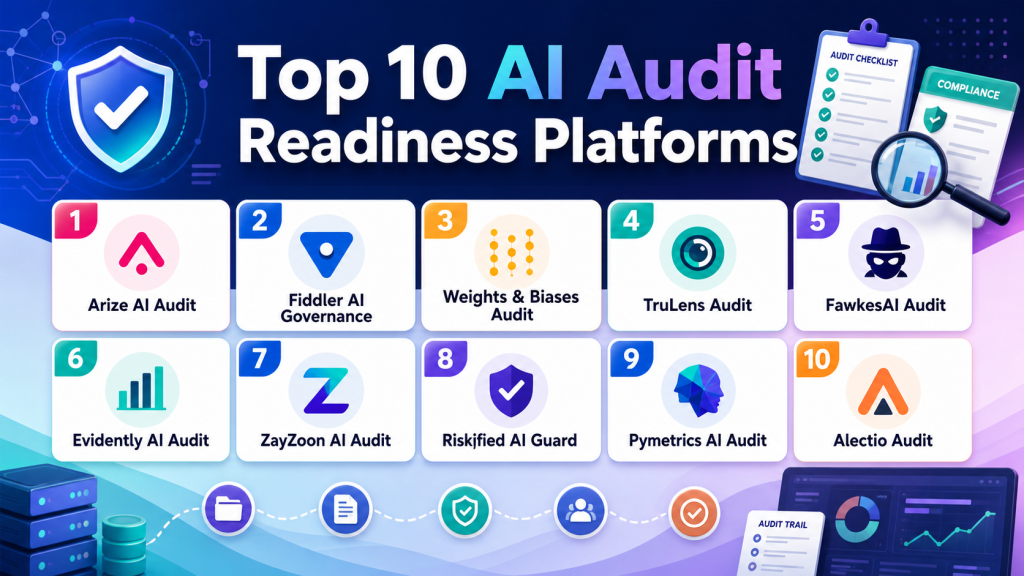
Top 10 AI Audit Readiness Platforms
1 — Arize AI Audit
One-line verdict: Enterprise-grade platform for AI audit readiness, governance, and compliance tracking across large-scale pipelines.
Short description :
Arize AI Audit provides structured audit-ready documentation for deployed AI models, capturing performance, drift, and bias. Teams can track governance decisions, generate reports, and integrate monitoring into existing MLOps pipelines. It is ideal for enterprises with regulatory scrutiny and complex AI workflows.
Standout Capabilities
- Drift and bias monitoring
- Audit-ready dashboards
- Multimodal AI support
- Governance and policy tracking
- Historical version comparisons
- CI/CD integration
- Customizable reporting
AI-Specific Depth
- Model support: Hosted / BYO
- RAG / knowledge integration: N/A
- Evaluation: Regression, human review, drift tracking
- Guardrails: Policy enforcement
- Observability: Metrics, token usage, latency
Pros
- Enterprise-ready
- Full audit trail tracking
- Integrates with pipelines
Cons
- Complex for smaller teams
- Steep learning curve
- Cost may be high for SMBs
Security & Compliance
SSO/SAML, RBAC, audit logs, encryption (Not publicly stated)
Deployment & Platforms
Web, Cloud
Integrations & Ecosystem
- MLflow
- Databricks
- Airflow
- SageMaker
- Snowflake
Pricing Model
Tiered / usage-based
Best-Fit Scenarios
- Enterprise AI audit preparation
- Regulated industry compliance
- Multimodal AI governance
2 — Fiddler AI Governance
One-line verdict: Compliance-focused AI audit readiness platform for regulated industries and risk mitigation.
Short description :
Fiddler AI Governance captures AI model performance, bias, and ethical metrics to prepare for audits. The platform supports dashboards, versioning, and automated reporting for compliance teams while integrating with ML pipelines.
Standout Capabilities
- Bias and fairness reporting
- Model versioning and documentation
- Automated compliance reporting
- Historical audit logs
- Dashboard visualizations
- Team collaboration
- API integration
AI-Specific Depth
- Model support: Hosted / BYO
- RAG / knowledge integration: N/A
- Evaluation: Prompt tests, regression
- Guardrails: Policy checks
- Observability: Token metrics, latency
Pros
- Strong compliance focus
- Enterprise-ready dashboards
- Automated reporting
Cons
- Smaller integration ecosystem
- Limited flexibility for dev teams
- Technical setup required
Security & Compliance
SSO/SAML, encryption, audit logs
Deployment & Platforms
Web, Cloud
Integrations & Ecosystem
- APIs
- Python SDK
- CI/CD pipelines
- MLflow, Airflow
Pricing Model
Tiered subscription
Best-Fit Scenarios
- Regulatory audit readiness
- Enterprise governance
- Bias monitoring
3 — Weights & Biases Audit
One-line verdict: Developer-friendly tool for audit documentation and AI compliance tracking across experiments and production models.
Short description :
Weights & Biases Audit enables teams to automatically generate audit documentation for ML models. It tracks performance metrics, bias, and version history while integrating with CI/CD pipelines, supporting reproducibility and governance in developer teams.
Standout Capabilities
- Automated experiment logging
- Versioned audit-ready documentation
- Drift and bias tracking
- Performance dashboards
- CI/CD integration
- Collaboration features
- Open-source support
AI-Specific Depth
- Model support: BYO / Open-source
- RAG / knowledge integration: N/A
- Evaluation: Regression, offline eval, human review
- Guardrails: N/A
- Observability: Metrics, token usage, latency
Pros
- Developer-friendly
- Automation reduces manual effort
- CI/CD ready
Cons
- Limited enterprise governance
- Minimal guardrails
- Integration requires setup
Security & Compliance
RBAC, encryption, audit logs
Deployment & Platforms
Web, Cloud, Hybrid
Integrations & Ecosystem
- Python SDK
- MLflow, TensorFlow, PyTorch
- Airflow, Databricks
Pricing Model
Usage-based / tiered
Best-Fit Scenarios
- Developer audit documentation
- Experiment tracking
- SMB and mid-sized ML teams
4 — TruLens Audit
One-line verdict: LLM-focused audit readiness tool for generative AI compliance, bias tracking, and risk assessment.
Shortdescription :
TruLens Audit allows enterprises to document and evaluate LLM outputs for bias, safety, and regulatory compliance. It provides dashboards and automated reports to support internal audits and external governance reviews, ideal for teams deploying generative AI responsibly.
Standout Capabilities
- LLM output evaluation
- Bias and fairness metrics
- Automated audit-ready reporting
- Versioned model documentation
- Safety and guardrails tracking
- Multimodal model support
- Dashboard visualizations
AI-Specific Depth
- Model support: Proprietary / BYO
- RAG / knowledge integration: N/A
- Evaluation: Prompt tests, regression, human review
- Guardrails: Policy checks, prompt-injection defense
- Observability: Metrics, token usage, latency
Pros
- Focused on generative AI
- Enterprise-ready dashboards
- Strong compliance reporting
Cons
- Smaller integration ecosystem
- Less open-source flexibility
- Specialized for LLMs
Security & Compliance
SSO/SAML, audit logs, encryption
Deployment & Platforms
Web, Cloud
Integrations & Ecosystem
- APIs, Python SDK
- MLflow, Airflow, Databricks
- CI/CD pipeline integration
Pricing Model
Tiered / usage-based
Best-Fit Scenarios
- Generative AI compliance
- LLM audit documentation
- Enterprise AI governance
5 — FawkesAI Audit
One-line verdict: Privacy-first AI audit readiness tool for sensitive data compliance and regulatory reporting.
Short description :
FawkesAI Audit documents AI models with a focus on privacy, data protection, and compliance readiness. It tracks model performance, limitations, and usage policies while generating audit-ready reports for enterprises handling sensitive datasets.
Standout Capabilities
- Privacy and compliance documentation
- Bias and fairness tracking
- Audit report generation
- Versioned model tracking
- Multimodal support
- Policy enforcement alerts
- Integration with MLOps pipelines
AI-Specific Depth
- Model support: BYO / Open-source
- RAG / knowledge integration: N/A
- Evaluation: Data privacy tests, regression
- Guardrails: Policy enforcement
- Observability: Token metrics, latency
Pros
- Privacy-first approach
- Supports regulated industry compliance
- Integrates with pipelines
Cons
- Limited explainability focus
- Smaller ecosystem
- Specialized for sensitive data
Security & Compliance
Encryption, RBAC, audit logs, data residency
Deployment & Platforms
Web, Cloud, Hybrid
Integrations & Ecosystem
- Python SDK
- CI/CD pipelines
- Databricks, Snowflake
Pricing Model
Usage-based / subscription
Best-Fit Scenarios
- Sensitive data AI compliance
- Enterprise audit readiness
- Regulatory reporting
6 — Evidently AI Audit
One-line verdict: Open-source monitoring and documentation platform for drift, bias, and AI audit preparation.
Short description :
Evidently AI Audit allows teams to generate structured documentation for AI models while monitoring drift, bias, and performance. It is open-source and developer-friendly, supporting reproducibility, audit readiness, and collaborative team workflows.
Standout Capabilities
- Drift and bias tracking
- Audit-ready dashboards
- Historical performance monitoring
- Open-source extensibility
- Collaboration tools
- API/SDK support
- Integration with pipelines
AI-Specific Depth
- Model support: Open-source / BYO
- RAG / knowledge integration: N/A
- Evaluation: Regression, offline evaluation
- Guardrails: N/A
- Observability: Metrics, latency
Pros
- Open-source and flexible
- Developer-friendly
- CI/CD ready
Cons
- Limited enterprise governance
- Guardrails minimal
- Requires technical setup
Security & Compliance
Varies / N/A
Deployment & Platforms
Web, Cloud, On-prem
Integrations & Ecosystem
- Python SDK
- MLflow, TensorFlow, PyTorch
- Airflow, Databricks
Pricing Model
Open-source + optional enterprise license
Best-Fit Scenarios
- Developer audit documentation
- Experiment tracking
- SMB and mid-sized ML teams
7 — ZayZoon AI Audit
One-line verdict: Enterprise AI audit and governance platform for compliance tracking and risk management.
Short description
ZayZoon AI Audit enables enterprises to maintain audit-ready documentation for all AI models. It tracks performance, compliance, and ethical considerations, providing dashboards and alerts for governance teams and regulatory reporting.
Standout Capabilities
- Enterprise-level audit tracking
- Compliance dashboards
- Risk scoring and reporting
- Versioned model documentation
- Alerts for deviations
- Multi-model support
- Pipeline integration
AI-Specific Depth
- Model support: Hosted / BYO
- RAG / knowledge integration: N/A
- Evaluation: Regression, human review
- Guardrails: Policy enforcement
- Observability: Latency, token metrics
Pros
- Enterprise-ready
- Governance and compliance
- Centralized documentation
Cons
- Less developer-friendly
- Smaller open-source ecosystem
- Requires team training
Security & Compliance
SSO/SAML, audit logs, encryption
Deployment & Platforms
Web, Cloud
Integrations & Ecosystem
- APIs, Python SDK
- MLflow, Airflow, Databricks
Pricing Model
Tiered subscription
Best-Fit Scenarios
- Enterprise AI governance
- Regulated industry compliance
- Model lifecycle tracking
8 — Riskified AI Guard
One-line verdict: Ethical and operational AI audit tool for enterprises needing compliance monitoring and risk tracking.
Short description :
Riskified AI Guard provides structured audit documentation focusing on ethical, operational, and regulatory risks. Teams can track governance, model usage, and generate reports, helping maintain compliance across AI deployments.
Standout Capabilities
- Operational risk documentation
- Ethical AI tracking
- Audit-ready reporting
- Versioned model cards
- Alerts for compliance and performance
- Multi-model support
- Integration with ML pipelines
AI-Specific Depth
- Model support: Hosted / BYO
- RAG / knowledge integration: N/A
- Evaluation: Regression, human review
- Guardrails: Policy enforcement
- Observability: Metrics, latency, cost
Pros
- Ethical AI focus
- Enterprise-ready dashboards
- Compliance alerts
Cons
- Smaller ecosystem
- Limited developer tools
- Requires configuration
Security & Compliance
SSO/SAML, RBAC, audit logs, encryption
Deployment & Platforms
Web, Cloud
Integrations & Ecosystem
- API, Python SDK
- MLflow, Airflow, Databricks
Pricing Model
Tiered subscription
Best-Fit Scenarios
- Ethical AI auditing
- Operational risk monitoring
- Enterprise compliance reporting
9 — Pymetrics AI Audit
One-line verdict: Developer-focused audit readiness platform for bias and fairness monitoring in AI models.
Short description :
Pymetrics AI Audit enables structured documentation for model fairness and bias evaluation. It is ideal for developers and ML teams needing reproducibility, compliance readiness, and collaborative audit workflows.
Standout Capabilities
- Bias and fairness monitoring
- Versioned documentation
- Performance dashboards
- Model metadata tracking
- CI/CD integration
- Collaboration tools
- Open-source support
AI-Specific Depth
- Model support: Open-source / BYO
- RAG / knowledge integration: N/A
- Evaluation: Regression, offline tests
- Guardrails: Policy alerts
- Observability: Metrics, latency
Pros
- Developer-friendly
- Bias and fairness focus
- CI/CD integration
Cons
- Limited enterprise features
- Smaller ecosystem
- Minimal guardrails
Security & Compliance
Varies / N/A
Deployment & Platforms
Cloud, Web
Integrations & Ecosystem
- Python SDK
- MLflow, Airflow, Databricks
Pricing Model
Usage-based / tiered
Best-Fit Scenarios
- Developer audit documentation
- Bias evaluation
- Small to mid-sized teams
10 — Alectio Audit
One-line verdict: Enterprise-scale AI audit platform for governance, compliance, and lifecycle documentation.
Short description :
Alectio Audit provides end-to-end documentation and monitoring for AI models, capturing performance, compliance, and ethical considerations. It is designed for large-scale enterprise deployments to maintain transparency and reproducibility across teams.
Standout Capabilities
- Model lifecycle documentation
- Drift and bias monitoring
- Versioned audit-ready cards
- Compliance dashboards
- Alerts and notifications
- Pipeline integration
- Collaboration tools
AI-Specific Depth
- Model support: BYO / Hosted
- RAG / knowledge integration: N/A
- Evaluation: Regression, offline tests
- Guardrails: Policy enforcement
- Observability: Metrics, latency, cost
Pros
- Enterprise-grade monitoring
- Multi-model support
- Strong documentation and compliance
Cons
- Learning curve
- Costly for SMBs
- Limited open-source support
Security & Compliance
SSO/SAML, encryption, audit logs
Deployment & Platforms
Cloud, Web
Integrations & Ecosystem
- APIs, Python SDK
- Databricks, Airflow, Snowflake
Pricing Model
Tiered subscription
Best-Fit Scenarios
- Enterprise AI governance
- Multi-model audit documentation
- Compliance reporting
Comparison Table
| Tool Name | Best For | Deployment | Model Flexibility | Strength | Watch-Out | Public Rating |
|---|---|---|---|---|---|---|
| Arize AI Audit | Enterprise AI governance | Cloud | Hosted / BYO | Drift & bias monitoring | Complex for SMBs | N/A |
| Fiddler AI Governance | Regulatory compliance | Cloud | Hosted / BYO | Explainability & docs | Limited flexibility | N/A |
| W&B Audit | Developer documentation | Cloud/Hybrid | BYO / Open-source | Automated logging | Limited enterprise features | N/A |
| TruLens Audit | LLM compliance | Cloud | Proprietary / BYO | Safety & bias tracking | Specialized for LLMs | N/A |
| FawkesAI Audit | Privacy-sensitive models | Cloud/Hybrid | BYO / Open-source | Privacy & compliance | Smaller ecosystem | N/A |
| Evidently AI Audit | Open-source monitoring | Web/Cloud | Open-source / BYO | Drift & bias tracking | Minimal guardrails | N/A |
| ZayZoon AI Audit | Enterprise governance | Cloud | Hosted / BYO | Compliance dashboards | Less developer-friendly | N/A |
| Riskified AI Guard | Ethical & operational AI | Cloud | Hosted / BYO | Risk tracking | Limited dev tools | N/A |
| Pymetrics AI Audit | Developers & fairness monitoring | Cloud | Open-source / BYO | Bias evaluation | Smaller ecosystem | N/A |
| Alectio Audit | Enterprise multi-model pipelines | Cloud | BYO / Hosted | Lifecycle & compliance | Costly for SMBs | N/A |
Scoring & Evaluation Table
| Tool | Core | Reliability/Eval | Guardrails | Integrations | Ease | Perf/Cost | Security/Admin | Support | Weighted Total |
|---|---|---|---|---|---|---|---|---|---|
| Arize AI Audit | 9 | 9 | 8 | 8 | 7 | 8 | 8 | 7 | 8.1 |
| Fiddler AI Governance | 8 | 8 | 8 | 7 | 8 | 7 | 8 | 7 | 7.7 |
| W&B Audit | 8 | 7 | 6 | 7 | 9 | 8 | 7 | 7 | 7.5 |
| TruLens Audit | 7 | 8 | 7 | 6 | 8 | 7 | 7 | 6 | 7.2 |
| FawkesAI Audit | 7 | 7 | 8 | 6 | 7 | 7 | 8 | 6 | 7.1 |
| Evidently AI Audit | 7 | 7 | 6 | 7 | 8 | 7 | 6 | 6 | 6.9 |
| ZayZoon AI Audit | 8 | 8 | 8 | 7 | 7 | 7 | 8 | 6 | 7.5 |
| Riskified AI Guard | 7 | 7 | 8 | 6 | 7 | 7 | 8 | 6 | 7.0 |
| Pymetrics AI Audit | 7 | 7 | 6 | 6 | 8 | 7 | 6 | 6 | 6.8 |
| Alectio Audit | 8 | 8 | 7 | 7 | 7 | 8 | 7 | 7 | 7.5 |
Top 3 for Enterprise: Arize AI Audit, ZayZoon AI Audit, Alectio Audit
Top 3 for SMB: W&B Audit, FawkesAI Audit, Evidently AI Audit
Top 3 for Developers: W&B Audit, Evidently AI Audit, Pymetrics AI Audit
Which AI Audit Readiness Platform Is Right for You?
Solo / Freelancer
Open-source tools like Evidently AI Audit or W&B Audit are lightweight and cost-effective for small AI projects.
SMB
Platforms like FawkesAI Audit or W&B Audit balance usability and compliance readiness.
Mid-Market
TruLens Audit or Riskified AI Guard provide dashboards for compliance and audit reporting.
Enterprise
Full-scale governance and compliance are best handled by Arize AI Audit, ZayZoon AI Audit, or Alectio Audit.
Regulated industries
Focus on privacy, bias tracking, and compliance: Fiddler AI Governance, FawkesAI Audit, TruLens Audit.
Budget vs premium
Open-source/BYO tools are cost-effective; enterprise platforms provide advanced audit-ready capabilities.
Build vs buy
DIY works for experimental or developer-led audits; regulated, multi-model environments benefit from licensed platforms.
Implementation Playbook (30 / 60 / 90 Days)
30 Days – Pilot Phase:
- Select 1–2 AI models for initial audit readiness documentation.
- Define metrics, evaluation criteria, bias, and governance checkpoints.
- Generate initial audit-ready documentation and dashboards.
- Integrate with CI/CD and MLOps pipelines for automated reporting.
60 Days – Expansion & Integration:
- Document all production and experimental models.
- Standardize templates for audit documentation across teams.
- Integrate bias, drift, and guardrails into audit reporting.
- Enable collaborative versioned editing and review.
- Automate compliance reporting for internal and external audits.
90 Days – Optimization & Scaling:
- Expand audit readiness to multimodal and LLM models.
- Optimize dashboards and automated reporting for historical trends.
- Conduct red-team testing for guardrails and compliance.
- Implement governance policies enterprise-wide.
- Continuous review and update cycles to maintain readiness.
Common Mistakes & How to Avoid Them
- Skipping structured audit documentation
- Ignoring bias and fairness metrics
- Lack of model versioning and traceability
- Minimal observability and performance monitoring
- Manual, inconsistent reporting causing cost overruns
- Over-automation without human review
- Vendor lock-in without abstraction layers
- Evaluating only single models
- Ignoring multimodal audit requirements
- Weak or missing guardrails
- Neglecting regulatory compliance
- Misinterpreting evaluation metrics
- Poor CI/CD integration
- Insufficient staff training
FAQs
- What are AI audit readiness platforms?
Tools that help organizations document, monitor, and prepare AI systems for audits.
They standardize reporting and reduce manual effort for compliance. - Why are they important?
They ensure transparency, accountability, and regulatory compliance for AI deployments.
They help reduce operational, ethical, and compliance risks. - Can I document BYO models?
Yes, platforms support BYO, hosted, or open-source models.
This ensures all AI models are included in audit documentation. - Do they handle multimodal AI?
Yes, they can document text, vision, audio, and structured data models.
Performance, bias, and usage metrics are tracked across all modalities. - What are guardrails in these platforms?
Guardrails are policy checks that ensure models operate safely and ethically.
They prevent non-compliant outputs and unsafe AI behavior. - Are these tools only for large companies?
No, open-source versions are suitable for SMBs and small teams.
Enterprise tools provide dashboards and compliance reporting for large organizations. - Do they integrate with MLOps pipelines?
Yes, APIs and SDKs allow automated logging and evaluation.
CI/CD integration ensures continuous audit readiness across workflows. - How often should audit documentation be updated?
Documentation should be updated continuously or after retraining.
This keeps audit records accurate and aligned with AI changes. - Do they improve model reliability?
They track bias, drift, and anomalies, but don’t fix models directly.
This helps teams detect potential issues early and maintain reliability. - Are enterprise certifications necessary?
Not strictly required; SSO, RBAC, encryption, and audit logs usually suffice.
Certifications can enhance trust but are optional depending on industry needs. - Can they help with regulatory reporting?
Yes, dashboards and automated reports simplify internal and external audits.
They save time and provide structured compliance evidence. - Which industries benefit most?
Finance, healthcare, public sector, and research organizations benefit most.
Any enterprise using AI in regulated or critical operations gains value.
Conclusion
AI Audit Readiness Platforms are essential for ensuring AI compliance, transparency, and risk mitigation. They allow teams to document model performance, bias, guardrails, and governance policies while integrating with MLOps pipelines for automated reporting. Open-source platforms suit developers and SMBs, whereas enterprise-grade solutions like Arize AI Audit, ZayZoon AI Audit, and Alectio Audit provide end-to-end audit readiness, ensuring regulatory compliance, operational safety, and ethical deployment across large-scale AI initiatives.
Next steps:
- Shortlist based on model flexibility, deployment type, and audit capabilities.
- Pilot with 1–2 critical models to test dashboards, guardrails, and reporting.
- Verify audit readiness, compliance, and observability before scaling enterprise-wide.
A well-structured article that highlights how AI can simplify audit preparation and evidence management. The comparison format makes it easy to explore multiple tools quickly.
This blog presents AI audit readiness concepts clearly while highlighting practical tools for maintaining strong governance and regulatory alignment.
Overall, this is a very practical overview of modern audit readiness platforms that improve efficiency, compliance accuracy, and organizational risk management.