Introduction
AI Risk Assessment Tools are platforms that identify, evaluate, and mitigate risks associated with AI models and deployments. As AI becomes increasingly multimodal, agentic, and integrated into mission-critical workflows, these tools are essential for ensuring ethical, secure, and reliable AI operations. They help organizations detect bias, prevent failures, and comply with regulatory frameworks while optimizing AI performance and operational efficiency.
Why these tools matter:
- Bias prevention: Detect unfair outcomes to prevent discrimination in hiring, lending, or healthcare.
- Reliability monitoring: Identify model drift, hallucinations, and performance degradation before impacting users.
- Regulatory compliance: Ensure AI models meet GDPR, HIPAA, or sector-specific standards.
- Security enforcement: Guard against prompt injections, adversarial attacks, and data leakage.
- Operational efficiency: Monitor latency, usage, and cost metrics across AI pipelines.
- Ethical assurance: Validate that AI outputs align with corporate policies and ethical standards.
Real-world use cases:
- Healthcare diagnostics: Validate imaging AI for accurate and fair results.
- Financial risk modeling: Monitor predictive models for reliability and regulatory compliance.
- Generative AI content moderation: Detect hallucinations and unsafe outputs in LLMs.
- Automated HR tools: Ensure hiring algorithms comply with equal opportunity policies.
- Enterprise AI decisions: Verify operational AI models before critical deployment.
- Multimodal AI evaluation: Track performance across text, vision, and structured data models.
Evaluation criteria for buyers:
- Model support: hosted, BYO, or open-source options
- Risk coverage: bias, drift, hallucinations, adversarial risks
- Guardrails: policy checks, prompt injection defense, safe defaults
- Evaluation/testing depth: regression, offline evaluation, human review
- Observability: token/cost metrics, latency, traceability
- Integration ecosystem: CI/CD, MLOps, connectors, RAG/vector DB support
- Ease of use: dashboards, reporting clarity
- Performance & cost: resource utilization and predictable expenses
- Security & compliance: RBAC, SSO, encryption, audit logs, retention policies
- Support & community: vendor support, documentation, and active community
- Scalability: multi-model and multimodal pipelines
- Vendor lock-in risk: ability to migrate workflows without disruption
Best for: AI governance teams, enterprise AI engineers, data scientists, compliance officers, and regulated industries like finance, healthcare, and public sector.
Not ideal for: Small teams, low AI adoption organizations, or experimental projects with lightweight monitoring needs.
What’s Changed in AI Risk Assessment Tools
- Support for agentic AI workflows and automated tool calling.
- Multimodal evaluation: text, vision, audio, structured data.
- Integrated bias and fairness detection.
- Prompt injection guardrails for LLMs.
- Enterprise-grade privacy, data residency, and retention controls.
- Cost and latency optimization via model routing and BYO models.
- Observability dashboards with token usage, latency, and cost metrics.
- Automated regulatory compliance reporting for GDPR, HIPAA, and sector rules.
- MLOps integration for continuous AI risk monitoring.
- Reliability testing including drift, hallucinations, and adversarial scenarios.
- Enhanced RAG/knowledge connectors for evaluation.
- Governance scoring frameworks for enterprise-wide risk posture.
Quick Buyer Checklist
- ✅ Data privacy and retention controls
- ✅ Hosted, BYO, or open-source model support
- ✅ RAG/connectors and vector DB compatibility
- ✅ Evaluation/testing: prompt, regression, human review
- ✅ Guardrails and prompt-injection defenses
- ✅ Latency and cost management
- ✅ Auditability and admin controls
- ✅ Vendor lock-in risk
- ✅ Observability dashboards and alerts
- ✅ Security compliance: RBAC, SSO, encryption, logs
- ✅ Integration with MLOps/CI-CD
- ✅ Support and community resources
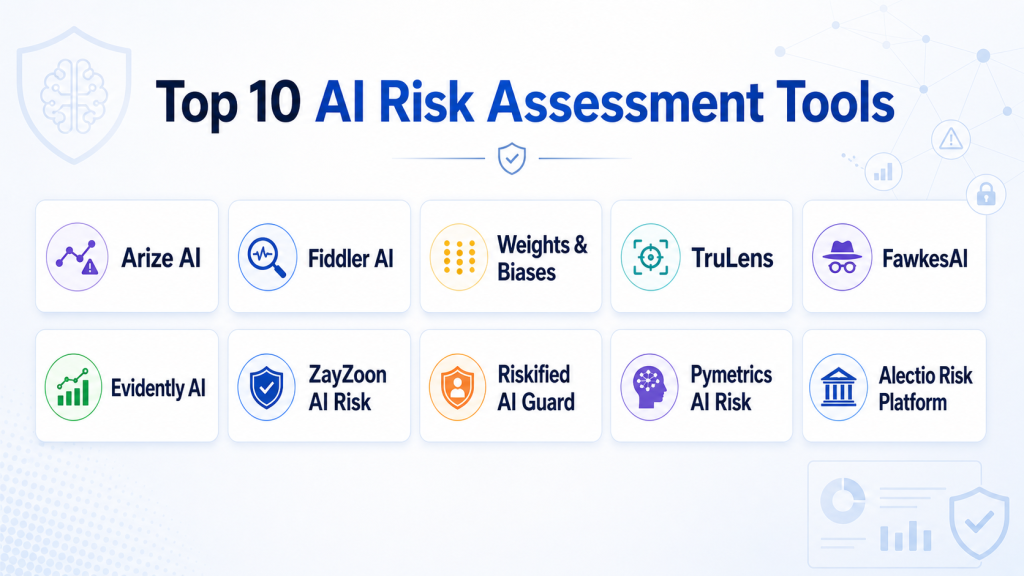
Top 10 AI Risk Assessment Tools
1 — Arize AI
One-line verdict: Enterprise observability platform for monitoring AI risk, bias, and drift in large-scale deployments.
Short description :
Arize AI detects, analyzes, and mitigates risks in deployed AI models.
It provides alerts for drift, bias, and performance issues.
Ideal for enterprises with compliance and operational observability needs.
Standout Capabilities
- Production model monitoring
- Drift and bias alerts
- Multimodal data support
- Root cause analysis dashboards
- Historical model comparison
- Integration with MLflow, Databricks, SageMaker
- Anomaly detection alerts
AI-Specific Depth
- Model support: Hosted / BYO
- RAG / knowledge integration: N/A
- Evaluation: Regression, drift detection, human review
- Guardrails: N/A
- Observability: Token metrics, latency, traces
Pros
- Enterprise-grade observability
- Supports multiple model types
- Detailed dashboards
Cons
- Complex for small teams
- Limited guardrail automation
- Integration setup requires expertise
Security & Compliance
SSO/SAML, RBAC, encryption, audit logs (Not publicly stated)
Deployment & Platforms
Web, Cloud
Integrations & Ecosystem
APIs and SDKs; integrates with:
- MLflow
- Databricks
- SageMaker
- Airflow
- Snowflake
Pricing Model
Tiered / usage-based
Best-Fit Scenarios
- Enterprise AI risk monitoring
- Compliance-focused AI deployments
- Multimodal model observability
2 — Fiddler AI
One-line verdict: Explainability and fairness platform for regulated industries and compliance auditing.
Short description :
Fiddler AI monitors deployed AI for bias, fairness, and explainability.
It generates alerts and dashboards for model evaluation.
Ideal for compliance-driven enterprise AI teams.
Standout Capabilities
- Explainability dashboards
- Bias/fairness detection
- Automated risk alerts
- Model comparison over time
- Integration APIs
- Custom evaluation metrics
- Feature importance visualization
AI-Specific Depth
- Model support: Hosted / BYO
- RAG / knowledge integration: N/A
- Evaluation: Bias/fairness, regression, human review
- Guardrails: Policy checks
- Observability: Token metrics, latency, traces
Pros
- Strong explainability focus
- Supports regulatory reporting
- Rapid bias detection
Cons
- Limited performance evaluation
- Smaller ecosystem
- Technical integration required
Security & Compliance
SSO/SAML, encryption, audit logs
Deployment & Platforms
Web, Cloud
Integrations & Ecosystem
- APIs, Python SDK
- MLOps pipelines
- Databricks, Snowflake
- Airflow
Pricing Model
Tiered subscription
Best-Fit Scenarios
- Regulatory compliance audits
- Fairness assessment
- Enterprise AI evaluation
3 — Weights & Biases (W&B)
One-line verdict: Developer-focused model monitoring and experiment tracking platform for risk and reliability assessment.
Short description :
W&B tracks deployed models for drift, bias, and performance issues.
Provides dashboards for experiments and production monitoring.
Ideal for AI engineering and ML DevOps teams.
Standout Capabilities
- Experiment tracking
- Drift and bias monitoring
- Performance dashboards
- Historical experiment comparison
- Alerts for anomalies
- CI/CD integration
- Multi-framework support
AI-Specific Depth
- Model support: BYO / Open-source
- RAG / knowledge integration: N/A
- Evaluation: Regression, offline tests
- Guardrails: N/A
- Observability: Token metrics, latency, cost
Pros
- Developer-friendly
- CI/CD integration
- Detailed visualization
Cons
- Less governance focus
- Guardrails limited
- Setup for enterprise can be complex
Security & Compliance
RBAC, encryption, audit logs
Deployment & Platforms
Web, Cloud, Hybrid
Integrations & Ecosystem
- MLflow, PyTorch, TensorFlow
- SageMaker
- Airflow, Databricks
Pricing Model
Usage-based / tiered
Best-Fit Scenarios
- Production model monitoring
- Technical AI teams
- Experiment tracking
4 — TruLens
One-line verdict: LLM and generative AI evaluation platform focusing on safety, reliability, and bias monitoring.
Short description :
TruLens evaluates LLM outputs for bias, hallucinations, and safety.
Provides dashboards and alerts for prompt-level issues.
Ideal for enterprises deploying generative AI responsibly.
Standout Capabilities
- Ethical evaluation
- Bias and toxicity testing
- Prompt safety analysis
- Regression testing
- Multi-model evaluation
- Customizable evaluation frameworks
- Dashboard visualizations
AI-Specific Depth
- Model support: Proprietary / BYO
- RAG / knowledge integration: N/A
- Evaluation: Prompt testing, offline eval, human review
- Guardrails: Policy checks
- Observability: Metrics, token counts, latency
Pros
- Focused on generative AI
- Transparent evaluation
- LLM safety features
Cons
- Limited integration ecosystem
- Smaller enterprise footprint
- Specialized for LLMs
Security & Compliance
SSO/SAML, audit logs, encryption
Deployment & Platforms
Web, Cloud
Integrations & Ecosystem
- APIs, Python SDK
- MLflow, Databricks
- Airflow
Pricing Model
Tiered / usage-based
Best-Fit Scenarios
- Generative AI evaluation
- LLM safety and prompt injection monitoring
- Ethical AI audits
5 — FawkesAI
One-line verdict: Privacy-first AI risk tool for compliance, sensitive data evaluation, and operational risk.
Short description :
FawkesAI monitors deployed models for privacy and compliance risks.
Detects data leakage and enforces retention policies.
Ideal for enterprises handling sensitive data.
Standout Capabilities
- Privacy leakage detection
- Data residency enforcement
- Risk scoring dashboards
- Compliance monitoring
- Alerts for anomalies
- Multimodal support
- MLOps pipeline integration
AI-Specific Depth
- Model support: BYO / Open-source
- RAG / knowledge integration: N/A
- Evaluation: Data privacy tests, regression
- Guardrails: Policy enforcement
- Observability: Token metrics, cost
Pros
- Privacy-first approach
- Compliance-focused
- Integrates with MLOps pipelines
Cons
- Limited explainability
- Specialized for privacy
- Smaller user base
Security & Compliance
Encryption, RBAC, audit logs, data residency
Deployment & Platforms
Cloud, Web, Hybrid
Integrations & Ecosystem
- Python SDK
- CI/CD pipelines
- Databricks, Snowflake
Pricing Model
Usage-based / subscription
Best-Fit Scenarios
- Sensitive data AI
- Privacy audits
- Enterprise compliance monitoring
6 — Evidently AI
One-line verdict: Open-source monitoring platform for drift, bias, and model performance in production.
Short description :
Evidently AI tracks deployed models for performance and drift over time.
Provides visual dashboards and alerts for bias and reliability.
Ideal for developers and ML engineers seeking lightweight monitoring.
Standout Capabilities
- Drift detection
- Bias monitoring
- Performance metric visualization
- Historical reporting
- Alerts for anomalies
- Model comparison dashboards
- Open-source extensibility
AI-Specific Depth
- Model support: Open-source / BYO
- RAG / knowledge integration: N/A
- Evaluation: Offline evaluation, regression tests
- Guardrails: N/A
- Observability: Metrics, latency, token usage
Pros
- Developer-friendly and open-source
- Easy CI/CD integration
- Clear visualization dashboards
Cons
- Limited enterprise guardrails
- Smaller ecosystem
- Technical setup required
Security & Compliance
Varies / N/A
Deployment & Platforms
Web, Cloud, On-prem
Integrations & Ecosystem
- Python SDK
- MLflow, TensorFlow, PyTorch
- Airflow, Databricks
Pricing Model
Open-source + optional enterprise license
Best-Fit Scenarios
- Technical AI teams
- Model drift monitoring
- CI/CD integrated evaluation
7 — ZayZoon AI Risk
One-line verdict: Enterprise-grade tool for governance, compliance, and AI operational risk monitoring.
Short description :
ZayZoon AI Risk tracks enterprise AI models for compliance and operational risk.
Generates dashboards for policy adherence and alerts for anomalies.
Ideal for regulated industries deploying AI at scale.
Standout Capabilities
- Risk scoring framework
- Compliance dashboards
- Evaluation automation
- Drift and performance monitoring
- Policy enforcement alerts
- Historical reporting
- Integration with ML pipelines
AI-Specific Depth
- Model support: Hosted / BYO
- RAG / knowledge integration: N/A
- Evaluation: Regression tests, human review
- Guardrails: Policy checks
- Observability: Latency, token metrics
Pros
- Enterprise governance focus
- Automated compliance reporting
- Integrates into existing pipelines
Cons
- Less developer-friendly
- Limited open-source support
- Niche enterprise tool
Security & Compliance
SSO/SAML, audit logs, encryption
Deployment & Platforms
Cloud, Web
Integrations & Ecosystem
- APIs, Python SDK
- Databricks, Airflow, Snowflake
Pricing Model
Tiered subscription
Best-Fit Scenarios
- Regulated industry AI
- Enterprise governance dashboards
- Compliance reporting
8 — Riskified AI Guard
One-line verdict: Platform focused on ethical and operational AI risk, ideal for finance and consumer data.
Short description :
Riskified AI Guard monitors model outputs for ethical and operational risks.
Provides dashboards for bias, fairness, and compliance monitoring.
Ideal for enterprises managing regulated and consumer AI applications.
Standout Capabilities
- Decision monitoring
- Bias detection
- Compliance alerts
- Historical analysis
- Audit-ready reporting
- Pipeline integration
- Multimodal support
AI-Specific Depth
- Model support: Hosted / BYO
- RAG / knowledge integration: N/A
- Evaluation: Offline eval, human review
- Guardrails: Policy checks
- Observability: Metrics, cost, latency
Pros
- Ethical and operational risk focus
- Enterprise-ready dashboards
- Compliance alerts
Cons
- Limited developer tools
- Narrower model types supported
- Requires enterprise integration
Security & Compliance
SSO/SAML, RBAC, encryption, audit logs
Deployment & Platforms
Cloud, Web
Integrations & Ecosystem
- API, Python SDK
- CI/CD pipelines
- Databricks, Snowflake
Pricing Model
Tiered subscription
Best-Fit Scenarios
- Ethical AI auditing
- Finance AI risk
- Enterprise compliance monitoring
9 — Pymetrics AI Risk
One-line verdict: Developer-focused tool for fairness, bias, and operational risk assessment.
Short description :
Pymetrics AI Risk evaluates models for bias, fairness, and reliability.
Provides dashboards and alerts for developers and analysts.
Ideal for technical AI teams assessing model ethics and drift.
Standout Capabilities
- Bias and fairness monitoring
- Drift detection
- Dashboard visualizations
- Regression evaluation
- Prompt monitoring
- Historical reports
- Integration with open-source ML tools
AI-Specific Depth
- Model support: Open-source / BYO
- RAG / knowledge integration: N/A
- Evaluation: Regression, offline tests
- Guardrails: Policy alerts
- Observability: Metrics, latency
Pros
- Developer-friendly
- Fairness and bias monitoring
- CI/CD integration
Cons
- Limited enterprise guardrails
- Smaller ecosystem
- Focused on open-source
Security & Compliance
Varies / N/A
Deployment & Platforms
Cloud, Web
Integrations & Ecosystem
- Python SDK
- MLflow, Airflow, Databricks
Pricing Model
Usage-based / tiered
Best-Fit Scenarios
- Developer AI teams
- Model fairness testing
- CI/CD integration
10 — Alectio Risk Platform
One-line verdict: Enterprise AI risk platform for observability, compliance, and operational monitoring.
Short description :
Alectio monitors deployed AI for bias, drift, and operational risks.
Provides dashboards for alerts, compliance, and performance metrics.
Ideal for enterprises requiring end-to-end AI risk management.
Standout Capabilities
- Observability dashboards
- Drift and performance monitoring
- Bias detection
- Policy enforcement
- Alerts and notifications
- Model comparison and evaluation
- Pipeline integration
AI-Specific Depth
- Model support: BYO / Hosted
- RAG / knowledge integration: N/A
- Evaluation: Regression, offline tests
- Guardrails: Policy checks
- Observability: Metrics, latency, cost
Pros
- Enterprise-grade monitoring
- Strong observability
- Supports complex pipelines
Cons
- Learning curve for new teams
- Limited open-source support
- Costly for SMBs
Security & Compliance
SSO/SAML, encryption, audit logs
Deployment & Platforms
Cloud, Web
Integrations & Ecosystem
- APIs, Python SDK
- Databricks, Airflow, Snowflake
Pricing Model
Tiered / subscription
Best-Fit Scenarios
- Enterprise AI governance
- Operational risk monitoring
- Multimodal AI pipelines
Comparison Table
| Tool Name | Best For | Deployment | Model Flexibility | Strength | Watch-Out | Public Rating |
|---|---|---|---|---|---|---|
| Arize AI | Enterprise AI teams | Cloud | Hosted / BYO | Drift & observability | Complex for small teams | N/A |
| Fiddler AI | Regulatory compliance audits | Cloud | Hosted / BYO | Explainability & fairness | Limited performance | N/A |
| Weights & Biases | Developer-focused monitoring | Cloud/Hybrid | BYO / Open-source | Experiment tracking | Limited governance | N/A |
| TruLens | LLM safety & evaluation | Cloud | Proprietary / BYO | Prompt-level evaluation | Smaller ecosystem | N/A |
| FawkesAI | Privacy & compliance | Cloud/Hybrid | BYO / Open-source | Privacy-first approach | Limited explainability | N/A |
| Evidently AI | Dev/ML teams monitoring | Web/Cloud | Open-source / BYO | Drift monitoring | Limited guardrails | N/A |
| ZayZoon AI Risk | Enterprise governance | Cloud | Hosted / BYO | Compliance reporting | Less dev-friendly | N/A |
| Riskified AI Guard | Ethical/operational AI risk | Cloud | Hosted / BYO | Ethical risk focus | Limited dev tools | N/A |
| Pymetrics AI Risk | Developers & analysts | Cloud | Open-source / BYO | Fairness monitoring | Smaller ecosystem | N/A |
| Alectio Risk Platform | Enterprise AI observability | Cloud | BYO / Hosted | Comprehensive monitoring | Costly for SMBs | N/A |
Scoring & Evaluation Table
| Tool | Core | Reliability/Eval | Guardrails | Integrations | Ease | Perf/Cost | Security/Admin | Support | Weighted Total |
|---|---|---|---|---|---|---|---|---|---|
| Arize AI | 9 | 9 | 7 | 8 | 7 | 8 | 8 | 7 | 8.1 |
| Fiddler AI | 8 | 8 | 8 | 7 | 8 | 7 | 8 | 7 | 7.7 |
| Weights & Biases | 8 | 7 | 6 | 7 | 9 | 8 | 7 | 7 | 7.5 |
| TruLens | 7 | 8 | 7 | 6 | 8 | 7 | 7 | 6 | 7.2 |
| FawkesAI | 7 | 7 | 8 | 6 | 7 | 7 | 8 | 6 | 7.1 |
| Evidently AI | 7 | 7 | 6 | 7 | 8 | 7 | 6 | 6 | 6.9 |
| ZayZoon AI Risk | 8 | 8 | 8 | 7 | 7 | 7 | 8 | 6 | 7.5 |
| Riskified AI Guard | 7 | 7 | 8 | 6 | 7 | 7 | 8 | 6 | 7.0 |
| Pymetrics AI Risk | 7 | 7 | 6 | 6 | 8 | 7 | 6 | 6 | 6.8 |
| Alectio Risk Platf | 8 | 8 | 7 | 7 | 7 | 8 | 7 | 7 | 7.5 |
Top 3 for Enterprise: Arize AI, ZayZoon AI Risk, Alectio Risk Platform
Top 3 for SMB: Weights & Biases, FawkesAI, Evidently AI
Top 3 for Developers: Weights & Biases, Evidently AI, Pymetrics AI Risk
Which AI Risk Assessment Tool Is Right for You?
Solo / Freelancer
Open-source tools like Weights & Biases and Evidently AI are ideal for small projects and experimentation.
SMB
FawkesAI and Weights & Biases balance usability with governance and monitoring.
Mid-Market
Tools like TruLens or Riskified AI Guard provide observability and compliance dashboards.
Enterprise
For enterprise-scale governance and monitoring, choose Arize AI, ZayZoon AI Risk, or Alectio Risk Platform.
Regulated industries
Focus on privacy, fairness, and explainability: Fiddler AI, FawkesAI, TruLens.
Budget vs premium
Open-source tools are cost-effective; enterprise platforms are premium.
Build vs buy
DIY works for experimentation using Evidently AI, but enterprise deployments require licensed platforms.
Implementation Playbook (30 / 60 / 90 Days)
30 Days –
- Select 1–2 high-risk AI models for initial evaluation.
- Define evaluation metrics for bias, drift, hallucination rates, and compliance.
- Conduct initial model assessments and generate risk dashboards.
- Document findings and refine evaluation templates.
60 Days –
- Extend monitoring to all production AI models.
- Integrate guardrails and compliance checks into pipelines.
- Implement human-in-loop review for critical models.
- Set up automated alerts and reporting for stakeholders.
- Train internal teams on tool usage and response procedures.
90 Days –
- Optimize latency, cost, and computational efficiency across all monitored models.
- Expand observability dashboards with historical trends and multi-model comparison.
- Apply governance frameworks enterprise-wide with documented policies.
- Conduct red-team testing and prompt-injection simulations.
- Refine incident handling and escalation procedures.
- Perform post-deployment audits and continuous evaluation cycles.
Common Mistakes & How to Avoid Them
- Ignoring prompt injection risks
- Skipping model evaluation for drift or bias
- Unmanaged data retention policies
- Lack of observability dashboards
- Cost overruns due to unmonitored usage
- Over-automation without human oversight
- Vendor lock-in without abstraction layers
- Evaluating only single models
- Ignoring multimodal AI risks
- Weak or missing guardrails
- Neglecting regulatory compliance
- Misinterpreting alerts from evaluation metrics
- Poor integration with CI/CD pipelines
- Insufficient staff training on tools
FAQs
- What is AI risk assessment?
Evaluates models for bias, reliability, and security before deployment. - Why do these tools matter?
They prevent operational, ethical, and compliance risks in AI projects. - Can I use BYO models?
Yes, most platforms allow custom or self-hosted AI models. - Do these tools support multimodal AI?
Yes, they evaluate text, vision, audio, and structured data models. - How do guardrails work?
They enforce policy checks and prevent unsafe outputs or prompt injections. - Are these tools only for large enterprises?
No, open-source tools suit SMBs and individual developers. - How often should AI be evaluated?
Continuously in production and after each major update. - Do these tools integrate with MLOps pipelines?
Yes, via APIs, SDKs, and CI/CD integration. - Do they improve model reliability?
They detect drift, bias, and anomalies but do not fix models directly. - Are enterprise certifications necessary?
Optional; RBAC, audit logs, and encryption often suffice. - Can these tools detect hallucinations?
Yes, through regression, evaluation metrics, and human review. - Which industries benefit most?
Finance, healthcare, public sector, and other regulated AI applications.
Conclusion
AI Risk Assessment Tools have become indispensable for organizations deploying AI at scale, helping teams ensure ethical, secure, and compliant AI operations. These tools allow businesses to monitor bias, detect model drift, prevent hallucinations, enforce guardrails, and maintain regulatory compliance, reducing financial, operational, and reputational risks. For developers and small teams, open-source platforms like Evidently AI and Weights & Biases provide lightweight, flexible monitoring. For SMBs, tools like FawkesAI and TruLens balance usability with governance, enabling teams to implement risk controls without extensive overhead. Enterprises and regulated industries benefit from comprehensive platforms such as Arize AI, ZayZoon AI Risk, and Alectio Risk Platform, which provide full observability, compliance reporting, and governance dashboards for large-scale AI deployments. Ultimately, selecting the right tool depends on the organization’s size, regulatory obligations, model complexity, and deployment strategy, ensuring that AI is deployed safely, ethically, and efficiently across all operational contexts.
Next steps:
- Shortlist tools based on deployment type, model flexibility, and evaluation coverage.
- Pilot selected models to test drift, bias, and observability metrics.
- Verify security, guardrails, and evaluation protocols before scaling enterprise-wide.
An insightful article that connects real-world AI risks with practical solutions and tools. The structured comparison makes it more useful and actionable.
Great resource for understanding how organizations can reduce AI-related risks using modern platforms.
This article clearly explains how AI risk assessment tools help organizations identify, analyze, and reduce potential risks in systems using data-driven and intelligent evaluation methods effectively.