Introduction
AI benchmark dataset curation tools help teams collect, clean, filter, annotate, deduplicate, validate, version, and organize datasets used to evaluate machine learning and generative AI systems. Instead of treating a benchmark as a static collection of examples, modern teams increasingly manage datasets as continuously evolving evaluation assets.
These tools are useful for creating benchmarks for large language models, computer vision, speech systems, multimodal models, retrieval systems, recommendation engines, agents, and domain-specific AI applications. They can help identify duplicates, remove low-quality examples, detect data leakage, balance classes, inspect difficult samples, create annotation workflows, and prepare datasets for reproducible evaluation.
Best for: AI research teams, ML engineers, data scientists, evaluation engineers, AI labs, universities, enterprises, and organizations building repeatable model-testing pipelines.
Not ideal for: Small teams with only a handful of manually maintained evaluation examples, projects where a simple spreadsheet or JSON repository is sufficient, or organizations that do not need dataset versioning, annotation, quality control, or large-scale curation.
When evaluating these platforms, buyers should consider data ingestion, annotation, deduplication, quality detection, dataset versioning, multimodal support, privacy, evaluation integration, automation, APIs, scalability, reproducibility, human review, observability, and deployment flexibility.
What’s Changed in AI Benchmark Dataset Curation Tools
- Benchmark datasets are becoming dynamic assets: Teams increasingly update evaluation sets as models and applications change instead of treating benchmarks as permanent snapshots.
- Synthetic data is entering benchmark workflows: AI-generated examples can expand difficult categories, although synthetic examples require independent validation.
- Data leakage detection matters more: Benchmark contamination can produce misleadingly high model scores, particularly when evaluation examples overlap with training or public web data.
- Near-duplicate detection is increasingly important: Semantically similar examples can unintentionally inflate benchmark performance.
- Multimodal benchmarks are expanding: Modern evaluation datasets can combine text, images, audio, video, documents, tables, and structured data.
- Hard-example mining is becoming more useful: Teams can identify samples where models consistently fail and add them to targeted evaluation sets.
- Human and AI annotation are increasingly combined: AI-assisted labeling can reduce manual workload while expert reviewers handle ambiguous examples.
- Data-centric evaluation is replacing simple accuracy testing: Teams increasingly examine coverage, difficulty, demographic balance, domain diversity, ambiguity, and failure modes.
- Agent benchmarks require richer datasets: Evaluating AI agents may require multi-step tasks, tool calls, expected trajectories, state transitions, and environment information.
- Dataset governance is becoming essential: Enterprises increasingly need provenance, access controls, version history, retention policies, and auditability.
- Evaluation reproducibility is gaining importance: Teams need to know exactly which dataset version, prompt, evaluator, and configuration produced a benchmark result.
- Cost optimization is becoming important: Large multimodal datasets can be expensive to annotate, store, process, and repeatedly evaluate.
- Privacy requirements are becoming stricter: Benchmark datasets may contain personal, confidential, proprietary, or regulated information.
- Model-assisted curation is becoming more sophisticated: Embeddings, classifiers, LLMs, and other models can help identify low-quality, redundant, or unusual samples.
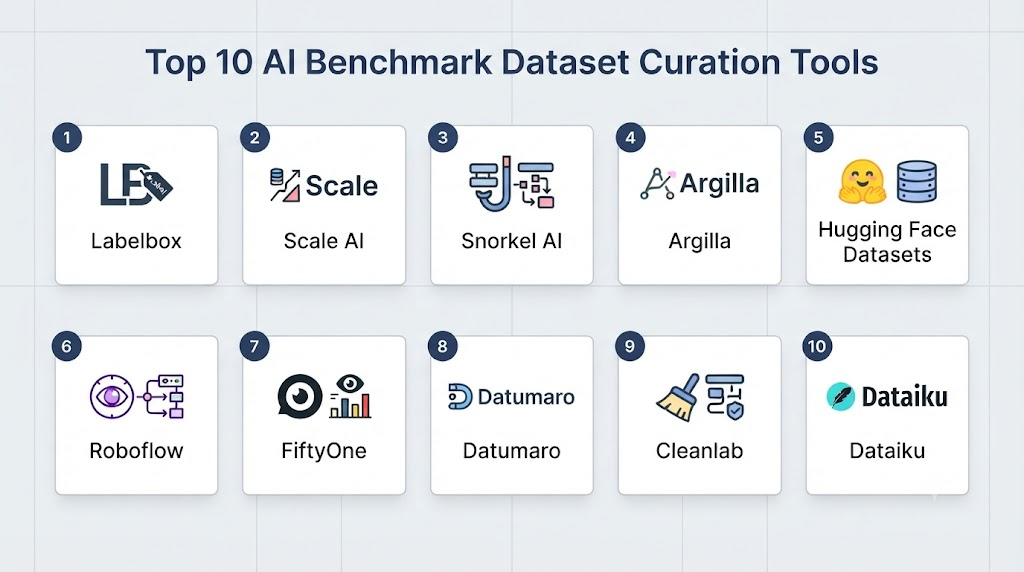
Top 10 AI Benchmark Dataset Curation Tools
1. NVIDIA NeMo Curator
One-line verdict: Best for large-scale AI teams curating high-quality text, multimodal, and training or evaluation datasets.
Short description:
NVIDIA NeMo Curator is designed for large-scale data curation workflows supporting generative AI and model development. It focuses on processing, filtering, deduplicating, and preparing datasets at scale.
Standout Capabilities
- Large-scale dataset processing
- Text data filtering
- Exact and fuzzy deduplication workflows
- Quality filtering
- Distributed data processing
- Synthetic-data workflows
- LLM-oriented dataset preparation
- Support for large AI development pipelines
AI-Specific Depth
- Model support: Designed to work with AI development pipelines and can support model-assisted data processing; exact model flexibility varies by workflow.
- RAG / knowledge integration: Not primarily a RAG platform.
- Evaluation: Can support preparation of datasets used for evaluation, but it is primarily a curation and processing toolkit.
- Guardrails: Data-quality filtering and configurable processing can reduce problematic data; dedicated prompt-injection defense is N/A.
- Observability: Processing and pipeline monitoring depend on the deployment and surrounding infrastructure.
Pros
- Well suited to very large datasets.
- Strong focus on data quality and deduplication.
- Useful for organizations building large AI pipelines.
Cons
- More engineering-oriented than simple annotation platforms.
- Infrastructure requirements can be significant.
- May be excessive for small benchmark datasets.
Security & Compliance
Security depends substantially on deployment architecture and infrastructure. Specific certifications for every NeMo Curator deployment are Not publicly stated.
Deployment & Platforms
- Linux
- Cloud
- Self-hosted
- GPU-accelerated infrastructure where appropriate
Integrations & Ecosystem
NeMo Curator fits into broader AI data and model-development workflows.
- Python-based workflows
- NVIDIA AI ecosystem
- Distributed processing
- Data storage systems
- Model-development pipelines
- Custom processing components
Pricing Model
The software is available as part of NVIDIA’s AI software ecosystem; infrastructure and associated enterprise services can introduce additional costs.
Best-Fit Scenarios
- Large AI laboratories
- Foundation-model development
- Large benchmark datasets
- Enterprise-scale data curation
2. Label Studio
One-line verdict: Best for teams combining flexible human annotation with AI-assisted data labeling and benchmark dataset preparation.
Short description:
Label Studio is a flexible data-labeling and annotation platform that can support text, images, audio, video, time-series data, and other data types. It is useful when benchmark curation requires humans to inspect and label difficult examples.
Standout Capabilities
- Flexible annotation interfaces
- Multiple data modalities
- Human-in-the-loop workflows
- AI-assisted labeling
- Custom labeling configurations
- Annotation review
- API access
- Dataset export
AI-Specific Depth
- Model support: Can integrate AI models into annotation workflows; exact model support depends on configuration.
- RAG / knowledge integration: Not a primary RAG platform.
- Evaluation: Annotation and review workflows can support benchmark-quality datasets; dedicated benchmark evaluation is Varies / N/A.
- Guardrails: Annotation workflows can implement validation rules and human review.
- Observability: Annotation and workflow metrics are available depending on deployment and configuration.
Pros
- Highly customizable.
- Strong human-in-the-loop workflow.
- Useful across many data modalities.
Cons
- Requires configuration for sophisticated benchmark pipelines.
- Large-scale deployments may require engineering expertise.
- Not solely focused on benchmark datasets.
Security & Compliance
Security controls depend on the edition and deployment. Specific certifications should be verified for the exact deployment.
Deployment & Platforms
- Web
- Cloud
- Self-hosted
- Linux-based deployments
Integrations & Ecosystem
- APIs
- Python workflows
- Machine-learning pipelines
- Model-assisted labeling
- Data storage
- Custom annotation interfaces
Pricing Model
Open-source capabilities are available, with commercial offerings for additional enterprise functionality. Exact pricing varies.
Best-Fit Scenarios
- Multimodal benchmark creation
- Human evaluation teams
- Custom annotation projects
3. Argilla
One-line verdict: Best for AI teams building open, developer-friendly workflows for LLM data curation, evaluation, feedback, and dataset refinement.
Short description:
Argilla is an open-source-oriented platform for working with datasets, human feedback, and LLM-related data workflows. It is particularly useful when teams need humans to inspect model outputs and curate high-quality examples.
Standout Capabilities
- LLM dataset management
- Human feedback
- Data annotation
- Dataset exploration
- Text and multimodal workflows
- Python integration
- Hugging Face ecosystem integration
- Iterative dataset refinement
AI-Specific Depth
- Model support: Flexible integration with models and AI pipelines.
- RAG / knowledge integration: Can be incorporated into retrieval and LLM data workflows but is not primarily a RAG database.
- Evaluation: Human feedback and dataset review can support evaluation-set creation.
- Guardrails: Human review can help identify problematic outputs; dedicated AI safety guardrails are Varies / N/A.
- Observability: Dataset and annotation workflows provide useful curation visibility; detailed model tracing depends on surrounding systems.
Pros
- Strong open-source orientation.
- Developer-friendly.
- Useful for iterative LLM dataset curation.
Cons
- Requires engineering effort for advanced workflows.
- Enterprise capabilities may depend on deployment.
- Not a complete benchmark-management system by itself.
Security & Compliance
Self-hosting can provide greater infrastructure control. Specific certifications are Not publicly stated.
Deployment & Platforms
- Web
- Cloud
- Self-hosted
- Linux
Integrations & Ecosystem
- Python
- Hugging Face ecosystem
- LLM workflows
- Dataset pipelines
- Custom model integrations
- Annotation systems
Pricing Model
Open-source availability with commercial options depending on requirements.
Best-Fit Scenarios
- AI research teams
- LLM evaluation projects
- Developer-centric organizations
4. Cleanlab
One-line verdict: Best for automatically identifying label problems, data-quality issues, duplicates, and difficult examples in machine-learning datasets.
Short description:
Cleanlab focuses heavily on data quality and identifying problematic examples. Its methods are useful for teams that need to understand which records are potentially mislabeled, ambiguous, duplicated, or otherwise unsuitable for reliable benchmarking.
Standout Capabilities
- Label-error detection
- Data-quality analysis
- Duplicate detection
- Outlier identification
- Dataset diagnostics
- Automated data cleaning
- Model-assisted data quality
- Python integration
AI-Specific Depth
- Model support: Works with machine-learning predictions and model outputs; exact supported models vary.
- RAG / knowledge integration: N/A as a primary function.
- Evaluation: Strong relevance to dataset-quality evaluation rather than prompt-level evaluation.
- Guardrails: Data-quality analysis can identify problematic records but is not a prompt-injection defense platform.
- Observability: Dataset diagnostics provide visibility into data-quality problems.
Pros
- Strong data-centric AI approach.
- Useful for identifying hidden dataset problems.
- Can improve benchmark reliability before evaluation.
Cons
- Not primarily an annotation-management platform.
- Requires ML knowledge for sophisticated use.
- Benchmark workflow orchestration may require additional tools.
Security & Compliance
Deployment and security depend on the selected product and environment. Specific certifications are Not publicly stated here.
Deployment & Platforms
- Python
- Cloud
- Deployment options vary
Integrations & Ecosystem
- Python
- Machine-learning models
- Data science workflows
- Dataset pipelines
- Classification workflows
- Custom AI applications
Pricing Model
Commercial and usage or enterprise arrangements vary. Exact pricing is Not publicly stated.
Best-Fit Scenarios
- ML data-quality teams
- Benchmark cleaning
- Label-error detection
5. FiftyOne
One-line verdict: Best for visual dataset exploration, multimodal inspection, embedding search, and curation of computer-vision benchmarks.
Short description:
FiftyOne is a data-centric AI platform particularly strong for exploring and curating visual datasets. It allows teams to inspect individual samples, metadata, model predictions, embeddings, and relationships within large datasets.
Standout Capabilities
- Computer-vision dataset visualization
- Embedding visualization
- Dataset search
- Sample inspection
- Model prediction analysis
- Dataset curation
- Multimodal data support
- Python workflows
AI-Specific Depth
- Model support: Supports integration with many machine-learning and computer-vision models.
- RAG / knowledge integration: Not primarily a RAG platform.
- Evaluation: Supports model evaluation and dataset analysis workflows.
- Guardrails: Data-quality workflows can help identify problematic examples; dedicated generative-AI guardrails are N/A.
- Observability: Strong dataset and prediction inspection capabilities.
Pros
- Excellent visual dataset exploration.
- Strong for computer vision.
- Useful for discovering difficult and redundant examples.
Cons
- More useful for visual AI than pure text benchmarks.
- Advanced enterprise workflows can require additional infrastructure.
- Requires technical users for maximum value.
Security & Compliance
Deployment-specific security varies. Specific certifications are Not publicly stated.
Deployment & Platforms
- Web
- Python
- Cloud
- Self-hosted options
Integrations & Ecosystem
- Python
- Computer-vision models
- ML frameworks
- Embedding workflows
- Dataset formats
- Model evaluation pipelines
Pricing Model
Open-source capabilities are available alongside commercial offerings.
Best-Fit Scenarios
- Computer-vision benchmarks
- Multimodal datasets
- Visual quality analysis
6. Hugging Face Datasets
One-line verdict: Best for researchers and developers who need a flexible open ecosystem for creating, sharing, processing, and versioning AI datasets.
Short description:
Hugging Face Datasets provides a widely used dataset library and ecosystem for machine-learning datasets. It is particularly useful for developers who want programmatic dataset processing and integration with model-development workflows.
Standout Capabilities
- Dataset loading
- Dataset processing
- Dataset sharing
- Dataset versioning
- Streaming
- Python integration
- Large dataset support
- ML ecosystem integration
AI-Specific Depth
- Model support: Broad compatibility through the machine-learning ecosystem.
- RAG / knowledge integration: Datasets can be used to build knowledge and retrieval workflows but are not themselves a RAG system.
- Evaluation: Useful for hosting and preparing benchmark datasets.
- Guardrails: Dataset-level filtering depends on user workflows.
- Observability: Dataset metadata and processing information are available, while detailed model observability requires additional tooling.
Pros
- Large open AI ecosystem.
- Developer-friendly.
- Strong interoperability.
Cons
- Requires technical knowledge.
- Curation quality depends heavily on implementation.
- Not a turnkey enterprise benchmark-management platform.
Security & Compliance
Security depends on how datasets and repositories are managed. Specific certification status varies by service and plan.
Deployment & Platforms
- Python
- Web
- Cloud
- Local development
Integrations & Ecosystem
- Python
- Transformers ecosystem
- Machine-learning frameworks
- Dataset repositories
- Evaluation tools
- Model-development workflows
Pricing Model
Open datasets and open-source tooling are widely available; hosted and enterprise services may have different commercial terms.
Best-Fit Scenarios
- ML researchers
- Open-source AI teams
- Benchmark developers
7. Scale AI
One-line verdict: Best for organizations requiring large-scale managed data annotation and human-powered dataset development for advanced AI systems.
Short description:
Scale AI provides data infrastructure and human-in-the-loop services for AI development. Its capabilities can support large-scale annotation and specialized data preparation across several AI modalities.
Standout Capabilities
- Large-scale annotation
- Human-in-the-loop data workflows
- Data labeling
- Specialized AI datasets
- Quality control
- Computer-vision workflows
- Language data
- Enterprise-scale operations
AI-Specific Depth
- Model support: AI-assisted data workflows and model-in-the-loop processes vary by service.
- RAG / knowledge integration: Not a primary RAG platform.
- Evaluation: Human evaluation and data-quality workflows can support benchmark development.
- Guardrails: Human review and quality-control processes can reduce problematic examples.
- Observability: Enterprise data workflows provide operational visibility, with exact AI metrics varying by service.
Pros
- Suitable for large data operations.
- Strong human-in-the-loop capabilities.
- Useful for specialized and complex datasets.
Cons
- Enterprise-oriented.
- Costs can be significant depending on workload.
- May be excessive for small research projects.
Security & Compliance
Enterprise security and compliance capabilities vary by service and contract. Specific certification requirements should be verified directly.
Deployment & Platforms
- Cloud
- Managed service
- Enterprise environments
Integrations & Ecosystem
- APIs
- Data pipelines
- Annotation workflows
- Human review
- ML systems
- Enterprise AI infrastructure
Pricing Model
Enterprise and usage-based models vary. Exact pricing is Not publicly stated.
Best-Fit Scenarios
- Large AI organizations
- Complex annotation programs
- Enterprise benchmark construction
8. Labelbox
One-line verdict: Best for enterprise teams managing large-scale multimodal labeling, annotation operations, and data-quality workflows.
Short description:
Labelbox provides data-labeling and AI data-development capabilities for organizations building machine-learning datasets. It is especially relevant when benchmark curation requires structured human annotation and enterprise workflow management.
Standout Capabilities
- Data labeling
- Human annotation
- AI-assisted labeling
- Multimodal workflows
- Quality control
- Annotation review
- Data management
- Enterprise workflows
AI-Specific Depth
- Model support: AI-assisted labeling and model-assisted workflows; exact model options vary.
- RAG / knowledge integration: N/A as a primary function.
- Evaluation: Human review and quality workflows can support benchmark dataset construction.
- Guardrails: Annotation quality controls can reduce labeling errors.
- Observability: Workflow and annotation metrics depend on the product configuration.
Pros
- Enterprise-oriented annotation workflows.
- Strong multimodal capabilities.
- Useful for large labeling operations.
Cons
- More complex than lightweight annotation tools.
- Commercial costs may be significant.
- Requires configuration for specialized benchmarks.
Security & Compliance
Enterprise security controls are available depending on product and plan. Specific certifications should be verified for the selected deployment.
Deployment & Platforms
- Web
- Cloud
- Enterprise environments
Integrations & Ecosystem
- APIs
- ML pipelines
- Annotation workflows
- Model-assisted labeling
- Data storage
- Enterprise systems
Pricing Model
Commercial and enterprise pricing. Exact pricing is Not publicly stated.
Best-Fit Scenarios
- Enterprise AI teams
- Multimodal datasets
- Large annotation projects
9. DataPerf
One-line verdict: Best for teams interested in data-centric AI benchmarks that evaluate data quality, selection, and improvement techniques.
Short description:
DataPerf is associated with data-centric AI benchmarking, focusing on measuring methods for improving data used by machine-learning systems. It is especially relevant to researchers studying how dataset quality affects model performance.
Standout Capabilities
- Data-centric benchmarking
- Dataset-quality evaluation
- Data selection research
- Data improvement workflows
- Benchmark-oriented experiments
- Research reproducibility
- Data-centric AI analysis
AI-Specific Depth
- Model support: Designed around data-centric AI experimentation.
- RAG / knowledge integration: N/A.
- Evaluation: Evaluation is central to the concept, particularly around data quality and data-centric methods.
- Guardrails: N/A as a primary feature.
- Observability: Depends on the benchmark and surrounding research workflow.
Pros
- Strong research orientation.
- Focuses directly on data quality.
- Useful for studying dataset impact on model performance.
Cons
- Not a general-purpose enterprise annotation platform.
- More research-oriented than commercial workflow software.
- Requires technical expertise.
Security & Compliance
Not primarily an enterprise security platform. Specific certification information is Not publicly stated.
Deployment & Platforms
- Research/developer environments
- Python-oriented workflows
- Deployment varies by implementation
Integrations & Ecosystem
- Machine-learning frameworks
- Benchmark datasets
- Research workflows
- Python
- Data-centric AI experiments
Pricing Model
Research-oriented/open ecosystem; exact commercial pricing is N/A.
Best-Fit Scenarios
- AI researchers
- Data-centric AI experiments
- Benchmark methodology development
10. Snorkel AI
One-line verdict: Best for organizations using programmatic labeling and weak supervision to rapidly build specialized datasets for AI evaluation.
Short description:
Snorkel AI focuses on programmatic data labeling, weak supervision, and data-centric AI workflows. It can help teams create training and evaluation datasets when manually labeling every example is expensive or slow.
Standout Capabilities
- Programmatic labeling
- Weak supervision
- Data labeling functions
- Dataset development
- Human review
- Data-quality improvement
- Enterprise AI workflows
- Custom labeling logic
AI-Specific Depth
- Model support: Supports model-driven data workflows; exact model integrations vary.
- RAG / knowledge integration: Not primarily a RAG system.
- Evaluation: Can support creation and refinement of evaluation datasets.
- Guardrails: Labeling rules and review workflows can enforce dataset policies.
- Observability: Dataset and labeling metrics depend on implementation.
Pros
- Reduces manual labeling requirements.
- Excellent for domain-specific datasets.
- Highly customizable labeling logic.
Cons
- Requires technical expertise.
- More complex than basic annotation software.
- Best value appears in larger or repeated data projects.
Security & Compliance
Enterprise security capabilities depend on deployment and commercial configuration. Specific certifications are Not publicly stated here.
Deployment & Platforms
- Cloud
- Enterprise environments
- Deployment options vary
Integrations & Ecosystem
- Python
- Machine-learning workflows
- Labeling functions
- Data pipelines
- Model outputs
- Enterprise AI systems
Pricing Model
Enterprise/commercial model. Exact pricing is Not publicly stated.
Best-Fit Scenarios
- Enterprise AI teams
- Specialized benchmark creation
- Weak-supervision workflows
Comparison Table
| Tool Name | Best For | Deployment | Model Flexibility | Strength | Watch-Out | Public Rating |
|---|---|---|---|---|---|---|
| NVIDIA NeMo Curator | Large-scale AI data curation | Cloud/Self-hosted | Multi-model / Flexible | Scale and deduplication | Engineering complexity | N/A |
| Label Studio | Flexible annotation | Cloud/Self-hosted | BYO / Multi-model | Custom labeling | Configuration effort | N/A |
| Argilla | LLM data and feedback | Cloud/Self-hosted | BYO / Multi-model | Human feedback | Engineering required | N/A |
| Cleanlab | Data-quality detection | Cloud/Python | Multi-model | Label-error detection | Technical workflow | N/A |
| FiftyOne | Vision and multimodal datasets | Cloud/Self-hosted | BYO / Multi-model | Visual inspection | Vision-centric | N/A |
| Hugging Face Datasets | Open AI datasets | Cloud/Local | Multi-model | Ecosystem | DIY curation | N/A |
| Scale AI | Managed enterprise data | Cloud | Multi-model | Human-in-the-loop scale | Enterprise complexity | N/A |
| Labelbox | Enterprise annotation | Cloud | BYO / Multi-model | Annotation operations | Cost/complexity | N/A |
| DataPerf | Data-centric benchmarks | Research/Local | Flexible | Data-quality benchmarking | Research-oriented | N/A |
| Snorkel AI | Programmatic labeling | Cloud/Enterprise | BYO / Multi-model | Weak supervision | Requires expertise | N/A |
Scoring & Evaluation
The following scoring is a comparative editorial framework, not an official vendor scorecard.
A higher score indicates stronger overall suitability for benchmark dataset curation, considering the specified criteria.
| Tool | Core | Reliability/Eval | Guardrails | Integrations | Ease | Perf/Cost | Security/Admin | Support | Weighted Total |
|---|---|---|---|---|---|---|---|---|---|
| NVIDIA NeMo Curator | 9.5 | 9.0 | 8.5 | 9.0 | 7.0 | 9.5 | 8.5 | 9.0 | 8.9 |
| Label Studio | 9.0 | 8.5 | 8.5 | 9.0 | 8.5 | 8.5 | 8.5 | 8.5 | 8.7 |
| Argilla | 8.5 | 9.0 | 8.0 | 9.0 | 8.0 | 9.0 | 8.0 | 8.0 | 8.5 |
| Cleanlab | 9.0 | 9.0 | 7.5 | 8.5 | 8.0 | 8.5 | 8.0 | 8.0 | 8.5 |
| FiftyOne | 9.0 | 8.5 | 8.0 | 9.0 | 8.0 | 8.5 | 8.0 | 8.5 | 8.5 |
| Hugging Face Datasets | 9.0 | 8.5 | 7.5 | 10.0 | 8.0 | 9.5 | 7.5 | 9.5 | 8.8 |
| Scale AI | 9.5 | 9.0 | 9.0 | 9.0 | 8.0 | 7.5 | 9.0 | 9.0 | 8.8 |
| Labelbox | 9.0 | 8.5 | 8.5 | 9.0 | 8.0 | 7.5 | 9.0 | 8.5 | 8.5 |
| DataPerf | 8.0 | 9.5 | 7.0 | 8.0 | 7.0 | 8.5 | 7.0 | 8.0 | 8.0 |
| Snorkel AI | 9.0 | 9.0 | 8.0 | 9.0 | 7.5 | 8.5 | 8.5 | 8.5 | 8.6 |
Top 3 for Enterprise
- NVIDIA NeMo Curator
- Scale AI
- Label Studio
Top 3 for SMB
- Label Studio
- Hugging Face Datasets
- FiftyOne
Top 3 for Developers
- Hugging Face Datasets
- Argilla
- Cleanlab
Which AI Benchmark Dataset Curation Tool Is Right for You?
Solo / Freelancer
For an individual researcher or developer, avoid building an elaborate data platform unless the benchmark is large or strategically important.
A practical stack can combine:
- Python
- Hugging Face Datasets
- Argilla
- Cleanlab
- A version-control system
- A simple evaluation framework
The main goal should be reproducibility rather than operational complexity.
SMB
Small and medium-sized teams should prioritize ease of use and interoperability.
Label Studio, Argilla, FiftyOne, and Hugging Face Datasets can cover many common workflows without requiring a massive data engineering organization.
Focus on:
- Dataset versioning
- Human review
- Deduplication
- Quality checks
- Reproducible benchmark runs
- Clear metadata
Mid-Market
Mid-market AI teams should establish a formal dataset lifecycle.
A good workflow looks like:
Collect → Filter → Deduplicate → Annotate → Validate → Version → Benchmark → Review → Release
Cleanlab can help identify problematic records, while Label Studio or Argilla can support human review.
Enterprise
Enterprise organizations should treat benchmark datasets as governed data assets.
Important requirements include:
- Centralized data cataloging
- Dataset lineage
- Access controls
- Audit logs
- Version management
- Human review
- Automated quality checks
- Data retention policies
- Evaluation reproducibility
- Model and dataset compatibility tracking
NVIDIA NeMo Curator, Scale AI, Labelbox, and enterprise deployments of flexible annotation systems can be considered depending on the architecture.
Regulated Industries
Organizations working with healthcare, finance, government, or other sensitive datasets should establish strict controls before using benchmark data.
Consider:
- Data minimization
- De-identification
- Access restrictions
- Encryption
- Retention policies
- Dataset provenance
- Human approval
- Auditability
- Regional storage requirements
A benchmark may look harmless but still contain sensitive information in text, images, documents, or metadata.
Budget vs Premium
Open-source tools can substantially reduce licensing costs but shift more responsibility to internal engineering teams.
A budget-oriented architecture might use:
- Hugging Face Datasets
- Argilla
- Label Studio
- Cleanlab
- Python
Premium enterprise systems can reduce operational burden when the organization needs managed annotation, large-scale human review, enterprise administration, and dedicated support.
Build vs Buy
Build when:
- Your benchmark is highly specialized.
- You have strong engineering resources.
- You require custom evaluation logic.
- Your data is proprietary.
- You need complete control over the pipeline.
Buy when:
- Annotation is the primary challenge.
- You need large-scale human labeling.
- You need enterprise workflow management.
- Your team cannot maintain custom infrastructure.
- You need rapid deployment.
A hybrid approach is usually effective: use open tools for dataset processing and specialized commercial systems for large-scale annotation or human review.
Implementation Playbook
First 30 Days: Pilot + Success Metrics
Start with one benchmark rather than attempting to curate every dataset at once.
Define:
- Target task
- Dataset size
- Required modalities
- Evaluation metrics
- Data sources
- Quality criteria
- Annotation guidelines
- Acceptance thresholds
Create a benchmark baseline.
Track:
- Duplicate rate
- Invalid-example rate
- Label-error rate
- Coverage
- Class balance
- Annotation agreement
- Evaluation variance
Days 31–60: Security + Evaluation
Introduce stronger governance.
Implement:
- Dataset versioning
- Provenance tracking
- Access controls
- Annotation review
- Data-quality checks
- Leakage detection
- Automated validation
- Human adjudication
Create an evaluation harness that records exactly which dataset version was used for each model test.
Red-team the benchmark for:
- Data contamination
- Ambiguous questions
- Duplicate examples
- Hidden shortcuts
- Personally identifiable information
- Adversarial examples
- Prompt injection
- Evaluation gaming
Days 61–90: Optimization + Governance
Automate the repetitive parts of curation.
Create pipelines for:
- Ingestion
- Deduplication
- Quality scoring
- Metadata generation
- Annotation
- Validation
- Dataset versioning
- Benchmark execution
- Reporting
Track the relationship between dataset changes and model scores.
If a benchmark score suddenly increases, investigate whether the improvement comes from a genuinely better model or an easier dataset.
Common Mistakes & How to Avoid Them
- Treating benchmark data as static: Version the dataset and update it deliberately.
- Ignoring duplicates: Remove exact and semantic duplicates where appropriate.
- Allowing label errors: Use automated diagnostics and human review.
- Failing to document provenance: Record where every benchmark subset originated.
- Ignoring data leakage: Test for overlap with training and public datasets.
- Overusing synthetic data: Validate synthetic examples independently.
- Creating an overly easy benchmark: Include difficult and representative examples.
- Ignoring edge cases: Deliberately include challenging examples.
- Using inconsistent annotations: Establish clear annotation guidelines.
- Ignoring annotator disagreement: Review ambiguous samples instead of forcing false certainty.
- Failing to version prompts: For LLM benchmarks, preserve prompt and evaluator versions.
- Changing datasets without recording changes: Maintain dataset lineage.
- Ignoring multimodal metadata: Preserve relationships between text, images, audio, and other modalities.
- Failing to protect sensitive data: Apply appropriate privacy controls.
- Optimizing only for benchmark scores: Ensure the dataset measures real-world capabilities.
- Using AI to validate itself: Independent human or alternative-model checks are valuable.
- Ignoring benchmark contamination: Continuously reassess whether evaluation data has entered model-training ecosystems.
- Failing to monitor cost: Large-scale annotation and repeated evaluation can become expensive.
- Over-automating curation: Human review remains important for ambiguous or high-impact examples.
- Ignoring reproducibility: Record dataset, model, prompt, evaluator, and configuration versions.
FAQs
What is AI benchmark dataset curation?
It is the process of collecting, cleaning, filtering, labeling, validating, organizing, and versioning datasets used to evaluate AI models.
Why is benchmark dataset quality important?
A flawed benchmark can produce misleading model rankings. Duplicates, bad labels, leakage, ambiguous examples, or unrepresentative data can make a model appear better or worse than it actually is.
What is the difference between dataset curation and annotation?
Annotation assigns labels or other structured information to examples. Curation is broader and includes collection, filtering, deduplication, quality control, annotation, validation, versioning, and organization.
Can AI automatically clean benchmark datasets?
Yes. AI and machine-learning techniques can identify duplicates, outliers, suspicious labels, low-quality samples, and difficult examples. Human validation remains important for uncertain cases.
What is data leakage in AI benchmarks?
Data leakage occurs when benchmark information becomes available to a model during training or indirectly through other data sources, causing evaluation results to overstate real-world performance.
How can I detect benchmark contamination?
Use exact and semantic overlap detection, provenance analysis, dataset comparisons, and targeted searches for benchmark examples in training or public datasets where feasible.
Can these tools curate LLM benchmark datasets?
Yes. Tools such as Argilla, Hugging Face Datasets, Label Studio, and other data-centric platforms can support LLM dataset creation and review workflows.
Can these tools support multimodal benchmarks?
Yes. Several platforms support combinations of text, images, audio, and video. The exact supported formats and workflows vary by tool.
Should benchmark datasets contain synthetic data?
Synthetic data can be useful for expanding coverage or generating difficult cases, but it should be clearly identified and independently validated.
Can I use open-source tools for benchmark curation?
Yes. Hugging Face Datasets, Argilla, Label Studio, FiftyOne, and other open-source-oriented tools can support substantial portions of a benchmark curation pipeline.
Is self-hosting important?
Self-hosting can be valuable when datasets contain sensitive or proprietary information or when organizations require greater control over infrastructure and data retention.
Do benchmark curation tools evaluate AI models?
Some can support evaluation workflows, while others primarily prepare datasets. A complete evaluation system may require additional model-testing infrastructure.
What is human-in-the-loop curation?
It means AI automates repetitive tasks while humans review uncertain, high-value, or safety-sensitive examples.
Can these tools detect bad labels?
Some tools, particularly data-centric AI systems, are designed to identify potentially incorrect labels or suspicious examples.
How should I version a benchmark dataset?
Assign immutable versions and record changes to examples, labels, metadata, prompts, evaluation logic, and data sources.
What is hard-example mining?
Hard-example mining identifies samples that models frequently get wrong or struggle with. These examples can become valuable additions to targeted benchmark sets.
How can I prevent benchmark gaming?
Avoid publishing every evaluation detail, periodically refresh hidden evaluation sets, include diverse examples, test for shortcuts, and maintain separate development and final evaluation datasets.
How much do benchmark dataset curation tools cost?
Costs range from free and open-source software to commercial enterprise platforms and managed annotation services. Exact costs depend on dataset size, users, infrastructure, annotation volume, and required support.
Should I choose one platform for everything?
Not necessarily. A strong architecture may combine a dataset repository, annotation platform, data-quality tool, benchmark runner, and experiment-tracking system.
What is the biggest mistake when building an AI benchmark?
The biggest mistake is assuming that a large dataset automatically produces a reliable benchmark. Quality, coverage, difficulty, independence, provenance, and reproducibility matter more than raw size.
Conclusion
AI benchmark dataset curation is becoming a critical part of modern AI engineering. As models become more capable, simply collecting more evaluation examples is no longer enough. Teams need carefully designed datasets that are representative, diverse, difficult, well-labeled, reproducible, and protected against leakage and contamination.For large-scale data processing, NVIDIA NeMo Curator is particularly relevant. For annotation and human review, Label Studio and Labelbox are strong options. For LLM feedback and dataset refinement, Argilla is highly useful. For data-quality analysis, Cleanlab stands out. For computer vision and multimodal inspection, FiftyOne is especially valuable. For open AI dataset workflows, Hugging Face Datasets provides a broad ecosystem. For managed enterprise annotation, Scale AI and Snorkel AI can support larger operational requirements.The most effective benchmark architecture is usually a combination of tools rather than a single platform. The key is to create a repeatable pipeline that connects data collection, curation, quality control, human review, versioning, evaluation, and governance