Introduction
AI Grant Writing Assistants are software tools that use artificial intelligence to help researchers, nonprofits, startups, universities, educators, and other organizations discover funding opportunities, interpret grant requirements, develop proposal outlines, draft application content, improve writing quality, and manage repetitive grant-development tasks.
Unlike general-purpose AI writing tools, grant-focused platforms are designed around funding workflows. They can help users work with funding announcements, eligibility criteria, evaluation requirements, organizational information, previous proposals, budgets, project descriptions, impact statements, and supporting materials.
Best for: Researchers, nonprofit organizations, universities, startups, government contractors, education organizations, healthcare organizations, foundations, and teams that regularly prepare multiple grant applications.
Not ideal for: People submitting only one simple application, organizations with highly specialized legal or regulatory requirements that require expert interpretation, or teams expecting AI to independently create a complete winning proposal without human research and review.
When selecting a platform, evaluate funding-database coverage, proposal drafting, document ingestion, AI accuracy, source grounding, privacy, collaboration, templates, compliance checking, integrations, workflow management, human review, model flexibility, cost controls, and administrative security.
What’s Changed in AI Grant Writing Assistants
- Funding discovery is becoming more intelligent: AI can help match project descriptions with potentially relevant funding opportunities rather than relying exclusively on keyword searches.
- Natural-language grant research is improving: Users can describe a project in ordinary language and use AI to identify potentially relevant funding themes.
- AI proposal drafting is becoming more structured: Modern systems can organize content around specific application questions instead of simply generating generic essays.
- Document-grounded generation is increasingly important: AI can work from funding announcements, organizational documents, previous proposals, research papers, and project materials.
- Requirement extraction is becoming a major workflow: AI can identify deadlines, eligibility requirements, required sections, page limits, attachments, and evaluation criteria.
- Proposal compliance checking is increasingly automated: AI can flag missing sections, inconsistent information, unsupported claims, and potentially overlooked requirements.
- Reusable organizational knowledge is becoming valuable: Teams can maintain approved descriptions, mission statements, biographies, project histories, and impact evidence.
- Multimodal workflows are expanding: Grant teams increasingly work with PDFs, spreadsheets, charts, tables, forms, and supporting documents rather than plain text alone.
- AI agents can coordinate multi-step workflows: Emerging systems can move from opportunity discovery to requirement analysis, drafting, review, and revision.
- Privacy is becoming critical: Grant proposals may contain unpublished research, financial information, intellectual property, donor information, or sensitive organizational data.
- Human oversight remains essential: AI can accelerate proposal development, but factual accuracy, eligibility, strategy, and final submission should remain under human control.
- Evaluation is becoming more sophisticated: Organizations should test whether AI actually improves proposal quality, reduces drafting time, and avoids factual or compliance errors.
- Cost and model selection matter: Large proposals can require significant context and repeated revisions, making model routing and usage controls increasingly relevant.
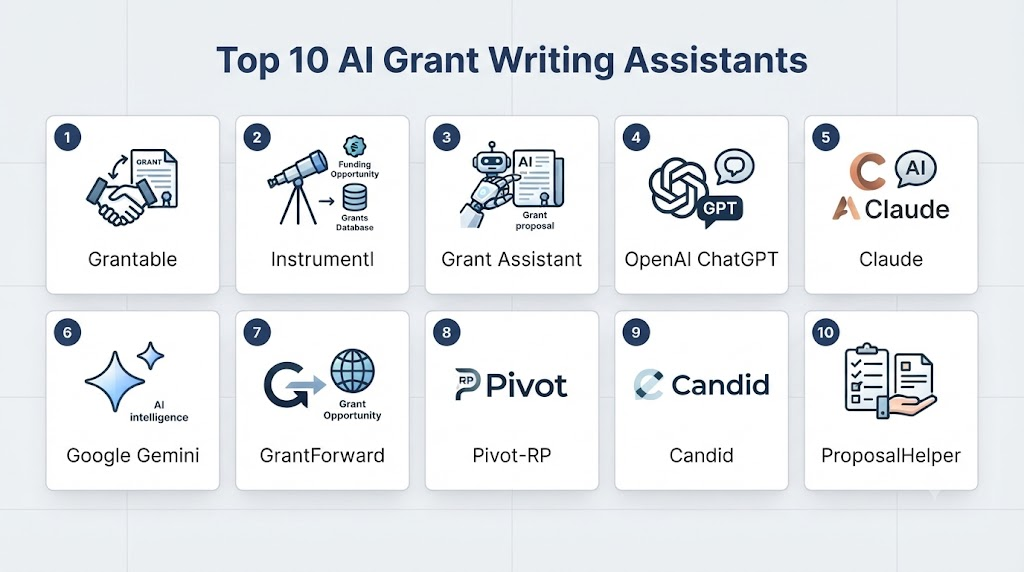
Top 10 AI Grant Writing Assistants
1. Instrumentl
One-line verdict: Best for nonprofits and grant teams combining funding discovery, opportunity matching, tracking, and AI-assisted grant research.
Short description:
Instrumentl is a grant-finding and grant-management platform focused on helping organizations discover relevant funding opportunities and manage their grant pipeline. Its workflow is particularly useful for nonprofits that need more than a standalone AI writing assistant.
Standout Capabilities
- Grant opportunity discovery
- AI-assisted grant matching
- Funding research
- Grant tracking
- Deadline management
- Opportunity filtering
- Grant pipeline organization
- Team workflows
AI-Specific Depth
- Model support: Proprietary AI capabilities; model flexibility is Not publicly stated.
- RAG / knowledge integration: Platform grant data and organizational information can support contextual workflows.
- Evaluation: Public details about a dedicated AI evaluation framework are Not publicly stated.
- Guardrails: Platform-level controls vary by feature and account.
- Observability: AI-specific token, latency, and trace monitoring are Varies / N/A.
Pros
- Strong emphasis on grant discovery.
- Useful for building a repeatable grant pipeline.
- Combines opportunity research with grant-management workflows.
Cons
- More nonprofit-focused than general-purpose research funding.
- Organizations seeking sophisticated proposal composition may need complementary tools.
- Pricing depends on plan and organizational requirements.
Security & Compliance
Security, access controls, and data-handling practices should be evaluated against the organization’s requirements. Specific certifications are Not publicly stated here.
Deployment & Platforms
- Web
- Cloud-based
- Team-oriented workflows
Integrations & Ecosystem
Instrumentl is designed around the grant-search and grant-management workflow.
- Grant databases
- Opportunity matching
- Grant tracking
- Team collaboration
- Organizational information
- Reporting
Pricing Model
Subscription-based pricing. Exact pricing is Not publicly stated.
Best-Fit Scenarios
- Nonprofit grant teams
- Organizations managing multiple applications
- Teams prioritizing grant discovery and pipeline management
2. Grantable
One-line verdict: Best for nonprofits wanting AI assistance with grant research, proposal development, and reusable organizational content.
Short description:
Grantable is an AI-focused grant-writing platform designed to help organizations develop funding proposals and work with their existing organizational information. It is particularly relevant for teams that want to accelerate narrative development without starting every proposal from scratch.
Standout Capabilities
- AI-assisted grant writing
- Proposal drafting
- Grant research
- Reusable organizational content
- Proposal customization
- Content generation
- Grant workflow support
- Narrative improvement
AI-Specific Depth
- Model support: AI-powered hosted workflows; exact underlying model options are Not publicly stated.
- RAG / knowledge integration: Supports working with organization-specific information.
- Evaluation: Dedicated public AI evaluation methodology is Not publicly stated.
- Guardrails: Workflow-level safeguards vary.
- Observability: Detailed model-level observability is Varies / N/A.
Pros
- Designed specifically for grant writing.
- Can reduce repetitive proposal drafting.
- Useful for maintaining reusable organizational information.
Cons
- Grant-writing focus may not cover every grant-management requirement.
- AI-generated content still requires substantial review.
- Advanced enterprise controls should be verified before deployment.
Security & Compliance
Security and data-handling details should be reviewed according to the organization’s requirements. Specific certifications are Not publicly stated.
Deployment & Platforms
- Web
- Cloud-based
Integrations & Ecosystem
- Organizational content
- Grant proposals
- Grant research
- Writing workflows
- Team collaboration
Pricing Model
Subscription-based. Exact pricing is Not publicly stated.
Best-Fit Scenarios
- Nonprofit development teams
- Small grant-writing teams
- Organizations creating multiple proposals
3. Grant Assistant
One-line verdict: Best for organizations seeking AI-assisted proposal development built around grant-specific writing workflows and organizational content.
Short description:
Grant Assistant is designed to support grant writers and organizations with proposal creation, content development, and related grant-writing tasks. Its grant-specific positioning makes it different from generic AI writing platforms.
Standout Capabilities
- Grant proposal drafting
- AI-assisted writing
- Proposal customization
- Organizational knowledge reuse
- Grant-specific content generation
- Editing and rewriting
- Proposal workflow support
AI-Specific Depth
- Model support: Hosted AI; specific model flexibility is Not publicly stated.
- RAG / knowledge integration: Organization-specific content can support proposal generation.
- Evaluation: Not publicly stated.
- Guardrails: Grant-writing workflow controls; detailed AI safety architecture is Not publicly stated.
- Observability: Varies / N/A.
Pros
- Purpose-built for grant writers.
- Can accelerate repetitive writing tasks.
- Useful for teams maintaining organizational context.
Cons
- Human editing remains necessary.
- Advanced grant-management features may require additional systems.
- AI model transparency is limited publicly.
Security & Compliance
Specific certifications and detailed security architecture are Not publicly stated.
Deployment & Platforms
- Web
- Cloud
Integrations & Ecosystem
- Grant documents
- Organizational information
- Proposal content
- Writing workflows
- Collaboration
Pricing Model
Commercial subscription. Exact pricing is Not publicly stated.
Best-Fit Scenarios
- Professional grant writers
- Nonprofit development departments
- Recurring proposal production
4. Grantboost
One-line verdict: Best for organizations wanting AI-assisted grant writing, proposal refinement, and support during application development.
Short description:
Grantboost focuses on using AI to support grant proposal creation and improvement. It can help users transform project information into more structured grant narratives while reducing repetitive drafting work.
Standout Capabilities
- AI grant writing
- Proposal improvement
- Grant-specific drafting
- Content generation
- Application assistance
- Proposal editing
- Structured writing workflows
AI-Specific Depth
- Model support: Hosted AI; exact model architecture is Not publicly stated.
- RAG / knowledge integration: Depends on supported document and organizational inputs.
- Evaluation: Not publicly stated.
- Guardrails: Detailed prompt-injection and AI safety controls are Not publicly stated.
- Observability: Varies / N/A.
Pros
- Focused specifically on grant writing.
- Can accelerate early-stage proposal creation.
- Useful for teams with limited writing capacity.
Cons
- Generated text requires factual review.
- May not replace specialized grant-management software.
- Enterprise governance details should be evaluated.
Security & Compliance
Specific certifications and detailed enterprise security controls are Not publicly stated.
Deployment & Platforms
- Web
- Cloud-based
Integrations & Ecosystem
- Proposal content
- Grant application workflows
- AI writing
- Document-based workflows
Pricing Model
Subscription or usage-based options may vary. Exact pricing is Not publicly stated.
Best-Fit Scenarios
- Small nonprofits
- First-time grant writers
- Teams needing faster proposal drafting
5. ChatGPT
One-line verdict: Best for flexible grant drafting, brainstorming, editing, research synthesis, and custom grant-development workflows.
Short description:
ChatGPT is a general-purpose AI assistant rather than a dedicated grant-management system, but it can support many grant-writing tasks when provided with funding announcements, project details, organizational information, evaluation criteria, and approved source material.
Standout Capabilities
- Grant proposal drafting
- Brainstorming
- Proposal restructuring
- Executive-summary creation
- Editing and rewriting
- Research synthesis
- Evaluation-plan development
- Custom grant workflows
AI-Specific Depth
- Model support: Multiple model configurations depending on account and product availability.
- RAG / knowledge integration: Can work with user-provided documents and connected sources where supported.
- Evaluation: Users can create custom evaluation prompts and review workflows; built-in grant-specific evaluation is Not publicly stated.
- Guardrails: Platform-level safety controls are present, but users remain responsible for grant-specific validation.
- Observability: Product-level usage information varies; detailed application-specific token observability is Varies / N/A.
Pros
- Highly flexible.
- Useful across nearly every stage of proposal development.
- Can be adapted to organization-specific workflows.
Cons
- Not a dedicated grant database.
- Requires careful prompting and source validation.
- Grant-specific compliance workflows may need to be built by the user.
Security & Compliance
Security and administrative capabilities vary by product and plan. Organizations should select an appropriate business configuration when handling sensitive information.
Deployment & Platforms
- Web
- Desktop
- Mobile
- Cloud
Integrations & Ecosystem
- Document workflows
- Research
- Custom GPT-style workflows where available
- APIs and developer workflows where applicable
- File analysis
- External tools and connectors where supported
Pricing Model
Subscription and usage-based options vary by product and plan.
Best-Fit Scenarios
- Researchers
- Startups
- Flexible internal grant-writing workflows
6. Claude
One-line verdict: Best for long-form proposal drafting, document analysis, rewriting, and maintaining coherent narrative structure across complex applications.
Short description:
Claude is a general-purpose AI assistant that can be used for grant writing, proposal review, document analysis, brainstorming, and long-form editing. Its usefulness comes from flexible document-oriented workflows rather than a dedicated grant database.
Standout Capabilities
- Long-form writing
- Proposal drafting
- Document analysis
- Editing
- Summarization
- Grant requirement interpretation
- Structured brainstorming
- Proposal critique
AI-Specific Depth
- Model support: Multiple proprietary model options depending on product availability.
- RAG / knowledge integration: Can work with provided documents and supported integrations.
- Evaluation: Custom user-created evaluation workflows are possible; grant-specific evaluation is Not publicly stated.
- Guardrails: Platform-level safety mechanisms are available.
- Observability: Detailed end-user AI tracing varies by product and deployment.
Pros
- Strong long-form writing workflows.
- Useful for analyzing large grant documents.
- Flexible proposal-development assistant.
Cons
- Not a dedicated funding-opportunity database.
- Requires user-created grant workflows.
- AI-generated content needs factual validation.
Security & Compliance
Security and administrative capabilities depend on the product and plan. Organizations should verify requirements before handling confidential proposal information.
Deployment & Platforms
- Web
- Desktop
- Cloud
Integrations & Ecosystem
- Documents
- Research
- Enterprise workflows
- APIs where supported
- Knowledge workflows
Pricing Model
Subscription and API-based usage models vary.
Best-Fit Scenarios
- University researchers
- Long-form proposal teams
- Organizations with custom AI workflows
7. GrantForward
One-line verdict: Best for researchers and institutions needing structured funding-opportunity discovery across academic and research-oriented grant programs.
Short description:
GrantForward is a funding-opportunity discovery platform focused heavily on research funding. It can help researchers and institutions identify potentially relevant opportunities and organize funding searches.
Standout Capabilities
- Funding opportunity search
- Research grant discovery
- Personalized opportunity matching
- Funding alerts
- Researcher profiles
- Opportunity filtering
- Institutional research workflows
AI-Specific Depth
- Model support: AI-assisted matching capabilities may be used; exact model details are Not publicly stated.
- RAG / knowledge integration: Funding databases and researcher information provide contextual matching.
- Evaluation: Not publicly stated.
- Guardrails: Platform controls vary.
- Observability: Varies / N/A.
Pros
- Strong research-funding orientation.
- Useful for academic institutions.
- Helps reduce manual opportunity discovery.
Cons
- More focused on funding discovery than complete AI proposal generation.
- Proposal-writing capabilities may require complementary tools.
- Institutional pricing and capabilities vary.
Security & Compliance
Specific certifications and detailed AI security architecture are Not publicly stated.
Deployment & Platforms
- Web
- Cloud
Integrations & Ecosystem
- Funding databases
- Researcher profiles
- Institutional workflows
- Alerts
- Opportunity management
Pricing Model
Institutional and subscription-based models. Exact pricing is Not publicly stated.
Best-Fit Scenarios
- Universities
- Research institutions
- Academic grant offices
8. Pivot-RP
One-line verdict: Best for universities and research organizations managing funding discovery, researcher profiles, and institutional grant-development workflows.
Short description:
Pivot-RP is a research-funding discovery and collaboration platform used by academic and research organizations. It helps researchers discover funding opportunities and potential collaborators while supporting institutional research-development workflows.
Standout Capabilities
- Funding opportunity discovery
- Researcher profiles
- Funding alerts
- Opportunity matching
- Collaboration discovery
- Institutional research workflows
- Funding intelligence
AI-Specific Depth
- Model support: AI-assisted matching and discovery capabilities vary.
- RAG / knowledge integration: Researcher profiles and funding information provide contextual data.
- Evaluation: Not publicly stated.
- Guardrails: Enterprise controls vary by implementation.
- Observability: Varies / N/A.
Pros
- Strong institutional research focus.
- Useful for funding discovery.
- Supports researcher collaboration.
Cons
- Not primarily a generative grant-writing assistant.
- Institutional implementation may be required.
- Less suitable for standalone proposal drafting.
Security & Compliance
Security and compliance details vary by institutional deployment. Specific certifications should be verified before procurement.
Deployment & Platforms
- Cloud
- Web
- Institutional environments
Integrations & Ecosystem
- Researcher profiles
- Funding databases
- Institutional research systems
- Alerts
- Collaboration workflows
Pricing Model
Institutional subscription. Exact pricing is Not publicly stated.
Best-Fit Scenarios
- Universities
- Research administration
- Large research organizations
9. GrantWatch
One-line verdict: Best for organizations needing broad grant-opportunity discovery and a centralized starting point for funding research.
Short description:
GrantWatch is primarily a grant-opportunity discovery service rather than a complete generative AI grant-writing environment. It can complement AI writing tools by providing funding opportunities that teams can evaluate and then use as the basis for proposal development.
Standout Capabilities
- Grant opportunity discovery
- Funding database
- Opportunity filtering
- Deadline research
- Category-based search
- Geographic filtering
- Funding alerts
AI-Specific Depth
- Model support: Dedicated AI model details are Not publicly stated.
- RAG / knowledge integration: Primarily grant-database driven.
- Evaluation: N/A for a dedicated generative AI evaluation framework.
- Guardrails: Varies / N/A.
- Observability: Varies / N/A.
Pros
- Useful funding discovery resource.
- Simple starting point for grant research.
- Can complement dedicated AI writing tools.
Cons
- Not primarily an AI proposal-writing platform.
- Requires additional tools for advanced proposal generation.
- AI-specific functionality is less central.
Security & Compliance
Specific enterprise certifications are Not publicly stated.
Deployment & Platforms
- Web
- Cloud
Integrations & Ecosystem
- Grant database
- Opportunity search
- Alerts
- Funding research
- External writing workflows
Pricing Model
Subscription-based access varies by offering.
Best-Fit Scenarios
- Small nonprofits
- Grant researchers
- Organizations building a funding pipeline
10. GrantScape
One-line verdict: Best for organizations exploring grant discovery and structured funding research as part of a broader AI-assisted proposal workflow.
Short description:
GrantScape-style grant intelligence workflows can help organizations identify funding opportunities and organize grant research. It is best considered as part of a broader grant-development stack rather than a universal replacement for proposal-management software.
Standout Capabilities
- Grant discovery
- Funding research
- Opportunity filtering
- Grant categorization
- Funding monitoring
- Research organization
- Opportunity comparison
AI-Specific Depth
- Model support: Varies / N/A.
- RAG / knowledge integration: Funding information can serve as the core knowledge layer.
- Evaluation: Not publicly stated.
- Guardrails: Varies / N/A.
- Observability: Varies / N/A.
Pros
- Useful for structured funding research.
- Can complement AI writing assistants.
- Helps organize funding opportunities.
Cons
- Not necessarily a full proposal-generation environment.
- AI-specific capabilities require validation.
- Advanced enterprise workflow capabilities may vary.
Security & Compliance
Specific certifications and enterprise security details are Not publicly stated.
Deployment & Platforms
- Web
- Cloud
- Exact deployment options vary
Integrations & Ecosystem
- Grant databases
- Funding research
- Opportunity tracking
- Proposal workflows
- External AI tools
Pricing Model
Exact pricing is Not publicly stated.
Best-Fit Scenarios
- Funding researchers
- Small organizations
- Teams building grant discovery workflows
Comparison Table
| Tool Name | Best For | Deployment | Model Flexibility | Strength | Watch-Out | Public Rating |
|---|---|---|---|---|---|---|
| Instrumentl | Nonprofit grant discovery and management | Cloud | Hosted / Varies | Opportunity matching | Less writing-centric | N/A |
| Grantable | AI-assisted nonprofit grant writing | Cloud | Hosted | Grant-focused drafting | Requires human review | N/A |
| Grant Assistant | Grant proposal development | Cloud | Hosted / Varies | Grant-specific writing | Limited public model details | N/A |
| Grantboost | AI-assisted proposal writing | Cloud | Hosted | Faster drafting | Verify governance | N/A |
| ChatGPT | Flexible grant workflows | Cloud/Web/Mobile | Multi-model | Broad flexibility | Not grant-specific | N/A |
| Claude | Long-form proposal development | Cloud/Web/Desktop | Multi-model | Document reasoning | No native grant database | N/A |
| GrantForward | Academic funding discovery | Cloud | Hosted / Varies | Research funding discovery | Writing requires complementary tools | N/A |
| Pivot-RP | Institutional research funding | Cloud | Hosted / Varies | Research workflows | Institutional focus | N/A |
| GrantWatch | Grant opportunity research | Web/Cloud | N/A | Funding discovery | Limited AI writing | N/A |
| GrantScape | Grant discovery workflows | Cloud/Web | Varies | Structured funding research | Capabilities vary | N/A |
Scoring & Evaluation
The scoring below is a comparative editorial framework rather than an official vendor ranking.
Scores consider how effectively each product supports AI-assisted grant development, opportunity discovery, reliability, safety, integrations, usability, performance, security, and support.
| Tool | Core | Reliability/Eval | Guardrails | Integrations | Ease | Perf/Cost | Security/Admin | Support | Weighted Total |
|---|---|---|---|---|---|---|---|---|---|
| Instrumentl | 9.0 | 8.5 | 8.5 | 9.0 | 9.0 | 8.5 | 8.5 | 9.0 | 8.8 |
| Grantable | 8.5 | 8.0 | 8.0 | 7.5 | 9.0 | 8.5 | 8.0 | 8.0 | 8.2 |
| Grant Assistant | 8.5 | 8.0 | 8.0 | 7.5 | 8.5 | 8.0 | 8.0 | 8.0 | 8.1 |
| Grantboost | 8.0 | 7.5 | 7.5 | 7.0 | 9.0 | 8.5 | 7.5 | 7.5 | 7.9 |
| ChatGPT | 9.0 | 8.5 | 8.5 | 9.5 | 9.0 | 8.5 | 9.0 | 9.0 | 8.9 |
| Claude | 8.5 | 8.5 | 8.5 | 8.5 | 9.0 | 8.5 | 8.5 | 8.5 | 8.6 |
| GrantForward | 8.5 | 8.0 | 8.0 | 8.0 | 8.5 | 8.0 | 8.5 | 8.5 | 8.2 |
| Pivot-RP | 8.5 | 8.0 | 8.0 | 8.5 | 8.0 | 8.0 | 8.5 | 8.5 | 8.2 |
| GrantWatch | 7.5 | 7.0 | 7.0 | 7.0 | 8.5 | 8.5 | 7.5 | 7.5 | 7.5 |
| GrantScape | 7.5 | 7.0 | 7.0 | 7.0 | 8.0 | 8.0 | 7.0 | 7.0 | 7.4 |
Top 3 for Enterprise
- ChatGPT
- Instrumentl
- Claude
Top 3 for SMB
- Instrumentl
- Grantable
- Grant Assistant
Top 3 for Developers
- ChatGPT
- Claude
- Grantable
Which AI Grant Writing Assistant Is Right for You?
Solo / Freelancer
Independent grant writers should prioritize flexibility, document handling, and low operational complexity.
A general-purpose AI assistant can be highly effective when combined with a structured process:
- Upload the funding announcement.
- Extract every requirement.
- Create a compliance checklist.
- Build the proposal outline.
- Draft each section.
- Validate every factual claim.
- Perform a final human review.
ChatGPT or Claude can be particularly useful for this workflow, while a grant-discovery platform can provide the funding pipeline.
SMB
Small organizations should avoid buying several overlapping platforms.
Prioritize:
- Opportunity discovery
- Grant matching
- Proposal drafting
- Reusable organization information
- Collaboration
- Deadline tracking
Instrumentl, Grantable, and Grant Assistant are reasonable categories to evaluate depending on whether discovery or writing is the primary problem.
Mid-Market
Mid-market organizations should build a repeatable grant-development process.
The AI system should have access to approved organizational information such as:
- Mission
- Programs
- Impact metrics
- Staff biographies
- Previous awards
- Standard project descriptions
- Evaluation methods
- Organizational statistics
This creates consistency across applications while reducing repetitive writing.
Enterprise
Large organizations should treat AI grant writing as an enterprise knowledge-management problem rather than simply a writing problem.
Important requirements include:
- Secure document handling
- Access controls
- Centralized knowledge
- Proposal versioning
- Auditability
- AI evaluation
- Human approval
- Workflow integration
- Data retention policies
- Organizational templates
- Multiple funding teams
General-purpose AI systems can be combined with dedicated grant-management platforms to create a more complete architecture.
Regulated Industries
Healthcare, public-sector, research, education, and other regulated organizations should be particularly careful about the information provided to AI systems.
Before deployment, establish:
- Data classification
- Retention rules
- User permissions
- Approval workflows
- Source verification
- AI-generated-content labeling
- Human review requirements
Never allow AI to fabricate research results, statistics, citations, partnerships, outcomes, or organizational achievements.
Budget vs Premium
Budget-conscious organizations should determine whether their primary challenge is finding grants or writing them.
If finding funding is the problem, a grant-discovery platform may deliver more value.
If proposal writing is the bottleneck, a general-purpose AI assistant or specialized grant-writing tool may be more useful.
Premium systems become more attractive when organizations need:
- Multiple users
- Grant pipelines
- Institutional research
- Collaboration
- Centralized organizational knowledge
- Advanced administration
- Continuous funding monitoring
Build vs Buy
Build when:
- Your organization already has an AI platform.
- You need highly customized grant workflows.
- You have proprietary proposal archives.
- You require custom evaluation criteria.
- You have internal engineering resources.
Buy when:
- You need a grant database.
- You want fast deployment.
- You lack AI engineering resources.
- You need specialized funding discovery.
- You want an established grant workflow.
A hybrid approach is often the most practical: use specialized software for funding discovery and a controlled AI environment for proposal development.
Implementation Playbook
First 30 Days: Pilot + Success Metrics
Choose a small set of real funding opportunities.
Measure:
- Time required to analyze each funding announcement
- Time required to create an outline
- Drafting time
- Revision cycles
- Requirement coverage
- Factual accuracy
- Reviewer satisfaction
Create a benchmark proposal and compare AI-assisted and traditional workflows.
Build a grant-specific evaluation checklist covering:
- Eligibility
- Deadline
- Required sections
- Page limits
- Evaluation criteria
- Budget requirements
- Supporting documents
Days 31–60: Security + Evaluation
Establish controlled AI workflows.
Implement:
- Approved knowledge sources
- Document access permissions
- Prompt/version control
- Proposal version history
- Human review
- Factual verification
- Citation checking
- Red-team testing
- Data-retention rules
Test the AI against intentionally difficult cases, including incomplete information and contradictory documents.
Days 61–90: Optimization + Governance
Expand to additional teams and grant programs.
Create reusable workflows for:
- Opportunity analysis
- Proposal drafting
- Executive summaries
- Project descriptions
- Impact statements
- Evaluation plans
- Budget narratives
- Reviewer-response preparation
Monitor:
- AI usage
- Cost
- Latency
- Proposal quality
- Human editing time
- Error rates
- Funding opportunities discovered
- Submission volume
Establish governance rules defining which content requires mandatory human approval.
Common Mistakes & How to Avoid Them
- Letting AI write the entire proposal without direction: Use structured prompts and section-specific requirements.
- Ignoring the funding announcement: Ground every proposal section in the actual requirements.
- Allowing fabricated statistics: Require source verification.
- Using outdated organizational information: Maintain a current knowledge base.
- Ignoring data privacy: Do not upload confidential information into uncontrolled AI systems.
- Failing to evaluate AI output: Compare AI-generated content against expert-reviewed examples.
- Overusing generic language: Provide project-specific evidence and measurable outcomes.
- Ignoring reviewer criteria: Make evaluation requirements explicit in the drafting workflow.
- Failing to check eligibility: AI should assist with interpretation, not make unsupported eligibility decisions.
- Submitting AI-generated content without review: Every final application should receive human approval.
- Ignoring prompt injection: Treat uploaded funding documents as untrusted content.
- Creating inconsistent proposals: Use approved organizational facts and reusable knowledge.
- Failing to track versions: Maintain a clear record of revisions and final approved content.
- Ignoring cost growth: Long documents and repeated revisions can increase AI usage.
- Choosing a platform solely because it generates fluent prose: Accuracy and requirement coverage matter more than writing style.
- Assuming AI improves funding success automatically: Measure actual proposal outcomes rather than relying on anecdotal productivity gains.
- Using one model for every task: Different models may perform better for analysis, drafting, summarization, or review.
- Failing to preserve human voice: Strong proposals should sound authentic to the organization and project team.
- Ignoring compliance requirements: Missing a small application requirement can invalidate otherwise strong work.
FAQs
What is an AI grant writing assistant?
It is an AI-powered system that helps with tasks such as grant discovery, requirement analysis, proposal outlining, drafting, editing, and application review.
Can AI write an entire grant proposal?
Yes, technically it can generate a complete draft, but that does not mean it should be submitted without review. Human experts should verify facts, strategy, eligibility, evidence, and compliance.
Can AI find grants for my organization?
Some specialized platforms focus on funding discovery and matching. General-purpose AI tools can assist with research but should not be assumed to have complete or current funding databases.
Can AI analyze a funding announcement?
Yes. AI can extract deadlines, eligibility requirements, questions, page limits, evaluation criteria, required attachments, and other important instructions from a funding announcement.
Can I use previous proposals with AI?
Yes, provided the platform and organizational policy permit it. Previous proposals can help establish organizational context, but outdated or inaccurate content should be removed before reuse.
Can AI improve grant proposal quality?
AI can improve clarity, structure, consistency, and drafting efficiency. It cannot guarantee that a proposal will receive funding.
Does AI replace professional grant writers?
Usually not. AI is better viewed as an accelerator that handles repetitive research and drafting while experienced grant professionals provide strategy, judgment, evidence, and final review.
Can AI help nonprofits with grants?
Yes. Nonprofits can use AI for opportunity research, proposal drafting, impact statements, project descriptions, editing, and application checklists.
Can researchers use AI for academic grants?
Yes. Researchers can use AI to analyze calls for proposals, structure research narratives, summarize supporting material, and improve proposal clarity. Research claims and technical content require careful validation.
Can AI analyze grant requirements automatically?
Many AI workflows can extract and organize requirements from funding documents. The results should still be checked against the original announcement.
Can I use my own AI model?
This depends on the platform. General-purpose AI APIs and custom systems provide more flexibility, while specialized grant platforms may use their own hosted AI architecture.
Are AI grant writing assistants secure?
Security varies significantly between providers. Organizations should evaluate encryption, access control, retention, data usage, administrative controls, and contractual terms before uploading confidential information.
Can grant proposals be self-hosted with AI?
Yes, if an organization builds or deploys an AI system using models and infrastructure that support self-hosting. Dedicated grant platforms may have different deployment options.
How can I prevent AI hallucinations in grant writing?
Provide authoritative source material, require source-grounded drafting, separate known facts from assumptions, test outputs against a benchmark, and require human review before submission.
Can AI create grant budgets?
AI can help structure budget narratives, categorize costs, and check consistency. Actual financial figures should come from approved organizational budgets and be reviewed by qualified staff.
Can AI write impact statements?
Yes. AI can help structure impact narratives around measurable outcomes, beneficiaries, evaluation methods, and evidence. It should not invent outcomes or unsupported claims.
How much do AI grant writing tools cost?
Pricing varies by platform, number of users, features, grant databases, usage limits, and enterprise requirements. Exact pricing should be confirmed directly with each provider.
What is the best AI grant writing assistant?
There is no universal winner. Instrumentl is particularly useful for funding discovery and grant management, specialized grant-writing platforms are useful for proposal workflows, and general-purpose systems such as ChatGPT and Claude provide greater flexibility for customized drafting and document analysis.
Should small nonprofits use a dedicated grant platform?
It depends on their workflow. If grant discovery and deadline management are major problems, a dedicated platform can be valuable. If writing is the primary bottleneck, an AI writing assistant may provide greater immediate value.
Can AI help with grant compliance?
AI can create requirement checklists and identify potential omissions. It should not be treated as the final authority on legal, regulatory, or funding-agency requirements.
What is the biggest risk of AI grant writing?
The biggest practical risks include fabricated information, inaccurate interpretation of requirements, privacy problems, generic writing, and submitting unverified AI-generated content.
How should organizations evaluate an AI grant writing assistant?
Test it using real funding announcements and previous proposals. Measure requirement coverage, factual accuracy, drafting time, editing effort, privacy controls, cost, and user satisfaction.
Conclusion
AI Grant Writing Assistants can significantly reduce the repetitive work involved in finding funding opportunities, understanding grant requirements, organizing proposal content, drafting narratives, and reviewing applications. The most effective approach is not to treat AI as an autonomous grant writer, but as a controlled assistant embedded within a well-defined funding workflow.For organizations focused heavily on grant discovery and pipeline management, Instrumentl and research-funding platforms can be valuable. For specialized proposal development, grant-focused AI writing tools can accelerate narrative creation and reuse organizational knowledge. For teams that need maximum flexibility, ChatGPT and Claude can support customized workflows across research, drafting, analysis, editing, and review.The best implementation combines AI speed with human judgment. A strong workflow should ground AI in authoritative documents, maintain an approved organizational knowledge base, evaluate outputs against real grant requirements, protect confidential information, and require human approval before submission.