Introduction
AI Patent Landscape Analysis Tools use artificial intelligence, machine learning, natural-language processing, semantic search, citation analysis, and data visualization to help organizations understand large collections of patent information. Instead of reviewing thousands of patent documents manually, IP professionals and R&D teams can use these platforms to identify technology trends, competitors, patent clusters, emerging inventions, whitespace opportunities, and potentially important intellectual-property risks.
Modern patent landscape analysis goes far beyond counting patent filings. A strong platform can help determine who is investing in a technology, which technical approaches are becoming crowded, how patent families relate to one another, where competitors are expanding, and which areas may offer opportunities for innovation.
Common use cases include:
- Technology landscape mapping
- Competitor patent monitoring
- Prior-art discovery
- Patent portfolio benchmarking
- White-space analysis
- Technology scouting
- M&A and licensing research
- R&D strategy
- Patent valuation
- Freedom-to-operate research
- Emerging technology monitoring
- Competitive intelligence
Best for: Corporate IP teams, patent attorneys, R&D departments, technology scouts, innovation managers, universities, investors, licensing teams, and organizations operating in patent-intensive industries such as pharmaceuticals, semiconductors, telecommunications, automotive, chemicals, biotechnology, and artificial intelligence.
Not ideal for: Individuals who only need occasional basic patent searches, very small organizations with minimal IP activity, or teams that only need access to raw patent documents. In those situations, simpler patent databases or public search services may be sufficient.
When evaluating an AI patent landscape platform, buyers should consider patent coverage, family normalization, semantic search, AI classification, citation analysis, visualization, legal-status information, competitive monitoring, data freshness, multilingual capabilities, portfolio analytics, AI explainability, security, integrations, export options, and total cost of ownership.
What’s Changed in AI Patent Landscape Analysis
- Natural-language patent search is becoming mainstream: Users can increasingly describe a technology concept rather than constructing complex Boolean queries.
- Semantic similarity is improving discovery: AI can identify patents discussing similar technical concepts even when they use different terminology.
- AI-assisted patent classification is reducing manual categorization: Large patent collections can be grouped by technology, application, company, or technical theme.
- Generative AI is entering patent workflows: AI assistants can summarize claims, explain technical disclosures, compare documents, and answer questions about patent collections.
- Patent landscapes are becoming more dynamic: Instead of creating one static report, teams can monitor technology areas continuously.
- Citation networks are becoming more useful: AI-assisted analysis can help identify influential patents and technological relationships.
- Company normalization is increasingly important: Acquisitions, subsidiaries, name changes, and corporate relationships can otherwise distort competitive analysis.
- Multimodal analysis is expanding: Some systems increasingly support patent text, drawings, figures, and other visual information.
- AI agents are changing research workflows: Emerging systems can combine search, filtering, classification, summarization, and analysis into multi-step workflows.
- Explainability matters more: AI-generated conclusions should be traceable to patent records and underlying evidence.
- Human validation remains essential: AI can accelerate patent analysis, but legal conclusions and high-stakes IP decisions still require qualified professionals.
- Privacy and governance are becoming strategic requirements: Confidential invention information and internal research data require careful handling when AI systems are involved.
- Integration is becoming more important: Patent intelligence increasingly connects with scientific literature, market intelligence, company data, R&D systems, and competitive-intelligence workflows.
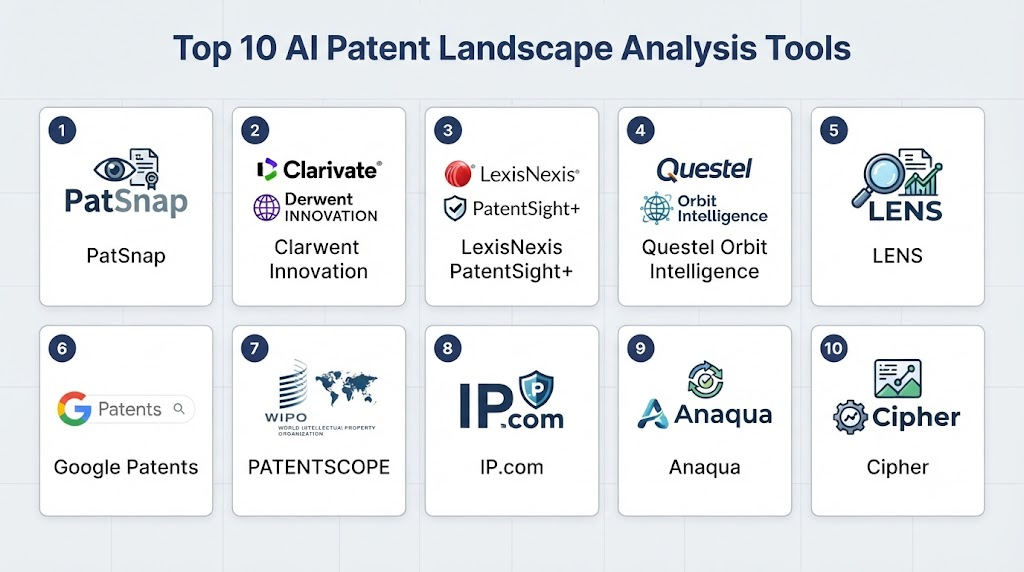
Top 10 AI Patent Landscape Analysis Tools
1. PatSnap
One-line verdict: Best for organizations combining AI-powered patent analysis, technology intelligence, R&D strategy, and competitive landscape research.
Short description:
PatSnap provides a broad patent intelligence and innovation analytics environment designed for IP, R&D, innovation, and competitive-intelligence teams. Its platform combines patent search, analytics, monitoring, visualization, and AI-assisted research capabilities.
Standout Capabilities
- AI-assisted patent search
- Natural-language research workflows
- Patent landscape visualization
- Technology trend analysis
- Patent family analysis
- Competitive intelligence
- Patent monitoring
- Integration of patent and scientific information
- Portfolio analytics
- AI-assisted patent interpretation
AI-Specific Depth
- Model support: Proprietary AI capabilities; model flexibility varies by product.
- RAG / knowledge integration: Strong integration with patent and scientific information.
- Evaluation: Specific customer-facing AI evaluation methodology is Not publicly stated.
- Guardrails: Enterprise access and governance controls vary by configuration.
- Observability: AI-specific token and model-level observability is Varies / N/A.
Pros
- Broad AI-powered patent intelligence capabilities.
- Strong fit for R&D and innovation teams.
- Useful visualization and technology landscape functionality.
Cons
- Enterprise-oriented platform can be complex.
- Pricing can be substantial for smaller teams.
- Some advanced capabilities require specific product configurations.
Security & Compliance
Enterprise security, authentication, access management, and data controls vary by deployment and contract. Specific certifications should be verified for the intended configuration.
Deployment & Platforms
- Cloud
- Enterprise environments
- Private or on-premises options may be available depending on configuration
Integrations & Ecosystem
PatSnap is designed as a broader innovation intelligence environment rather than simply a patent search database.
- Patent databases
- Scientific literature
- R&D workflows
- APIs
- Analytics
- Monitoring
- Collaboration workflows
Pricing Model
Enterprise and subscription-based pricing. Exact pricing is Not publicly stated.
Best-Fit Scenarios
- Corporate IP departments
- Technology scouting
- R&D strategy and competitive intelligence
2. Questel Orbit Intelligence
One-line verdict: Best for IP professionals requiring advanced patent search, landscape analysis, competitive intelligence, and patent-family research.
Short description:
Orbit Intelligence is a patent intelligence platform used for patent search, analytics, competitive intelligence, technology landscaping, and portfolio research. It is particularly useful for professional IP analysts who need detailed patent-family and technology analysis.
Standout Capabilities
- Semantic patent search
- Patent family analysis
- Technology landscaping
- Citation analysis
- Competitive intelligence
- Patent monitoring
- Portfolio analysis
- Visualization
- Patent classification
- Professional search workflows
AI-Specific Depth
- Model support: AI capabilities are integrated into the platform; broader model flexibility is Varies / N/A.
- RAG / knowledge integration: Patent and non-patent information can support contextual analysis.
- Evaluation: Dedicated customer-facing AI evaluation information is Not publicly stated.
- Guardrails: Enterprise access and administrative controls vary.
- Observability: AI token and inference metrics are Varies / N/A.
Pros
- Strong professional patent research environment.
- Good patent-family and landscape functionality.
- Suitable for complex competitive-intelligence projects.
Cons
- Can have a significant learning curve.
- Professional features may be excessive for casual users.
- Enterprise licensing can be difficult for very small teams.
Security & Compliance
Security and compliance controls depend on the specific service configuration. Certifications should be verified during procurement.
Deployment & Platforms
- Cloud
- Web-based
- Enterprise deployment
Integrations & Ecosystem
Orbit supports professional IP workflows and can connect patent intelligence with broader research activities.
- Patent databases
- Scientific information
- APIs
- Analytics
- Portfolio workflows
- Monitoring
- Reporting
Pricing Model
Enterprise and modular subscription pricing. Exact pricing is Not publicly stated.
Best-Fit Scenarios
- Patent law firms
- Corporate IP departments
- Professional patent landscape analysts
3. Derwent Innovation
One-line verdict: Best for professional patent researchers prioritizing curated patent information, advanced analytics, and high-quality landscape research.
Short description:
Derwent Innovation is a patent intelligence platform associated with Clarivate’s intellectual-property information ecosystem. It is designed for professional patent searching, technology analysis, portfolio benchmarking, competitive intelligence, and landscape work.
Standout Capabilities
- Curated patent information
- Advanced patent search
- Patent family analysis
- Citation analysis
- Technology landscaping
- Competitive intelligence
- Patent portfolio analysis
- Patent strength analysis
- Custom classification
- Patent visualization
AI-Specific Depth
- Model support: AI and machine-learning functionality is integrated into selected workflows.
- RAG / knowledge integration: Patent, citation, litigation, and related information can support analysis.
- Evaluation: Public details on a complete AI evaluation framework are Not publicly stated.
- Guardrails: Enterprise security and access controls vary.
- Observability: AI-specific tracing and token metrics are Varies / N/A.
Pros
- Strong professional patent-data environment.
- Useful for strategic patent portfolio analysis.
- Strong analytical and visualization capabilities.
Cons
- Primarily designed for professional users.
- Can require specialist training.
- Enterprise licensing may be expensive for smaller organizations.
Security & Compliance
Enterprise security, access control, audit, and compliance capabilities vary by product and contract. Certifications should be verified directly before procurement.
Deployment & Platforms
- Cloud
- Web-based
- Enterprise environments
Integrations & Ecosystem
The ecosystem supports professional patent intelligence and strategic IP analysis.
- Patent databases
- Scientific information
- Litigation information
- Analytics
- APIs
- Portfolio analysis
- Reporting
Pricing Model
Enterprise licensing. Exact pricing is Not publicly stated.
Best-Fit Scenarios
- Patent research organizations
- Corporate IP strategy
- Complex technology landscapes
4. LexisNexis PatentSight+
One-line verdict: Best for strategic patent portfolio benchmarking, competitive intelligence, and evaluating patent quality at company and technology levels.
Short description:
PatentSight+ focuses heavily on strategic patent analytics, portfolio benchmarking, patent quality, competitive intelligence, and technology positioning. It is particularly relevant when the objective is understanding the strength and strategic importance of patent portfolios rather than simply finding individual documents.
Standout Capabilities
- Patent portfolio benchmarking
- Patent quality analysis
- Technology comparisons
- Competitive intelligence
- Patent valuation indicators
- Portfolio visualization
- Technology trend analysis
- Company benchmarking
- Strategic IP analysis
AI-Specific Depth
- Model support: AI and analytical models are integrated into selected workflows.
- RAG / knowledge integration: Patent and company-level information supports strategic analysis.
- Evaluation: Specific generative-AI evaluation information is Not publicly stated.
- Guardrails: Enterprise access controls vary by configuration.
- Observability: AI-specific observability is Varies / N/A.
Pros
- Strong strategic portfolio perspective.
- Useful for benchmarking competitors.
- Particularly valuable for IP strategy and management.
Cons
- More strategy-oriented than basic patent search.
- Requires understanding of patent analytics metrics.
- Pricing is typically enterprise-oriented.
Security & Compliance
Enterprise security and administrative controls vary by deployment and contract. Certifications should be verified before purchase.
Deployment & Platforms
- Cloud
- Web
- Enterprise environments
Integrations & Ecosystem
PatentSight+ can support strategic IP analysis across organizations and technology areas.
- Patent data
- Company information
- Portfolio analytics
- Competitive intelligence
- Reporting
- Enterprise workflows
Pricing Model
Enterprise subscription. Exact pricing is Not publicly stated.
Best-Fit Scenarios
- IP strategy teams
- Corporate competitive intelligence
- Portfolio benchmarking
5. The Lens
One-line verdict: Best for researchers, universities, and organizations seeking broad patent and scholarly information with accessible analytical capabilities.
Short description:
The Lens is a widely used patent and scholarly research platform that combines intellectual-property information with research literature. It can be particularly useful for organizations that need to investigate relationships between scientific research and patent activity.
Standout Capabilities
- Patent searching
- Scholarly literature search
- Patent family information
- Citation analysis
- Patent collections
- Research-to-patent connections
- Technology exploration
- Patent analytics
- Open-access research functionality
AI-Specific Depth
- Model support: AI-specific model choices are Varies / N/A.
- RAG / knowledge integration: Patent and scholarly datasets provide broad research context.
- Evaluation: Varies / N/A.
- Guardrails: Account and platform controls vary.
- Observability: AI-specific observability is Varies / N/A.
Pros
- Useful combination of patents and scholarly literature.
- Accessible to researchers.
- Valuable for technology discovery.
Cons
- Advanced enterprise AI workflows may be more limited than commercial platforms.
- Some professional landscape requirements require additional analysis.
- Specialized IP workflows may need external tools.
Security & Compliance
Security and administrative capabilities vary by service and usage model. Specific certifications are Not publicly stated here.
Deployment & Platforms
- Web
- Cloud-accessible research environment
Integrations & Ecosystem
- Patent databases
- Scholarly literature
- Research collections
- Data analysis
- Export capabilities
- Research workflows
Pricing Model
Some functionality is accessible without enterprise licensing, while advanced capabilities vary.
Best-Fit Scenarios
- Universities
- Scientific researchers
- Budget-conscious patent research teams
6. MaxVal Relecura
One-line verdict: Best for patent analysts needing AI-assisted technology classification, landscape analytics, and competitive intelligence workflows.
Short description:
Relecura is designed for patent analytics and competitive intelligence, with emphasis on technology classification, patent landscaping, and analysis of large patent datasets.
Standout Capabilities
- AI-assisted patent classification
- Technology landscaping
- Patent analytics
- Competitive intelligence
- Patent clustering
- Technology tracking
- Portfolio analysis
- Patent monitoring
AI-Specific Depth
- Model support: Proprietary AI capabilities; exact model flexibility is Varies / N/A.
- RAG / knowledge integration: Patent collections provide the primary knowledge base.
- Evaluation: Specific evaluation framework is Not publicly stated.
- Guardrails: Access controls vary.
- Observability: AI-specific token and latency monitoring is Varies / N/A.
Pros
- Strong emphasis on AI-assisted classification.
- Useful for technology landscape projects.
- Can reduce manual patent categorization effort.
Cons
- Less universally recognized than the largest enterprise platforms.
- Feature depth varies by use case.
- Pricing information is not generally standardized publicly.
Security & Compliance
Security and compliance details depend on the service arrangement. Certifications should be verified directly.
Deployment & Platforms
- Cloud
- Enterprise environments
- Deployment details vary
Integrations & Ecosystem
- Patent data
- Classification workflows
- Competitive intelligence
- Analytics
- APIs
- Reporting
Pricing Model
Paid and enterprise-oriented models. Exact pricing is Not publicly stated.
Best-Fit Scenarios
- Patent analysts
- Technology scouting
- Competitive intelligence teams
7. PatSeer
One-line verdict: Best for patent professionals seeking integrated search, analytics, landscape creation, monitoring, and portfolio research capabilities.
Short description:
PatSeer combines patent search and analytics with landscape, monitoring, and portfolio-analysis capabilities. It is designed for IP professionals who need to move from document discovery into structured technology analysis.
Standout Capabilities
- Patent search
- Patent family analysis
- Patent analytics
- Landscape generation
- Citation analysis
- Portfolio analysis
- Patent monitoring
- Technology clustering
AI-Specific Depth
- Model support: AI capabilities vary by workflow.
- RAG / knowledge integration: Patent databases provide the primary information layer.
- Evaluation: Varies / N/A.
- Guardrails: User and administrative controls vary.
- Observability: AI-specific metrics are Varies / N/A.
Pros
- Integrated patent search and analysis.
- Useful for landscape studies.
- Suitable for professional IP teams.
Cons
- May require training for advanced workflows.
- AI capabilities are not the sole focus of the platform.
- Enterprise requirements should be assessed carefully.
Security & Compliance
Security controls and compliance features vary according to deployment and contract. Specific certifications should be verified.
Deployment & Platforms
- Cloud
- Web
- Enterprise environments
Integrations & Ecosystem
- Patent databases
- Search
- Analytics
- Monitoring
- Reporting
- APIs
- Portfolio workflows
Pricing Model
Commercial subscription and enterprise licensing. Exact pricing is Not publicly stated.
Best-Fit Scenarios
- Patent analysts
- IP departments
- Competitive landscape research
8. IPRally
One-line verdict: Best for AI-native patent discovery where semantic and machine-learning approaches can accelerate prior-art and technology research.
Short description:
IPRally focuses on AI-assisted patent search and discovery. Its approach is particularly relevant for researchers who want to move beyond traditional keyword-based searching and discover technically similar patent documents.
Standout Capabilities
- AI-assisted patent search
- Semantic similarity
- Machine-learning-based discovery
- Patent relevance ranking
- Prior-art research
- Technology exploration
- Patent document analysis
AI-Specific Depth
- Model support: Proprietary AI and machine-learning approaches.
- RAG / knowledge integration: Patent documents form the core knowledge base.
- Evaluation: Specific public evaluation methodology is Not publicly stated.
- Guardrails: Platform access controls vary.
- Observability: AI-specific tracing and token metrics are Varies / N/A.
Pros
- AI-first search philosophy.
- Useful for discovering technically related patents.
- Can complement conventional keyword searching.
Cons
- Primarily focused on search rather than complete IP lifecycle management.
- Users still need professional validation.
- Advanced landscape reporting requirements may require additional tools.
Security & Compliance
Security and compliance capabilities vary by configuration. Specific certifications should be verified before procurement.
Deployment & Platforms
- Cloud
- Web-based
- Enterprise use
Integrations & Ecosystem
- Patent search
- AI discovery
- Patent analysis
- Research workflows
- Export and integration capabilities
Pricing Model
Commercial subscription. Exact pricing is Not publicly stated.
Best-Fit Scenarios
- Prior-art researchers
- Patent attorneys
- AI-assisted patent discovery
9. Anaqua AcclaimIP
One-line verdict: Best for IP teams wanting patent analytics and competitive intelligence alongside broader intellectual-property management workflows.
Short description:
AcclaimIP provides patent search, analytics, competitive intelligence, and portfolio research capabilities. It can be particularly useful for teams wanting patent analysis to connect with broader IP management activities.
Standout Capabilities
- Patent search
- Patent analytics
- Portfolio analysis
- Competitive intelligence
- Patent landscape research
- Patent monitoring
- Visualization
- IP workflow integration
AI-Specific Depth
- Model support: AI capabilities vary by product and workflow.
- RAG / knowledge integration: Patent and IP information can support contextual analysis.
- Evaluation: Varies / N/A.
- Guardrails: Enterprise permissions and administration vary.
- Observability: AI-specific observability is Varies / N/A.
Pros
- Good combination of analytics and IP management.
- Useful for corporate IP teams.
- Supports broader portfolio workflows.
Cons
- AI-specific capabilities vary.
- Some advanced workflows require enterprise configuration.
- May be broader than a simple landscape-analysis requirement.
Security & Compliance
Security, access management, and compliance controls vary by deployment and contract. Certifications should be verified.
Deployment & Platforms
- Cloud
- Web
- Enterprise environments
Integrations & Ecosystem
- Patent management
- Patent analytics
- Portfolio workflows
- Competitive intelligence
- APIs
- Reporting
Pricing Model
Commercial and enterprise licensing. Exact pricing is Not publicly stated.
Best-Fit Scenarios
- Corporate IP teams
- Patent portfolio management
- Competitive intelligence
10. Google Patents
One-line verdict: Best for researchers and technical teams needing broad patent discovery without immediately committing to an enterprise patent analytics platform.
Short description:
Google Patents provides broad access to patent documents and search capabilities. It is particularly useful for initial research, technology discovery, prior-art exploration, and teams that want to combine patent data with their own analytics workflows.
Standout Capabilities
- Patent document search
- Full-text search
- Patent family exploration
- Citation navigation
- Classification-based discovery
- Technical keyword research
- Global patent information
- Data-oriented research workflows
AI-Specific Depth
- Model support: No dedicated proprietary patent-analysis model should be assumed.
- RAG / knowledge integration: External workflows can combine patent information with AI systems.
- Evaluation: Varies / N/A.
- Guardrails: Depends heavily on the external AI architecture used.
- Observability: Depends on the external analytics or AI stack.
Pros
- Accessible for initial patent research.
- Useful for technical teams.
- Can serve as a data source for custom analytics workflows.
Cons
- Not a complete enterprise patent landscape platform.
- Advanced visualization requires additional tooling.
- AI-assisted analysis depends heavily on the workflow built around the data.
Security & Compliance
Security depends on the Google service and any external AI or analytics environment used. Specific enterprise requirements should be assessed separately.
Deployment & Platforms
- Web
- Cloud-based research environment
- Custom analytics workflows
Integrations & Ecosystem
- Patent research
- Data analysis
- Big-data workflows
- APIs or datasets where available
- External AI systems
- Business intelligence tools
Pricing Model
Basic patent searching is generally accessible without enterprise licensing. Advanced data and analytics workflows can introduce separate infrastructure costs.
Best-Fit Scenarios
- Early-stage patent research
- Universities and researchers
- Developers building custom patent analytics
Comparison Table
| Tool Name | Best For | Deployment | Model Flexibility | Strength | Watch-Out | Public Rating |
|---|---|---|---|---|---|---|
| PatSnap | AI-powered IP and R&D intelligence | Cloud/Enterprise | Proprietary AI / Varies | Integrated innovation intelligence | Enterprise complexity | N/A |
| Orbit Intelligence | Professional patent landscaping | Cloud | Hosted / Varies | Search and landscape depth | Learning curve | N/A |
| Derwent Innovation | Professional patent research | Cloud | Hosted / Varies | Curated patent intelligence | Enterprise-oriented | N/A |
| PatentSight+ | Portfolio benchmarking | Cloud | Analytical models / Varies | Strategic portfolio analytics | Less search-centric | N/A |
| The Lens | Research and patent discovery | Web/Cloud | Varies | Patent + scholarly research | Fewer enterprise workflows | N/A |
| Relecura | AI-assisted classification | Cloud | Proprietary AI | Technology classification | Smaller ecosystem | N/A |
| PatSeer | Patent analytics | Cloud | Varies | Integrated landscape workflows | Requires training | N/A |
| IPRally | AI-native patent discovery | Cloud | Proprietary AI | Semantic discovery | More search-focused | N/A |
| AcclaimIP | IP analytics and management | Cloud | Varies | IP workflow integration | Broader platform | N/A |
| Google Patents | Accessible patent research | Web/Cloud | External AI possible | Easy discovery | Limited native analytics | N/A |
Scoring & Evaluation
The following scoring is a comparative editorial assessment rather than an official vendor score.
The scores consider how well each platform fits AI-assisted patent landscape analysis, including core patent capabilities, AI reliability, safety controls, integrations, usability, performance, security, and support.
Scores should be treated as a starting point rather than a substitute for testing with your own patent datasets.
| Tool | Core | Reliability/Eval | Guardrails | Integrations | Ease | Perf/Cost | Security/Admin | Support | Weighted Total |
|---|---|---|---|---|---|---|---|---|---|
| PatSnap | 9.5 | 9.0 | 8.5 | 9.5 | 8.5 | 8.0 | 9.0 | 9.0 | 8.9 |
| Orbit Intelligence | 9.5 | 8.5 | 8.5 | 9.0 | 7.5 | 8.0 | 9.0 | 9.0 | 8.6 |
| Derwent Innovation | 9.5 | 9.0 | 8.5 | 9.0 | 7.5 | 7.5 | 9.0 | 9.5 | 8.7 |
| PatentSight+ | 9.0 | 8.5 | 8.5 | 8.5 | 8.0 | 7.5 | 9.0 | 9.0 | 8.5 |
| The Lens | 8.0 | 7.5 | 7.5 | 8.5 | 9.0 | 9.5 | 7.5 | 8.0 | 8.2 |
| Relecura | 8.5 | 8.5 | 8.0 | 8.0 | 8.0 | 8.0 | 8.0 | 8.0 | 8.2 |
| PatSeer | 8.5 | 8.0 | 8.0 | 8.5 | 8.0 | 8.0 | 8.0 | 8.0 | 8.2 |
| IPRally | 8.5 | 9.0 | 8.0 | 7.5 | 8.5 | 8.0 | 8.0 | 8.0 | 8.3 |
| AcclaimIP | 8.5 | 7.5 | 8.5 | 9.0 | 8.0 | 7.5 | 9.0 | 9.0 | 8.3 |
| Google Patents | 7.5 | 7.0 | 7.0 | 8.0 | 9.5 | 9.5 | 7.5 | 8.0 | 8.0 |
Top 3 for Enterprise
- PatSnap
- Derwent Innovation
- Orbit Intelligence
Top 3 for SMB
- The Lens
- PatSeer
- AcclaimIP
Top 3 for Developers
- Google Patents
- The Lens
- IPRally
Which AI Patent Landscape Analysis Tool Is Right for You?
Solo / Freelancer
Independent patent researchers usually do not need a large enterprise intelligence platform.
Start with accessible research environments and focus on:
- Patent discovery
- Semantic search
- Citation exploration
- Family analysis
- Technology classification
- Exportable data
Google Patents and The Lens can be practical starting points, while IPRally can be considered when AI-assisted semantic discovery is especially important.
SMB
Small and medium-sized businesses should prioritize ease of deployment and analytical value.
A suitable platform should provide:
- Patent search
- Competitor monitoring
- Landscape visualization
- Technology clustering
- Patent-family analysis
- Export capabilities
The Lens, PatSeer, AcclaimIP, and Relecura can be considered depending on the organization’s requirements.
Mid-Market
Mid-market organizations should focus on integration and repeatability.
Instead of producing one-off patent reports, create continuous workflows for:
- Competitor monitoring
- New filing alerts
- Technology trend analysis
- Portfolio benchmarking
- White-space discovery
At this stage, commercial platforms can provide significant productivity benefits over manually assembled spreadsheets.
Enterprise
Enterprise organizations should evaluate the entire IP intelligence architecture.
Important requirements include:
- Global coverage
- Family normalization
- Legal-status information
- Company normalization
- AI-assisted classification
- Portfolio analytics
- Competitive intelligence
- API access
- Role-based access
- Auditability
- Data governance
- Integration with existing IP systems
PatSnap, Orbit Intelligence, and Derwent Innovation are strong candidates for this type of environment.
Regulated Industries
Pharmaceuticals, healthcare, telecommunications, aerospace, semiconductors, chemicals, and other patent-intensive industries should place additional emphasis on data quality and traceability.
AI-generated patent conclusions should never automatically be treated as legal opinions.
The system should allow professionals to trace conclusions back to:
- Patent documents
- Claims
- Family relationships
- Citations
- Legal-status information
- Filing jurisdictions
- Relevant technical disclosures
Budget vs Premium
Budget-conscious organizations should first determine whether they need a complete patent intelligence platform or simply better patent discovery.
For basic research, public and lower-cost tools may be sufficient.
Premium platforms become more valuable when the organization needs:
- Large-scale portfolio analysis
- Automated technology classification
- Competitor monitoring
- Advanced visualizations
- Legal and corporate data
- Professional analyst workflows
- Enterprise administration
Build vs Buy
Build when:
- You have a dedicated data science team.
- You need specialized technology taxonomies.
- Patent data must be combined with proprietary R&D information.
- You need custom scoring models.
- You already operate an internal AI platform.
Buy when:
- Patent coverage is a major requirement.
- You need normalized patent families.
- You require reliable professional search.
- Your team needs ready-made landscape analytics.
- Maintaining patent datasets would be expensive.
A hybrid model can often be effective: purchase high-quality patent data and build custom AI analytics around it.
Implementation Playbook
First 30 Days: Pilot + Success Metrics
Select one technology domain and one competitive landscape project.
Define questions such as:
- Who are the leading patent holders?
- Which companies are entering the technology?
- Which technical areas are crowded?
- Where are the apparent white spaces?
- Which patents are heavily cited?
- Which organizations are filing aggressively?
- Which jurisdictions are strategically important?
Create a benchmark dataset containing manually validated patent records.
Measure:
- Search precision
- Search recall
- Classification accuracy
- Duplicate-family detection
- Summary accuracy
- Analyst time saved
- False-positive rate
Days 31–60: Security + Evaluation
Introduce formal evaluation procedures.
Test AI outputs for:
- Incorrect patent summaries
- Incorrect assignee identification
- Confused patent families
- Misinterpreted claims
- Incorrect technology classifications
- Unsupported conclusions
- Missing important documents
Create an AI evaluation harness with representative patent questions.
Also implement:
- Access controls
- SSO where required
- Data-retention policies
- Prompt/version control
- Human review
- Audit logging
- Red-team testing
Days 61–90: Optimization + Governance
Expand the pilot to additional technologies and competitors.
Create standardized workflows for:
- Technology landscape reports
- Competitor monitoring
- Patent portfolio reviews
- White-space analysis
- R&D opportunity analysis
- Licensing research
Track:
- Search latency
- AI usage
- Analyst productivity
- False positives
- Data quality
- Cost
- User adoption
- Model performance
Establish governance rules specifying when AI output requires mandatory expert review.
Common Mistakes & How to Avoid Them
- Treating AI search as a replacement for professional patent searching: Use AI to accelerate discovery, not eliminate expert validation.
- Trusting AI-generated claim interpretations without verification: Always review the original claim language.
- Using only keywords: Combine Boolean, classification, citation, and semantic approaches.
- Ignoring patent families: Family duplication can dramatically distort landscape results.
- Ignoring corporate ownership changes: Subsidiaries and acquisitions can make competitor portfolios appear fragmented.
- Using outdated patent data: Patent landscapes can change rapidly.
- Ignoring legal status: A technically relevant patent may have very different strategic importance depending on status.
- Confusing patent counts with patent strength: More patents do not automatically mean stronger IP.
- Failing to validate AI classifications: Automated classifications can contain false positives and false negatives.
- Ignoring citation networks: Important technological relationships may not be obvious from keywords.
- Overlooking non-patent literature: Scientific publications can provide important context.
- Ignoring multilingual documents: Important prior art may exist outside English-language collections.
- Failing to preserve evidence: AI conclusions should be traceable to source documents.
- Ignoring prompt injection risks: Uploaded or retrieved content should not be allowed to manipulate system behavior.
- Sending confidential invention information to uncontrolled AI systems: Establish data governance before using generative AI.
- No evaluation benchmark: Test AI performance using real patent questions.
- Ignoring cost scaling: Large patent collections can create significant AI processing requirements.
- Building overly complicated dashboards: Analysts need actionable insights, not visual complexity.
- Assuming one model is best for every task: Search, classification, summarization, and reasoning can require different approaches.
- Automating legal decisions: Patent analytics should support qualified professionals rather than independently make legal conclusions.
FAQs
What is AI patent landscape analysis?
AI patent landscape analysis uses machine learning, semantic search, NLP, analytics, and sometimes generative AI to analyze large patent collections and identify technology trends, competitors, patent clusters, and potential opportunities.
What is the difference between patent search and patent landscape analysis?
Patent search focuses primarily on finding relevant documents. Patent landscape analysis goes further by organizing and interpreting a collection of patents to understand technology areas, competitors, trends, relationships, and opportunities.
Can AI replace a patent analyst?
No. AI can automate repetitive discovery and analysis tasks, but expert review remains important for interpreting claims, legal status, relevance, and strategic implications.
Can these tools identify white-space opportunities?
Yes. Landscape platforms can help visualize areas with relatively lower patent activity. However, an apparent white space does not automatically mean an invention is patentable or free from IP risk.
Can AI analyze patent claims?
AI can assist with claim analysis and comparison, but important conclusions should be verified against the original patent claims and supporting legal information.
Can these platforms analyze competitors?
Yes. Many patent intelligence platforms support competitor portfolio analysis, filing trends, technology comparisons, monitoring, and benchmarking.
Can AI identify emerging technologies?
AI can help identify growing filing activity, new technical clusters, citation patterns, and changes in patent activity. Analysts should validate whether the observed increase represents a meaningful technological trend.
Can patent landscape tools analyze multiple countries?
Many commercial platforms provide international patent coverage, but the exact jurisdictions and data depth vary. Buyers should verify coverage for the countries relevant to their business.
What is semantic patent search?
Semantic search attempts to find patents based on technical meaning rather than exact keyword matches. This can help discover documents that use different terminology to describe similar inventions.
What is patent family analysis?
Patent family analysis groups related filings associated with the same underlying invention. This helps prevent multiple jurisdictional filings from being incorrectly counted as completely separate inventions.
Can AI analyze patent citations?
Yes. Citation networks can be analyzed to identify influential patents, technological relationships, and potential development paths.
Is patent landscape analysis useful for R&D?
Yes. R&D teams can use landscapes to understand existing technology, identify crowded areas, discover competitors, and find potential opportunities for differentiated research.
Is patent landscape analysis the same as a freedom-to-operate analysis?
No. A patent landscape provides strategic information about technology and patent activity. A formal freedom-to-operate analysis is a more specific legal assessment and generally requires qualified IP professionals.
Can these tools analyze patent drawings?
Some platforms increasingly support visual or multimodal analysis, but capabilities vary considerably. Buyers working with engineering drawings should test representative patent figures before purchasing.
Can I use my own AI model?
Model flexibility varies. Some platforms primarily provide proprietary AI capabilities, while custom architectures can use patent data as an input to externally managed AI systems.
Can patent data be used with RAG?
Yes. Patent records can be indexed and retrieved as a knowledge source for RAG systems. Strong access controls, data quality, source attribution, and evaluation are essential.
Can these tools be self-hosted?
Deployment options vary by vendor. Some enterprise platforms may offer private or controlled deployment options, while others are primarily cloud-based.
How should AI patent analysis be evaluated?
Use real patent research questions and compare AI results against expert-validated answers. Measure retrieval accuracy, relevance, classification quality, summary accuracy, source traceability, latency, and false-positive rates.
How much do AI patent landscape tools cost?
Pricing varies significantly by platform, number of users, data coverage, modules, jurisdictions, analytics requirements, and enterprise configuration. Exact pricing is often customized.
What is the best AI patent landscape tool?
There is no universal winner. PatSnap is particularly strong for integrated AI-powered innovation intelligence, Orbit Intelligence and Derwent Innovation are strong professional patent-analysis environments, PatentSight+ is highly relevant for strategic portfolio benchmarking, and The Lens is useful for accessible patent and scholarly research.
Are free patent tools enough for businesses?
They can be sufficient for early research and simple searches. Businesses conducting significant patent strategy, competitive intelligence, portfolio management, or FTO-related work may benefit from professional commercial platforms.
How can companies reduce AI hallucinations in patent analysis?
Use source-grounded retrieval, require evidence for important conclusions, evaluate models against validated patent questions, preserve citations to underlying records, and require human review for legal or strategic decisions.
Conclusion
AI Patent Landscape Analysis Tools are changing how organizations research technology, monitor competitors, evaluate patent portfolios, and identify innovation opportunities. The strongest platforms combine high-quality patent data with semantic search, AI classification, citation analysis, visualization, monitoring, and strategic analytics.For enterprise IP and R&D teams, PatSnap, Orbit Intelligence, and Derwent Innovation offer broad capabilities for professional patent intelligence. PatentSight+ is particularly useful for strategic portfolio benchmarking, while The Lens provides a valuable research-oriented option. Relecura, PatSeer, IPRally, and AcclaimIP address different combinations of AI-assisted search, landscape analysis, and IP workflows. Google Patents remains a practical starting point for accessible patent discovery and custom research workflows.The most important consideration is not simply which platform has the most AI features. The better question is whether the system can produce accurate, traceable, current, and strategically useful intelligence from the patent data that matters to your organizatio