Introduction
AI CFD acceleration toolkits combine computational fluid dynamics with machine learning to reduce simulation time, approximate expensive numerical calculations, improve design exploration, and support faster engineering decisions. Instead of replacing CFD completely, these tools often work alongside conventional solvers by learning surrogate models, accelerating repeated simulations, predicting flow fields, optimizing meshes or designs, or approximating expensive portions of a simulation workflow.
AI acceleration is especially valuable when engineers need to run thousands of simulations for optimization, uncertainty analysis, digital twins, aerodynamic design, thermal management, or real-time decision support.
Best for: CFD engineers, aerospace teams, automotive manufacturers, energy companies, industrial engineering organizations, computational scientists, digital-twin teams, and researchers running large simulation campaigns.
Not ideal for: Small CFD projects where a conventional solver is already fast enough, highly unusual physics with insufficient training data, or safety-critical applications where an AI approximation has not been rigorously validated against trusted numerical methods.
When evaluating AI CFD acceleration tooling, focus on physics coverage, surrogate accuracy, solver compatibility, mesh handling, GPU acceleration, training cost, inference speed, scalability, uncertainty estimation, optimization capabilities, integration options, reproducibility, and validation against established CFD solvers.
What’s Changed in AI CFD Acceleration Toolkits
- Surrogate models are becoming central: Machine learning can approximate expensive CFD calculations after training on representative simulation data.
- Neural operators are increasingly relevant: They can learn mappings between input conditions and complete physical fields rather than producing only individual point predictions.
- Physics-informed learning is expanding: Models can incorporate physical constraints alongside simulation or experimental data.
- GPU-accelerated CFD is becoming more important: Modern engineering workflows increasingly combine accelerated numerical solvers with AI models.
- AI-assisted design exploration is growing: Engineers can evaluate many candidate geometries without running a complete high-fidelity simulation for every design.
- Reduced-order models remain valuable: AI can enhance traditional reduced-order modeling approaches for faster prediction.
- Digital twins are driving demand: Fast surrogate models can provide near-real-time estimates for systems where conventional CFD is too computationally expensive.
- Multiphysics workflows are becoming more sophisticated: Teams increasingly combine fluid, thermal, structural, chemical, and electromagnetic models.
- Uncertainty is receiving greater attention: Fast predictions are less useful when engineers cannot determine where a model is unreliable.
- Active learning can reduce training cost: New simulations can be selected strategically instead of generating enormous uniform datasets.
- AI and conventional solvers are increasingly hybridized: Rather than replacing CFD, machine learning can accelerate selected components of the workflow.
- Automation is expanding: AI can support geometry exploration, parameter selection, optimization, simulation prioritization, and result analysis.
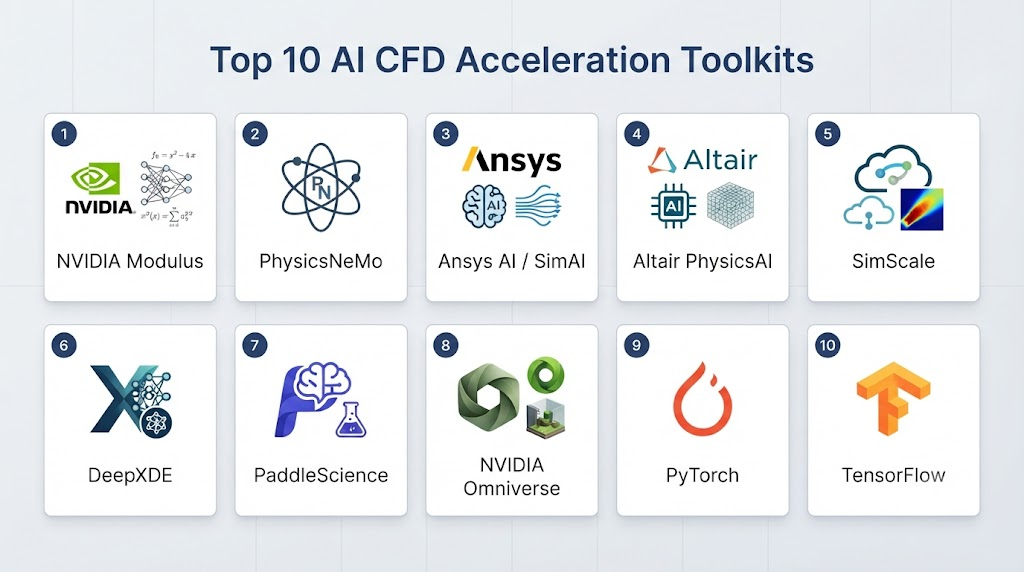
Top 10 AI CFD Acceleration Toolkits
1. NVIDIA PhysicsNeMo
One-line verdict: Best for enterprise scientific AI teams building GPU-accelerated CFD surrogates, neural operators, and physics-informed models.
Short description:
NVIDIA PhysicsNeMo is a scientific machine-learning framework focused on combining AI with physics and engineering simulations. It supports physics-informed learning, surrogate modeling, neural operators, and other approaches that can help accelerate computationally expensive engineering workflows.
Standout Capabilities
- Physics-informed neural networks.
- Neural operators.
- CFD surrogate modeling.
- Physics-ML workflows.
- GPU acceleration.
- Scientific deep learning.
- Engineering digital twins.
- Large-scale model training.
AI-Specific Depth
- Model support: Neural networks, PINNs, neural operators, and scientific AI architectures.
- RAG / knowledge integration: N/A.
- Evaluation: Physics-based validation and comparison against simulation data.
- Guardrails: Physical equations and domain constraints.
- Observability: Training and experiment metrics can be incorporated into scientific ML workflows.
Pros
- Strong focus on physics-based AI.
- Excellent fit for GPU-intensive workflows.
- Broad scientific ML capabilities.
Cons
- Requires significant technical expertise.
- Large workloads can require substantial GPU infrastructure.
- May be more complex than necessary for small CFD projects.
Security & Compliance
Security depends on deployment architecture. Specific certifications are Not publicly stated across all configurations.
Deployment & Platforms
- Linux.
- Cloud.
- Self-hosted.
- GPU infrastructure.
- HPC environments.
Integrations & Ecosystem
PhysicsNeMo can fit into Python and GPU-based scientific computing pipelines.
- PyTorch-based workflows.
- NVIDIA GPUs.
- CFD datasets.
- Simulation pipelines.
- HPC systems.
- Digital-twin workflows.
- Scientific computing environments.
Pricing Model
Varies by software and infrastructure configuration. Not publicly stated as a single universal pricing model.
Best-Fit Scenarios
- Enterprise CFD acceleration.
- Large-scale surrogate modeling.
- AI-powered digital twins.
2. NVIDIA Modulus
One-line verdict: Best for engineering organizations using physics-informed machine learning to accelerate simulation and CFD workflows.
Short description:
NVIDIA Modulus is a physics-ML framework designed for creating models that incorporate governing equations and engineering constraints. It can be used for surrogate modeling, PDE learning, digital twins, and other simulation-acceleration applications.
Standout Capabilities
- Physics-informed neural networks.
- Physics-constrained learning.
- Surrogate models.
- PDE learning.
- CFD-related workflows.
- GPU acceleration.
- Digital twins.
- Engineering AI.
AI-Specific Depth
- Model support: Physics-informed neural networks and other neural architectures.
- RAG / knowledge integration: N/A.
- Evaluation: Physics residuals and simulation comparisons.
- Guardrails: Governing equations and physical constraints.
- Observability: Training metrics and scientific validation workflows.
Pros
- Strong engineering orientation.
- GPU-friendly.
- Suitable for advanced scientific AI.
Cons
- Steep learning curve.
- Requires domain expertise.
- Infrastructure can become complex at scale.
Security & Compliance
Specific certifications are Not publicly stated for every deployment configuration.
Deployment & Platforms
- Linux.
- Cloud.
- Self-hosted.
- GPU/HPC systems.
Integrations & Ecosystem
- Python.
- PyTorch.
- NVIDIA GPU infrastructure.
- CFD datasets.
- Scientific computing.
- Digital twins.
- Engineering simulation.
Pricing Model
Varies according to deployment and associated infrastructure.
Best-Fit Scenarios
- Physics-informed CFD.
- Engineering digital twins.
- Scientific surrogate models.
3. PyTorch
One-line verdict: Best for developers building customized CFD surrogate models, neural operators, and physics-aware deep-learning pipelines.
Short description:
PyTorch is not a dedicated CFD acceleration platform, but its automatic differentiation, GPU support, flexible architectures, and extensive ecosystem make it a powerful foundation for AI-based CFD acceleration.
Standout Capabilities
- Neural CFD models.
- Surrogate modeling.
- Neural operators.
- Automatic differentiation.
- GPU acceleration.
- Custom loss functions.
- Distributed training.
- Research flexibility.
AI-Specific Depth
- Model support: Broad neural-network architectures and custom scientific models.
- RAG / knowledge integration: N/A.
- Evaluation: Fully customizable.
- Guardrails: Physics constraints can be incorporated into model losses.
- Observability: External experiment-tracking tools can be integrated.
Pros
- Extremely flexible.
- Large AI ecosystem.
- Strong GPU support.
Cons
- Requires significant development.
- No dedicated CFD workflow out of the box.
- Scientific validation is the user’s responsibility.
Security & Compliance
Specific certifications are Not publicly stated for the framework itself.
Deployment & Platforms
- Windows.
- macOS.
- Linux.
- Cloud.
- Self-hosted.
- HPC/GPU environments.
Integrations & Ecosystem
- Python.
- NumPy.
- SciPy.
- CUDA.
- Jupyter.
- ML experiment tools.
- Scientific computing libraries.
Pricing Model
Open-source.
Best-Fit Scenarios
- Custom CFD surrogates.
- Research projects.
- Neural-operator development.
4. JAX
One-line verdict: Best for high-performance research teams building differentiable CFD models and accelerator-optimized scientific AI systems.
Short description:
JAX provides automatic differentiation, compilation, vectorization, and accelerator-oriented numerical computing. It is useful for research teams implementing custom CFD surrogates, differentiable simulations, and physics-informed models.
Standout Capabilities
- Automatic differentiation.
- GPU acceleration.
- TPU acceleration.
- Just-in-time compilation.
- Vectorized computation.
- Differentiable simulation.
- Custom scientific models.
- High-performance numerical computing.
AI-Specific Depth
- Model support: Custom neural networks and differentiable scientific models.
- RAG / knowledge integration: N/A.
- Evaluation: Custom numerical and physics validation.
- Guardrails: Physical constraints can be incorporated into model objectives.
- Observability: Requires external experiment-management tooling.
Pros
- Excellent computational performance.
- Powerful differentiation capabilities.
- Strong fit for research.
Cons
- Requires advanced programming skills.
- Not a dedicated CFD platform.
- Significant custom development may be required.
Security & Compliance
Specific certifications are Not publicly stated.
Deployment & Platforms
- Linux.
- macOS.
- Cloud.
- GPU.
- TPU.
- Self-hosted.
Integrations & Ecosystem
- Python.
- NumPy-compatible workflows.
- Scientific computing.
- Neural-network libraries.
- Accelerator infrastructure.
- Optimization tools.
Pricing Model
Open-source.
Best-Fit Scenarios
- Differentiable CFD.
- High-performance surrogates.
- Advanced scientific ML research.
5. DeepXDE
One-line verdict: Best for researchers using physics-informed learning to approximate CFD-related PDEs and fluid-flow systems.
Short description:
DeepXDE is an open-source scientific ML library focused on physics-informed learning and differential equations. It can be used to develop PINN-based models for fluid and other physical systems.
Standout Capabilities
- PINNs.
- PDE solving.
- Boundary conditions.
- Initial conditions.
- Inverse problems.
- Physics-informed regression.
- Scientific experimentation.
- Custom physics losses.
AI-Specific Depth
- Model support: Neural networks for physics-informed learning.
- RAG / knowledge integration: N/A.
- Evaluation: PDE residuals and numerical validation.
- Guardrails: Governing equations and physical constraints.
- Observability: Training metrics and external experiment tracking.
Pros
- Open-source.
- Focused on physics-informed workflows.
- Useful for academic CFD research.
Cons
- Requires scientific ML knowledge.
- Not a complete CFD solver.
- Complex industrial workflows require additional tooling.
Security & Compliance
Specific certifications are Not publicly stated.
Deployment & Platforms
- Windows.
- macOS.
- Linux.
- Cloud.
- Self-hosted.
Integrations & Ecosystem
- Python.
- TensorFlow.
- PyTorch.
- Jupyter.
- Scientific datasets.
- Numerical computing tools.
Pricing Model
Open-source.
Best-Fit Scenarios
- CFD-related PDE research.
- PINN experimentation.
- Academic fluid dynamics projects.
6. TensorFlow
One-line verdict: Best for organizations building production-oriented CFD AI models on a mature general-purpose machine-learning platform.
Short description:
TensorFlow provides automatic differentiation, GPU support, distributed training, and model deployment capabilities that can be used to construct CFD surrogate and physics-informed models.
Standout Capabilities
- Automatic differentiation.
- GPU acceleration.
- Neural-network training.
- Custom physics losses.
- Distributed computing.
- Model deployment.
- Experiment visualization.
- Scientific ML implementations.
AI-Specific Depth
- Model support: Custom neural networks and scientific ML architectures.
- RAG / knowledge integration: N/A.
- Evaluation: Custom CFD and physics-based validation.
- Guardrails: Physics constraints through model architecture and losses.
- Observability: TensorBoard and external tooling.
Pros
- Mature ecosystem.
- Good deployment support.
- Strong accelerator capabilities.
Cons
- Requires custom CFD implementation.
- Not purpose-built for CFD.
- Scientific workflows may need additional libraries.
Security & Compliance
Specific certifications are Not publicly stated for the framework.
Deployment & Platforms
- Windows.
- macOS.
- Linux.
- Cloud.
- Self-hosted.
- Accelerator environments.
Integrations & Ecosystem
- Python.
- Keras.
- TensorBoard.
- GPU infrastructure.
- Scientific libraries.
- Deployment tools.
Pricing Model
Open-source.
Best-Fit Scenarios
- Production CFD AI.
- Custom surrogate models.
- Existing TensorFlow organizations.
7. NeuralPDE
One-line verdict: Best for Julia-based scientific teams combining differential equations, neural networks, and high-performance numerical computing.
Short description:
NeuralPDE is part of the Julia scientific machine-learning ecosystem. It provides neural approaches to differential equations and can support physics-informed modeling relevant to CFD research.
Standout Capabilities
- Physics-informed learning.
- Differential equations.
- Scientific ML.
- Automatic differentiation.
- Parameter estimation.
- Numerical optimization.
- Symbolic-numeric workflows.
- Julia ecosystem integration.
AI-Specific Depth
- Model support: Neural-network scientific models.
- RAG / knowledge integration: N/A.
- Evaluation: Differential-equation residuals and numerical validation.
- Guardrails: Physical equations and boundary conditions.
- Observability: Julia scientific-computing tools.
Pros
- Strong scientific computing ecosystem.
- Excellent Julia integration.
- Useful for sophisticated PDE research.
Cons
- Requires Julia knowledge.
- Smaller general ML ecosystem.
- May require additional CFD tooling.
Security & Compliance
Specific certifications are Not publicly stated.
Deployment & Platforms
- Windows.
- macOS.
- Linux.
- Cloud.
- Self-hosted.
Integrations & Ecosystem
- Julia.
- Differential-equation libraries.
- SciML ecosystem.
- Symbolic computing.
- Optimization.
- Scientific datasets.
Pricing Model
Open-source.
Best-Fit Scenarios
- Julia-based CFD research.
- PDE surrogate modeling.
- Scientific ML experimentation.
8. SimNet
One-line verdict: Best for teams evaluating physics-informed deep learning approaches within NVIDIA-oriented engineering simulation workflows.
Short description:
SimNet was designed for physics-informed deep learning and engineering simulation applications. Its approach is relevant to CFD surrogate modeling and physics-based machine learning, although newer NVIDIA scientific AI tooling has become more prominent.
Standout Capabilities
- Physics-informed learning.
- PDE modeling.
- CFD-related applications.
- Engineering simulation.
- GPU acceleration.
- Surrogate modeling.
- Physical constraints.
- Scientific ML.
AI-Specific Depth
- Model support: Physics-informed neural networks.
- RAG / knowledge integration: N/A.
- Evaluation: Physics residuals and simulation comparison.
- Guardrails: Physical equations and constraints.
- Observability: Training metrics and scientific validation.
Pros
- Engineering-focused.
- Physics-first approach.
- NVIDIA ecosystem compatibility.
Cons
- Tooling has evolved toward newer NVIDIA scientific AI offerings.
- May not be the first choice for a new project.
- Requires specialized expertise.
Security & Compliance
Specific certifications are Not publicly stated.
Deployment & Platforms
- Linux.
- GPU systems.
- Cloud.
- Self-hosted.
- HPC.
Integrations & Ecosystem
- NVIDIA GPUs.
- Python.
- Scientific computing.
- Engineering simulations.
- Physics datasets.
- AI workflows.
Pricing Model
Current commercial positioning varies. Not publicly stated.
Best-Fit Scenarios
- Existing physics-ML projects.
- Engineering research.
- Evaluation of NVIDIA scientific AI workflows.
9. OpenFOAM + AI/ML Toolchains
One-line verdict: Best for CFD teams wanting to preserve a trusted open-source solver while adding machine-learning acceleration and automation.
Short description:
OpenFOAM is a widely used open-source CFD framework that can serve as the numerical foundation for AI-accelerated workflows. Machine-learning models can be developed around simulation outputs for surrogate modeling, optimization, turbulence modeling, parameter exploration, and automated design.
Standout Capabilities
- Open-source CFD.
- Custom solver development.
- AI surrogate integration.
- Automated parameter studies.
- Optimization workflows.
- Turbulence-model research.
- HPC support.
- Custom engineering pipelines.
AI-Specific Depth
- Model support: Depends on the selected AI framework.
- RAG / knowledge integration: N/A.
- Evaluation: Direct comparison with CFD solver results.
- Guardrails: Numerical CFD solver can provide a high-fidelity reference.
- Observability: Depends on the surrounding ML infrastructure.
Pros
- Strong CFD foundation.
- Highly customizable.
- Useful as ground truth for AI models.
Cons
- AI acceleration requires additional development.
- Engineering expertise is necessary.
- End-to-end AI tooling is not unified.
Security & Compliance
Specific certifications are Not publicly stated.
Deployment & Platforms
- Linux.
- Windows.
- macOS.
- Cloud.
- Self-hosted.
- HPC.
Integrations & Ecosystem
- Python.
- C++.
- HPC.
- Machine-learning frameworks.
- Scientific computing.
- Optimization systems.
- Engineering pipelines.
Pricing Model
Open-source.
Best-Fit Scenarios
- AI-augmented CFD.
- Research environments.
- Custom surrogate development.
10. Custom Neural Operator and Surrogate Modeling Stacks
One-line verdict: Best for advanced engineering teams building specialized AI surrogates around their existing CFD solvers and datasets.
Short description:
Many organizations do not need a single commercial AI CFD platform. Instead, they build a custom stack around a CFD solver, machine-learning framework, numerical datasets, and model-serving infrastructure.
Standout Capabilities
- Custom CFD surrogates.
- Neural operators.
- Reduced-order modeling.
- Active learning.
- Automated simulation generation.
- Design optimization.
- Custom physics constraints.
- High-performance inference.
AI-Specific Depth
- Model support: Depends on the selected ML framework.
- RAG / knowledge integration: N/A.
- Evaluation: Fully customizable.
- Guardrails: Physics constraints and solver-based validation.
- Observability: Depends on selected infrastructure.
Pros
- Maximum flexibility.
- Can be optimized for specific physics.
- Strong control over data and deployment.
Cons
- High engineering cost.
- Requires ML and CFD expertise.
- Long-term maintenance becomes the organization’s responsibility.
Security & Compliance
Depends entirely on architecture and infrastructure. Specific certifications are Not publicly stated.
Deployment & Platforms
- Windows.
- Linux.
- macOS.
- Cloud.
- Self-hosted.
- HPC.
Integrations & Ecosystem
- CFD solvers.
- PyTorch.
- JAX.
- Python.
- HPC.
- Optimization software.
- Internal engineering systems.
Pricing Model
Typically open-source components plus infrastructure and engineering costs.
Best-Fit Scenarios
- Specialized enterprise CFD.
- Large simulation datasets.
- Proprietary engineering workflows.
Comparison Table
| Tool | Best For | Deployment | Model Flexibility | Strength | Watch-Out | Public Rating |
|---|---|---|---|---|---|---|
| NVIDIA PhysicsNeMo | Enterprise scientific AI | Cloud/Self-hosted/HPC | Multi-model/BYO | Physics AI | Complexity | N/A |
| NVIDIA Modulus | Physics-informed engineering | Cloud/Self-hosted/HPC | Multi-model/BYO | Physics constraints | Learning curve | N/A |
| PyTorch | Custom CFD AI | Cloud/Self-hosted | Open-source/BYO | Flexibility | Development effort | N/A |
| JAX | High-performance research | Cloud/Self-hosted | Open-source/BYO | Accelerator performance | Complexity | N/A |
| DeepXDE | PINN-based CFD | Self-hosted/Cloud | Open-source | PINN focus | Limited turnkey CFD | N/A |
| TensorFlow | Production ML | Cloud/Self-hosted | Open-source/BYO | Mature ecosystem | Custom implementation | N/A |
| NeuralPDE | Julia scientific ML | Self-hosted/Cloud | Open-source | PDE integration | Julia expertise | N/A |
| SimNet | Physics-ML research | Cloud/Self-hosted/HPC | Physics-ML | Engineering orientation | Evolving tooling | N/A |
| OpenFOAM + AI | Open CFD + AI | Self-hosted/HPC | Open-source/BYO | CFD foundation | AI requires integration | N/A |
| Custom AI CFD Stack | Specialized enterprise | Hybrid/Self-hosted | Multi-model/BYO | Maximum control | Engineering cost | N/A |
Scoring & Evaluation
The scores below are comparative estimates based on technical flexibility, physics capabilities, ecosystem maturity, customization, and suitability for AI-assisted CFD workflows. They are not official vendor scores and should be validated against the specific CFD problem.
A toolkit that scores highly overall may still be unsuitable for a particular turbulence model, geometry, Reynolds-number regime, multiphysics problem, or production requirement.
| Tool | Core | Reliability/Eval | Guardrails | Integrations | Ease | Perf/Cost | Security/Admin | Support | Weighted Total |
|---|---|---|---|---|---|---|---|---|---|
| NVIDIA PhysicsNeMo | 9.5 | 9.5 | 9.5 | 9.5 | 7 | 10 | 9 | 9 | 9.3 |
| NVIDIA Modulus | 9.5 | 9.5 | 9.5 | 9 | 7 | 9.5 | 9 | 9 | 9.2 |
| PyTorch | 9.5 | 9.5 | 9 | 10 | 8 | 9.5 | 8.5 | 10 | 9.3 |
| JAX | 9 | 9.5 | 9 | 9.5 | 7 | 10 | 8 | 9 | 9.0 |
| DeepXDE | 8.5 | 9 | 9.5 | 8.5 | 8.5 | 8.5 | 7.5 | 9 | 8.7 |
| TensorFlow | 9 | 9 | 9 | 9.5 | 8 | 9 | 8.5 | 9.5 | 8.9 |
| NeuralPDE | 8.5 | 9.5 | 9.5 | 9.5 | 7.5 | 9 | 8 | 9 | 8.8 |
| SimNet | 8.5 | 8.5 | 9.5 | 8.5 | 7 | 9 | 8.5 | 8.5 | 8.5 |
| OpenFOAM + AI | 9.5 | 10 | 9.5 | 10 | 6.5 | 9 | 8 | 10 | 9.2 |
| Custom AI CFD Stack | 10 | 10 | 10 | 10 | 5.5 | 9 | 8.5 | 8.5 | 9.0 |
Top 3 for Enterprise
- NVIDIA PhysicsNeMo
- NVIDIA Modulus
- OpenFOAM + AI Toolchains
Top 3 for SMB
- DeepXDE
- PyTorch
- TensorFlow
Top 3 for Developers
- PyTorch
- JAX
- OpenFOAM + AI Toolchains
Which AI CFD Acceleration Toolkit Is Right for You?
Solo / Freelancer
Start with an existing CFD solver and an accessible machine-learning framework.
A practical combination is:
CFD Solver → Dataset → PyTorch/JAX → Surrogate Model → Validation
This provides flexibility without requiring a large enterprise platform.
SMB
SMBs should focus on a narrow acceleration target.
Good initial targets include:
- Parameter sweeps.
- Geometry optimization.
- Flow-field prediction.
- Thermal prediction.
- Reduced-order models.
- Design-space exploration.
Avoid training large models before demonstrating measurable time savings.
Mid-Market
Mid-market teams should create reusable AI-CFD pipelines.
Prioritize:
- Automated data generation.
- Dataset management.
- Model validation.
- Experiment tracking.
- GPU training.
- Model serving.
- CFD-to-AI pipelines.
- Automated retraining.
The objective should be a repeatable engineering workflow rather than a single successful prototype.
Enterprise
Enterprise CFD organizations should consider AI acceleration as part of a broader engineering platform.
Important capabilities include:
- HPC integration.
- GPU infrastructure.
- CFD solver interoperability.
- Model governance.
- Dataset versioning.
- Uncertainty quantification.
- Digital-twin integration.
- Automated design optimization.
- Human engineering review.
- Production monitoring.
The strongest architecture is often hybrid rather than AI-only.
Regulated Industries
For aerospace, energy, automotive, healthcare devices, and critical infrastructure, AI predictions should be validated against trusted computational or experimental references.
Use:
- Independent validation datasets.
- Solver comparison.
- Physical conservation checks.
- Out-of-distribution detection.
- Uncertainty estimation.
- Model versioning.
- Approval workflows.
- Reproducible experiments.
Budget vs Premium
Open-source tooling can be highly capable, but software licensing is only one part of CFD AI cost.
Consider:
- GPU infrastructure.
- CFD simulation generation.
- Data storage.
- Engineering time.
- Model training.
- Monitoring.
- Validation.
- Maintenance.
A custom open-source stack may have low licensing costs but substantial engineering costs.
Build vs Buy
Build when:
- Your physics are highly specialized.
- You have proprietary CFD data.
- You need a custom neural operator.
- Existing commercial tools cannot represent your workflow.
- You have strong CFD and ML teams.
Choose an established toolkit when:
- You need faster implementation.
- You want GPU-ready scientific AI.
- You need existing examples.
- You want to minimize platform engineering.
Implementation Playbook
First 30 Days: Pilot + Success Metrics
Choose one CFD problem.
Establish:
- Baseline CFD runtime.
- Required prediction accuracy.
- Dataset size.
- Target inference time.
- Relevant physical parameters.
- Geometry range.
- Operating conditions.
Generate representative training data using a trusted CFD solver.
Train a simple surrogate before attempting a sophisticated neural operator.
Measure:
- Prediction error.
- CFD runtime.
- Training cost.
- Inference latency.
- Memory usage.
- Physical consistency.
Days 31–60: Harden Security + Evaluation
Build an evaluation harness.
Test:
- Interpolation.
- Extrapolation.
- Different geometries.
- Different boundary conditions.
- Different flow conditions.
- Extreme operating points.
- Mesh variations where applicable.
Compare AI predictions with high-fidelity CFD results.
Introduce:
- Dataset versioning.
- Model versioning.
- Experiment tracking.
- Automated regression testing.
- Physics-based validation.
Use red-team-style testing to identify conditions where the model produces physically implausible results.
Days 61–90: Optimize + Govern + Scale
Once accuracy is established, optimize:
- Model architecture.
- Sampling.
- Training data.
- GPU utilization.
- Inference latency.
- Model compression.
- Batch inference.
- Active learning.
Create a fallback mechanism:
AI Prediction → Confidence Check → High-Fidelity CFD When Required
This can prevent the AI model from silently producing unreliable predictions.
Common Mistakes & How to Avoid Them
- Training on too little CFD data: Generate data across the full operating range.
- Using non-representative simulations: Make the training dataset reflect production conditions.
- Ignoring extrapolation: Detect when inputs fall outside the training domain.
- Replacing CFD too early: Keep high-fidelity simulations as a validation reference.
- Ignoring physics: Measure conservation and physical consistency.
- Using only average error: Examine worst-case errors and critical regions.
- Ignoring transient behavior: Validate time-dependent behavior separately.
- Poor geometry coverage: Include representative geometry variation.
- Ignoring mesh effects: Understand how training and inference interact with discretization.
- No uncertainty estimation: Quantify where the model is less reliable.
- No active learning: Use new CFD simulations strategically to improve weak regions.
- Ignoring computational cost: Include data-generation and training costs in ROI calculations.
- No model version control: Track exactly which data and configuration produced each model.
- Over-automating engineering decisions: Keep human review for high-impact decisions.
- Ignoring model drift: Monitor whether real-world conditions move away from training data.
- No fallback solver: Maintain a trusted CFD path for uncertain cases.
- Assuming faster means better: A fast model is useful only if it meets accuracy requirements.
- Ignoring numerical stability: Validate behavior across difficult physical regimes.
- No reproducibility: Store simulation configurations, datasets, code, and model parameters.
- Treating every CFD problem as a neural-network problem: Some workflows remain better served by conventional numerical methods.
FAQs
What are AI CFD acceleration toolkits?
They are software frameworks and workflows that use machine learning to speed up, approximate, optimize, or automate computational fluid dynamics simulations.
Can AI completely replace CFD solvers?
Usually, replacement should not be assumed. AI models are often most useful as surrogates or accelerators while conventional CFD remains the high-fidelity reference.
What is a CFD surrogate model?
A surrogate model learns the relationship between simulation inputs and outputs so that future predictions can be generated much faster than running the original simulation.
How much faster can AI make CFD?
There is no universal speedup. Performance depends on the model, hardware, CFD solver, dataset, physics, and inference requirements. Exact gains must be benchmarked for the target problem.
Are PINNs useful for CFD acceleration?
They can be useful for specific PDE and physics-learning problems, but PINNs are not automatically faster than conventional CFD. Surrogate models and neural operators may be better for repeated simulation queries in some applications.
What are neural operators?
Neural operators learn mappings between input functions or fields and output physical fields. They can be useful when the same type of physical problem must be solved repeatedly across changing conditions.
Can AI CFD models work with experimental data?
Yes. Experimental measurements can be combined with simulation data to improve models or correct discrepancies between simulation and real-world behavior.
Can AI accelerate transient CFD?
Yes, but transient behavior requires careful validation. The model must reproduce relevant temporal dynamics rather than only static flow fields.
Which machine-learning framework is best for CFD?
There is no universal winner. PyTorch and JAX provide strong flexibility, while dedicated physics-ML frameworks can reduce development effort for physics-informed workflows.
Do AI CFD tools require GPUs?
Not always. Training larger scientific models often benefits from GPUs, while inference may be practical on different hardware depending on model size and latency requirements.
Can AI CFD models run in real time?
Potentially. Once trained, surrogate models can provide predictions much faster than conventional simulations, making them attractive for real-time and digital-twin applications.
How should an AI CFD model be validated?
Compare it with trusted high-fidelity CFD results, analytical solutions where available, experimental measurements, and physical constraints.
What is active learning in CFD?
Active learning selects new CFD simulations based on where the AI model is uncertain or inaccurate, helping improve the training dataset more efficiently.
Can AI optimize CFD designs?
Yes. Surrogate models can allow optimization algorithms to explore many design candidates without running a full CFD simulation for every candidate.
What are the biggest risks of AI CFD acceleration?
The major risks include poor extrapolation, hidden physical errors, insufficient training data, incorrect uncertainty estimates, and using a model outside its validated operating range.
Is OpenFOAM useful for AI CFD workflows?
Yes. An open-source CFD solver can provide high-fidelity simulation data for training, testing, and validating machine-learning models.
Should engineering teams build custom AI CFD platforms?
Build custom systems when the organization has specialized physics, proprietary data, and sufficient ML and CFD engineering resources. Otherwise, an established framework can reduce development effort.
Can AI CFD models support digital twins?
Yes. Fast surrogate models can provide approximate flow or thermal predictions where running full CFD continuously would be computationally impractical.
How should companies calculate ROI?
Compare the total AI workflow cost—including simulation data generation, training, infrastructure, maintenance, and validation—with the time and compute savings achieved during repeated simulation tasks.
Can AI CFD acceleration work for multiphysics?
It can, but multiphysics increases complexity. The model must accurately represent interactions between the relevant physical systems.
Conclusion
AI CFD acceleration is becoming an important component of modern computational engineering. The biggest opportunity is not necessarily eliminating traditional CFD but combining high-fidelity numerical simulation with machine learning to create faster, more scalable engineering workflows.NVIDIA PhysicsNeMo and NVIDIA Modulus are strong choices for organizations focused on physics-informed AI and GPU-accelerated scientific computing. PyTorch and JAX provide flexibility for teams developing custom CFD surrogates and neural operators. DeepXDE is useful for physics-informed PDE experimentation, while OpenFOAM combined with AI tooling offers a flexible path for organizations that want to retain control over the underlying CFD workflow.The right approach depends on the engineering problem, required accuracy, available simulation data, hardware, and production constraints.