Introduction
AI Surrogate Modeling Tools use machine learning to create fast approximations of expensive simulations, numerical models, experiments, or physical systems. Instead of repeatedly running a computationally expensive simulation, an AI surrogate learns the relationship between inputs and outputs and produces approximate results much faster.
This is especially valuable in engineering, robotics, aerospace, automotive design, computational fluid dynamics, energy systems, materials science, climate modeling, digital twins, and scientific computing.
Best for: Simulation engineers, computational scientists, mechanical engineers, aerospace teams, robotics researchers, ML engineers, materials scientists, energy companies, and organizations running expensive physics-based simulations.
Not ideal for: Simple calculations, small deterministic problems that already execute quickly, or applications where approximation error is unacceptable and the original solver can run within the required latency.
When evaluating a surrogate-modeling platform, focus on physics integration, accuracy, uncertainty quantification, data efficiency, differentiability, scalability, GPU support, model architectures, active learning, optimization compatibility, deployment latency, explainability, and the ability to combine AI with established numerical methods.
What’s Changed in AI Surrogate Modeling Tools
- Physics-informed AI is becoming more practical: Modern surrogate workflows increasingly combine observational or simulation data with governing equations and physical constraints.
- Neural operators are expanding the design space: Operator-learning approaches can approximate mappings between functions rather than only fixed-dimensional input/output relationships.
- Foundation models for scientific computing are emerging: Large pretrained scientific models are increasingly being explored for simulation acceleration and transferable representations.
- Multifidelity modeling is increasingly important: Organizations can combine inexpensive approximate simulations with smaller quantities of expensive high-fidelity data.
- Active learning is reducing simulation costs: AI can identify which new simulations would provide the greatest information for improving a surrogate.
- Uncertainty quantification is becoming a core requirement: Engineering users increasingly need confidence estimates rather than only point predictions.
- Differentiable surrogates support optimization: Fast differentiable models can make gradient-based design optimization more practical.
- Digital twins increasingly use surrogate models: Surrogates can provide fast approximations where real-time simulation is otherwise impractical.
- GPU acceleration is becoming central: Training and inference increasingly benefit from modern accelerator hardware.
- AI agents can coordinate simulation workflows: Emerging systems can automate experiment selection, simulation execution, surrogate training, evaluation, and optimization.
- Hybrid physics-ML architectures are gaining traction: Pure black-box models are increasingly complemented by physics-based constraints.
- Deployment is moving closer to engineering applications: Surrogates can increasingly be embedded into simulation software, optimization systems, control loops, and edge environments.
Quick Buyer Checklist
- Does the platform support surrogate modeling?
- Can it work with simulation-generated datasets?
- Does it support physics-informed learning?
- Does it support neural operators?
- Can it handle high-dimensional inputs and outputs?
- Does it support multifidelity data?
- Can it quantify uncertainty?
- Does it support active learning?
- Can it integrate with existing simulation software?
- Does it support differentiable models?
- Can models be trained on GPUs?
- Does it support distributed training?
- Can it handle large simulation datasets?
- Does it provide automated experiment tracking?
- Can users compare multiple model architectures?
- Does it support custom neural networks?
- Can models be exported for production inference?
- Does it support real-time inference?
- Can it integrate with optimization algorithms?
- Does it support digital-twin workflows?
- Can users monitor model error after deployment?
- Does it provide data and model versioning?
- Does it support cloud and self-hosted deployment?
- Can sensitive engineering data remain in controlled environments?
- Does it reduce total simulation cost rather than merely shift compute costs?
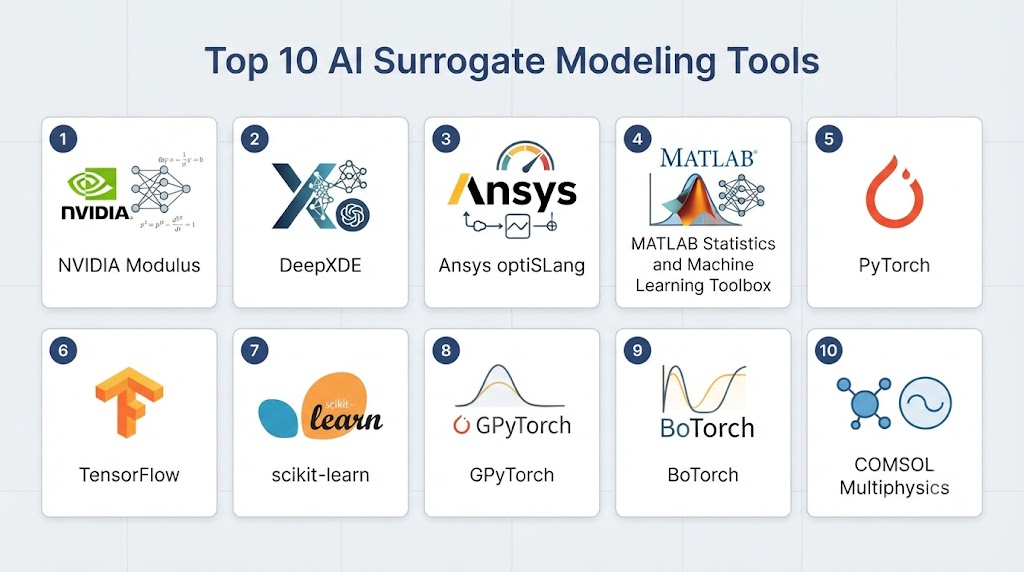
Top 10 AI Surrogate Modeling Tools
1. NVIDIA Modulus
One-line verdict: Best for engineers and researchers building physics-informed surrogate models and scientific machine-learning workflows.
Short description:
NVIDIA Modulus is a framework for physics-ML workflows that combines neural networks with physical knowledge. It is particularly relevant for teams working on engineering simulations, computational physics, digital twins, and scientific machine learning.
Standout Capabilities
- Physics-informed machine learning.
- Physics-constrained neural networks.
- Scientific simulation acceleration.
- Surrogate modeling.
- GPU acceleration.
- Digital-twin workflows.
- Custom neural architectures.
- Engineering-focused workflows.
AI-Specific Depth
- Model support: Neural networks and physics-informed architectures.
- RAG / knowledge integration: N/A for core surrogate modeling.
- Evaluation: Custom simulation validation and physics-based error evaluation.
- Guardrails: Physics constraints act as application-level constraints rather than conventional AI safety guardrails.
- Observability: Training and experiment metrics can be integrated with ML monitoring workflows.
Pros
- Strong physics-ML capabilities.
- Excellent GPU ecosystem.
- Suitable for sophisticated engineering research.
Cons
- Requires substantial technical expertise.
- Physics-informed workflows can be difficult to configure.
- Best suited to specialized technical teams.
Security & Compliance
Security depends on the deployment architecture. Specific certifications for individual workflows are Not publicly stated.
Deployment & Platforms
- Linux.
- GPU environments.
- Cloud.
- Self-hosted.
- HPC environments.
Integrations & Ecosystem
NVIDIA Modulus fits into scientific computing and GPU-based ML environments.
- PyTorch.
- NVIDIA GPUs.
- Simulation data.
- Scientific computing workflows.
- HPC infrastructure.
- Python.
- Digital-twin systems.
Pricing Model
The framework is available for development use; infrastructure and related NVIDIA products can introduce additional costs.
Best-Fit Scenarios
- Physics-informed surrogate models.
- Engineering simulation acceleration.
- Digital twins.
2. DeepXDE
One-line verdict: Best for researchers developing physics-informed neural networks and custom scientific surrogate models in Python.
Short description:
DeepXDE is an open-source library designed for scientific machine learning, particularly physics-informed neural networks. It can be used to approximate solutions to differential equations and build surrogate representations of physical systems.
Standout Capabilities
- Physics-informed neural networks.
- Differential-equation learning.
- Boundary-condition modeling.
- Inverse problems.
- Scientific machine learning.
- Custom neural architectures.
- Python workflows.
- Research experimentation.
AI-Specific Depth
- Model support: Neural-network architectures designed for scientific ML.
- RAG / knowledge integration: N/A.
- Evaluation: Physics-based losses and custom validation.
- Guardrails: Governing equations and physical constraints.
- Observability: Training metrics and experiment tracking can be added externally.
Pros
- Open-source.
- Strong research flexibility.
- Useful for physics-informed modeling.
Cons
- Requires scientific ML expertise.
- Production deployment requires additional infrastructure.
- Not designed as a complete enterprise platform.
Security & Compliance
Specific certifications are Not publicly stated.
Deployment & Platforms
- Windows.
- macOS.
- Linux.
- Cloud.
- Self-hosted.
Integrations & Ecosystem
- Python.
- TensorFlow.
- PyTorch.
- JAX-related scientific workflows depending on configuration.
- Scientific datasets.
- Jupyter.
- Numerical simulation workflows.
Pricing Model
Open-source.
Best-Fit Scenarios
- Scientific research.
- Physics-informed surrogate development.
- PDE-based modeling.
3. NVIDIA PhysicsNeMo
One-line verdict: Best for advanced scientific AI teams building scalable physics-ML models and surrogate simulations on GPU infrastructure.
Short description:
NVIDIA PhysicsNeMo provides tools and models for physics-based machine learning and scientific computing. It is relevant to teams building neural surrogates, physics-informed models, and accelerated simulation workflows.
Standout Capabilities
- Physics-ML modeling.
- Neural operators.
- Surrogate modeling.
- Scientific foundation-model workflows.
- GPU acceleration.
- Distributed training.
- Digital-twin applications.
- Custom physics architectures.
AI-Specific Depth
- Model support: Neural networks, neural operators, physics-informed approaches, and scientific AI models.
- RAG / knowledge integration: N/A.
- Evaluation: Physics-based validation and simulation comparison.
- Guardrails: Physical constraints and application-level validation.
- Observability: ML experiment and training metrics can be integrated into workflows.
Pros
- Designed for advanced scientific AI.
- Strong GPU acceleration.
- Suitable for large-scale workloads.
Cons
- High technical complexity.
- Hardware acceleration can increase infrastructure requirements.
- Better suited to advanced teams than beginners.
Security & Compliance
Specific certification applicability depends on deployment and organizational architecture. Not publicly stated for all configurations.
Deployment & Platforms
- Linux.
- Cloud.
- Self-hosted.
- HPC.
- GPU infrastructure.
Integrations & Ecosystem
- NVIDIA GPUs.
- PyTorch.
- Scientific datasets.
- HPC systems.
- Simulation pipelines.
- Python.
- Digital-twin workflows.
Pricing Model
Software and infrastructure economics vary by deployment.
Best-Fit Scenarios
- Large-scale scientific AI.
- Neural-operator surrogates.
- GPU-based simulation acceleration.
4. SimulAI
One-line verdict: Best for researchers exploring AI-based surrogate and scientific modeling workflows with flexible machine-learning experimentation.
Short description:
SimulAI is a research-oriented scientific machine-learning framework that can support surrogate modeling and related AI approaches for computational science. Its value depends on the specific scientific workflow and models being implemented.
Standout Capabilities
- Scientific machine learning.
- Surrogate modeling.
- Neural networks.
- Physics-related modeling.
- Research experimentation.
- Custom model development.
- Python workflows.
- Simulation-data integration.
AI-Specific Depth
- Model support: Machine-learning and neural-network approaches vary by workflow.
- RAG / knowledge integration: N/A.
- Evaluation: Custom simulation-based validation.
- Guardrails: Physics and domain constraints can be implemented.
- Observability: Depends on the surrounding ML workflow.
Pros
- Research flexibility.
- Useful for scientific experimentation.
- Can integrate AI with computational workflows.
Cons
- Smaller ecosystem than major enterprise ML platforms.
- Production readiness varies.
- Requires technical expertise.
Security & Compliance
Specific certifications are Not publicly stated.
Deployment & Platforms
- Python.
- Self-hosted.
- Cloud environments can be configured.
Integrations & Ecosystem
- Python.
- ML frameworks.
- Scientific data.
- Simulation pipelines.
- Research environments.
Pricing Model
Open-source/research-oriented components may be available; commercial pricing is Not publicly stated.
Best-Fit Scenarios
- Scientific research.
- Experimental surrogate modeling.
- Custom simulation workflows.
5. PyTorch
One-line verdict: Best for developers building highly customized neural surrogate models with complete control over training and inference.
Short description:
PyTorch is a general-purpose deep-learning framework rather than a dedicated surrogate-modeling product. Its flexibility makes it widely useful for creating neural surrogates, reduced-order models, operator-learning systems, and physics-informed architectures.
Standout Capabilities
- Custom neural networks.
- Automatic differentiation.
- GPU acceleration.
- Distributed training.
- Scientific ML.
- Custom loss functions.
- Model export.
- Research ecosystem.
AI-Specific Depth
- Model support: Broad neural-network and custom model support.
- RAG / knowledge integration: N/A.
- Evaluation: Fully customizable.
- Guardrails: Physics constraints and application-level validation can be implemented.
- Observability: Training metrics require integration with experiment-tracking systems.
Pros
- Extremely flexible.
- Large developer ecosystem.
- Excellent research capabilities.
Cons
- Not a dedicated surrogate platform.
- Requires engineering expertise.
- Production governance must be built around it.
Security & Compliance
Security depends on the deployment architecture. Specific certifications are Not publicly stated for PyTorch as a modeling framework.
Deployment & Platforms
- Windows.
- macOS.
- Linux.
- Cloud.
- Self-hosted.
- GPU/HPC.
Integrations & Ecosystem
- Python.
- NumPy.
- Scientific libraries.
- CUDA.
- MLflow.
- Jupyter.
- HPC environments.
Pricing Model
Open-source.
Best-Fit Scenarios
- Custom surrogate research.
- Neural operators.
- Engineering ML applications.
6. JAX
One-line verdict: Best for researchers needing fast differentiable scientific computing and custom surrogate-model optimization workflows.
Short description:
JAX is a numerical-computing and machine-learning framework designed around composable transformations, automatic differentiation, compilation, and accelerator execution. These characteristics make it useful for scientific surrogate modeling and differentiable simulation workflows.
Standout Capabilities
- Automatic differentiation.
- GPU acceleration.
- TPU support.
- Just-in-time compilation.
- Vectorization.
- Scientific computing.
- Optimization.
- Differentiable modeling.
AI-Specific Depth
- Model support: Custom neural and numerical models.
- RAG / knowledge integration: N/A.
- Evaluation: Fully customizable.
- Guardrails: Domain-specific physical constraints can be encoded.
- Observability: Requires external experiment and monitoring tools.
Pros
- Excellent performance.
- Strong differentiability.
- Well suited to scientific research.
Cons
- Steeper learning curve.
- Not a dedicated surrogate platform.
- Production workflows require additional components.
Security & Compliance
Specific certifications are Not publicly stated.
Deployment & Platforms
- Linux.
- macOS.
- Cloud.
- GPU/TPU environments.
- Self-hosted.
Integrations & Ecosystem
- Python.
- NumPy-compatible workflows.
- Scientific computing.
- GPU/TPU infrastructure.
- Neural-network libraries.
- Optimization frameworks.
Pricing Model
Open-source.
Best-Fit Scenarios
- Differentiable simulation.
- Scientific ML.
- High-performance surrogate research.
7. TensorFlow
One-line verdict: Best for teams building production-oriented custom neural surrogates with a mature machine-learning ecosystem.
Short description:
TensorFlow provides tools for developing and deploying neural networks that can approximate computationally expensive simulations. It can support surrogate models ranging from simple regression networks to sophisticated scientific ML architectures.
Standout Capabilities
- Deep learning.
- GPU acceleration.
- Automatic differentiation.
- Model deployment.
- Custom loss functions.
- Distributed training.
- Model optimization.
- Production inference.
AI-Specific Depth
- Model support: Broad neural-network architectures.
- RAG / knowledge integration: N/A.
- Evaluation: Custom model and simulation validation.
- Guardrails: Domain constraints can be implemented through architecture and loss functions.
- Observability: TensorBoard and related tooling can support experiment monitoring.
Pros
- Mature ML ecosystem.
- Strong production tooling.
- Good deployment options.
Cons
- General-purpose framework.
- Surrogate workflows require custom development.
- Scientific modeling may require additional libraries.
Security & Compliance
Specific certifications are Not publicly stated for the framework itself.
Deployment & Platforms
- Windows.
- macOS.
- Linux.
- Cloud.
- Edge.
- Self-hosted.
Integrations & Ecosystem
- Python.
- TensorBoard.
- Keras.
- GPU infrastructure.
- Scientific libraries.
- Deployment runtimes.
Pricing Model
Open-source.
Best-Fit Scenarios
- Production surrogate models.
- Deep-learning simulation approximations.
- Custom engineering systems.
8. scikit-learn
One-line verdict: Best for teams creating lightweight and interpretable surrogate models from structured simulation or experimental datasets.
Short description:
Scikit-learn provides a broad set of regression, ensemble, preprocessing, and model-selection tools that can be used to create surrogate models. It is particularly useful when a relatively simple machine-learning model can approximate an expensive simulation effectively.
Standout Capabilities
- Regression.
- Random forests.
- Gradient boosting.
- Gaussian-process workflows through related tooling.
- Preprocessing.
- Cross-validation.
- Hyperparameter optimization.
- Model pipelines.
AI-Specific Depth
- Model support: Traditional ML and regression models.
- RAG / knowledge integration: N/A.
- Evaluation: Strong cross-validation and regression evaluation.
- Guardrails: Custom validation and domain constraints.
- Observability: External monitoring required.
Pros
- Easy to learn.
- Strong documentation and ecosystem.
- Often sufficient for lower-complexity surrogates.
Cons
- Limited native physics integration.
- Less suitable for extremely high-dimensional simulation outputs.
- Deep-learning workloads require other frameworks.
Security & Compliance
Specific certifications are Not publicly stated.
Deployment & Platforms
- Windows.
- macOS.
- Linux.
- Cloud.
- Self-hosted.
Integrations & Ecosystem
- Python.
- NumPy.
- Pandas.
- SciPy.
- Jupyter.
- MLflow.
- Scientific computing libraries.
Pricing Model
Open-source.
Best-Fit Scenarios
- Low-cost surrogate models.
- Engineering prototypes.
- Tabular simulation data.
9. MATLAB
One-line verdict: Best for engineering teams combining surrogate modeling with numerical simulation, optimization, and signal-processing workflows.
Short description:
MATLAB provides extensive engineering and mathematical capabilities for building approximation models around simulation and experimental data. Its integration with optimization and engineering workflows makes it useful for surrogate-assisted design.
Standout Capabilities
- Regression modeling.
- Optimization.
- Neural networks.
- Design exploration.
- Numerical computing.
- Simulation integration.
- Engineering visualization.
- Model deployment options.
AI-Specific Depth
- Model support: Statistical, machine-learning, and neural approaches depending on available toolboxes.
- RAG / knowledge integration: N/A.
- Evaluation: Cross-validation and custom engineering validation.
- Guardrails: Engineering constraints can be incorporated into workflows.
- Observability: MATLAB-based experiment and analysis workflows.
Pros
- Excellent engineering ecosystem.
- Strong optimization integration.
- Familiar to many technical organizations.
Cons
- Commercial licensing.
- Advanced features can require additional products.
- Less open than Python-based ecosystems.
Security & Compliance
Specific certifications are Not publicly stated for all configurations.
Deployment & Platforms
- Windows.
- macOS.
- Linux.
- Cloud options vary.
Integrations & Ecosystem
- Simulink.
- Python.
- C/C++.
- Optimization tools.
- Engineering simulation software.
- Hardware systems.
Pricing Model
Commercial licensing; exact pricing varies.
Best-Fit Scenarios
- Engineering design optimization.
- Simulation-based modeling.
- Industrial R&D.
10. OpenMDAO
One-line verdict: Best for multidisciplinary engineering optimization where surrogate models need to interact with complex computational design workflows.
Short description:
OpenMDAO is an open-source framework for multidisciplinary design analysis and optimization. It can incorporate surrogate models into larger engineering optimization workflows, making it particularly useful for aerospace and other computational engineering applications.
Standout Capabilities
- Multidisciplinary optimization.
- Surrogate models.
- Gradient-based optimization.
- Engineering workflows.
- Coupled system modeling.
- Design-space exploration.
- Python integration.
- High-performance engineering optimization.
AI-Specific Depth
- Model support: Surrogate and mathematical models; AI models can be incorporated through custom components.
- RAG / knowledge integration: N/A.
- Evaluation: Engineering optimization and model validation.
- Guardrails: Physical and engineering constraints.
- Observability: Custom metrics and optimization diagnostics.
Pros
- Excellent engineering optimization.
- Open-source.
- Strong multidisciplinary workflow capabilities.
Cons
- Requires engineering expertise.
- Not primarily an AI platform.
- Custom AI integration may be required.
Security & Compliance
Specific certifications are Not publicly stated.
Deployment & Platforms
- Windows.
- macOS.
- Linux.
- Cloud.
- Self-hosted.
Integrations & Ecosystem
- Python.
- NumPy.
- SciPy.
- Engineering simulation tools.
- Optimization algorithms.
- Custom surrogate models.
Pricing Model
Open-source.
Best-Fit Scenarios
- Aerospace design.
- Multidisciplinary engineering.
- Surrogate-assisted optimization.
Comparison Table
| Tool | Best For | Deployment | Model Flexibility | Strength | Watch-Out | Public Rating |
|---|---|---|---|---|---|---|
| NVIDIA Modulus | Physics-informed AI | Cloud/Self-hosted/HPC | Multi-model/BYO | Physics-ML | Technical complexity | N/A |
| DeepXDE | Scientific ML research | Self-hosted/Cloud | Open-source | PINNs | Research-oriented | N/A |
| NVIDIA PhysicsNeMo | Scientific AI at scale | Cloud/Self-hosted/HPC | Multi-model/BYO | GPU scientific AI | Infrastructure requirements | N/A |
| SimulAI | Scientific experimentation | Self-hosted/Cloud | Open-source/BYO | Research flexibility | Smaller ecosystem | N/A |
| PyTorch | Custom AI surrogates | Cloud/Self-hosted | Open-source/BYO | Flexibility | Requires development | N/A |
| JAX | Differentiable science | Cloud/Self-hosted | Open-source/BYO | Performance | Steep learning curve | N/A |
| TensorFlow | Production ML | Cloud/Self-hosted/Edge | Open-source/BYO | Mature ecosystem | General-purpose | N/A |
| scikit-learn | Lightweight surrogates | Cloud/Self-hosted | Open-source | Simplicity | Limited physics support | N/A |
| MATLAB | Engineering design | Desktop/Cloud | Multi-model/BYO | Engineering integration | Licensing | N/A |
| OpenMDAO | Engineering optimization | Self-hosted/Cloud | Open-source/BYO | Multidisciplinary optimization | Technical | N/A |
Scoring & Evaluation
The scoring below is comparative rather than absolute. Surrogate-model quality depends heavily on the underlying simulation, training-data coverage, dimensionality, physical constraints, and required accuracy.
The rubric emphasizes surrogate-model capabilities, scientific reliability, integrations, optimization support, performance, deployment flexibility, and engineering usability.
| Tool | Core | Reliability/Eval | Guardrails | Integrations | Ease | Perf/Cost | Security/Admin | Support | Weighted Total |
|---|---|---|---|---|---|---|---|---|---|
| NVIDIA Modulus | 9.5 | 9.5 | 9.5 | 9 | 7 | 9.5 | 9 | 9 | 9.1 |
| DeepXDE | 9 | 9 | 9.5 | 8 | 8 | 8.5 | 7.5 | 8.5 | 8.6 |
| NVIDIA PhysicsNeMo | 9.5 | 9.5 | 9.5 | 9.5 | 7 | 10 | 9 | 9 | 9.2 |
| SimulAI | 8 | 8 | 8.5 | 7.5 | 7.5 | 8 | 7 | 7.5 | 7.8 |
| PyTorch | 9.5 | 9.5 | 8.5 | 10 | 8 | 9.5 | 8.5 | 10 | 9.3 |
| JAX | 9 | 9.5 | 8.5 | 9 | 7 | 10 | 8 | 9 | 8.9 |
| TensorFlow | 9 | 9 | 8.5 | 9.5 | 8 | 9 | 8.5 | 9.5 | 8.9 |
| scikit-learn | 8 | 8.5 | 8 | 9.5 | 9.5 | 9.5 | 8 | 10 | 8.9 |
| MATLAB | 9 | 9 | 9 | 9.5 | 9 | 8.5 | 8.5 | 9 | 8.9 |
| OpenMDAO | 9 | 9 | 9.5 | 9 | 7.5 | 9 | 8 | 9 | 8.8 |
Top 3 for Enterprise
- NVIDIA PhysicsNeMo
- NVIDIA Modulus
- PyTorch
Top 3 for SMB
- MATLAB
- scikit-learn
- DeepXDE
Top 3 for Developers
- PyTorch
- JAX
- OpenMDAO
Which AI Surrogate Modeling Tool Is Right for You?
Solo / Freelancer
Individual researchers and developers should prioritize flexibility and low infrastructure overhead.
scikit-learn is often a practical starting point for structured simulation data. PyTorch, JAX, and DeepXDE become more attractive when physics-informed learning or advanced neural architectures are required.
Start with a simple regression or ensemble surrogate before moving to deep learning.
SMB
Small engineering organizations should focus on reducing simulation time without creating an overly complex ML stack.
A practical workflow is:
Simulation → Dataset → Baseline Surrogate → Validation → Optimization → Deployment
Prioritize:
- Simple deployment.
- Engineering compatibility.
- Explainability.
- Uncertainty estimation.
- Reproducible experiments.
- Low infrastructure costs.
Mid-Market
Mid-market engineering teams should consider a structured surrogate-modeling pipeline.
Important capabilities include:
- Automated data generation.
- Experiment tracking.
- Active learning.
- Multifidelity modeling.
- Model comparison.
- Uncertainty quantification.
- Simulation integration.
- Optimization integration.
The goal should be to reduce the number of expensive simulations while maintaining acceptable accuracy.
Enterprise
Large organizations often need a complete simulation-to-AI workflow.
Consider:
- HPC integration.
- GPU acceleration.
- Data governance.
- Model versioning.
- Digital-twin integration.
- Physics constraints.
- Uncertainty quantification.
- Distributed training.
- Deployment APIs.
- Model monitoring.
- Security.
NVIDIA’s scientific AI ecosystem, PyTorch, MATLAB, and OpenMDAO can be particularly useful depending on whether the primary requirement is physics-informed learning, custom AI, engineering design, or optimization.
Regulated Industries
Aerospace, automotive, healthcare, energy, and critical infrastructure organizations should be particularly careful with surrogate-model validation.
Important requirements include:
- Traceability.
- Validation datasets.
- Model versioning.
- Uncertainty estimation.
- Engineering approval.
- Change management.
- Reproducibility.
- Auditability.
- Human review.
A surrogate should not automatically replace a validated physics solver in safety-critical applications without appropriate verification and validation.
Budget vs Premium
Open-source frameworks such as PyTorch, JAX, DeepXDE, scikit-learn, and OpenMDAO can significantly reduce software licensing costs.
However, compute, GPU infrastructure, engineering time, data generation, and model maintenance can become the largest expenses.
Evaluate:
Software + Simulation Compute + Data Generation + GPU Cost + Engineering + Validation + Maintenance
rather than software licensing alone.
Build vs Buy
Build when:
- You have highly specialized physical systems.
- Existing commercial tools do not match your workflow.
- You need full model control.
- Your organization has strong scientific ML expertise.
- The surrogate is strategically important.
Buy or use a managed ecosystem when:
- You need faster deployment.
- Your team lacks scientific ML specialists.
- You need enterprise support.
- Standard workflows meet your requirements.
- Integration is more valuable than complete algorithmic control.
Implementation Playbook
First 30 Days: Pilot + Success Metrics
Choose one expensive simulation or computational bottleneck.
Define:
- Current simulation runtime.
- Simulation cost.
- Input variables.
- Output variables.
- Required accuracy.
- Required inference latency.
- Valid operating domain.
Create an initial dataset spanning the relevant design space.
Establish a simple baseline model before testing advanced neural architectures.
Measure:
- Mean absolute error.
- Root mean squared error.
- Maximum error.
- Relative error.
- Inference latency.
- Training cost.
- Simulation reduction.
Days 31–60: Harden Security + Evaluation
Create a robust evaluation dataset that includes regions of the design space not used during training.
Test:
- Interpolation.
- Extrapolation.
- Boundary conditions.
- Rare configurations.
- Extreme inputs.
- Physical constraints.
- Noisy simulation data.
For AI systems, create an evaluation harness that tracks:
- Model version.
- Training dataset.
- Simulation configuration.
- Hyperparameters.
- Error metrics.
- Inference latency.
- Uncertainty.
Red-team the surrogate by intentionally testing physically unrealistic and boundary-condition inputs.
Days 61–90: Optimize + Govern + Scale
Once accuracy is acceptable, integrate the surrogate into the engineering workflow.
Optimize:
- GPU utilization.
- Batch inference.
- Model compression.
- Active-learning loops.
- Multifidelity training.
- Simulation selection.
- Caching.
Add governance around:
- Model approval.
- Dataset versions.
- Validation results.
- Deployment versions.
- Rollback.
- Monitoring.
A hybrid system can often be safer than complete replacement:
Fast Surrogate → Confidence Check → Full Simulation When Needed
Common Mistakes & How to Avoid Them
- Training only on convenient simulation points: The surrogate may fail elsewhere in the design space.
- Ignoring extrapolation: Neural surrogates can behave unpredictably outside their training distribution.
- No physics constraints: Purely data-driven models can produce physically implausible outputs.
- Ignoring uncertainty: Point predictions can hide dangerous approximation errors.
- Using too little training data: Complex simulation spaces often require broad coverage.
- Overusing deep learning: Gaussian processes, tree models, polynomial methods, or simpler regressors may be sufficient.
- Ignoring simulation errors: A surrogate cannot become more reliable than the data-generating process without additional physical knowledge.
- No baseline model: Always compare advanced AI against simpler surrogate approaches.
- No validation outside the training distribution: Hold out meaningful regions of the design space.
- Ignoring rare events: Extreme physical conditions can be particularly difficult for surrogates.
- Ignoring conservation laws: Physics-informed constraints can improve reliability where appropriate.
- No active learning: Let the surrogate identify where additional simulations would be most valuable.
- Ignoring multifidelity data: Low-cost simulations can complement expensive high-fidelity runs.
- No model versioning: Every production prediction should be traceable to a model and dataset version.
- No uncertainty threshold: Low-confidence predictions may need to trigger the original simulator.
- Replacing validated solvers too early: Use surrogate models alongside established simulation systems until sufficiently validated.
- Ignoring computational costs: Training a surrogate can be expensive if the simulation dataset is huge.
- No monitoring after deployment: Surrogate accuracy can degrade when the design space changes.
- Ignoring physical boundaries: Inputs outside the valid physical domain can cause unreliable outputs.
- No human engineering review: High-impact engineering decisions require appropriate expert oversight.
FAQs
What is AI surrogate modeling?
AI surrogate modeling uses machine learning to approximate the behavior of an expensive simulation, physical experiment, or numerical model so that similar predictions can be produced much faster.
Why use a surrogate model instead of the original simulator?
A simulation may take seconds, minutes, hours, or even days. A trained surrogate can sometimes generate predictions much faster, making large-scale optimization and real-time applications more practical.
Are surrogate models accurate?
They can be highly accurate within the domain represented by their training data, but accuracy varies by problem. Validation against the original simulator remains essential.
What is a physics-informed surrogate model?
It is a surrogate that incorporates physical laws, equations, constraints, or known relationships into the learning process.
What are neural operators?
Neural operators learn mappings between functions or fields and can be useful for approximating families of physical systems rather than a single fixed simulation configuration.
Can surrogate models replace physics simulations completely?
Usually, they should not be assumed to do so automatically. A hybrid architecture can use the surrogate for fast predictions while retaining the original solver for validation or high-risk cases.
What is multifidelity surrogate modeling?
Multifidelity modeling combines data from simulations with different accuracy and computational costs to achieve useful predictions while reducing expensive high-fidelity simulation requirements.
What is active learning in surrogate modeling?
Active learning allows the AI system to identify which new simulations would provide the most useful information for improving the surrogate.
Can surrogate models provide uncertainty estimates?
Yes. Certain approaches can estimate predictive uncertainty, while other models require additional techniques to obtain useful uncertainty estimates.
Why is uncertainty important?
A surrogate can be highly accurate in one region and unreliable in another. Uncertainty estimates can help identify predictions that require additional simulation or expert review.
Can surrogate models be used for optimization?
Yes. Surrogates are commonly useful for design-space exploration and optimization because they can evaluate candidate designs much faster than expensive simulations.
Can surrogate models support real-time digital twins?
Yes. Fast surrogate inference can be useful when a full physics simulation cannot meet real-time latency requirements.
Do I need deep learning for surrogate modeling?
No. Traditional regression, Gaussian-process methods, tree-based models, polynomial approximations, and other techniques can work very well depending on the problem.
Which framework is best for physics-informed modeling?
There is no universal winner. NVIDIA Modulus, NVIDIA PhysicsNeMo, and DeepXDE are particularly relevant to physics-informed scientific ML, while PyTorch and JAX offer broader customization.
Can I use Python for surrogate modeling?
Yes. Python has a broad ecosystem covering machine learning, scientific computing, optimization, simulation, and visualization.
Can surrogate models run on GPUs?
Yes. Frameworks such as PyTorch, JAX, TensorFlow, and NVIDIA’s scientific AI tools support GPU-accelerated workflows.
How much simulation data is required?
There is no fixed requirement. It depends on the dimensionality of the input space, complexity of the physics, desired accuracy, noise, and model architecture.
Can a surrogate model work with experimental data?
Yes. Surrogates can be trained using experimental measurements, simulation outputs, or combinations of both.
What is surrogate-model drift?
Surrogate drift occurs when the deployed model encounters physical conditions or design configurations that differ significantly from the data used during training.
How should surrogate models be evaluated?
Evaluate them against trusted simulation or experimental results across the full intended operating domain, including boundary conditions and difficult cases.
Conclusion
AI Surrogate Modeling Tools are becoming increasingly valuable for organizations that need to reduce the computational cost of simulation while maintaining useful engineering accuracy. They can transform workflows that previously required thousands of expensive simulation runs into faster AI-assisted design and optimization processes.The strongest solution depends on the engineering problem.NVIDIA Modulus and NVIDIA PhysicsNeMo are particularly relevant to physics-informed and GPU-accelerated scientific AI. DeepXDE provides an accessible open-source path for physics-informed neural networks. PyTorch and JAX offer exceptional flexibility for custom scientific ML architectures, while TensorFlow provides a mature general-purpose deep-learning ecosystem. MATLAB and OpenMDAO are strong choices for engineering-focused design and optimization workflows, while scikit-learn can be surprisingly effective when a simpler surrogate is sufficient.The most important lesson is that surrogate modeling is not simply about selecting the most advanced AI architecture. The quality of the training design space, physical constraints, validation methodology, uncertainty estimation, and integration with trusted simulation tools often matter more.