Introduction
Human-Robot Interaction (HRI) AI Systems are software platforms, frameworks, and AI technologies that help robots understand people, communicate with them, interpret human behavior, and respond appropriately. Modern HRI combines computer vision, speech recognition, natural-language processing, large language models, gesture recognition, emotion or intent estimation, planning, and robot control.
HRI is becoming increasingly important as robots move beyond controlled industrial environments into warehouses, hospitals, offices, retail spaces, homes, education, and public environments. AI allows robots to interpret spoken instructions, identify objects and people, understand context, and adapt their behavior instead of relying entirely on predefined commands.
Typical applications include:
- Voice-controlled robots.
- Natural-language robot programming.
- Collaborative industrial robots.
- Service and hospitality robots.
- Assistive robotics.
- Social robotics.
- Human-aware navigation.
- Gesture and activity recognition.
- Multimodal robot assistants.
- Robot tutoring and education.
Best for: Robotics engineers, AI developers, automation teams, research organizations, manufacturers, healthcare and service organizations, and companies developing robots that must operate around people.
Not ideal for: Fully isolated automation environments where human interaction is minimal and deterministic control systems are sufficient.
What to Evaluate
- Natural-language understanding.
- Speech recognition.
- Text-to-speech.
- Computer vision.
- Multimodal interaction.
- Gesture recognition.
- Human detection and tracking.
- Intent recognition.
- Context awareness.
- Robot planning.
- Safety mechanisms.
- Latency.
- Model flexibility.
- Privacy controls.
- Edge inference.
- Cloud connectivity.
- ROS/ROS 2 compatibility.
- Hardware support.
- Simulation support.
- Observability and evaluation.
What’s Changed in Human-Robot Interaction AI Systems
- Multimodal interaction is becoming the default: Modern HRI systems can combine speech, vision, gestures, spatial information, and robot state rather than relying on a single input modality.
- Large language models are changing robot interfaces: People can increasingly describe tasks in natural language instead of learning rigid command structures.
- Vision-language-action systems are gaining importance: Robots can connect visual observations with language instructions and physical actions.
- Voice interaction is becoming more conversational: HRI systems increasingly support multi-turn conversations and contextual instructions.
- AI agents are moving toward tool calling: An HRI agent can potentially invoke navigation, perception, manipulation, search, scheduling, or other robot capabilities.
- Grounding is critical: A robot needs to connect language to real objects, locations, actions, and physical constraints.
- Prompt-injection and instruction-security concerns are emerging: Robots connected to LLMs must distinguish trusted commands from untrusted environmental information.
- Latency matters more: Cloud-based AI can provide powerful reasoning but may introduce network delays that are problematic for interactive robotics.
- Edge AI is becoming more important: Local inference can reduce latency and improve privacy.
- Human-aware navigation is expanding: Robots increasingly need to account for human movement, personal space, and social context.
- Evaluation is becoming more rigorous: Teams need to test task completion, misunderstanding, unsafe actions, response latency, and interaction quality.
- Privacy is becoming a core HRI concern: Robots may continuously process microphones, cameras, location information, and other sensitive environmental data.
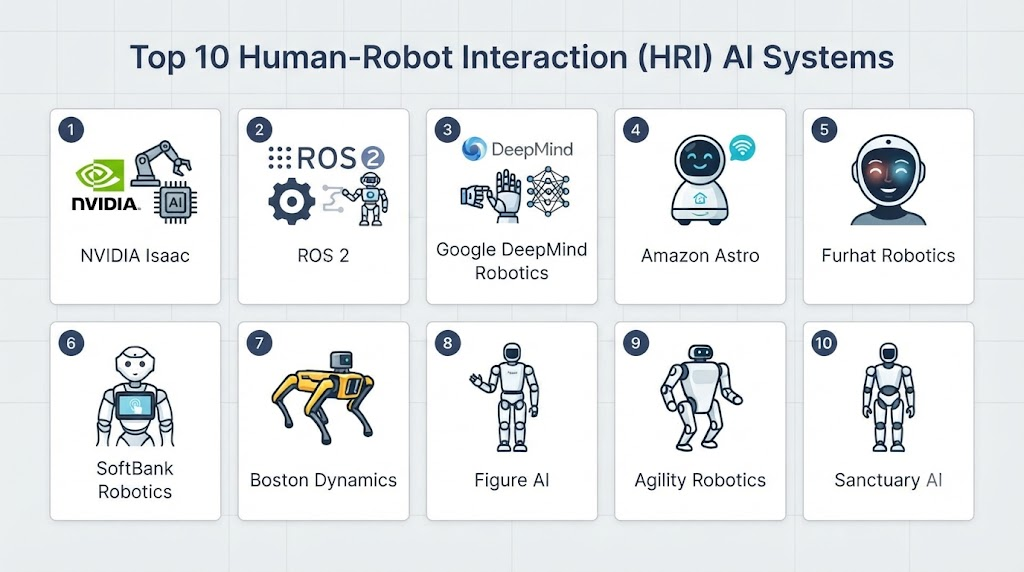
Top 10 Human-Robot Interaction (HRI) AI Systems
1. NVIDIA Isaac ROS
One-line verdict: Best for developers building AI-enabled robots with perception, navigation, manipulation, and accelerated ROS-based workflows.
Short description:
NVIDIA Isaac ROS provides robotics software packages designed to accelerate AI-enabled robotics applications. It is particularly useful for integrating perception, navigation, visual processing, and AI capabilities into ROS-based robots.
Standout Capabilities
- ROS 2 integration.
- GPU-accelerated perception.
- Computer vision.
- Navigation.
- Visual SLAM.
- Object detection.
- Manipulation-related workflows.
- Edge AI.
AI-Specific Depth
- Model support: Supports integration with neural-network and AI models.
- RAG / knowledge integration: N/A as a core HRI capability.
- Evaluation: Robotics and perception evaluation through application workflows.
- Guardrails: Robotics safety and application constraints can be implemented.
- Observability: ROS telemetry and application-level metrics.
Pros
- Strong robotics ecosystem.
- Excellent GPU acceleration.
- Useful for real-world AI robotics.
Cons
- NVIDIA hardware ecosystem can be important.
- Requires ROS and robotics expertise.
- Not a complete conversational AI platform by itself.
Security & Compliance
Security depends on system architecture, ROS deployment, hardware, and organizational controls. Specific certifications should be verified for the intended deployment.
Deployment & Platforms
- Linux.
- NVIDIA-powered edge devices.
- Robotics computers.
- Cloud-connected robotics systems.
Integrations & Ecosystem
- ROS 2.
- NVIDIA Jetson.
- NVIDIA GPUs.
- Computer vision.
- Navigation.
- Robotics simulation.
- AI models.
Pricing Model
The software components are generally part of an open robotics ecosystem, while hardware and associated infrastructure may introduce costs.
Best-Fit Scenarios
- Multimodal robot perception.
- AI-enabled mobile robots.
- ROS-based HRI systems.
2. ROS 2
One-line verdict: Best foundational robotics middleware for connecting perception, interaction, planning, control, sensors, and robot hardware.
Short description:
ROS 2 is a robotics middleware and development ecosystem rather than a standalone AI product. It provides communication, lifecycle management, tooling, and interfaces that allow HRI components to communicate with robot hardware and software.
Standout Capabilities
- Distributed robotics architecture.
- Publish/subscribe communication.
- Services and actions.
- Lifecycle management.
- Robot hardware integration.
- Navigation integration.
- Perception integration.
- Large robotics ecosystem.
AI-Specific Depth
- Model support: Algorithm-agnostic.
- RAG / knowledge integration: N/A.
- Evaluation: Application-specific.
- Guardrails: Can support safety and control architectures.
- Observability: ROS tooling and telemetry.
Pros
- Extremely flexible.
- Broad robotics ecosystem.
- Excellent foundation for custom HRI.
Cons
- Requires significant engineering.
- Does not provide conversational AI by itself.
- Safety and AI governance remain application responsibilities.
Security & Compliance
ROS 2 provides security mechanisms, but implementation depends on the deployment architecture and configuration.
Deployment & Platforms
- Linux.
- Windows.
- Embedded robotics computers.
- Cloud-connected systems.
Integrations & Ecosystem
- Robot sensors.
- Cameras.
- Microphones.
- Navigation.
- Manipulation.
- AI models.
- Simulation platforms.
Pricing Model
Open-source.
Best-Fit Scenarios
- Custom HRI platforms.
- Research robots.
- Industrial and service robots.
3. NVIDIA Isaac Sim
One-line verdict: Best for testing human-robot interaction scenarios safely in photorealistic, physics-based simulation.
Short description:
NVIDIA Isaac Sim is a robotics simulation environment useful for developing and evaluating perception, navigation, manipulation, and AI-driven robotic behaviors before deployment on physical robots.
Standout Capabilities
- Physics-based simulation.
- Synthetic data.
- Robot simulation.
- Human-environment scenarios.
- Computer vision.
- Sensor simulation.
- ROS 2 integration.
- Digital-twin workflows.
AI-Specific Depth
- Model support: External AI models can be integrated.
- RAG / knowledge integration: N/A.
- Evaluation: Simulation-based evaluation.
- Guardrails: Simulation constraints and task-specific safety checks.
- Observability: Simulation telemetry and robot-state data.
Pros
- Excellent for safe testing.
- Supports complex environments.
- Useful for sim-to-real workflows.
Cons
- Requires capable hardware.
- Simulation expertise is needed.
- Real-world interaction still requires physical validation.
Security & Compliance
Deployment-specific.
Deployment & Platforms
- Linux.
- GPU workstations.
- GPU servers.
- Cloud environments.
Integrations & Ecosystem
- ROS 2.
- NVIDIA Isaac ROS.
- Robot models.
- Synthetic data.
- AI models.
- Digital twins.
Pricing Model
Varies depending on software, hardware, infrastructure, and enterprise requirements.
Best-Fit Scenarios
- HRI simulation.
- Safety testing.
- Multimodal robotics development.
4. Google DeepMind Gemini Robotics
One-line verdict: Best for exploring vision-language-action models that connect natural-language understanding with physical robot behavior.
Short description:
Gemini Robotics represents an emerging class of AI systems designed to connect multimodal reasoning with robotic action. These systems are relevant to HRI because people can communicate tasks using natural language while the model interprets visual and physical context.
Standout Capabilities
- Multimodal understanding.
- Vision-language reasoning.
- Natural-language interaction.
- Robot action generation.
- Generalization across tasks.
- Physical-world reasoning.
- Robotics research.
- Agent-style workflows.
AI-Specific Depth
- Model support: Gemini-family robotics models and associated interfaces where available.
- RAG / knowledge integration: Application-dependent.
- Evaluation: Robotics task evaluation.
- Guardrails: Application-level safety controls remain important.
- Observability: Application-specific.
Pros
- Strong multimodal AI capabilities.
- Natural-language interaction potential.
- Relevant to next-generation robotics.
Cons
- Availability and capabilities can vary.
- Requires careful physical grounding.
- Not a universal robot operating system.
Security & Compliance
Specific enterprise controls depend on the applicable service and deployment.
Deployment & Platforms
- Cloud and supported AI environments.
- Robotics integration depends on the specific implementation.
Integrations & Ecosystem
- Multimodal AI.
- Robotics platforms.
- Cameras.
- Natural-language interfaces.
- Robot control systems.
- AI agents.
Pricing Model
Varies by applicable model or service.
Best-Fit Scenarios
- Natural-language robot control.
- Vision-language-action research.
- Multimodal HRI.
5. Hugging Face Transformers
One-line verdict: Best for developers building custom multimodal, language, vision, and conversational AI components for robots.
Short description:
Hugging Face Transformers provides access to a broad ecosystem of pretrained AI models. Robotics developers can use it to build custom speech, vision, language, multimodal, and agent components for HRI systems.
Standout Capabilities
- Language models.
- Vision models.
- Multimodal models.
- Speech-related models.
- Model fine-tuning.
- Open-source model ecosystem.
- Local inference.
- Custom pipelines.
AI-Specific Depth
- Model support: Large ecosystem of hosted and open-source models.
- RAG / knowledge integration: Can be integrated with external retrieval systems.
- Evaluation: Model-specific and custom evaluation.
- Guardrails: Requires implementation using suitable safety tooling.
- Observability: External monitoring and inference tooling.
Pros
- Huge model ecosystem.
- Flexible deployment.
- Supports experimentation with different models.
Cons
- Requires significant engineering.
- Model quality varies.
- Robotics integration is not automatic.
Security & Compliance
Depends on selected models, infrastructure, and deployment architecture.
Deployment & Platforms
- Linux.
- Windows.
- macOS.
- Cloud.
- Local GPU.
- Edge devices depending on model.
Integrations & Ecosystem
- PyTorch.
- TensorFlow.
- Computer vision.
- Speech.
- LLMs.
- Robotics middleware.
Pricing Model
Many components are open-source; hosted services and infrastructure can have separate costs.
Best-Fit Scenarios
- Custom HRI research.
- Multimodal robot assistants.
- Local AI deployment.
6. OpenAI Models and APIs
One-line verdict: Best for developers building conversational and multimodal AI interfaces that connect people with robotic systems.
Short description:
OpenAI models can provide language, reasoning, and multimodal capabilities that can serve as the conversational intelligence layer of an HRI system. Robotics developers can connect model outputs to controlled robot tools and actions.
Standout Capabilities
- Natural-language interaction.
- Multimodal understanding.
- Reasoning.
- Tool calling.
- Structured outputs.
- Conversational context.
- Agent-style workflows.
- Custom application integration.
AI-Specific Depth
- Model support: Multiple hosted model options depending on the applicable API.
- RAG / knowledge integration: Can be connected to external retrieval and application data.
- Evaluation: Application-level evaluation and model-evaluation workflows.
- Guardrails: Application-level policies and safety mechanisms.
- Observability: Application telemetry can track latency, usage, and tool execution.
Pros
- Strong conversational experience.
- Flexible tool integration.
- Useful for multimodal HRI.
Cons
- Physical grounding must be engineered.
- Cloud dependency can introduce latency.
- Robot safety cannot be delegated entirely to the language model.
Security & Compliance
Specific controls vary by product, API configuration, and deployment. Organizations should verify requirements for their intended environment.
Deployment & Platforms
- Cloud/API.
- Robotics applications.
- Edge-side components can complement the cloud layer.
Integrations & Ecosystem
- Robot APIs.
- ROS 2.
- Vision systems.
- Databases.
- Retrieval systems.
- Tool-calling interfaces.
Pricing Model
Usage-based API pricing may apply depending on the selected model and service.
Best-Fit Scenarios
- Conversational robot assistants.
- Natural-language robot commands.
- Multimodal HRI agents.
7. NVIDIA Riva
One-line verdict: Best for low-latency speech recognition and speech synthesis in AI-enabled robotic interfaces.
Short description:
NVIDIA Riva provides speech AI capabilities that can be integrated into interactive systems. For robotics, speech recognition and synthesis can form the voice interface connecting humans to robot applications.
Standout Capabilities
- Automatic speech recognition.
- Text-to-speech.
- Conversational interfaces.
- GPU acceleration.
- Real-time speech processing.
- Customization.
- Edge-oriented deployment.
- Multilingual capabilities depending on supported models.
AI-Specific Depth
- Model support: NVIDIA speech models and supported customization workflows.
- RAG / knowledge integration: N/A directly.
- Evaluation: Speech recognition and synthesis metrics.
- Guardrails: Application-level.
- Observability: Application telemetry and inference metrics.
Pros
- Useful for voice-first HRI.
- Low-latency architecture options.
- Strong NVIDIA ecosystem integration.
Cons
- Primarily a speech layer.
- GPU infrastructure may be required.
- Full HRI requires additional components.
Security & Compliance
Depends on deployment and configuration.
Deployment & Platforms
- Linux.
- NVIDIA GPUs.
- Edge systems.
- Cloud infrastructure.
Integrations & Ecosystem
- ROS 2.
- NVIDIA AI tools.
- Speech applications.
- LLMs.
- Robot control systems.
Pricing Model
Varies depending on deployment and associated infrastructure.
Best-Fit Scenarios
- Voice-controlled robots.
- Real-time speech interfaces.
- Edge HRI.
8. MoveIt 2
One-line verdict: Best for integrating human instructions with safe robotic-arm motion planning and manipulation workflows.
Short description:
MoveIt 2 is a robotics manipulation framework built around ROS 2. It provides motion planning and manipulation capabilities that can serve as the physical execution layer underneath an AI-powered HRI system.
Standout Capabilities
- Motion planning.
- Collision checking.
- Manipulator control.
- Trajectory generation.
- Robot configuration.
- Grasping workflows.
- ROS 2 integration.
- Planning scene management.
AI-Specific Depth
- Model support: Algorithm-agnostic; integrates with external AI systems.
- RAG / knowledge integration: N/A.
- Evaluation: Motion-planning and robot-task evaluation.
- Guardrails: Collision checking and motion constraints.
- Observability: ROS 2 telemetry and planning data.
Pros
- Strong manipulation ecosystem.
- Useful physical execution layer.
- Integrates naturally with ROS 2.
Cons
- Not a conversational AI platform.
- Requires robotics engineering.
- AI reasoning must be integrated separately.
Security & Compliance
Deployment-specific.
Deployment & Platforms
- Linux.
- ROS 2 systems.
- Robot controllers.
- Industrial and research workstations.
Integrations & Ecosystem
- ROS 2.
- Robot arms.
- AI agents.
- Perception systems.
- Motion planners.
- Simulation.
Pricing Model
Open-source.
Best-Fit Scenarios
- Language-to-manipulation systems.
- Collaborative robots.
- AI-driven robotic arms.
9. Open-RMF
One-line verdict: Best for coordinating robots, people, and shared spaces in complex facilities such as hospitals and commercial buildings.
Short description:
Open-RMF is a framework for interoperability and coordination among autonomous robots and facility systems. While it is not itself an HRI AI model, it can provide important infrastructure for robots operating around people.
Standout Capabilities
- Multi-robot coordination.
- Facility integration.
- Shared-space management.
- Fleet interoperability.
- Scheduling.
- Traffic coordination.
- ROS 2 integration.
AI-Specific Depth
- Model support: Algorithm-agnostic.
- RAG / knowledge integration: N/A.
- Evaluation: Facility and fleet-level metrics.
- Guardrails: Operational constraints and coordination rules.
- Observability: Robot and facility telemetry.
Pros
- Strong facility integration.
- Useful for human-robot environments.
- Open ecosystem.
Cons
- Not primarily a conversational AI platform.
- Requires integration with fleet systems.
- AI interaction layer must be added separately.
Security & Compliance
Depends on the deployed infrastructure and facility architecture.
Deployment & Platforms
- Linux.
- Cloud-connected facilities.
- On-premises robotics infrastructure.
Integrations & Ecosystem
- ROS 2.
- Robot fleets.
- Facility-management systems.
- Doors and elevators.
- Scheduling systems.
- Navigation systems.
Pricing Model
Open-source framework; deployment and infrastructure costs vary.
Best-Fit Scenarios
- Hospitals.
- Large facilities.
- Multi-robot environments.
10. Webots
One-line verdict: Best for accessible robotics simulation and HRI prototyping across perception, navigation, control, and interaction scenarios.
Short description:
Webots is a robotics simulation environment that supports robot models, sensors, controllers, and simulated environments. It can be used to prototype HRI systems before deploying them on physical robots.
Standout Capabilities
- Robot simulation.
- Sensor simulation.
- Camera simulation.
- Human-environment scenarios.
- Robot controllers.
- ROS integration.
- Physics simulation.
- Educational and research workflows.
AI-Specific Depth
- Model support: External AI models can be integrated.
- RAG / knowledge integration: N/A.
- Evaluation: Simulation-based testing.
- Guardrails: Environment and controller constraints.
- Observability: Simulation state and controller metrics.
Pros
- Accessible simulation.
- Good for prototyping.
- Useful for HRI experiments.
Cons
- Simulation cannot fully reproduce real human behavior.
- Advanced production systems require additional tooling.
- AI capabilities depend on external models.
Security & Compliance
Deployment-specific.
Deployment & Platforms
- Windows.
- Linux.
- macOS.
- Local and development environments.
Integrations & Ecosystem
- ROS 2.
- Python.
- C/C++.
- AI models.
- Sensors.
- Robotics controllers.
Pricing Model
Open-source components and licensing arrangements may vary by use case.
Best-Fit Scenarios
- HRI research.
- Robot simulation.
- Education and prototyping.
Comparison Table
| Tool | Best For | Deployment | Model Flexibility | Strength | Watch-Out | Public Rating |
|---|---|---|---|---|---|---|
| NVIDIA Isaac ROS | AI robotics | Self-hosted / Edge | Multi-model | Accelerated robotics | NVIDIA ecosystem | N/A |
| ROS 2 | HRI infrastructure | Self-hosted / Edge | Algorithm-agnostic | Robotics middleware | Engineering required | N/A |
| NVIDIA Isaac Sim | HRI simulation | Self-hosted / Cloud | Multi-model | Safe testing | GPU requirements | N/A |
| Gemini Robotics | Multimodal robot AI | Cloud / Supported environments | Hosted | Vision-language-action | Availability varies | N/A |
| Hugging Face Transformers | Custom HRI AI | Cloud / Self-hosted | Open-source / Multi-model | Model ecosystem | Integration effort | N/A |
| OpenAI Models and APIs | Conversational HRI | Cloud/API | Hosted / Multi-model | Language and multimodal interaction | Cloud dependency | N/A |
| NVIDIA Riva | Voice interaction | Edge / Cloud | Supported models | Speech AI | Speech-focused | N/A |
| MoveIt 2 | Manipulation | Self-hosted | Algorithm-agnostic | Motion planning | Not conversational | N/A |
| Open-RMF | Human-robot facilities | Self-hosted / Hybrid | Algorithm-agnostic | Fleet coordination | Integration complexity | N/A |
| Webots | HRI simulation | Self-hosted | Multi-model | Accessible simulation | Simulation limitations | N/A |
Scoring & Evaluation
The following scoring is comparative rather than absolute. HRI systems range from robotics middleware and simulation platforms to multimodal AI services, so the scores reflect usefulness as components of a complete HRI architecture rather than identical product categories.
| Tool | Core | Reliability/Eval | Guardrails | Integrations | Ease | Perf/Cost | Security/Admin | Support | Weighted Total |
|---|---|---|---|---|---|---|---|---|---|
| NVIDIA Isaac ROS | 9.5 | 9 | 9 | 9.5 | 7.5 | 9 | 8.5 | 9.5 | 8.9 |
| ROS 2 | 9.5 | 9 | 9.5 | 10 | 7 | 9 | 8.5 | 10 | 9.0 |
| NVIDIA Isaac Sim | 9.5 | 9.5 | 9 | 9.5 | 7 | 8 | 8 | 9.5 | 8.8 |
| Gemini Robotics | 9.5 | 8.5 | 8 | 8.5 | 8.5 | 7.5 | 8 | 9 | 8.4 |
| Hugging Face Transformers | 9.5 | 9 | 8 | 10 | 8 | 8.5 | 7.5 | 10 | 8.8 |
| OpenAI Models and APIs | 9.5 | 9 | 8.5 | 9.5 | 9 | 8 | 8 | 9.5 | 8.9 |
| NVIDIA Riva | 8.5 | 9 | 8 | 9 | 8 | 9 | 8 | 9 | 8.6 |
| MoveIt 2 | 9 | 9 | 9.5 | 9.5 | 7.5 | 9 | 8 | 9.5 | 8.8 |
| Open-RMF | 8.5 | 8.5 | 9 | 9.5 | 7 | 8.5 | 8 | 9 | 8.3 |
| Webots | 8.5 | 8.5 | 8.5 | 9 | 9 | 8.5 | 7.5 | 9 | 8.5 |
Top 3 for Enterprise
- ROS 2
- NVIDIA Isaac ROS
- NVIDIA Isaac Sim
Top 3 for SMB
- ROS 2
- Webots
- Hugging Face Transformers
Top 3 for Developers
- ROS 2
- Hugging Face Transformers
- OpenAI Models and APIs
Which Human-Robot Interaction AI System Is Right for You?
Solo / Freelancer
For individual developers, avoid building a complete HRI stack from scratch.
A practical starting architecture can combine:
- ROS 2.
- A speech-recognition system.
- A language model.
- Computer vision.
- A simulator.
- A simple robot controller.
Simulation should be used extensively before testing on physical hardware.
SMB
SMBs should focus on modularity.
Use a robotics middleware layer such as ROS 2 and add only the AI capabilities that the robot actually needs.
For example:
- Voice commands.
- Object recognition.
- Navigation.
- Conversational assistance.
Avoid giving a general-purpose AI model unrestricted access to robot actuators.
Mid-Market
Mid-market teams should establish a formal HRI architecture.
Separate:
- Human input.
- Perception.
- AI reasoning.
- Task planning.
- Robot action.
- Safety control.
- Monitoring.
This separation makes the system easier to test and replace.
Enterprise
Enterprise HRI systems should use layered architectures.
A typical architecture might contain:
- Multimodal input.
- Identity and authorization.
- AI reasoning.
- Retrieval or enterprise knowledge.
- Tool/action layer.
- Task planner.
- Safety controller.
- Robot middleware.
- Hardware abstraction.
- Observability.
The AI should propose actions while deterministic systems enforce physical constraints.
Regulated Industries
Healthcare, public-sector, financial, and other regulated environments should pay particular attention to:
- Microphone data.
- Camera data.
- Human identity.
- Location information.
- Conversation history.
- Data retention.
- Access control.
- Model behavior.
- Audit logs.
Sensitive interaction data should be minimized and retained only as necessary for the application.
Budget vs Premium
Open-source frameworks provide flexibility and can lower software costs.
However, teams still need to budget for:
- Robot hardware.
- GPUs.
- Cameras.
- Microphones.
- AI inference.
- Cloud services.
- Engineering.
- Simulation.
- Testing.
Premium AI services can accelerate development but may increase recurring inference costs and introduce cloud dependencies.
Build vs Buy
Build custom HRI components when:
- The robot has unique hardware.
- Interaction requirements are specialized.
- You need complete control over AI models.
- Data must remain on-premises.
- The system has unusual safety requirements.
Use established components when:
- You need rapid prototyping.
- Standard speech or vision capabilities are sufficient.
- Your team lacks specialized AI infrastructure expertise.
- You want a mature robotics ecosystem.
Implementation Playbook
First 30 Days: Pilot + Success Metrics
Start with one interaction scenario.
For example:
“Robot, bring the package from the loading area to workstation three.”
Define exactly what the system must accomplish.
Measure:
- Speech recognition accuracy.
- Intent recognition.
- Object recognition.
- Task completion.
- Response latency.
- Navigation success.
- Human intervention.
- Unsafe-action rate.
Build the interaction pipeline in simulation first.
Days 31–60: Security + Evaluation + Hardening
Create an HRI evaluation harness.
Test:
- Different accents.
- Background noise.
- Ambiguous instructions.
- Multiple people speaking.
- Unexpected objects.
- Incorrect commands.
- Adversarial instructions.
- Prompt injection through environmental text.
- Network interruptions.
- Sensor failures.
Add:
- Authentication.
- Authorization.
- Action allowlists.
- Human override.
- Emergency-stop integration.
- Logging.
- Model versioning.
Days 61–90: Deployment + Optimization
Move to carefully controlled real-world testing.
Optimize:
- AI inference latency.
- Speech-processing latency.
- Vision latency.
- Network dependency.
- Edge/cloud routing.
- Model size.
- GPU utilization.
Introduce production monitoring for:
- Failed interactions.
- Misunderstood commands.
- Unsafe requests.
- Robot failures.
- Latency.
- Model usage.
- Human intervention.
Common Mistakes & How to Avoid Them
- Giving an LLM direct actuator control: Place deterministic action validation between the AI and robot hardware.
- Ignoring grounding: Language must be connected to actual objects, locations, and robot capabilities.
- No evaluation: Test interaction quality systematically rather than relying on demonstrations.
- Ignoring speech noise: Real environments contain machinery, conversations, and echoes.
- Overusing cloud AI: Latency and connectivity can affect robot responsiveness.
- Ignoring privacy: Cameras and microphones can collect sensitive information.
- No human override: People should be able to stop or override the robot when necessary.
- Trusting every instruction: Robots should verify authorization and feasibility.
- Ignoring prompt injection: Text displayed in the environment can potentially influence multimodal AI systems.
- No action allowlist: Restrict what an AI system is permitted to command.
- Skipping simulation: Test dangerous and unusual scenarios virtually first.
- No fallback controller: Maintain deterministic recovery behavior.
- Ignoring context errors: Robots need to handle ambiguous references such as “that object.”
- Poor latency management: Interactive robots need predictable response times.
- No model versioning: Changes to AI models can alter robot behavior.
- Over-automation: Keep humans involved where the consequences of failure are significant.
FAQs
What is Human-Robot Interaction AI?
HRI AI refers to artificial-intelligence technologies that allow people and robots to communicate and collaborate using speech, vision, gestures, language, and contextual understanding.
How does AI improve human-robot interaction?
AI allows robots to understand natural language, interpret visual information, recognize human actions, and adapt their behavior to changing situations.
Can humans control robots using natural language?
Yes. A language model can interpret natural-language instructions and translate them into structured robot tasks, provided the system has appropriate grounding and safety controls.
Can ChatGPT or another LLM directly control a robot?
An LLM can serve as a reasoning or interaction layer, but unrestricted direct control of physical actuators is generally inappropriate. Robot actions should pass through validated tools, planners, and safety mechanisms.
What is multimodal HRI?
Multimodal HRI combines multiple interaction channels such as speech, vision, gestures, text, spatial information, and robot-state information.
What is vision-language-action AI?
Vision-language-action systems connect visual observations and language instructions with physical actions, allowing robots to reason about what they see and what people ask them to do.
Can HRI systems work offline?
Yes. Some speech, vision, and language models can run locally. Offline deployment can reduce latency and improve privacy, although hardware requirements may increase.
Should HRI use cloud or edge AI?
The best architecture is often hybrid. Time-sensitive perception and safety-related processing can run locally, while more computationally intensive reasoning may use cloud services where appropriate.
How important is ROS 2 for HRI?
ROS 2 is highly useful because it provides communication and integration infrastructure for connecting AI systems with robot sensors, planners, controllers, and hardware.
How can HRI systems protect privacy?
Organizations can minimize data collection, process sensitive inputs locally where possible, apply access controls, define retention policies, and avoid storing unnecessary audio, video, or conversation data.
How should HRI AI be evaluated?
Evaluate both AI and robotics performance. Important measurements include task success, misunderstanding rate, response latency, unsafe actions, human intervention, perception accuracy, and physical reliability.
What are AI guardrails in robotics?
Guardrails are restrictions and validation mechanisms that prevent an AI system from executing unauthorized, unsafe, or physically impossible actions.
Can robots understand gestures?
Yes. Computer vision and pose-estimation systems can recognize gestures and human body movements. Accuracy depends on the environment, camera placement, and model.
Can HRI AI recognize human emotions?
Some systems attempt emotion or affect recognition, but these capabilities should be treated cautiously because human emotional states are difficult to infer reliably from external signals.
Can HRI systems work with multiple people?
Yes. Multi-person tracking, speaker identification, spatial reasoning, and authorization systems can help robots distinguish among different people.
What is human-aware navigation?
Human-aware navigation allows robots to account for people when planning movement, including maintaining appropriate distances and adapting to human motion.
What is the biggest HRI challenge?
Reliable grounding is one of the biggest challenges. A robot must connect what a person says with the actual physical environment and execute the instruction safely.
Conclusion
Human-Robot Interaction AI is evolving from simple command interfaces toward multimodal systems that combine language, vision, speech, planning, and physical action. The most capable systems increasingly allow people to communicate with robots using natural language while the robot reasons about its environment and available capabilities.However, successful HRI requires more than adding an LLM to a robot. The AI must be grounded in real-world perception, connected to reliable planning and control systems, constrained by safety mechanisms, and evaluated against realistic human interaction scenarios.ROS 2 provides a strong foundation for integrating HRI components, while NVIDIA Isaac ROS and Isaac Sim are valuable for AI-enabled robotics and simulation. OpenAI models, Gemini Robotics, and Hugging Face Transformers can provide different approaches to language and multimodal intelligence. NVIDIA Riva is useful for speech interaction, while MoveIt 2 provides an important manipulation and motion-planning layer.