Introduction
Reinforcement Learning for Control Tooling refers to software frameworks, libraries, simulators, and development environments used to train AI agents to control robots, autonomous machines, industrial systems, vehicles, and other dynamic processes through trial-and-error learning. Instead of manually programming every control rule, reinforcement learning allows an agent to learn actions that maximize a defined reward or objective.
This tooling is becoming increasingly important for robotics and autonomous systems because modern control problems often involve complex environments, nonlinear dynamics, uncertainty, and large numbers of possible actions. Reinforcement learning can complement traditional control approaches such as PID, MPC, trajectory optimization, and model-based control.
Best for: Robotics engineers, AI researchers, autonomous-system developers, industrial automation teams, reinforcement-learning practitioners, and organizations developing advanced control policies.
Not ideal for: Simple deterministic control problems where PID, MPC, state machines, or conventional optimization can provide reliable performance with much less complexity.
What to Evaluate
- Algorithm availability.
- Simulation compatibility.
- Continuous-control support.
- Discrete-action support.
- Sample efficiency.
- Parallel training.
- GPU acceleration.
- Distributed training.
- Environment APIs.
- Multi-agent support.
- Experiment tracking.
- Evaluation tooling.
- Reproducibility.
- Sim-to-real capabilities.
- Safety constraints.
- Model export.
- Deployment support.
- Community and documentation.
- Hardware integration.
- Total infrastructure cost.
What’s Changed in Reinforcement Learning for Control Tooling
- Simulation-first training is becoming standard: Expensive physical interactions can be replaced by large numbers of simulated training episodes.
- GPU-accelerated environments are increasingly important: Fast parallel environments can dramatically improve training throughput.
- Sim-to-real is a central engineering concern: Developers increasingly use domain randomization, system identification, and robust policies to transfer learned behavior to physical machines.
- Model-based reinforcement learning is gaining attention: Combining learned models with planning can reduce the amount of interaction required.
- Offline reinforcement learning is expanding: Existing datasets can sometimes be used instead of collecting every training interaction online.
- Hybrid control is becoming more practical: RL policies can work alongside traditional controllers rather than replacing them completely.
- Safety constraints matter more: Industrial and robotic deployments require action limits, fallback controllers, monitoring, and emergency-stop mechanisms.
- Multi-agent learning is becoming more relevant: Robot fleets, warehouse systems, and coordinated autonomous machines create control problems involving multiple agents.
- Large-scale experimentation is easier: Distributed training and parallel simulation allow teams to evaluate many policy configurations.
- AI evaluation is becoming more rigorous: Reward alone is not enough; teams increasingly measure stability, robustness, latency, energy consumption, constraint violations, and real-world transfer.
- Policy deployment is becoming more diverse: Learned policies may need to run on cloud infrastructure, edge computers, GPUs, CPUs, or embedded hardware.
- Reproducibility is increasingly important: Versioning environments, reward functions, policies, hyperparameters, and simulation configurations is essential for reliable experimentation.
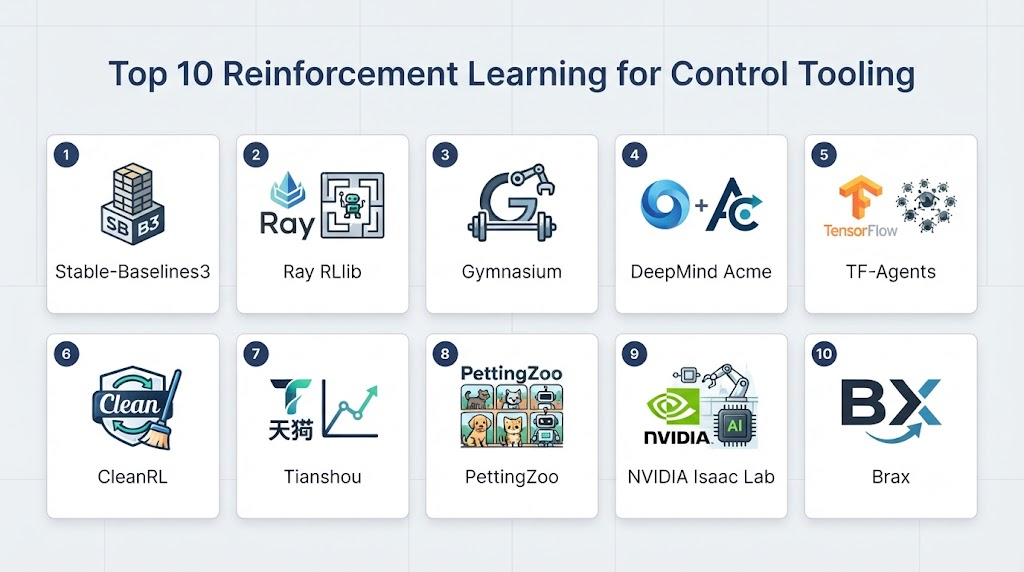
Top 10 Reinforcement Learning for Control Tooling
1. NVIDIA Isaac Lab
One-line verdict: Best for large-scale GPU-accelerated reinforcement learning research and training for advanced robotic control.
Short description:
NVIDIA Isaac Lab is a robotics learning framework designed around simulation and reinforcement-learning workflows. It is particularly useful for training control policies for locomotion, manipulation, navigation, and other robotics problems at scale.
Standout Capabilities
- GPU-accelerated reinforcement learning.
- Large-scale parallel simulation.
- Robotics environments.
- Locomotion training.
- Manipulation workflows.
- Domain randomization.
- Sim-to-real experimentation.
- Integration with NVIDIA robotics simulation.
AI-Specific Depth
- Model support: Supports reinforcement-learning policies and integration with common RL approaches.
- RAG / knowledge integration: N/A.
- Evaluation: Simulation-based policy evaluation.
- Guardrails: Environment constraints and task-specific safety mechanisms.
- Observability: Training metrics, rewards, episode statistics, and simulation telemetry.
Pros
- Excellent for high-throughput robotics RL.
- Strong GPU acceleration.
- Well suited to sim-to-real experimentation.
Cons
- Requires capable GPU infrastructure.
- More complex than beginner-oriented RL libraries.
- Strongly oriented toward robotics and NVIDIA’s ecosystem.
Security & Compliance
Security depends on deployment infrastructure and organizational configuration. Specific certifications should be verified for the intended environment.
Deployment & Platforms
- Linux.
- GPU workstations.
- GPU servers.
- Cloud infrastructure.
Integrations & Ecosystem
- Robotics simulation.
- ROS 2.
- Reinforcement-learning libraries.
- NVIDIA GPU infrastructure.
- Robot models.
- AI development workflows.
Pricing Model
The software framework and associated infrastructure have different cost considerations. Compute and supporting NVIDIA technologies can introduce additional costs.
Best-Fit Scenarios
- Robot locomotion.
- Manipulation policy training.
- Large-scale simulation.
2. Stable-Baselines3
One-line verdict: Best for developers who want reliable, accessible implementations of popular reinforcement-learning algorithms.
Short description:
Stable-Baselines3 is a Python reinforcement-learning library based on PyTorch. It provides implementations of widely used algorithms and is commonly used with Gymnasium-compatible environments for experimentation and control tasks.
Standout Capabilities
- PPO.
- SAC.
- TD3.
- DQN.
- A2C.
- Gymnasium compatibility.
- PyTorch-based implementation.
- Practical experimentation workflows.
AI-Specific Depth
- Model support: Multiple RL algorithms and custom policy architectures.
- RAG / knowledge integration: N/A.
- Evaluation: Policy evaluation and environment-based testing.
- Guardrails: Application-specific.
- Observability: Training metrics and callbacks.
Pros
- Easy to start with.
- Strong documentation and community adoption.
- Good selection of established algorithms.
Cons
- Not a complete robotics platform.
- Large-scale distributed training requires additional tooling.
- Production safety controls must usually be implemented separately.
Security & Compliance
Depends on the application and deployment architecture.
Deployment & Platforms
- Windows.
- Linux.
- macOS.
- Python environments.
Integrations & Ecosystem
- Gymnasium.
- PyTorch.
- Robotics environments.
- Simulation frameworks.
- Custom Python environments.
- Experiment tracking systems.
Pricing Model
Open-source.
Best-Fit Scenarios
- RL experimentation.
- Robotics prototypes.
- Continuous-control research.
3. Ray RLlib
One-line verdict: Best for distributed reinforcement learning, large-scale experiments, multi-agent systems, and production-oriented training infrastructure.
Short description:
RLlib is a reinforcement-learning library within the Ray ecosystem. It focuses on scalable training and supports distributed workloads, multiple reinforcement-learning approaches, and multi-agent environments.
Standout Capabilities
- Distributed RL.
- Multi-agent reinforcement learning.
- Scalable training.
- Parallel environments.
- Experiment management.
- Custom environments.
- Large-scale experimentation.
- Cloud-oriented workloads.
AI-Specific Depth
- Model support: Multiple RL algorithms and customizable models.
- RAG / knowledge integration: N/A.
- Evaluation: Configurable evaluation workflows.
- Guardrails: Application-specific constraints.
- Observability: Training metrics and Ray-based monitoring.
Pros
- Excellent scalability.
- Strong multi-agent capabilities.
- Suitable for distributed workloads.
Cons
- More complex than lightweight RL libraries.
- Requires understanding of distributed systems.
- Infrastructure can become expensive at scale.
Security & Compliance
Depends on Ray deployment and infrastructure configuration.
Deployment & Platforms
- Linux.
- Windows.
- Cloud.
- On-premises infrastructure.
- Distributed clusters.
Integrations & Ecosystem
- Ray.
- Python.
- PyTorch.
- TensorFlow.
- Custom environments.
- Distributed infrastructure.
Pricing Model
Open-source software with infrastructure costs depending on deployment.
Best-Fit Scenarios
- Multi-agent RL.
- Distributed policy training.
- Large-scale experimentation.
4. CleanRL
One-line verdict: Best for researchers who value readable reinforcement-learning implementations and transparent algorithm experimentation.
Short description:
CleanRL provides concise implementations of reinforcement-learning algorithms intended to make training logic easier to understand, inspect, and modify.
Standout Capabilities
- Clean algorithm implementations.
- PyTorch-based workflows.
- PPO.
- SAC.
- DQN.
- Experiment reproducibility.
- Educational value.
- Customization.
AI-Specific Depth
- Model support: Multiple RL algorithms.
- RAG / knowledge integration: N/A.
- Evaluation: Training and benchmark evaluation.
- Guardrails: Application-specific.
- Observability: Training logs and experiment metrics.
Pros
- Easy to inspect.
- Excellent for researchers.
- Useful for learning algorithm behavior.
Cons
- Less of a complete enterprise platform.
- Infrastructure management is left to the user.
- Production deployment requires additional components.
Security & Compliance
Depends on deployment architecture.
Deployment & Platforms
- Python.
- Linux.
- Windows.
- macOS.
Integrations & Ecosystem
- Gymnasium.
- PyTorch.
- Simulation environments.
- Experiment tracking.
- Custom environments.
Pricing Model
Open-source.
Best-Fit Scenarios
- RL research.
- Algorithm experimentation.
- Educational robotics projects.
5. TorchRL
One-line verdict: Best for PyTorch developers building flexible reinforcement-learning and sequential decision-making systems.
Short description:
TorchRL is a reinforcement-learning library within the PyTorch ecosystem. It provides components for environments, policies, data collection, transforms, replay buffers, and training workflows.
Standout Capabilities
- PyTorch integration.
- Environment abstractions.
- Replay buffers.
- Data collectors.
- Policy components.
- Transform pipelines.
- Distributed training possibilities.
- Modular RL development.
AI-Specific Depth
- Model support: PyTorch models and RL components.
- RAG / knowledge integration: N/A.
- Evaluation: Environment and policy evaluation.
- Guardrails: Custom implementation.
- Observability: Training and experiment metrics.
Pros
- Excellent PyTorch integration.
- Modular architecture.
- Useful for advanced RL development.
Cons
- Requires PyTorch expertise.
- More framework-oriented than turnkey.
- Production control safety needs additional engineering.
Security & Compliance
Application-dependent.
Deployment & Platforms
- Linux.
- Windows.
- macOS.
- Python environments.
Integrations & Ecosystem
- PyTorch.
- Gymnasium.
- Robotics environments.
- Simulation platforms.
- Custom neural networks.
Pricing Model
Open-source.
Best-Fit Scenarios
- PyTorch-based robotics.
- Research projects.
- Custom RL algorithms.
6. Tianshou
One-line verdict: Best for flexible reinforcement-learning research with modular components and support for diverse training approaches.
Short description:
Tianshou is a Python reinforcement-learning library providing modular tools for agents, replay buffers, policies, collectors, and training. It is useful for developers building customized RL research pipelines.
Standout Capabilities
- Modular RL architecture.
- Replay buffers.
- Policy implementations.
- Parallel data collection.
- Offline RL workflows.
- Multi-agent capabilities.
- PyTorch support.
- Custom environments.
AI-Specific Depth
- Model support: Multiple RL policies and custom PyTorch models.
- RAG / knowledge integration: N/A.
- Evaluation: Policy and environment evaluation.
- Guardrails: Custom.
- Observability: Training metrics and experiment logging.
Pros
- Flexible.
- Good for research.
- Supports customized workflows.
Cons
- Smaller ecosystem than some major alternatives.
- Requires engineering knowledge.
- Production deployment requires additional components.
Security & Compliance
Depends on deployment architecture.
Deployment & Platforms
- Linux.
- Windows.
- macOS.
- Python.
Integrations & Ecosystem
- PyTorch.
- Gymnasium.
- Simulation environments.
- Custom environments.
- Robotics frameworks.
Pricing Model
Open-source.
Best-Fit Scenarios
- RL research.
- Offline RL experiments.
- Custom control systems.
7. Gymnasium
One-line verdict: Best as a standard environment interface for developing and benchmarking reinforcement-learning control applications.
Short description:
Gymnasium provides APIs for reinforcement-learning environments. It is particularly valuable as a common interface between RL algorithms and environments, making it easier to experiment with different algorithms and tasks.
Standout Capabilities
- Standard environment API.
- Discrete action spaces.
- Continuous action spaces.
- Observation spaces.
- Environment wrappers.
- Benchmark environments.
- Custom environment development.
- Broad ecosystem compatibility.
AI-Specific Depth
- Model support: N/A as an environment framework.
- RAG / knowledge integration: N/A.
- Evaluation: Environment-level evaluation.
- Guardrails: Environment-specific.
- Observability: Environment statistics and episode metrics.
Pros
- Widely useful standard interface.
- Easy to integrate.
- Excellent for experimentation.
Cons
- Not a complete RL training platform.
- Does not provide production safety by itself.
- Requires an RL algorithm library.
Security & Compliance
N/A as a general environment framework.
Deployment & Platforms
- Python.
- Linux.
- Windows.
- macOS.
Integrations & Ecosystem
- Stable-Baselines3.
- RLlib.
- CleanRL.
- TorchRL.
- Tianshou.
- Custom RL algorithms.
Pricing Model
Open-source.
Best-Fit Scenarios
- RL benchmarking.
- Custom control environments.
- Algorithm comparison.
8. PettingZoo
One-line verdict: Best for multi-agent reinforcement learning environments, coordination problems, and competitive or cooperative control research.
Short description:
PettingZoo provides an environment API and collection of environments designed for multi-agent reinforcement learning. It is useful for studying coordination and competition among multiple agents.
Standout Capabilities
- Multi-agent environments.
- Cooperative scenarios.
- Competitive scenarios.
- Standardized APIs.
- Environment wrappers.
- Research benchmarks.
- Custom environment development.
AI-Specific Depth
- Model support: Works with external RL algorithms.
- RAG / knowledge integration: N/A.
- Evaluation: Multi-agent environment evaluation.
- Guardrails: Environment-specific.
- Observability: Episode and agent metrics.
Pros
- Strong multi-agent focus.
- Useful for research.
- Standardized environment interface.
Cons
- Not a complete training system.
- Requires separate RL algorithms.
- Production deployment needs additional engineering.
Security & Compliance
N/A as an environment framework.
Deployment & Platforms
- Python.
- Linux.
- Windows.
- macOS.
Integrations & Ecosystem
- RLlib.
- Stable-Baselines3-related workflows.
- PyTorch.
- Custom algorithms.
- Multi-agent simulators.
Pricing Model
Open-source.
Best-Fit Scenarios
- Robot coordination.
- Multi-agent control.
- Fleet research.
9. MATLAB Reinforcement Learning Toolbox
One-line verdict: Best for engineering organizations combining reinforcement learning with control-system modeling, simulation, and MATLAB workflows.
Short description:
MATLAB Reinforcement Learning Toolbox provides tools for designing, training, simulating, and evaluating reinforcement-learning agents. Its integration with MATLAB and Simulink makes it particularly relevant to engineering and control applications.
Standout Capabilities
- RL agent development.
- Simulink integration.
- Control-system modeling.
- Simulation.
- Policy training.
- Model-based workflows.
- Algorithm experimentation.
- Engineering analysis.
AI-Specific Depth
- Model support: Reinforcement-learning agents and supported deep-learning workflows.
- RAG / knowledge integration: N/A.
- Evaluation: Simulation and agent evaluation.
- Guardrails: Control constraints can be incorporated.
- Observability: Training statistics and simulation metrics.
Pros
- Strong engineering integration.
- Excellent for control-system workflows.
- Useful for simulation-heavy projects.
Cons
- Commercial licensing.
- MATLAB expertise is required.
- Less attractive for teams committed entirely to open-source stacks.
Security & Compliance
Depends on deployment and organizational infrastructure.
Deployment & Platforms
- Windows.
- Linux.
- macOS.
- Desktop.
- Enterprise engineering environments.
Integrations & Ecosystem
- Simulink.
- Robotics tools.
- Control systems.
- Deep learning.
- Hardware-in-the-loop.
- Engineering simulation.
Pricing Model
Commercial licensing; exact pricing varies.
Best-Fit Scenarios
- Industrial control.
- Robotics engineering.
- Model-based RL.
10. OpenAI Gym-compatible Robotics Environments
One-line verdict: Best for developers building custom robotics reinforcement-learning experiments around standardized simulation interfaces.
Short description:
Gym-compatible robotics environments provide standardized interfaces for robotics tasks that can be connected to different reinforcement-learning libraries. They are useful when developers want to separate the environment from the learning algorithm.
Standout Capabilities
- Standardized environment interfaces.
- Robotics tasks.
- Continuous control.
- Simulation-based learning.
- Algorithm flexibility.
- Custom environment development.
- Benchmarking.
- Reproducible experiments.
AI-Specific Depth
- Model support: Depends on the external RL framework.
- RAG / knowledge integration: N/A.
- Evaluation: Task and environment metrics.
- Guardrails: Environment-specific.
- Observability: Episode metrics and simulation telemetry.
Pros
- Flexible.
- Works with multiple RL approaches.
- Good for experimentation.
Cons
- Not a complete commercial platform.
- Environment quality varies.
- Production safety requires additional development.
Security & Compliance
Depends on the specific environment and deployment.
Deployment & Platforms
- Python.
- Linux.
- Windows.
- macOS.
Integrations & Ecosystem
- Gymnasium.
- PyTorch.
- RLlib.
- Stable-Baselines3.
- Robotics simulators.
- Custom environments.
Pricing Model
Generally open-source environment tooling; specific environment licensing can vary.
Best-Fit Scenarios
- Robotics research.
- Control experiments.
- Simulation-based RL.
Comparison Table
| Tool | Best For | Deployment | Model Flexibility | Strength | Watch-Out | Public Rating |
|---|---|---|---|---|---|---|
| NVIDIA Isaac Lab | Robotics RL | Cloud / Self-hosted | Multi-model | GPU-accelerated simulation | High compute needs | N/A |
| Stable-Baselines3 | General RL | Self-hosted | Multi-model | Simplicity | Limited distributed tooling | N/A |
| Ray RLlib | Distributed RL | Cloud / Self-hosted | Multi-model | Scalability | Complexity | N/A |
| CleanRL | RL research | Self-hosted | Multi-model | Readability | Not turnkey production | N/A |
| TorchRL | PyTorch RL | Self-hosted | Multi-model | Modularity | PyTorch expertise | N/A |
| Tianshou | Flexible RL | Self-hosted | Multi-model | Customization | Smaller ecosystem | N/A |
| Gymnasium | RL environments | Self-hosted | Algorithm-agnostic | Standard API | Not a trainer | N/A |
| PettingZoo | Multi-agent RL | Self-hosted | Algorithm-agnostic | Multi-agent environments | Requires separate trainer | N/A |
| MATLAB RL Toolbox | Engineering RL | Desktop / Enterprise | Multi-model | Control integration | Commercial licensing | N/A |
| Gym-compatible Robotics Environments | Robotics experiments | Self-hosted | Algorithm-agnostic | Flexibility | Environment variation | N/A |
Scoring & Evaluation
The following scores are comparative rather than absolute. Reinforcement-learning tooling varies considerably by use case, so a lightweight research library should not be judged by exactly the same standards as a distributed production-training platform.
| Tool | Core | Reliability/Eval | Guardrails | Integrations | Ease | Perf/Cost | Security/Admin | Support | Weighted Total |
|---|---|---|---|---|---|---|---|---|---|
| NVIDIA Isaac Lab | 9.5 | 9.5 | 8.5 | 9.5 | 7 | 8 | 8.5 | 9.5 | 8.9 |
| Stable-Baselines3 | 9 | 9 | 7.5 | 9 | 9 | 8.5 | 7 | 9.5 | 8.7 |
| Ray RLlib | 9.5 | 9 | 8 | 9.5 | 7 | 9 | 8 | 9.5 | 8.8 |
| CleanRL | 8.5 | 9 | 7.5 | 8 | 8.5 | 8.5 | 7 | 8.5 | 8.2 |
| TorchRL | 9 | 9 | 8 | 9.5 | 7.5 | 8.5 | 7.5 | 9 | 8.6 |
| Tianshou | 8.5 | 8.5 | 7.5 | 8.5 | 8 | 8.5 | 7 | 8.5 | 8.2 |
| Gymnasium | 8.5 | 9 | 7.5 | 10 | 9.5 | 9 | 7 | 9.5 | 8.8 |
| PettingZoo | 8.5 | 8.5 | 7.5 | 9 | 8.5 | 8.5 | 7 | 8.5 | 8.3 |
| MATLAB RL Toolbox | 9.5 | 9.5 | 9 | 9.5 | 7.5 | 7.5 | 9 | 9.5 | 8.9 |
| Gym-Compatible Robotics Environments | 8 | 8.5 | 7 | 9 | 8.5 | 8.5 | 7 | 8 | 8.1 |
Top 3 for Enterprise
- MATLAB Reinforcement Learning Toolbox
- NVIDIA Isaac Lab
- Ray RLlib
Top 3 for SMB
- Stable-Baselines3
- Gymnasium
- CleanRL
Top 3 for Developers
- Stable-Baselines3
- TorchRL
- Gymnasium
Which Reinforcement Learning for Control Tool Is Right for You?
Solo / Freelancer
Start with lightweight, open-source tools.
Stable-Baselines3 combined with Gymnasium is a practical starting point. CleanRL is useful when understanding the implementation details of algorithms is important.
For robotics projects requiring advanced simulation, Isaac Lab can become attractive once GPU infrastructure is available.
SMB
SMBs should avoid building an unnecessarily complicated distributed RL platform.
A practical stack could combine:
- Gymnasium.
- Stable-Baselines3.
- A robotics simulator.
- PyTorch.
- Experiment tracking.
Add distributed training only when experimentation volume justifies it.
Mid-Market
Mid-market organizations should focus on repeatable experimentation.
Prioritize:
- Environment versioning.
- Reward-function versioning.
- Evaluation suites.
- Simulation benchmarks.
- Model checkpoints.
- Experiment tracking.
- Deployment pipelines.
- Safety constraints.
The goal should be to make RL experiments reproducible rather than relying on individual researchers’ notebooks.
Enterprise
Enterprises should treat reinforcement learning as an engineering lifecycle.
Important capabilities include:
- Centralized experiment management.
- Distributed training.
- Simulation infrastructure.
- Model governance.
- Access controls.
- Evaluation.
- Safety validation.
- Deployment monitoring.
- Rollback.
- Hardware-in-the-loop testing.
For industrial robotics, RL should normally operate alongside deterministic safety mechanisms rather than directly controlling safety-critical functions without independent safeguards.
Regulated Industries
Regulated organizations should document:
- Training datasets.
- Environment versions.
- Reward definitions.
- Policy versions.
- Training configurations.
- Evaluation results.
- Safety constraints.
- Deployment approvals.
- Incident history.
The learned policy should be treated as a software artifact that requires validation and lifecycle management.
Budget vs Premium
Open-source RL tooling can reduce licensing costs but shifts responsibility toward engineering and infrastructure.
Commercial platforms may provide:
- Professional support.
- Engineering integrations.
- Simulation environments.
- Enterprise administration.
- Hardware support.
The real cost of RL often comes from GPU training, simulation, experimentation, and engineering rather than the framework itself.
Build vs Buy
Build custom tooling when:
- Your control problem is unusual.
- You need custom algorithms.
- Existing environments do not represent your system.
- You have strong ML and control engineering expertise.
Use established tooling when:
- You want faster experimentation.
- Standard algorithms are sufficient.
- You need existing simulation integrations.
- You want to reduce maintenance burden.
Implementation Playbook
First 30 Days: Pilot + Success Metrics
Select one control problem.
Define:
- State representation.
- Action space.
- Reward function.
- Safety constraints.
- Evaluation metrics.
- Training environment.
Start with simulation rather than physical hardware.
Establish baseline performance using a traditional controller where possible.
Measure:
- Task success.
- Stability.
- Control error.
- Energy consumption.
- Constraint violations.
- Episode length.
- Inference latency.
Days 31–60: Harden Evaluation + Safety
Create an automated evaluation harness.
Test:
- Multiple random seeds.
- Different environments.
- Sensor noise.
- Model perturbations.
- Unexpected states.
- Actuator limits.
- Latency.
- Failure scenarios.
Add red-team-style testing for unsafe actions.
Version:
- Policies.
- Rewards.
- Environments.
- Hyperparameters.
- Simulation configurations.
Compare RL against conventional control methods.
Days 61–90: Sim-to-Real + Optimization
Begin carefully controlled physical validation.
Use:
- Hardware-in-the-loop.
- Domain randomization.
- System identification.
- Conservative action limits.
- Fallback controllers.
- Monitoring.
- Rollback mechanisms.
Optimize:
- Training throughput.
- GPU utilization.
- Inference latency.
- Policy size.
- Simulation costs.
- Environment complexity.
Only expand deployment after the learned policy demonstrates repeatable performance against defined acceptance criteria.
Common Mistakes & How to Avoid Them
- Poor reward design: A poorly designed reward can teach an agent to exploit the objective rather than solve the intended problem.
- No baseline controller: Always compare RL against simpler approaches.
- Training directly on expensive hardware: Simulation can dramatically reduce experimentation costs and safety risks.
- Ignoring safety constraints: Action limits and fallback mechanisms are essential for physical systems.
- Overfitting to simulation: Use varied environments and domain randomization.
- No evaluation harness: Reward during training is not enough.
- Testing only average performance: Measure worst-case and failure behavior.
- Ignoring inference latency: A successful policy that runs too slowly may be unusable.
- Ignoring actuator limitations: Simulation may allow actions unavailable to real hardware.
- No reproducibility: Track seeds, environments, rewards, code, and model versions.
- Ignoring sensor noise: Real sensors rarely behave like ideal simulation sensors.
- No human review: High-risk robotic decisions should have appropriate engineering oversight.
- Training without monitoring: Long-running training jobs need metrics and failure detection.
- Ignoring infrastructure costs: RL can require substantial compute.
- Deploying without rollback: Every production policy should have a safe recovery path.
FAQs
What is reinforcement learning for control?
It is the use of reinforcement-learning algorithms to learn control policies that determine which actions an agent should take in a dynamic environment.
Is reinforcement learning better than PID control?
Not universally. PID is often simpler, easier to validate, and highly effective for many control problems. RL becomes attractive when the control problem is complex, nonlinear, adaptive, or difficult to model manually.
Can reinforcement learning control robots?
Yes. RL can be used for locomotion, manipulation, navigation, grasping, balancing, and other robotic behaviors.
Can reinforcement learning be trained without a real robot?
Yes. Simulation is commonly used to train and evaluate RL policies before physical deployment.
What is sim-to-real?
Sim-to-real is the process of transferring a policy trained or developed in simulation to a physical system.
Why is reward design important?
The reward defines what the agent is trying to optimize. Poor reward design can cause unintended behaviors or reward exploitation.
What is a continuous-control problem?
A continuous-control problem has actions represented by continuous values, such as motor torque, steering angle, velocity, or acceleration.
Can reinforcement learning work with traditional control?
Yes. RL can provide high-level decisions, trajectory optimization, adaptive parameters, or learned components while conventional controllers handle low-level stability and safety.
What is offline reinforcement learning?
Offline RL learns from previously collected interaction data rather than requiring the agent to generate all training experiences through new environment interactions.
Is reinforcement learning expensive?
It can be. Training costs depend on simulation speed, number of environments, model size, experiment count, and hardware requirements.
Can RL be used for multi-robot systems?
Yes. Multi-agent reinforcement learning can be used for coordination, task allocation, collision avoidance, and cooperative behaviors.
Can RL policies run on edge devices?
Yes, depending on policy size, architecture, hardware, and inference requirements. Policy optimization or model compression may be needed for resource-constrained devices.
How do I evaluate an RL control policy?
Use multiple metrics rather than reward alone. Consider success rate, stability, robustness, constraint violations, latency, energy use, safety events, and sim-to-real performance.
What is domain randomization?
Domain randomization changes simulation parameters such as friction, lighting, mass, sensor noise, or object properties during training to improve robustness when moving to the physical world.
Can RL replace human operators?
In some narrowly defined control tasks it can reduce manual intervention, but high-risk systems should retain appropriate supervision, constraints, and fallback mechanisms.
Should I use open-source or commercial RL tooling?
Open-source tooling is attractive for flexibility and cost control. Commercial platforms can be useful when engineering support, integrated simulation, enterprise workflows, or specialized tooling are more important.
How do I choose an RL framework?
Start with your environment, control type, simulation platform, algorithm requirements, scale, deployment target, and evaluation needs. Then choose the simplest framework that supports those requirements.
Conclusion
Reinforcement learning can provide powerful solutions for control problems that are difficult to solve using manually designed rules or conventional optimization alone. However, successful RL control is not simply a matter of selecting an algorithm and starting training.The strongest implementations combine reinforcement learning with simulation, rigorous evaluation, safety constraints, traditional control techniques, observability, and careful sim-to-real validation.NVIDIA Isaac Lab is particularly compelling for GPU-accelerated robotics training, while Stable-Baselines3 offers a practical starting point for many developers. Ray RLlib is a strong choice when distributed or multi-agent training becomes important. TorchRL, CleanRL, and Tianshou provide flexible research-oriented alternatives, while Gymnasium and PettingZoo provide valuable environment interfaces for single-agent and multi-agent experimentation. MATLAB Reinforcement Learning Toolbox remains particularly relevant for engineering teams already working in MATLAB and Simulink.