Introduction
UAV swarm coordination platforms are software systems and robotics frameworks that allow multiple unmanned aerial vehicles to operate as a coordinated team. Instead of controlling every drone independently, swarm software can coordinate missions, communication, positioning, task allocation, formation behavior, collision avoidance, and collective decision-making.
These platforms are increasingly relevant for large-area inspection, mapping, environmental monitoring, search and rescue, precision agriculture, infrastructure assessment, research, and other applications where multiple aircraft can complete a mission faster than a single drone.
Modern swarm systems can combine flight controllers, autonomous navigation, AI-based perception, distributed computing, simulation, sensor fusion, and fleet-management technologies. The most important capabilities are not simply the number of drones supported, but how reliably the system handles communication loss, GPS degradation, conflicting missions, dynamic obstacles, and individual vehicle failures.
Best for: Robotics researchers, UAV manufacturers, aerospace companies, industrial inspection teams, mapping organizations, agricultural technology companies, universities, and engineering teams developing multi-drone autonomy.
Not ideal for: Simple single-drone missions, basic waypoint operations, recreational pilots, or organizations that do not need coordinated multi-aircraft behavior.
What to Evaluate
- Multi-UAV coordination.
- Fleet scalability.
- Communication architecture.
- Flight-controller compatibility.
- Distributed planning.
- Task allocation.
- Formation control.
- Collision avoidance.
- Sensor fusion.
- GPS-denied navigation.
- AI perception.
- Edge computing.
- Simulation support.
- ROS/ROS 2 compatibility.
- MAVLink support.
- Telemetry.
- Mission management.
- Failure recovery.
- Security.
- Logging and observability.
- Hardware compatibility.
- API and SDK availability.
- Cloud integration.
- Regulatory support.
What’s Changed in UAV Swarm Coordination Platforms
- AI-assisted task allocation: Swarm systems can increasingly use optimization and machine-learning techniques to assign tasks across multiple aircraft.
- Distributed decision-making: More architectures are moving away from a single centralized controller toward systems where drones can make local decisions.
- Edge AI is becoming more important: Real-time perception and collision avoidance often require onboard processing rather than dependence on cloud connectivity.
- Multi-agent coordination is becoming more sophisticated: Drones can coordinate routes, formations, sensing areas, and mission objectives.
- Communication resilience matters more: Swarms need to handle intermittent connectivity, packet loss, latency, and changing network topology.
- Simulation is becoming essential: Developers can test dozens or hundreds of virtual aircraft before operating physical drones.
- AI model evaluation is expanding: Perception and planning models need testing against different weather, lighting, terrain, sensor failures, and aircraft configurations.
- Sensor fusion is increasingly distributed: Different UAVs can potentially contribute observations to a shared operational picture.
- Dynamic obstacle avoidance is gaining importance: Swarms must avoid not only terrain and static objects but also other aircraft and moving objects.
- Human supervision remains important: Higher autonomy does not eliminate the need for monitoring, intervention, and emergency procedures.
- Cybersecurity is becoming central: A compromised node can potentially affect other vehicles, making authentication, communication security, and software integrity particularly important.
- Fleet-level observability is improving: Operators increasingly need visibility into individual aircraft health, mission state, network performance, and AI behavior.
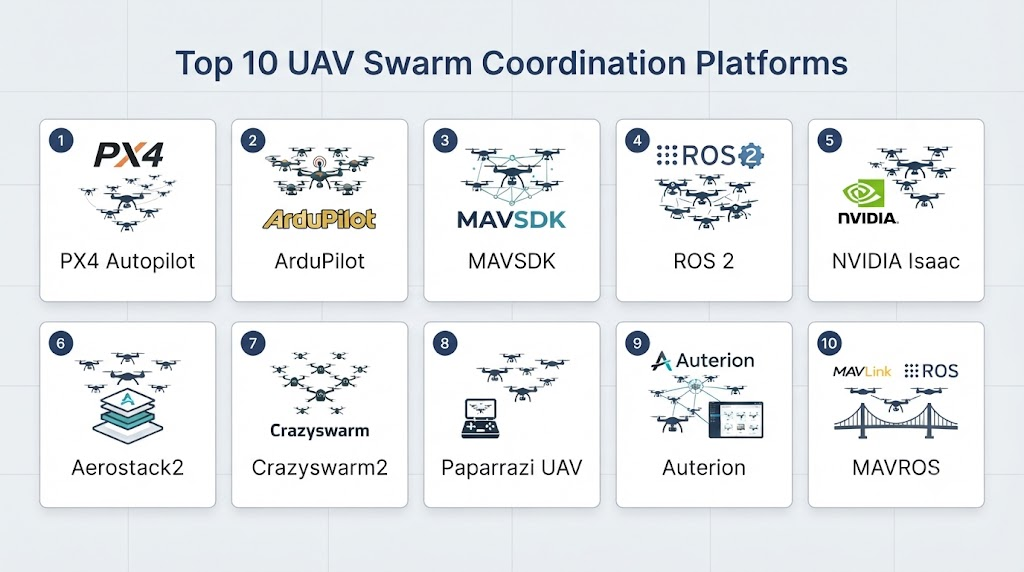
Top 10 UAV Swarm Coordination Platforms
1. PX4 Autopilot
One-line verdict: Best foundation for developers building customizable multi-UAV systems with open flight control and swarm experimentation.
Short description:
PX4 is an open-source flight-control platform widely used for autonomous UAV development and robotics research. While it is not a complete swarm-management platform by itself, it provides a strong foundation for building multi-drone systems through companion computers, communication protocols, simulation, and higher-level coordination software.
Standout Capabilities
- Autonomous flight.
- Multi-vehicle support.
- Mission execution.
- Flight stabilization.
- Sensor integration.
- MAVLink communication.
- Simulation.
- Companion-computer integration.
AI-Specific Depth
- Model support: External AI models can be deployed through companion computers.
- RAG / knowledge integration: N/A.
- Evaluation: Simulation and flight-log workflows support evaluation.
- Guardrails: Flight-control failsafes provide deterministic safety mechanisms; swarm-level AI safeguards require additional architecture.
- Observability: Telemetry and flight logs.
Pros
- Highly customizable.
- Strong robotics ecosystem.
- Excellent foundation for research and commercial UAV development.
Cons
- Swarm intelligence requires additional software.
- Requires experienced engineering teams.
- Production swarm deployments require extensive testing.
Security & Compliance
Security depends on the complete aircraft, communications, firmware, network, and ground-system architecture. Specific regulatory compliance depends on deployment circumstances.
Deployment & Platforms
- Embedded flight controllers: Yes.
- Linux companion computers: Yes.
- Simulation: Yes.
- Cloud: Through external systems.
Integrations & Ecosystem
- MAVLink.
- ROS 2.
- Gazebo.
- Companion computers.
- GNSS.
- Cameras.
- LiDAR.
Pricing Model
Open-source.
Best-Fit Scenarios
- Multi-UAV research.
- Custom swarm architectures.
- Autonomous drone development.
2. ArduPilot
One-line verdict: Best for flexible multi-aircraft projects requiring broad vehicle support and customizable autonomous mission behavior.
Short description:
ArduPilot is an open-source autopilot ecosystem supporting multicopters, fixed-wing aircraft, rovers, boats, and other vehicle types. Developers can combine multiple ArduPilot-controlled aircraft with communication and coordination software to build swarm-like systems.
Standout Capabilities
- Autonomous missions.
- Multiple vehicle types.
- Waypoint navigation.
- Telemetry.
- Sensor integration.
- Mission automation.
- Geofencing.
- Companion-computer support.
AI-Specific Depth
- Model support: External AI models can be integrated through companion computers.
- RAG / knowledge integration: N/A.
- Evaluation: Simulation and flight-log analysis.
- Guardrails: Vehicle-level failsafes; swarm-level safety requires additional software.
- Observability: Telemetry and logs.
Pros
- Flexible and open-source.
- Supports different aircraft categories.
- Large development community.
Cons
- Swarm coordination is not its primary function.
- Complex configurations require expertise.
- Advanced AI behavior requires additional components.
Security & Compliance
Depends on aircraft architecture, communications, firmware, and operational environment.
Deployment & Platforms
- Embedded: Yes.
- Companion computers: Yes.
- Simulation: Yes.
- Ground control: Supported through ecosystem tools.
Integrations & Ecosystem
- MAVLink.
- ROS.
- ROS 2.
- Mission planning software.
- Companion computers.
- Telemetry systems.
- Sensors.
Pricing Model
Open-source.
Best-Fit Scenarios
- Multi-UAV prototypes.
- Research fleets.
- Custom autonomous aircraft.
3. ROS 2
One-line verdict: Best for engineering teams developing sophisticated distributed swarm intelligence and multi-agent robotics applications.
Short description:
ROS 2 provides middleware and tools for building distributed robotics applications. Its modular architecture allows developers to connect UAV flight controllers, perception systems, navigation algorithms, communication systems, AI models, and swarm coordination logic.
Standout Capabilities
- Distributed robotics.
- Multi-agent communication.
- Navigation.
- Sensor processing.
- AI integration.
- Simulation.
- Modular architecture.
- Real-time-oriented workflows.
AI-Specific Depth
- Model support: Broad integration through external AI frameworks.
- RAG / knowledge integration: Possible at the application layer.
- Evaluation: Automated tests, simulation, logging, and replay.
- Guardrails: Must be designed into the swarm architecture.
- Observability: Strong logging and distributed telemetry capabilities.
Pros
- Highly extensible.
- Excellent for research.
- Strong multi-agent robotics ecosystem.
Cons
- Requires significant engineering.
- Not a complete swarm product.
- Safety architecture must be developed carefully.
Security & Compliance
Security depends on ROS 2 configuration, DDS implementation, authentication, network design, operating system, and application architecture.
Deployment & Platforms
- Linux: Yes.
- Edge: Yes.
- Embedded: Yes.
- Cloud: Possible.
- UAVs: Through flight-controller integration.
Integrations & Ecosystem
- PX4.
- ArduPilot.
- Gazebo.
- NVIDIA platforms.
- Cameras.
- LiDAR.
- AI frameworks.
Pricing Model
Open-source.
Best-Fit Scenarios
- Academic swarm research.
- Distributed autonomous UAVs.
- Custom multi-agent systems.
4. NVIDIA Isaac ROS
One-line verdict: Best for AI-heavy UAV swarms requiring accelerated perception, localization, and edge computing.
Short description:
NVIDIA Isaac ROS provides robotics software components designed to accelerate perception and other robotics workloads. Combined with ROS 2 and suitable NVIDIA hardware, it can serve as an AI layer in autonomous multi-UAV architectures.
Standout Capabilities
- GPU acceleration.
- Computer vision.
- Perception.
- Localization.
- ROS 2 integration.
- Sensor processing.
- Edge AI.
- Robotics acceleration.
AI-Specific Depth
- Model support: Supports AI deployment workflows compatible with its supported ecosystem.
- RAG / knowledge integration: N/A.
- Evaluation: Simulation and robotics testing workflows.
- Guardrails: Safety logic must be implemented at the system level.
- Observability: ROS 2 tools and hardware-performance monitoring.
Pros
- Strong AI performance.
- Excellent computer-vision capabilities.
- Useful for onboard swarm perception.
Cons
- Hardware ecosystem considerations.
- Requires robotics expertise.
- Not itself a complete swarm controller.
Security & Compliance
Depends on the deployment architecture, network, operating system, hardware, and application.
Deployment & Platforms
- Edge: Yes.
- Embedded: Yes.
- Linux: Yes.
- ROS 2: Yes.
Integrations & Ecosystem
- ROS 2.
- NVIDIA Jetson.
- PX4.
- Cameras.
- LiDAR.
- AI models.
- Simulation.
Pricing Model
Software availability varies by component; hardware costs vary.
Best-Fit Scenarios
- AI-powered UAV swarms.
- Multi-camera perception.
- Edge robotics research.
5. MAVSDK
One-line verdict: Best for developers creating custom applications that coordinate missions and telemetry across MAVLink-compatible UAV fleets.
Short description:
MAVSDK provides APIs for interacting with MAVLink-compatible vehicles. Developers can use it as an application layer for sending commands, collecting telemetry, managing missions, and coordinating multiple aircraft.
Standout Capabilities
- Drone APIs.
- Mission management.
- Telemetry.
- Flight commands.
- Camera control.
- Multi-drone application development.
- MAVLink support.
- Multiple programming environments.
AI-Specific Depth
- Model support: External AI models can be integrated through application code.
- RAG / knowledge integration: N/A.
- Evaluation: Application-level testing and simulation.
- Guardrails: Depends on flight controller and application architecture.
- Observability: Telemetry APIs and application logs.
Pros
- Developer-friendly.
- Flexible application layer.
- Works with MAVLink ecosystems.
Cons
- Not a full swarm-intelligence framework.
- Coordination logic must be developed.
- Safety requires additional architecture.
Security & Compliance
Depends on the application, communications, authentication, and aircraft configuration.
Deployment & Platforms
- Linux: Yes.
- Windows: Supported development workflows.
- macOS: Supported development workflows.
- Embedded: Possible.
- Cloud: Possible for appropriate workloads.
Integrations & Ecosystem
- PX4.
- MAVLink.
- ArduPilot-compatible systems.
- Python.
- C++.
- Ground-control systems.
- Telemetry infrastructure.
Pricing Model
Open-source.
Best-Fit Scenarios
- Custom swarm applications.
- Fleet mission management.
- Multi-drone telemetry.
6. Gazebo
One-line verdict: Best for testing multi-UAV coordination algorithms safely through physics-based simulation before real-world deployment.
Short description:
Gazebo is a robotics simulation environment that can model multiple vehicles, sensors, environments, and physical interactions. It is particularly useful for testing swarm behaviors without risking physical aircraft.
Standout Capabilities
- Multi-robot simulation.
- Physics simulation.
- Sensor simulation.
- 3D environments.
- ROS 2 integration.
- Autonomous navigation testing.
- Failure testing.
- Simulation-based evaluation.
AI-Specific Depth
- Model support: External AI models can be connected.
- RAG / knowledge integration: N/A.
- Evaluation: Strong simulation-based evaluation.
- Guardrails: Supports safe virtual experimentation but does not replace physical safety systems.
- Observability: Simulation logs and ROS telemetry.
Pros
- Supports safe testing.
- Strong robotics ecosystem.
- Useful for swarm algorithm development.
Cons
- Simulation does not perfectly reproduce real-world conditions.
- Requires technical expertise.
- Configuration of large swarms can become computationally demanding.
Security & Compliance
Primarily dependent on the development environment.
Deployment & Platforms
- Linux: Yes.
- Simulation: Yes.
- Cloud: Possible.
- ROS 2: Yes.
Integrations & Ecosystem
- PX4.
- ArduPilot.
- ROS 2.
- Cameras.
- LiDAR.
- AI models.
- Physics engines.
Pricing Model
Open-source.
Best-Fit Scenarios
- Swarm simulation.
- Multi-agent testing.
- Autonomous UAV research.
7. AirSim
One-line verdict: Best for researchers experimenting with multi-drone autonomy, computer vision, reinforcement learning, and simulation.
Short description:
AirSim is a simulator for autonomous vehicles and robotics research. Its drone simulation capabilities can be used for experimenting with perception, navigation, machine learning, and multi-agent behaviors.
Standout Capabilities
- Drone simulation.
- Computer vision.
- Sensor simulation.
- Autonomous navigation.
- Reinforcement-learning research.
- Virtual environments.
- Algorithm testing.
AI-Specific Depth
- Model support: External machine-learning frameworks can be integrated.
- RAG / knowledge integration: N/A.
- Evaluation: Simulation-based testing.
- Guardrails: Virtual safety only; physical systems need independent safety controls.
- Observability: Simulation data and telemetry.
Pros
- Useful for AI research.
- Supports simulated sensors.
- Reduces risk during early experimentation.
Cons
- Long-term project suitability should be evaluated before production adoption.
- Simulation-to-real transfer remains difficult.
- Not a flight-control platform.
Security & Compliance
Depends on the development environment.
Deployment & Platforms
- Desktop: Supported environments vary.
- Simulation: Yes.
- Cloud: Possible with appropriate infrastructure.
Integrations & Ecosystem
- Machine learning.
- Computer vision.
- Drone controllers.
- Python.
- Simulation environments.
- Research workflows.
Pricing Model
Open-source.
Best-Fit Scenarios
- Swarm research.
- Reinforcement learning.
- Autonomous UAV experiments.
8. Auterion
One-line verdict: Best for commercial drone organizations seeking integrated aircraft software, autonomy, mission operations, and fleet infrastructure.
Short description:
Auterion provides software infrastructure for commercial drones and autonomous aircraft. Its ecosystem connects aircraft software with mission operations, fleet management, and other enterprise capabilities.
Standout Capabilities
- Drone operating systems.
- Autonomous flight.
- Fleet operations.
- Mission management.
- Payload integration.
- Remote operations.
- Cloud connectivity.
- Enterprise workflows.
AI-Specific Depth
- Model support: AI capabilities depend on supported aircraft and deployment architecture.
- RAG / knowledge integration: N/A.
- Evaluation: Operational and mission data can support analysis.
- Guardrails: Depends on aircraft and operational architecture.
- Observability: Telemetry and fleet-level monitoring.
Pros
- Enterprise-oriented.
- Commercial drone focus.
- Integrates multiple operational layers.
Cons
- Commercial ecosystem.
- Platform capabilities depend on supported hardware.
- Custom autonomy may require specialized engineering.
Security & Compliance
Specific security and compliance capabilities vary by product and configuration and should be verified for the intended deployment.
Deployment & Platforms
- Aircraft: Yes.
- Edge: Yes.
- Cloud: Yes.
- Fleet management: Yes.
Integrations & Ecosystem
- Commercial aircraft.
- Payloads.
- Flight controllers.
- Mission systems.
- APIs.
- Cloud services.
- Ground-control applications.
Pricing Model
Commercial and enterprise-oriented; exact pricing is not publicly stated.
Best-Fit Scenarios
- Enterprise UAV fleets.
- Commercial inspection.
- Large-scale drone operations.
9. Crazyswarm2
One-line verdict: Best for research teams experimenting with coordinated autonomous quadrotors and multi-agent aerial robotics.
Short description:
Crazyswarm2 is a research-oriented framework designed for coordinating multiple small quadrotors. It is particularly useful for academic and experimental work involving synchronized flight, trajectory planning, and multi-agent aerial robotics.
Standout Capabilities
- Multi-quadrotor coordination.
- Trajectory generation.
- Formation experiments.
- ROS 2 integration.
- Research-oriented workflows.
- Small-UAV support.
- Synchronized behaviors.
AI-Specific Depth
- Model support: External AI models can be integrated into the research stack.
- RAG / knowledge integration: N/A.
- Evaluation: Simulation and physical experiments.
- Guardrails: Research-level safety mechanisms require additional system design.
- Observability: ROS 2 telemetry and experiment logging.
Pros
- Designed specifically for swarm research.
- Strong fit for small quadrotors.
- Useful for academic experimentation.
Cons
- Not primarily an enterprise fleet platform.
- Hardware requirements can constrain deployments.
- Requires robotics expertise.
Security & Compliance
Depends on the research environment and network architecture.
Deployment & Platforms
- Linux: Yes.
- ROS 2: Yes.
- Embedded drones: Yes.
- Simulation: Supported workflows.
Integrations & Ecosystem
- Crazyflie platforms.
- ROS 2.
- Motion-capture systems.
- Trajectory planners.
- Simulation tools.
- Research software.
Pricing Model
Open-source.
Best-Fit Scenarios
- University research.
- Multi-quadrotor experiments.
- Formation-control research.
10. Paparazzi UAV
One-line verdict: Best for open-source UAV research teams seeking customizable autopilot software for experimental autonomous aircraft.
Short description:
Paparazzi UAV is an open-source unmanned-aircraft project that provides autopilot and ground-control capabilities. It can serve as a foundation for experimental UAV systems and research involving autonomous aircraft.
Standout Capabilities
- Autopilot functions.
- Mission planning.
- Telemetry.
- Autonomous navigation.
- Multiple aircraft configurations.
- Custom firmware.
- Ground-control workflows.
AI-Specific Depth
- Model support: External AI components can be integrated.
- RAG / knowledge integration: N/A.
- Evaluation: Simulation and experimental testing.
- Guardrails: Flight-control safety depends on configuration.
- Observability: Telemetry and flight data.
Pros
- Open-source.
- Highly customizable.
- Suitable for research.
Cons
- Smaller ecosystem than some major alternatives.
- Requires engineering knowledge.
- Swarm intelligence requires additional development.
Security & Compliance
Depends on the aircraft and communication architecture.
Deployment & Platforms
- Embedded: Yes.
- Ground-control: Yes.
- Simulation: Supported workflows.
- Linux: Common development environment.
Integrations & Ecosystem
- Flight controllers.
- Telemetry systems.
- Sensors.
- Ground-control tools.
- Custom software.
- Simulation environments.
Pricing Model
Open-source.
Best-Fit Scenarios
- Experimental UAV development.
- Academic research.
- Custom autonomous aircraft.
Comparison Table
| Tool | Best For | Deployment | Model Flexibility | Strength | Watch-Out | Public Rating |
|---|---|---|---|---|---|---|
| PX4 Autopilot | Custom UAV swarms | Embedded / Edge | Multi-framework | Flight-control foundation | Requires swarm layer | N/A |
| ArduPilot | Flexible multi-aircraft systems | Embedded / Edge | Multi-framework | Broad vehicle support | Complex configuration | N/A |
| ROS 2 | Distributed swarm intelligence | Edge / Embedded / Cloud | Multi-model | Modular architecture | High engineering effort | N/A |
| NVIDIA Isaac ROS | AI-heavy UAV swarms | Edge / Embedded | Multi-model | GPU acceleration | Hardware ecosystem | N/A |
| MAVSDK | Custom fleet applications | Edge / Desktop | Multi-framework | Developer APIs | Not full swarm autonomy | N/A |
| Gazebo | Swarm simulation | Desktop / Cloud | Multi-framework | Safe testing | Simulation-to-real gap | N/A |
| AirSim | AI swarm research | Desktop / Cloud | Multi-framework | Autonomous simulation | Long-term suitability varies | N/A |
| Auterion | Commercial fleets | Edge / Cloud | Platform-dependent | Enterprise UAV infrastructure | Commercial ecosystem | N/A |
| Crazyswarm2 | Small UAV research | Edge / Embedded | Multi-framework | Multi-quadrotor coordination | Research-focused | N/A |
| Paparazzi UAV | Experimental UAVs | Embedded / Desktop | Multi-framework | Customization | Smaller ecosystem | N/A |
Scoring & Evaluation
The scoring below is comparative rather than an official vendor assessment. Swarm coordination is highly architecture-dependent, so the best score does not automatically mean the best production choice.
| Tool | Core | Reliability/Eval | Guardrails | Integrations | Ease | Perf/Cost | Security/Admin | Support | Weighted Total |
|---|---|---|---|---|---|---|---|---|---|
| PX4 Autopilot | 9.5 | 9.5 | 9.5 | 10 | 7.5 | 9.5 | 8.5 | 9.5 | 9.2 |
| ArduPilot | 9.5 | 9.5 | 9.5 | 10 | 7.5 | 9.5 | 8.5 | 9.5 | 9.2 |
| ROS 2 | 9.5 | 9.5 | 8.5 | 10 | 6.5 | 9 | 8 | 9.5 | 8.9 |
| NVIDIA Isaac ROS | 9 | 9.5 | 8 | 9.5 | 7.5 | 9.5 | 8.5 | 9.5 | 8.9 |
| MAVSDK | 8.5 | 8 | 8 | 9.5 | 9 | 9 | 8 | 9 | 8.7 |
| Gazebo | 8.5 | 9.5 | 8 | 9.5 | 7 | 9 | 7.5 | 9 | 8.6 |
| AirSim | 8 | 8.5 | 7 | 8.5 | 7 | 8.5 | 7 | 7.5 | 7.9 |
| Auterion | 9.5 | 9 | 9 | 9.5 | 8.5 | 8.5 | 9 | 9 | 9.0 |
| Crazyswarm2 | 8.5 | 9 | 8 | 9 | 7.5 | 8.5 | 7.5 | 8.5 | 8.4 |
| Paparazzi UAV | 8 | 8 | 8 | 8 | 7 | 9 | 7.5 | 8 | 7.9 |
Top 3 for Enterprise
- Auterion
- PX4 Autopilot
- ArduPilot
Top 3 for SMB
- ArduPilot
- PX4 Autopilot
- MAVSDK
Top 3 for Developers
- ROS 2
- PX4 Autopilot
- Crazyswarm2
Which UAV Swarm Coordination Platform Is Right for You?
Solo / Freelancer
For individual developers, avoid starting with a highly complicated distributed architecture unless the project genuinely requires it.
Good starting options include:
- PX4.
- ArduPilot.
- MAVSDK.
- Gazebo.
A practical architecture can use one flight controller per drone, a companion computer for higher-level autonomy, and a central application for mission coordination.
SMB
SMBs should focus on reliability and manageable complexity.
Consider:
- ArduPilot for flexible aircraft configurations.
- PX4 for custom UAV development.
- MAVSDK for fleet-level application logic.
- Commercial fleet platforms when operational simplicity matters more than deep customization.
Start with two or three aircraft rather than immediately designing for a massive fleet.
Mid-Market
Mid-market organizations should use a layered architecture.
A typical design might include:
- Flight controller.
- Navigation stack.
- Sensor-fusion layer.
- AI perception.
- Local planner.
- Swarm coordinator.
- Task allocator.
- Communication layer.
- Fleet manager.
- Operator interface.
This architecture allows the team to replace one component without redesigning the entire swarm.
Enterprise
Enterprise deployments should prioritize resilience over demonstration-level autonomy.
Important requirements include:
- Fleet identity.
- Secure communications.
- Centralized configuration.
- Aircraft health monitoring.
- Mission authorization.
- Software version management.
- AI model versioning.
- Operational logs.
- Incident handling.
- Failure recovery.
- Human supervision.
- Regulatory compliance.
Enterprises should also test what happens when individual drones fail, communication links disappear, or sensor data becomes unreliable.
Regulated Industries
Swarm operations in regulated environments require careful attention to applicable aviation requirements, operational limitations, data protection, cybersecurity, and human oversight.
Organizations should retain:
- Flight logs.
- Mission history.
- Software versions.
- Configuration information.
- AI model versions.
- Operator records.
- Incident reports.
- Safety-test results.
The autonomy architecture should clearly define which decisions can be made automatically and which require human authorization.
Budget vs Premium
Open-source platforms can lower software licensing expenses but require more internal engineering.
Commercial platforms may provide:
- Fleet-management functionality.
- Enterprise support.
- Integrated operations.
- Hardware compatibility.
- Professional services.
- Central administration.
A lower licensing cost does not necessarily mean a lower total cost of ownership. Engineering, testing, integration, maintenance, hardware, networking, and safety validation can become major expenses.
Build vs Buy
Build when:
- You need unique swarm behavior.
- Your aircraft are custom-designed.
- You have robotics expertise.
- You require complete control over algorithms.
- Your mission cannot be handled by existing platforms.
Buy or adopt a commercial ecosystem when:
- Fleet operations are the priority.
- You need faster deployment.
- You need enterprise support.
- You have standardized aircraft.
- Your team does not want to maintain the entire autonomy stack.
Implementation Playbook
First 30 Days: Pilot + Baseline
Begin with a small number of drones.
Define:
- Mission completion rate.
- Communication reliability.
- Positioning accuracy.
- Inter-drone separation.
- Collision-avoidance performance.
- Task-allocation success.
- Latency.
- Battery consumption.
- Human intervention frequency.
- Recovery performance.
Build a simulated environment representing the intended operating area.
Test individual aircraft before testing collective behavior.
Days 31–60: Security + Evaluation + Controlled Swarm Flights
Create evaluation scenarios involving:
- Communication loss.
- GPS degradation.
- Sensor failure.
- Delayed telemetry.
- Unexpected obstacles.
- Drone failure.
- Battery limitations.
- Conflicting missions.
- Dynamic objects.
- Network congestion.
Create version control for:
- Flight firmware.
- Swarm algorithms.
- AI models.
- Mission configurations.
- Sensor parameters.
- Companion-computer software.
Perform controlled red-team testing against communication and coordination failures.
Days 61–90: Optimize + Scale
After successful testing:
- Optimize network traffic.
- Reduce unnecessary AI inference.
- Improve task allocation.
- Tune formation behavior.
- Improve failure recovery.
- Optimize onboard computing.
- Establish fleet configuration standards.
- Implement monitoring.
- Establish rollback procedures.
- Introduce governance controls.
Scale gradually from a small test fleet to larger groups.
Common Mistakes & How to Avoid Them
- Using a centralized architecture for everything: Add distributed capabilities where communication reliability requires them.
- Ignoring communication failures: Design and test behavior when drones lose network connectivity.
- No collision strategy: Every swarm needs explicit separation and avoidance logic.
- Overusing AI: Deterministic safety mechanisms should complement AI-based decisions.
- Skipping simulation: Test swarm behavior virtually before real-world flights.
- Testing only identical conditions: Vary weather, lighting, terrain, connectivity, and sensor quality.
- No failure recovery: Define what happens when one aircraft drops out.
- Ignoring latency: Delayed messages can create dangerous coordination errors.
- No observability: Monitor every aircraft as well as the swarm as a whole.
- Uncontrolled AI updates: Version and validate every model.
- Ignoring battery differences: Individual aircraft can have different energy states.
- Poor task allocation: Avoid assigning conflicting or unreachable missions.
- No human override: Maintain appropriate intervention mechanisms.
- Weak cybersecurity: Protect command, telemetry, APIs, firmware, and network infrastructure.
- Scaling too quickly: Validate small groups before increasing swarm size.
FAQs
What is a UAV swarm coordination platform?
It is software or a collection of software components that allows multiple UAVs to coordinate missions, movement, communication, sensing, and task execution.
Does UAV swarm coordination require AI?
No. Swarms can use deterministic algorithms, optimization, distributed control, and predefined rules. AI can improve perception, planning, and adaptive decision-making.
What is the best open-source platform for UAV swarms?
PX4, ArduPilot, and ROS 2 are strong foundations. The right choice depends on whether the primary requirement is flight control, application development, or distributed robotics.
Can PX4 control multiple drones?
PX4 can serve as the flight-control foundation for multiple aircraft. Higher-level swarm coordination generally requires additional software for fleet management and collective behavior.
Can ArduPilot be used for drone swarms?
Yes. Multiple ArduPilot-controlled vehicles can participate in coordinated systems, with higher-level software responsible for swarm behavior.
What role does ROS 2 play in a UAV swarm?
ROS 2 can provide communication and modular software infrastructure for perception, planning, coordination, telemetry, and AI components across multiple robots.
How do UAV swarms communicate?
Depending on the system, aircraft can communicate through radio links, Wi-Fi, mesh networks, cellular networks, or other communication technologies.
Can a swarm operate without constant connectivity?
Some distributed architectures can continue limited autonomous behavior during communication interruptions. The exact capabilities depend on the architecture and must be explicitly designed and tested.
Can AI models run onboard each drone?
Yes. Companion computers and edge-AI hardware can run perception and other models locally. The appropriate hardware depends on model complexity, latency, and power constraints.
How is a UAV swarm tested safely?
Simulation, software-in-the-loop, hardware-in-the-loop, controlled physical testing, and progressively larger field tests can be combined to reduce risk.
What is formation control?
Formation control allows multiple UAVs to maintain a desired geometric relationship while moving through an environment.
What is distributed swarm coordination?
Distributed coordination means individual drones can make certain decisions locally while sharing relevant information with other vehicles rather than depending entirely on one central controller.
How can AI improve swarm coordination?
AI can assist with perception, task allocation, route planning, anomaly detection, environmental interpretation, and adaptive decision-making.
Is cloud computing suitable for real-time swarm control?
Cloud systems can be useful for mission planning, analytics, fleet management, and historical data processing. Time-critical flight and collision-avoidance functions generally benefit from onboard or edge processing.
How can companies reduce swarm operating costs?
Use simulation before physical testing, optimize onboard inference, select efficient hardware, minimize unnecessary network traffic, automate diagnostics, and standardize aircraft configurations.
What is the biggest challenge with UAV swarms?
Reliability under uncertainty. Communication loss, aircraft failures, changing environmental conditions, sensor errors, and coordination conflicts can all affect collective behavior.
Conclusion
UAV swarm coordination is evolving from simple multi-drone mission management toward sophisticated multi-agent systems that combine autonomous flight, distributed computing, AI perception, task allocation, sensor fusion, and cooperative planning.PX4 and ArduPilot provide strong flight-control foundations, while ROS 2 offers a flexible architecture for building distributed swarm intelligence. NVIDIA Isaac ROS can strengthen AI-powered perception at the edge, while Gazebo and similar simulation environments are valuable for testing multi-UAV behavior before physical deployment. Commercial ecosystems such as Auterion can be more attractive when fleet operations, enterprise workflows, and operational management are the primary priorities.There is no universal best swarm platform. The right architecture depends on aircraft hardware, swarm size, communication environment, mission complexity, AI requirements, safety constraints, and available engineering resources