Introduction
IoT Sensor Fusion Analytics combines data from multiple sensors, machines, devices, and connected systems to create a more complete and reliable understanding of physical environments. Instead of analyzing temperature, vibration, pressure, location, camera feeds, or machine telemetry independently, sensor fusion brings these signals together and uses analytics or AI to identify patterns that individual sensors may miss.
This technology is increasingly valuable for industrial automation, smart buildings, predictive maintenance, logistics, robotics, agriculture, energy, transportation, healthcare devices, and connected infrastructure. AI-driven sensor fusion can help organizations detect anomalies, estimate asset conditions, predict failures, optimize operations, and make decisions in real time.
Best for: IoT architects, industrial engineers, data scientists, manufacturers, robotics teams, energy companies, logistics providers, and enterprises operating large connected-device environments.
Not ideal for: Small deployments with only one or two simple sensors, organizations that only need basic dashboards, or projects where conventional time-series monitoring already provides sufficient insight.
What to Evaluate Before Choosing a Platform
Key evaluation criteria include:
- Sensor and protocol compatibility.
- Real-time data processing.
- Time-series analytics.
- Stream processing.
- AI and machine-learning capabilities.
- Multimodal data support.
- Data quality and synchronization.
- Edge processing.
- Cloud integration.
- Anomaly detection.
- Predictive analytics.
- Device and fleet management.
- Security and access control.
- Scalability.
- Data retention.
- API and SDK availability.
- Visualization.
- Integration with existing enterprise systems.
- Total cost of ownership.
- Vendor lock-in.
What’s Changed in IoT Sensor Fusion Analytics
- AI models are increasingly combining structured sensor telemetry with unstructured inputs such as images, audio, and video.
- Edge processing is becoming more important for latency-sensitive industrial applications.
- Multimodal AI is enabling richer interpretation of physical environments.
- Sensor fusion is moving beyond simple statistical aggregation toward learned representations.
- Digital twins are increasingly being connected to real-time sensor streams.
- Predictive maintenance systems are combining multiple signals rather than relying on single-sensor thresholds.
- AI-based anomaly detection is helping identify subtle relationships between sensors.
- Data synchronization is receiving more attention because poorly aligned timestamps can produce misleading results.
- Streaming architectures are becoming more important for high-frequency industrial telemetry.
- Organizations are increasingly demanding explainable alerts instead of opaque AI predictions.
- Sensor-quality monitoring is becoming part of analytics pipelines.
- Privacy and security are becoming more important when sensor networks capture audio, images, location, or behavioral information.
- Model monitoring is becoming necessary as physical environments change.
- Edge-to-cloud architectures are increasingly used to balance latency, cost, and centralized analytics.
- Organizations are increasingly looking for platforms that can combine IoT analytics with AI workflows rather than maintaining disconnected systems.
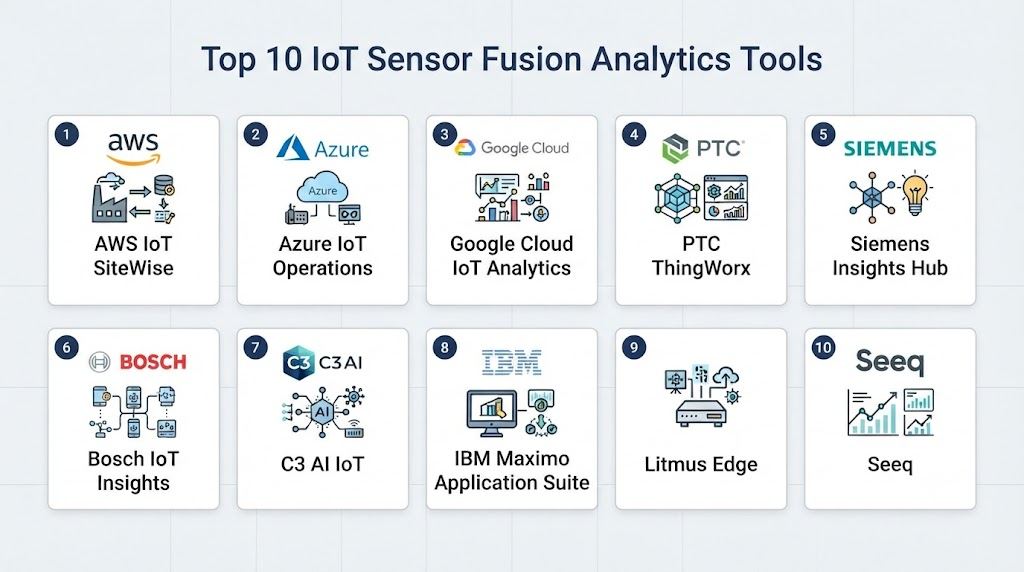
Top 10 IoT Sensor Fusion Analytics Tools
1. AWS IoT SiteWise
One-line verdict: Best for industrial organizations building scalable sensor analytics and asset-monitoring applications within the AWS ecosystem.
Short description:
AWS IoT SiteWise is designed to collect, structure, monitor, and analyze industrial equipment data. It is particularly useful for organizations that need to turn machine telemetry into operational metrics and combine data from industrial assets.
Standout Capabilities
- Industrial telemetry ingestion.
- Asset modeling.
- Time-series data.
- Industrial metrics.
- Operational dashboards.
- Edge data processing.
- Integration with AWS analytics services.
- Industrial equipment monitoring.
AI-Specific Depth
- Model support: AI/ML can be incorporated through the wider AWS ecosystem.
- RAG / knowledge integration: Not a core sensor-fusion capability.
- Evaluation: Can integrate with AWS machine-learning workflows.
- Guardrails: Application and AWS security controls.
- Observability: Monitoring through AWS services and IoT capabilities.
Pros
- Strong industrial IoT capabilities.
- Excellent integration with AWS services.
- Suitable for large-scale asset monitoring.
Cons
- AWS ecosystem dependency.
- Architecture can become complex.
- Costs vary according to data, devices, and connected services.
Security & Compliance
AWS provides security capabilities across its IoT ecosystem, including identity and access controls. Exact compliance coverage depends on the services and architecture selected.
Deployment & Platforms
- Cloud: Yes.
- Edge: Supported through applicable AWS IoT technologies.
- Hybrid: Yes.
- Web: Yes.
Integrations & Ecosystem
AWS IoT SiteWise can connect industrial data to broader AWS analytics and machine-learning services.
- AWS IoT.
- AWS IoT Greengrass.
- Amazon SageMaker.
- Amazon Kinesis.
- AWS Lambda.
- Amazon S3.
- CloudWatch.
Pricing Model
Usage-based cloud pricing; exact costs depend on deployment, ingestion, storage, processing, and related AWS services.
Best-Fit Scenarios
- Industrial manufacturing.
- Equipment monitoring.
- Large AWS-based IoT deployments.
2. Azure IoT Operations
One-line verdict: Best for industrial enterprises seeking edge-to-cloud IoT data processing within Microsoft’s broader Azure ecosystem.
Short description:
Azure IoT Operations provides capabilities for connecting, processing, and managing industrial IoT data across edge environments. It is useful for organizations that need to bring sensor information together before sending selected data to cloud systems.
Standout Capabilities
- Industrial data connectivity.
- Edge processing.
- MQTT-based architectures.
- Data transformation.
- Industrial asset connectivity.
- Cloud integration.
- Event-driven processing.
- Kubernetes-oriented edge architecture.
AI-Specific Depth
- Model support: AI models can be integrated through Azure’s broader AI ecosystem.
- RAG / knowledge integration: Application-dependent.
- Evaluation: Azure AI and ML tooling can provide evaluation workflows.
- Guardrails: Azure security and governance capabilities.
- Observability: Azure monitoring and telemetry tools.
Pros
- Strong Microsoft ecosystem integration.
- Useful for industrial edge architectures.
- Flexible data processing capabilities.
Cons
- Requires technical expertise for advanced deployments.
- Azure ecosystem dependency.
- Exact capabilities depend on the surrounding architecture.
Security & Compliance
Security and compliance depend on the Azure services and deployment configuration used.
Deployment & Platforms
- Cloud: Yes.
- Edge: Yes.
- Hybrid: Yes.
- Linux-based environments: Supported for applicable edge deployments.
Integrations & Ecosystem
- Azure IoT.
- Azure Event Hubs.
- Azure Data Explorer.
- Azure Machine Learning.
- Azure AI.
- Kubernetes.
- MQTT.
Pricing Model
Azure service and consumption-based pricing. Exact pricing varies by deployment.
Best-Fit Scenarios
- Industrial IoT.
- Edge analytics.
- Microsoft-centric enterprises.
3. Siemens Industrial Edge
One-line verdict: Best for manufacturers combining industrial sensor analytics, edge computing, automation, and factory operations.
Short description:
Siemens Industrial Edge provides an industrial edge environment for processing data close to machines and production systems. It is designed for manufacturing environments where real-time analytics and operational integration are important.
Standout Capabilities
- Industrial edge computing.
- Machine-data processing.
- Manufacturing analytics.
- Application deployment.
- Industrial connectivity.
- Edge AI.
- Factory integration.
- Operational data processing.
AI-Specific Depth
- Model support: AI and analytics applications can be deployed through the Industrial Edge ecosystem.
- RAG / knowledge integration: N/A as a primary platform capability.
- Evaluation: Application-dependent.
- Guardrails: Enterprise and application security controls.
- Observability: Edge and industrial monitoring capabilities.
Pros
- Strong manufacturing focus.
- Good fit for industrial environments.
- Connects analytics with automation infrastructure.
Cons
- More specialized than general-purpose IoT platforms.
- Can require Siemens ecosystem expertise.
- Enterprise deployments may require significant planning.
Security & Compliance
Security capabilities depend on the Industrial Edge configuration and applications deployed. Specific certifications should be verified for the selected product configuration.
Deployment & Platforms
- Edge: Yes.
- On-premises: Yes.
- Hybrid: Yes.
- Cloud: Integration supported.
Integrations & Ecosystem
- Siemens automation systems.
- Industrial controllers.
- Industrial protocols.
- Edge applications.
- Manufacturing systems.
- Cloud services.
- AI/analytics applications.
Pricing Model
Commercial and enterprise-based; exact pricing is Not publicly stated for all configurations.
Best-Fit Scenarios
- Smart factories.
- Industrial sensor fusion.
- Manufacturing analytics.
4. PTC ThingWorx
One-line verdict: Best for enterprises developing connected-product, industrial IoT, and operational analytics applications across complex assets.
Short description:
PTC ThingWorx is an industrial IoT application platform used to connect devices, collect data, create applications, and analyze operational information. It can support sensor-fusion use cases where multiple machine signals need to be interpreted together.
Standout Capabilities
- IoT application development.
- Device connectivity.
- Industrial data modeling.
- Real-time dashboards.
- Asset monitoring.
- Predictive analytics.
- Digital-twin-oriented applications.
- Enterprise integration.
AI-Specific Depth
- Model support: AI capabilities can be incorporated through ThingWorx and external ML technologies.
- RAG / knowledge integration: Not a core capability.
- Evaluation: Application-dependent.
- Guardrails: Platform and enterprise security controls.
- Observability: IoT monitoring and operational analytics.
Pros
- Strong industrial IoT heritage.
- Useful application-building capabilities.
- Supports complex connected-product scenarios.
Cons
- Enterprise platform complexity.
- Commercial licensing can require planning.
- Advanced AI workflows may require additional technologies.
Security & Compliance
Enterprise security capabilities are available, but exact certifications and controls depend on the product version and deployment.
Deployment & Platforms
- Cloud: Yes.
- On-premises: Supported in applicable configurations.
- Hybrid: Yes.
- Edge: Supported through relevant technologies.
Integrations & Ecosystem
- Industrial systems.
- ERP platforms.
- CRM systems.
- Cloud services.
- Machine-learning systems.
- Digital twin technologies.
- APIs.
Pricing Model
Commercial enterprise licensing; exact pricing is Not publicly stated.
Best-Fit Scenarios
- Connected products.
- Industrial equipment.
- Enterprise IoT applications.
5. IBM Maximo Application Suite
One-line verdict: Best for asset-intensive organizations combining IoT telemetry, asset management, maintenance, and AI-driven operational insights.
Short description:
IBM Maximo Application Suite brings together asset management, maintenance, monitoring, and operational intelligence. It is particularly useful when sensor data needs to support maintenance decisions and asset lifecycle management.
Standout Capabilities
- Asset management.
- Predictive maintenance.
- Condition monitoring.
- IoT data integration.
- Work management.
- AI-assisted insights.
- Asset health monitoring.
- Enterprise workflows.
AI-Specific Depth
- Model support: AI capabilities are available through the broader Maximo ecosystem.
- RAG / knowledge integration: Application-dependent.
- Evaluation: Model-specific and implementation-dependent.
- Guardrails: Enterprise security and workflow controls.
- Observability: Asset and operational monitoring.
Pros
- Strong maintenance capabilities.
- Useful for asset-heavy organizations.
- Combines operational and maintenance workflows.
Cons
- Broader platform can be complex.
- May be excessive for simple IoT projects.
- Enterprise implementation can require specialist expertise.
Security & Compliance
IBM provides enterprise security capabilities across its product ecosystem. Exact certifications depend on product configuration and deployment.
Deployment & Platforms
- Cloud: Yes.
- On-premises: Available for applicable configurations.
- Hybrid: Yes.
- Edge: Supported through relevant components.
Integrations & Ecosystem
- IoT platforms.
- Enterprise asset management.
- Maintenance systems.
- ERP systems.
- AI/ML services.
- APIs.
- Industrial data sources.
Pricing Model
Enterprise and subscription-based models may apply; exact pricing is Not publicly stated.
Best-Fit Scenarios
- Predictive maintenance.
- Utilities.
- Manufacturing.
- Transportation assets.
6. Datadog IoT Monitoring
One-line verdict: Best for teams that need unified monitoring of IoT-connected infrastructure, telemetry, applications, and operational environments.
Short description:
Datadog provides monitoring and observability capabilities that can help teams analyze telemetry from connected systems and infrastructure. It is particularly useful when IoT sensor information needs to be correlated with application and infrastructure signals.
Standout Capabilities
- Infrastructure monitoring.
- Metrics.
- Logs.
- Distributed observability.
- Alerting.
- Dashboards.
- Event correlation.
- Cloud monitoring.
AI-Specific Depth
- Model support: AI-assisted capabilities depend on the Datadog products used.
- RAG / knowledge integration: Not a primary sensor-fusion function.
- Evaluation: Application-dependent.
- Guardrails: Platform security controls.
- Observability: A major platform strength, including metrics, logs, traces, and related telemetry.
Pros
- Strong observability ecosystem.
- Excellent telemetry visualization.
- Useful for correlating multiple data sources.
Cons
- Primarily an observability platform rather than a dedicated sensor-fusion engine.
- Cost can increase with telemetry volume.
- Advanced industrial workflows may require additional platforms.
Security & Compliance
Enterprise security features are available; exact certifications and controls depend on the selected service and plan.
Deployment & Platforms
- Cloud: Yes.
- Edge: Through supported agents and architectures.
- Hybrid: Yes.
- Web: Yes.
Integrations & Ecosystem
- Cloud infrastructure.
- Kubernetes.
- Databases.
- IoT systems.
- APIs.
- Logs.
- Metrics.
- Traces.
Pricing Model
Typically usage-based and product-dependent.
Best-Fit Scenarios
- IoT observability.
- Connected infrastructure.
- Cloud-edge monitoring.
7. ThingsBoard
One-line verdict: Best for organizations wanting an IoT platform with device management, telemetry processing, dashboards, and customizable analytics.
Short description:
ThingsBoard is an IoT platform designed for device connectivity, telemetry collection, visualization, processing, and IoT application development. It can be used to combine multiple sensor streams into operational dashboards and rules.
Standout Capabilities
- Device management.
- Telemetry collection.
- Rule engine.
- Dashboards.
- IoT data processing.
- Alarms.
- API access.
- Custom IoT applications.
AI-Specific Depth
- Model support: AI integration is generally application-dependent.
- RAG / knowledge integration: N/A.
- Evaluation: External or custom ML evaluation.
- Guardrails: Rule and application controls.
- Observability: Telemetry dashboards and monitoring.
Pros
- Flexible IoT architecture.
- Strong device and telemetry capabilities.
- Suitable for custom deployments.
Cons
- Advanced AI capabilities may require external tools.
- Complex deployments require engineering resources.
- Analytics depth depends on implementation.
Security & Compliance
Security features depend on the selected edition and deployment configuration. Certifications: Not publicly stated as a universal platform claim.
Deployment & Platforms
- Cloud: Yes.
- Self-hosted: Yes.
- Edge: Applicable architectures.
- Hybrid: Yes.
Integrations & Ecosystem
- MQTT.
- HTTP.
- CoAP.
- WebSockets.
- REST APIs.
- Databases.
- External analytics platforms.
Pricing Model
Open-source and commercial editions are available; exact commercial pricing varies.
Best-Fit Scenarios
- Custom IoT platforms.
- SMB and mid-market deployments.
- Sensor telemetry dashboards.
8. InfluxDB
One-line verdict: Best for high-volume time-series sensor data where efficient storage, querying, and analytics are central requirements.
Short description:
InfluxDB is a time-series database and data platform designed to store and query telemetry efficiently. While it is not a complete sensor-fusion AI platform, it can serve as an important analytics layer for applications combining multiple sensor streams.
Standout Capabilities
- Time-series storage.
- High-frequency telemetry.
- Data querying.
- Monitoring.
- Visualization integration.
- Historical analysis.
- Real-time analytics.
- IoT data management.
AI-Specific Depth
- Model support: AI integration is external/application-dependent.
- RAG / knowledge integration: N/A.
- Evaluation: External ML systems.
- Guardrails: Application-level.
- Observability: Strong telemetry and time-series capabilities.
Pros
- Excellent for time-series data.
- Strong IoT ecosystem.
- Useful foundation for custom sensor-fusion systems.
Cons
- Not a complete AI platform.
- Sensor-fusion algorithms must generally be built separately.
- Requires additional technologies for advanced ML.
Security & Compliance
Security depends on the deployment and edition. Specific certifications: Not publicly stated for every deployment scenario.
Deployment & Platforms
- Cloud: Yes.
- Self-hosted: Yes.
- Hybrid: Yes.
- Linux: Yes.
- Windows: Applicable deployment options vary.
Integrations & Ecosystem
- Telegraf.
- MQTT ecosystems.
- Grafana.
- Python.
- APIs.
- Kubernetes.
- Cloud services.
Pricing Model
Open-source and commercial/cloud options exist; exact pricing varies.
Best-Fit Scenarios
- High-volume telemetry.
- Custom analytics pipelines.
- Industrial time-series workloads.
9. Grafana
One-line verdict: Best for visualizing and correlating multi-source IoT telemetry while building operational monitoring and analytics dashboards.
Short description:
Grafana is a widely used visualization and observability platform capable of connecting to many data sources. It can be an effective analytics layer for IoT teams that need to visualize multiple sensor streams and identify relationships between them.
Standout Capabilities
- Multi-source dashboards.
- Time-series visualization.
- Alerting.
- Data exploration.
- Operational monitoring.
- Plugin ecosystem.
- Correlation of telemetry.
- Real-time dashboards.
AI-Specific Depth
- Model support: AI functionality depends on connected services and extensions.
- RAG / knowledge integration: N/A as a core capability.
- Evaluation: External.
- Guardrails: Platform and application controls.
- Observability: One of its strongest capabilities.
Pros
- Highly flexible visualization.
- Large ecosystem.
- Works with many IoT data sources.
Cons
- Not a dedicated sensor-fusion engine.
- Advanced AI requires additional components.
- Dashboard design can become complex at scale.
Security & Compliance
Security features depend on the Grafana edition and deployment. Specific certifications should be verified for the selected offering.
Deployment & Platforms
- Cloud: Yes.
- Self-hosted: Yes.
- Hybrid: Yes.
- Web: Yes.
Integrations & Ecosystem
- InfluxDB.
- Prometheus.
- SQL databases.
- Cloud monitoring platforms.
- IoT databases.
- APIs.
- Plugins.
Pricing Model
Open-source and commercial/cloud offerings are available; pricing varies.
Best-Fit Scenarios
- IoT dashboards.
- Sensor monitoring.
- Multi-source operational analytics.
10. Apache Kafka
One-line verdict: Best for engineering teams building scalable real-time sensor-fusion pipelines from large volumes of streaming IoT data.
Short description:
Apache Kafka is a distributed event-streaming platform rather than a dedicated IoT analytics application. It is nevertheless highly relevant to sensor fusion because it can transport and process high-volume streams from many sensors before those streams reach AI and analytics systems.
Standout Capabilities
- High-volume event streaming.
- Real-time data pipelines.
- Sensor-stream integration.
- Event processing.
- Distributed architecture.
- Data replay.
- Stream integration.
- Large-scale ingestion.
AI-Specific Depth
- Model support: AI models typically operate through connected processing systems.
- RAG / knowledge integration: N/A.
- Evaluation: External.
- Guardrails: Application and infrastructure dependent.
- Observability: Monitoring through Kafka and associated observability tools.
Pros
- Excellent scalability.
- Strong event-streaming architecture.
- Useful foundation for custom sensor-fusion pipelines.
Cons
- Not a complete IoT analytics platform.
- Requires substantial engineering expertise.
- Additional components are needed for ML inference and visualization.
Security & Compliance
Security capabilities depend on deployment and configuration. Certifications: Not publicly stated as a universal Kafka deployment claim.
Deployment & Platforms
- Cloud: Yes.
- Self-hosted: Yes.
- Hybrid: Yes.
- Linux: Yes.
- Containers: Yes.
Integrations & Ecosystem
- Kafka Streams.
- Connectors.
- Databases.
- IoT platforms.
- Data warehouses.
- Machine-learning systems.
- Stream-processing frameworks.
Pricing Model
Apache Kafka is open source; managed commercial services have separate pricing models.
Best-Fit Scenarios
- Large-scale sensor streaming.
- Custom AI pipelines.
- Enterprise event-driven architectures.
Comparison Table
| Tool | Best For | Deployment | Model Flexibility | Strength | Watch-Out | Public Rating |
|---|---|---|---|---|---|---|
| AWS IoT SiteWise | Industrial sensor analytics | Cloud / Edge / Hybrid | Multi-model through AWS | Industrial asset modeling | AWS dependency | N/A |
| Azure IoT Operations | Industrial edge analytics | Cloud / Edge / Hybrid | Multi-model | Edge data processing | Architecture complexity | N/A |
| Siemens Industrial Edge | Smart manufacturing | Edge / Hybrid | Multi-model | Factory integration | Specialized ecosystem | N/A |
| PTC ThingWorx | Enterprise industrial IoT | Cloud / Edge / Hybrid | Multi-model | IoT application development | Enterprise complexity | N/A |
| IBM Maximo | Asset analytics | Cloud / Hybrid / On-premises | Multi-model | Predictive maintenance | Broad platform scope | N/A |
| Datadog | IoT observability | Cloud / Hybrid | Multi-model | Telemetry correlation | Not dedicated sensor fusion | N/A |
| ThingsBoard | Custom IoT systems | Cloud / Self-hosted | BYO / External AI | Device management | AI requires integration | N/A |
| InfluxDB | Time-series analytics | Cloud / Self-hosted | BYO / External AI | Sensor data storage | Not a complete AI platform | N/A |
| Grafana | Sensor visualization | Cloud / Self-hosted | BYO / External AI | Flexible dashboards | Requires data sources | N/A |
| Apache Kafka | Sensor-stream pipelines | Cloud / Self-hosted / Hybrid | BYO / External AI | Real-time streaming | High engineering overhead | N/A |
Scoring & Evaluation
The following scoring is comparative rather than an official ranking. Scores reflect typical strengths for IoT sensor-fusion analytics, not guaranteed performance for every workload. Actual results depend on sensor volume, data quality, hardware, architecture, AI models, and deployment complexity.
| Tool | Core | Reliability/Eval | Guardrails | Integrations | Ease | Perf/Cost | Security/Admin | Support | Weighted Total |
|---|---|---|---|---|---|---|---|---|---|
| AWS IoT SiteWise | 9.5 | 8.5 | 8.5 | 9.5 | 8 | 8.5 | 9 | 9.5 | 8.9 |
| Azure IoT Operations | 9 | 8.5 | 9 | 9.5 | 7.5 | 8.5 | 9 | 9.5 | 8.8 |
| Siemens Industrial Edge | 9.5 | 8.5 | 8.5 | 9 | 7.5 | 9 | 9 | 9 | 8.8 |
| PTC ThingWorx | 9.5 | 8.5 | 8.5 | 9.5 | 7.5 | 8 | 9 | 9 | 8.7 |
| IBM Maximo | 9 | 8.5 | 9 | 9 | 7.5 | 8 | 9.5 | 9.5 | 8.7 |
| Datadog | 8 | 8.5 | 8.5 | 9.5 | 8.5 | 7.5 | 9 | 9.5 | 8.5 |
| ThingsBoard | 8.5 | 7.5 | 7.5 | 8.5 | 8 | 9 | 7.5 | 8.5 | 8.2 |
| InfluxDB | 8.5 | 8 | 7.5 | 9 | 8 | 9 | 8 | 9 | 8.3 |
| Grafana | 8 | 7.5 | 7.5 | 9.5 | 9 | 8.5 | 8.5 | 9.5 | 8.4 |
| Apache Kafka | 9 | 8.5 | 8 | 10 | 6.5 | 9 | 8.5 | 9.5 | 8.6 |
Top 3 for Enterprise
- AWS IoT SiteWise
- Azure IoT Operations
- Siemens Industrial Edge
Top 3 for SMB
- ThingsBoard
- InfluxDB
- Grafana
Top 3 for Developers
- Apache Kafka
- InfluxDB
- ThingsBoard
Which IoT Sensor Fusion Analytics Tool Is Right for You?
Solo / Freelancer
For individual developers, the priority should be flexibility and low infrastructure overhead.
Consider:
- ThingsBoard.
- InfluxDB.
- Grafana.
- Apache Kafka for advanced streaming projects.
Avoid adopting a large enterprise IoT suite unless the project genuinely requires its device-management and industrial capabilities.
SMB
SMBs should prioritize simplicity, transparent architecture, and manageable operating costs.
A practical architecture might combine:
- MQTT for device communication.
- ThingsBoard for device and telemetry management.
- InfluxDB for time-series storage.
- Grafana for visualization.
- A lightweight ML service for anomaly detection.
This approach can provide substantial flexibility without introducing an unnecessarily complex enterprise platform.
Mid-Market
Mid-market organizations should focus on integration and operational scalability.
Evaluate:
- Device count.
- Sensor frequency.
- Data retention.
- Edge processing.
- AI inference requirements.
- Alert volume.
- Existing cloud infrastructure.
- Security requirements.
AWS IoT SiteWise, Azure IoT Operations, PTC ThingWorx, and Siemens Industrial Edge can be strong candidates depending on the existing environment.
Enterprise
Large enterprises should think beyond dashboards and focus on the complete data lifecycle.
Important capabilities include:
- Device identity.
- Data governance.
- Edge processing.
- Stream processing.
- Asset modeling.
- AI model deployment.
- Model monitoring.
- Security.
- Auditability.
- Integration with enterprise systems.
The best solution may involve multiple technologies rather than one monolithic platform.
Regulated Industries
For healthcare, energy, transportation, public infrastructure, and other regulated environments, sensor fusion requires careful data governance.
Pay particular attention to:
- Data residency.
- Retention.
- Encryption.
- Access control.
- Audit logging.
- Device identity.
- Secure updates.
- Data minimization.
- AI model governance.
- Human review for high-impact decisions.
Do not assume that an IoT platform is automatically compliant simply because it is marketed for enterprise use.
Budget vs Premium
Open-source components can reduce licensing costs but increase engineering and operational responsibilities.
Commercial platforms can reduce implementation effort while introducing subscription, infrastructure, and vendor costs.
Calculate total cost across:
- Devices.
- Connectivity.
- Storage.
- Processing.
- AI inference.
- Cloud services.
- Engineering.
- Maintenance.
- Monitoring.
- Security.
Build vs Buy
Build your own sensor-fusion pipeline when you need:
- Highly specialized algorithms.
- Custom sensor combinations.
- Proprietary data-processing logic.
- Specialized edge hardware.
- Unique AI models.
Buy an established platform when:
- You need fast deployment.
- Device management is important.
- Your team lacks IoT infrastructure expertise.
- You require enterprise integrations.
- You need operational support.
A hybrid approach is often the most practical choice: use established IoT infrastructure and build proprietary fusion and AI logic on top.
Implementation Playbook
First 30 Days: Pilot + Success Metrics
Start with a single operational use case.
Identify:
- Sensors.
- Data frequency.
- Data formats.
- Timestamp accuracy.
- Missing-data rates.
- Noise levels.
- Network constraints.
- Target decisions.
Create baseline metrics for:
- Detection accuracy.
- False-positive rate.
- False-negative rate.
- Latency.
- Data completeness.
- Processing cost.
Before applying AI, establish a reliable sensor-data pipeline.
Days 31–60: Security + Evaluation + Rollout
Introduce sensor-quality validation.
Check:
- Missing values.
- Duplicate events.
- Timestamp drift.
- Sensor calibration.
- Outliers.
- Communication failures.
- Contradictory sensor signals.
Build an evaluation harness for AI models.
Test:
- Normal conditions.
- Rare events.
- Sensor failures.
- Noisy inputs.
- Missing sensors.
- Conflicting signals.
- Distribution changes.
Add secure authentication and role-based access where required.
Days 61–90: Optimization + Governance + Scale
At this stage:
- Optimize stream processing.
- Move latency-sensitive workloads toward the edge.
- Reduce unnecessary cloud ingestion.
- Improve model inference efficiency.
- Establish model version control.
- Monitor sensor drift.
- Track AI performance.
- Establish incident-response procedures.
- Automate device and model deployment.
Create clear ownership for devices, data pipelines, models, and operational alerts.
Common Mistakes & How to Avoid Them
- Treating sensor fusion as simple data aggregation: Fusion requires synchronization, normalization, and meaningful interpretation.
- Ignoring timestamp quality: Misaligned timestamps can create false relationships.
- Trusting every sensor equally: Sensor reliability varies.
- Ignoring calibration: Poorly calibrated sensors can undermine an entire AI system.
- No missing-data strategy: Real-world IoT networks frequently experience gaps.
- Sending everything to the cloud: Edge processing can reduce latency and bandwidth.
- No sensor-quality monitoring: Detect failing sensors before they corrupt analytics.
- No AI evaluation framework: Validate models against realistic operating conditions.
- Ignoring false positives: Excessive alerts can cause operational teams to ignore the system.
- Ignoring false negatives: Missed failures can be more expensive than noisy alerts.
- No model version control: Always know which model produced an operational decision.
- Overlooking security: Every connected sensor can become part of the attack surface.
- Building an overly complex architecture: Start with the smallest useful sensor-fusion pipeline.
- Ignoring vendor lock-in: Maintain portable data formats and APIs where practical.
FAQs
What is IoT sensor fusion analytics?
It is the process of combining information from multiple sensors and analyzing those signals together to produce more reliable insights than individual sensor streams can provide.
Why is sensor fusion useful?
Multiple sensors can provide complementary information. Combining them can improve anomaly detection, asset monitoring, localization, predictive maintenance, and operational decision-making.
Does sensor fusion always require AI?
No. Rule engines, statistical methods, filtering, and traditional signal-processing techniques can all perform sensor fusion. AI becomes useful for more complex patterns and prediction problems.
What sensors can be combined?
Almost any compatible data sources can potentially be combined, including temperature, vibration, pressure, current, humidity, GPS, accelerometers, cameras, microphones, and machine telemetry.
Can sensor fusion run at the edge?
Yes. Edge processing is often valuable when low latency, offline operation, bandwidth reduction, or data privacy is important.
What is the biggest challenge in sensor fusion?
Data quality is one of the biggest challenges. Sensor readings must often be synchronized, calibrated, cleaned, normalized, and validated before fusion.
Can sensor fusion support predictive maintenance?
Yes. Combining vibration, temperature, current, pressure, acoustic, and operational data can help identify patterns associated with equipment degradation.
Can IoT sensor analytics use machine learning?
Yes. Machine-learning models can be trained to detect anomalies, classify conditions, predict failures, estimate asset health, and identify complex relationships between sensors.
Should all sensor data be stored?
Not necessarily. Organizations should determine what data needs long-term retention, what can be summarized, and what should be processed locally.
Is real-time processing necessary?
It depends on the application. Safety, robotics, autonomous systems, and industrial control may require very low latency, while long-term asset analytics may tolerate delayed processing.
Can open-source tools be used for sensor fusion?
Yes. Tools such as ThingsBoard, InfluxDB, Grafana, and Apache Kafka can form parts of an open-source or hybrid IoT analytics architecture.
How expensive is IoT sensor fusion analytics?
Costs vary significantly. Expenses can include sensors, gateways, connectivity, cloud infrastructure, storage, AI inference, software licensing, engineering, and ongoing maintenance.
What is edge-to-cloud sensor fusion?
It is an architecture where some processing occurs near sensors while larger-scale analytics, historical analysis, or model training occurs in centralized cloud or data-center environments.
How can organizations reduce sensor-fusion costs?
Process latency-sensitive data at the edge, aggregate unnecessary high-frequency signals, optimize storage, use efficient models, and avoid sending raw data to the cloud when processed results are sufficient.
What security risks should be considered?
IoT sensor networks can face device compromise, credential theft, insecure communication, unauthorized access, malicious firmware, data manipulation, and attacks against connected analytics systems.
How do I choose between an IoT platform and a time-series database?
An IoT platform generally provides device connectivity and management in addition to analytics. A time-series database focuses primarily on storing and querying telemetry. Many real deployments use both.
Conclusion
IoT Sensor Fusion Analytics is becoming increasingly important as organizations deploy larger and more diverse networks of connected devices. The real value does not come from collecting more sensor data; it comes from combining signals intelligently and turning them into reliable operational decisions.For industrial environments, AWS IoT SiteWise, Azure IoT Operations, Siemens Industrial Edge, PTC ThingWorx, and IBM Maximo provide broader enterprise capabilities. For flexible and developer-oriented architectures, ThingsBoard, InfluxDB, Grafana, and Apache Kafka can serve as important building blocks.The right solution depends on the problem being solved. A simple monitoring project may need only a time-series database and dashboard, while a global manufacturing operation may require edge processing, asset modeling, AI inference, device management, streaming infrastructure, and centralized govern