Introduction
AI In-Car Voice Assistants are intelligent voice interfaces that allow drivers and passengers to interact with vehicles using natural language. Instead of relying mainly on buttons, menus, or rigid voice commands, modern systems can understand conversational requests and connect them with navigation, media, communication, vehicle functions, and other digital services.
Common use cases include hands-free navigation, music control, phone calls, message handling, climate-control commands, vehicle-status questions, destination search, restaurant or charging-station discovery, and conversational assistance while driving.
Best for: Automakers, automotive software teams, connected-car companies, fleet operators, infotainment developers, and technology teams building software-defined vehicles.
Not ideal for: Older vehicles without connected infotainment systems, organizations that only need basic voice commands, or applications where offline deterministic controls are sufficient.
What’s Changed in AI In-Car Voice Assistants
- Conversational AI is replacing rigid command-based voice interfaces.
- Generative AI can make vehicle assistants better at handling natural language.
- Multimodal assistants can combine voice with maps, screens, cameras, and vehicle data.
- Automotive assistants are increasingly connected to navigation and infotainment systems.
- AI can handle follow-up questions without requiring the driver to repeat context.
- Cloud AI enables more capable language understanding, while edge processing can reduce latency.
- Hybrid architectures can use local models for privacy-sensitive or safety-critical functions.
- Vehicle assistants are increasingly being integrated with software-defined vehicle platforms.
- AI assistants can potentially connect with third-party services through controlled APIs.
- Context awareness can incorporate location, trip state, vehicle status, and previous conversational turns.
- Automotive cybersecurity is becoming increasingly important as voice assistants gain access to vehicle functions.
- Prompt injection and malicious voice input need consideration when assistants interact with external services.
- Data retention and voice-recording policies are important because conversational systems can process sensitive information.
- Automakers need clear boundaries between conversational assistance and safety-critical vehicle control.
- Evaluation must cover speech recognition, intent accuracy, hallucination, latency, multilingual performance, and failure behavior.
- OTA software updates make continuous improvement of automotive assistants more practical.
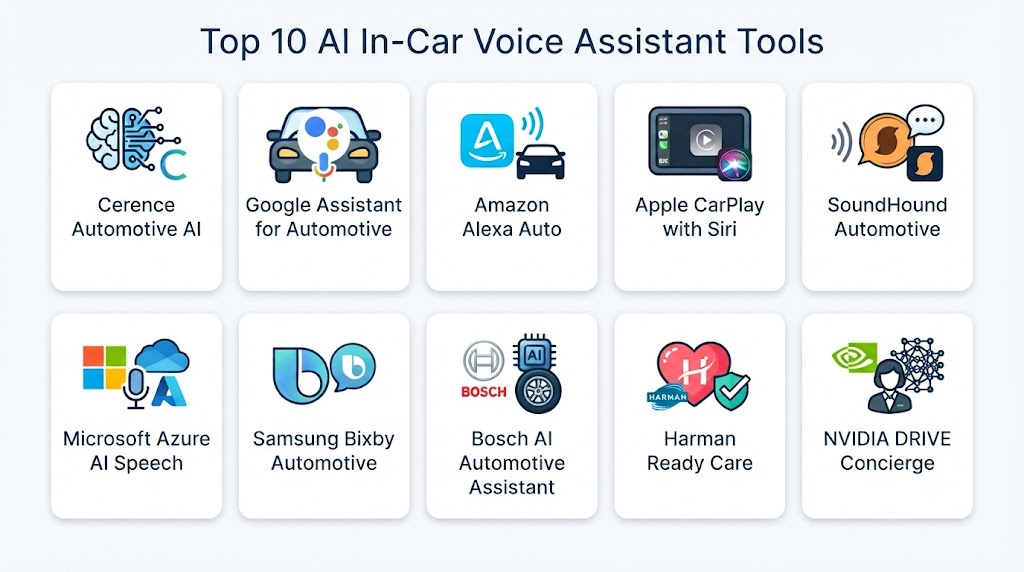
Top 10 AI In-Car Voice Assistant Tools
1 — Google Gemini for Automotive
One-line verdict: Best for automakers seeking a conversational AI assistant deeply connected with Google services and Android-based automotive experiences.
Short description:
Google Gemini for Automotive brings generative AI capabilities into vehicle experiences. It is designed to support more natural conversations and can connect assistance with functions such as navigation, communication, and entertainment depending on the vehicle implementation.
Standout Capabilities
- Natural-language conversations
- Generative AI assistance
- Navigation-related assistance
- Media interaction
- Communication support
- Contextual responses
- Android automotive integration
- Conversational follow-up
AI-Specific Depth
- Model support: Google Gemini models and automotive-specific integrations.
- RAG / knowledge integration: Connected information capabilities vary by implementation.
- Evaluation: Automotive AI evaluation and platform testing.
- Guardrails: Safety and product-level controls.
- Observability: Platform and implementation-dependent monitoring.
Pros
- Strong generative-AI capabilities.
- Natural conversational interaction.
- Broad Google ecosystem integration.
Cons
- Availability depends on automaker and vehicle implementation.
- Requires integration with automotive software.
- Cloud dependency may affect some use cases.
Security & Compliance
Security, privacy, data retention, and access controls depend on the automotive implementation and selected Google services.
Deployment & Platforms
- Automotive infotainment
- Android Automotive environments
- Cloud
- Vehicle-integrated systems
Integrations & Ecosystem
- Google services
- Navigation
- Media
- Communication
- Android Automotive
- Vehicle systems
- Third-party services
Pricing Model
Commercial terms for automakers vary.
Best-Fit Scenarios
- Software-defined vehicles
- Connected-car infotainment
- Generative-AI automotive assistants
2 — Amazon Alexa Custom Assistant
One-line verdict: Best for automakers wanting customizable conversational voice technology integrated into connected vehicle experiences.
Short description:
Amazon’s automotive voice technologies enable automakers to create voice-controlled experiences for vehicles. Alexa-related automotive solutions can support entertainment, navigation, smart-home interactions, and other connected services.
Standout Capabilities
- Voice interaction
- Natural-language commands
- Media control
- Smart-home connectivity
- Navigation-related capabilities
- Custom automotive experiences
- Third-party integrations
- Voice applications
AI-Specific Depth
- Model support: Amazon voice and AI technologies.
- RAG / knowledge integration: Depends on application integration.
- Evaluation: Application-specific voice and intent evaluation.
- Guardrails: Platform and application controls.
- Observability: Implementation-dependent.
Pros
- Mature voice ecosystem.
- Broad smart-device integrations.
- Customizable automotive experiences.
Cons
- Automotive availability varies.
- Some capabilities depend on cloud connectivity.
- Automakers need to integrate vehicle-specific functions.
Security & Compliance
Security and privacy depend on platform configuration, vehicle integration, and applicable Amazon services.
Deployment & Platforms
- Cloud
- Automotive infotainment
- Embedded vehicle environments
Integrations & Ecosystem
- Alexa services
- Smart-home devices
- Navigation
- Media
- Automotive systems
- APIs
- Third-party services
Pricing Model
Commercial and OEM-specific terms vary.
Best-Fit Scenarios
- Connected vehicles
- Voice-controlled infotainment
- Smart-home-connected cars
3 — Cerence AI
One-line verdict: Best for automakers seeking automotive-focused conversational AI designed specifically for in-vehicle interaction.
Short description:
Cerence specializes in AI-powered automotive assistants and conversational technologies. Its solutions are designed around vehicle voice interaction, infotainment, navigation, and connected-car experiences.
Standout Capabilities
- Automotive voice recognition
- Conversational AI
- In-car assistants
- Navigation interaction
- Media control
- Vehicle command integration
- Multilingual interaction
- Automotive personalization
AI-Specific Depth
- Model support: Proprietary automotive AI technologies.
- RAG / knowledge integration: Capabilities vary by product and implementation.
- Evaluation: Automotive speech and conversational evaluation.
- Guardrails: Automotive command and product-level controls.
- Observability: Deployment-dependent.
Pros
- Automotive-specific expertise.
- Designed for in-car environments.
- Broad voice and conversational capabilities.
Cons
- Primarily OEM-oriented.
- Commercial implementation requires automotive integration.
- Exact AI architecture varies by product.
Security & Compliance
Specific security, retention, and compliance capabilities depend on the product and OEM deployment.
Deployment & Platforms
- Embedded automotive systems
- Cloud
- Hybrid configurations
Integrations & Ecosystem
- Infotainment systems
- Navigation
- Vehicle controls
- Media
- Automotive software
- Cloud services
- APIs
Pricing Model
Enterprise/OEM commercial model.
Best-Fit Scenarios
- Automotive OEMs
- Connected vehicles
- In-car voice interfaces
4 — SoundHound AI
One-line verdict: Best for automakers seeking conversational voice AI with automotive-specific integrations and flexible voice experiences.
Short description:
SoundHound AI develops conversational voice technologies and automotive solutions. Its platform is designed to understand natural speech and support voice-driven interactions within connected vehicle environments.
Standout Capabilities
- Conversational voice AI
- Natural-language understanding
- Automotive assistants
- Navigation
- Media
- Connected services
- Multi-turn conversations
- Voice-enabled applications
AI-Specific Depth
- Model support: Proprietary conversational AI technologies.
- RAG / knowledge integration: Supported capabilities vary by deployment.
- Evaluation: Voice and conversational evaluation.
- Guardrails: Application and automotive controls.
- Observability: Deployment-dependent.
Pros
- Strong voice-AI specialization.
- Automotive focus.
- Supports natural conversational interaction.
Cons
- OEM-focused implementation.
- Exact feature availability varies.
- Integration requires automotive software work.
Security & Compliance
Specific security and data-retention controls depend on the product and deployment.
Deployment & Platforms
- Embedded automotive
- Cloud
- Hybrid
Integrations & Ecosystem
- Navigation
- Infotainment
- Automotive systems
- APIs
- Connected services
- Media
- Third-party applications
Pricing Model
Enterprise/OEM pricing.
Best-Fit Scenarios
- Connected vehicles
- Automotive infotainment
- Conversational voice systems
5 — Apple CarPlay with Siri
One-line verdict: Best for drivers wanting familiar voice interaction across compatible vehicles and Apple devices.
Short description:
Apple CarPlay integrates iPhone capabilities into compatible vehicle infotainment systems, while Siri provides voice interaction for supported functions. It is particularly useful for communication, navigation, media, and hands-free interactions.
Standout Capabilities
- Siri voice interaction
- Navigation
- Calls
- Messages
- Music
- Hands-free operation
- iPhone integration
- Voice-driven applications
AI-Specific Depth
- Model support: Apple’s proprietary voice and AI technologies.
- RAG / knowledge integration: Connected Apple services and supported applications.
- Evaluation: Apple-controlled platform evaluation.
- Guardrails: Platform-level restrictions.
- Observability: Not publicly stated in detail.
Pros
- Familiar user experience.
- Strong iPhone integration.
- Broad consumer adoption.
Cons
- Requires compatible Apple devices and vehicles.
- Vehicle integration is more limited than native OEM systems for some functions.
- Feature availability varies by vehicle and region.
Security & Compliance
Apple provides platform-level privacy and security controls, while vehicle-specific handling depends on the automaker.
Deployment & Platforms
- Compatible vehicles
- iPhone
- Vehicle infotainment displays
Integrations & Ecosystem
- iPhone
- Siri
- Apple Maps
- Messages
- Music
- Calls
- Compatible applications
Pricing Model
CarPlay availability and vehicle integration depend on the automaker; Siri is part of Apple’s device ecosystem.
Best-Fit Scenarios
- Consumer vehicles
- iPhone users
- Hands-free infotainment
6 — Android Auto
One-line verdict: Best for Android users who want voice-enabled navigation, communication, and media inside compatible vehicles.
Short description:
Android Auto brings compatible Android smartphone functions into vehicle infotainment systems. Voice interaction can support navigation, communication, media, and other supported applications.
Standout Capabilities
- Voice interaction
- Navigation
- Calls
- Messaging
- Media
- Google Assistant-related experiences
- Android application integration
- Hands-free operation
AI-Specific Depth
- Model support: Google voice and AI technologies.
- RAG / knowledge integration: Depends on connected services.
- Evaluation: Platform-specific testing.
- Guardrails: Platform and automotive restrictions.
- Observability: Not publicly stated in detail.
Pros
- Strong Android integration.
- Broad vehicle compatibility.
- Familiar mobile-to-car experience.
Cons
- Depends on smartphone connectivity.
- Vehicle control capabilities vary.
- Feature availability differs across vehicles and regions.
Security & Compliance
Platform-level security and privacy controls are provided, while vehicle-specific handling depends on the implementation.
Deployment & Platforms
- Android smartphones
- Compatible vehicles
- Infotainment displays
Integrations & Ecosystem
- Android
- Google services
- Navigation
- Messaging
- Media
- Compatible applications
- Vehicle infotainment
Pricing Model
Generally part of the compatible Android and vehicle ecosystem; vehicle implementation varies.
Best-Fit Scenarios
- Android users
- Connected vehicles
- Hands-free navigation and communication
7 — Microsoft Automotive AI Technologies
One-line verdict: Best for automakers and mobility companies building enterprise-connected vehicle assistants around cloud and AI services.
Short description:
Microsoft provides cloud, AI, speech, and enterprise technologies that can be used to create connected automotive assistants. Teams can combine speech recognition, language models, APIs, and vehicle data into custom conversational experiences.
Standout Capabilities
- Speech recognition
- Conversational AI
- Cloud AI
- Enterprise integration
- Custom assistants
- APIs
- Data integration
- Developer tooling
AI-Specific Depth
- Model support: Multiple AI and speech technologies.
- RAG / knowledge integration: Available through broader AI services.
- Evaluation: Application-specific and platform capabilities.
- Guardrails: AI safety and enterprise controls vary by service.
- Observability: Cloud monitoring and application telemetry.
Pros
- Strong enterprise ecosystem.
- Flexible cloud architecture.
- Broad AI development capabilities.
Cons
- Requires significant automotive development.
- Not a complete plug-and-play automotive assistant.
- Vehicle integration remains the OEM’s responsibility.
Security & Compliance
Cloud identity, access management, encryption, logging, and governance capabilities depend on selected services and configuration.
Deployment & Platforms
- Cloud
- Embedded systems
- APIs
- Edge
- Hybrid
Integrations & Ecosystem
- Speech services
- AI services
- Cloud platforms
- Vehicle APIs
- Databases
- Enterprise applications
- Developer tools
Pricing Model
Usage-based and enterprise pricing varies by service.
Best-Fit Scenarios
- Custom automotive assistants
- Enterprise mobility platforms
- Connected-vehicle applications
8 — NVIDIA DRIVE AI
One-line verdict: Best for automakers developing high-performance in-vehicle AI experiences integrated with broader vehicle computing platforms.
Short description:
NVIDIA DRIVE provides automotive computing and AI technologies that can support intelligent vehicle experiences. Its ecosystem can be part of an architecture combining voice, perception, cockpit computing, and other AI workloads.
Standout Capabilities
- Automotive AI computing
- Edge AI
- In-vehicle processing
- Generative AI integration
- Multimodal AI
- High-performance inference
- Cockpit computing
- Software-defined vehicle infrastructure
AI-Specific Depth
- Model support: Broad AI model and framework support.
- RAG / knowledge integration: Possible through application architecture.
- Evaluation: Developer and application-specific.
- Guardrails: Automotive application controls.
- Observability: Depends on the deployed software stack.
Pros
- High-performance automotive computing.
- Strong AI ecosystem.
- Suitable for multimodal vehicle experiences.
Cons
- Infrastructure-oriented.
- Requires substantial automotive engineering.
- Not simply a consumer voice-assistant application.
Security & Compliance
Security depends on vehicle architecture, software stack, OEM controls, and deployment.
Deployment & Platforms
- Automotive edge
- Vehicle computers
- Cloud
- Hybrid
Integrations & Ecosystem
- NVIDIA DRIVE
- GPUs
- AI frameworks
- Vehicle sensors
- Cockpit systems
- APIs
- Automotive software
Pricing Model
Enterprise/OEM commercial model.
Best-Fit Scenarios
- Software-defined vehicles
- AI cockpits
- Multimodal automotive AI
9 — Qualcomm Snapdragon Digital Chassis
One-line verdict: Best for automakers building connected digital cockpits with integrated voice, AI, infotainment, and vehicle computing.
Short description:
Qualcomm’s automotive platform technologies support digital cockpits, connectivity, computing, and AI workloads. These capabilities can provide infrastructure for integrated voice assistants and intelligent in-car experiences.
Standout Capabilities
- Digital cockpit computing
- AI acceleration
- Voice interaction
- Connectivity
- Infotainment
- Edge processing
- Multimodal applications
- Vehicle integration
AI-Specific Depth
- Model support: Supports automotive AI workloads; exact model availability varies.
- RAG / knowledge integration: Application-dependent.
- Evaluation: OEM/application-specific.
- Guardrails: Platform and OEM controls.
- Observability: Deployment-dependent.
Pros
- Automotive-specific computing.
- Strong edge-AI capabilities.
- Supports integrated cockpit architectures.
Cons
- Hardware/platform oriented.
- Requires OEM software integration.
- Specific assistant capabilities vary by implementation.
Security & Compliance
Security architecture depends on the platform, vehicle design, software stack, and OEM implementation.
Deployment & Platforms
- Automotive edge
- Digital cockpit
- Embedded systems
- Cloud-connected environments
Integrations & Ecosystem
- Automotive operating systems
- Infotainment
- AI frameworks
- Connectivity
- Vehicle systems
- Cloud services
- Developer tools
Pricing Model
Enterprise/OEM commercial pricing.
Best-Fit Scenarios
- Digital cockpits
- Connected vehicles
- Edge-AI assistants
10 — Open-Source Voice AI Stack
One-line verdict: Best for developers wanting maximum control over voice models, privacy, deployment, and automotive assistant architecture.
Short description:
An open-source voice AI architecture can combine speech recognition, language models, text-to-speech, vector databases, APIs, and automotive software into a custom assistant. This approach is particularly attractive to organizations requiring greater control over data and deployment.
Standout Capabilities
- Custom speech recognition
- Local language models
- Text-to-speech
- RAG
- Local inference
- Vehicle API integration
- Custom wake-word systems
- Multimodal extensions
AI-Specific Depth
- Model support: Open-source and custom models.
- RAG / knowledge integration: Highly customizable.
- Evaluation: Fully customizable.
- Guardrails: Developer-controlled.
- Observability: Developer-controlled.
Pros
- Maximum customization.
- Potential for local/private processing.
- Reduced dependence on one vendor.
Cons
- High engineering burden.
- Automotive-grade validation is required.
- Long-term maintenance becomes the organization’s responsibility.
Security & Compliance
Depends on architecture. Self-hosting can provide greater control over data retention and processing, but security must be implemented and maintained by the organization.
Deployment & Platforms
- Linux
- Automotive edge
- Cloud
- Containers
- Embedded systems
- Hybrid
Integrations & Ecosystem
- Speech-to-text models
- LLMs
- Text-to-speech
- Automotive APIs
- Databases
- Vector databases
- Edge AI frameworks
Pricing Model
Open-source components with infrastructure and engineering costs varying by implementation.
Best-Fit Scenarios
- Private automotive AI
- Research
- Custom voice assistants
Comparison Table
| Tool | Best For | Deployment | Model Flexibility | Strength | Watch-Out | Public Rating |
|---|---|---|---|---|---|---|
| Google Gemini for Automotive | OEM conversational AI | Cloud/Automotive | Hosted | Generative AI | OEM integration | |
| Amazon Alexa Custom Assistant | Connected-car voice | Cloud/Automotive | Hosted | Voice ecosystem | Availability varies | |
| Cerence AI | Automotive voice assistants | Hybrid | Proprietary | Automotive specialization | OEM-focused | |
| SoundHound AI | Conversational automotive AI | Hybrid | Proprietary | Natural voice interaction | Enterprise integration | |
| Apple CarPlay/Siri | Consumer infotainment | Mobile/Automotive | Hosted | Apple ecosystem | Device dependency | |
| Android Auto | Android infotainment | Mobile/Automotive | Hosted | Android integration | Smartphone dependency | |
| Microsoft AI Technologies | Custom assistants | Cloud/Hybrid | Multi-model | Enterprise flexibility | Requires development | |
| NVIDIA DRIVE | AI cockpit | Edge/Hybrid | Multi-model | AI computing | Infrastructure complexity | |
| Qualcomm Digital Chassis | Digital cockpit | Edge/Hybrid | Multi-model | Automotive computing | OEM integration | |
| Open-Source Voice AI | Custom/private systems | Any | Open-source | Maximum control | Engineering burden |
Scoring & Evaluation
The scores below are comparative assessments rather than official vendor ratings. Automotive voice assistants should be evaluated on conversational quality, latency, vehicle integration, safety, privacy, deployment flexibility, and long-term software support.
| Tool | Core | Reliability/Eval | Guardrails | Integrations | Ease | Perf/Cost | Security/Admin | Support | Weighted Total |
|---|---|---|---|---|---|---|---|---|---|
| Google Gemini for Automotive | 10 | 10 | 10 | 10 | 9 | 8 | 9 | 10 | 9.55 |
| Amazon Alexa Custom Assistant | 9 | 9 | 9 | 10 | 9 | 8 | 9 | 10 | 9.10 |
| Cerence AI | 10 | 10 | 10 | 10 | 8 | 8 | 9 | 10 | 9.45 |
| SoundHound AI | 10 | 9 | 9 | 9 | 9 | 8 | 9 | 9 | 9.05 |
| Apple CarPlay/Siri | 9 | 10 | 10 | 10 | 10 | 9 | 10 | 10 | 9.70 |
| Android Auto | 9 | 9 | 10 | 10 | 10 | 9 | 9 | 10 | 9.50 |
| Microsoft AI Technologies | 9 | 9 | 9 | 10 | 7 | 8 | 10 | 10 | 9.00 |
| NVIDIA DRIVE | 10 | 10 | 10 | 10 | 6 | 8 | 9 | 10 | 9.25 |
| Qualcomm Digital Chassis | 10 | 9 | 10 | 10 | 7 | 9 | 9 | 10 | 9.35 |
| Open-Source Voice AI | 9 | 8 | 8 | 10 | 5 | 9 | 7 | 8 | 8.05 |
Top 3 for Enterprise
- Google Gemini for Automotive
- Cerence AI
- NVIDIA DRIVE
Top 3 for SMB
- Android Auto
- Apple CarPlay with Siri
- Amazon Alexa technologies
Top 3 for Developers
- Open-Source Voice AI Stack
- Microsoft AI Technologies
- NVIDIA DRIVE
Which AI In-Car Voice Assistant Tool Is Right for You?
Solo / Freelancer
For prototypes, developers should avoid attempting to build a complete automotive assistant from scratch.
A practical prototype can combine:
- Speech recognition
- An LLM
- Text-to-speech
- Navigation APIs
- A simple vehicle simulator
- Basic guardrails
- Voice-command logging
Open-source voice technologies can provide substantial flexibility for experimentation.
SMB
Smaller mobility companies should prioritize reliability and integration over complex conversational intelligence.
Focus on:
- Navigation
- Calls
- Messaging
- Music
- Simple vehicle commands
- Privacy
- Low latency
- Reliable fallback behavior
Mid-Market
Mid-sized automotive technology companies can consider hybrid architectures.
A practical architecture is:
Voice Input → Speech Recognition → Intent/LLM → Policy Layer → Vehicle/Service API → Response → Speech Output
The policy layer is particularly important when the assistant can interact with vehicle functions.
Enterprise
Large automakers should evaluate:
- Automotive-grade voice recognition
- Edge/cloud processing
- Multimodal AI
- Navigation
- Infotainment
- Vehicle APIs
- Personalization
- OTA updates
- Cybersecurity
- Data governance
- Model evaluation
- Global language support
Regulated Industries
Automotive organizations should pay close attention to:
- Voice recordings
- Location data
- Driver identity
- Passenger data
- Vehicle telemetry
- Data residency
- Retention
- Access controls
- Security monitoring
- AI governance
Safety-critical commands should have deterministic controls and clear validation rather than depending solely on generative AI.
Budget vs Premium
A basic assistant can use speech recognition, fixed intents, and predefined responses.
Premium systems can add:
- Conversational AI
- Context awareness
- Multimodal interaction
- Personalized experiences
- Local AI
- Connected services
- Advanced vehicle integration
Build vs Buy
Buy when the organization needs mature automotive voice technology quickly.
Build when conversational AI is a strategic differentiator and the organization has strong AI and automotive engineering teams.
A hybrid architecture is often attractive: use established speech or AI infrastructure while retaining control over vehicle commands and safety policies.
Implementation Playbook
30 Days: Pilot + Success Metrics
- Define supported voice scenarios.
- Identify vehicle functions.
- Build a voice prototype.
- Integrate speech recognition.
- Add text-to-speech.
- Connect navigation.
- Establish a basic conversational layer.
- Define safety boundaries.
Measure:
- Speech recognition accuracy
- Intent accuracy
- Response latency
- Task completion
- User corrections
- Failed commands
- Hallucination rate
60 Days: Harden Security + Evaluation + Rollout
- Add model evaluation.
- Test noisy cabin environments.
- Test multiple accents.
- Test multilingual scenarios.
- Introduce prompt-injection defenses.
- Add command authorization.
- Validate vehicle API permissions.
- Establish data-retention policies.
- Test cloud outages.
- Create fallback behavior.
90 Days: Optimize Cost + Latency + Governance
- Optimize edge/cloud routing.
- Reduce response latency.
- Introduce contextual personalization.
- Expand third-party integrations.
- Monitor model drift.
- Improve multilingual performance.
- Establish AI governance.
- Conduct security testing.
- Expand OTA update capabilities.
- Create production monitoring dashboards.
Common Mistakes & How to Avoid Them
- Treating the assistant as a generic chatbot: Automotive assistants require specialized safety and latency considerations.
- Allowing unrestricted vehicle control: Sensitive commands should pass through deterministic policy and authorization layers.
- Ignoring cabin noise: Real-world vehicles are much noisier than laboratory environments.
- Skipping evaluation: Test real driving scenarios, accents, interruptions, and ambiguous requests.
- Ignoring latency: Long response delays make voice interaction frustrating.
- Relying entirely on cloud AI: Critical or latency-sensitive functions may need local fallback capabilities.
- No prompt-injection defense: External content can potentially influence AI systems connected to tools.
- Ignoring data retention: Voice and location information can be sensitive.
- Overusing generative AI: Simple deterministic commands do not always require an LLM.
- No fallback: The assistant should clearly communicate when it cannot complete a request.
- Ignoring multilingual performance: Global vehicles need appropriate language and accent coverage.
- Insufficient API isolation: Vehicle APIs should expose only the capabilities an assistant actually needs.
- No model-version control: AI updates can change behavior unexpectedly.
- Ignoring OTA governance: Continuous AI updates require testing and controlled deployment.
- Confusing convenience with safety: A conversational assistant should not be treated as a replacement for safety-critical vehicle systems.
FAQs
What are AI in-car voice assistants?
They are voice-controlled AI systems designed specifically for vehicle environments. They can help drivers interact with navigation, media, communication, connected services, and selected vehicle functions.
How are AI car assistants different from traditional voice commands?
Traditional systems often depend on predefined phrases. AI assistants can understand more natural language and maintain conversational context.
Can an AI assistant control vehicle functions?
Potentially, depending on the vehicle architecture. Safety-sensitive functions should be protected by deterministic controls, authorization, and appropriate validation.
Do in-car AI assistants require internet connectivity?
Not necessarily. Some systems can perform selected tasks locally, while cloud connectivity can provide more advanced AI and information services.
What is edge AI in automotive voice assistants?
Edge AI processes some voice or AI workloads inside the vehicle rather than sending everything to the cloud. This can reduce latency and improve resilience.
Can AI assistants understand multiple languages?
Many modern voice technologies support multiple languages, but actual automotive availability and quality vary by platform, vehicle, market, and implementation.
Can an AI car assistant use navigation data?
Yes. Automotive assistants can integrate with navigation systems to search for destinations, calculate routes, answer location questions, and support trip planning.
Can AI voice assistants control music and entertainment?
Yes. Media playback and content discovery are common voice-assistant use cases.
How important is privacy?
Very important. Voice, location, vehicle telemetry, and user information can all be sensitive, so organizations should establish appropriate processing, retention, and access policies.
Can companies build their own automotive voice assistant?
Yes. A custom system can combine speech recognition, language models, text-to-speech, vehicle APIs, navigation, databases, and policy controls.
Should an automotive assistant use an LLM for every request?
No. Simple commands can often be handled faster and more predictably with deterministic intent systems. LLMs are most useful when natural-language understanding or complex interaction is required.
What is RAG in an in-car assistant?
RAG can allow an assistant to retrieve information from approved knowledge sources before responding. It can be useful for vehicle manuals, product information, service information, or other controlled knowledge.
How should AI hallucinations be handled?
Assistants should restrict sensitive actions, ground factual answers where appropriate, provide clear uncertainty, and use deterministic systems for critical vehicle operations.
What should automotive companies test?
Testing should cover speech accuracy, noisy environments, accents, languages, latency, hallucination, tool use, privacy, cybersecurity, prompt injection, and failure recovery.
Can AI assistants work without a smartphone?
Some native automotive assistants can operate directly through the vehicle’s software and connectivity stack. Smartphone-based systems depend on the applicable mobile integration.
How much do automotive AI voice assistants cost?
There is no universal price. OEM solutions generally involve commercial agreements, integration, software, cloud services, hardware, and ongoing support costs.
Should automakers build or buy voice AI?
Buying can accelerate deployment and provide mature automotive capabilities. Building can provide greater control and differentiation but requires substantial engineering and validation.
Conclusion
AI In-Car Voice Assistants are evolving from simple command systems into conversational interfaces for software-defined vehicles. The most capable architectures combine speech recognition, generative AI, navigation, infotainment, vehicle data, contextual awareness, and carefully controlled tool access.Google Gemini for Automotive, Cerence AI, SoundHound AI, Amazon Alexa technologies, Apple CarPlay with Siri, and Android Auto represent different approaches to automotive voice interaction. Meanwhile, NVIDIA DRIVE, Qualcomm’s automotive platforms, Microsoft technologies, and open-source AI stacks can provide infrastructure for organizations developing customized systems.The best solution depends on whether the priority is consumer familiarity, OEM customization, conversational intelligence, edge processing, privacy, or full control over the AI stack.