Introduction
AI Translation for Government Services refers to artificial intelligence systems that help public-sector organizations translate government information, forms, notices, websites, applications, correspondence, and citizen communications between languages. These systems combine machine translation, generative AI, terminology management, document processing, speech recognition, and human review to make multilingual public services more accessible.
Government translation is different from ordinary consumer translation because accuracy, privacy, accessibility, terminology consistency, and accountability matter. A mistranslated immigration instruction, public-health notice, tax document, benefits application, or emergency message can have serious consequences.
When evaluating these systems, organizations should consider translation quality, language coverage, terminology control, privacy, data retention, security, accessibility, document support, speech capabilities, human review, APIs, integration options, latency, cost, auditability, and g Government agencies, municipalities, public-health departments, courts, education authorities, immigration services, social-service organizations, and public-sector teams serving multilingual populatiVery small organizations with limited multilingual requirements or situations involving highly sensitive legal documents where fully automated translation cannot receive qualified human review.
What’s Changed in AI Translation for Government Services
- Generative AI is making translation more context-aware than traditional word-for-word machine translation.
- Multimodal AI can work with text, documents, images, audio, and other communication formats.
- Speech translation can help public-service organizations support multilingual conversations.
- AI assistants can translate citizen questions and generate responses in the preferred language.
- Retrieval-augmented workflows can connect translation systems to approved government terminology and reference material.
- Custom terminology is becoming increasingly important for legislation, benefits, healthcare, taxation, immigration, and public administration.
- Translation workflows can now be integrated directly into government portals and internal applications through APIs.
- Human review remains important for legal, medical, emergency, and high-impact communications.
- Organizations are paying greater attention to data residency, retention, access controls, and confidentiality.
- Prompt injection and malicious document content must be considered when AI systems process externally submitted material.
- Automated quality evaluation can compare AI translations against approved reference translations.
- Speech-to-text combined with translation can improve accessibility for multilingual service interactions.
- AI can help identify inconsistent translations of names, agencies, programs, and technical terminology.
- Model selection can be optimized according to language pair, complexity, latency, and cost.
- Smaller or specialized models can potentially handle routine translation while more capable models handle difficult content.
- Governance is becoming more important as governments use AI in citizen-facing services.
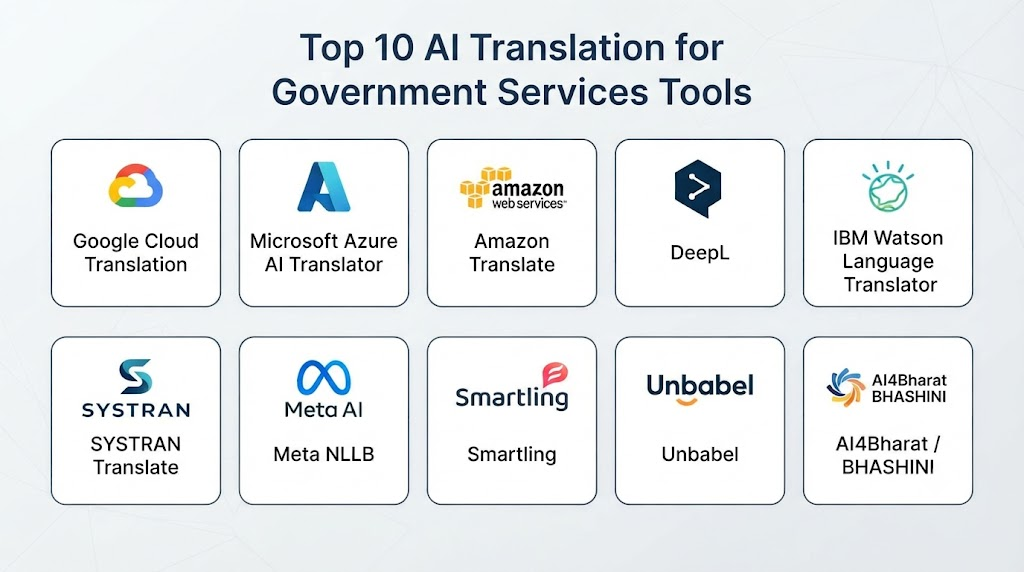
Top 10 AI Translation for Government Services Tools
1. Google Cloud Translation
One-line verdict: Best for government organizations needing scalable multilingual translation through APIs, applications, and cloud workflows.
Short description:
Google Cloud Translation provides machine translation capabilities that can be integrated into websites, applications, document workflows, and public-service systems. It is particularly useful when agencies need automated translation at significant scale.
Standout Capabilities
- Text translation
- Document translation
- Translation APIs
- Language detection
- Custom terminology
- Automated multilingual workflows
- Cloud integration
- Application integration
AI-Specific Depth
- Model support: Google-managed translation models and AI capabilities; exact model availability varies.
- RAG / knowledge integration: N/A for conventional translation; custom application architectures can provide contextual information.
- Evaluation: Translation quality can be evaluated using automated and human review workflows.
- Guardrails: Application-level validation and access controls can be implemented.
- Observability: Cloud-level usage, latency, and operational monitoring are available depending on configuration.
Pros
- Strong scalability
- Developer-friendly APIs
- Suitable for automated government applications
Cons
- Requires careful configuration for sensitive workflows
- Translation quality varies by language pair and content
- Advanced customization may require technical expertise
Security & Compliance
Google Cloud provides enterprise security, identity, access management, encryption, and administrative controls. Specific certifications, data residency, and retention requirements should be verified for the selected service and region.
Deployment & Platforms
- Cloud: Yes
- Web: Application-dependent
- Windows/macOS/Linux: Application-dependent
- Self-hosted: N/A for the managed service
Integrations & Ecosystem
Google Cloud Translation can be incorporated into broader government applications.
- REST APIs
- Cloud applications
- Websites
- Document workflows
- Data platforms
- Custom software
Pricing Model
Usage-based pricing generally depends on translation volume and selected capabilities. Exact pricing varies.
Best-Fit Scenarios
- Multilingual government websites
- High-volume document translation
- Citizen-service applications
2. Microsoft Azure AI Translator
One-line verdict: Best for government agencies already using Microsoft cloud infrastructure and enterprise identity systems.
Short description:
Azure AI Translator provides translation capabilities for applications, websites, documents, and multilingual communication workflows. It can fit naturally into Microsoft-centric public-sector environments.
Standout Capabilities
- Text translation
- Document translation
- Language detection
- Transliteration
- Custom terminology
- API integration
- Enterprise cloud integration
- Multilingual application support
AI-Specific Depth
- Model support: Microsoft-managed translation models.
- RAG / knowledge integration: Custom application integration is possible.
- Evaluation: Translation quality can be tested through automated and human evaluation.
- Guardrails: Enterprise identity and application-level controls can be applied.
- Observability: Azure monitoring capabilities vary by architecture.
Pros
- Strong enterprise ecosystem
- Good API integration
- Suitable for large government environments
Cons
- Requires cloud configuration
- Costs vary with usage
- Complex requirements may need custom engineering
Security & Compliance
Azure provides enterprise security, identity, encryption, access control, auditing, and governance capabilities. Specific compliance and residency options should be verified for the chosen Azure region and service.
Deployment & Platforms
- Cloud: Yes
- Web: Yes through applications
- Windows: Supported through applications
- Self-hosted: Varies / N/A
Integrations & Ecosystem
- Azure services
- Microsoft 365
- Government portals
- REST APIs
- Content-management systems
- Custom applications
Pricing Model
Usage-based cloud pricing varies by translation volume and service configuration.
Best-Fit Scenarios
- Microsoft-based government departments
- Multilingual citizen portals
- Large translation APIs
3. Amazon Translate
One-line verdict: Best for agencies using AWS that need scalable translation integrated into cloud applications and automated workflows.
Short description:
Amazon Translate provides neural machine translation through AWS services. It can be integrated into government applications, customer-service workflows, websites, and document-processing systems.
Standout Capabilities
- Neural machine translation
- Text translation
- Real-time translation
- Batch workflows
- Custom terminology
- API integration
- AWS ecosystem integration
- Automated processing
AI-Specific Depth
- Model support: AWS-managed translation models.
- RAG / knowledge integration: N/A directly; external retrieval can be integrated at application level.
- Evaluation: Human and automated evaluation workflows can be implemented.
- Guardrails: AWS identity and application controls can protect workflows.
- Observability: AWS monitoring can track application and service activity.
Pros
- Strong cloud scalability
- Good AWS integration
- Suitable for automated services
Cons
- Requires AWS expertise
- Quality varies by language
- Custom workflows may need engineering
Security & Compliance
AWS provides encryption, IAM, auditing, and broader cloud security capabilities. Specific regulatory requirements should be assessed against the selected AWS services and deployment architecture.
Deployment & Platforms
- Cloud: Yes
- Web: Application-dependent
- Self-hosted: N/A for the managed service
Integrations & Ecosystem
- AWS Lambda
- Amazon S3
- API Gateway
- Cloud applications
- Data pipelines
- Government applications
Pricing Model
Usage-based pricing varies according to translation volume and service type.
Best-Fit Scenarios
- AWS-based government systems
- Automated document workflows
- Multilingual web applications
4. DeepL API
One-line verdict: Best for organizations prioritizing high-quality multilingual text translation and straightforward application integration.
Short description:
DeepL provides AI-powered translation for text and documents and offers API-based integration. It can be useful for government teams translating communications, internal material, and public-facing information.
Standout Capabilities
- Text translation
- Document translation
- API access
- Glossaries
- Context-sensitive translation
- Multiple language options
- Enterprise workflows
- Application integration
AI-Specific Depth
- Model support: DeepL-managed translation models.
- RAG / knowledge integration: N/A directly.
- Evaluation: Human review and automated translation evaluation can be implemented.
- Guardrails: Application-level controls are required for specialized government workflows.
- Observability: API usage and operational monitoring vary by implementation.
Pros
- Strong translation quality for supported languages
- Easy API integration
- Useful document translation capabilities
Cons
- Language coverage differs from larger cloud platforms
- Government-specific requirements may need additional controls
- Not designed as a complete government-service platform
Security & Compliance
Enterprise security and administrative capabilities are available. Specific certifications, retention, and residency arrangements should be verified for the relevant service.
Deployment & Platforms
- Cloud: Yes
- Web: Yes
- API: Yes
- Self-hosted: Varies / N/A
Integrations & Ecosystem
- REST API
- Document systems
- Websites
- Enterprise applications
- Content-management systems
- Custom software
Pricing Model
Subscription and usage-based plans vary.
Best-Fit Scenarios
- Government communications
- Document translation
- Multilingual websites
5. IBM watsonx
One-line verdict: Best for government organizations combining translation with broader governed AI, data, and enterprise workflow requirements.
Short description:
IBM watsonx provides an enterprise AI platform that can support custom multilingual applications and governed AI workflows. It is especially relevant when translation is part of a larger government AI architecture.
Standout Capabilities
- Enterprise AI
- Model management
- AI governance
- Data integration
- Custom applications
- Document workflows
- Multilingual AI
- Enterprise controls
AI-Specific Depth
- Model support: Multiple model options depending on product and architecture.
- RAG / knowledge integration: Supported through broader AI architecture.
- Evaluation: AI evaluation and governance capabilities are available.
- Guardrails: Governance and AI control capabilities are available.
- Observability: Monitoring capabilities vary by deployment.
Pros
- Strong governance
- Enterprise architecture
- Suitable for customized workflows
Cons
- More complex than a dedicated translation API
- Requires technical expertise
- Translation may need application-level implementation
Security & Compliance
Enterprise security, governance, identity, and access controls are available. Specific compliance claims should be verified for the selected deployment.
Deployment & Platforms
- Cloud: Yes
- Hybrid: Yes
- Enterprise environments: Supported
- Self-managed options: Varies
Integrations & Ecosystem
- Enterprise data
- AI models
- APIs
- Databases
- Document repositories
- Government applications
Pricing Model
Enterprise pricing varies by deployment and services.
Best-Fit Scenarios
- Large government organizations
- Governed multilingual AI
- Complex public-sector AI programs
6. OpenAI API
One-line verdict: Best for developers building customized multilingual government assistants combining translation, reasoning, retrieval, and conversational workflows.
Short description:
The OpenAI API can be used as part of custom government translation applications. Development teams can combine AI translation with document processing, retrieval, speech, structured outputs, and multilingual citizen-service assistants.
Standout Capabilities
- Multilingual text processing
- Translation
- Document analysis
- Speech workflows
- Structured outputs
- Tool calling
- Agentic workflows
- Custom applications
AI-Specific Depth
- Model support: Multiple model options are available within the API ecosystem.
- RAG / knowledge integration: Can be implemented using external knowledge systems and application-managed retrieval.
- Evaluation: Developers can create translation-specific evaluation datasets and regression tests.
- Guardrails: Application-level controls, validation, access policies, and safety systems can be implemented.
- Observability: Developers can monitor latency, usage, errors, and costs through application infrastructure.
Pros
- Highly flexible
- Suitable for conversational translation
- Can combine translation with broader AI workflows
Cons
- Requires engineering expertise
- Translation quality must be evaluated by language pair
- Government governance must be designed carefully
Security & Compliance
Security and data-handling characteristics depend on the API service and architecture selected. Government organizations should verify current retention, residency, access, and compliance requirements before deployment.
Deployment & Platforms
- Cloud API: Yes
- Web: Application-dependent
- Mobile: Application-dependent
- Self-hosted: Varies / N/A
Integrations & Ecosystem
- APIs
- Vector databases
- Government portals
- CRM systems
- Document repositories
- Speech systems
- Custom applications
Pricing Model
Usage-based API pricing varies according to model and usage.
Best-Fit Scenarios
- Multilingual citizen assistants
- Custom translation applications
- AI-powered public-service workflows
7. Claude for Enterprise
One-line verdict: Best for government teams needing multilingual document analysis, drafting, summarization, and translation assistance.
Short description:
Claude can process lengthy documents and support multilingual writing and analysis workflows. It can be useful where translation is combined with document summarization, rewriting, classification, and policy analysis.
Standout Capabilities
- Multilingual writing
- Document analysis
- Summarization
- Rewriting
- Translation assistance
- Long-context workflows
- Enterprise collaboration
- API-based applications
AI-Specific Depth
- Model support: Claude model family.
- RAG / knowledge integration: Can be incorporated into enterprise knowledge workflows.
- Evaluation: Evaluation capabilities depend on the selected product and architecture.
- Guardrails: Enterprise and application-level safeguards are available.
- Observability: Monitoring varies between enterprise and API deployments.
Pros
- Strong long-document capabilities
- Useful beyond basic translation
- Good for multilingual policy workflows
Cons
- Not a dedicated translation platform
- Language performance can vary
- Requires human review for high-impact content
Security & Compliance
Enterprise security controls are available. Specific certifications and data-management configurations should be verified.
Deployment & Platforms
- Cloud: Yes
- Web: Yes
- API: Yes
- Self-hosted: Varies / N/A
Integrations & Ecosystem
- APIs
- Document repositories
- Enterprise applications
- Knowledge systems
- Workflow platforms
Pricing Model
Subscription and API usage models vary.
Best-Fit Scenarios
- Government document translation
- Multilingual policy analysis
- Internal communications
8. SYSTRAN
One-line verdict: Best for organizations requiring specialized machine translation capabilities and customization for enterprise or public-sector workflows.
Short description:
SYSTRAN specializes in machine translation and multilingual language technologies. Its solutions can support organizations that need controlled translation environments, customization, and specialized language workflows.
Standout Capabilities
- Machine translation
- Customization
- Domain-specific translation
- Enterprise translation workflows
- API capabilities
- Multilingual processing
- Terminology management
- Translation automation
AI-Specific Depth
- Model support: Proprietary translation technology; specific model configurations vary.
- RAG / knowledge integration: Varies / N/A.
- Evaluation: Translation quality can be evaluated using domain-specific datasets.
- Guardrails: Custom terminology and controlled workflows can reduce unwanted variation.
- Observability: Deployment-dependent.
Pros
- Long-standing translation specialization
- Enterprise-oriented workflows
- Customization options
Cons
- Implementation complexity may vary
- Exact capabilities depend on deployment
- Requires language-specific evaluation
Security & Compliance
Security and deployment controls vary by product. Specific certifications should be verified before procurement.
Deployment & Platforms
- Cloud: Yes
- Enterprise deployment: Available depending on product
- API: Yes
- Private deployment: Varies
Integrations & Ecosystem
- APIs
- Translation workflows
- Enterprise applications
- Content systems
- Document platforms
- Custom applications
Pricing Model
Enterprise pricing varies.
Best-Fit Scenarios
- Specialized government translation
- Domain-specific terminology
- Enterprise multilingual workflows
9. ModernMT
One-line verdict: Best for organizations seeking adaptive machine translation and context-aware translation workflows for specialized content.
Short description:
ModernMT provides adaptive machine translation capabilities designed to incorporate context into translation workflows. It can be useful for organizations handling recurring terminology and specialized content.
Standout Capabilities
- Adaptive translation
- Context-aware translation
- Machine translation
- Enterprise integration
- API workflows
- Custom terminology
- Translation automation
AI-Specific Depth
- Model support: Proprietary machine translation technology.
- RAG / knowledge integration: Varies / N/A.
- Evaluation: Domain-specific translation testing can be implemented.
- Guardrails: Terminology and workflow controls can help constrain output.
- Observability: Deployment-dependent.
Pros
- Context-aware approach
- Useful for recurring content
- Designed for professional translation workflows
Cons
- Government-specific features vary
- Requires language-pair evaluation
- Not a complete citizen-service platform
Security & Compliance
Security and compliance capabilities vary by deployment and contract. Specific certifications should be independently verified.
Deployment & Platforms
- Cloud: Yes
- API: Yes
- Enterprise deployment: Varies
Integrations & Ecosystem
- Translation management
- APIs
- Content platforms
- Enterprise systems
- Custom workflows
Pricing Model
Enterprise pricing varies.
Best-Fit Scenarios
- Repeated government communications
- Specialized terminology
- Enterprise translation workflows
10. Meta AI / Seamless Translation Technologies
One-line verdict: Best for teams exploring multilingual speech and translation technologies in experimental or custom AI applications.
Short description:
Meta has developed multilingual AI and speech-translation technologies that demonstrate the potential of AI for real-time multilingual communication. Government organizations can consider such technologies as part of research and custom application development, subject to licensing and deployment requirements.
Standout Capabilities
- Multilingual AI
- Speech translation research
- Speech recognition
- Multilingual processing
- Real-time communication potential
- Open research ecosystem
- Custom development opportunities
AI-Specific Depth
- Model support: Depends on the specific Meta technology or model.
- RAG / knowledge integration: Application-dependent.
- Evaluation: Requires task-specific testing.
- Guardrails: Application developers must establish appropriate controls.
- Observability: Depends on implementation.
Pros
- Strong multilingual AI research
- Interesting speech-translation potential
- Useful for experimental applications
Cons
- Not a conventional government translation SaaS platform
- Production support varies by technology
- Government deployment requires careful assessment
Security & Compliance
Specific enterprise security and compliance capabilities vary by technology and deployment.
Deployment & Platforms
- Cloud: Varies
- Open models: Some technologies may support this
- Self-hosted: Depends on model and license
- Applications: Developer-dependent
Integrations & Ecosystem
- AI frameworks
- Speech applications
- Custom software
- Research environments
- APIs or model interfaces where supported
Pricing Model
Varies by technology and deployment.
Best-Fit Scenarios
- Multilingual speech research
- Experimental government applications
- Custom AI development
Comparison Table
| Tool Name | Best For | Deployment | Model Flexibility | Strength | Watch-Out | Public Rating |
|---|---|---|---|---|---|---|
| Google Cloud Translation | Scalable government translation | Cloud | Hosted | Scale and APIs | Language-specific quality | N/A |
| Azure AI Translator | Microsoft environments | Cloud | Hosted | Enterprise integration | Configuration complexity | N/A |
| Amazon Translate | AWS environments | Cloud | Hosted | Cloud scalability | AWS expertise required | N/A |
| DeepL API | High-quality translation | Cloud | Hosted | Translation quality | Language coverage varies | N/A |
| IBM watsonx | Governed AI | Cloud/Hybrid | Multi-model | Governance | Implementation effort | N/A |
| OpenAI API | Custom AI applications | Cloud API | Multi-model | Flexibility | Requires engineering | N/A |
| Claude for Enterprise | Long multilingual documents | Cloud | Hosted | Document analysis | Not translation-specific | N/A |
| SYSTRAN | Specialized translation | Cloud/Enterprise | Proprietary | Customization | Deployment complexity | N/A |
| ModernMT | Adaptive translation | Cloud/API | Proprietary | Context awareness | Requires evaluation | N/A |
| Meta AI Technologies | Experimental multilingual AI | Varies | Open/Research-dependent | Multimodal potential | Production suitability varies | N/A |
Scoring & Evaluation
The following scores are comparative estimates for government translation suitability rather than official vendor ratings.
Translation quality can differ significantly by language pair, domain, document type, and deployment architecture.
| Tool | Core | Reliability/Eval | Guardrails | Integrations | Ease | Perf/Cost | Security/Admin | Support | Weighted Total |
|---|---|---|---|---|---|---|---|---|---|
| Google Cloud Translation | 9.4 | 9.0 | 8.8 | 9.6 | 9.0 | 9.0 | 9.2 | 9.2 | 9.2 |
| Azure AI Translator | 9.4 | 9.0 | 9.0 | 9.6 | 8.9 | 8.8 | 9.4 | 9.3 | 9.2 |
| Amazon Translate | 9.1 | 8.8 | 8.8 | 9.6 | 8.8 | 9.0 | 9.2 | 9.2 | 9.0 |
| DeepL API | 9.2 | 9.0 | 8.5 | 9.0 | 9.2 | 8.7 | 8.8 | 8.8 | 8.9 |
| IBM watsonx | 8.8 | 9.0 | 9.4 | 9.2 | 7.8 | 8.0 | 9.5 | 9.2 | 8.9 |
| OpenAI API | 9.1 | 8.9 | 8.8 | 9.6 | 7.8 | 8.7 | 8.9 | 9.1 | 8.9 |
| Claude for Enterprise | 8.7 | 8.8 | 8.7 | 8.8 | 9.0 | 8.5 | 9.0 | 9.0 | 8.8 |
| SYSTRAN | 8.8 | 8.7 | 8.7 | 8.8 | 8.0 | 8.0 | 8.8 | 8.7 | 8.5 |
| ModernMT | 8.6 | 8.6 | 8.4 | 8.5 | 8.3 | 8.2 | 8.5 | 8.4 | 8.4 |
| Meta AI Technologies | 8.0 | 8.2 | 7.7 | 8.0 | 7.2 | 8.0 | 7.5 | 7.4 | 7.8 |
Top 3 for Enterprise
- Azure AI Translator
- Google Cloud Translation
- IBM watsonx
Top 3 for SMB
- DeepL API
- Google Cloud Translation
- Microsoft Azure AI Translator
Top 3 for Developers
- OpenAI API
- Google Cloud Translation
- Amazon Translate
Which AI Translation for Government Services Tool Is Right for You?
Solo / Freelancer
Independent consultants, small nonprofits, and contractors generally need simple translation rather than a full AI governance platform.
Prioritize:
- Required language pairs
- Document support
- Translation quality
- Glossaries
- Simple workflows
- Reasonable usage costs
Avoid unnecessary enterprise complexity unless sensitive government information is involved.
SMB
Small public-sector organizations should prioritize:
- Ease of deployment
- API availability
- Document translation
- Terminology management
- Human review
- Data controls
A cloud translation API may be sufficient for many straightforward workflows.
Mid-Market
Mid-sized agencies should introduce a centralized translation architecture.
Useful components include:
- Translation API
- Terminology database
- Translation memory
- Document management
- Review workflow
- Quality evaluation
- User authentication
- Audit logging
This provides more consistency than allowing individual employees to use unrelated translation tools.
Enterprise
Large government organizations should prioritize governance and integration.
Important capabilities include:
- SSO
- RBAC
- Audit logs
- Data-retention controls
- Data residency
- Encryption
- API management
- Central terminology
- Human review
- Translation quality measurement
- Model governance
- Incident management
Regulated Industries and Public Sector
Government translation can involve personally identifiable information, legal documents, healthcare information, immigration records, financial information, or confidential communications.
Use stronger controls for:
- Citizen records
- Court documents
- Healthcare communications
- Immigration documents
- Tax information
- Emergency communications
- Unpublished government material
For high-impact information, establish a mandatory human review process.
Budget vs Premium
Budget solutions can handle:
- Basic website translation
- Internal communications
- Routine documents
- Public information
- Draft translations
Premium systems become valuable when agencies require:
- Custom terminology
- Translation memories
- Private deployment
- Advanced APIs
- Governance
- Large-scale document processing
- Multilingual speech
- Advanced quality management
Build vs Buy
Buy when:
- Translation is the primary requirement.
- The agency needs rapid implementation.
- Standard translation APIs are sufficient.
- Internal engineering resources are limited.
Build when:
- Translation must be embedded into complex citizen-service workflows.
- The agency needs specialized terminology.
- Multiple AI capabilities must work together.
- Existing government systems require custom integration.
A hybrid approach is often effective: use a specialized translation engine while building the government-specific workflow, review, authentication, and governance layer internally.
Implementation Playbook: 30 / 60 / 90 Days
First 30 Days: Pilot + Success Metrics
Select a low-risk pilot.
Good candidates include:
- Public website content
- General information pages
- Non-sensitive forms
- Public announcements
- Frequently asked questions
Create a test set covering:
- Common phrases
- Government terminology
- Names
- Dates
- Numbers
- Legal terminology
- Long sentences
- Regional variations
Measure:
- Translation accuracy
- Human correction rate
- Terminology consistency
- Response time
- Cost per translated unit
- Citizen comprehension
Days 31–60: Security + Evaluation + Rollout
Create a translation evaluation framework.
Test:
- Language-pair accuracy
- Sensitive terminology
- Named entities
- Numbers
- Dates
- Formatting
- Formality
- Accessibility
- Hallucinations
- Missing information
- Prompt injection
- Malicious uploaded documents
Establish:
- Human review procedures
- Data-retention policies
- Access controls
- Prompt and configuration versioning
- Approved terminology
- Incident-response procedures
Days 61–90: Optimize Cost/Latency + Governance + Scale
Expand to additional services after the pilot meets quality requirements.
Introduce:
- Automated translation pipelines
- Model routing
- Caching where appropriate
- Translation memories
- Central terminology management
- Quality dashboards
- Cost monitoring
- Latency monitoring
- Multilingual chat
- Speech translation where appropriate
Use different AI models or translation engines according to content complexity rather than sending every request through the most expensive option.
Common Mistakes & How to Avoid Them
- Assuming every language pair has the same translation quality.
- Translating legal or medical content without human review.
- Ignoring regional language variations.
- Failing to maintain government-specific terminology.
- Allowing multiple departments to use inconsistent translations.
- Sending confidential citizen information to unapproved AI services.
- Ignoring data-retention policies.
- Failing to evaluate translation quality using real government documents.
- Measuring speed but not accuracy.
- Ignoring numbers, dates, names, and legal references.
- Using generic translations for specialized government terminology.
- Failing to preserve document formatting.
- Assuming AI-generated translations are automatically unbiased.
- Ignoring accessibility requirements.
- Failing to monitor API usage and costs.
- Allowing untrusted documents to influence AI instructions.
- Using fully automated translation for emergency communications without verification.
- Failing to create escalation procedures for low-confidence translations.
- Locking every workflow to one AI vendor without an exit strategy.
- Treating translation as a one-time project instead of an ongoing language-management process.
FAQs
What is AI Translation for Government Services?
It is the use of AI and machine translation technology to help government organizations translate public information, documents, forms, websites, and citizen communications.
Why is AI translation important for governments?
It can make public services more accessible to multilingual populations while reducing manual translation workload and speeding up communication.
Can AI translation replace professional translators?
For routine, low-risk material it can reduce workload significantly. For legal, medical, emergency, and high-impact content, qualified human review remains important.
Can AI translate government websites?
Yes. Translation APIs can be integrated into websites and content-management systems to provide multilingual versions of public information.
Can government agencies translate confidential documents with AI?
Potentially, but the organization should first verify data handling, retention, access controls, encryption, residency, and contractual requirements.
What is machine translation versus generative AI translation?
Traditional machine translation generally relies on specialized translation models, while generative AI can combine translation with broader contextual reasoning, document analysis, and conversational capabilities.
Can AI translate PDFs and scanned documents?
Many platforms support document translation, while scanned PDFs may require OCR before translation. Capabilities vary by service.
Can AI translate speech for government services?
Yes. Speech recognition, translation, and text-to-speech can be combined to create multilingual communication systems.
How accurate is AI government translation?
Accuracy varies substantially by language, subject matter, document complexity, terminology, and model. Government agencies should evaluate the exact language pairs and content types they plan to use.
What is terminology management?
Terminology management allows an organization to define approved translations for government agencies, programs, technical terms, legal phrases, and other important vocabulary.
Can organizations use their own translation models?
Some enterprise architectures support customized or privately deployed models, while managed translation services generally use provider-operated models.
Can AI translation be self-hosted?
Some translation technologies and models can be deployed privately, but many managed cloud services are not designed for conventional self-hosting.
How should AI translation be evaluated?
Use representative government documents and measure terminology accuracy, meaning preservation, named entities, formatting, fluency, human correction rates, and language-specific quality.
What is prompt injection in AI translation?
Prompt injection occurs when content being processed attempts to manipulate the AI’s instructions. It becomes important when translation systems handle citizen-submitted documents or other untrusted content.
Can AI translation support accessibility?
Yes. Multilingual text, speech recognition, text-to-speech, and conversational interfaces can collectively improve access to public services.
How can governments control translation costs?
Organizations can use usage monitoring, caching where appropriate, model routing, batch processing, translation memories, and different models for different content types.
What are alternatives to AI translation?
Alternatives include professional translators, traditional translation-management systems, human interpretation, conventional machine translation, and hybrid human-machine workflows.
Conclusion
AI Translation for Government Services can significantly improve multilingual access to public information and services. The strongest implementations do more than simply convert words from one language to another. They combine translation technology with terminology management, document processing, human review, privacy controls, quality evaluation, accessibility, and government-specific workflows.Cloud translation platforms are well suited to agencies that need scalable APIs and straightforward integration. Enterprise AI platforms become more attractive when translation is part of a broader governed AI strategy. Developer-focused AI platforms are useful when agencies need conversational translation, custom workflows, document intelligence, or multilingual agents.The most important consideration is not simply which platform produces the most fluent translation. Government organizations should determine whether the system can consistently preserve meaning, terminology, context, privacy, accessibility, and accountability across the languages and services that citizens depend on.