Introduction
AI DevOps ChatOps Assistants are intelligent software tools that integrate directly into communication platforms like Slack, Microsoft Teams, or custom DevOps dashboards to automate operational tasks, monitor systems, and provide proactive alerts. These assistants combine AI-driven insights with real-time collaboration, enabling teams to identify issues faster, execute commands safely, and maintain operational reliability without leaving the chat interface.
Why It Matters
- Faster incident response: AI assists in identifying and resolving incidents in real time.
- Reduces human error: Automates repetitive operational tasks with AI validation.
- Centralized DevOps workflows: Teams can trigger scripts, deployments, or rollbacks from a single interface.
- Proactive monitoring & alerting: AI predicts potential outages or performance issues.
- Knowledge retention: Captures troubleshooting steps and automation workflows for reuse.
- Improves collaboration: Teams coordinate responses, approvals, and commands through chat.
- Cost and efficiency optimization: Reduces downtime and accelerates operational efficiency.
Real-World Use Cases
- Auto-remediation of failed CI/CD pipelines.
- Incident management and proactive alerting.
- Chat-based execution of deployments and rollbacks.
- Monitoring system metrics and predicting outages.
- Automating approvals and compliance checks.
- Generating operational reports and insights on-demand.
Evaluation Criteria
- Integration with communication platforms
- AI reliability and predictive insights
- Automation of tasks and workflows
- Guardrails and safe execution of commands
- Observability of AI decisions and actions
- Security and access control
- Compliance with enterprise policies
- Ease of use and onboarding
- Multi-cloud / hybrid environment support
- Cost efficiency and scaling
- Knowledge capture and sharing
- Customization of commands and triggers
Best for: DevOps engineers, SREs, IT managers, and enterprises with complex or multi-cloud infrastructure.
Not ideal for: Small teams without automated DevOps pipelines or where manual workflows suffice.
What’s Changed in AI DevOps ChatOps Assistants
- Agentic workflows with auto-remediation and multi-step task execution.
- Integration of multimodal inputs including logs, metrics, and chat commands.
- Advanced evaluation of command reliability and potential risks.
- Built-in guardrails for safe automation and prompt-injection defense.
- Enterprise privacy features: data residency, audit logs, and retention policies.
- Cost and latency optimization with model routing and dynamic task execution.
- Observability dashboards showing AI action traces, token usage, and latency.
- Governance and compliance integration for regulatory environments.
- Integration with CI/CD pipelines, monitoring, and incident management tools.
- Collaboration features for multi-team incident response.
Quick Buyer Checklist
- Data privacy & retention compliance
- Model support: hosted, BYO, or open-source
- Integration with RAG or observability systems
- Evaluation and testing capabilities
- Guardrails for safe command execution
- Latency & cost optimization
- Auditability & admin controls
- Vendor lock-in risk assessment
- Multi-platform integration (Slack, Teams, custom dashboards)
- Customization and command scripting flexibility
- Knowledge base capture and reuse
- Predictive monitoring and auto-remediation support
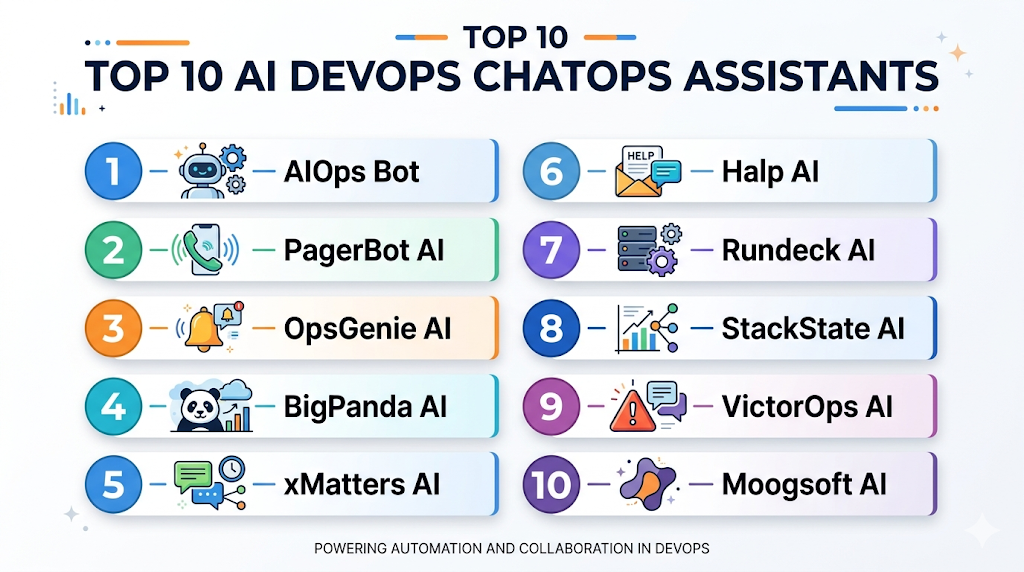
Top 10 AI DevOps ChatOps Assistants
1 — AIOps Bot
One-line verdict: Best for enterprise teams requiring AI-driven monitoring, alerts, and automated remediation via chat.
Short description: AIOps Bot integrates with Slack and Teams to automate incident detection, remediation, and workflow execution. It monitors CI/CD pipelines, cloud infrastructure, and application performance while providing contextual suggestions and executing safe chat-based commands for rapid issue resolution.
Standout Capabilities
- Real-time alerts and auto-remediation
- Multi-cloud monitoring and deployment integration
- Incident ticketing and workflow management
- Contextual command suggestions in chat
- Knowledge capture for recurring incidents
- Role-based command execution
AI-Specific Depth
- Model support: Proprietary
- RAG / knowledge integration: Ticketing & monitoring system connectors
- Evaluation: Regression testing of commands, offline validation
- Guardrails: Safe execution policies and approvals
- Observability: Tracks AI decisions, command usage, latency
Pros
- Speeds up incident response
- Reduces human errors
- Captures knowledge for future use
Cons
- Enterprise plan required for advanced features
- Complex configuration for multi-cloud environments
- Limited integration with niche tools
Security & Compliance
- SSO, RBAC, encryption, audit logs
- Not publicly stated
Deployment & Platforms
- Web, Slack, Teams
- Cloud
Integrations & Ecosystem
- CI/CD pipelines, monitoring systems
- Jira, ServiceNow
- Slack & Teams APIs
- Automation scripts and webhooks
Pricing Model
Subscription-based
Best-Fit Scenarios
- Large enterprises with multi-cloud infrastructure
- Incident management and auto-remediation
- DevOps teams automating CI/CD pipelines
2 — PagerBot AI
One-line verdict: Ideal for SREs and DevOps teams needing predictive alerts and chat-based command execution.
Short description: PagerBot AI uses predictive AI models to analyze logs and metrics, sending actionable alerts to Slack or Teams. It allows automated remediation commands, escalation workflows, and historical incident analysis for improved reliability.
Standout Capabilities
- Predictive incident detection
- Chat-based remediation execution
- Escalation workflows and alert prioritization
- Historical incident analysis
- Multi-cloud environment monitoring
AI-Specific Depth
- Model support: Proprietary
- RAG / knowledge integration: Log and metric connectors
- Evaluation: Human review of auto-remediation suggestions
- Guardrails: Command approval and safe execution checks
- Observability: Latency, success rate, and token metrics
Pros
- Proactive issue detection
- Reduces MTTR (Mean Time to Repair)
- Supports multi-cloud infrastructure
Cons
- Setup can be complex
- Paid subscription for full functionality
- Limited integration with legacy tools
Security & Compliance
- SSO, RBAC, encryption
- Not publicly stated
Deployment & Platforms
- Web, Slack, Teams
- Cloud
Integrations & Ecosystem
- Monitoring tools, Jira, ServiceNow
- CI/CD pipelines
- Automation scripts
Pricing Model
Subscription-based
Best-Fit Scenarios
- Predictive monitoring for multi-cloud apps
- ChatOps-driven incident resolution
- Enterprise DevOps teams
3 — OpsGenie AI
One-line verdict: Best for teams needing intelligent alert routing and automated on-call incident management.
Short description: OpsGenie AI enhances incident response by routing alerts intelligently, predicting potential outages, and automating escalation workflows. It integrates seamlessly with Slack, Teams, and monitoring tools, enabling DevOps teams to resolve incidents faster while maintaining operational compliance. Historical incident analysis helps teams optimize response strategies.
Standout Capabilities
- AI-based alert routing and prioritization
- Predictive outage detection
- Automated on-call escalations
- Integration with monitoring and logging systems
- Historical incident trend analysis
- Chat-based remediation commands
AI-Specific Depth
- Model support: Proprietary
- RAG / knowledge integration: Log and monitoring connectors
- Evaluation: Incident simulation, regression testing
- Guardrails: Command approval and safety checks
- Observability: Tracks AI actions, latency, and alert response metrics
Pros
- Reduces alert fatigue
- Speeds up incident resolution
- Optimizes on-call workflows
Cons
- Advanced predictive features require subscription
- Setup requires integration with multiple tools
- Learning curve for configuration
Security & Compliance
- SSO, RBAC, encryption, audit logs
- Not publicly stated
Deployment & Platforms
- Web, Slack, Teams
- Cloud
Integrations & Ecosystem
- Jira, ServiceNow, monitoring platforms
- Automation scripts and webhooks
- API access
- CI/CD pipelines
Pricing Model
Subscription-based
Best-Fit Scenarios
- Enterprise on-call management
- Predictive incident routing
- Multi-cloud operations
4 — BigPanda AI
One-line verdict: Ideal for enterprises needing intelligent event correlation and chat-driven remediation.
Short description: BigPanda AI correlates alerts from multiple monitoring tools, detects root causes, and triggers automated chat workflows for remediation. Teams can collaborate in Slack or Teams, reduce alert noise, and accelerate resolution of complex incidents. It supports multi-cloud environments and historical incident analytics.
Standout Capabilities
- AI-driven alert correlation
- Root cause analysis
- Automated remediation workflows
- ChatOps integration for Slack and Teams
- Multi-cloud support
- Historical incident analytics
AI-Specific Depth
- Model support: Proprietary
- RAG / knowledge integration: Monitoring tool connectors
- Evaluation: Incident simulation and regression testing
- Guardrails: Policy enforcement for command execution
- Observability: Tracks AI actions, token usage, and latency
Pros
- Reduces noise from multiple alerts
- Speeds up root cause analysis
- Integrates with existing DevOps tools
Cons
- Requires subscription for full enterprise features
- Setup can be complex
- Limited customization in free tiers
Security & Compliance
- SSO, RBAC, encryption, audit logs
- Not publicly stated
Deployment & Platforms
- Web, Slack, Teams
- Cloud
Integrations & Ecosystem
- CI/CD pipelines, monitoring tools
- Jira, ServiceNow
- API access
- Automation scripts
Pricing Model
Subscription-based
Best-Fit Scenarios
- Multi-monitoring tool environments
- ChatOps-driven incident resolution
- Enterprise predictive maintenance
5 — xMatters AI
One-line verdict: Best for organizations needing automated incident notifications, chat commands, and workflow orchestration.
Short description: xMatters AI automatically triggers alerts, executes chat-based commands, and manages operational workflows. It integrates with Slack, Teams, and monitoring tools to streamline incident response and reduce mean time to resolution. The platform supports predictive alerts and intelligent escalation for enterprise DevOps teams.
Standout Capabilities
- Automated incident notifications
- Chat-based command execution
- Workflow orchestration and approval workflows
- Predictive alerting
- Integration with monitoring systems
- Escalation and on-call automation
AI-Specific Depth
- Model support: Proprietary
- RAG / knowledge integration: Monitoring/logging connectors
- Evaluation: Regression testing for automated tasks
- Guardrails: Safe execution and approval policies
- Observability: Tracks command execution and latency
Pros
- Reduces manual intervention
- Streamlines incident workflows
- Improves response times
Cons
- Paid tiers needed for full functionality
- Learning curve for complex workflows
- Setup requires integration with multiple platforms
Security & Compliance
- SSO, RBAC, encryption
- Not publicly stated
Deployment & Platforms
- Web, Slack, Teams
- Cloud
Integrations & Ecosystem
- CI/CD, Jira, ServiceNow
- API and webhook support
- Automation and scripting
Pricing Model
Subscription-based
Best-Fit Scenarios
- Enterprise incident response
- Multi-team workflow orchestration
- Predictive alerts and escalation
6 — Halp AI
One-line verdict: Ideal for small to medium teams needing conversational ticketing and DevOps workflow automation.
Short description: Halp AI converts chat messages into actionable tickets, automates incident responses, and integrates with Slack or Teams. Teams can triage requests, trigger automated scripts, and monitor operational metrics, making it ideal for SMB DevOps teams seeking efficiency without complex setup.
Standout Capabilities
- Chat-to-ticket conversion
- Automated workflow triggers
- Integration with Slack and Teams
- Simple triage and routing
- Metrics and reporting
- Knowledge capture for recurring issues
AI-Specific Depth
- Model support: Proprietary
- RAG / knowledge integration: Ticketing systems
- Evaluation: Human review, offline validation
- Guardrails: Ensures safe task execution
- Observability: Tracks task success and response times
Pros
- Easy setup for small teams
- Reduces ticket handling time
- Captures knowledge for future incidents
Cons
- Limited enterprise features
- Paid subscription for advanced workflows
- Focused on chat-driven tickets
Security & Compliance
- SSO, RBAC
- Not publicly stated
Deployment & Platforms
- Web, Slack, Teams
- Cloud
Integrations & Ecosystem
- Jira, ServiceNow
- Automation scripts
- API access
Pricing Model
Subscription-based
Best-Fit Scenarios
- SMB DevOps teams
- Chat-based ticketing
- Workflow automation for support
7 — Rundeck AI
One-line verdict: Best for automating operations and chat-based runbook execution in hybrid environments.
Short description: Rundeck AI automates operational runbooks and executes tasks through chat commands in Slack or Teams. It allows teams to orchestrate jobs, manage hybrid cloud environments, and monitor execution outcomes while reducing manual errors.
Standout Capabilities
- Runbook automation and orchestration
- ChatOps command execution
- Multi-cloud and hybrid support
- Job scheduling and monitoring
- Role-based access and approvals
AI-Specific Depth
- Model support: Proprietary
- RAG / knowledge integration: Ops runbooks and monitoring logs
- Evaluation: Regression testing of automated tasks
- Guardrails: Enforces approval workflows and safe execution
- Observability: Tracks execution success, errors, and latency
Pros
- Reduces manual operational tasks
- Supports hybrid and multi-cloud environments
- Chat-based orchestration
Cons
- Enterprise tier required for advanced features
- Setup complexity for hybrid environments
- Limited predictive AI features
Security & Compliance
- SSO, RBAC, encryption
- Not publicly stated
Deployment & Platforms
- Web, Slack, Teams
- Cloud / On-prem
Integrations & Ecosystem
- CI/CD, monitoring tools
- Jira, ServiceNow
- API access
- Automation scripts
Pricing Model
Subscription-based
Best-Fit Scenarios
- Hybrid cloud automation
- Incident orchestration
- DevOps runbook execution
8 — StackState AI
One-line verdict: Ideal for monitoring and predictive incident management with chat-based remediation.
Short description: StackState AI uses AI to monitor systems, correlate events, and provide predictive insights. Teams can execute commands directly from chat to resolve issues faster. It is suitable for large DevOps teams managing complex, multi-cloud infrastructures.
Standout Capabilities
- AI-driven monitoring and correlation
- Predictive incident detection
- ChatOps remediation commands
- Multi-cloud support
- Historical analysis and insights
AI-Specific Depth
- Model support: Proprietary
- RAG / knowledge integration: Monitoring systems
- Evaluation: Incident prediction testing
- Guardrails: Safe execution policies
- Observability: Tracks alerts, resolution metrics, and latency
Pros
- Proactive incident detection
- Reduces downtime
- Integrates with CI/CD and monitoring tools
Cons
- Paid plan for full features
- Complex configuration
- May require training for teams
Security & Compliance
- SSO, RBAC, encryption
- Not publicly stated
Deployment & Platforms
- Web, Slack, Teams
- Cloud
Integrations & Ecosystem
- Monitoring tools, Jira
- CI/CD pipelines
- Automation scripts
Pricing Model
Subscription-based
Best-Fit Scenarios
- Multi-cloud DevOps teams
- Predictive monitoring
- ChatOps incident resolution
9 — VictorOps AI
One-line verdict: Best for DevOps teams needing intelligent on-call management and chat-based coordination.
Short description: VictorOps AI automates alert routing, incident management, and on-call coordination through Slack or Teams. It predicts potential outages, escalates incidents, and provides actionable insights to reduce downtime. Ideal for SRE and DevOps teams handling critical systems.
Standout Capabilities
- Intelligent alert routing
- Predictive incident analysis
- ChatOps-driven remediation
- Escalation workflows
- Historical metrics and insights
AI-Specific Depth
- Model support: Proprietary
- RAG / knowledge integration: Log/monitoring connectors
- Evaluation: Regression and offline testing
- Guardrails: Approval-based command execution
- Observability: Tracks latency, alert success, and command logs
Pros
- Reduces on-call fatigue
- Accelerates incident resolution
- Predictive AI alerts
Cons
- Paid subscription
- Learning curve for full features
- Limited integration with legacy tools
Security & Compliance
- SSO, RBAC, encryption
- Not publicly stated
Deployment & Platforms
- Web, Slack, Teams
- Cloud
Integrations & Ecosystem
- Monitoring platforms, Jira, ServiceNow
- CI/CD pipelines
- API and webhook support
Pricing Model
Subscription-based
Best-Fit Scenarios
- Enterprise on-call management
- Predictive DevOps monitoring
- Multi-team coordination
10 — Moogsoft AI
One-line verdict: Ideal for large enterprises needing AIOps-driven alert correlation and automated chat workflows.
Short description: Moogsoft AI correlates alerts, detects anomalies, and triggers automated remediation workflows via chat. It reduces noise, accelerates root-cause analysis, and allows multi-cloud DevOps teams to respond proactively. Historical event analysis and AI insights improve operational reliability.
Standout Capabilities
- AI-based alert correlation
- Anomaly detection and prediction
- Automated chat-based remediation workflows
- Multi-cloud environment monitoring
- Historical incident trend analysis
AI-Specific Depth
- Model support: Proprietary
- RAG / knowledge integration: Monitoring and log connectors
- Evaluation: Regression testing for workflows
- Guardrails: Safe execution policies and approvals
- Observability: Tracks latency, token usage, and resolution success
Pros
- Reduces alert fatigue
- Predictive incident resolution
- Supports complex multi-cloud systems
Cons
- Subscription required for enterprise features
- Setup complexity for hybrid clouds
- May require training
Security & Compliance
- SSO, RBAC, encryption
- Not publicly stated
Deployment & Platforms
- Web, Slack, Teams
- Cloud
Integrations & Ecosystem
- CI/CD pipelines, monitoring tools
- Jira, ServiceNow
- Automation scripts, APIs
Pricing Model
Subscription-based
Best-Fit Scenarios
- Enterprise multi-cloud environments
- AIOps-driven incident resolution
- Large-scale DevOps teams
Comparison Table
| Tool Name | Best For | Deployment | Model Flexibility | Strength | Watch-Out | Public Rating |
|---|---|---|---|---|---|---|
| AIOps Bot | Enterprise DevOps teams | Web, Slack, Teams | Proprietary | Real-time auto-remediation | Enterprise plan required | N/A |
| PagerBot AI | SREs & DevOps engineers | Web, Slack, Teams | Proprietary | Predictive alerts & chat commands | Complex setup | N/A |
| OpsGenie AI | Enterprise on-call teams | Web, Slack, Teams | Proprietary | Intelligent alert routing | Paid for predictive features | N/A |
| BigPanda AI | Multi-cloud enterprises | Web, Slack, Teams | Proprietary | Alert correlation & root cause | Setup complexity | N/A |
| xMatters AI | DevOps orchestration | Web, Slack, Teams | Proprietary | Workflow automation | Learning curve | N/A |
| Halp AI | SMB DevOps teams | Web, Slack, Teams | Proprietary | Chat-to-ticket automation | Limited enterprise features | N/A |
| Rundeck AI | Hybrid cloud DevOps | Web, Slack, Teams | Proprietary | Runbook automation | Enterprise tier needed | N/A |
| StackState AI | Large multi-cloud teams | Web, Slack, Teams | Proprietary | Predictive monitoring | Complex configuration | N/A |
| VictorOps AI | SREs & incident management | Web, Slack, Teams | Proprietary | Intelligent on-call routing | Paid subscription | N/A |
| Moogsoft AI | Enterprise AIOps | Web, Slack, Teams | Proprietary | AI alert correlation | Subscription required | N/A |
Scoring & Evaluation
Scoring is comparative, reflecting practical use across enterprises, SMBs, and developers.
| Tool | Core | Reliability/Eval | Guardrails | Integrations | Ease | Perf/Cost | Security/Admin | Support | Weighted Total |
|---|---|---|---|---|---|---|---|---|---|
| AIOps Bot | 9 | 9 | 8 | 8 | 9 | 8 | 8 | 7 | 8.4 |
| PagerBot AI | 8 | 8 | 8 | 8 | 8 | 8 | 8 | 7 | 8.0 |
| OpsGenie AI | 8 | 8 | 8 | 7 | 8 | 8 | 8 | 7 | 7.9 |
| BigPanda AI | 9 | 8 | 8 | 8 | 7 | 8 | 8 | 7 | 8.0 |
| xMatters AI | 8 | 8 | 8 | 8 | 8 | 8 | 8 | 7 | 8.0 |
| Halp AI | 7 | 7 | 7 | 7 | 8 | 7 | 7 | 6 | 7.1 |
| Rundeck AI | 8 | 8 | 8 | 8 | 7 | 8 | 8 | 7 | 7.9 |
| StackState AI | 8 | 8 | 8 | 8 | 7 | 8 | 8 | 7 | 7.9 |
| VictorOps AI | 8 | 8 | 8 | 7 | 8 | 8 | 8 | 7 | 7.9 |
| Moogsoft AI | 9 | 8 | 8 | 8 | 7 | 8 | 8 |
Top 3 for Enterprise
- AIOps Bot – Enterprise teams benefit from real-time auto-remediation, alert monitoring, and chat-based incident resolution. Ideal for complex, multi-cloud infrastructure.
- BigPanda AI – Excels at correlating events across multiple systems and predicting outages, reducing downtime and improving operational efficiency.
- Moogsoft AI – AI-driven alert correlation and automated workflows help large DevOps teams quickly detect and resolve incidents.
Top 3 for SMB
- Halp AI – Lightweight assistant that converts chat messages into actionable tickets, ideal for smaller teams automating workflows.
- PagerBot AI – Predictive alerts and chat command execution make it easy for SMBs to monitor infrastructure without complex setup.
- xMatters AI – Automates notifications and incident workflows, improving collaboration and operational efficiency for growing teams.
Top 3 for Developers
- Quick integration-focused tools – PagerBot AI or AIOps Bot allow developers to quickly integrate AI commands into CI/CD pipelines.
- Rundeck AI – Executes chat-based runbooks for developers managing hybrid or multi-cloud deployments.
- Small-scale automation tools – Halp AI enables rapid prototyping and lightweight automation for individual developers or small teams.
Which AI DevOps ChatOps Tool Is Right for You?
Solo / Freelancer
- PagerBot AI or Halp AI are ideal for individual developers or freelancers. Easy setup, minimal learning curve, and lightweight integrations for small infrastructures.
SMB
- Halp AI or xMatters AI help small teams automate ticketing and incident management through chat. Reduce manual effort and improve team collaboration.
Mid-Market
- OpsGenie AI or BigPanda AI provide predictive alerts, automated escalations, and workflow automation for growing DevOps teams handling more complex infrastructure.
Enterprise
- AIOps Bot, Moogsoft AI, StackState AI are designed for large organizations with multi-cloud, multi-team operations. They deliver AI-driven alert correlation, automated remediation, and compliance-ready governance.
Regulated Industries
- Choose tools with SSO, RBAC, encryption, and audit logs. These ensure secure, compliant operations in finance, healthcare, or public sector environments.
Budget vs Premium
- Lightweight tools reduce costs but have limited functionality. Enterprise SaaS tools provide predictive monitoring, compliance, and multi-team support.
Build vs Buy
- DIY solutions suit experimentation or small projects. SaaS solutions are recommended for teams needing enterprise-scale monitoring, automation, and governance.
Implementation Playbook (30 / 60 / 90 Days)
30 Days – Pilot & Metrics:
- Deploy AI assistant in a single Slack/Teams channel
- Monitor alerts, commands, and auto-remediation success
- Track MTTR and response times
60 Days – Harden & Rollout:
- Integrate with CI/CD pipelines and monitoring tools
- Set guardrails for safe automated actions
- Define escalation policies and multi-team workflows
- Monitor AI predictions for accuracy
90 Days – Optimize & Scale:
- Expand to multiple channels or teams
- Refine AI models for predictive alerts
- Optimize task latency, resource usage, and cost
- Implement compliance, version control, and governance
- Document processes and knowledge capture
Common Mistakes & How to Avoid Them
- Over-automation without human validation
- Ignoring evaluation or testing of AI commands
- Poor management of data retention and logs
- Lack of observability on automated tasks
- Cost surprises from high-frequency automation
- Skipping guardrails for command safety
- Vendor lock-in without fallback or export options
- Not integrating with CI/CD or monitoring systems
- Inconsistent workflow documentation
- Missing version control for commands
- Not training teams on AI suggestions
- Over-reliance on predictions without human oversight
- Failing to customize alerts for relevance
FAQs
- What is an AI DevOps ChatOps Assistant?
A chat-integrated AI tool that automates operational tasks, alerts, and workflows for DevOps teams. - Which platforms are supported?
Commonly Slack, Microsoft Teams, and custom web dashboards. - Can they perform auto-remediation?
Yes, enterprise-grade tools can safely execute predefined scripts from chat. - Do they work with multi-cloud environments?
Most support AWS, Azure, GCP, and hybrid cloud setups. - Are they secure for sensitive operations?
Enterprise options include SSO, RBAC, encryption, and audit logs. - Can small teams use them effectively?
Yes, tools like Halp AI and PagerBot AI are lightweight and easy to adopt. - Do they integrate with CI/CD pipelines?
Yes, most integrate with Jenkins, GitLab, GitHub Actions, and other pipelines. - Can AI predictions be trusted?
They are mostly reliable but require validation and guardrails for critical actions. - Are these tools cost-effective?
Subscription-based models scale with team size and automation complexity. - Can they capture team knowledge?
Yes, historical incidents, scripts, and workflows are stored for reuse. - How do they reduce MTTR?
By automating alerts, remediation, and escalation workflows directly in chat. - What are alternatives?
Manual scripting, traditional monitoring tools, or low-code DevOps automation platforms.
Conclusion
AI DevOps ChatOps Assistants are rapidly transforming how teams manage, monitor, and operate complex infrastructure by combining artificial intelligence with chat-based workflows. They reduce human error, accelerate incident response, and provide predictive insights that help DevOps, SREs, and IT teams proactively prevent outages. By integrating directly into communication platforms like Slack or Teams, these assistants enable real-time collaboration, automated remediation, and knowledge retention, allowing teams to work smarter while maintaining governance and compliance
Next Steps:
- Shortlist tools that align with your communication platforms and DevOps workflows.
- Pilot on a single team or project to measure performance, accuracy, and MTTR reduction.
- Verify security, governance, and evaluation capabilities before scaling across teams.
- Scale adoption, implement standard processes, monitor metrics, and optimize costs and latency.