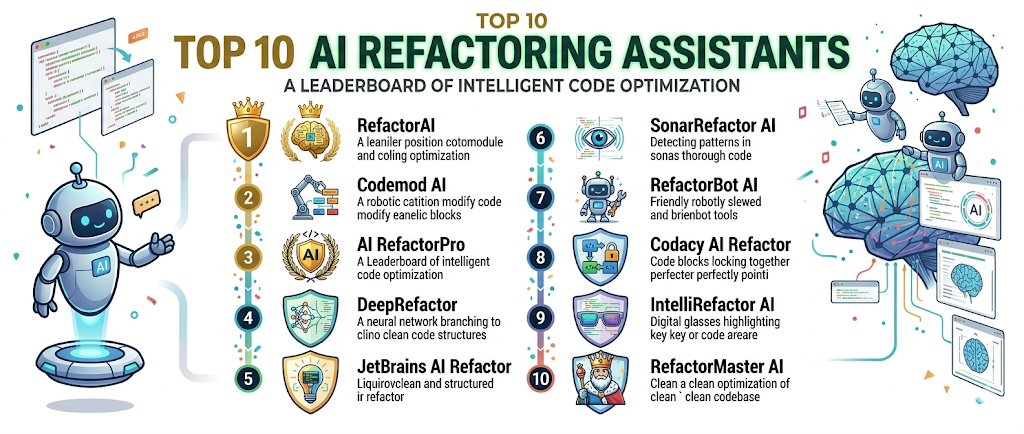
Introduction
AI Refactoring Assistants are tools that leverage artificial intelligence to automatically improve code structure, readability, and maintainability without changing its external behavior. They analyze legacy and modern codebases, detect anti-patterns, duplicate code, and technical debt, and provide suggestions or automated refactorings to improve code quality. These assistants help developers save time, reduce errors, and maintain high software quality as systems evolve.
Why it matters:
- Improves code maintainability: Reduces technical debt and ensures long-term readability and efficiency.
- Accelerates development: Developers spend less time manually cleaning code and more on building features.
- Reduces bugs: Automated detection of duplicate or complex code helps prevent runtime errors.
- Ensures consistency: Standardizes coding patterns across multi-team projects.
- Supports legacy modernization: Refactors older codebases for easier integration with modern frameworks.
- Facilitates CI/CD: Integrates with pipelines for automated refactoring during builds and merges.
- Enhances collaboration: Teams can work on uniform, standardized codebases with less friction.
- Predictive impact analysis: Assesses how refactorings affect dependent modules before applying changes.
Real-world use cases:
- Refactoring legacy enterprise applications to improve maintainability and reduce errors.
- Modernizing AI/ML pipelines by restructuring modular components for efficiency.
- Optimizing microservices architecture for performance, readability, and scalability.
- Cleaning up open-source contributions with AI-assisted standardization.
- Improving CI/CD pipeline code quality through automated refactorings.
- Standardizing coding practices across distributed global development teams.
Evaluation criteria for buyers:
- Accuracy of automated refactoring recommendations
- Support for multi-language codebases
- Integration with IDEs (VS Code, IntelliJ, PyCharm)
- CI/CD pipeline integration
- Predictive analysis of downstream impact
- Ability to detect anti-patterns, duplicate code, and technical debt
- Ease of use and developer workflow adoption
- Observability and reporting on refactorings
- Security and privacy of code during analysis
- Customization of rules, coding standards, and patterns
- Scalability for large repositories and multi-team projects
- Performance and latency in automated refactoring tasks
Best for: Software engineers, QA teams, DevOps engineers, and enterprise organizations managing large, multi-language codebases.
Not ideal for: Small projects or single-language repositories where manual refactoring is sufficient.
What’s Changed in AI Refactoring Assistants
- Support for multi-repo and multi-language codebases
- Agentic workflows with tool calling for automated refactoring pipelines
- Integration of AI with predictive impact analysis
- Detection and suggestion for anti-patterns, code smells, and duplicate logic
- Enterprise privacy, data residency, and retention controls
- Cost and latency optimization for large-scale automated refactorings
- Observability dashboards for refactor trends, complexity metrics, and module health
- Guardrails to prevent breaking changes during automated refactoring
- CI/CD integration for automated deployment of clean code
- Policy enforcement for coding standards
- Multi-model support and BYO AI options for proprietary refactoring models
- Governance and audit tracking for compliance in regulated industries
Quick Buyer Checklist
- Multi-language support and multi-repo handling
- Integration with CI/CD pipelines for automated workflows
- IDE integration for developer adoption and real-time suggestions
- Accurate detection of anti-patterns, duplicates, and technical debt
- Predictive analysis of downstream code impact
- Configurable coding rules and standards
- Observability dashboards and reporting metrics
- Security and privacy controls, SSO, RBAC
- Latency and cost optimization for large codebases
- Auditability and compliance for regulated industries
- Vendor lock-in risk and extensibility with APIs
- Support for BYO AI models and multi-model routing
Top 10 AI Refactoring Assistants
1 — RefactorAI
One-line verdict: Best for enterprise teams needing automated multi-language refactoring with predictive impact analysis.
Short description: RefactorAI analyzes code to detect anti-patterns, duplicates, and technical debt, providing automated refactoring suggestions and PRs for seamless integration into existing workflows. It supports multiple languages and large repositories.
Standout Capabilities
- Multi-language code refactoring (Python, Java, JS, TypeScript)
- Detects anti-patterns, duplicate code, and complex modules
- Predictive impact analysis for dependent modules
- Automated PR generation for suggested refactorings
- CI/CD integration for continuous improvement
- Observability dashboards with metrics on code health
- Customizable coding rules and refactoring patterns
AI-Specific Depth
- Model support: Proprietary
- RAG / knowledge integration: N/A
- Evaluation: Regression and static analysis
- Guardrails: Policy enforcement to prevent breaking changes
- Observability: Metrics dashboards, predictive impact visualization
Pros
- Reduces manual refactoring effort
- Scales to enterprise-level multi-language repositories
- Predictive insights reduce regression risk
Cons
- Initial setup complexity
- Requires developer validation for some changes
- Licensing cost for enterprise features
Security & Compliance
- SSO, RBAC, encryption, retention policies
- Certifications: Not publicly stated
Deployment & Platforms
- Web, Windows, macOS, Linux
- Cloud / Hybrid
Integrations & Ecosystem
- GitHub, GitLab, Bitbucket
- CI/CD pipelines
- IDE plugins (VS Code, IntelliJ, PyCharm)
- Slack, Jira notifications
Pricing Model
- Subscription-based enterprise tiers
Best-Fit Scenarios
- Enterprise multi-language codebases
- Legacy modernization projects
- CI/CD integrated automated refactorings
2 — Codemod AI
One-line verdict: Ideal for developers needing lightweight, IDE-integrated refactoring suggestions across multiple languages.
Short description: Codemod AI provides AI-driven refactoring suggestions directly in IDEs, helping developers clean up code, eliminate duplicates, and adhere to coding standards in real-time without disrupting workflow.
Standout Capabilities
- IDE integration for real-time refactoring suggestions
- Duplicate code detection and removal
- Anti-pattern recognition
- Multi-language support
- Predictive impact estimation for dependent modules
- Integration with CI/CD for automated PRs
- Customizable coding rules
AI-Specific Depth
- Model support: Proprietary
- RAG / knowledge integration: N/A
- Evaluation: Regression and pattern analysis
- Guardrails: Prevents unsafe refactorings
- Observability: Metrics for code complexity and duplicate detection
Pros
- Real-time suggestions reduce developer overhead
- Supports multiple languages
- Integrates seamlessly with IDEs
Cons
- Less suited for large enterprise repos
- Limited enterprise compliance reporting
- Requires manual validation for complex refactorings
Security & Compliance
- Encryption and access control
- Certifications: Not publicly stated
Deployment & Platforms
- Web, Windows, macOS, Linux
- Cloud / Hybrid
Integrations & Ecosystem
- VS Code, IntelliJ, PyCharm IDEs
- GitHub, GitLab, Bitbucket
- CI/CD pipelines
- Slack notifications
Pricing Model
- Subscription-based
Best-Fit Scenarios
- Small to mid-sized teams
- IDE-integrated refactoring
- Multi-language development projects
3 — AI RefactorPro
One-line verdict: Best for mid-to-large teams needing automated refactoring for multi-language projects with CI/CD integration.
Short description: AI RefactorPro analyzes code to detect code smells, anti-patterns, and complex modules. It automatically suggests or applies refactorings while integrating with CI/CD pipelines, enabling teams to maintain clean, maintainable, and efficient code across large repositories.
Standout Capabilities
- Automated code smell detection
- Anti-pattern identification and resolution suggestions
- Multi-language support (Python, Java, C#, JS/TS)
- Predictive impact analysis for dependent modules
- Integration with CI/CD pipelines for automated PRs
- Visual dashboards showing refactoring metrics
- Customizable coding patterns and rules
AI-Specific Depth
- Model support: Proprietary
- RAG / knowledge integration: N/A
- Evaluation: Regression and static code analysis
- Guardrails: Prevents breaking changes in critical modules
- Observability: Dashboards for metrics, trends, and predictive analysis
Pros
- Reduces developer effort for repetitive refactorings
- Supports large multi-language repositories
- Predictive insights reduce regression risk
Cons
- Enterprise features require licensing
- Setup may be complex for first-time users
- Some changes require human validation
Security & Compliance
- SSO, RBAC, encryption, retention policies
- Certifications: Not publicly stated
Deployment & Platforms
- Web, Windows, macOS, Linux
- Cloud / Hybrid
Integrations & Ecosystem
- GitHub, GitLab, Bitbucket
- CI/CD pipelines
- IDE plugins (VS Code, IntelliJ)
- Slack and Jira notifications
Pricing Model
- Subscription-based enterprise tiers
Best-Fit Scenarios
- Multi-language enterprise projects
- CI/CD integrated automated refactoring
- Legacy modernization initiatives
4 — DeepRefactor
One-line verdict: Ideal for developers needing AI-driven refactoring suggestions to clean code and improve maintainability.
Short description: DeepRefactor identifies duplicate code, complex logic, and technical debt. It generates recommendations or automatic refactorings to improve code readability and maintainability, helping teams reduce bugs and increase productivity.
Standout Capabilities
- Duplicate code detection and resolution
- Detection of code complexity and technical debt
- Predictive impact analysis on dependent modules
- Multi-language support
- CI/CD and IDE integration
- Customizable coding rules
- Metrics dashboards for code health
AI-Specific Depth
- Model support: Proprietary
- RAG / knowledge integration: N/A
- Evaluation: Regression and pattern analysis
- Guardrails: Prevents unsafe refactorings
- Observability: Dashboards showing complexity, duplication, and impact
Pros
- Reduces bugs caused by complex code
- Improves maintainability and readability
- Integrates into developer workflow
Cons
- Enterprise-grade features require subscription
- Large-scale repository integration may require setup
- Manual validation recommended for critical changes
Security & Compliance
- Encryption and access control
- Certifications: Not publicly stated
Deployment & Platforms
- Web, Windows, macOS, Linux
- Cloud / Hybrid
Integrations & Ecosystem
- IDEs: VS Code, IntelliJ, PyCharm
- GitHub, GitLab, Bitbucket
- CI/CD pipelines
- Slack, Jira, API access
Pricing Model
- Subscription-based
Best-Fit Scenarios
- Mid-size dev teams
- Refactoring legacy or complex code
- CI/CD-integrated refactoring pipelines
5 — JetBrains AI Refactor
One-line verdict: Best for JetBrains IDE users seeking real-time AI-powered refactoring guidance for complex code.
Short description: JetBrains AI Refactor integrates directly with IntelliJ, PyCharm, and WebStorm, providing real-time refactoring suggestions, duplicate code detection, and anti-pattern resolution. Developers benefit from improved code quality and consistency without leaving their IDE.
Standout Capabilities
- Real-time IDE refactoring suggestions
- Duplicate and complex code detection
- Anti-pattern recognition
- Multi-language support (Java, Python, JS/TS)
- Predictive impact on dependent modules
- CI/CD integration for automated PRs
- Customizable refactoring rules
AI-Specific Depth
- Model support: Proprietary / Hosted
- RAG / knowledge integration: N/A
- Evaluation: Regression and static analysis
- Guardrails: Prevents breaking changes in critical modules
- Observability: IDE dashboards showing metrics and recommendations
Pros
- IDE-native integration
- Real-time refactoring guidance
- Reduces manual cleanup effort
Cons
- Limited to JetBrains IDEs
- Enterprise reporting limited
- Requires learning curve for complex rules
Security & Compliance
- Encryption and access control
- Certifications: Not publicly stated
Deployment & Platforms
- Windows, macOS, Linux
- Cloud / On-prem optional
Integrations & Ecosystem
- IntelliJ, PyCharm, WebStorm
- GitHub, GitLab, Bitbucket
- CI/CD pipelines
Pricing Model
- Subscription-based
Best-Fit Scenarios
- JetBrains IDE users
- Multi-language refactoring
- Teams needing real-time guidance
6 — SonarRefactor AI
One-line verdict: Ideal for enterprises needing predictive refactoring insights with multi-language static analysis.
Short description: SonarRefactor AI detects code smells, duplicates, and technical debt, providing predictive recommendations for safe refactoring. Integrates with SonarQube dashboards and CI/CD pipelines to automate maintainability improvements at scale.
Standout Capabilities
- Predictive code smell and duplicate detection
- Multi-language support (Java, Python, C#, JS)
- CI/CD integration
- Visual dashboards for maintainability metrics
- Predictive scoring for refactoring priorities
- Anti-pattern detection
- Automated PR generation
AI-Specific Depth
- Model support: Proprietary
- RAG / knowledge integration: N/A
- Evaluation: Regression and static analysis
- Guardrails: Ensures safe automated refactoring
- Observability: Metrics dashboards and trend tracking
Pros
- Reduces technical debt
- Integrates with SonarQube and CI/CD pipelines
- Scales for multi-team repositories
Cons
- Enterprise subscription required for full features
- Setup may be complex
- Requires monitoring for large-scale refactoring
Security & Compliance
- SSO, RBAC, encryption
- Certifications: Not publicly stated
Deployment & Platforms
- Web, Windows, Linux, macOS
- Cloud / Hybrid
Integrations & Ecosystem
- SonarQube, GitHub, GitLab, Bitbucket
- IDE plugins
- CI/CD pipelines
Pricing Model
- Tiered subscription
Best-Fit Scenarios
- Enterprise codebases
- Large multi-team projects
- CI/CD-integrated maintainability improvement
7 — RefactorBot AI
One-line verdict: Best for teams needing automated code cleanup with predictive suggestions and impact analysis.
Short description: RefactorBot AI identifies duplicate code, technical debt, and anti-patterns. It automates safe refactorings while providing predictive impact insights to minimize regression risks.
Standout Capabilities
- Duplicate code and anti-pattern detection
- Predictive refactoring impact analysis
- Multi-language support
- CI/CD integration for automated PRs
- Dashboards for maintainability and metrics
- Configurable coding rules
- Rollback options
AI-Specific Depth
- Model support: Proprietary
- RAG / knowledge integration: N/A
- Evaluation: Regression and static analysis
- Guardrails: Ensures safe automated changes
- Observability: Metrics dashboards for predictive analysis
Pros
- Reduces developer manual work
- Scales for multi-repo projects
- Predictive insights minimize regression risk
Cons
- Enterprise features require subscription
- Initial configuration may be complex
- Requires human validation for critical modules
Security & Compliance
- Encryption, SSO, RBAC
- Certifications: Not publicly stated
Deployment & Platforms
- Web, Windows, Linux, macOS
- Cloud / Hybrid
Integrations & Ecosystem
- GitHub, GitLab, Bitbucket
- CI/CD pipelines
- Slack, Jira notifications
Pricing Model
- Subscription-based
Best-Fit Scenarios
- Multi-team codebases
- CI/CD integrated refactoring
- Legacy code cleanup
8 — Codacy AI Refactor
One-line verdict: Ideal for development teams needing automated maintainability improvements and code standard enforcement.
Short description: Codacy AI Refactor automates detection of code smells, anti-patterns, and duplicate code. It provides safe refactoring suggestions integrated into CI/CD pipelines and IDEs, helping maintain consistent coding standards across teams.
Standout Capabilities
- Automated maintainability and code quality detection
- Anti-pattern and duplication resolution
- CI/CD integration and automated PRs
- Multi-language support
- Dashboards for predictive trends and metrics
- Configurable coding rules
- Rollback support for critical updates
AI-Specific Depth
- Model support: Proprietary
- RAG / knowledge integration: N/A
- Evaluation: Regression, static analysis, pattern detection
- Guardrails: Prevents breaking changes during automated refactoring
- Observability: Dashboards with maintainability metrics
Pros
- Improves maintainability and readability
- CI/CD and IDE integration
- Multi-language repository support
Cons
- Enterprise subscription required
- Manual review recommended for complex changes
- Initial onboarding can take time
Security & Compliance
- SSO, RBAC, encryption
- Certifications: Not publicly stated
Deployment & Platforms
- Web, Windows, Linux, macOS
- Cloud / Hybrid
Integrations & Ecosystem
- GitHub, GitLab, Bitbucket
- CI/CD pipelines
- IDE plugins, Slack, Jira
Pricing Model
- Subscription-based
Best-Fit Scenarios
- Large multi-language projects
- Teams enforcing coding standards
- CI/CD integrated code quality
9 — IntelliRefactor AI
One-line verdict: Best for developers seeking IDE-integrated AI suggestions for refactoring legacy and modern codebases.
Short description: IntelliRefactor AI integrates with IDEs to provide real-time refactoring suggestions, duplication removal, and code complexity reduction. It improves code readability, maintainability, and developer productivity while reducing manual refactoring effort.
Standout Capabilities
- IDE-native refactoring suggestions
- Duplicate code detection
- Code complexity analysis
- Predictive impact assessment
- Multi-language support
- CI/CD integration
- Dashboards and metrics
AI-Specific Depth
- Model support: Proprietary
- RAG / knowledge integration: N/A
- Evaluation: Regression and static analysis
- Guardrails: Prevents unsafe automated changes
- Observability: IDE and dashboard metrics
Pros
- Real-time suggestions in IDE
- Reduces manual refactoring effort
- Supports multi-language projects
Cons
- Limited to IDE users
- Enterprise-level metrics require subscription
- Requires developer validation
Security & Compliance
- Encryption, SSO
- Certifications: Not publicly stated
Deployment & Platforms
- Windows, macOS, Linux
- Cloud / Hybrid
Integrations & Ecosystem
- VS Code, IntelliJ, PyCharm
- GitHub, GitLab, Bitbucket
- CI/CD pipelines, Slack, Jira
Pricing Model
- Subscription-based
Best-Fit Scenarios
- IDE-focused refactoring
- Multi-language developer projects
- Legacy code modernization
10 — RefactorMaster AI
One-line verdict: Ideal for enterprises needing predictive refactoring, technical debt reduction, and automated CI/CD integration.
Short description: RefactorMaster AI identifies complex code, technical debt, and anti-patterns, providing predictive automated refactoring suggestions. It integrates with CI/CD pipelines and multi-language repositories to maintain maintainable, scalable, and high-quality codebases.
Standout Capabilities
- Predictive refactoring and anti-pattern resolution
- Duplicate code detection
- Technical debt assessment
- Multi-language support
- CI/CD integration with automated PRs
- Dashboards and metrics
- Rollback and conflict resolution
AI-Specific Depth
- Model support: Proprietary
- RAG / knowledge integration: N/A
- Evaluation: Regression and static analysis
- Guardrails: Safe automated refactoring enforcement
- Observability: Dashboards for predictive metrics
Pros
- Reduces technical debt
- Scales for enterprise projects
- Integrates with CI/CD pipelines
Cons
- Enterprise features require subscription
- Complex setup for multi-repo environments
- Human validation recommended for critical changes
Security & Compliance
- SSO, RBAC, encryption, audit logs
- Certifications: Not publicly stated
Deployment & Platforms
- Web, Windows, macOS, Linux
- Cloud / Hybrid
Integrations & Ecosystem
- GitHub, GitLab, Bitbucket
- CI/CD pipelines, Slack, Jira
- IDE integration and API access
Pricing Model
- Tiered subscription
Best-Fit Scenarios
- Large-scale enterprise codebases
- Multi-team refactoring projects
- Automated CI/CD integrated refactorings
Comparison Table
| Tool Name | Best For | Deployment | Model Flexibility | Strength | Watch-Out | Public Rating |
|---|---|---|---|---|---|---|
| RefactorAI | Enterprise multi-language repos | Cloud / Hybrid | Proprietary | Predictive refactoring & CI/CD integration | Initial setup complexity | N/A |
| Codemod AI | Developers needing IDE-integrated refactoring | Cloud / Hybrid | Proprietary | Real-time IDE suggestions | Limited enterprise reporting | N/A |
| AI RefactorPro | Mid-to-large teams | Cloud / Hybrid | Proprietary | Automated CI/CD-integrated refactoring | Licensing cost | N/A |
| DeepRefactor | Developers seeking maintainability improvements | Cloud / Hybrid | Proprietary | Duplicate code & technical debt resolution | Manual validation recommended | N/A |
| JetBrains AI Refactor | JetBrains IDE users | Cloud / On-prem | Proprietary / Hosted | IDE-native AI suggestions | IDE-specific | N/A |
| SonarRefactor AI | Enterprise multi-language projects | Cloud / Hybrid | Proprietary | Predictive refactoring & code health dashboards | Enterprise subscription required | N/A |
| RefactorBot AI | Multi-team projects | Cloud / Hybrid | Proprietary | Automated duplicate and technical debt fixes | Requires human validation | N/A |
| Codacy AI Refactor | Teams enforcing coding standards | Cloud / Hybrid | Proprietary | Maintainability improvement & CI/CD integration | Enterprise subscription required | N/A |
| IntelliRefactor AI | IDE-focused developers | Cloud / Hybrid | Proprietary | Real-time IDE suggestions & complexity reduction | IDE dependency | N/A |
| RefactorMaster AI | Enterprise-scale refactoring | Cloud / Hybrid | Proprietary | Predictive refactoring & automated CI/CD integration | Setup complexity for multi-repo | N/A |
Scoring & Evaluation (Transparent Rubric)
Scoring is comparative, not absolute, helping buyers select the best fit based on weighted criteria:
| Tool | Core | Reliability/Eval | Guardrails | Integrations | Ease | Perf/Cost | Security/Admin | Support | Weighted Total |
|---|---|---|---|---|---|---|---|---|---|
| RefactorAI | 9 | 8 | 8 | 9 | 7 | 8 | 8 | 7 | 8.3 |
| Codemod AI | 7 | 7 | 6 | 7 | 8 | 7 | 6 | 6 | 6.8 |
| AI RefactorPro | 8 | 8 | 8 | 8 | 7 | 8 | 7 | 7 | 7.9 |
| DeepRefactor | 8 | 7 | 7 | 7 | 8 | 7 | 6 | 6 | 7.0 |
| JetBrains AI Refactor | 7 | 7 | 6 | 7 | 8 | 7 | 6 | 6 | 6.8 |
| SonarRefactor AI | 9 | 8 | 8 | 8 | 7 | 8 | 8 | 7 | 8.1 |
| RefactorBot AI | 8 | 8 | 7 | 7 | 7 | 7 | 7 | 7 | 7.5 |
| Codacy AI Refactor | 8 | 7 | 7 | 8 | 7 | 7 | 7 | 7 | 7.4 |
| IntelliRefactor AI | 7 | 7 | 6 | 7 | 8 | 7 | 6 | 6 | 6.8 |
| RefactorMaster AI | 9 | 9 | 8 | 8 | 7 | 8 | 8 | 7 | 8.3 |
Top 3 for Enterprise:
- RefactorAI → Predictive refactoring, multi-language support, CI/CD integration
- RefactorMaster AI → Enterprise-scale predictive refactoring, automated pipelines
- SonarRefactor AI → Multi-language static analysis with dashboards
Top 3 for SMB:
- AI RefactorPro → Mid-size team automation
- Codemod AI → IDE-integrated suggestions for small teams
- RefactorBot AI → Multi-team automated code cleanup
Top 3 for Developers:
- JetBrains AI Refactor → IDE-native real-time suggestions
- DeepRefactor → Maintainability improvements and technical debt reduction
- IntelliRefactor AI → IDE-focused predictive refactoring
Which AI Refactoring Assistant Tool Is Right for You?
Solo / Freelancer
- Recommended: Codemod AI, IntelliRefactor AI
- Why: Lightweight, IDE-integrated, minimal setup, quick refactoring for individual projects
SMB
- Recommended: AI RefactorPro, RefactorBot AI, DeepRefactor
- Why: Supports multi-repo projects, automated suggestions, and CI/CD integration for smaller teams
Mid-Market
- Recommended: Codacy AI Refactor, JetBrains AI Refactor
- Why: Ensures maintainable and standardized code across mid-sized teams, with predictive impact analysis
Enterprise
- Recommended: RefactorAI, RefactorMaster AI, SonarRefactor AI
- Why: Multi-repo support, predictive refactoring, CI/CD integration, enterprise compliance, and dashboards
Regulated industries (Finance/Healthcare/Public Sector)
- Recommended: RefactorAI, SonarRefactor AI
- Why: Predictive analysis, audit-ready dashboards, policy enforcement, and secure handling of code
Budget vs Premium
- Budget: Codemod AI, DeepRefactor, IntelliRefactor AI → lightweight, IDE-friendly, minimal cost
- Premium: RefactorAI, RefactorMaster AI, SonarRefactor AI → enterprise-scale automation, predictive intelligence, CI/CD integration
Build vs Buy
- Build: DIY scripts for small projects feasible, but limited predictive insights
- Buy: Commercial AI refactoring assistants provide predictive refactorings, multi-language support, and integration with CI/CD and IDEs
Implementation Playbook (30 / 60 / 90 Days)
30 Days – Pilot:
- Deploy tool on a single repo or critical module
- Measure success: reduction in technical debt, number of suggested refactorings, developer adoption
- Enable dashboards for monitoring trends and metrics
- Validate predictive recommendations against human review
60 Days – Expansion & Security:
- Roll out to multiple repositories and modules
- Harden security: SSO, RBAC, encryption, retention policies
- Integrate fully into CI/CD pipelines for automated PRs
- Refine predictive rules and coding standards
90 Days – Optimization & Scaling:
- Optimize performance and latency for multi-repo scans
- Scale dashboards across teams for visibility into code health
- Automate regression testing and rollback strategies
- Establish governance, audit logs, and compliance workflows
Common Mistakes & How to Avoid Them
- Over-automation without human validation
- Ignoring guardrails for AI-generated refactorings
- Unmanaged retention of code analysis history
- Lack of observability dashboards
- Ignoring predictive impact analysis
- Not integrating with CI/CD pipelines
- Failing to configure coding standards
- Vendor lock-in without abstraction layers
- Overlooking multi-language or multi-repo complexity
- Not prioritizing critical modules for refactoring
- Poor communication between DevOps and developers
- Not tracking technical debt metrics
- Ignoring regression risk
- Neglecting security in refactoring pipelines
FAQs
- Which languages are supported?
Most tools support Python, Java, JavaScript, TypeScript, C#, and additional enterprise languages depending on the tool. - Can they handle multi-repo projects?
Yes, enterprise-grade tools like RefactorAI and RefactorMaster AI support multi-repository refactoring. - Are these tools suitable for freelancers?
Yes, Codemod AI and IntelliRefactor AI provide lightweight IDE-integrated refactoring. - Do they integrate with CI/CD pipelines?
All top tools integrate with Jenkins, GitHub Actions, GitLab CI, and Bitbucket pipelines. - How do they ensure code safety?
Guardrails prevent breaking changes, predictive impact analysis evaluates dependencies before applying refactorings. - Can these tools detect technical debt?
Yes, all top assistants identify code complexity, duplication, and anti-patterns to reduce debt. - Do they provide dashboards and metrics?
Yes, visual dashboards track code quality, refactoring trends, and predictive metrics. - Can they integrate with IDEs?
Codemod AI, JetBrains AI Refactor, and IntelliRefactor AI provide IDE-native refactoring suggestions. - Are they multi-language compatible?
Yes, most enterprise tools support Java, Python, C#, JS/TS, and more. - Do they provide automated PRs?
Yes, AI RefactorPro, RefactorAI, and RefactorMaster AI generate automated pull requests. - Can they predict the impact of changes?
Yes, predictive impact analysis evaluates downstream modules for potential regression. - Are mobile projects supported?
Some tools, like Codemagic integrations, support cross-platform mobile refactorings. - Do they handle legacy code?
Yes, AI assistants are designed to refactor legacy applications safely. - Can they enforce coding standards?
Yes, configurable coding rules and policy enforcement ensure team-wide consistency. - Which industries benefit most?
Finance, healthcare, SaaS, e-commerce, mobile apps, and regulated sectors gain the most from automated predictive refactoring.
Conclusion
AI Refactoring Assistants are crucial for reducing technical debt, improving maintainability, and automating repetitive refactoring tasks. Enterprises benefit most from predictive tools like RefactorAI and RefactorMaster AI, while SMBs and individual developers can leverage Codemod AI or DeepRefactor for lightweight, IDE-integrated improvements. Choosing the right tool depends on repository size, coding standards, CI/CD integration, and multi-language support.
Next Steps:
- Shortlist tools based on team size, repository complexity, and CI/CD requirements
- Pilot selected tools to evaluate predictive accuracy, developer adoption, and impact analysis
- Verify security, compliance, and rollback strategies before full-scale deployment
This is a well-structured and insightful breakdown of AI refactoring assistants. The comparison of features, pros, and cons makes it easy to understand which tool fits different development needs. Really helpful for developers looking to improve code quality and productivity!
A very well-written article explaining how AI refactoring assistants can simplify code optimization and maintenance. The comparisons are clear, informative, and highly relevant for developers.