Introduction
AI Audio Generation Tools use artificial intelligence to create, transform, enhance, or edit audio from text, voice recordings, music references, prompts, or other inputs. Depending on the platform, they can generate spoken narration, synthetic voices, music, sound effects, podcasts, dubbing, background audio, and other forms of digital sound.
These tools are becoming useful across marketing, entertainment, education, gaming, software development, advertising, e-learning, and media production. Instead of recording every voice-over or producing every sound manually, teams can use AI to accelerate repetitive audio tasks and experiment with new creative ideas.
Best for: Content creators, marketers, video producers, podcasters, educators, game developers, media companies, agencies, software teams, and enterprises producing audio at scale.
Not ideal for: High-stakes voice authentication, situations requiring unrestricted control over every musical or vocal element, or projects involving real people’s voices without appropriate permission and governance.
What’s Changed in AI Audio Generation
- Multimodal creation is becoming standard: Audio systems increasingly interact with text, images, video, and other media rather than operating as isolated voice tools.
- Natural-sounding speech continues to improve: Modern synthetic voices can produce more expressive narration, conversational delivery, pauses, emphasis, and emotional variation.
- Voice cloning has become more accessible: This creates useful production opportunities but also increases the importance of consent, identity protection, and misuse prevention.
- Real-time voice interaction is expanding: Low-latency synthetic speech is becoming increasingly important for AI assistants, customer service, games, and interactive applications.
- Multilingual generation is becoming a major workflow: Businesses can create localized narration and translated content without recording every language manually.
- AI music generation is becoming more practical: Creators can generate musical concepts, background tracks, arrangements, and other audio assets using natural-language instructions.
- Sound-effect generation is expanding: Game developers, filmmakers, and creators can generate environmental sounds and effects from descriptions.
- Audio editing and generation are converging: AI can increasingly clean recordings, separate elements, modify speech, and generate missing or replacement audio.
- Agentic audio workflows are emerging: AI systems can potentially combine scripting, voice generation, editing, localization, quality checks, and publishing into multi-step pipelines.
- Voice consistency is increasingly important: Commercial teams need voices that remain recognizable across large amounts of content.
- Enterprise privacy is receiving greater attention: Uploaded recordings can contain sensitive conversations, customer information, employee information, or proprietary material.
- Audio provenance is becoming more important: Businesses increasingly need to understand how synthetic voices and generated audio were created and where they are used.
- Cost and latency matter at scale: High-volume narration, real-time applications, and large music-generation workflows can create substantial compute and usage costs.
- API-first workflows are growing: Developers can embed speech, music, dubbing, and audio-generation capabilities into their own applications.
- Human review remains important: AI-generated audio can contain pronunciation errors, unnatural emphasis, musical inconsistencies, or unintended sounds.
- Responsible synthetic-media policies are becoming essential: Organizations need clear rules for voice cloning, impersonation, consent, disclosure, and commercial use.
Quick Buyer Checklist
Before choosing an AI audio generation platform, evaluate:
- Text-to-speech quality.
- Voice naturalness.
- Voice expressiveness.
- Emotional control.
- Pronunciation control.
- Voice cloning.
- Voice customization.
- Voice consistency.
- Multilingual support.
- Language coverage.
- Accent options.
- Speech-to-speech capabilities.
- Real-time generation.
- Text-to-music.
- Text-to-sound-effects.
- Music editing.
- Audio transformation.
- Noise removal.
- Voice isolation.
- Background removal.
- Audio enhancement.
- Podcast workflows.
- Audiobook workflows.
- Video dubbing.
- Lip-sync compatibility.
- API access.
- SDK support.
- Batch processing.
- Streaming support.
- Hosted versus self-managed deployment.
- Model selection.
- BYO-model support.
- Data privacy.
- Data retention.
- Data residency.
- SSO.
- RBAC.
- Audit logging.
- Usage controls.
- Consent mechanisms.
- Voice-abuse prevention.
- Commercial-use rights.
- Content ownership.
- Cost per generated minute.
- Cost per API request.
- Real-time latency.
- Vendor lock-in.
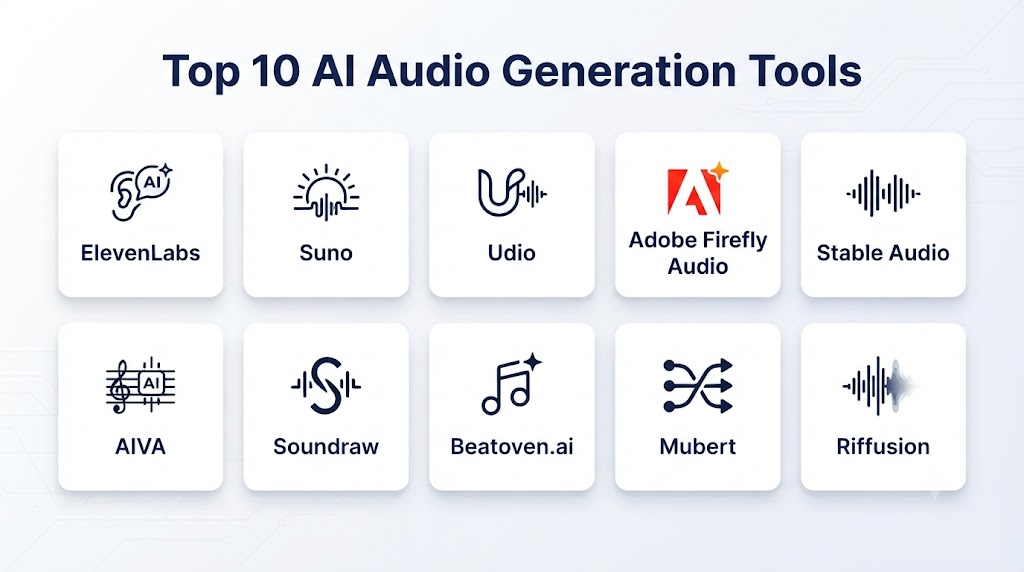
Top 10 AI Audio Generation Tools
1. ElevenLabs
One-line verdict: Best for highly realistic AI voices, narration, multilingual content, and developer-focused voice applications.
Short description:
ElevenLabs is an AI audio platform focused heavily on synthetic speech, voice generation, voice cloning, dubbing, and related audio workflows. It is widely relevant to content creators, developers, media teams, publishers, and businesses.
Standout Capabilities
- Text-to-speech.
- Realistic AI voices.
- Voice cloning.
- Voice customization.
- Multilingual speech.
- Dubbing and localization.
- Voice-oriented APIs.
- Conversational voice applications.
AI-Specific Depth
- Model support: Proprietary platform-managed models; model availability varies.
- RAG / knowledge integration: Not a core RAG platform; can be integrated into RAG applications through APIs.
- Evaluation: Application-level evaluation can assess pronunciation, naturalness, latency, and consistency.
- Guardrails: Platform policies and controls around synthetic voices and misuse.
- Observability: Usage and API-level metrics can be monitored; exact telemetry varies by implementation.
Pros
- Strong natural-speech quality.
- Broad voice and localization applications.
- Useful API ecosystem.
Cons
- Usage costs can increase with large volumes.
- Voice cloning requires careful consent governance.
- Hosted-service dependency.
Security & Compliance
Enterprise security, administrative controls, data handling, and certifications vary by offering. Specific certifications should be verified before procurement.
Deployment & Platforms
- Cloud.
- Web.
- API.
- Developer applications.
Integrations & Ecosystem
ElevenLabs is particularly useful in developer and content-production workflows.
- APIs.
- Voice applications.
- Video production.
- Podcasts.
- E-learning.
- Games.
- Content-management workflows.
Pricing Model
Subscription and usage-based pricing models vary.
Best-Fit Scenarios
- Professional narration.
- AI voice applications.
- Multilingual content production.
2. OpenAI Audio
One-line verdict: Best for developers building multimodal applications requiring speech generation, real-time interaction, and AI-powered audio experiences.
Short description:
OpenAI provides audio capabilities that can support speech generation and interactive AI experiences. Its biggest advantage is the ability to integrate audio into broader multimodal applications rather than treating speech as an isolated production task.
Standout Capabilities
- Text-to-speech.
- AI-generated speech.
- Real-time voice interaction.
- Multimodal applications.
- Conversational AI.
- Developer APIs.
- Voice-enabled assistants.
- Application-level automation.
AI-Specific Depth
- Model support: OpenAI-managed models; exact availability varies by service.
- RAG / knowledge integration: Can be integrated into RAG and agentic applications.
- Evaluation: Developers can evaluate pronunciation, response quality, latency, safety, and task completion.
- Guardrails: Platform safety controls and application-level policies.
- Observability: API usage and application telemetry can be monitored; exact metrics depend on implementation.
Pros
- Strong multimodal ecosystem.
- Suitable for interactive AI applications.
- Developer-oriented APIs.
Cons
- Hosted-model dependency.
- Audio costs depend on application usage.
- Exact capabilities can vary across services.
Security & Compliance
Security and privacy controls depend on the applicable OpenAI product and deployment. Organizations should verify current requirements before using sensitive recordings.
Deployment & Platforms
- Cloud.
- API.
- Web applications.
- Custom software.
Integrations & Ecosystem
- AI assistants.
- RAG systems.
- Agentic applications.
- Customer-service applications.
- Mobile applications.
- Enterprise software.
- Voice interfaces.
Pricing Model
Usage-based pricing varies by service and audio workload.
Best-Fit Scenarios
- Voice-enabled AI assistants.
- Real-time conversational applications.
- Multimodal software.
3. Google Cloud Text-to-Speech
One-line verdict: Best for enterprises needing scalable synthetic speech integrated with broader cloud applications and services.
Short description:
Google Cloud’s speech-generation capabilities provide developers with programmatic access to synthetic voices and speech services. They are particularly relevant to enterprises already using cloud infrastructure.
Standout Capabilities
- Text-to-speech.
- Multiple voices.
- Multilingual speech.
- Developer APIs.
- Cloud integration.
- Application automation.
- Speech customization.
- Enterprise deployment workflows.
AI-Specific Depth
- Model support: Google-managed speech models and voice technologies.
- RAG / knowledge integration: Can be integrated into RAG applications.
- Evaluation: Application-level speech-quality and task-level evaluation.
- Guardrails: Cloud security and service-level controls.
- Observability: Cloud monitoring and application telemetry.
Pros
- Strong cloud ecosystem.
- Developer-friendly.
- Suitable for enterprise-scale applications.
Cons
- Cloud configuration can require technical expertise.
- Pricing can become complex at scale.
- Some advanced workflows may require additional services.
Security & Compliance
Google Cloud provides extensive enterprise security capabilities. Specific controls and certifications depend on the service and configuration.
Deployment & Platforms
- Cloud.
- APIs.
- Enterprise applications.
- Mobile and web applications.
Integrations & Ecosystem
- Google Cloud.
- AI applications.
- Contact centers.
- Mobile applications.
- Websites.
- Enterprise software.
- Data platforms.
Pricing Model
Usage-based cloud pricing.
Best-Fit Scenarios
- Enterprise applications.
- Automated narration.
- Cloud-based voice services.
4. Amazon Polly
One-line verdict: Best for developers needing scalable cloud-based text-to-speech integrated into AWS applications and workflows.
Short description:
Amazon Polly provides cloud-based text-to-speech services designed for application developers. It is useful for websites, applications, accessibility features, voice interfaces, and automated narration.
Standout Capabilities
- Text-to-speech.
- Synthetic voices.
- Multiple languages.
- Speech APIs.
- Cloud integration.
- Application automation.
- Streaming capabilities.
- Developer workflows.
AI-Specific Depth
- Model support: AWS-managed speech technologies.
- RAG / knowledge integration: Can be integrated into retrieval-based applications.
- Evaluation: Application-level testing.
- Guardrails: AWS security and application-level controls.
- Observability: AWS monitoring capabilities.
Pros
- Strong AWS integration.
- Developer-friendly API.
- Suitable for scalable applications.
Cons
- Primarily focused on speech rather than broader generative audio.
- Cloud configuration may require technical expertise.
- Advanced creative audio generation requires other tools.
Security & Compliance
AWS provides extensive security and compliance capabilities. Exact controls depend on architecture and service configuration.
Deployment & Platforms
- Cloud.
- API.
- AWS applications.
- Web and mobile applications.
Integrations & Ecosystem
- AWS services.
- Web applications.
- Mobile applications.
- Accessibility systems.
- Customer-service systems.
- Voice assistants.
- Enterprise applications.
Pricing Model
Usage-based pricing.
Best-Fit Scenarios
- AWS applications.
- Accessibility features.
- Automated speech.
5. Azure AI Speech
One-line verdict: Best for Microsoft-oriented enterprises requiring speech generation, voice applications, and integrated cloud AI services.
Short description:
Azure AI Speech provides speech-related AI capabilities for applications, including synthetic speech and voice experiences. It is particularly useful for organizations already invested in Microsoft Azure.
Standout Capabilities
- Text-to-speech.
- Neural voices.
- Speech customization.
- Multilingual capabilities.
- Voice applications.
- Cloud APIs.
- Enterprise integration.
- Conversational experiences.
AI-Specific Depth
- Model support: Microsoft-managed speech models.
- RAG / knowledge integration: Can be integrated with broader Azure AI applications.
- Evaluation: Application-level testing.
- Guardrails: Azure security and AI governance capabilities.
- Observability: Azure monitoring and application telemetry.
Pros
- Strong Microsoft ecosystem.
- Enterprise integration.
- Suitable for large-scale applications.
Cons
- Cloud complexity.
- Advanced capabilities may require additional configuration.
- Primarily speech-focused.
Security & Compliance
Azure provides enterprise security and governance capabilities. Specific certifications and configurations should be verified for the selected service.
Deployment & Platforms
- Cloud.
- APIs.
- Enterprise applications.
- Web and mobile applications.
Integrations & Ecosystem
- Microsoft Azure.
- Microsoft applications.
- Enterprise software.
- Contact centers.
- AI assistants.
- Customer-service systems.
- Accessibility solutions.
Pricing Model
Usage-based cloud pricing.
Best-Fit Scenarios
- Microsoft enterprise environments.
- Voice applications.
- Automated narration.
6. Suno
One-line verdict: Best for creators seeking accessible AI-generated music and rapid experimentation with complete musical concepts.
Short description:
Suno focuses on generative music creation. Users can describe musical concepts and generate songs or musical pieces, making the platform useful for experimentation, creative ideation, and content development.
Standout Capabilities
- Text-to-music.
- Song generation.
- Vocal generation.
- Music experimentation.
- Genre-based creation.
- Creative iteration.
- Rapid prototyping.
- Music ideation.
AI-Specific Depth
- Model support: Platform-managed generative music models.
- RAG / knowledge integration: N/A.
- Evaluation: Human creative review.
- Guardrails: Platform safety and content policies.
- Observability: Usage metrics vary.
Pros
- Easy music experimentation.
- Rapid creation.
- Useful for musical ideation.
Cons
- Detailed musical control can be limited.
- Commercial-use terms require careful review.
- Generated music may require human editing.
Security & Compliance
Specific enterprise controls and certifications should be verified for the applicable offering.
Deployment & Platforms
- Cloud.
- Web.
- Platform-specific applications may vary.
Integrations & Ecosystem
- Music creation.
- Social content.
- Video production.
- Creative experimentation.
- Advertising concepts.
- Content creation.
Pricing Model
Subscription and/or usage-based models vary.
Best-Fit Scenarios
- Music ideation.
- Content creation.
- Creative experimentation.
7. Udio
One-line verdict: Best for creators experimenting with AI-generated songs, musical styles, vocals, and rapid music prototyping.
Short description:
Udio is a generative music platform focused on creating musical content from natural-language descriptions. It is useful for creators who want to experiment with songs, arrangements, vocals, and musical concepts.
Standout Capabilities
- Text-to-music.
- Song generation.
- Vocal generation.
- Musical-style experimentation.
- Creative iteration.
- Music concepts.
- Short-form music creation.
- AI-assisted songwriting.
AI-Specific Depth
- Model support: Platform-managed models.
- RAG / knowledge integration: N/A.
- Evaluation: Human creative review.
- Guardrails: Platform safety controls and policies.
- Observability: Usage information varies.
Pros
- Accessible music creation.
- Rapid experimentation.
- Useful for songwriting concepts.
Cons
- Fine-grained control can be limited.
- Licensing and commercial-use requirements require careful review.
- Generated outputs may need editing.
Security & Compliance
Specific enterprise controls and certifications are not assumed without verification.
Deployment & Platforms
- Cloud.
- Web.
Integrations & Ecosystem
- Music creation.
- Creative production.
- Social media.
- Video projects.
- Songwriting.
- Content experimentation.
Pricing Model
Subscription and/or usage-based models vary.
Best-Fit Scenarios
- Song experimentation.
- Music ideation.
- Creative projects.
8. Stability AI Audio
One-line verdict: Best for developers and creative teams interested in generative audio models and customizable AI media workflows.
Short description:
Stability AI has developed generative AI technologies across multiple media types, including audio-related generation. Its ecosystem can be relevant to teams interested in model-driven creative workflows and more flexible AI experimentation.
Standout Capabilities
- Generative audio experimentation.
- Text-based audio generation where supported.
- Developer-oriented workflows.
- Generative media.
- Model experimentation.
- Creative prototyping.
- AI research workflows.
- Custom application development.
AI-Specific Depth
- Model support: Open and/or platform-managed models depending on the applicable offering.
- RAG / knowledge integration: N/A as a core audio function.
- Evaluation: Developer-defined evaluation.
- Guardrails: Model and application-level safety controls.
- Observability: Depends on deployment.
Pros
- Relevant to developer experimentation.
- Potential model flexibility.
- Useful for research-oriented workflows.
Cons
- Model capabilities can change.
- Requires technical expertise for advanced deployment.
- Commercial and licensing requirements should be reviewed carefully.
Security & Compliance
Deployment-specific. Enterprise controls depend on how the models are accessed or deployed.
Deployment & Platforms
- Cloud.
- API.
- Potentially self-managed for applicable models and licenses.
Integrations & Ecosystem
- AI applications.
- Developer workflows.
- Generative-media systems.
- Creative tools.
- Model-serving infrastructure.
- Research environments.
Pricing Model
Varies by model and deployment.
Best-Fit Scenarios
- Developer experimentation.
- Generative-audio research.
- Custom AI applications.
9. Murf AI
One-line verdict: Best for businesses producing professional AI voice-overs, training content, presentations, and marketing narration.
Short description:
Murf AI focuses on AI-generated voice-over and speech production. It is designed for creators and business teams that need polished narration without traditional recording workflows.
Standout Capabilities
- AI voice-over.
- Text-to-speech.
- Voice customization.
- Multilingual narration.
- Presentation voice-over.
- Training content.
- Marketing narration.
- Audio editing.
AI-Specific Depth
- Model support: Platform-managed AI voice models.
- RAG / knowledge integration: Can be integrated into broader content workflows.
- Evaluation: Human review and application-level testing.
- Guardrails: Platform safety policies.
- Observability: Usage metrics vary.
Pros
- Business-oriented workflow.
- Useful for professional narration.
- Accessible for non-technical teams.
Cons
- More focused on voice than general music generation.
- Advanced customization varies.
- Enterprise requirements should be validated.
Security & Compliance
Specific enterprise controls, certifications, and retention policies should be verified for the applicable offering.
Deployment & Platforms
- Cloud.
- Web.
- Business workflows.
- API capabilities vary.
Integrations & Ecosystem
- Presentations.
- E-learning.
- Marketing.
- Video.
- Training.
- Corporate communications.
- Content creation.
Pricing Model
Subscription and usage-based pricing vary.
Best-Fit Scenarios
- Corporate narration.
- Training videos.
- Marketing voice-overs.
10. Descript
One-line verdict: Best for creators and teams combining AI audio generation, transcription, podcast editing, and multimedia production.
Short description:
Descript combines transcription, audio editing, video editing, and AI-powered content tools. It is particularly useful when audio generation needs to be part of a broader podcast or multimedia-production workflow.
Standout Capabilities
- AI voice capabilities.
- Transcription.
- Podcast editing.
- Audio editing.
- Video editing.
- Text-based editing.
- Content repurposing.
- Multimedia workflows.
AI-Specific Depth
- Model support: Platform-managed AI capabilities.
- RAG / knowledge integration: Not a core RAG platform.
- Evaluation: Human review and workflow-level evaluation.
- Guardrails: Platform safety and usage policies.
- Observability: Usage and project metrics vary.
Pros
- Combines audio and video production.
- Strong podcast workflow.
- Text-based editing is convenient.
Cons
- Not primarily a dedicated music-generation platform.
- Advanced workflows may require additional tools.
- AI capabilities vary by plan.
Security & Compliance
Security and enterprise administration vary by offering. Specific certifications should be verified before procurement.
Deployment & Platforms
- Cloud.
- Web.
- Desktop workflows.
- Multimedia applications.
Integrations & Ecosystem
- Podcasts.
- Video production.
- Transcription.
- Content creation.
- Marketing.
- Social media.
- Collaboration.
Pricing Model
Subscription and usage-based pricing vary.
Best-Fit Scenarios
- Podcast production.
- Video/audio editing.
- Content repurposing.
Comparison Table
| Tool Name | Best For | Deployment | Model Flexibility | Strength | Watch-Out | Public Rating |
|---|---|---|---|---|---|---|
| ElevenLabs | AI voices and narration | Cloud | Hosted | Realistic synthetic speech | Usage costs | |
| OpenAI Audio | Multimodal voice applications | Cloud | Hosted | AI interaction | Hosted dependency | |
| Google Cloud Text-to-Speech | Enterprise speech applications | Cloud | Hosted | Cloud integration | Technical complexity | |
| Amazon Polly | AWS voice applications | Cloud | Hosted | AWS ecosystem | Speech-focused | |
| Azure AI Speech | Microsoft enterprise speech | Cloud | Hosted | Enterprise integration | Cloud complexity | |
| Suno | AI music creation | Cloud | Hosted | Song generation | Licensing review | |
| Udio | AI music experimentation | Cloud | Hosted | Music ideation | Commercial-use considerations | |
| Stability AI Audio | Developer experimentation | Cloud / potentially self-managed | Varies | Model flexibility | Technical requirements | |
| Murf AI | Professional voice-over | Cloud | Hosted | Business narration | Voice-focused | |
| Descript | Podcast and multimedia production | Cloud / Desktop | Hosted | Audio + video workflow | Not primarily music generation |
Scoring & Evaluation
The following scores are comparative editorial assessments rather than official vendor benchmarks. The weighting emphasizes audio capability, AI reliability, integrations, usability, operational performance, security, and support.
| Tool | Core | Reliability/Eval | Guardrails | Integrations | Ease | Perf/Cost | Security/Admin | Support | Weighted Total |
|---|---|---|---|---|---|---|---|---|---|
| ElevenLabs | 10 | 9 | 9 | 9 | 9 | 8 | 8 | 9 | 8.95 |
| OpenAI Audio | 10 | 9 | 9 | 10 | 9 | 8 | 9 | 9 | 9.15 |
| Google Cloud Text-to-Speech | 9 | 9 | 9 | 10 | 8 | 9 | 10 | 9 | 9.10 |
| Amazon Polly | 9 | 9 | 9 | 10 | 8 | 9 | 10 | 9 | 9.10 |
| Azure AI Speech | 9 | 9 | 9 | 10 | 8 | 9 | 10 | 9 | 9.10 |
| Suno | 9 | 8 | 8 | 7 | 9 | 8 | 7 | 8 | 8.10 |
| Udio | 9 | 8 | 8 | 7 | 9 | 8 | 7 | 8 | 8.10 |
| Stability AI Audio | 8 | 8 | 7 | 8 | 7 | 8 | 7 | 8 | 7.65 |
| Murf AI | 9 | 9 | 9 | 8 | 10 | 8 | 8 | 9 | 8.95 |
| Descript | 9 | 9 | 8 | 9 | 10 | 8 | 8 | 9 | 9.00 |
Top 3 for Enterprise
- Google Cloud Text-to-Speech — Strong choice for organizations already operating cloud-native applications.
- Azure AI Speech — Particularly suitable for Microsoft-oriented enterprises.
- Amazon Polly — Strong fit for AWS-centric applications.
Top 3 for SMB
- ElevenLabs — Strong for professional AI narration and voice workflows.
- Murf AI — Useful for business-oriented voice-over production.
- Descript — Good fit for teams combining audio production with video and podcast workflows.
Top 3 for Developers
- OpenAI Audio — Strong for multimodal and conversational AI applications.
- Google Cloud Text-to-Speech — Strong API and cloud integration.
- Amazon Polly — Strong option for AWS application development.
Which AI Audio Generation Tool Is Right for You?
Solo / Freelancer
Solo creators should prioritize:
- Natural voice quality.
- Simple editing.
- Fast generation.
- Affordable usage.
- Multilingual support.
- Export options.
- Commercial-use clarity.
ElevenLabs, Murf AI, Descript, Suno, and Udio can be useful depending on whether the creator needs speech, music, or multimedia production.
SMB
SMBs should focus on:
- Brand consistency.
- Professional narration.
- Voice quality.
- Localization.
- Team collaboration.
- Easy editing.
- Usage management.
- Commercial rights.
For voice-over production, ElevenLabs and Murf AI are strong candidates. For podcast and multimedia production, Descript can be a better fit.
Mid-Market
Mid-market teams should evaluate:
- API availability.
- Workflow automation.
- Content management.
- Voice consistency.
- Localization.
- Usage analytics.
- Security.
- Data retention.
- Administrative controls.
At this stage, audio generation should be integrated into existing content and marketing processes instead of becoming another disconnected tool.
Enterprise
Enterprise buyers should consider:
- SSO.
- RBAC.
- Data governance.
- Data retention.
- Data residency.
- API scalability.
- Monitoring.
- Cost controls.
- Voice consent.
- Synthetic-media governance.
- Auditability.
- Vendor risk.
- Commercial rights.
Google Cloud Text-to-Speech, Azure AI Speech, Amazon Polly, and OpenAI audio capabilities are particularly relevant to enterprise application architectures.
Regulated Industries
Organizations handling sensitive information should be careful when uploading:
- Customer recordings.
- Employee voices.
- Call-center conversations.
- Healthcare conversations.
- Financial discussions.
- Internal meetings.
- Confidential documents.
- Proprietary scripts.
Establish clear policies governing retention, access, consent, processing, and synthetic-voice usage.
Budget vs Premium
Budget
Prioritize:
- Basic text-to-speech.
- Short-form narration.
- Limited voice requirements.
- Simple editing.
- Low-volume generation.
Premium
Consider:
- High-quality expressive voices.
- Voice customization.
- Enterprise APIs.
- Multilingual production.
- Real-time interaction.
- High-volume automation.
- Advanced administration.
Build vs Buy
Build when:
- Audio AI is part of your core product.
- You require customized voice workflows.
- You have AI engineering resources.
- You need deep integration.
- You require infrastructure control.
Buy when:
- You need immediate productivity.
- Audio is not your core technology.
- You want managed infrastructure.
- You need production-ready interfaces.
- You lack specialized ML expertise.
Hybrid Approach
A hybrid architecture can combine:
- Commercial speech APIs.
- Open-source audio models.
- Internal content systems.
- Human approval.
- Voice governance.
- Automated quality testing.
- Custom application logic.
Implementation Playbook: 30 / 60 / 90 Days
First 30 Days: Pilot + Success Metrics
Start with low-risk audio workflows.
Examples include:
- Internal training.
- Product narration.
- Marketing videos.
- Podcast introductions.
- E-learning.
- Social-media audio.
- Internal presentations.
Build an evaluation dataset with:
- Short scripts.
- Long-form scripts.
- Difficult pronunciations.
- Brand terminology.
- Different languages.
- Different speaking styles.
Measure:
- Naturalness.
- Pronunciation.
- Voice consistency.
- Emotional quality.
- Latency.
- Generation success.
- Cost per finished minute.
- Human preference.
Days 31–60: Security + Evaluation + Rollout
Create an audio evaluation harness.
Test:
- Pronunciation.
- Accent.
- Emotional delivery.
- Speaking rate.
- Pauses.
- Background noise.
- Voice consistency.
- Language quality.
- Translation quality.
- Brand compliance.
For voice cloning, establish:
- Consent verification.
- Identity controls.
- Access restrictions.
- Usage logging.
- Revocation processes.
- Approved voice libraries.
Introduce version control for:
- Scripts.
- Prompts.
- Voices.
- Models.
- Generation settings.
- Localization assets.
Days 61–90: Optimize + Scale
Move successful use cases into production.
Consider:
- Automated narration.
- Content localization.
- AI-assisted podcast workflows.
- Customer-service voice systems.
- Personalized audio.
- E-learning automation.
- Marketing automation.
Monitor:
- Cost.
- Latency.
- Quality.
- Failure rates.
- Voice misuse.
- User adoption.
- Model changes.
- Customer feedback.
Common Mistakes & How to Avoid Them
- Using voice cloning without consent: Establish documented authorization.
- Ignoring pronunciation: Test brand names, technical terms, and proper nouns.
- No evaluation dataset: Build representative scripts before selecting a platform.
- Ignoring latency: Real-time applications require much tighter performance requirements.
- No cost controls: High-volume audio generation can become expensive.
- Uploading sensitive recordings: Review data-retention and privacy policies.
- Ignoring voice identity risks: Restrict access to cloned or customized voices.
- No human review: Check important public-facing audio before publishing.
- Ignoring multilingual quality: Translation and pronunciation should be evaluated separately.
- No audio provenance: Maintain records for important synthetic-media assets.
- Assuming all voices are commercially usable: Verify applicable licensing terms.
- Ignoring model changes: Hosted AI services may change model behavior over time.
- No fallback voice: Production applications should have failure-handling strategies.
- Over-automating customer communication: Important customer interactions may still require human oversight.
- Ignoring background noise: Generated speech can sound unnatural when mixed poorly.
- No version control: Track scripts, voices, models, and settings.
- Ignoring vendor lock-in: Preserve source scripts and reusable production assets.
- No red-team testing: Test for impersonation, abuse, unsafe content, and unintended outputs.
FAQs
1. What Are AI Audio Generation Tools?
AI Audio Generation Tools use artificial intelligence to create or transform speech, music, sound effects, and other audio content from text, recordings, prompts, or other inputs.
2. What Can AI Audio Tools Generate?
Depending on the platform, they can generate narration, synthetic voices, songs, music, sound effects, podcast content, dubbing, and other audio assets.
3. What Is AI Text-to-Speech?
Text-to-speech converts written text into spoken audio using an AI-generated or synthetic voice.
4. What Is AI Voice Cloning?
Voice cloning attempts to reproduce characteristics of a person’s voice so that new speech can be generated using that voice.
5. Is Voice Cloning Safe?
Voice cloning can be useful but creates impersonation and identity risks. Organizations should use explicit consent, access controls, monitoring, and clear usage policies.
6. Can AI Generate Music?
Yes. Music-generation platforms can create musical compositions, songs, vocals, arrangements, or musical ideas from natural-language instructions.
7. Can AI Generate Sound Effects?
Some generative-audio systems can create sound effects from textual descriptions, which can be useful for games, videos, advertisements, and creative projects.
8. Can AI Audio Be Used Commercially?
Commercial use depends on the provider’s terms, model, subscription, source material, and applicable rights. Always verify the current licensing requirements.
9. Can AI Audio Generate Multiple Languages?
Yes. Many speech-generation platforms support multiple languages and can be used for localization and multilingual narration.
10. Can AI Preserve the Same Voice Across Multiple Videos?
Many platforms are designed to maintain a consistent selected voice, but output characteristics can still vary depending on the model and generation settings.
11. Can AI Audio Be Used for Podcasts?
Yes. AI can support narration, introductions, editing, transcription, dubbing, and other podcast-production tasks.
12. Can AI Audio Replace Professional Voice Actors?
For some routine narration, AI can reduce production requirements. However, professional voice actors remain valuable for nuanced performances, distinctive characters, high-stakes productions, and situations requiring human interpretation.
13. Can AI Generate Real-Time Speech?
Some AI audio systems support low-latency or real-time speech generation, making them useful for conversational assistants and interactive applications.
14. Can AI Audio APIs Be Integrated Into Software?
Yes. Several providers offer APIs that developers can use to integrate speech and other audio capabilities into applications.
15. Can AI Audio Tools Be Self-Hosted?
Some open or independently deployable audio models can be self-hosted. Hardware requirements, licensing, model availability, and engineering complexity vary.
16. Is Self-Hosting Better Than Cloud AI Audio?
Self-hosting can provide greater infrastructure and data control, while cloud services generally provide easier deployment and managed scaling.
17. Does AI Audio Support RAG?
RAG is not usually an audio-generation capability itself. However, a RAG system can retrieve relevant information and pass that content to an AI speech system for narration.
18. How Should AI Voice Quality Be Evaluated?
Evaluate pronunciation, naturalness, pacing, emotion, consistency, language quality, latency, intelligibility, and performance across representative scripts.
19. How Much Does AI Audio Generation Cost?
Costs vary according to the provider, model, audio duration, voice type, quality, API usage, and subscription plan. High-volume workloads should be tested before production.
20. How Can Businesses Control AI Audio Costs?
Use appropriate quality settings, batch processing, caching, reusable assets, efficient models, usage limits, and automated quality checks.
21. What Is AI Dubbing?
AI dubbing uses AI to translate and generate spoken audio for existing video or audio content in another language.
22. Can AI Match Lip Movements During Dubbing?
Some video-production workflows combine generated speech with lip-synchronization technology. Results vary depending on the source video, language, voice, and system.
23. Can AI Create Audiobooks?
Yes. AI-generated narration can be used to produce audiobook-style content, subject to applicable rights and quality requirements.
24. Can AI Audio Be Used in Games?
Yes. Game developers can use AI for character voices, narration, environmental audio, sound effects, prototypes, and dynamic voice experiences.
25. Can AI Generate Character Voices?
Yes. AI voice systems can generate synthetic character voices, although teams should carefully consider voice ownership, consent, licensing, and consistency.
26. How Can Companies Protect Their Brand Voice?
Organizations can use approved voices, pronunciation dictionaries, controlled scripts, brand guidelines, review processes, and centralized voice libraries.
27. How Can AI Audio Systems Be Protected From Prompt Injection?
Applications should validate untrusted inputs, isolate instructions, limit tool permissions, apply content filtering, and prevent external data from overriding system-level controls.
28. What Is the Best AI Audio Generation Tool?
There is no universal winner. ElevenLabs is particularly strong for AI voice generation, OpenAI Audio for multimodal and conversational applications, major cloud speech services for enterprise development, and Suno or Udio for AI music experimentation.
29. Which AI Audio Tool Is Best for Beginners?
The best choice depends on the task. Voice-focused users may prefer ElevenLabs or Murf AI, while creators interested in music may prefer Suno or Udio.
30. What Should Enterprises Check Before Buying an AI Audio Platform?
Enterprises should evaluate privacy, retention, security, SSO, RBAC, data residency, API capabilities, scalability, voice-consent controls, commercial rights, monitoring, and governance.
31. Should AI-Generated Audio Be Reviewed by Humans?
Yes. Human review is especially important for advertising, education, healthcare, financial communications, customer interactions, and other sensitive applications.
32. How Can Companies Avoid Vendor Lock-In?
Keep original scripts, recordings, prompts, metadata, voice specifications, and production assets independent from a single vendor whenever practical.
Conclusion
AI Audio Generation Tools are evolving from basic text-to-speech systems into broader AI-powered audio production platforms capable of generating speech, music, sound effects, dubbing, and interactive voice experiences.ElevenLabs is particularly relevant for realistic synthetic voices and narration. OpenAI Audio is well suited to multimodal and conversational AI applications. Google Cloud Text-to-Speech, Amazon Polly, and Azure AI Speech are strong options for developers building cloud-based enterprise applications. Suno and Udio address the growing AI-music market, while Murf AI and Descript are useful for business narration and broader content-production workflows.The right tool depends on what you are actually trying to create. A podcast producer, enterprise developer, music creator, game studio, and e-learning team can have completely different requirements.