Introduction
Agent policy and permission systems are specialized platforms designed to control what AI agents can and cannot do. In simple terms, they act as the “rule engine” behind AI agents—defining boundaries, permissions, and behaviors to ensure safe, compliant, and predictable execution.
As AI systems evolve from passive assistants into autonomous agents capable of executing tasks, calling APIs, and interacting with sensitive data, policy enforcement becomes critical. Without proper controls, agents may access unauthorized data, execute harmful actions, or violate compliance requirements. These systems help enforce rules, validate actions, and ensure that AI operates within defined constraints.
real world use cases include:
- Controlling API and tool access for AI agents
- Enforcing data access permissions
- Preventing unsafe or unauthorized actions
- Implementing governance and compliance policies
- Managing multi-agent workflows with role-based controls
- Auditing and monitoring agent decisions
Key evaluation criteria buyers should consider:
- Granularity of permission controls
- Policy definition flexibility
- Integration with AI frameworks and APIs
- Support for multi-agent environments
- Real-time enforcement capabilities
- Observability and audit logging
- Guardrails and safety mechanisms
- Model compatibility (BYO/multi-model)
- Deployment flexibility
- Ease of policy management
Best for: CTOs, AI engineers, security teams, and enterprises building agent-based systems in finance, healthcare, SaaS, and government sectors.
Not ideal for: Teams building simple AI chatbots or non-autonomous workflows where strict permission control is not required.
What’s Changed in Agent Policy & Permission Systems
- Shift from static rules to dynamic, context-aware policy enforcement
- Integration with agent frameworks and tool-calling systems
- Fine-grained access control for APIs, data, and workflows
- Built-in prompt injection and jailbreak defense mechanisms
- Real-time policy evaluation during agent execution
- Support for multi-agent coordination and role-based permissions
- Increased focus on auditability and compliance logging
- Integration with identity and access management (IAM) systems
- Privacy-first controls (data masking, retention policies)
- Model-agnostic enforcement (works across multiple LLMs)
- Policy-as-code approaches for scalability
- Increased demand for explainability in decisions
Quick Buyer Checklist (Scan-Friendly)
- Can you define fine-grained permissions for tools, APIs, and data?
- Does it support real-time policy enforcement during execution?
- Are there built-in guardrails for prompt injection and misuse?
- Does it provide audit logs and traceability?
- Can you integrate with existing IAM or security systems?
- Does it support multi-agent environments and role-based access?
- Are data privacy and retention policies configurable?
- Can you use your own models (BYO) or multiple models?
- Does it support evaluation and testing of policies?
- Is deployment flexible (cloud, self-hosted, hybrid)?
- How easy is it to update and manage policies at scale?
- Is there a risk of vendor lock-in?
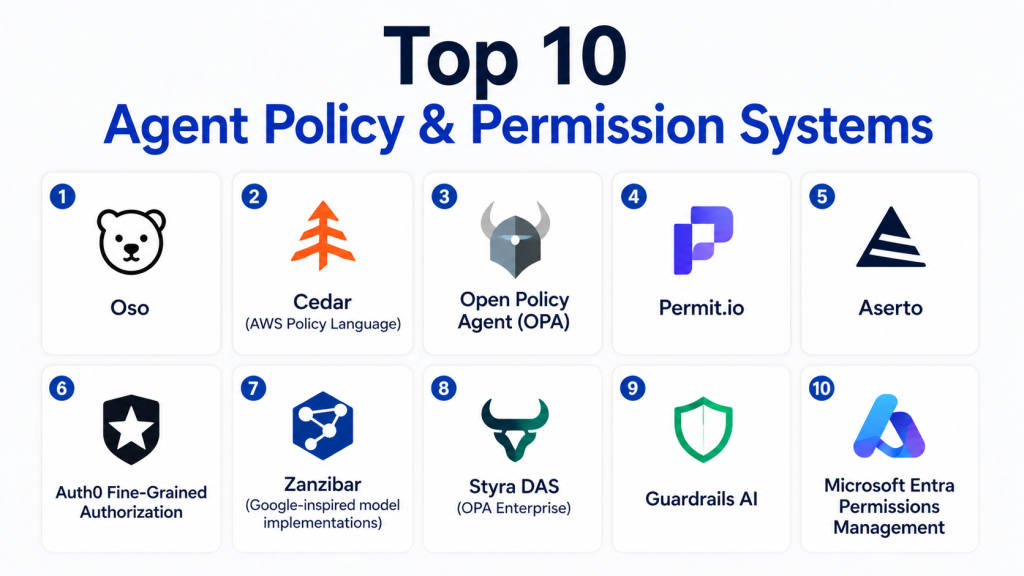
Top 10 Agent Policy & Permission Systems
1 — Oso
One-line verdict: Best for developers needing fine-grained authorization embedded directly into AI agent workflows.
Short description:
Oso is an authorization framework that enables developers to define and enforce access policies across applications and AI systems.
Standout Capabilities
- Policy-as-code using declarative syntax
- Fine-grained authorization logic
- Integration with application backends
- Role-based and attribute-based access control
- Scalable policy enforcement
AI-Specific Depth
- Model support: N/A
- RAG / knowledge integration: N/A
- Evaluation: Limited
- Guardrails: Moderate
- Observability: Moderate
Pros
- Highly flexible policy system
- Developer-friendly
- Scales well
Cons
- Not AI-native
- Requires engineering effort
- Limited built-in AI evaluation
Security & Compliance
- RBAC support, audit capabilities (details vary)
Deployment & Platforms
- Cloud / Self-hosted
Integrations & Ecosystem
- APIs
- Backend frameworks
- Identity systems
- Custom integrations
Pricing Model
- Open-source + enterprise
Best-Fit Scenarios
- Backend-driven agent control
- Fine-grained permissions
- Custom policy systems
2 — Cedar (AWS Policy Language)
One-line verdict: Best for enterprises implementing scalable and auditable policy systems for AI and applications.
Short description:
Cedar is a policy language designed for defining access control in a structured and scalable way.
Standout Capabilities
- Policy-as-code framework
- Fine-grained access control
- Strong auditability
- Scalable architecture
- Formal policy validation
AI-Specific Depth
- Model support: N/A
- RAG / knowledge integration: N/A
- Evaluation: Limited
- Guardrails: Moderate
- Observability: Moderate
Pros
- Highly scalable
- Strong policy structure
- Enterprise-ready
Cons
- Requires expertise
- Not AI-specific
- Limited out-of-box integrations
Security & Compliance
- Designed for secure access control (details vary)
Deployment & Platforms
- Cloud / Hybrid
Integrations & Ecosystem
- AWS ecosystem
- APIs
- IAM systems
Pricing Model
- Not publicly stated
Best-Fit Scenarios
- Enterprise policy systems
- Compliance-heavy environments
- Scalable access control
3 — Open Policy Agent (OPA)
One-line verdict: Best for teams needing open-source, flexible policy enforcement across AI and infrastructure.
Short description:
OPA is a widely used open-source policy engine for enforcing rules across systems, including AI workflows.
Standout Capabilities
- Policy-as-code using Rego
- Open-source flexibility
- Works across environments
- Strong community support
- Integration with cloud-native systems
AI-Specific Depth
- Model support: N/A
- RAG / knowledge integration: N/A
- Evaluation: Limited
- Guardrails: Moderate
- Observability: Moderate
Pros
- Highly flexible
- Open-source
- Broad ecosystem
Cons
- Requires setup
- Not AI-native
- Learning curve
Security & Compliance
- Strong policy enforcement capabilities (details vary)
Deployment & Platforms
- Cloud / Self-hosted
Integrations & Ecosystem
- Kubernetes
- APIs
- Cloud platforms
- DevOps tools
Pricing Model
- Open-source
Best-Fit Scenarios
- Infrastructure-level policy control
- Custom AI governance
- DevOps integration
4 — Permit.io
One-line verdict: Best for teams building modern authorization systems with easy integration into AI applications.
Short description:
Permit.io provides authorization-as-a-service with developer-friendly APIs and dashboards.
Standout Capabilities
- Authorization-as-a-service
- RBAC and ABAC support
- Developer-friendly APIs
- UI for policy management
- Real-time enforcement
AI-Specific Depth
- Model support: N/A
- RAG / knowledge integration: N/A
- Evaluation: Limited
- Guardrails: Moderate
- Observability: Moderate
Pros
- Easy to integrate
- Good UX
- Flexible policies
Cons
- Not AI-native
- Limited evaluation features
- Dependency on service
Security & Compliance
- RBAC, audit logs (details vary)
Deployment & Platforms
- Cloud
Integrations & Ecosystem
- APIs
- SDKs
- Backend systems
Pricing Model
- Tiered
Best-Fit Scenarios
- SaaS applications
- AI app authorization
- Rapid deployment
5 — Aserto
One-line verdict: Best for enterprises needing centralized authorization and policy decision points.
Short description:
Aserto provides centralized authorization with policy decision engines for applications and services.
Standout Capabilities
- Centralized policy engine
- Fine-grained access control
- Real-time decisioning
- Integration with identity systems
AI-Specific Depth
- Model support: N/A
- RAG / knowledge integration: N/A
- Evaluation: Limited
- Guardrails: Moderate
- Observability: Moderate
Pros
- Centralized control
- Scalable
- Enterprise-ready
Cons
- Complex setup
- Not AI-focused
- Limited ecosystem
Security & Compliance
- Enterprise-grade controls (details vary)
Deployment & Platforms
- Cloud / Hybrid
Integrations & Ecosystem
- IAM systems
- APIs
- Backend services
Pricing Model
- Not publicly stated
Best-Fit Scenarios
- Enterprise governance
- Centralized authorization
- Multi-service environments
6 — Auth0 Fine-Grained Authorization
One-line verdict: Best for identity-driven permission control integrated with AI-powered applications.
Short description:
Auth0 provides identity and access management with fine-grained authorization capabilities.
Standout Capabilities
- Identity-based access control
- RBAC and ABAC
- Integration with authentication systems
- Scalable user management
AI-Specific Depth
- Model support: N/A
- RAG / knowledge integration: N/A
- Evaluation: N/A
- Guardrails: Moderate
- Observability: Moderate
Pros
- Strong identity integration
- Scalable
- Widely adopted
Cons
- Not AI-specific
- Limited agent-focused features
- Can be complex
Security & Compliance
- Enterprise IAM features (details vary)
Deployment & Platforms
- Cloud
Integrations & Ecosystem
- Identity providers
- APIs
- SaaS tools
Pricing Model
- Tiered
Best-Fit Scenarios
- Identity-driven AI systems
- SaaS platforms
- User-based permissions
7 — Zanzibar (Google-inspired model implementations)
One-line verdict: Best for large-scale distributed systems requiring highly scalable permission models.
Short description:
Zanzibar-style systems provide graph-based authorization for large-scale applications.
Standout Capabilities
- Graph-based permissions
- Massive scalability
- Relationship-based access control
- Distributed architecture
AI-Specific Depth
- Model support: N/A
- RAG / knowledge integration: N/A
- Evaluation: Limited
- Guardrails: Moderate
- Observability: Moderate
Pros
- Highly scalable
- Flexible model
- Suitable for large systems
Cons
- Complex implementation
- Not AI-native
- Requires expertise
Security & Compliance
- Not publicly stated
Deployment & Platforms
- Self-hosted / Hybrid
Integrations & Ecosystem
- APIs
- Distributed systems
- Backend services
Pricing Model
- Not publicly stated
Best-Fit Scenarios
- Large-scale systems
- Complex relationships
- Enterprise architectures
8 — Styra DAS (OPA Enterprise)
One-line verdict: Best for enterprises wanting managed policy enforcement built on OPA.
Short description:
Styra DAS provides enterprise-grade management for OPA-based policies.
Standout Capabilities
- Managed OPA
- Policy lifecycle management
- Governance dashboards
- Enterprise controls
AI-Specific Depth
- Model support: N/A
- RAG / knowledge integration: N/A
- Evaluation: Limited
- Guardrails: Moderate
- Observability: Strong
Pros
- Enterprise-ready
- Built on proven OPA
- Strong governance
Cons
- Requires OPA knowledge
- Not AI-native
- Cost considerations
Security & Compliance
- Enterprise controls (details vary)
Deployment & Platforms
- Cloud / Hybrid
Integrations & Ecosystem
- OPA ecosystem
- APIs
- Cloud platforms
Pricing Model
- Enterprise
Best-Fit Scenarios
- Enterprise policy management
- Governance
- Compliance
9 — Guardrails AI
One-line verdict: Best for enforcing output-level policies and constraints in AI agent systems.
Short description:
Guardrails AI focuses on validating and constraining AI outputs using defined rules.
Standout Capabilities
- Output validation
- Schema enforcement
- Policy constraints
- Integration with LLM workflows
AI-Specific Depth
- Model support: Multi-model
- RAG / knowledge integration: N/A
- Evaluation: Limited
- Guardrails: Strong
- Observability: Limited
Pros
- Strong AI focus
- Easy integration
- Flexible validation
Cons
- Not full permission system
- Limited policy depth
- Requires setup
Security & Compliance
- Not publicly stated
Deployment & Platforms
- Varies / N/A
Integrations & Ecosystem
- APIs
- SDKs
- LLM frameworks
Pricing Model
- Open-source + enterprise
Best-Fit Scenarios
- Output control
- AI safety
- Guardrail enforcement
10 — Microsoft Entra Permissions Management
One-line verdict: Best for enterprises managing permissions across cloud and AI environments.
Short description:
Microsoft Entra provides centralized permission management across cloud resources.
Standout Capabilities
- Cloud permission visibility
- Risk detection
- Identity-based control
- Integration with Azure ecosystem
AI-Specific Depth
- Model support: N/A
- RAG / knowledge integration: N/A
- Evaluation: N/A
- Guardrails: Moderate
- Observability: Strong
Pros
- Enterprise-grade
- Strong visibility
- Integrated ecosystem
Cons
- Azure-centric
- Not AI-specific
- Complex setup
Security & Compliance
- Enterprise IAM controls (details vary)
Deployment & Platforms
- Cloud
Integrations & Ecosystem
- Azure services
- Identity systems
- APIs
Pricing Model
- Not publicly stated
Best-Fit Scenarios
- Cloud governance
- Enterprise security
- Permission auditing
Comparison Table
| Tool Name | Best For | Deployment | Model Flexibility | Strength | Watch-Out | Public Rating |
|---|---|---|---|---|---|---|
| Oso | Developers | Cloud/Self-hosted | N/A | Fine-grained auth | Not AI-native | N/A |
| Cedar | Enterprise | Cloud/Hybrid | N/A | Scalable policies | Complexity | N/A |
| OPA | Open-source teams | Cloud/Self-hosted | N/A | Flexibility | Learning curve | N/A |
| Permit.io | SaaS apps | Cloud | N/A | Easy integration | Service dependency | N/A |
| Aserto | Enterprises | Cloud/Hybrid | N/A | Centralized control | Setup complexity | N/A |
| Auth0 | Identity-based | Cloud | N/A | IAM integration | Not AI-focused | N/A |
| Zanzibar | Large systems | Self-hosted | N/A | Scalability | Complexity | N/A |
| Styra DAS | Enterprise | Cloud/Hybrid | N/A | Governance | Requires OPA | N/A |
| Guardrails AI | AI safety | Varies | Multi-model | Strong guardrails | Limited scope | N/A |
| Microsoft Entra | Enterprise | Cloud | N/A | Visibility | Azure dependency | N/A |
Scoring & Evaluation (Transparent Rubric)
These scores are comparative and based on overall capability, not absolute performance.
| Tool | Core | Reliability/Eval | Guardrails | Integrations | Ease | Perf/Cost | Security/Admin | Support | Weighted Total |
|---|---|---|---|---|---|---|---|---|---|
| Oso | 9 | 6 | 7 | 8 | 7 | 7 | 8 | 7 | 7.6 |
| Cedar | 9 | 6 | 7 | 8 | 6 | 7 | 9 | 7 | 7.7 |
| OPA | 8 | 6 | 7 | 9 | 6 | 8 | 8 | 8 | 7.7 |
| Permit.io | 7 | 6 | 6 | 8 | 8 | 7 | 7 | 7 | 7.1 |
| Aserto | 8 | 6 | 7 | 7 | 6 | 7 | 8 | 6 | 7.2 |
| Auth0 | 8 | 5 | 6 | 9 | 7 | 7 | 9 | 8 | 7.6 |
| Zanzibar | 9 | 6 | 7 | 7 | 5 | 8 | 9 | 6 | 7.4 |
| Styra DAS | 8 | 6 | 7 | 8 | 6 | 7 | 9 | 7 | 7.5 |
| Guardrails AI | 7 | 6 | 9 | 7 | 7 | 7 | 7 | 7 | 7.3 |
| Microsoft Entra | 9 | 6 | 7 | 9 | 6 | 7 | 9 | 8 | 7.9 |
Top 3 for Enterprise:
- Microsoft Entra
- Cedar
- Styra DAS
Top 3 for SMB:
- Permit.io
- Oso
- Guardrails AI
Top 3 for Developers:
- OPA
- Oso
- Guardrails AI
Which Agent Policy & Permission System Is Right for You?
Solo / Freelancer
Use lightweight or open-source tools like OPA or Guardrails AI to keep costs low.
SMB
Permit.io or Oso provide ease of use and flexibility.
Mid-Market
Aserto or Styra DAS offer better scalability and governance.
Enterprise
Microsoft Entra or Cedar are strong choices for compliance and scale.
Regulated industries (finance/healthcare/public sector)
Prioritize tools with strong auditability and governance like Cedar or Microsoft Entra.
Budget vs premium
- Budget: Open-source tools
- Premium: Enterprise IAM and policy systems
Build vs buy (when to DIY)
Build if you need custom policies; buy if you need speed and compliance.
Implementation Playbook (30 / 60 / 90 Days)
30 Days
- Define policy requirements
- Build pilot policies
- Identify sensitive actions
60 Days
- Implement guardrails
- Integrate with systems
- Test enforcement
90 Days
- Optimize performance
- Add governance
- Scale deployment
Common Mistakes & How to Avoid Them
- Weak policy definitions
- No real-time enforcement
- Ignoring prompt injection
- Poor audit logging
- Lack of testing
- Over-complex rules
- No monitoring
- Vendor lock-in
- Weak integration
- No human oversight
FAQs
1. What is an agent policy system?
A system that defines and enforces rules controlling what AI agents can do, access, and execute.
2. Why are permissions important for AI agents?
They prevent unauthorized actions, protect data, and ensure compliance with regulations.
3. Can I use my own models?
Yes, most systems are model-agnostic since they operate at the policy layer.
4. Do these tools support self-hosting?
Many tools support self-hosting or hybrid deployment options.
5. Are these tools necessary?
They are essential for autonomous AI systems but not for simple applications.
6. Do they include guardrails?
Some include built-in guardrails, while others require integration.
7. How do they handle data privacy?
Through access controls, data masking, and policy enforcement.
8. Are they expensive?
Costs vary widely depending on scale and deployment.
9. Can I switch tools easily?
Switching can be complex without proper abstraction layers.
10. Do they support evaluation?
Some tools offer limited evaluation features.
11. Are they beginner-friendly?
Many require technical expertise.
12. What is the main benefit?
They ensure safe, controlled, and compliant AI behavior.
Conclusion
Agent policy and permission systems are essential for controlling AI behavior, protecting data, and ensuring compliance as AI agents become more autonomous. The right tool depends on your scale, technical needs, and governance requirements—so focus on testing a few options, validating policy enforcement, and scaling only after ensuring security and reliability.
Really informative article on AI governance tools The comparison of features, pros, and cons makes it easy to understand how organizations manage permissions, compliance, and risk control in agentic workflows.