Introduction
Agent Safety Guardrail Layers are critical components in modern AI systems that ensure agents behave safely, reliably, and within defined boundaries. These layers sit between user inputs, AI models, and external tools—monitoring, filtering, and enforcing policies across every interaction. As AI agents become more autonomous, guardrails are no longer optional; they are essential for preventing harmful outputs, data leakage, prompt injection attacks, and unintended actions.
This category has gained importance as organizations deploy AI agents in production environments where trust, compliance, and risk management are key. Without proper guardrails, even powerful agents can produce unsafe or unpredictable results.
real world use cases include:
- Preventing prompt injection and jailbreak attacks
- Filtering harmful or policy-violating outputs
- Enforcing compliance in regulated industries
- Monitoring agent behavior in production
- Securing tool-calling and external API access
- Managing data privacy and sensitive information exposure
What to evaluate:
- Policy enforcement flexibility
- Prompt injection and jailbreak defense
- Real-time input/output filtering
- Integration with agent frameworks
- Evaluation and testing capabilities
- Observability and audit logging
- Latency impact
- Custom rule configuration
- Support for multimodal inputs
- Deployment flexibility (cloud vs self-hosted)
Best for: AI engineers, security teams, CTOs, and organizations deploying AI agents in production, especially in regulated or high-risk environments.
Not ideal for: Simple prototypes, low-risk applications, or single-turn chatbots where strict safety controls are not required.
What’s Changed in Agent Safety Guardrail Layers
- Shift from static filters to dynamic, context-aware guardrails
- Built-in defenses against prompt injection and tool misuse
- Integration with agent workflows and tool-calling pipelines
- Support for multimodal safety (text, images, audio)
- Emergence of policy-as-code frameworks for guardrails
- Real-time monitoring and enforcement during execution
- Increased focus on enterprise privacy and data residency
- Cost-aware safety checks to reduce latency overhead
- Observability tools for tracing violations and decisions
- Integration with evaluation frameworks for continuous testing
- Support for multi-agent environments and coordination safety
Quick Buyer Checklist (Scan-Friendly)
- Does it protect against prompt injection and jailbreaks?
- Can it enforce custom policies and rules?
- Does it support real-time input/output filtering?
- Can it integrate with your agent framework or LLM stack?
- Does it provide evaluation or testing tools?
- Are logs and audit trails available?
- What is the latency overhead?
- Does it support BYO models or multi-model setups?
- Are there controls for sensitive data handling?
- Is there a risk of vendor lock-in?
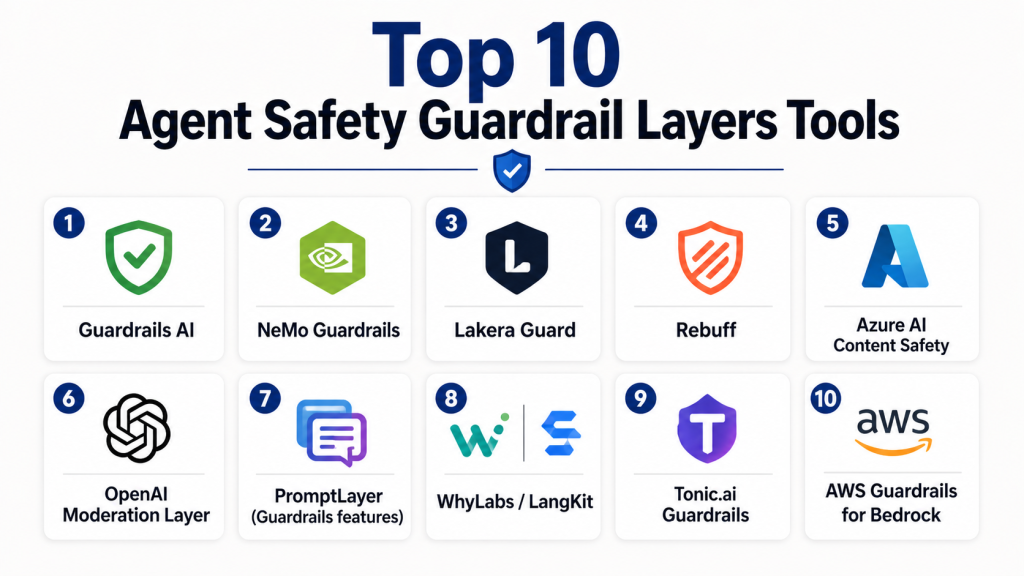
Top 10 Agent Safety Guardrail Layers Tools
1 — Guardrails AI
One-line verdict: Best for developers needing structured validation and policy enforcement directly in AI outputs.
Short description:
Guardrails AI provides schema-based validation and safety checks to ensure outputs meet predefined rules and formats.
Standout Capabilities
- Schema validation for outputs
- Structured data enforcement
- Custom policy rules
- Integration with LLM pipelines
- Output correction mechanisms
- Open-source flexibility
AI-Specific Depth
- Model support: Multi-model / BYO
- RAG / knowledge integration: N/A
- Evaluation: Basic
- Guardrails: Strong
- Observability: Basic
Pros
- Strong validation capabilities
- Easy integration
- Open-source flexibility
Cons
- Limited observability
- Requires setup
- Not full-stack safety solution
Security & Compliance
Not publicly stated
Deployment & Platforms
Cloud / Self-hosted
Integrations & Ecosystem
Supports integration with agent frameworks and APIs.
- Python SDK
- LLM pipelines
- APIs
- Custom workflows
Pricing Model
Open-source
Best-Fit Scenarios
- Output validation
- Structured responses
- Developer workflows
2 — NeMo Guardrails
One-line verdict: Best for enterprise-grade conversational safety with advanced policy and dialogue control.
Short description:
NeMo Guardrails enables developers to define conversational boundaries and enforce safety across agent interactions.
Standout Capabilities
- Dialogue policy control
- Safety rule enforcement
- Prompt injection defense
- Multi-turn conversation handling
- Integration with enterprise systems
AI-Specific Depth
- Model support: Multi-model
- RAG / knowledge integration: Moderate
- Evaluation: Moderate
- Guardrails: Strong
- Observability: Moderate
Pros
- Enterprise-ready
- Strong conversational control
- Flexible policies
Cons
- Complex setup
- Learning curve
- Limited UI
Security & Compliance
Not publicly stated
Deployment & Platforms
Cloud / Self-hosted
Integrations & Ecosystem
- APIs
- SDKs
- Agent frameworks
- Enterprise tools
Pricing Model
Not publicly stated
Best-Fit Scenarios
- Customer support bots
- Regulated environments
- Enterprise agents
3 — Lakera Guard
One-line verdict: Best for real-time prompt injection detection and AI security monitoring.
Short description:
Lakera Guard focuses on detecting malicious inputs and ensuring safe interactions with AI systems.
Standout Capabilities
- Prompt injection detection
- Real-time monitoring
- Security-focused design
- Lightweight integration
- Fast response
AI-Specific Depth
- Model support: Multi-model
- RAG / knowledge integration: N/A
- Evaluation: Limited
- Guardrails: Strong
- Observability: Moderate
Pros
- Strong security focus
- Easy integration
- Fast performance
Cons
- Limited broader features
- Not full workflow solution
- Limited customization
Security & Compliance
Not publicly stated
Deployment & Platforms
Cloud
Integrations & Ecosystem
- APIs
- SDKs
- Security tools
- Agent platforms
Pricing Model
Not publicly stated
Best-Fit Scenarios
- Prompt injection defense
- Security monitoring
- API protection
4 — Rebuff
One-line verdict: Best for defending AI applications against prompt injection and adversarial inputs.
Short description:
Rebuff provides detection and mitigation tools for adversarial attacks targeting AI systems.
Standout Capabilities
- Injection detection
- Adversarial defense
- Lightweight design
- Easy integration
- Open-source
AI-Specific Depth
- Model support: BYO
- RAG / knowledge integration: N/A
- Evaluation: Basic
- Guardrails: Strong
- Observability: Basic
Pros
- Simple setup
- Effective for attacks
- Open-source
Cons
- Limited features
- Not enterprise-ready
- Basic observability
Security & Compliance
Not publicly stated
Deployment & Platforms
Self-hosted
Integrations & Ecosystem
- APIs
- SDKs
- Agent tools
Pricing Model
Open-source
Best-Fit Scenarios
- Security testing
- Lightweight apps
- Research
5 — Azure AI Content Safety
One-line verdict: Best for enterprise-scale content moderation and compliance across AI applications.
Short description:
Azure AI Content Safety provides moderation and filtering services for harmful or sensitive content.
Standout Capabilities
- Content moderation
- Policy enforcement
- Multimodal support
- Enterprise integration
- Scalable infrastructure
AI-Specific Depth
- Model support: Proprietary
- RAG / knowledge integration: N/A
- Evaluation: Moderate
- Guardrails: Strong
- Observability: Moderate
Pros
- Enterprise-grade
- Scalable
- Reliable moderation
Cons
- Vendor lock-in
- Limited customization
- Requires cloud usage
Security & Compliance
Not publicly stated
Deployment & Platforms
Cloud
Integrations & Ecosystem
- APIs
- SDKs
- Cloud services
- Enterprise apps
Pricing Model
Usage-based
Best-Fit Scenarios
- Content moderation
- Compliance
- Enterprise deployments
6 — OpenAI Moderation Layer
One-line verdict: Best for simple and effective content safety within OpenAI-based applications.
Short description:
Provides built-in moderation capabilities to filter unsafe or policy-violating content.
Standout Capabilities
- Built-in moderation
- Easy integration
- Fast performance
- Model-native support
- Scalable
AI-Specific Depth
- Model support: Proprietary
- RAG / knowledge integration: N/A
- Evaluation: Limited
- Guardrails: Moderate
- Observability: Basic
Pros
- Easy to use
- Reliable
- Integrated
Cons
- Limited customization
- Vendor dependency
- Basic features
Security & Compliance
Not publicly stated
Deployment & Platforms
Cloud
Integrations & Ecosystem
- APIs
- SDKs
- Applications
Pricing Model
Usage-based
Best-Fit Scenarios
- Simple apps
- Rapid deployment
- Content filtering
7 — PromptLayer (Guardrails features)
One-line verdict: Best for monitoring, logging, and enforcing guardrails in production AI systems.
Short description:
PromptLayer provides observability and guardrail features for tracking and controlling AI interactions.
Standout Capabilities
- Logging and monitoring
- Prompt tracking
- Policy enforcement
- Debugging tools
- Evaluation support
AI-Specific Depth
- Model support: Multi-model
- RAG / knowledge integration: Moderate
- Evaluation: Moderate
- Guardrails: Moderate
- Observability: Strong
Pros
- Strong observability
- Easy debugging
- Good integrations
Cons
- Not pure guardrail tool
- Limited enforcement depth
- Requires setup
Security & Compliance
Not publicly stated
Deployment & Platforms
Cloud
Integrations & Ecosystem
- APIs
- SDKs
- Agent frameworks
- Logging systems
Pricing Model
Not publicly stated
Best-Fit Scenarios
- Monitoring
- Debugging
- Production systems
8 — WhyLabs / LangKit
One-line verdict: Best for continuous monitoring, anomaly detection, and safety evaluation of AI systems.
Short description:
WhyLabs with LangKit provides monitoring and evaluation for AI safety and performance.
Standout Capabilities
- Data monitoring
- Anomaly detection
- Safety evaluation
- Observability tools
- Production analytics
AI-Specific Depth
- Model support: Multi-model
- RAG / knowledge integration: Moderate
- Evaluation: Strong
- Guardrails: Moderate
- Observability: Strong
Pros
- Strong monitoring
- Advanced analytics
- Production-ready
Cons
- Not pure guardrail layer
- Requires integration
- Learning curve
Security & Compliance
Not publicly stated
Deployment & Platforms
Cloud / Hybrid
Integrations & Ecosystem
- APIs
- SDKs
- Data systems
- ML pipelines
Pricing Model
Not publicly stated
Best-Fit Scenarios
- Monitoring
- Evaluation
- Enterprise AI
9 — Tonic.ai Guardrails
One-line verdict: Best for protecting sensitive data and enforcing privacy rules in AI workflows.
Short description:
Tonic.ai provides tools for data safety, masking, and compliance in AI applications.
Standout Capabilities
- Data masking
- Privacy controls
- Compliance support
- Policy enforcement
- Secure data pipelines
AI-Specific Depth
- Model support: BYO
- RAG / knowledge integration: Moderate
- Evaluation: Limited
- Guardrails: Strong
- Observability: Moderate
Pros
- Strong privacy controls
- Enterprise focus
- Secure data handling
Cons
- Limited AI-specific features
- Complex setup
- Narrow focus
Security & Compliance
Not publicly stated
Deployment & Platforms
Cloud / Hybrid
Integrations & Ecosystem
- APIs
- SDKs
- Data platforms
- Enterprise tools
Pricing Model
Not publicly stated
Best-Fit Scenarios
- Data protection
- Compliance
- Regulated industries
10 — AWS Guardrails for Bedrock
One-line verdict: Best for managing safety and policy enforcement within AWS-based AI deployments.
Short description:
AWS Guardrails for Bedrock enables policy enforcement and safety controls for AI applications built on AWS.
Standout Capabilities
- Policy enforcement
- Integration with AWS ecosystem
- Content filtering
- Scalable infrastructure
- Enterprise support
AI-Specific Depth
- Model support: Proprietary / Multi-model
- RAG / knowledge integration: Moderate
- Evaluation: Limited
- Guardrails: Strong
- Observability: Moderate
Pros
- Strong cloud integration
- Scalable
- Enterprise-ready
Cons
- Vendor lock-in
- Requires AWS ecosystem
- Limited flexibility
Security & Compliance
Not publicly stated
Deployment & Platforms
Cloud
Integrations & Ecosystem
- AWS services
- APIs
- SDKs
- Cloud tools
Pricing Model
Usage-based
Best-Fit Scenarios
- AWS deployments
- Enterprise AI
- Scalable systems
Comparison Table
| Tool Name | Best For | Deployment | Model Flexibility | Strength | Watch-Out | Public Rating |
|---|---|---|---|---|---|---|
| Guardrails AI | Output validation | Hybrid | Multi-model | Schema enforcement | Limited observability | N/A |
| NeMo Guardrails | Enterprise safety | Hybrid | Multi-model | Policy control | Complexity | N/A |
| Lakera Guard | Security | Cloud | Multi-model | Injection defense | Limited scope | N/A |
| Rebuff | Attack defense | Self-hosted | BYO | Lightweight | Limited features | N/A |
| Azure Content Safety | Moderation | Cloud | Proprietary | Scalability | Vendor lock-in | N/A |
| OpenAI Moderation | Simple safety | Cloud | Proprietary | Ease of use | Limited control | N/A |
| PromptLayer | Monitoring | Cloud | Multi-model | Observability | Not pure guardrail | N/A |
| WhyLabs | Evaluation | Hybrid | Multi-model | Analytics | Setup effort | N/A |
| Tonic.ai | Data privacy | Hybrid | BYO | Data protection | Narrow focus | N/A |
| AWS Guardrails | AWS safety | Cloud | Multi-model | Integration | Lock-in | N/A |
Scoring & Evaluation
These scores are comparative and reflect practical usability across real-world deployments.
| Tool | Core | Reliability/Eval | Guardrails | Integrations | Ease | Perf/Cost | Security/Admin | Support | Weighted Total |
|---|---|---|---|---|---|---|---|---|---|
| Guardrails AI | 8 | 6 | 8 | 7 | 7 | 8 | 7 | 7 | 7.4 |
| NeMo Guardrails | 9 | 7 | 9 | 8 | 6 | 7 | 8 | 8 | 8.0 |
| Lakera Guard | 7 | 6 | 9 | 7 | 8 | 8 | 7 | 7 | 7.5 |
| Rebuff | 6 | 5 | 8 | 6 | 8 | 8 | 6 | 6 | 6.8 |
| Azure Content Safety | 8 | 7 | 9 | 9 | 7 | 7 | 8 | 8 | 8.1 |
| OpenAI Moderation | 7 | 6 | 7 | 8 | 9 | 8 | 7 | 7 | 7.6 |
| PromptLayer | 7 | 7 | 6 | 8 | 8 | 7 | 7 | 7 | 7.3 |
| WhyLabs | 8 | 9 | 7 | 8 | 6 | 7 | 8 | 7 | 7.8 |
| Tonic.ai | 7 | 6 | 8 | 7 | 6 | 7 | 9 | 7 | 7.4 |
| AWS Guardrails | 8 | 7 | 9 | 9 | 7 | 7 | 8 | 8 | 8.1 |
Top 3 for Enterprise
- Azure AI Content Safety
- AWS Guardrails for Bedrock
- NeMo Guardrails
Top 3 for SMB
- Guardrails AI
- OpenAI Moderation
- PromptLayer
Top 3 for Developers
- Guardrails AI
- Rebuff
- Lakera Guard
Which Agent Safety Guardrail Tool Is Right for You?
Solo / Freelancer
Use lightweight tools like Rebuff or OpenAI Moderation for simplicity.
SMB
Guardrails AI or PromptLayer offer a balance of control and ease of use.
Mid-Market
Lakera Guard or WhyLabs provide better monitoring and safety depth.
Enterprise
NeMo Guardrails, Azure AI Content Safety, or AWS Guardrails are strong choices.
Regulated industries (finance/healthcare/public sector)
Focus on tools with strong compliance, audit logs, and data privacy controls.
Budget vs premium
- Budget: Open-source tools like Guardrails AI, Rebuff
- Premium: Azure, AWS, enterprise platforms
Build vs buy (when to DIY)
- Build: Combine open-source tools
- Buy: Managed guardrail platforms
Implementation Playbook (30 / 60 / 90 Days)
30 days
- Identify risks and define safety policies
- Build a pilot with guardrails
- Establish evaluation metrics
60 days
- Implement guardrails across workflows
- Add monitoring and logging
- Conduct red teaming
90 days
- Optimize performance
- Strengthen governance
- Scale across applications
Common Mistakes & How to Avoid Them
- Ignoring prompt injection risks
- No evaluation framework
- Over-reliance on a single guardrail
- Lack of observability
- Poor policy definition
- High latency from excessive checks
- No data governance
- Weak integration
- Vendor lock-in
- No incident response plan
- Lack of testing
- Over-automation without review
FAQs
1. What are AI guardrails?
They are systems that ensure AI outputs remain safe and compliant.
2. Why are guardrails important?
They prevent harmful outputs and protect users and systems.
3. Do all AI systems need guardrails?
Most production systems do, especially those interacting with users.
4. Can guardrails stop all attacks?
No, but they significantly reduce risk.
5. Are guardrails expensive?
Costs vary depending on implementation.
6. Can I build my own guardrails?
Yes, using open-source tools and frameworks.
7. Do they support multiple models?
Many tools support multi-model setups.
8. Are they easy to integrate?
Depends on the tool and complexity.
9. Do they affect performance?
Yes, but optimization can reduce impact.
10. Can guardrails handle multimodal inputs?
Some tools support this capability.
11. Are they required for compliance?
Often required in regulated industries.
12. Can I switch tools later?
Yes, but migration effort varies.
Conclusion
The right Agent Safety Guardrail Layer ultimately depends on how much risk, scale, and control your AI systems require. Some teams will prioritize deep policy enforcement and enterprise-grade governance, while others may need lightweight, developer-friendly guardrails that integrate quickly into existing workflows. There’s no single best option—only the best fit for your architecture, compliance needs, and tolerance for risk. Start by shortlisting a few tools, run controlled pilots with real-world scenarios, and validate their effectiveness in handling edge cases before scaling across production environments.
Fantastic overview of AI safety frameworks! The blog clearly shows how different tools provide layered protection across prompt validation, API control, RAG safety, and workflow enforcement.