Introduction
Agent Planning & Reasoning Modules are the core intelligence layer behind modern AI agents. These systems enable agents to break down complex tasks, plan multi-step workflows, reason through decisions, and dynamically adapt based on outcomes. Instead of reacting to a single prompt, agents equipped with planning and reasoning modules can think ahead, choose tools, revise strategies, and execute tasks autonomously.
This category has become essential as AI shifts toward agentic systems capable of handling real-world complexity. From autonomous research agents to enterprise workflow automation, planning modules define how effectively an AI system can operate over time.
Common use cases include:
- Autonomous task execution (multi-step workflows)
- Research and analysis agents
- Code generation with iterative refinement
- Customer support automation with decision trees
- Multi-agent collaboration systems
Key evaluation criteria:
- Planning strategy (tree search, iterative, reactive)
- Reasoning depth and accuracy
- Tool-calling integration
- Multi-step execution reliability
- Evaluation and testing capabilities
- Guardrails and safety mechanisms
- Latency and cost efficiency
- Observability and debugging tools
- Model compatibility (BYO vs hosted)
- Scalability across workflows
Best for: AI engineers, CTOs, and teams building autonomous agents, copilots, or workflow automation systems requiring structured reasoning.
Not ideal for: Simple chatbots, one-step automation tasks, or applications where deterministic logic is sufficient.
What’s Changed in Agent Planning & Reasoning Modules
- Shift from linear prompt chains to dynamic planning graphs and tree-based reasoning
- Increased adoption of agentic workflows with iterative refinement loops
- Native support for tool-calling within reasoning steps
- Integration of multimodal inputs into reasoning pipelines
- Built-in evaluation frameworks for reasoning accuracy and hallucination detection
- Emergence of self-reflection and critique loops within agents
- Guardrails to prevent unsafe or irrelevant reasoning paths
- Cost-aware planning strategies (early stopping, pruning)
- Observability tools for tracing reasoning steps and decisions
- Support for multi-agent coordination and shared reasoning
- BYO model support with routing across models for efficiency
Quick Buyer Checklist (Scan-Friendly)
- Does the platform support multi-step planning and execution?
- Can it integrate with tools and APIs during reasoning?
- Does it offer evaluation or testing for reasoning quality?
- Are guardrails available to prevent unsafe outputs?
- What are the latency and cost implications of reasoning loops?
- Does it support BYO or multi-model routing?
- Are reasoning traces observable and debuggable?
- Does it support multi-agent coordination?
- How flexible is the planning strategy?
- Is there a risk of vendor lock-in?
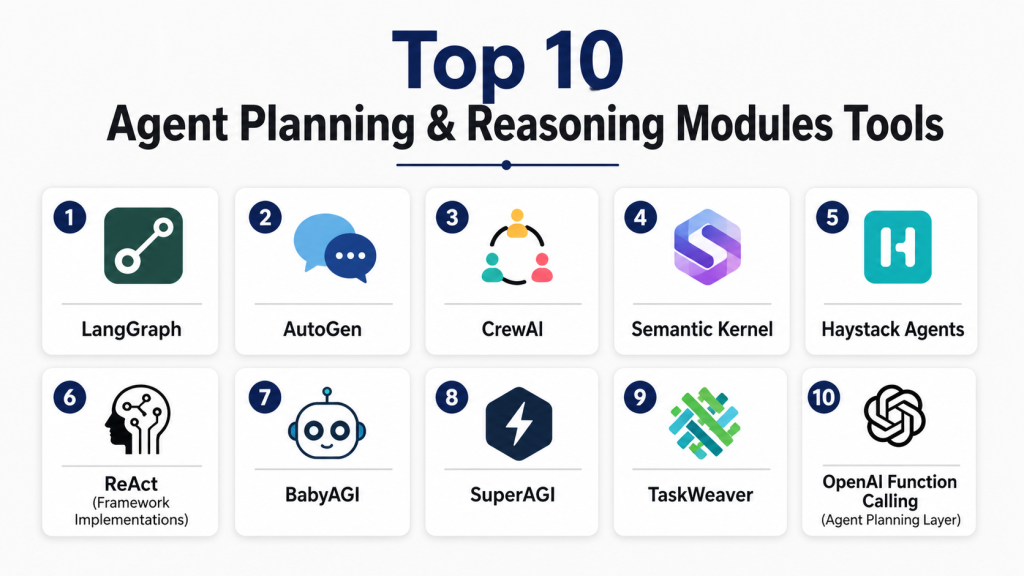
Top 10 Agent Planning & Reasoning Modules Tools
1 — LangGraph
One-line verdict: Best for building structured, stateful agent workflows with advanced planning and reasoning control.
Short description:
LangGraph extends agent frameworks with graph-based execution, enabling stateful planning and iterative reasoning across complex workflows.
Standout Capabilities
- Graph-based execution model
- Stateful workflows
- Iterative reasoning loops
- Tool orchestration
- Fine-grained control over agent steps
- Integration with agent ecosystems
AI-Specific Depth
- Model support: Multi-model / BYO
- RAG / knowledge integration: Strong
- Evaluation: Basic
- Guardrails: Limited
- Observability: Strong
Pros
- Highly flexible architecture
- Excellent for complex workflows
- Strong ecosystem support
Cons
- Requires engineering effort
- Learning curve
- Limited built-in guardrails
Security & Compliance
Not publicly stated
Deployment & Platforms
Cloud / Self-hosted
Integrations & Ecosystem
Supports APIs and SDKs with deep integration into agent frameworks.
- Python SDK
- Tool integrations
- Vector databases
- Workflow systems
Pricing Model
Open-source
Best-Fit Scenarios
- Multi-step workflows
- Autonomous agents
- Complex orchestration
2 — AutoGen
One-line verdict: Best for multi-agent collaboration and conversational reasoning workflows across distributed tasks.
Short description:
AutoGen enables multiple AI agents to collaborate, communicate, and solve tasks through structured reasoning loops.
Standout Capabilities
- Multi-agent communication
- Conversational reasoning
- Task delegation
- Dynamic planning
- Tool integration
AI-Specific Depth
- Model support: Multi-model
- RAG / knowledge integration: Moderate
- Evaluation: Limited
- Guardrails: Limited
- Observability: Moderate
Pros
- Strong multi-agent capabilities
- Flexible workflows
- Scalable reasoning
Cons
- Complex setup
- Limited guardrails
- Debugging challenges
Security & Compliance
Not publicly stated
Deployment & Platforms
Cloud / Self-hosted
Integrations & Ecosystem
- APIs
- SDKs
- Agent frameworks
- External tools
Pricing Model
Open-source
Best-Fit Scenarios
- Multi-agent systems
- Collaborative workflows
- Research agents
3 — CrewAI
One-line verdict: Best for role-based multi-agent planning with structured task delegation and coordination.
Short description:
CrewAI focuses on role-based agents that collaborate using defined responsibilities and planning strategies.
Standout Capabilities
- Role-based agents
- Task delegation
- Workflow coordination
- Structured planning
- Easy setup
AI-Specific Depth
- Model support: BYO
- RAG / knowledge integration: Moderate
- Evaluation: Basic
- Guardrails: Limited
- Observability: Basic
Pros
- Easy to use
- Clear abstraction
- Good for teams
Cons
- Limited depth
- Basic observability
- Scaling challenges
Security & Compliance
Not publicly stated
Deployment & Platforms
Cloud / Self-hosted
Integrations & Ecosystem
- APIs
- SDKs
- Agent tools
- Workflow tools
Pricing Model
Open-source
Best-Fit Scenarios
- Task-based agents
- Team simulations
- Workflow automation
4 — Semantic Kernel
One-line verdict: Best for enterprise-grade planning with strong integration into existing software ecosystems.
Short description:
Semantic Kernel provides orchestration, planning, and reasoning capabilities integrated into enterprise applications.
Standout Capabilities
- Planner modules
- Skill-based execution
- Enterprise integration
- Tool orchestration
- Memory integration
AI-Specific Depth
- Model support: Multi-model / BYO
- RAG / knowledge integration: Strong
- Evaluation: Moderate
- Guardrails: Limited
- Observability: Moderate
Pros
- Enterprise-ready
- Strong integrations
- Flexible
Cons
- Complex setup
- Requires expertise
- Limited guardrails
Security & Compliance
Not publicly stated
Deployment & Platforms
Cloud / Hybrid
Integrations & Ecosystem
- APIs
- SDKs
- Enterprise systems
- Cloud services
Pricing Model
Open-source + enterprise
Best-Fit Scenarios
- Enterprise apps
- Internal copilots
- Workflow automation
5 — Haystack Agents
One-line verdict: Best for combining retrieval pipelines with planning and reasoning in production AI systems.
Short description:
Haystack provides agent capabilities integrated with search and retrieval pipelines for structured reasoning.
Standout Capabilities
- RAG integration
- Pipeline-based reasoning
- Modular design
- Tool integration
- Production focus
AI-Specific Depth
- Model support: Multi-model
- RAG / knowledge integration: Strong
- Evaluation: Moderate
- Guardrails: Limited
- Observability: Moderate
Pros
- Strong RAG support
- Modular
- Production-ready
Cons
- Setup complexity
- Limited guardrails
- Requires tuning
Security & Compliance
Not publicly stated
Deployment & Platforms
Cloud / Self-hosted
Integrations & Ecosystem
- APIs
- SDKs
- Vector DBs
- Data pipelines
Pricing Model
Open-source + enterprise
Best-Fit Scenarios
- Knowledge agents
- Search systems
- Enterprise AI
6 — ReAct (Framework Implementations)
One-line verdict: Best for reasoning and acting loops that combine thinking and tool execution effectively.
Short description:
ReAct is a reasoning pattern that integrates thinking steps with actions, widely used in agent frameworks.
Standout Capabilities
- Thought-action loops
- Tool execution
- Simple design
- Flexible integration
- Broad adoption
AI-Specific Depth
- Model support: Multi-model
- RAG / knowledge integration: Moderate
- Evaluation: Limited
- Guardrails: N/A
- Observability: Basic
Pros
- Simple concept
- Effective reasoning
- Widely supported
Cons
- Limited structure
- Requires implementation
- No built-in governance
Security & Compliance
Not publicly stated
Deployment & Platforms
Varies / N/A
Integrations & Ecosystem
- Agent frameworks
- APIs
- Tools
- SDKs
Pricing Model
Varies / N/A
Best-Fit Scenarios
- Simple agents
- Tool-driven workflows
- Prototyping
7 — BabyAGI
One-line verdict: Best for experimental autonomous agents with iterative task planning and prioritization.
Short description:
BabyAGI is an experimental framework that continuously creates, prioritizes, and executes tasks.
Standout Capabilities
- Task generation
- Iterative planning
- Autonomous loops
- Prioritization logic
- Experimental design
AI-Specific Depth
- Model support: BYO
- RAG / knowledge integration: Limited
- Evaluation: N/A
- Guardrails: N/A
- Observability: Basic
Pros
- Innovative concept
- Autonomous workflows
- Open-source
Cons
- Not production-ready
- Limited features
- Stability issues
Security & Compliance
Not publicly stated
Deployment & Platforms
Self-hosted
Integrations & Ecosystem
- APIs
- SDKs
- Agent tools
Pricing Model
Open-source
Best-Fit Scenarios
- Experiments
- Research
- Learning
8 — SuperAGI
One-line verdict: Best for full-stack agent systems with planning, execution, and monitoring capabilities.
Short description:
SuperAGI offers an end-to-end platform for building autonomous agents with planning modules included.
Standout Capabilities
- Full-stack platform
- Planning modules
- Monitoring tools
- Agent marketplace
- Workflow automation
AI-Specific Depth
- Model support: Multi-model
- RAG / knowledge integration: Moderate
- Evaluation: Limited
- Guardrails: Limited
- Observability: Moderate
Pros
- All-in-one platform
- Easy setup
- Good UI
Cons
- Limited depth
- Less flexibility
- Performance concerns
Security & Compliance
Not publicly stated
Deployment & Platforms
Cloud / Self-hosted
Integrations & Ecosystem
- APIs
- SDKs
- Tools
- Plugins
Pricing Model
Not publicly stated
Best-Fit Scenarios
- End-to-end agents
- Rapid deployment
- Prototyping
9 — TaskWeaver
One-line verdict: Best for structured task decomposition and execution in enterprise AI workflows.
Short description:
TaskWeaver focuses on breaking down complex tasks into manageable steps for execution by agents.
Standout Capabilities
- Task decomposition
- Structured workflows
- Tool integration
- Execution pipelines
- Enterprise focus
AI-Specific Depth
- Model support: BYO
- RAG / knowledge integration: Moderate
- Evaluation: Basic
- Guardrails: Limited
- Observability: Moderate
Pros
- Structured approach
- Enterprise use
- Scalable
Cons
- Setup complexity
- Limited ecosystem
- Requires expertise
Security & Compliance
Not publicly stated
Deployment & Platforms
Cloud / Hybrid
Integrations & Ecosystem
- APIs
- SDKs
- Enterprise tools
- Data systems
Pricing Model
Not publicly stated
Best-Fit Scenarios
- Enterprise workflows
- Task automation
- Structured agents
10 — OpenAI Function Calling (Agent Planning Layer)
One-line verdict: Best for integrating tool-calling with lightweight reasoning in modern AI applications.
Short description:
Function calling enables structured reasoning by allowing models to decide when and how to call tools.
Standout Capabilities
- Tool-calling integration
- Structured outputs
- Flexible workflows
- Model-native support
- Easy integration
AI-Specific Depth
- Model support: Proprietary
- RAG / knowledge integration: Moderate
- Evaluation: Limited
- Guardrails: Moderate
- Observability: Basic
Pros
- Easy to implement
- Strong model support
- Flexible
Cons
- Limited planning depth
- Vendor dependency
- Requires orchestration
Security & Compliance
Not publicly stated
Deployment & Platforms
Cloud
Integrations & Ecosystem
- APIs
- SDKs
- Tools
- Applications
Pricing Model
Usage-based
Best-Fit Scenarios
- Tool-based agents
- Lightweight workflows
- Rapid development
Comparison Table
| Tool Name | Best For | Deployment | Model Flexibility | Strength | Watch-Out | Public Rating |
|---|---|---|---|---|---|---|
| LangGraph | Complex workflows | Hybrid | Multi-model | Stateful planning | Learning curve | N/A |
| AutoGen | Multi-agent | Hybrid | Multi-model | Collaboration | Complexity | N/A |
| CrewAI | Task agents | Hybrid | BYO | Simplicity | Limited depth | N/A |
| Semantic Kernel | Enterprise | Hybrid | Multi-model | Integration | Setup complexity | N/A |
| Haystack | RAG agents | Hybrid | Multi-model | Retrieval + planning | Tuning | N/A |
| ReAct | Simple reasoning | Varies | Multi-model | Thought-action loop | No structure | N/A |
| BabyAGI | Experiments | Self-hosted | BYO | Autonomous loops | Not production-ready | N/A |
| SuperAGI | Full-stack | Hybrid | Multi-model | All-in-one | Flexibility limits | N/A |
| TaskWeaver | Enterprise tasks | Hybrid | BYO | Structured execution | Setup effort | N/A |
| Function Calling | Tool agents | Cloud | Proprietary | Simplicity | Limited depth | N/A |
Scoring & Evaluation
These scores are comparative benchmarks based on real-world usability, not absolute measures.
| Tool | Core | Reliability/Eval | Guardrails | Integrations | Ease | Perf/Cost | Security/Admin | Support | Weighted Total |
|---|---|---|---|---|---|---|---|---|---|
| LangGraph | 9 | 7 | 6 | 9 | 6 | 8 | 7 | 8 | 7.9 |
| AutoGen | 8 | 7 | 6 | 8 | 6 | 7 | 6 | 7 | 7.3 |
| CrewAI | 7 | 6 | 5 | 7 | 8 | 7 | 6 | 7 | 6.9 |
| Semantic Kernel | 9 | 7 | 6 | 9 | 6 | 7 | 7 | 8 | 7.8 |
| Haystack | 8 | 7 | 6 | 8 | 6 | 7 | 6 | 7 | 7.2 |
| ReAct | 7 | 6 | 5 | 7 | 8 | 8 | 6 | 7 | 7.0 |
| BabyAGI | 6 | 5 | 4 | 6 | 7 | 6 | 5 | 6 | 5.9 |
| SuperAGI | 7 | 6 | 5 | 7 | 7 | 7 | 6 | 6 | 6.7 |
| TaskWeaver | 8 | 7 | 6 | 8 | 6 | 7 | 7 | 7 | 7.4 |
| Function Calling | 8 | 6 | 6 | 8 | 9 | 8 | 7 | 7 | 7.6 |
Top 3 for Enterprise
- LangGraph
- Semantic Kernel
- TaskWeaver
Top 3 for SMB
- CrewAI
- Haystack
- SuperAGI
Top 3 for Developers
- LangGraph
- ReAct
- AutoGen
Which Agent Planning & Reasoning Tool Is Right for You?
Solo / Freelancer
Use ReAct or CrewAI for simplicity and fast experimentation.
SMB
CrewAI or Haystack offer a balance between usability and capability.
Mid-Market
LangGraph or AutoGen provide flexibility and scalability.
Enterprise
Semantic Kernel, LangGraph, or TaskWeaver for structured, scalable systems.
Regulated industries (finance/healthcare/public sector)
Prefer self-hosted or hybrid solutions with strict control over reasoning pipelines.
Budget vs premium
- Budget: ReAct, CrewAI
- Premium: Semantic Kernel, LangGraph
Build vs buy (when to DIY)
- Build: LangGraph + custom logic
- Buy: Managed platforms or integrated stacks
Implementation Playbook (30 / 60 / 90 Days)
30 days
- Define use cases and workflows
- Build pilot agents
- Set evaluation metrics (accuracy, latency, cost)
60 days
- Add guardrails and safety checks
- Implement evaluation pipelines
- Begin staged rollout
90 days
- Optimize reasoning efficiency
- Improve observability and tracing
- Scale across teams and use cases
Common Mistakes & How to Avoid Them
- Overcomplicating planning logic
- Ignoring evaluation of reasoning quality
- No guardrails for unsafe outputs
- High latency due to excessive reasoning loops
- Poor observability into agent decisions
- Lack of cost control mechanisms
- Over-reliance on a single model
- No fallback strategies
- Weak data governance
- Vendor lock-in without abstraction
- No human-in-the-loop validation
- Poor testing of edge cases
FAQs
1. What is an agent planning module?
It enables AI agents to break tasks into steps and execute them systematically.
2. How is reasoning different from planning?
Planning defines steps; reasoning determines decisions within those steps.
3. Do all agents need planning modules?
No, only complex or multi-step workflows benefit significantly.
4. Can I combine multiple planning tools?
Yes, many systems integrate multiple frameworks for flexibility.
5. Are these tools production-ready?
Some are, while others are experimental—depends on the platform.
6. How do I evaluate reasoning quality?
Through testing, benchmarks, and real-world performance metrics.
7. Do they support multiple models?
Many support BYO or multi-model routing.
8. Are they expensive?
Costs depend on usage, especially reasoning loops.
9. Can I self-host them?
Most tools support self-hosting.
10. Do they integrate with RAG systems?
Yes, many integrate with retrieval pipelines.
11. What about security?
Varies; requires proper configuration.
12. Can I switch tools later?
Yes, but migration can be complex.
Conclusion
Agent Planning & Reasoning Modules are becoming a critical layer in modern AI systems, enabling agents to move beyond simple responses into structured, goal-driven execution. The right tool depends heavily on your use case—whether you prioritize flexibility, control, scalability, or ease of use. Start by shortlisting tools that align with your architecture, run a focused pilot to test reasoning reliability and cost efficiency, and validate security and evaluation workflows before scaling into production.
This article provides a clear breakdown of agent planning and reasoning modules and their role in modern AI systems. The comparison section makes it easier to understand how each framework differs in real-world use cases.
The blog does a solid job highlighting how reasoning modules power autonomous agents, research assistants, and workflow automation systems across enterprise use cases.