Introduction
Agent Workflow Engines are platforms that help developers design, orchestrate, and manage AI-driven workflows powered by autonomous or semi-autonomous agents. These engines enable multiple AI components—such as LLMs, tools, APIs, and data sources—to collaborate in structured pipelines to complete complex tasks.
In 2026, these platforms have become essential due to the rise of agentic AI systems that go beyond simple prompts. Organizations now build systems where AI agents plan, reason, execute actions, and collaborate across workflows. This shift has made workflow orchestration a core layer in modern AI architecture.
Common use cases include:
- Automating customer support workflows
- Building AI copilots for internal operations
- Multi-step data processing and analysis pipelines
- Autonomous research agents
- AI-powered DevOps and monitoring workflows
When evaluating these tools, buyers should consider:
- Workflow orchestration flexibility
- Multi-agent coordination support
- Model compatibility (open-source vs proprietary)
- Observability and debugging
- Guardrails and safety controls
- Cost optimization and scaling
- Integration ecosystem
- Security and governance features
Best for: AI engineers, platform teams, startups, and enterprises building agent-based applications or automation pipelines.
Not ideal for: Small teams needing simple chatbots or single-step automation where full orchestration adds unnecessary complexity.
What’s Changed in Agent Workflow Engines
- Native support for multi-agent collaboration and role-based agent design
- Built-in tool calling and API orchestration across workflows
- Multimodal workflows (text, image, audio inputs combined)
- Strong focus on evaluation frameworks to reduce hallucinations
- Advanced guardrails against prompt injection and unsafe outputs
- Enterprise-grade privacy with data residency and isolation controls
- Cost-aware execution with dynamic model routing
- Real-time observability with trace-level debugging
- Integration with vector databases for RAG workflows
- Version control for prompts, agents, and workflows
- Event-driven architectures replacing static pipelines
- Increased demand for auditability and governance features
Quick Buyer Checklist (Scan-Friendly)
- Does the platform support multi-agent orchestration natively?
- Can you bring your own model (BYO) or use open-source models?
- Are RAG workflows and vector DB integrations supported?
- Does it include evaluation and testing tools?
- Are guardrails and policy controls configurable?
- Is there visibility into token usage, latency, and errors?
- Can workflows scale efficiently under load?
- Does it provide audit logs and admin controls?
- What are the data retention and privacy policies?
- Is there a risk of vendor lock-in?
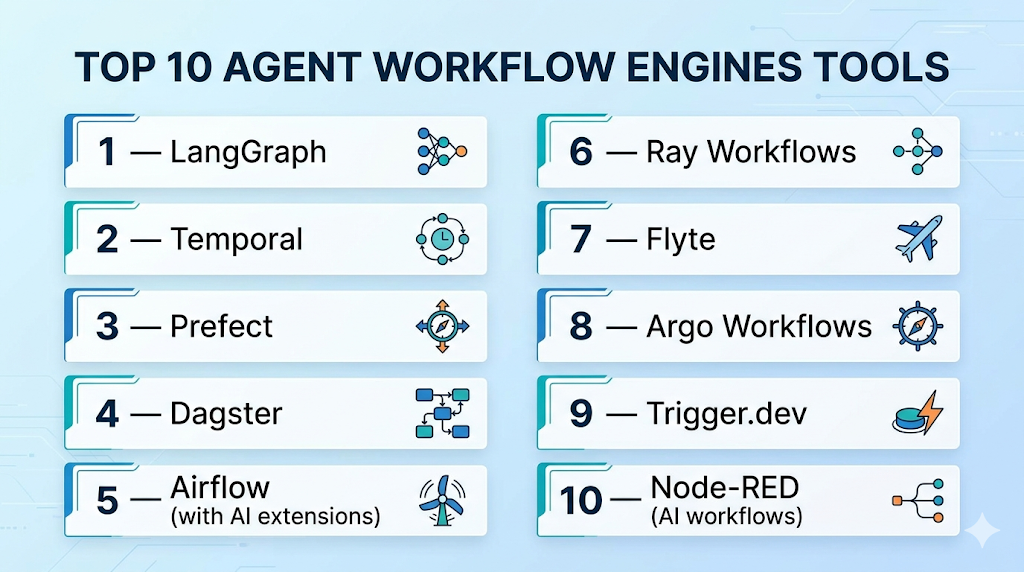
Top 10 Agent Workflow Engines Tools
1 — LangGraph
One-line verdict: Best for developers building complex, stateful multi-agent workflows with fine-grained control.
Short description:
LangGraph is a graph-based orchestration framework designed for building stateful, multi-agent workflows. It extends traditional LLM pipelines with branching, looping, and memory-aware execution.
Standout Capabilities
- Graph-based workflow design
- Stateful agent execution
- Built-in memory handling
- Flexible branching logic
- Tight integration with LLM tooling
- Supports long-running workflows
AI-Specific Depth
- Model support: BYO model / multi-model routing
- RAG / knowledge integration: Vector DB compatible
- Evaluation: Basic / Varies
- Guardrails: Limited / custom
- Observability: Tracing supported
Pros
- Highly flexible workflow design
- Ideal for complex agent logic
- Strong developer control
Cons
- Steeper learning curve
- Requires engineering effort
- Limited out-of-the-box UI
Security & Compliance
Not publicly stated
Deployment & Platforms
Cloud / Self-hosted
Integrations & Ecosystem
Supports APIs, SDKs, and integration with LLM ecosystems.
- Python SDK
- Vector DBs
- External APIs
- Custom tools
Pricing Model
Open-source + enterprise extensions
Best-Fit Scenarios
- Multi-agent reasoning systems
- Complex decision workflows
- Research automation pipelines
2 — Temporal
One-line verdict: Best for enterprise-grade workflow orchestration with reliability and fault tolerance.
Short description:
Temporal is a durable execution platform adapted for AI workflows, enabling long-running processes with guaranteed execution.
Standout Capabilities
- Fault-tolerant workflows
- Durable execution
- Retry and rollback mechanisms
- Event-driven architecture
- Scalable orchestration
AI-Specific Depth
- Model support: BYO
- RAG: N/A
- Evaluation: N/A
- Guardrails: N/A
- Observability: Strong
Pros
- Enterprise reliability
- Scalable architecture
- Strong observability
Cons
- Not AI-native
- Requires integration work
- Higher complexity
Security & Compliance
RBAC, audit logs (varies), encryption supported
Deployment & Platforms
Cloud / Self-hosted
Integrations & Ecosystem
- SDKs (Go, Java, Python)
- APIs
- Cloud services
- Microservices
Pricing Model
Tiered / enterprise
Best-Fit Scenarios
- Enterprise automation
- Long-running workflows
- Critical system orchestration
3 — Prefect
One-line verdict: Best for data and AI workflow orchestration with strong developer experience.
Short description:
Prefect simplifies workflow orchestration for data pipelines and AI tasks with an intuitive developer-first approach.
Standout Capabilities
- Python-native workflows
- Dynamic pipeline execution
- Monitoring dashboards
- Scheduling and automation
- Error handling
AI-Specific Depth
- Model support: BYO
- RAG: Compatible
- Evaluation: Limited
- Guardrails: N/A
- Observability: Strong
Pros
- Easy to use
- Strong UI
- Flexible pipelines
Cons
- Limited agent-native features
- Less focus on multi-agent
- Requires setup
Security & Compliance
Not publicly stated
Deployment & Platforms
Cloud / Hybrid
Integrations & Ecosystem
- Python SDK
- APIs
- Data tools
- Cloud storage
Pricing Model
Tiered
Best-Fit Scenarios
- Data + AI workflows
- Automation pipelines
- ETL + AI systems
4 — Dagster
One-line verdict: Best for structured data and AI workflows with strong observability and lineage tracking.
Short description:
Dagster is a data orchestration platform that increasingly supports AI workflows with modular pipeline design.
Standout Capabilities
- Data lineage tracking
- Modular workflows
- Strong UI
- Testing framework
- Asset-based orchestration
AI-Specific Depth
- Model support: BYO
- RAG: Compatible
- Evaluation: Basic
- Guardrails: N/A
- Observability: Strong
Pros
- Excellent debugging
- Clear pipeline visibility
- Developer-friendly
Cons
- Not agent-native
- Requires configuration
- Limited AI-specific tools
Security & Compliance
Not publicly stated
Deployment & Platforms
Cloud / Self-hosted
Integrations & Ecosystem
- APIs
- Data tools
- Python ecosystem
- Cloud services
Pricing Model
Tiered
Best-Fit Scenarios
- Data-heavy AI workflows
- Analytics pipelines
- ML pipelines
5 — Airflow (with AI extensions)
One-line verdict: Best for teams extending existing orchestration systems with AI capabilities.
Short description:
Apache Airflow is a widely used workflow orchestrator now adapted for AI pipelines through plugins and integrations.
Standout Capabilities
- DAG-based workflows
- Scheduling and automation
- Large ecosystem
- Extensibility
- Mature platform
AI-Specific Depth
- Model support: BYO
- RAG: Compatible
- Evaluation: N/A
- Guardrails: N/A
- Observability: Moderate
Pros
- Mature ecosystem
- Highly extensible
- Strong community
Cons
- Not AI-native
- Complex setup
- Limited agent support
Security & Compliance
Varies / N/A
Deployment & Platforms
Cloud / Self-hosted
Integrations & Ecosystem
- APIs
- Plugins
- Data tools
- Cloud providers
Pricing Model
Open-source
Best-Fit Scenarios
- Existing Airflow users
- Batch AI workflows
- Data orchestration
6 — Ray Workflows
One-line verdict: Best for scalable distributed AI workflows and parallel agent execution.
Short description:
Ray Workflows extends Ray’s distributed computing framework to orchestrate scalable AI workflows.
Standout Capabilities
- Distributed execution
- Parallel processing
- Scalable architecture
- Integration with Ray ecosystem
- Fault tolerance
AI-Specific Depth
- Model support: BYO / multi-model
- RAG: Compatible
- Evaluation: N/A
- Guardrails: N/A
- Observability: Strong
Pros
- Highly scalable
- Efficient for large workloads
- Flexible
Cons
- Requires expertise
- Complex setup
- Limited UI
Security & Compliance
Not publicly stated
Deployment & Platforms
Cloud / Self-hosted
Integrations & Ecosystem
- Ray ecosystem
- APIs
- Python SDK
- Distributed systems
Pricing Model
Open-source
Best-Fit Scenarios
- Distributed AI systems
- High-scale inference workflows
- Parallel agent execution
7 — Flyte
One-line verdict: Best for production-grade ML and AI workflows with strong versioning and reproducibility.
Short description:
Flyte is a workflow orchestration platform built for ML and AI pipelines with reproducibility and scalability.
Standout Capabilities
- Versioned workflows
- Strong reproducibility
- Kubernetes-native
- Scalable pipelines
- Metadata tracking
AI-Specific Depth
- Model support: BYO
- RAG: Compatible
- Evaluation: Basic
- Guardrails: N/A
- Observability: Strong
Pros
- Production-ready
- Scalable
- Strong governance
Cons
- Complex setup
- Learning curve
- Limited agent focus
Security & Compliance
RBAC, audit logs (varies)
Deployment & Platforms
Cloud / Self-hosted
Integrations & Ecosystem
- Kubernetes
- APIs
- Python SDK
- ML tools
Pricing Model
Open-source
Best-Fit Scenarios
- ML pipelines
- Enterprise AI workflows
- Reproducible systems
8 — Argo Workflows
One-line verdict: Best for Kubernetes-native workflow orchestration with AI pipeline flexibility.
Short description:
Argo Workflows enables container-based workflow orchestration within Kubernetes environments.
Standout Capabilities
- Kubernetes-native
- Container workflows
- Scalable pipelines
- Declarative configuration
- Parallel execution
AI-Specific Depth
- Model support: BYO
- RAG: Compatible
- Evaluation: N/A
- Guardrails: N/A
- Observability: Moderate
Pros
- Cloud-native
- Scalable
- Flexible
Cons
- Kubernetes dependency
- Not AI-specific
- Setup complexity
Security & Compliance
Varies / N/A
Deployment & Platforms
Self-hosted
Integrations & Ecosystem
- Kubernetes
- APIs
- CI/CD tools
- Cloud services
Pricing Model
Open-source
Best-Fit Scenarios
- Kubernetes environments
- Containerized AI workflows
- DevOps automation
9 — Trigger.dev
One-line verdict: Best for event-driven AI workflows and background job orchestration.
Short description:
Trigger.dev focuses on event-driven workflows and background job execution for modern applications.
Standout Capabilities
- Event-driven architecture
- Background jobs
- Developer-friendly
- Real-time triggers
- Monitoring tools
AI-Specific Depth
- Model support: BYO
- RAG: N/A
- Evaluation: N/A
- Guardrails: N/A
- Observability: Moderate
Pros
- Easy integration
- Fast setup
- Flexible triggers
Cons
- Limited AI-native features
- Not multi-agent focused
- Smaller ecosystem
Security & Compliance
Not publicly stated
Deployment & Platforms
Cloud
Integrations & Ecosystem
- APIs
- Webhooks
- SDKs
- App integrations
Pricing Model
Tiered
Best-Fit Scenarios
- Event-driven AI apps
- Background processing
- Automation workflows
10 — Node-RED (AI workflows)
One-line verdict: Best for visual workflow building with simple AI integrations for non-expert users.
Short description:
Node-RED is a visual programming tool that can orchestrate AI workflows using node-based design.
Standout Capabilities
- Visual workflow builder
- Drag-and-drop interface
- Extensible nodes
- Real-time flows
- Low-code approach
AI-Specific Depth
- Model support: BYO
- RAG: Limited
- Evaluation: N/A
- Guardrails: N/A
- Observability: Limited
Pros
- Easy to use
- Visual interface
- Low-code
Cons
- Not enterprise-grade
- Limited scalability
- Basic AI support
Security & Compliance
Not publicly stated
Deployment & Platforms
Self-hosted
Integrations & Ecosystem
- APIs
- Plugins
- IoT systems
- Web services
Pricing Model
Open-source
Best-Fit Scenarios
- Prototyping workflows
- Small-scale automation
- Non-technical users
Comparison Table
| Tool Name | Best For | Deployment | Model Flexibility | Strength | Watch-Out | Public Rating |
|---|---|---|---|---|---|---|
| LangGraph | Multi-agent workflows | Self-hosted | BYO/Multi | Stateful orchestration | Complexity | N/A |
| Temporal | Enterprise workflows | Hybrid | BYO | Reliability | Not AI-native | N/A |
| Prefect | Data + AI pipelines | Cloud | BYO | Ease of use | Limited agents | N/A |
| Dagster | Data workflows | Hybrid | BYO | Observability | Not agent-first | N/A |
| Airflow | Legacy pipelines | Self-hosted | BYO | Mature ecosystem | Complexity | N/A |
| Ray Workflows | Distributed AI | Self-hosted | Multi | Scalability | Setup complexity | N/A |
| Flyte | ML workflows | Hybrid | BYO | Reproducibility | Learning curve | N/A |
| Argo | Kubernetes workflows | Self-hosted | BYO | Cloud-native | Requires K8s | N/A |
| Trigger.dev | Event workflows | Cloud | BYO | Simplicity | Limited AI features | N/A |
| Node-RED | Visual workflows | Self-hosted | BYO | Low-code | Limited scale | N/A |
Scoring & Evaluation (Transparent Rubric)
Scoring is comparative and reflects how each tool performs relative to others in this category.
| Tool | Core | Reliability/Eval | Guardrails | Integrations | Ease | Perf/Cost | Security/Admin | Support | Weighted Total |
|---|---|---|---|---|---|---|---|---|---|
| LangGraph | 9 | 7 | 6 | 8 | 6 | 8 | 6 | 7 | 7.5 |
| Temporal | 9 | 8 | 6 | 8 | 6 | 8 | 8 | 8 | 7.9 |
| Prefect | 8 | 7 | 6 | 8 | 8 | 7 | 6 | 7 | 7.4 |
| Dagster | 8 | 7 | 6 | 8 | 7 | 7 | 6 | 7 | 7.3 |
| Airflow | 7 | 6 | 5 | 9 | 6 | 7 | 6 | 8 | 6.9 |
| Ray Workflows | 9 | 7 | 6 | 8 | 6 | 9 | 6 | 7 | 7.8 |
| Flyte | 8 | 7 | 6 | 7 | 6 | 8 | 7 | 7 | 7.3 |
| Argo | 8 | 6 | 5 | 7 | 5 | 8 | 6 | 6 | 6.9 |
| Trigger.dev | 7 | 6 | 5 | 7 | 8 | 7 | 6 | 6 | 6.8 |
| Node-RED | 6 | 5 | 5 | 6 | 9 | 6 | 5 | 6 | 6.2 |
Top 3 for Enterprise: Temporal, Ray Workflows, Flyte
Top 3 for SMB: Prefect, Trigger.dev, LangGraph
Top 3 for Developers: LangGraph, Ray Workflows, Dagster
Which Agent Workflow Engine Is Right for You?
Solo / Freelancer
Use Node-RED or Trigger.dev for simplicity and fast setup.
SMB
Prefect or LangGraph offer balance between flexibility and usability.
Mid-Market
Dagster or Flyte provide structure and scalability.
Enterprise
Temporal and Ray Workflows deliver reliability and performance.
Regulated industries
Choose Flyte or Temporal for governance and control.
Budget vs premium
Open-source tools (Airflow, Argo) are cost-effective but require effort.
Build vs buy
DIY if you need full control; buy if speed and reliability matter.
Implementation Playbook (30 / 60 / 90 Days)
30 Days
- Define use cases
- Build pilot workflows
- Set evaluation metrics
60 Days
- Add guardrails
- Implement observability
- Roll out to limited users
90 Days
- Optimize cost and latency
- Add governance controls
- Scale workflows organization-wide
Common Mistakes & How to Avoid Them
- Ignoring prompt injection risks
- No evaluation pipelines
- Poor data governance
- Lack of observability
- Unexpected cost spikes
- Over-automation
- Vendor lock-in
- No version control
- Weak security controls
- Poor workflow design
- Lack of monitoring
- No fallback mechanisms
FAQs
1. What is an Agent Workflow Engine?
A system that orchestrates AI agents and tools into structured workflows.
2. Do I need coding skills?
Most tools require some coding, though low-code options exist.
3. Can I use my own models?
Yes, most platforms support BYO models.
4. Are these tools secure?
Security varies; enterprise tools offer better controls.
5. Do they support multi-agent systems?
Yes, especially newer platforms like LangGraph.
6. What about cost?
Costs vary based on usage and infrastructure.
7. Can I self-host?
Many tools support self-hosting.
8. How do I evaluate outputs?
Use evaluation frameworks and human review.
9. Are guardrails included?
Some tools provide them; others require custom implementation.
10. Can I switch tools later?
Yes, but migration effort depends on architecture.
11. Do they support RAG?
Many support RAG via integrations.
12. What is the biggest risk?
Lack of evaluation and governance.
Conclusion
Agent Workflow Engines are becoming the backbone of modern AI systems, especially as multi-agent architectures gain traction. The right choice depends on your scale, technical expertise, and use case complexity—there is no one-size-fits-all solution. Start by shortlisting tools based on your needs, run a controlled pilot to validate performance and reliability, and then scale with proper governance, evaluation, and cost controls in place.
A well-structured article covering both technical capabilities and practical use cases of workflow engines. The pros and cons section adds real value for developers choosing the right platform.
Impressive article on agent workflow engines and orchestration systems. The structured breakdown of features, pros, and cons adds strong practical value.