Introduction
Multi-Agent Coordination Platforms are systems designed to manage multiple AI agents working together toward complex goals. Instead of relying on a single model, these platforms orchestrate specialized agents—each responsible for planning, reasoning, execution, or validation—into coordinated workflows.
This category has become essential as AI systems evolve into agent-driven architectures. Modern applications increasingly require distributed intelligence, where agents collaborate, delegate tasks, and adapt dynamically. These platforms provide the infrastructure to design, monitor, and control such systems at scale.
real-world use cases include:
- Autonomous research systems where multiple agents analyze, validate, and synthesize information
- Enterprise workflow automation involving planning, execution, and review agents
- AI-driven operations systems (DevOps, finance, compliance)
- Multi-agent simulations for strategy testing and forecasting
- Complex decision-support systems with layered reasoning agents
What to evaluate:
- Multi-agent orchestration flexibility
- Communication protocols between agents
- Memory management (short-term, long-term, shared)
- Tool and API integration
- Evaluation and testing frameworks
- Guardrails and safety mechanisms
- Observability and debugging tools
- Latency and cost optimization
- Deployment flexibility
- Governance and compliance readiness
Best for: AI engineers, research teams, enterprise architects, and organizations building complex, multi-step AI systems.
Not ideal for: Simple chatbot use cases, single-agent workflows, or teams without engineering capacity—lighter frameworks are more suitable.
What’s Changed in Multi-Agent Coordination Platforms
- Agentic workflows now include planning, reflection, and self-correction loops
- Native support for tool calling and API orchestration
- Multimodal agents handling text, images, and structured data
- Built-in evaluation pipelines for reliability and regression testing
- Advanced guardrails against prompt injection and unsafe actions
- Shared and persistent memory across multiple agents
- Cost-aware routing and execution optimization
- Distributed execution for scalability
- Detailed observability with trace-level debugging
- Enterprise governance features (RBAC, audit logs)
- Hybrid and air-gapped deployment options
- Increased focus on reliability and failure recovery
Quick Buyer Checklist (Scan-Friendly)
- Does it support true multi-agent orchestration?
- Can agents communicate and share memory effectively?
- Does it allow BYO models or enforce vendor lock-in?
- Built-in evaluation/testing tools available?
- Guardrails for safety and prompt injection defense?
- Observability: can you trace agent decisions?
- Latency and cost optimization features?
- Integration with APIs, tools, and data sources?
- Deployment flexibility (cloud, self-hosted, hybrid)?
- Security controls and auditability?
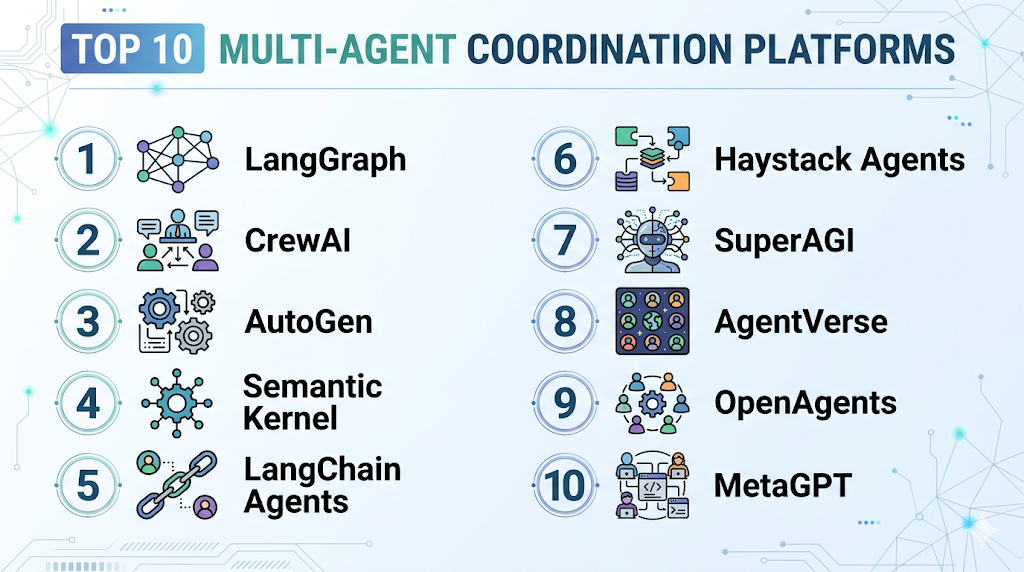
Top 10 Multi-Agent Coordination Platforms
1 — LangGraph
One-line verdict: Best for developers needing deterministic, stateful multi-agent workflows with precise control over execution paths.
Short description:
LangGraph uses graph-based execution to orchestrate agents with clear transitions and state management. It is widely used for structured, production-grade workflows.
Standout Capabilities
- Graph-based orchestration engine
- Stateful execution with checkpoints
- Conditional branching and loops
- Deterministic workflow control
- Debuggable execution paths
- Scalable pipelines
- Strong integration ecosystem
AI-Specific Depth
- Model support: Multi-model / BYO
- RAG / knowledge integration: Supported via integrations
- Evaluation: Custom / basic
- Guardrails: Limited built-in
- Observability: Strong tracing
Pros
- Highly structured workflows
- Excellent for complex systems
- Strong debugging capabilities
Cons
- Steep learning curve
- Requires engineering effort
- Limited built-in guardrails
Security & Compliance
Not publicly stated
Deployment & Platforms
Cloud / Self-hosted
Integrations & Ecosystem
LangGraph integrates well with modern AI stacks and developer tooling.
- Python SDK
- APIs
- Vector databases
- Workflow orchestration tools
- LLM providers
Pricing Model
Varies / N/A
Best-Fit Scenarios
- Enterprise-grade orchestration
- Multi-agent pipelines
- Complex automation systems
2 — CrewAI
One-line verdict: Best for teams building role-based agent systems with intuitive task delegation and minimal setup complexity.
Short description:
CrewAI focuses on human-like agent collaboration where each agent has a defined role, goal, and responsibility.
Standout Capabilities
- Role-based agent architecture
- Task delegation system
- Sequential and parallel workflows
- Lightweight framework
- Easy configuration
- Rapid prototyping
- Community-driven ecosystem
AI-Specific Depth
- Model support: Multi-model
- RAG / knowledge integration: Basic
- Evaluation: Limited
- Guardrails: Minimal
- Observability: Basic
Pros
- Easy to learn
- Fast setup
- Flexible workflows
Cons
- Limited enterprise features
- Weak observability
- Not ideal for large-scale systems
Security & Compliance
Not publicly stated
Deployment & Platforms
Cloud / Local
Integrations & Ecosystem
- Python SDK
- API integrations
- Custom tools
- LLM providers
Pricing Model
Open-source + optional services
Best-Fit Scenarios
- Rapid prototyping
- Role-based automation
- Small-scale agent systems
3 — AutoGen
One-line verdict: Best for building conversational multi-agent systems with autonomous collaboration and reasoning loops.
Short description:
AutoGen enables agents to interact through conversations, allowing dynamic collaboration and iterative problem-solving.
Standout Capabilities
- Multi-agent conversations
- Autonomous collaboration
- Role-based interactions
- Code execution integration
- Flexible agent design
- Iterative reasoning loops
AI-Specific Depth
- Model support: Multi-model
- RAG / knowledge integration: Limited
- Evaluation: Research-level
- Guardrails: Minimal
- Observability: Moderate
Pros
- Strong research capabilities
- Flexible interactions
- Supports complex reasoning
Cons
- Not fully production-ready
- Limited governance features
- Requires tuning
Security & Compliance
Not publicly stated
Deployment & Platforms
Cloud / Local
Integrations & Ecosystem
- Python SDK
- APIs
- Code execution tools
- LLM integrations
Pricing Model
Varies / N/A
Best-Fit Scenarios
- Research environments
- Conversational agents
- Autonomous workflows
4 — Semantic Kernel
One-line verdict: Best for enterprises integrating multi-agent orchestration into structured business applications.
Short description:
Semantic Kernel provides planning, memory, and orchestration capabilities tailored for enterprise AI systems.
Standout Capabilities
- Planner-based orchestration
- Memory integration
- Modular architecture
- Multi-language SDKs
- Enterprise integration
- Extensible pipelines
AI-Specific Depth
- Model support: Multi-model
- RAG / knowledge integration: Supported
- Evaluation: Limited
- Guardrails: Moderate
- Observability: Moderate
Pros
- Enterprise-ready
- Strong integration support
- Flexible architecture
Cons
- Complex setup
- Learning curve
- Limited UI tools
Security & Compliance
Not publicly stated
Deployment & Platforms
Cloud / Hybrid
Integrations & Ecosystem
- APIs
- SDKs (Python, C#)
- Enterprise systems
- Cloud platforms
Pricing Model
Varies / N/A
Best-Fit Scenarios
- Enterprise AI systems
- Business workflows
- Application integration
5 — LangChain Agents
One-line verdict: Best for developers needing flexible, integration-heavy agent workflows with large ecosystem support.
Short description:
LangChain provides tools for building agents that interact with APIs, tools, and data sources.
Standout Capabilities
- Tool-based agents
- Extensive ecosystem
- Flexible chaining
- Modular components
- Strong community support
AI-Specific Depth
- Model support: Multi-model
- RAG / knowledge integration: Strong
- Evaluation: Basic
- Guardrails: Limited
- Observability: Moderate
Pros
- Huge ecosystem
- Flexible design
- Active community
Cons
- Complexity increases quickly
- Requires tuning
- Limited guardrails
Security & Compliance
Not publicly stated
Deployment & Platforms
Cloud / Local
Integrations & Ecosystem
- APIs
- SDKs
- Vector databases
- Tool integrations
Pricing Model
Open-source + services
Best-Fit Scenarios
- Custom AI apps
- Agent pipelines
- RAG systems
6 — Haystack Agents
One-line verdict: Best for combining search-based systems with agent workflows in production environments.
Short description:
Haystack extends its RAG capabilities into agent-based workflows with strong search integration.
Standout Capabilities
- RAG-first architecture
- Pipeline orchestration
- Document processing
- Search integration
- Modular design
AI-Specific Depth
- Model support: Open-source / BYO
- RAG: Strong
- Evaluation: Basic
- Guardrails: Limited
- Observability: Moderate
Pros
- Strong retrieval capabilities
- Open-source flexibility
- Good for search workflows
Cons
- Limited orchestration depth
- Less focus on multi-agent logic
- Requires customization
Security & Compliance
Not publicly stated
Deployment & Platforms
Cloud / Self-hosted
Integrations & Ecosystem
- APIs
- Vector DBs
- Search systems
- ML pipelines
Pricing Model
Open-source
Best-Fit Scenarios
- Search-driven agents
- Knowledge systems
- Document workflows
7 — SuperAGI
One-line verdict: Best for autonomous agent experimentation with built-in management dashboards.
Short description:
SuperAGI focuses on building autonomous agents with monitoring and management capabilities.
Standout Capabilities
- Autonomous agent execution
- Dashboard monitoring
- Task automation
- Plugin system
- Agent lifecycle management
AI-Specific Depth
- Model support: Multi-model
- RAG: Basic
- Evaluation: Limited
- Guardrails: Minimal
- Observability: Moderate
Pros
- Built-in UI
- Autonomous workflows
- Easy experimentation
Cons
- Stability concerns
- Limited enterprise features
- Early-stage ecosystem
Security & Compliance
Not publicly stated
Deployment & Platforms
Cloud
Integrations & Ecosystem
- APIs
- Plugins
- LLM providers
- Monitoring tools
Pricing Model
Varies / N/A
Best-Fit Scenarios
- Autonomous agents
- Experimentation
- Rapid prototyping
8 — AgentVerse
One-line verdict: Best for multi-agent simulations and research-driven coordination experiments.
Short description:
AgentVerse provides a platform for simulating and studying agent interactions at scale.
Standout Capabilities
- Multi-agent simulation
- Scenario testing
- Research workflows
- Scalable environments
- Experimental setups
AI-Specific Depth
- Model support: Multi-model
- RAG: N/A
- Evaluation: Research-focused
- Guardrails: Minimal
- Observability: Moderate
Pros
- Strong for simulations
- Flexible experimentation
- Research-focused
Cons
- Not enterprise-ready
- Limited production use
- Early-stage
Security & Compliance
Not publicly stated
Deployment & Platforms
Cloud
Integrations & Ecosystem
- APIs
- Simulation tools
- LLM integrations
- Research frameworks
Pricing Model
Varies / N/A
Best-Fit Scenarios
- Research
- Simulations
- Testing agent behavior
9 — OpenAgents
One-line verdict: Best for open ecosystems enabling customizable and extensible multi-agent coordination.
Short description:
OpenAgents focuses on open-source, extensible frameworks for building agent systems.
Standout Capabilities
- Open architecture
- Custom agent design
- Extensibility
- Modular components
- Flexible workflows
AI-Specific Depth
- Model support: Open-source / BYO
- RAG: Supported
- Evaluation: Limited
- Guardrails: Minimal
- Observability: Basic
Pros
- Flexible
- Open ecosystem
- Customizable
Cons
- Early-stage
- Limited tooling
- Requires engineering effort
Security & Compliance
Not publicly stated
Deployment & Platforms
Cloud / Self-hosted
Integrations & Ecosystem
- APIs
- SDKs
- Open-source tools
- Custom integrations
Pricing Model
Open-source
Best-Fit Scenarios
- Custom agent systems
- Open-source projects
- Experimental setups
10 — MetaGPT
One-line verdict: Best for structured, role-based agent systems mimicking software team workflows.
Short description:
MetaGPT simulates software teams with agents assigned roles like PM, engineer, and tester.
Standout Capabilities
- Role-based workflows
- Task decomposition
- Structured pipelines
- Automation of development tasks
- Collaborative agents
AI-Specific Depth
- Model support: Multi-model
- RAG: Limited
- Evaluation: Basic
- Guardrails: Minimal
- Observability: Basic
Pros
- Unique structure
- Clear workflows
- Easy concept
Cons
- Limited flexibility
- Not enterprise-ready
- Requires tuning
Security & Compliance
Not publicly stated
Deployment & Platforms
Cloud / Local
Integrations & Ecosystem
- APIs
- SDKs
- LLM providers
- Workflow tools
Pricing Model
Varies / N/A
Best-Fit Scenarios
- Structured workflows
- Team simulation
- Task automation
Comparison Table
| Tool Name | Best For | Deployment | Model Flexibility | Strength | Watch-Out | Public Rating |
|---|---|---|---|---|---|---|
| LangGraph | Structured workflows | Cloud/Self-hosted | Multi-model | Deterministic control | Complexity | N/A |
| CrewAI | Role-based agents | Cloud/Local | Multi-model | Simplicity | Limited enterprise features | N/A |
| AutoGen | Conversational agents | Cloud/Local | Multi-model | Autonomous collaboration | Not production-ready | N/A |
| Semantic Kernel | Enterprise apps | Cloud/Hybrid | Multi-model | Enterprise integration | Learning curve | N/A |
| LangChain | Flexible agents | Cloud/Local | Multi-model | Ecosystem | Complexity | N/A |
| Haystack | RAG + agents | Cloud/Self-hosted | Open-source | Retrieval strength | Limited orchestration | N/A |
| SuperAGI | Autonomous systems | Cloud | Multi-model | Automation | Stability | N/A |
| AgentVerse | Simulations | Cloud | Multi-model | Research | Early stage | N/A |
| OpenAgents | Open systems | Cloud/Self-hosted | Open-source | Flexibility | Immaturity | N/A |
| MetaGPT | Structured agents | Cloud/Local | Multi-model | Role-based design | Limited flexibility | N/A |
Scoring & Evaluation (Transparent Rubric)
Scoring is comparative based on available capabilities, maturity, and ecosystem strength. It reflects relative positioning—not absolute performance.
| Tool | Core | Reliability/Eval | Guardrails | Integrations | Ease | Perf/Cost | Security/Admin | Support | Weighted Total |
|---|---|---|---|---|---|---|---|---|---|
| LangGraph | 9 | 8 | 6 | 8 | 6 | 8 | 7 | 7 | 7.8 |
| CrewAI | 7 | 6 | 5 | 6 | 8 | 7 | 5 | 6 | 6.5 |
| AutoGen | 8 | 7 | 5 | 7 | 6 | 7 | 5 | 6 | 6.8 |
| Semantic Kernel | 8 | 7 | 7 | 8 | 6 | 7 | 8 | 7 | 7.4 |
| LangChain | 8 | 7 | 6 | 9 | 7 | 7 | 6 | 8 | 7.5 |
| Haystack | 7 | 6 | 6 | 7 | 7 | 7 | 6 | 6 | 6.7 |
| SuperAGI | 7 | 6 | 5 | 6 | 7 | 6 | 5 | 6 | 6.3 |
| AgentVerse | 6 | 6 | 5 | 6 | 6 | 6 | 5 | 5 | 5.9 |
| OpenAgents | 6 | 5 | 5 | 6 | 6 | 6 | 5 | 5 | 5.8 |
| MetaGPT | 7 | 6 | 5 | 6 | 7 | 6 | 5 | 6 | 6.3 |
Top 3 for Enterprise: Semantic Kernel, LangGraph, LangChain
Top 3 for SMB: CrewAI, LangChain, Haystack
Top 3 for Developers: LangGraph, AutoGen, LangChain
Which Multi-Agent Coordination Platform Is Right for You?
Solo / Freelancer
CrewAI or LangChain offers simplicity and flexibility without heavy infrastructure.
SMB
LangChain or Haystack balances cost, features, and scalability.
Mid-Market
LangGraph or Semantic Kernel provides structured workflows and control.
Enterprise
Semantic Kernel or LangGraph is ideal for governance, scalability, and reliability.
Regulated industries
Choose platforms with strong deployment control and auditability.
Budget vs premium
Open-source tools reduce cost but require engineering investment.
Build vs buy
Build if customization is critical; buy if speed and support matter.
Implementation Playbook (30 / 60 / 90 Days)
30 Days
- Pilot 1–2 platforms
- Define success metrics
- Build initial workflows
60 Days
- Implement guardrails
- Add evaluation pipelines
- Begin controlled rollout
90 Days
- Optimize cost and latency
- Scale agent systems
- Establish governance and monitoring
Common Mistakes & How to Avoid Them
- No evaluation framework
- Ignoring prompt injection risks
- Lack of observability
- Over-complex workflows
- No cost control
- Weak memory design
- No fallback strategies
- Vendor lock-in
- Over-automation
- No human oversight
- Poor testing practices
- Unclear agent roles
FAQs
1. What is a multi-agent coordination platform?
A system that enables multiple AI agents to collaborate and solve complex tasks together.
2. Are these platforms production-ready?
Some are enterprise-ready, while others are still experimental.
3. Can I use my own models?
Yes, most platforms support BYO models.
4. Do they support RAG?
Many platforms integrate with RAG systems.
5. Are they secure?
Security varies; enterprise tools offer better controls.
6. Do they require coding?
Yes, most platforms are developer-focused.
7. Can agents communicate?
Yes, communication is a core feature.
8. Are they scalable?
Yes, with proper architecture.
9. Can I self-host them?
Many platforms support self-hosting.
10. How do they manage cost?
Some include optimization tools; others require manual tuning.
11. What is the biggest challenge?
Managing complexity and ensuring reliability.
12. Can they replace human workflows?
They can automate parts, but human oversight is still important.
Conclusion
Multi-agent coordination platforms are shaping the future of advanced AI systems by enabling collaborative, scalable, and intelligent workflows. The right choice depends on your technical expertise, system complexity, and governance needs—there is no single best platform for every use case. Start by shortlisting a few tools aligned with your requirements, run controlled pilots to evaluate reliability and cost, and then scale with strong guardrails and observability in place.
The discussion on orchestration and inter-agent communication is very relevant for building scalable AI systems.It gives a practical view of how multi-agent frameworks operate in enterprise environments.
Great job presenting a clear and professional comparison of coordination platforms. The article feels relevant, technical, and highly useful for building production AI systems.