Introduction
AI Agent Orchestration Frameworks are platforms and libraries designed to coordinate multiple AI agents, tools, and workflows into structured, goal-driven systems. Instead of relying on a single model prompt, these frameworks enable multi-step reasoning, tool usage, memory handling, and agent collaboration—making AI systems far more capable and autonomous.
These frameworks matter because modern AI applications are no longer simple chatbots. They involve complex pipelines such as multi-agent collaboration, dynamic tool execution, long-running workflows, and decision-making loops. Without orchestration, managing these systems becomes fragile, expensive, and difficult to scale.
Real-world use cases include:
- Autonomous research agents that gather, verify, and synthesize information
- Multi-agent customer support systems with escalation and memory
- Financial analysis pipelines with tool-calling and verification loops
- DevOps automation agents that monitor, debug, and resolve issues
- AI copilots that coordinate multiple APIs and internal tools
When evaluating these tools, consider: multi-agent coordination, memory handling, tool integration, evaluation/testing, observability, guardrails, scalability, latency control, cost management, and security controls.
Best for: AI engineers, platform teams, and enterprises building complex AI agents, automation systems, or multi-step workflows.
Not ideal for: Simple chatbot use cases, small prototypes, or teams without engineering resources—basic prompt-based solutions may be sufficient.
What’s Changed in AI Agent Orchestration Frameworks
- Shift from single-agent systems to multi-agent collaboration models
- Built-in support for tool calling and external API orchestration
- Native handling of multimodal workflows (text, image, audio pipelines)
- Improved evaluation frameworks to detect hallucinations and failures
- Stronger guardrails against prompt injection and unsafe outputs
- Integration with vector databases for persistent memory
- Real-time observability including traces, latency, and token usage
- Model routing across multiple providers for cost and performance optimization
- Enterprise demand for private deployment and data isolation
- Standardization of agent workflows and reusable components
- Support for long-running and stateful agent processes
- Increased focus on governance, auditability, and compliance
Quick Buyer Checklist (Scan-Friendly)
- Does it support multi-agent orchestration and task delegation?
- Can you use your own models (BYO) or multiple providers?
- Are evaluation tools available for testing agent reliability?
- Does it include guardrails against prompt injection and misuse?
- How strong is observability (logs, traces, token/cost tracking)?
- Does it support memory (short-term + long-term context)?
- Can it integrate with your existing APIs, tools, and databases?
- Are there latency and cost optimization controls?
- Does it provide admin controls, RBAC, and audit logs?
- Is deployment flexible (cloud, self-hosted, hybrid)?
- What is the vendor lock-in risk?
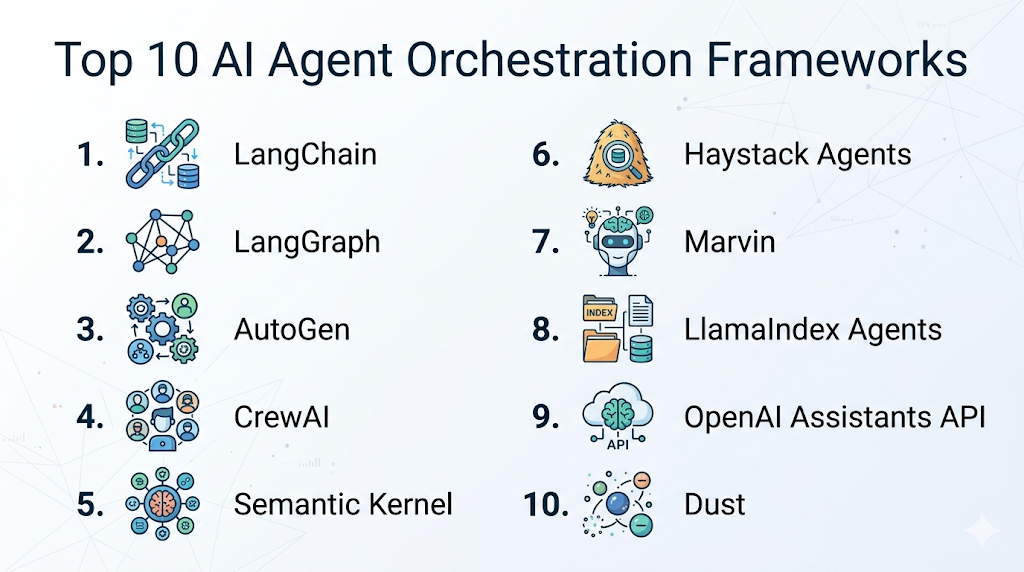
Top 10 AI Agent Orchestration Frameworks
1 — LangChain
One-line verdict: Best for developers building flexible, modular multi-agent systems with strong ecosystem support.
Short description:
LangChain is one of the most widely used frameworks for building AI agents and workflows. It provides modular components for chaining prompts, tools, memory, and agents.
Standout Capabilities
- Modular chain-based architecture
- Extensive integrations ecosystem
- Built-in agent abstractions
- Memory management support
- Tool and API orchestration
- Strong community and documentation
- Support for multiple LLM providers
AI-Specific Depth
- Model support: Multi-model, BYO supported
- RAG / knowledge integration: Strong (vector DB integrations)
- Evaluation: Basic tools, evolving ecosystem
- Guardrails: Limited native, relies on integrations
- Observability: Available via integrations (e.g., tracing tools)
Pros
- Extremely flexible and customizable
- Large ecosystem and community
- Supports complex workflows
Cons
- Can be complex for beginners
- Debugging multi-agent flows is difficult
- Performance tuning requires effort
Security & Compliance
Not publicly stated
Deployment & Platforms
- Python, JavaScript
- Cloud / Self-hosted
Integrations & Ecosystem
LangChain integrates widely across the AI ecosystem.
- OpenAI, Anthropic, Hugging Face
- Vector DBs (Pinecone, Weaviate)
- APIs and custom tools
- Observability tools
Pricing Model
Open-source + optional enterprise tooling
Best-Fit Scenarios
- Building custom AI agents
- RAG-based applications
- Multi-step reasoning workflows
2 — LangGraph
One-line verdict: Best for stateful, long-running agent workflows with graph-based orchestration.
Short description:
LangGraph extends LangChain with graph-based execution, enabling more reliable and stateful multi-agent systems.
Standout Capabilities
- Graph-based execution model
- Stateful workflows
- Deterministic agent flows
- Built for long-running processes
- Debugging and replay capabilities
AI-Specific Depth
- Model support: Multi-model
- RAG: Supported via LangChain
- Evaluation: Limited native
- Guardrails: Limited
- Observability: Improved tracing support
Pros
- Better control over workflows
- Handles complex agent logic
- More predictable execution
Cons
- Still evolving
- Requires understanding graph concepts
- Limited enterprise tooling
Security & Compliance
Not publicly stated
Deployment & Platforms
- Python
- Self-hosted / Cloud
Integrations & Ecosystem
- LangChain ecosystem
- APIs and tools
- Vector DB integrations
Pricing Model
Open-source
Best-Fit Scenarios
- Stateful agent systems
- Complex automation pipelines
- Long-running workflows
3 — AutoGen
One-line verdict: Best for multi-agent collaboration and conversational agent ecosystems.
Short description:
AutoGen focuses on enabling multiple agents to collaborate through conversations, often used for autonomous workflows.
Standout Capabilities
- Multi-agent conversation system
- Autonomous agent collaboration
- Task delegation between agents
- Flexible conversation patterns
- Human-in-the-loop support
AI-Specific Depth
- Model support: Multi-model
- RAG: Basic support
- Evaluation: Limited
- Guardrails: Minimal
- Observability: Basic
Pros
- Great for experimentation
- Easy multi-agent setup
- Flexible interaction patterns
Cons
- Less production-ready
- Limited observability
- Guardrails need external tools
Security & Compliance
Not publicly stated
Deployment & Platforms
- Python
- Self-hosted
Integrations & Ecosystem
- LLM APIs
- Custom tools
- Developer integrations
Pricing Model
Open-source
Best-Fit Scenarios
- Multi-agent experimentation
- Research workflows
- Autonomous collaboration systems
4 — CrewAI
One-line verdict: Best for role-based multi-agent systems with structured task delegation.
Short description:
CrewAI enables teams of AI agents with defined roles, responsibilities, and workflows for task execution.
Standout Capabilities
- Role-based agent design
- Task delegation workflows
- Structured collaboration
- Simple configuration
- Lightweight framework
AI-Specific Depth
- Model support: Multi-model
- RAG: Basic
- Evaluation: Limited
- Guardrails: Minimal
- Observability: Basic
Pros
- Easy to use
- Clear agent roles
- Good for structured workflows
Cons
- Limited advanced features
- Less mature ecosystem
- Scaling challenges
Security & Compliance
Not publicly stated
Deployment & Platforms
- Python
- Self-hosted
Integrations & Ecosystem
- APIs
- LLM providers
- Basic tool integrations
Pricing Model
Open-source
Best-Fit Scenarios
- Role-based agent systems
- Task automation workflows
- Lightweight orchestration
5 — Semantic Kernel
One-line verdict: Best for enterprise-grade orchestration with strong integration into existing software ecosystems.
Short description:
Semantic Kernel provides structured orchestration with enterprise-ready integrations and plugin systems.
Standout Capabilities
- Plugin-based architecture
- Strong enterprise integration
- Memory and planning capabilities
- Supports structured workflows
- Multi-language SDKs
AI-Specific Depth
- Model support: Multi-model
- RAG: Supported
- Evaluation: Limited
- Guardrails: Basic
- Observability: Moderate
Pros
- Enterprise-friendly
- Strong integration capabilities
- Structured workflows
Cons
- Less flexible than open frameworks
- Smaller community than LangChain
- Learning curve
Security & Compliance
Not publicly stated
Deployment & Platforms
- Cloud / Self-hosted
- Multiple languages
Integrations & Ecosystem
- APIs
- Enterprise systems
- Plugin ecosystem
Pricing Model
Varies / N/A
Best-Fit Scenarios
- Enterprise applications
- Internal automation
- Structured AI workflows
6 — Haystack Agents
One-line verdict: Best for search-heavy agent workflows and document-centric AI systems.
Short description:
Haystack extends its search framework into agent-based orchestration with strong RAG capabilities.
Standout Capabilities
- Strong RAG pipelines
- Document search optimization
- Agent workflows
- Modular architecture
- Open-source flexibility
AI-Specific Depth
- Model support: Multi-model
- RAG: Strong
- Evaluation: Available
- Guardrails: Limited
- Observability: Moderate
Pros
- Excellent for document workflows
- Strong retrieval capabilities
- Open-source flexibility
Cons
- Less focus on multi-agent collaboration
- Limited guardrails
- Requires setup effort
Security & Compliance
Not publicly stated
Deployment & Platforms
- Self-hosted / Cloud
Integrations & Ecosystem
- Vector DBs
- APIs
- Search systems
Pricing Model
Open-source
Best-Fit Scenarios
- Document-heavy agents
- Knowledge systems
- Search-based AI
7 — Marvin
One-line verdict: Best for lightweight orchestration and Python-native AI workflows.
Short description:
Marvin focuses on simplicity and Python-first orchestration for building AI-powered applications quickly.
Standout Capabilities
- Python-native design
- Simple abstractions
- Lightweight orchestration
- Fast prototyping
- Developer-friendly
AI-Specific Depth
- Model support: Multi-model
- RAG: Basic
- Evaluation: Minimal
- Guardrails: Minimal
- Observability: Limited
Pros
- Easy to use
- Fast setup
- Great for prototyping
Cons
- Not enterprise-ready
- Limited advanced features
- Smaller ecosystem
Security & Compliance
Not publicly stated
Deployment & Platforms
- Python
- Self-hosted
Integrations & Ecosystem
- APIs
- Python ecosystem
- LLM providers
Pricing Model
Open-source
Best-Fit Scenarios
- Prototypes
- Small projects
- Python-based workflows
8 — LlamaIndex Agents
One-line verdict: Best for data-connected agents with strong indexing and retrieval capabilities.
Short description:
LlamaIndex focuses on connecting agents to structured and unstructured data sources.
Standout Capabilities
- Data indexing framework
- Strong RAG pipelines
- Agent integration
- Structured data connectors
- Flexible architecture
AI-Specific Depth
- Model support: Multi-model
- RAG: Strong
- Evaluation: Limited
- Guardrails: Minimal
- Observability: Moderate
Pros
- Strong data integration
- Flexible architecture
- Good for knowledge systems
Cons
- Less focus on orchestration depth
- Guardrails limited
- Requires configuration
Security & Compliance
Not publicly stated
Deployment & Platforms
- Python
- Cloud / Self-hosted
Integrations & Ecosystem
- Databases
- APIs
- Vector stores
Pricing Model
Open-source + enterprise
Best-Fit Scenarios
- Data-driven agents
- Knowledge assistants
- RAG workflows
9 — OpenAI Assistants API
One-line verdict: Best for managed orchestration with minimal infrastructure overhead.
Short description:
Provides built-in agent capabilities with tool use, memory, and orchestration managed by the platform.
Standout Capabilities
- Managed agent system
- Tool calling support
- Built-in memory
- Easy integration
- Scalable infrastructure
AI-Specific Depth
- Model support: Proprietary
- RAG: Supported
- Evaluation: Limited
- Guardrails: Strong
- Observability: Moderate
Pros
- Easy to use
- No infrastructure management
- Strong reliability
Cons
- Vendor lock-in
- Limited customization
- Less control
Security & Compliance
Not publicly stated
Deployment & Platforms
- Cloud
Integrations & Ecosystem
- APIs
- Developer SDKs
- Tool integrations
Pricing Model
Usage-based
Best-Fit Scenarios
- Fast deployment
- Managed solutions
- SaaS products
10 — Dust
One-line verdict: Best for enterprise teams building collaborative internal AI agents with governance controls.
Short description:
Dust focuses on enterprise agent workflows with collaboration, governance, and internal data integration.
Standout Capabilities
- Enterprise agent workflows
- Internal data integration
- Collaboration features
- Governance controls
- User-friendly interface
AI-Specific Depth
- Model support: Multi-model
- RAG: Strong
- Evaluation: Limited
- Guardrails: Moderate
- Observability: Moderate
Pros
- Enterprise-ready
- Easy collaboration
- Strong internal use cases
Cons
- Less flexible for developers
- Limited customization
- Pricing not transparent
Security & Compliance
Not publicly stated
Deployment & Platforms
- Cloud
Integrations & Ecosystem
- Enterprise tools
- APIs
- Data systems
Pricing Model
Not publicly stated
Best-Fit Scenarios
- Internal AI assistants
- Enterprise workflows
- Team collaboration tools
Comparison Table
| Tool Name | Best For | Deployment | Model Flexibility | Strength | Watch-Out | Public Rating |
|---|---|---|---|---|---|---|
| LangChain | Developers | Hybrid | Multi-model | Ecosystem | Complexity | N/A |
| LangGraph | Stateful workflows | Self-hosted | Multi-model | Control | Maturity | N/A |
| AutoGen | Multi-agent systems | Self-hosted | Multi-model | Collaboration | Stability | N/A |
| CrewAI | Role-based agents | Self-hosted | Multi-model | Simplicity | Scalability | N/A |
| Semantic Kernel | Enterprise | Hybrid | Multi-model | Integration | Flexibility | N/A |
| Haystack | Search agents | Hybrid | Multi-model | RAG strength | Limited agents | N/A |
| Marvin | Prototyping | Self-hosted | Multi-model | Simplicity | Limited features | N/A |
| LlamaIndex | Data agents | Hybrid | Multi-model | Data integration | Orchestration depth | N/A |
| OpenAI Assistants | Managed agents | Cloud | Proprietary | Ease of use | Lock-in | N/A |
| Dust | Enterprise teams | Cloud | Multi-model | Collaboration | Customization | N/A |
Scoring & Evaluation (Transparent Rubric)
Scores are comparative across tools based on practical usability, not absolute performance. Each tool is evaluated across features, reliability, safety, integrations, usability, performance, security, and support.
| Tool | Core | Reliability | Guardrails | Integrations | Ease | Perf/Cost | Security | Support | Total |
|---|---|---|---|---|---|---|---|---|---|
| LangChain | 9 | 8 | 6 | 9 | 7 | 7 | 6 | 9 | 7.9 |
| LangGraph | 8 | 8 | 6 | 8 | 6 | 7 | 6 | 7 | 7.3 |
| AutoGen | 7 | 6 | 5 | 7 | 7 | 6 | 5 | 6 | 6.3 |
| CrewAI | 7 | 6 | 5 | 6 | 8 | 6 | 5 | 6 | 6.2 |
| Semantic Kernel | 8 | 7 | 6 | 8 | 7 | 7 | 7 | 7 | 7.4 |
| Haystack | 8 | 7 | 6 | 8 | 6 | 7 | 6 | 7 | 7.2 |
| Marvin | 6 | 5 | 4 | 6 | 8 | 6 | 5 | 5 | 5.9 |
| LlamaIndex | 8 | 7 | 5 | 8 | 6 | 7 | 6 | 7 | 7.1 |
| OpenAI Assistants | 8 | 8 | 8 | 7 | 9 | 7 | 7 | 8 | 7.9 |
| Dust | 7 | 7 | 6 | 7 | 8 | 6 | 7 | 7 | 7.0 |
Top 3 for Enterprise: Semantic Kernel, Dust, OpenAI Assistants
Top 3 for SMB: CrewAI, LangChain, LlamaIndex
Top 3 for Developers: LangChain, LangGraph, AutoGen
Which AI Agent Orchestration Framework Is Right for You?
Solo / Freelancer
Use Marvin or CrewAI for simplicity and fast prototyping.
SMB
LangChain or LlamaIndex offer flexibility without heavy enterprise overhead.
Mid-Market
LangGraph and Haystack provide better scalability and structured workflows.
Enterprise
Semantic Kernel, Dust, or OpenAI Assistants for governance and reliability.
Regulated industries
Prefer self-hosted frameworks like LangChain or Haystack for control.
Budget vs premium
Open-source tools are cost-effective; managed platforms reduce engineering effort.
Build vs buy
Build if customization is critical; buy if speed and reliability matter more.
Implementation Playbook (30 / 60 / 90 Days)
30 Days
- Define use cases
- Build prototype agents
- Set evaluation metrics
60 Days
- Add guardrails and monitoring
- Conduct testing and validation
- Begin internal rollout
90 Days
- Optimize cost and latency
- Implement governance controls
- Scale across teams
Common Mistakes & How to Avoid Them
- No evaluation framework
- Ignoring prompt injection risks
- Poor observability
- Lack of cost control
- Over-automation
- No human review
- Weak memory handling
- Vendor lock-in
- Poor testing
- Ignoring latency
- No governance
- Lack of documentation
FAQs
1. What is an AI agent orchestration framework?
A system that coordinates multiple AI agents, tools, and workflows to complete complex tasks.
2. Do I need one for simple chatbots?
No, basic chatbots usually don’t require orchestration frameworks.
3. Can I use my own models?
Yes, most frameworks support BYO models.
4. Are these tools secure?
Security varies; self-hosted options provide more control.
5. Do they support evaluation?
Some do, but often require external tools.
6. What about guardrails?
Most frameworks rely on integrations for guardrails.
7. Are they expensive?
Open-source options are free; managed platforms are usage-based.
8. Can I switch tools later?
Yes, but migration can be complex.
9. Do they support multimodal AI?
Increasingly yes, depending on the framework.
10. What is the biggest challenge?
Managing complexity and ensuring reliability.
11. Are they production-ready?
Some are, others are still evolving.
12. Which is best overall?
It depends on your use case and scale.
Conclusion
AI agent orchestration frameworks are becoming essential for building reliable, scalable, and intelligent AI systems that go far beyond simple prompt-based interactions. The right choice depends heavily on your needs—whether you prioritize flexibility, enterprise governance, ease of use, or rapid prototyping. Open-source tools like LangChain and LlamaIndex offer unmatched customization, while managed platforms provide speed and simplicity. Before committing, shortlist a few tools, run a controlled pilot, and validate performance, security, and evaluation workflows. Once confident, scale gradually with strong observability and governance in place to ensure long-term success.
This article provides a comprehensive overview of modern AI agent orchestration frameworks and their evolving role in multi-agent systems.The comparison makes it easier to understand how different tools manage coordination, memory, and execution flow.
This blog provides strong insights into orchestration as the backbone of AI agent systems. The explanations are clear, modern, and very actionable for production use cases.