Introduction
Model fine-tuning platforms help teams customize pre-trained AI models to perform better on specific tasks, datasets, or domains. Instead of relying on generic outputs, fine-tuning enables organizations to train models on proprietary data, improving accuracy, tone, and relevance.
As AI adoption matures, fine-tuning has become a key capability for building competitive AI systems. From enterprise copilots to domain-specific assistants, companies now require models that understand their unique workflows and data.
Common real-world use cases include:
- Customer support chatbots trained on internal knowledge
- Domain-specific AI assistants (legal, finance, healthcare)
- Personalized content generation systems
- Internal knowledge copilots
- AI agents tailored for workflows
- Multilingual or localized AI applications
Key evaluation criteria:
- Model flexibility (open vs proprietary)
- Fine-tuning techniques (full, LoRA, adapters)
- Dataset management and versioning
- Evaluation and testing capabilities
- Guardrails and safety alignment
- Deployment and scalability
- Cost efficiency
- Observability and monitoring
- Integration with existing tools
- Security and governance
Best for: AI engineers, ML teams, startups building AI products, and enterprises requiring domain-specific intelligence.
Not ideal for: simple use cases where prompt engineering is enough, or teams without datasets or ML expertise.
What’s Changed in Model Fine-Tuning Platforms
- Rise of parameter-efficient tuning (LoRA, adapters)
- Integration with agent-based workflows
- Built-in evaluation pipelines
- Multimodal fine-tuning support
- Dataset versioning and lineage tracking
- Focus on hallucination reduction
- Embedded guardrails and safety alignment
- Cost optimization through smaller models
- Hybrid RAG + fine-tuning architectures
- Continuous fine-tuning workflows
- Improved observability tools
- Stronger enterprise privacy controls
Quick Buyer Checklist (Scan-Friendly)
- Does it support your required base models?
- Can you use LoRA or adapter-based tuning?
- Are datasets versioned and tracked?
- Does it include evaluation tools?
- Are guardrails built in or external?
- Can it scale to production workloads?
- Are costs predictable and controllable?
- Does it integrate with your stack?
- Are audit logs and permissions available?
- Is vendor lock-in a concern?
- Does it support hybrid RAG workflows?
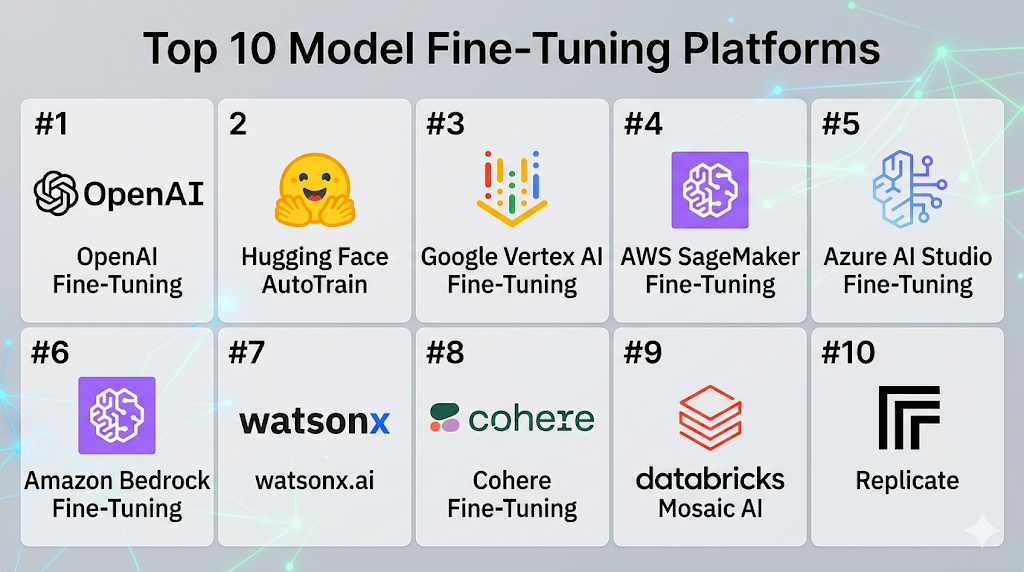
Top 10 Model Fine-Tuning Platforms
#1 — OpenAI Fine-Tuning
One-line verdict: Best for fast, reliable fine-tuning with simple API-driven deployment.
Short description:
Managed fine-tuning for proprietary models with seamless API integration for production use.
Standout Capabilities
- API-based fine-tuning workflow
- Structured dataset ingestion
- Quick deployment
- Stable performance
- Scalable infrastructure
- Strong developer ecosystem
AI-Specific Depth
- Model support: Proprietary
- RAG / knowledge integration: External
- Evaluation: Basic
- Guardrails: Built-in
- Observability: Usage metrics
Pros
- Easy to use
- Reliable outputs
- Fast deployment
Cons
- Limited customization
- Vendor lock-in
- Less control over internals
Security & Compliance
Not publicly stated
Deployment & Platforms
- Cloud
Integrations & Ecosystem
- APIs
- SDKs
- Backend services
- AI pipelines
Pricing Model
Usage-based
Best-Fit Scenarios
- Chatbots
- SaaS AI features
- API-based apps
#2 — Hugging Face AutoTrain
One-line verdict: Best no-code solution for fine-tuning open-source models quickly.
Short description:
A beginner-friendly platform enabling quick fine-tuning with minimal ML expertise.
Standout Capabilities
- No-code interface
- Dataset preprocessing
- Open model access
- Quick experimentation
- Hugging Face ecosystem
AI-Specific Depth
- Model support: Open-source
- RAG / knowledge integration: External
- Evaluation: Built-in
- Guardrails: External
- Observability: Basic
Pros
- Easy onboarding
- Open ecosystem
- Fast iteration
Cons
- Limited advanced control
- Scaling challenges
- Deployment setup required
Security & Compliance
Not publicly stated
Deployment & Platforms
- Cloud
Integrations & Ecosystem
- Hugging Face Hub
- Transformers
- Datasets
- ML tools
Pricing Model
Tiered
Best-Fit Scenarios
- Beginners
- Prototyping
- Open-source workflows
#3 — Google Vertex AI Fine-Tuning
One-line verdict: Best for enterprise-scale fine-tuning with integrated ML pipelines.
Short description:
A comprehensive ML platform supporting training, deployment, and monitoring.
Standout Capabilities
- End-to-end ML lifecycle
- Scalable infrastructure
- Integrated pipelines
- Data management
- Enterprise readiness
AI-Specific Depth
- Model support: Multi-model
- RAG / knowledge integration: Supported
- Evaluation: Built-in
- Guardrails: Policy-based
- Observability: Advanced
Pros
- Highly scalable
- Strong ecosystem
- Enterprise-grade
Cons
- Complex setup
- Learning curve
- Cost management needed
Security & Compliance
Not publicly stated
Deployment & Platforms
- Cloud
Integrations & Ecosystem
- Data pipelines
- ML tools
- APIs
- Cloud services
Pricing Model
Usage-based
Best-Fit Scenarios
- Enterprise AI
- Large-scale ML
- Production systems
#4 — AWS SageMaker Fine-Tuning
One-line verdict: Best for flexible and customizable fine-tuning pipelines at scale.
Short description:
A robust ML platform for building and deploying custom fine-tuned models.
Standout Capabilities
- Custom pipelines
- Scalable compute
- Model registry
- Experiment tracking
- Deployment integration
AI-Specific Depth
- Model support: Multi-model
- RAG / knowledge integration: Supported
- Evaluation: Built-in
- Guardrails: External
- Observability: Advanced
Pros
- Highly flexible
- Scalable infrastructure
- Production-ready
Cons
- Complex setup
- Requires expertise
- Cost control needed
Security & Compliance
Not publicly stated
Deployment & Platforms
- Cloud
Integrations & Ecosystem
- AWS ecosystem
- APIs
- Data services
- ML pipelines
Pricing Model
Usage-based
Best-Fit Scenarios
- Enterprise ML
- Custom workflows
- Large-scale training
#5 — Azure AI Studio Fine-Tuning
One-line verdict: Best for enterprises already using Microsoft ecosystem for AI deployment.
Short description:
A platform for building and fine-tuning AI models with enterprise integrations.
Standout Capabilities
- Enterprise integration
- Secure deployment
- Monitoring tools
- Scalable training
- Workflow orchestration
AI-Specific Depth
- Model support: Multi-model
- RAG / knowledge integration: Supported
- Evaluation: Built-in
- Guardrails: Policy controls
- Observability: Advanced
Pros
- Strong enterprise fit
- Secure environment
- Scalable
Cons
- Ecosystem dependency
- Complexity
- Pricing variability
Security & Compliance
Not publicly stated
Deployment & Platforms
- Cloud
Integrations & Ecosystem
- Microsoft tools
- APIs
- Enterprise systems
Pricing Model
Usage-based
Best-Fit Scenarios
- Enterprise apps
- Secure deployments
- Microsoft environments
#6 — Amazon Bedrock Fine-Tuning
One-line verdict: Best for managed fine-tuning across multiple foundation models.
Short description:
A platform providing access to multiple models with fine-tuning capabilities.
Standout Capabilities
- Multi-model access
- Managed infrastructure
- Secure environment
- Integration with AWS
- Simplified workflows
AI-Specific Depth
- Model support: Multi-model
- RAG / knowledge integration: Supported
- Evaluation: Basic
- Guardrails: Built-in
- Observability: Available
Pros
- Flexible model choice
- Managed setup
- Secure
Cons
- Limited customization
- Ecosystem dependency
- Learning curve
Security & Compliance
Not publicly stated
Deployment & Platforms
- Cloud
Integrations & Ecosystem
- AWS tools
- APIs
- Data services
Pricing Model
Usage-based
Best-Fit Scenarios
- Multi-model strategies
- Enterprise AI
- Cloud-native apps
#7 — IBM watsonx.ai
One-line verdict: Best for regulated industries needing governance-heavy fine-tuning workflows.
Short description:
An enterprise AI platform focused on governance, compliance, and model customization.
Standout Capabilities
- Governance tools
- Data control
- Enterprise workflows
- Model customization
- Compliance focus
AI-Specific Depth
- Model support: Multi-model
- RAG / knowledge integration: Supported
- Evaluation: Built-in
- Guardrails: Strong
- Observability: Advanced
Pros
- Strong governance
- Enterprise focus
- Secure
Cons
- Complex
- Slower setup
- Less developer-friendly
Security & Compliance
Not publicly stated
Deployment & Platforms
- Cloud / Hybrid
Integrations & Ecosystem
- Enterprise systems
- APIs
- Data platforms
Pricing Model
Not publicly stated
Best-Fit Scenarios
- Regulated industries
- Enterprise AI
- Compliance-heavy use cases
#8 — Cohere Fine-Tuning
One-line verdict: Best for NLP-focused fine-tuning with enterprise-friendly APIs.
Short description:
A platform focused on language model customization for enterprise applications.
Standout Capabilities
- NLP specialization
- API-first design
- Custom model tuning
- Enterprise support
- Scalable infrastructure
AI-Specific Depth
- Model support: Proprietary
- RAG / knowledge integration: External
- Evaluation: Basic
- Guardrails: Built-in
- Observability: Available
Pros
- Strong NLP performance
- Easy integration
- Developer-friendly
Cons
- Limited model variety
- Less ecosystem depth
- Customization limits
Security & Compliance
Not publicly stated
Deployment & Platforms
- Cloud
Integrations & Ecosystem
- APIs
- SDKs
- Enterprise apps
Pricing Model
Usage-based
Best-Fit Scenarios
- NLP apps
- Chatbots
- Enterprise AI
#9 — Databricks Mosaic AI
One-line verdict: Best for data-centric fine-tuning integrated with analytics and lakehouse architecture.
Short description:
A platform combining data engineering and model fine-tuning in one ecosystem.
Standout Capabilities
- Data + AI integration
- Lakehouse architecture
- Custom model training
- Scalable pipelines
- Enterprise analytics
AI-Specific Depth
- Model support: Open + proprietary
- RAG / knowledge integration: Strong
- Evaluation: Built-in
- Guardrails: External
- Observability: Advanced
Pros
- Strong data integration
- Scalable pipelines
- Enterprise-ready
Cons
- Complex setup
- Learning curve
- Cost considerations
Security & Compliance
Not publicly stated
Deployment & Platforms
- Cloud
Integrations & Ecosystem
- Data pipelines
- ML tools
- APIs
Pricing Model
Usage-based
Best-Fit Scenarios
- Data-heavy AI
- Enterprise analytics
- ML pipelines
#10 — Replicate
One-line verdict: Best for developers experimenting with fine-tuned models via simple APIs.
Short description:
A platform for running and fine-tuning models with easy deployment and sharing.
Standout Capabilities
- Simple API usage
- Model hosting
- Community models
- Fast experimentation
- Easy deployment
AI-Specific Depth
- Model support: Open-source
- RAG / knowledge integration: External
- Evaluation: Limited
- Guardrails: External
- Observability: Basic
Pros
- Easy to start
- Flexible
- Developer-friendly
Cons
- Limited enterprise features
- Basic monitoring
- Scaling challenges
Security & Compliance
Not publicly stated
Deployment & Platforms
- Cloud
Integrations & Ecosystem
- APIs
- Developer tools
- Model hosting
Pricing Model
Usage-based
Best-Fit Scenarios
- Prototyping
- Experiments
- Indie developers
Comparison Table (Top 10)
| Tool | Best For | Deployment | Model Flexibility | Strength | Watch-Out | Public Rating |
|---|---|---|---|---|---|---|
| OpenAI | API apps | Cloud | Proprietary | Ease | Lock-in | N/A |
| Hugging Face | Open-source | Cloud | Open | Flexibility | Scaling | N/A |
| Vertex AI | Enterprise | Cloud | Multi | Scalability | Complexity | N/A |
| SageMaker | Custom ML | Cloud | Multi | Control | Cost | N/A |
| Azure AI | Enterprise | Cloud | Multi | Integration | Lock-in | N/A |
| Bedrock | Multi-model | Cloud | Multi | Choice | Limits | N/A |
| IBM watsonx | Governance | Hybrid | Multi | Compliance | Complexity | N/A |
| Cohere | NLP apps | Cloud | Proprietary | Simplicity | Limits | N/A |
| Databricks | Data AI | Cloud | Multi | Data integration | Complexity | N/A |
| Replicate | Devs | Cloud | Open | Ease | Scaling | N/A |
Scoring & Evaluation (Transparent Rubric)
| Tool | Core | Reliability | Guardrails | Integrations | Ease | Perf/Cost | Security | Support | Weighted Total |
|---|---|---|---|---|---|---|---|---|---|
| OpenAI | 9 | 9 | 8 | 9 | 10 | 8 | 8 | 9 | 8.9 |
| Hugging Face | 9 | 8 | 7 | 9 | 9 | 8 | 7 | 9 | 8.5 |
| Vertex AI | 9 | 9 | 8 | 10 | 7 | 9 | 9 | 9 | 8.9 |
| SageMaker | 9 | 9 | 7 | 10 | 6 | 9 | 9 | 9 | 8.7 |
| Azure AI | 9 | 9 | 8 | 10 | 7 | 8 | 9 | 9 | 8.8 |
| Bedrock | 8 | 8 | 8 | 9 | 8 | 8 | 9 | 8 | 8.4 |
| IBM watsonx | 8 | 9 | 9 | 8 | 6 | 7 | 10 | 8 | 8.3 |
| Cohere | 8 | 8 | 7 | 8 | 9 | 8 | 8 | 8 | 8.2 |
| Databricks | 9 | 9 | 7 | 10 | 6 | 9 | 9 | 8 | 8.6 |
| Replicate | 7 | 7 | 6 | 7 | 9 | 7 | 7 | 7 | 7.4 |
Top 3 for Enterprise: Vertex AI, Azure AI, SageMaker
Top 3 for SMB: OpenAI, Hugging Face, Cohere
Top 3 for Developers: Hugging Face, OpenAI, Replicate
Which Model Fine-Tuning Platform Is Right for You?
Solo / Freelancer
Use Hugging Face or Replicate for flexibility and ease.
SMB
OpenAI and Cohere provide strong balance.
Mid-Market
SageMaker or Databricks for scaling.
Enterprise
Vertex AI, Azure AI, or IBM watsonx.
Regulated industries
IBM watsonx or Azure AI preferred.
Budget vs premium
- Budget: Hugging Face
- Premium: Vertex AI, Azure
Build vs buy
Build if control is critical; buy for speed and simplicity.
Implementation Playbook (30 / 60 / 90 Days)
30 Days
- Define use case
- Prepare datasets
- Run pilot fine-tuning
- Set success metrics
60 Days
- Add evaluation pipeline
- Improve dataset quality
- Deploy staging model
- Add guardrails
90 Days
- Optimize costs
- Scale deployment
- Add monitoring
- Implement governance
Common Mistakes & How to Avoid Them
- Poor dataset quality
- No evaluation process
- Ignoring hallucinations
- Overfitting
- No monitoring
- Weak guardrails
- Cost overruns
- No version control
- Vendor lock-in
- Lack of human review
- Missing audit logs
- No rollback plan
FAQs
What is model fine-tuning?
Customizing a pre-trained model for specific tasks.
Is it always necessary?
No, simple tasks may only need prompting.
Is it expensive?
Varies based on compute and dataset size.
Can beginners use it?
Yes, with no-code tools.
Is it secure?
Depends on platform and setup.
Can I use my own data?
Yes, that’s the main purpose.
Can I combine with RAG?
Yes, often recommended.
Does it reduce hallucinations?
It can, but not completely.
Is open-source better?
Depends on control vs convenience.
Can I switch platforms later?
Possible but may require rework.
Do I need ML expertise?
Helpful but not always required.
What’s the biggest risk?
Poor data leading to poor models.
Conclusion
Model fine-tuning platforms are essential for turning generic AI into highly specialized systems. There is no single “best” platform—your choice depends on your scale, data, and technical expertise.
Next steps:
- Shortlist 2–3 platforms
- Run pilot fine-tuning
- Validate evaluation, cost, and security before scaling
Very useful breakdown of how fine-tuning platforms simplify adapting large models for domain-specific tasks.It clearly highlights the balance between control, performance, and infrastructure complexity.