Introduction
AI Medical Scribe Tools are healthcare software systems that use artificial intelligence to capture clinical conversations and convert them into structured medical documentation. Instead of manually typing notes throughout or after a patient encounter, clinicians can use an AI scribe to listen to the conversation, identify clinically relevant information, organize it into a preferred note format, and generate a draft for review.Modern AI medical scribes increasingly use ambient listening, speech recognition, clinical language processing, large language models, contextual reasoning, and healthcare-specific workflows. Some platforms can also support coding, patient summaries, referral documentation, care instructions, and other downstream documentation tasks.The category is becoming particularly important as healthcare organizations look for ways to reduce documentation burden without sacrificing clinical accuracy. Leading platforms now focus on EHR integration, specialty-specific documentation, multilingual conversations, evidence-linked notes, clinician customization, privacy, security, and human verification. Abridge, for example, describes its platform as an enterprise clinical-conversation system integrated into EHR workflows and supporting multiple care settings and specialties.
What’s Changing in AI Medical Scribe Tools
- Ambient documentation is becoming the standard workflow. Instead of requiring clinicians to dictate after an appointment, many platforms listen to the encounter and generate documentation automatically.
- Real-time processing is improving. Some systems can generate or update documentation during the encounter, allowing clinicians to review information sooner.
- EHR integration is becoming a major differentiator. A high-quality note is less useful if clinicians have to copy and paste it manually into the EHR.
- AI is moving beyond note generation. Platforms are increasingly exploring coding, patient instructions, care summaries, referrals, order suggestions, and other documentation-related tasks.
- Specialty-specific intelligence is becoming more important. Cardiology, oncology, psychiatry, emergency medicine, pediatrics, surgery, and other specialties require different terminology and documentation patterns.
- Multilingual documentation is expanding. Some platforms can recognize and document conversations in multiple languages. Nabla, for example, currently states that it supports more than 30 languages.
- Evidence-linked documentation is emerging. Modern platforms increasingly aim to help clinicians verify where information in a generated note came from instead of treating the AI output as an unexplained black box.
- AI governance is becoming a clinical requirement. Healthcare organizations need processes for monitoring model performance, reviewing errors, controlling access, managing updates, and investigating incidents.
- Privacy is becoming more important. Patient conversations contain sensitive health information, so organizations need to carefully evaluate data retention, processing, encryption, access controls, and third-party subprocessors.
- Customization is expanding. Clinicians increasingly expect AI scribes to learn preferred note structures, specialty terminology, documentation styles, and organizational requirements.
- AI is moving into nursing documentation. Newer platforms are extending ambient documentation beyond physician notes. Abridge, for example, describes workflows for converting nurse-patient conversations into draft flowsheet information for review.
- Agentic healthcare workflows are emerging. Future systems may not stop at writing a note. They may help prepare information before the encounter and support downstream documentation and administrative tasks after the visit.
- Human verification remains essential. The most useful systems are designed around clinician review rather than assuming that every AI-generated statement is correct.
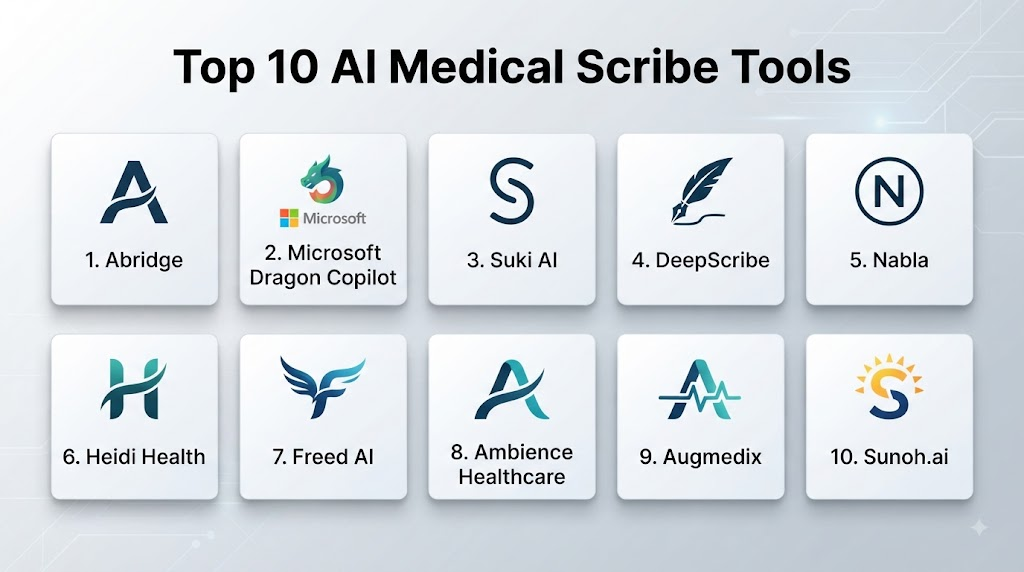
Top 10 AI Medical Scribe Tools
1. Abridge
One-line verdict: Best for health systems seeking enterprise-grade ambient documentation, deep EHR workflows, clinical context, and broad specialty support.
Short description:
Abridge is an ambient AI platform focused on turning clinical conversations into structured documentation. Its platform is designed for enterprise healthcare organizations and supports multiple care settings and specialties.
Abridge describes its Contextual Reasoning Engine as the technology behind its clinical documentation workflows and emphasizes integration directly into EHR environments. (Abridge)
Standout Capabilities
- Ambient clinical conversation capture.
- AI-generated clinical notes.
- EHR-integrated workflows.
- Multi-specialty documentation.
- Multiple care-setting support.
- Multilingual conversation processing.
- Contextual clinical reasoning.
- Evidence-linked documentation workflows.
AI-Specific Depth
- Model support: Proprietary clinical AI and contextual reasoning technology.
- RAG / knowledge integration: Can incorporate previous patient context, health-system-specific guidelines, and clinician preferences according to its product description.
- Evaluation: Abridge publicly emphasizes clinical accuracy, verification, and enterprise deployment; detailed independent evaluation methodology varies.
- Guardrails: Clinician review and verification are central to the workflow.
- Observability: Clinical documentation workflows and evidence-linked information are supported; detailed token-level AI cost metrics are Not publicly stated.
Pros
- Strong enterprise orientation.
- Deep focus on clinical context.
- Broad specialty and care-setting support.
Cons
- Enterprise implementation may require significant IT involvement.
- May provide more functionality than a solo clinician needs.
- Exact pricing is Not publicly stated.
Security & Compliance
Abridge positions its platform for enterprise healthcare environments. Exact customer-specific encryption, retention, residency, access controls, and certification details should be verified for the intended deployment. Certifications: Not publicly stated.
Deployment & Platforms
- Enterprise cloud platform.
- EHR-integrated workflows.
- Mobile capture options.
- Web-based enterprise workflows.
- Self-hosted deployment: Not publicly stated.
Integrations & Ecosystem
Abridge emphasizes direct integration with existing clinical workflows.
- EHR systems.
- Clinical documentation.
- Nursing workflows.
- Patient conversations.
- Revenue-cycle documentation.
- Health-system guidelines.
- Clinician preferences.
Pricing Model
Enterprise quote-based pricing. Exact public pricing is Not publicly stated.
Best-Fit Scenarios
- Large health systems.
- Academic medical centers.
- Enterprise organizations using complex EHR environments.
2. Microsoft Dragon Copilot
One-line verdict: Best for large healthcare organizations wanting ambient documentation connected to Microsoft’s clinical speech and healthcare ecosystem.
Short description:
Microsoft Dragon Copilot combines clinical speech recognition and generative AI capabilities to support documentation and clinician workflows. It builds on Microsoft’s long-standing Dragon medical speech technology and extends it into ambient and AI-assisted documentation.
It is particularly relevant for healthcare organizations already invested in Microsoft technologies and enterprise clinical infrastructure.
Standout Capabilities
- Ambient clinical documentation.
- Medical speech recognition.
- AI-assisted note generation.
- Voice-driven clinical workflows.
- Clinical documentation support.
- Enterprise healthcare integration.
- Dictation and ambient workflows.
- Microsoft ecosystem compatibility.
AI-Specific Depth
- Model support: Microsoft-hosted AI and speech technologies; exact model configuration can vary.
- RAG / knowledge integration: Healthcare and clinical workflow integration are supported; general-purpose vector database compatibility is Not publicly stated.
- Evaluation: Microsoft provides healthcare-focused product development and validation information; detailed customer-specific evaluation results vary.
- Guardrails: Clinician review and enterprise governance controls are important components.
- Observability: Enterprise administration and operational monitoring are available; detailed token-level cost telemetry is Not publicly stated.
Pros
- Strong enterprise infrastructure.
- Mature medical speech-recognition heritage.
- Good fit for Microsoft-oriented healthcare organizations.
Cons
- Enterprise implementation can be complex.
- Full functionality may require broader Microsoft ecosystem adoption.
- Pricing is generally enterprise-specific.
Security & Compliance
Microsoft provides extensive enterprise security and healthcare compliance capabilities across its cloud ecosystem. Exact controls and certifications applicable to a specific Dragon Copilot deployment should be verified. Certifications: Not publicly stated for every specific configuration.
Deployment & Platforms
- Enterprise cloud.
- Desktop workflows.
- Mobile workflows.
- EHR-integrated environments.
- Hybrid options may vary.
Integrations & Ecosystem
The Microsoft ecosystem is a major component of the platform.
- EHR systems.
- Microsoft healthcare services.
- Speech recognition.
- Clinical documentation.
- Enterprise identity.
- Cloud infrastructure.
- Productivity workflows.
Pricing Model
Enterprise and healthcare organization pricing. Exact pricing is Not publicly stated.
Best-Fit Scenarios
- Large hospitals.
- Microsoft-oriented health systems.
- Organizations already using Dragon medical speech technologies.
3. Suki
One-line verdict: Best for clinicians wanting a voice-first AI assistant that combines ambient documentation with conversational workflow control.
Short description:
Suki is an AI clinical assistant built around voice interaction and documentation. The platform has evolved from voice-command functionality toward ambient clinical documentation and broader clinician-assistance workflows.
Its voice-centric approach makes it particularly interesting for clinicians who prefer speaking naturally rather than interacting with multiple menus and buttons.
Standout Capabilities
- Ambient documentation.
- Voice commands.
- Clinical note generation.
- Conversational interaction.
- EHR integration.
- Clinical workflow assistance.
- Specialty support.
- Documentation customization.
AI-Specific Depth
- Model support: Proprietary AI and voice technologies.
- RAG / knowledge integration: Clinical context can be incorporated; general-purpose RAG architecture is Not publicly stated.
- Evaluation: Clinical deployment and documentation quality are emphasized; detailed public benchmark methodology is Not publicly stated.
- Guardrails: Clinician review remains important before notes enter the medical record.
- Observability: Operational product analytics are supported; detailed model-level token and cost metrics are Not publicly stated.
Pros
- Natural voice interaction.
- Strong focus on clinician workflow.
- Useful for users who prefer voice-driven interfaces.
Cons
- Quality can vary depending on specialty and encounter complexity.
- Enterprise integrations may require implementation work.
- Exact pricing is Not publicly stated.
Security & Compliance
Security and compliance capabilities are designed for healthcare environments. Exact encryption, retention, residency, SSO, RBAC, and certification details should be verified for the relevant deployment. Certifications: Not publicly stated.
Deployment & Platforms
- Mobile.
- Desktop.
- EHR-connected workflows.
- Cloud-based service.
- Self-hosted deployment: Not publicly stated.
Integrations & Ecosystem
Suki is designed to operate within clinical documentation workflows.
- EHR systems.
- Voice commands.
- Ambient conversations.
- Clinical notes.
- Patient information.
- Healthcare workflows.
- Provider applications.
Pricing Model
Enterprise and clinician-oriented pricing models may vary. Exact pricing is Not publicly stated.
Best-Fit Scenarios
- Mid-sized medical groups.
- Voice-oriented clinicians.
- Healthcare organizations seeking an AI clinical assistant.
4. Nabla Copilot
One-line verdict: Best for clinicians seeking multilingual ambient documentation across specialties with flexible web, mobile, and browser access.
Short description:
Nabla Copilot is an ambient AI assistant that generates clinical notes from patient encounters. Nabla states that it works across specialties and clinical settings and supports more than 30 languages. It can be accessed through desktop, mobile, and browser-based workflows. (Nabla Help Center)
Standout Capabilities
- Ambient clinical documentation.
- Real-time note generation.
- Multilingual support.
- Multiple clinical specialties.
- Desktop web application.
- Mobile applications.
- Browser extension.
- Clinical document generation.
AI-Specific Depth
- Model support: Proprietary clinical AI technology; exact model providers are Not publicly stated.
- RAG / knowledge integration: Clinical encounter information and relevant context can be incorporated; general-purpose vector database compatibility is Not publicly stated.
- Evaluation: Nabla emphasizes clinical collaboration and product development with clinicians; detailed public benchmark methodology is Not publicly stated.
- Guardrails: Clinician review is required before final documentation.
- Observability: User workflows are supported across devices; detailed token and cost metrics are Not publicly stated.
Pros
- Strong multilingual positioning.
- Flexible device access.
- Broad specialty support.
Cons
- Integration depth varies by EHR.
- Enterprise requirements may need technical configuration.
- Exact pricing is Not publicly stated.
Security & Compliance
Nabla provides healthcare-oriented privacy and security information. Exact encryption, retention, residency, RBAC, SSO, and certification details should be verified for the specific deployment. Certifications: Not publicly stated.
Deployment & Platforms
- Desktop web application.
- iOS.
- Android.
- Chrome extension.
- Cloud-based service.
Nabla specifically confirms these access options in its current product documentation. (Nabla Help Center)
Integrations & Ecosystem
Nabla focuses on flexible clinical documentation workflows.
- EHR systems.
- Browser workflows.
- Mobile devices.
- Clinical notes.
- Patient conversations.
- Healthcare organizations.
- Specialty documentation.
Pricing Model
Clinician and enterprise pricing models vary. Exact enterprise pricing is Not publicly stated.
Best-Fit Scenarios
- Multilingual practices.
- Independent clinicians.
- Healthcare groups needing flexible access across devices.
5. DeepScribe
One-line verdict: Best for specialty-focused practices needing detailed ambient notes and clinical documentation tailored to complex medical conversations.
Short description:
DeepScribe is an AI medical scribe platform focused on capturing patient-provider conversations and converting them into clinical documentation. Its positioning emphasizes specialty workflows and detailed clinical notes.
Standout Capabilities
- Ambient listening.
- AI-generated clinical notes.
- Specialty-specific documentation.
- Clinical terminology.
- EHR integration.
- Documentation customization.
- Coding support.
- Patient encounter summaries.
AI-Specific Depth
- Model support: Proprietary AI and clinical language technologies.
- RAG / knowledge integration: Patient and encounter context can be incorporated; general-purpose RAG support is Not publicly stated.
- Evaluation: Clinical documentation performance is emphasized; detailed independent evaluation methodology is Not publicly stated.
- Guardrails: Clinician review remains necessary.
- Observability: Operational documentation metrics may be available; detailed token-level cost metrics are Not publicly stated.
Pros
- Strong specialty orientation.
- Detailed clinical documentation.
- Useful for complex medical conversations.
Cons
- Setup and integration can vary by EHR.
- May be more functionality than basic primary-care workflows require.
- Pricing is Not publicly stated.
Security & Compliance
Healthcare privacy and security requirements are addressed within enterprise deployments. Exact certifications, encryption, retention, residency, and access controls should be verified for the specific contract. Certifications: Not publicly stated.
Deployment & Platforms
- Web.
- Mobile.
- Cloud-based.
- EHR-connected workflows.
- Self-hosted deployment: Not publicly stated.
Integrations & Ecosystem
DeepScribe is designed to integrate with clinical documentation workflows.
- EHR systems.
- Clinical notes.
- Specialty templates.
- Patient encounters.
- Coding workflows.
- Healthcare practices.
Pricing Model
Clinician and enterprise pricing varies. Exact pricing is Not publicly stated.
Best-Fit Scenarios
- Specialty practices.
- Complex outpatient workflows.
- Clinicians seeking detailed AI-generated notes.
6. Heidi Health
One-line verdict: Best for clinicians wanting flexible AI documentation with broad specialty support and a relatively accessible workflow.
Short description:
Heidi Health is an AI clinical documentation platform that supports medical note generation and other documentation workflows. It is particularly attractive to clinicians and smaller practices looking for flexible AI documentation without necessarily adopting a large enterprise platform.
Standout Capabilities
- Ambient clinical documentation.
- Medical note generation.
- Custom templates.
- Specialty workflows.
- AI-assisted documentation.
- Patient summaries.
- Multilingual capabilities.
- Clinician customization.
AI-Specific Depth
- Model support: Proprietary AI and clinical documentation technology.
- RAG / knowledge integration: Clinical context can be incorporated; detailed RAG architecture is Not publicly stated.
- Evaluation: Clinical use and product validation are emphasized; detailed public evaluation methodology is Not publicly stated.
- Guardrails: Clinician review and controlled documentation workflows.
- Observability: Product usage analytics may be available; detailed token/cost telemetry is Not publicly stated.
Pros
- Flexible documentation workflows.
- Accessible for smaller practices.
- Strong customization potential.
Cons
- Enterprise integration depth should be verified.
- Advanced capabilities can vary by subscription or deployment.
- Exact enterprise pricing is Not publicly stated.
Security & Compliance
Healthcare privacy and security information is provided by the vendor. Exact encryption, retention, residency, SSO, RBAC, and certifications should be verified for the intended deployment. Certifications: Not publicly stated.
Deployment & Platforms
- Web.
- Mobile.
- Cloud-based.
- EHR workflows.
- Self-hosted availability: Not publicly stated.
Integrations & Ecosystem
Heidi focuses on flexible clinician documentation.
- EHR workflows.
- Clinical notes.
- Templates.
- Patient conversations.
- Specialty documentation.
- Healthcare practices.
Pricing Model
The product has offered different clinician-oriented and organizational pricing arrangements. Exact current enterprise pricing is Not publicly stated.
Best-Fit Scenarios
- Solo clinicians.
- Small and medium-sized practices.
- Clinicians wanting customizable documentation.
7. Freed
One-line verdict: Best for independent clinicians wanting a simple AI scribe with fast setup and minimal enterprise complexity.
Short description:
Freed focuses on making AI-powered clinical documentation accessible to individual clinicians and smaller practices. Its workflow centers on capturing the patient encounter and generating a clinical note that can be reviewed and transferred into the clinician’s EHR.
Standout Capabilities
- Ambient documentation.
- Clinical note generation.
- Simple setup.
- Specialty templates.
- Browser and mobile workflows.
- Patient conversation capture.
- EHR copy-and-paste workflow.
- Clinician customization.
AI-Specific Depth
- Model support: Proprietary AI-based documentation technology.
- RAG / knowledge integration: Clinical context and documentation templates; general-purpose RAG architecture is Not publicly stated.
- Evaluation: Product performance is emphasized, but detailed independent evaluation methodology is Not publicly stated.
- Guardrails: Clinician review before finalizing notes.
- Observability: Detailed AI token, latency, and cost metrics are Not publicly stated.
Pros
- Simple onboarding.
- Well suited to independent clinicians.
- Less enterprise-heavy than large health-system platforms.
Cons
- Less appropriate for complex enterprise deployments.
- EHR integration may be less comprehensive than enterprise-focused competitors.
- Exact current pricing can vary.
Security & Compliance
Healthcare privacy and security requirements should be reviewed before entering patient information. Exact encryption, retention, residency, SSO, RBAC, and certification details are Not publicly stated for every deployment.
Deployment & Platforms
- Web.
- Mobile.
- Cloud.
- EHR copy-and-paste workflows.
- Self-hosted deployment: Not publicly stated.
Integrations & Ecosystem
Freed is designed around straightforward clinical documentation.
- EHR systems.
- Clinical notes.
- Patient conversations.
- Templates.
- Mobile workflows.
- Browser workflows.
Pricing Model
Clinician subscription model; exact current pricing should be verified because plans can change.
Best-Fit Scenarios
- Solo physicians.
- Small clinics.
- Clinicians seeking fast implementation.
8. Ambience Healthcare
One-line verdict: Best for health systems seeking AI documentation combined with broader clinical workflow and revenue-cycle automation.
Short description:
Ambience Healthcare focuses on ambient clinical intelligence and documentation while extending into coding and other healthcare workflows. It is positioned toward organizations that want more than a simple AI note generator.
Standout Capabilities
- Ambient clinical documentation.
- Clinical note generation.
- Specialty workflows.
- Medical coding support.
- Revenue-cycle assistance.
- Patient summaries.
- Clinical workflow automation.
- Enterprise deployment.
AI-Specific Depth
- Model support: Proprietary healthcare AI technology.
- RAG / knowledge integration: Clinical and organizational context can be incorporated; exact RAG implementation is Not publicly stated.
- Evaluation: Healthcare workflow performance is emphasized; detailed public AI evaluation methodology is Not publicly stated.
- Guardrails: Clinician review and enterprise workflow controls.
- Observability: Enterprise workflow analytics are available; detailed token-level AI cost metrics are Not publicly stated.
Pros
- Goes beyond simple note generation.
- Strong enterprise workflow orientation.
- Revenue-cycle capabilities can add business value.
Cons
- Enterprise implementation can be complex.
- May be excessive for solo clinicians.
- Pricing is Not publicly stated.
Security & Compliance
Enterprise healthcare security controls should be verified for the exact implementation. Certifications: Not publicly stated.
Deployment & Platforms
- Enterprise cloud.
- EHR-connected workflows.
- Web-based interfaces.
- Mobile capture options may vary.
Integrations & Ecosystem
Ambience is positioned as a broader clinical intelligence platform.
- EHR systems.
- Clinical documentation.
- Medical coding.
- Revenue cycle.
- Patient summaries.
- Specialty workflows.
- Enterprise healthcare systems.
Pricing Model
Enterprise quote-based pricing. Exact pricing is Not publicly stated.
Best-Fit Scenarios
- Large medical groups.
- Health systems.
- Organizations seeking documentation plus revenue-cycle automation.
9. Augmedix
One-line verdict: Best for organizations interested in combining ambient AI documentation with healthcare-specific service and workflow support.
Short description:
Augmedix has historically combined technology with human-supported clinical documentation services. Its evolution toward AI-enabled documentation makes it relevant for organizations that may prefer a combination of automation and human oversight.
Standout Capabilities
- Ambient documentation.
- AI-assisted clinical notes.
- Healthcare-specific workflows.
- Documentation services.
- EHR integration.
- Clinical workflow support.
- Specialty documentation.
- Human-assisted options.
AI-Specific Depth
- Model support: Proprietary AI and speech technologies; exact underlying models are Not publicly stated.
- RAG / knowledge integration: Clinical context and patient information can be incorporated; general-purpose RAG compatibility is Not publicly stated.
- Evaluation: Healthcare documentation workflows have been evaluated operationally; detailed current AI benchmark methodology is Not publicly stated.
- Guardrails: Human review options can provide an additional control layer.
- Observability: Workflow-level monitoring is supported; detailed AI token and cost telemetry is Not publicly stated.
Pros
- Healthcare-specific documentation heritage.
- Potential combination of AI and human support.
- Suitable for organizations that need additional operational assistance.
Cons
- Service model can be more complex than pure software.
- Product and business structure have evolved over time.
- Exact pricing is Not publicly stated.
Security & Compliance
Security and compliance depend on the specific service arrangement. Exact encryption, retention, residency, access controls, and certifications should be verified. Certifications: Not publicly stated.
Deployment & Platforms
- Cloud.
- Mobile.
- Web.
- EHR-connected workflows.
- Human-supported documentation services.
Integrations & Ecosystem
Augmedix is oriented toward healthcare documentation workflows.
- EHR systems.
- Ambient capture.
- Clinical notes.
- Human documentation support.
- Healthcare organizations.
- Patient encounters.
Pricing Model
Enterprise and service-based pricing. Exact pricing is Not publicly stated.
Best-Fit Scenarios
- Health systems.
- Organizations requiring additional documentation support.
- Practices interested in hybrid AI and human workflows.
10. Doximity Scribe
One-line verdict: Best for clinicians wanting lightweight AI-assisted documentation within an established physician-focused healthcare technology ecosystem.
Short description:
Doximity Scribe is an AI-powered clinical documentation tool designed to help clinicians generate notes from patient encounters. Its positioning makes it particularly relevant to physicians already using the broader Doximity ecosystem.
Standout Capabilities
- AI clinical note generation.
- Patient conversation transcription.
- Clinical documentation.
- Physician-focused workflow.
- Mobile-oriented access.
- Simple note creation.
- EHR transfer workflow.
- Integration with the broader Doximity environment.
AI-Specific Depth
- Model support: AI-based clinical documentation; exact model architecture is Not publicly stated.
- RAG / knowledge integration: Clinical encounter context can be incorporated; general-purpose RAG architecture is Not publicly stated.
- Evaluation: Detailed independent evaluation methodology is Not publicly stated.
- Guardrails: Clinician review is required before using generated documentation as the final medical record.
- Observability: Detailed model-level token and cost metrics are Not publicly stated.
Pros
- Familiar physician-oriented ecosystem.
- Straightforward documentation workflow.
- Attractive for clinicians already using Doximity services.
Cons
- Enterprise integration depth should be evaluated carefully.
- May not provide the same breadth as large enterprise ambient platforms.
- Exact pricing and feature availability can change.
Security & Compliance
Healthcare privacy and security information should be reviewed for the specific product configuration. Exact certifications, encryption, retention, residency, SSO, and RBAC details are Not publicly stated for every deployment.
Deployment & Platforms
- Mobile.
- Web.
- Cloud-based.
- EHR transfer workflows.
- Self-hosted deployment: Not publicly stated.
Integrations & Ecosystem
Doximity Scribe benefits from its broader physician technology ecosystem.
- Clinical documentation.
- Physician workflows.
- EHR transfer.
- Mobile healthcare tools.
- Patient encounters.
- Doximity ecosystem.
Pricing Model
Clinician-oriented subscription and service models may vary. Exact current pricing is Not publicly stated.
Best-Fit Scenarios
- Individual physicians.
- Small practices.
- Clinicians already using Doximity.
Comparison Table
| Tool Name | Best For | Deployment | Model Flexibility | Strength | Watch-Out | Public Rating |
|---|---|---|---|---|---|---|
| Abridge | Enterprise health systems | Cloud / EHR | Proprietary | Clinical context | Enterprise complexity | N/A |
| Microsoft Dragon Copilot | Large healthcare organizations | Cloud / Enterprise | Proprietary | Speech + AI | Enterprise implementation | N/A |
| Suki | Voice-first clinical workflows | Cloud / Mobile | Proprietary | Voice interaction | Integration requirements | N/A |
| Nabla Copilot | Multilingual documentation | Web / Mobile | Proprietary | Language support | EHR fit varies | N/A |
| DeepScribe | Specialty practices | Cloud / Web / Mobile | Proprietary | Specialty documentation | Enterprise fit varies | N/A |
| Heidi Health | Flexible clinician workflows | Web / Mobile | Proprietary | Customization | Integration depth varies | N/A |
| Freed | Solo clinicians | Web / Mobile | Proprietary | Simple setup | Limited enterprise scope | N/A |
| Ambience Healthcare | Enterprise clinical workflows | Cloud / EHR | Proprietary | Documentation + RCM | Enterprise complexity | N/A |
| Augmedix | AI + human-supported workflows | Cloud / Mobile | Proprietary / Hybrid | Human support | Service complexity | N/A |
| Doximity Scribe | Individual physicians | Web / Mobile | Proprietary | Physician ecosystem | Enterprise features vary | N/A |
Scoring & Evaluation
The following scores are comparative editorial assessments rather than official vendor ratings. They are designed to provide a practical way to compare documentation platforms across core functionality, AI reliability, safety, integration, usability, performance, security, and support.
The most important consideration is not the total score. A health system should prioritize EHR compatibility, privacy, clinical accuracy, workflow fit, and governance. A solo clinician may place much greater weight on usability and price.
| Tool | Core | Reliability/Eval | Guardrails | Integrations | Ease | Perf/Cost | Security/Admin | Support | Weighted Total |
|---|---|---|---|---|---|---|---|---|---|
| Abridge | 9.7 | 9.4 | 9.5 | 9.7 | 8.8 | 8.5 | 9.3 | 9.3 | 9.3 |
| Microsoft Dragon Copilot | 9.6 | 9.2 | 9.4 | 9.7 | 8.2 | 8.2 | 9.5 | 9.4 | 9.2 |
| Suki | 9.2 | 9.0 | 9.1 | 9.2 | 9.0 | 8.7 | 9.0 | 8.8 | 9.0 |
| Nabla Copilot | 9.1 | 9.0 | 9.0 | 8.8 | 9.2 | 9.0 | 8.8 | 8.7 | 8.9 |
| DeepScribe | 9.1 | 8.9 | 8.9 | 8.8 | 8.8 | 8.6 | 8.8 | 8.6 | 8.8 |
| Heidi Health | 8.9 | 8.7 | 8.8 | 8.2 | 9.2 | 9.1 | 8.5 | 8.5 | 8.7 |
| Freed | 8.7 | 8.6 | 8.7 | 7.8 | 9.5 | 9.3 | 8.2 | 8.4 | 8.6 |
| Ambience Healthcare | 9.4 | 9.0 | 9.2 | 9.2 | 8.4 | 8.3 | 9.0 | 8.8 | 9.0 |
| Augmedix | 8.9 | 8.8 | 9.0 | 8.7 | 8.5 | 8.0 | 8.8 | 9.0 | 8.7 |
| Doximity Scribe | 8.5 | 8.2 | 8.5 | 8.0 | 9.4 | 9.3 | 8.4 | 9.0 | 8.6 |
Top 3 for Enterprise
- Abridge — Excellent fit for large health systems requiring contextual documentation, EHR integration, and broad clinical coverage.
- Microsoft Dragon Copilot — Strong choice for organizations deeply invested in Microsoft and established medical speech workflows.
- Ambience Healthcare — Attractive for organizations looking beyond note generation toward coding and broader clinical workflows.
Top 3 for SMB
- Heidi Health — Flexible and accessible for smaller clinical organizations.
- Suki — Strong voice-oriented workflow and useful clinical assistant capabilities.
- Nabla Copilot — Good balance of documentation, multilingual support, and flexible access.
Top 3 for Developers
- Abridge — Strong enterprise clinical workflow orientation.
- Nabla Copilot — Flexible multi-device and multilingual environment.
- Suki — Interesting for voice-driven clinical workflows.
Which AI Medical Scribe Tool Is Right for You?
Solo / Individual Clinician
Individual clinicians should avoid choosing a platform simply because it has the largest feature list.
Prioritize:
- Note accuracy.
- Fast setup.
- EHR compatibility.
- Specialty support.
- Mobile access.
- Custom templates.
- Privacy.
- Transparent pricing.
- Low administrative overhead.
Freed, Heidi Health, Nabla Copilot, Suki, and Doximity Scribe can be attractive for individual clinicians depending on specialty and workflow.
The ideal solo-clinician tool should disappear into the background of the consultation rather than becoming another application that requires constant interaction.
SMB Healthcare Organization
Small and medium-sized practices should focus on workflow consistency.
Important requirements include:
- Multiple clinician support.
- Shared templates.
- EHR compatibility.
- Administrative controls.
- User management.
- Privacy.
- Documentation quality.
- Specialty customization.
- Implementation support.
Nabla, Suki, Heidi Health, DeepScribe, and other mid-market solutions may be suitable depending on the organization’s EHR and specialty mix.
Mid-Market
Mid-sized healthcare groups should evaluate both clinician experience and administrative scalability.
Look for:
- Centralized administration.
- EHR integration.
- Multi-specialty support.
- Usage analytics.
- Security controls.
- Custom templates.
- Model monitoring.
- Implementation support.
- Cost predictability.
The best platform is one that clinicians actually use consistently and that the IT team can manage without excessive operational complexity.
Enterprise
Large health systems should treat an AI medical scribe as clinical infrastructure rather than a simple productivity application.
Important considerations include:
- EHR integration.
- Identity management.
- Data governance.
- Clinical validation.
- Security architecture.
- Model governance.
- Auditability.
- Specialty support.
- Multilingual capability.
- Enterprise support.
- Business continuity.
- Vendor resilience.
Abridge, Microsoft Dragon Copilot, Ambience Healthcare, Suki, and other enterprise platforms can be evaluated depending on the organization’s clinical and technical environment.
Regulated industries
Healthcare organizations should evaluate applicable privacy and medical-AI requirements in their jurisdictions.
Important questions include:
- Where is patient audio processed?
- How long is audio retained?
- Is audio deleted after note generation?
- Who can access recordings?
- Are generated notes stored?
- What subprocessors are involved?
- Can data be used for model improvement?
- How are security incidents handled?
- How are model changes governed?
Healthcare organizations should obtain written answers during procurement rather than relying solely on marketing claims.
Budget vs premium
A low subscription price does not necessarily mean lower total cost.
Organizations should calculate:
- License costs.
- EHR integration costs.
- Implementation.
- Training.
- Security review.
- Support.
- Data processing.
- Administrative overhead.
- Clinician productivity.
- Documentation quality.
- Coding improvements.
For enterprise buyers, the value of an AI scribe should be measured in terms of time saved, documentation quality, clinician satisfaction, patient experience, and downstream operational benefits.
Build vs buy
Building an AI medical scribe internally can look attractive because speech recognition and language models are widely available.
However, production healthcare documentation requires much more than transcription.
A serious implementation must address:
- Medical terminology.
- Speaker identification.
- Clinical context.
- Hallucination prevention.
- Privacy.
- Security.
- EHR integration.
- Specialty templates.
- Clinical validation.
- Model monitoring.
- Incident response.
- Data retention.
- Human review.
For most organizations, buying or integrating a mature platform is more practical unless the organization has a strong internal healthcare-AI engineering and governance team.
Implementation Playbook
First 30 Days: Pilot and Define Success
Begin with a small group of clinicians rather than deploying across the entire organization.
Key activities:
- Select participating clinicians.
- Choose representative specialties.
- Identify high-volume appointment types.
- Map the existing documentation workflow.
- Establish baseline documentation time.
- Measure after-hours charting.
- Identify preferred note formats.
- Test EHR integration.
- Review audio quality.
- Establish patient-consent procedures where required.
- Create representative clinical test cases.
- Define acceptable error thresholds.
- Establish human-review requirements.
Useful success metrics include:
- Documentation time per encounter.
- Note-editing time.
- Clinician satisfaction.
- Note completeness.
- Factual error rate.
- Hallucination rate.
- EHR workflow time.
- Patient experience.
- Adoption rate.
Days 31–60: Harden Security and Evaluation
After the pilot, focus on reliability and governance.
Key activities:
- Review access controls.
- Validate encryption.
- Review data retention.
- Review audio deletion.
- Review data residency.
- Review subprocessors.
- Establish SSO where appropriate.
- Configure RBAC.
- Test clinical terminology.
- Test different accents.
- Test multilingual encounters.
- Test overlapping speakers.
- Test noisy environments.
- Test incomplete conversations.
- Test adversarial prompts.
- Test hallucination scenarios.
- Establish model-change procedures.
AI medical scribes should be tested against clinically reviewed scenarios, not only generic transcription benchmarks.
Days 61–90: Optimize and Scale
After security and evaluation are established, expand gradually.
Key activities:
- Expand to additional specialties.
- Monitor documentation quality.
- Track clinician edits.
- Monitor model performance.
- Track latency.
- Monitor AI processing costs.
- Review recurring error patterns.
- Update specialty templates.
- Establish clinical governance.
- Create incident-management procedures.
- Monitor vendor changes.
- Establish periodic AI evaluation.
- Train new clinicians.
- Review patient feedback.
- Create a long-term vendor-management process.
The goal is to make AI documentation part of the clinical workflow without creating a new source of administrative burden.
Common Mistakes & How to Avoid Them
- Treating AI-generated notes as automatically correct: Every generated note should be reviewed by the responsible clinician before becoming part of the official medical record.
- Choosing a tool without testing the EHR workflow: A technically impressive scribe can become frustrating if clinicians have to copy and paste constantly.
- Ignoring specialty terminology: A primary-care workflow may not perform equally well in cardiology, oncology, psychiatry, surgery, or emergency medicine.
- Failing to evaluate hallucinations: AI can produce plausible but unsupported information.
- Ignoring patient consent: Organizations should establish appropriate procedures for recording and processing clinical conversations.
- Retaining audio unnecessarily: Audio recordings can contain highly sensitive information and should have clearly defined retention policies.
- Ignoring multilingual performance: A tool that works well in English may behave differently across other languages.
- Not testing accents: Speech recognition quality can vary across accents and communication styles.
- Ignoring noisy environments: Hospitals and clinics can contain background noise, alarms, multiple speakers, and interruptions.
- Assuming transcription accuracy equals clinical accuracy: A transcript can be accurate while the generated medical summary still misinterprets clinical meaning.
- Over-customizing templates: Excessive customization can make maintenance and governance difficult.
- Ignoring model updates: AI vendors may update models, prompts, or processing pipelines, potentially changing output behavior.
- Failing to monitor clinician edits: Repeated corrections can reveal systematic weaknesses in the AI system.
- Ignoring security architecture: Patient conversations should not be treated like ordinary consumer audio data.
- Measuring only time savings: Documentation quality, patient experience, clinician trust, safety, and error rates matter too.
- Deploying everywhere immediately: Start with controlled pilots and expand after validating safety and workflow performance.
FAQs
What is an AI Medical Scribe Tool?
An AI medical scribe captures a clinical encounter and uses artificial intelligence to generate a structured medical note.
The clinician reviews and edits the generated documentation before it becomes part of the official record.
How does an AI medical scribe work?
The system typically captures audio from a patient encounter, converts speech into text, identifies clinically relevant information, and uses AI to organize that information into a medical note.
Some platforms add patient context, templates, coding assistance, or other clinical workflow capabilities.
Can AI medical scribes replace human medical scribes?
They can automate substantial documentation work, but they do not eliminate the need for clinical oversight.
Human review remains important because AI systems can misunderstand conversations or generate incorrect information.
Are AI medical scribes accurate?
Accuracy varies by vendor, specialty, language, recording environment, and encounter complexity.
Organizations should test real clinical scenarios rather than relying only on vendor demonstrations.
Can AI medical scribes hallucinate?
Yes. AI-generated documentation can contain unsupported or incorrect information.
This is why clinicians should verify generated notes before signing them.
Do AI medical scribes work with EHR systems?
Many leading platforms provide EHR integrations, but integration depth varies.
A buyer should determine whether the system writes directly into structured EHR fields or requires copy-and-paste workflows.
Can AI medical scribes work in different specialties?
Many support multiple specialties, but performance can vary.
A healthcare organization should specifically test its highest-value specialties and most complex encounter types.
Can AI medical scribes support multiple languages?
Some can. Nabla currently states that it supports more than 30 languages, while other vendors also provide multilingual capabilities. (Nabla Help Center)
Language support should be evaluated separately for speech recognition and clinical note generation.
Do AI medical scribes record patient conversations?
Ambient systems generally need to capture the clinical conversation to generate a note.
Organizations should establish appropriate consent, privacy, retention, access, and deletion procedures for recorded audio.
Is the patient audio stored?
Storage practices vary by platform and configuration.
Healthcare organizations should specifically ask whether audio is retained, for how long, where it is processed, and whether it is used for model improvement.
Are AI medical scribes HIPAA compliant?
Healthcare organizations should not rely on a generic “HIPAA compliant” statement alone.
They should verify the specific service configuration, contractual terms, business-associate arrangements, security controls, data processing, and retention policies.
Can AI scribes generate SOAP notes?
Many AI medical scribes can generate structured clinical notes, including SOAP-style documentation.
Exact formats and customization capabilities vary by product.
Can AI medical scribes generate billing codes?
Some platforms provide coding or revenue-cycle assistance.
However, coding suggestions should be reviewed by qualified staff and should not automatically be treated as correct.
Can AI scribes create patient instructions?
Some platforms can generate patient-facing summaries or instructions.
Any patient-facing content should be reviewed according to the organization’s clinical governance requirements.
Can AI medical scribes work during telehealth appointments?
Some platforms support telehealth workflows, although exact integration and recording methods vary.
Organizations should test audio quality and speaker separation in real-world telehealth conditions.
What is ambient clinical documentation?
Ambient clinical documentation means the AI listens to the clinical encounter in the background and creates documentation without requiring the clinician to manually dictate every detail.
It is the core workflow behind many modern AI medical scribes.
What is the difference between transcription and an AI medical scribe?
Transcription converts speech into text.
An AI medical scribe goes further by interpreting the conversation and organizing clinically relevant information into a structured medical document.
Can AI medical scribes understand medical terminology?
Modern healthcare-focused systems are designed to recognize medical terminology, but performance can vary by specialty, accent, pronunciation, and context.
Specialty-specific testing is important.
How should organizations evaluate an AI medical scribe?
Evaluate note accuracy, hallucination rate, EHR integration, specialty performance, multilingual capability, privacy, security, latency, usability, clinician editing time, and patient-consent workflows.
What are AI guardrails for medical scribes?
Guardrails can include restricted access, clinician verification, evidence-based generation, privacy controls, audit trails, prohibited actions, and restrictions on autonomous changes to patient records.
Should AI-generated notes be automatically inserted into the medical record?
Organizations should carefully evaluate this workflow.
In many environments, clinician verification before final submission is an important safety control.
Can an AI scribe write nursing documentation?
Some newer platforms are expanding beyond physician notes. Abridge, for example, describes AI-assisted nursing documentation workflows that generate draft flowsheet information for review. (Abridge)
Can AI scribes reduce clinician burnout?
Reducing documentation workload can potentially improve clinician experience, but the actual impact depends on note quality, workflow integration, clinician adoption, and the amount of editing required.
The technology should be evaluated using measurable local outcomes.
What is the biggest risk of AI medical scribes?
One of the most important risks is incorrect documentation entering the medical record.
Even a small hallucination can become clinically significant if it changes a medication, diagnosis, symptom, procedure, or treatment plan.
Should a healthcare organization build its own AI medical scribe?
Building internally can make sense for organizations with strong AI engineering, clinical informatics, security, and governance teams.
For most organizations, purchasing an established platform is likely to be more practical.
Which AI medical scribe tool is best?
There is no universal winner.
Abridge is particularly strong for enterprise health systems and contextual clinical documentation. Microsoft Dragon Copilot is attractive for organizations using Microsoft’s healthcare ecosystem. Suki is strong for voice-driven workflows, Nabla for multilingual documentation, DeepScribe for specialty-oriented documentation, Heidi Health for flexible clinician workflows, and Freed for independent clinicians.
How much does an AI medical scribe cost?
Pricing varies significantly by vendor, clinician count, functionality, EHR integration, contract size, and deployment.
Enterprise vendors generally use customized pricing, while some clinician-focused products offer more transparent subscription models.
Exact pricing should be verified directly before making a purchasing decision.
Conclusion
AI Medical Scribe Tools are changing the way clinical documentation is created. Instead of forcing clinicians to divide their attention between patients and keyboards, ambient AI can capture conversations and transform them into structured documentation that clinicians can review.The technology is also moving beyond simple note generation. Modern platforms increasingly incorporate contextual reasoning, specialty-specific documentation, multilingual support, EHR integration, coding assistance, patient summaries, nursing workflows, and broader clinical intelligence.Abridge stands out for enterprise clinical documentation and contextual reasoning. Microsoft Dragon Copilot benefits from Microsoft’s established medical speech technology and enterprise infrastructure. Suki provides a strong voice-first experience, while Nabla Copilot offers broad language and device support. DeepScribe is particularly relevant for specialty-heavy practices. Heidi Health provides flexibility for clinicians and smaller organizations. Freed emphasizes straightforward adoption for individual clinicians. Ambience Healthcare focuses on documentation combined with broader clinical and revenue-cycle workflows. Augmedix brings healthcare documentation expertise and hybrid workflow possibilities, while Doximity Scribe is particularly relevant for physicians already using the Doximity ecosystem.