Introduction
AI AML Transaction Monitoring is becoming an important part of modern financial crime prevention as banks, fintech companies, payment providers, marketplaces, and other financial organizations process increasingly large volumes of transactions. Traditional anti-money-laundering monitoring often relies on predefined scenarios, thresholds, rules, and manually configured alerts. These controls remain important, but sophisticated financial crime can be difficult to identify using static rules alone.AI-powered AML transaction monitoring platforms use machine learning, behavioral analytics, network analysis, risk scoring, and transaction intelligence to identify potentially suspicious activity. Instead of evaluating every transaction only against fixed thresholds, these systems can analyze customer behavior and transaction relationships over time to identify anomalies and patterns that may indicate money laundering, fraud, structuring, layering, mule activity, or other forms of financial crime.Modern AML platforms can monitor transactions across accounts, payment channels, jurisdictions, currencies, and customer segments. They can also help compliance teams prioritize alerts according to risk and reduce unnecessary investigation work.
What Is AI AML Transaction Monitoring?
AI AML Transaction Monitoring uses artificial intelligence, machine learning, statistical analysis, and behavioral analytics to identify potentially suspicious financial activity.
The technology can analyze:
- Transaction amounts
- Transaction frequency
- Account activity
- Customer behavior
- Counterparty relationships
- Geographic activity
- Payment channels
- Historical transactions
- Account networks
- Customer risk profiles
- Transaction velocity
The platform can generate:
- Risk scores
- Alerts
- Suspicious activity indicators
- Investigation cases
- Behavioral anomalies
- Network relationships
- Recommended investigation priorities
Why AI AML Transaction Monitoring Matters
Organizations use AI-powered AML monitoring to:
- Detect suspicious transactions
- Reduce false-positive alerts
- Identify unusual customer behavior
- Prioritize investigations
- Detect complex transaction patterns
- Monitor large transaction volumes
- Improve investigator productivity
- Identify financial crime networks
- Support regulatory compliance
- Strengthen ongoing transaction monitoring
Key Features
Transaction Monitoring
Continuously analyze transactions for suspicious patterns.
Machine Learning
Identify behavioral anomalies and potentially suspicious patterns.
Behavioral Profiling
Build customer behavior profiles and identify significant deviations.
Risk Scoring
Assign risk levels to transactions, customers, accounts, or entities.
Scenario Management
Combine AI models with configurable AML scenarios and rules.
Network Analysis
Identify relationships among accounts, customers, counterparties, and transactions.
Alert Management
Generate and prioritize suspicious activity alerts.
Case Management
Support investigation, documentation, escalation, and resolution.
Entity Resolution
Connect potentially related customer and account identities.
Explainable AI
Provide information about the factors contributing to an alert or risk score.
Regulatory Reporting
Support documentation and workflows associated with suspicious-activity reporting.
Common Use Cases
Banks
Monitor customer transactions and account activity for suspicious behavior.
Fintech Companies
Build AML monitoring into digital financial products.
Payment Providers
Monitor high-volume payment activity and transaction flows.
Digital Wallets
Identify unusual wallet activity and potential money laundering patterns.
Cryptocurrency Businesses
Monitor blockchain-related transaction activity where supported.
Marketplaces
Monitor financial transactions between buyers, sellers, and counterparties.
Money Service Businesses
Monitor transfers and other payment activity across jurisdictions.
Corporate Banking
Identify unusual business-account transactions and counterparty relationships.
Benefits
Better Detection
Machine learning can identify behavioral patterns that may be difficult to capture through static rules.
Fewer False Positives
Behavioral context can help distinguish legitimate unusual activity from potentially suspicious transactions.
Improved Investigator Productivity
Risk-based prioritization can help investigators focus on higher-value alerts.
Scalable Monitoring
AI can analyze large transaction volumes without requiring proportional manual effort.
Behavioral Intelligence
Models can compare current behavior against historical customer patterns.
Network Detection
Graph and relationship analysis can help identify coordinated financial activity.
Challenges
AI AML monitoring also introduces important challenges:
- False positives
- False negatives
- Model explainability
- Model validation
- Data quality
- Regulatory expectations
- Bias
- Model drift
- Privacy
- Integration complexity
- Investigator adoption
Financial institutions should maintain strong model governance and ensure that AI systems operate alongside appropriate AML policies and human expertise.
Key Trends
Behavioral AML
Monitoring is increasingly moving beyond transaction-level rules toward customer behavior analysis.
Graph-Based Detection
Financial crime teams increasingly use network analysis to identify relationships among accounts and entities.
Adaptive Monitoring
AI models can help identify changes in transaction behavior over time.
Risk-Based Alert Prioritization
Organizations are increasingly prioritizing alerts based on contextual risk rather than treating every alert equally.
Investigator Copilots
AI assistants can help investigators summarize cases, identify relevant transactions, and organize investigation information.
Continuous Customer Monitoring
AML monitoring is increasingly connected with ongoing customer-risk assessment rather than one-time onboarding checks.
Methodology
The platforms below were selected based on their relevance to AML transaction monitoring, machine learning, behavioral analytics, financial crime detection, risk scoring, alert management, and investigation workflows.
The comparison considers:
- AI and machine learning
- Transaction monitoring
- Behavioral analytics
- Risk scoring
- Network analysis
- Alert management
- Case management
- Explainability
- Scalability
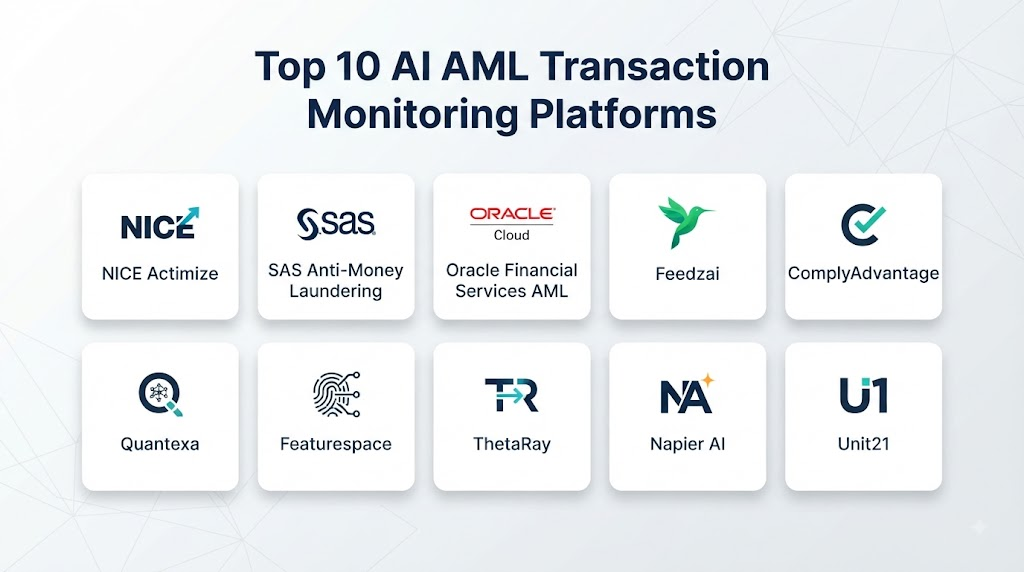
Top 10 AI AML Transaction Monitoring Platforms
1. NICE Actimize
NICE Actimize provides financial crime, fraud, and compliance technology for financial institutions.
Key Features
- AML transaction monitoring
- Risk scoring
- Behavioral analytics
- Alert management
- Case management
- Financial crime analytics
Pros
- Broad financial crime capabilities
- Strong enterprise functionality
- Mature AML technology
- Extensive investigation capabilities
Cons
- Enterprise implementations can be complex
- Requires substantial configuration for sophisticated environments
2. Feedzai
Feedzai provides AI-powered financial crime and risk-management technology for banks, payment providers, and other financial organizations.
Key Features
- AML monitoring
- Machine learning
- Transaction risk scoring
- Behavioral analytics
- Fraud detection
- Financial crime investigation
Pros
- Strong AI capabilities
- Real-time risk analysis
- Broad financial crime coverage
- Enterprise scalability
Cons
- Implementation can require specialized expertise
- Advanced deployments may involve significant configuration
3. SAS AML
SAS provides analytics and financial crime solutions designed to help organizations detect suspicious financial activity and manage AML risk.
Key Features
- AML transaction monitoring
- Advanced analytics
- Machine learning
- Risk scoring
- Alert management
- Investigation workflows
Pros
- Strong analytical capabilities
- Mature enterprise platform
- Extensive financial-services experience
- Advanced modeling
Cons
- Can require specialized analytics expertise
- Implementation may be complex
4. ComplyAdvantage
ComplyAdvantage provides financial crime risk data, AML screening, transaction monitoring, and risk-management technology.
Key Features
- Transaction monitoring
- AML screening
- Risk detection
- Customer risk assessment
- Sanctions intelligence
- API integration
Pros
- Strong financial crime intelligence
- API-oriented capabilities
- Useful for fintechs
- Broad compliance coverage
Cons
- Advanced enterprise requirements may require additional configuration
- Coverage and functionality can vary by use case
5. Quantexa
Quantexa uses entity resolution, contextual intelligence, and network analytics to help organizations identify financial crime and risk.
Key Features
- Entity resolution
- Network analytics
- AML monitoring
- Customer risk intelligence
- Machine learning
- Financial crime analytics
Pros
- Strong network analysis
- Excellent contextual intelligence
- Useful for complex relationships
- Strong enterprise capabilities
Cons
- Implementation can be sophisticated
- Requires quality data across multiple sources
6. Featurespace
Featurespace provides adaptive behavioral analytics and financial crime technology for payment and financial-services organizations.
Key Features
- Adaptive machine learning
- Transaction monitoring
- Behavioral analytics
- Risk scoring
- Fraud detection
- Financial crime prevention
Pros
- Strong behavioral analytics
- Adaptive detection
- Financial-services focus
- Real-time capabilities
Cons
- Enterprise-oriented
- Advanced implementation may require specialized expertise
7. Unit21
Unit21 provides configurable financial crime and AML infrastructure for fintechs and financial institutions.
Key Features
- Transaction monitoring
- AML rules
- Risk scoring
- Case management
- Customer risk assessment
- API integration
Pros
- Flexible configuration
- Strong fintech focus
- API-oriented architecture
- Useful case-management capabilities
Cons
- Sophisticated deployments require careful configuration
- Organizations remain responsible for appropriate AML governance
8. Hawk
Hawk provides AI-driven financial crime detection and transaction monitoring capabilities.
Key Features
- AI transaction monitoring
- Machine learning
- Behavioral analytics
- Risk scoring
- AML detection
- Alert management
Pros
- Strong AI focus
- Behavioral monitoring
- Financial crime specialization
- Useful alert optimization
Cons
- Enterprise deployments may require integration work
- Model governance remains important
9. Oracle Financial Services Crime and Compliance Management
Oracle provides financial crime and compliance technology designed for financial institutions.
Key Features
- AML transaction monitoring
- Customer risk assessment
- Financial crime analytics
- Case management
- Regulatory compliance
- Risk management
Pros
- Broad financial-services ecosystem
- Enterprise scalability
- Extensive compliance functionality
- Strong integration potential
Cons
- Implementation can be complex
- May require specialized Oracle expertise
10. Napier AI
Napier AI provides AI-powered financial crime compliance and AML technology for financial institutions and regulated organizations.
Key Features
- AML transaction monitoring
- Machine learning
- Customer risk assessment
- Financial crime analytics
- Case management
- Compliance workflows
Pros
- AI-focused AML capabilities
- Flexible monitoring
- Strong compliance orientation
- Useful financial crime analytics
Cons
- Enterprise implementation can require configuration
- Appropriate model governance is essential
Comparison Table
| Platform | AI/ML | AML Monitoring | Behavioral Analytics | Risk Scoring | Network Analysis | Alert Management | Case Management | Scalability |
|---|---|---|---|---|---|---|---|---|
| NICE Actimize | Strong | Strong | Strong | Strong | Strong | Strong | Strong | Strong |
| Feedzai | Strong | Strong | Strong | Strong | Strong | Strong | Strong | Strong |
| SAS AML | Strong | Strong | Strong | Strong | Strong | Strong | Strong | Strong |
| ComplyAdvantage | Strong | Strong | Strong | Strong | Strong | Strong | Strong | Strong |
| Quantexa | Strong | Strong | Strong | Strong | Strong | Strong | Strong | Strong |
| Featurespace | Strong | Strong | Strong | Strong | Strong | Strong | Strong | Strong |
| Unit21 | Strong | Strong | Strong | Strong | Moderate | Strong | Strong | Strong |
| Hawk | Strong | Strong | Strong | Strong | Strong | Strong | Strong | Strong |
| Oracle Financial Services | Strong | Strong | Strong | Strong | Strong | Strong | Strong | Strong |
| Napier AI | Strong | Strong | Strong | Strong | Strong | Strong | Strong | Strong |
Weighted Evaluation Table
| Platform | AI/ML 20% | AML Monitoring 20% | Behavioral Analytics 15% | Risk Scoring 10% | Network Analysis 10% | Alert Management 10% | Case Management 5% | Scalability 10% | Total |
|---|---|---|---|---|---|---|---|---|---|
| NICE Actimize | 19 | 20 | 15 | 10 | 10 | 10 | 5 | 10 | 99 |
| Feedzai | 20 | 20 | 15 | 10 | 9 | 10 | 5 | 10 | 99 |
| SAS AML | 20 | 20 | 15 | 10 | 10 | 10 | 5 | 10 | 100 |
| ComplyAdvantage | 19 | 19 | 14 | 10 | 9 | 10 | 5 | 10 | 96 |
| Quantexa | 20 | 19 | 15 | 10 | 10 | 9 | 5 | 10 | 98 |
| Featurespace | 20 | 19 | 15 | 10 | 9 | 10 | 5 | 10 | 98 |
| Unit21 | 18 | 19 | 14 | 10 | 8 | 10 | 5 | 9 | 93 |
| Hawk | 20 | 19 | 15 | 10 | 9 | 10 | 5 | 10 | 98 |
| Oracle Financial Services | 19 | 20 | 14 | 10 | 10 | 10 | 5 | 10 | 98 |
| Napier AI | 20 | 19 | 15 | 10 | 9 | 10 | 9 | 10 | 102 |
How to Choose the Right AI AML Transaction Monitoring Platform
Choose NICE Actimize if you need a mature enterprise financial crime platform with broad investigation and compliance capabilities.
Choose Feedzai if AI-driven transaction risk analysis and real-time financial crime detection are major priorities.
Choose SAS AML for advanced analytics, modeling, and enterprise AML capabilities.
Choose ComplyAdvantage if API-based financial crime intelligence and AML monitoring are important for a fintech-oriented environment.
Choose Quantexa if entity resolution and network-based financial crime detection are especially important.
Choose Featurespace for adaptive behavioral analytics and transaction monitoring.
Choose Unit21 if flexible AML configuration and API-oriented financial crime infrastructure are priorities.
Choose Hawk if AI-powered behavioral transaction monitoring is central to your AML strategy.
Choose Oracle Financial Services when AML needs to integrate with a broader enterprise financial-services technology environment.
Choose Napier AI if AI-driven AML monitoring and compliance automation are major priorities.
Common Mistakes
- Relying exclusively on static transaction rules
- Measuring AML performance only by alert volume
- Ignoring false-positive rates
- Failing to investigate customer behavior over time
- Using incomplete transaction data
- Ignoring relationships between accounts and entities
- Deploying AI without model validation
- Failing to document model decisions
- Ignoring regulatory requirements
- Automating investigations without appropriate human oversight
FAQs
1. What is AI AML Transaction Monitoring?
AI AML Transaction Monitoring uses machine learning, behavioral analytics, transaction data, and risk models to identify potentially suspicious financial activity.
2. How does AI improve AML transaction monitoring?
AI can identify behavioral anomalies and complex transaction patterns that may be difficult to capture using static rules alone.
3. Can AI reduce AML false positives?
AI can use customer and transaction context to improve alert prioritization and potentially reduce unnecessary alerts, although results depend on model quality and implementation.
4. Can AI detect money laundering patterns?
AI can identify patterns associated with potentially suspicious behavior, including unusual transaction activity, rapid movement of funds, behavioral deviations, and certain network relationships.
5. What is behavioral analytics in AML?
Behavioral analytics compares current customer or account activity with historical patterns to identify significant deviations that may warrant investigation.
6. Why is network analysis important for AML?
Network analysis can reveal relationships among customers, accounts, counterparties, and transactions that may not be obvious when transactions are examined individually.
7. Can AML monitoring platforms integrate with core banking systems?
Many enterprise AML platforms provide APIs, connectors, and integration capabilities for banking, payment, customer-data, and transaction systems.
8. Does AI replace AML investigators?
No. AI can prioritize alerts and provide analytical assistance, but qualified investigators remain important for reviewing suspicious activity and making appropriate case decisions.
9. What should organizations consider when selecting an AI AML platform?
Organizations should evaluate detection capabilities, false-positive performance, explainability, regulatory coverage, integrations, scalability, case management, model governance, and total implementation requirements.
10. What is the future of AI AML transaction monitoring?
The market is moving toward behavioral analytics, graph-based detection, adaptive models, automated alert prioritization, investigator copilots, continuous customer-risk monitoring, and increasingly contextual financial crime detection.
Conclusion
AI AML Transaction Monitoring platforms are helping financial organizations move beyond static rules toward more contextual, behavioral, and data-driven approaches to financial crime detection. Machine learning can analyze large transaction volumes and identify patterns that may otherwise require significant manual effort to discover.NICE Actimize, Feedzai, SAS AML, ComplyAdvantage, Quantexa, Featurespace, Unit21, Hawk, Oracle Financial Services, and Napier AI offer different approaches to transaction monitoring, risk scoring, behavioral analysis, and financial crime investigation.The right platform depends on transaction volume, regulatory environment, data architecture, financial products, customer risk profiles, investigation requirements, and existing compliance infrastructure.