Introduction
AI algorithmic trading assistants are software tools that use artificial intelligence, machine learning, quantitative models, or natural-language interfaces to support systematic trading workflows. They can help traders and quantitative researchers generate ideas, analyze market data, create trading logic, backtest strategies, monitor portfolios, and automate selected research or execution tasks.The category is becoming more relevant as traders increasingly combine traditional quantitative strategies with machine learning, alternative datasets, natural-language interfaces, and automated workflows. Instead of manually writing every research query or strategy component, users can increasingly delegate repetitive analytical tasks to software.
Common use cases include strategy generation, code assistance, market analysis, backtesting, signal research, portfolio monitoring, risk analysis, trade automation, and performance evaluation.
Buyers should evaluate model reliability, data quality, backtesting methodology, execution controls, integrations, latency, security, explainability, observability, cost, customization, and human oversight.
What’s Changed in AI Algorithmic Trading Assistant
- Natural-language interfaces are making strategy research more accessible to traders who are not full-time programmers.
- AI coding assistants can help generate, explain, debug, and modify trading-system code.
- Machine-learning models can be incorporated into signal-generation and classification workflows.
- Automated agents can potentially coordinate data retrieval, analysis, backtesting, and reporting tasks.
- Multimodal workflows can combine structured market data with documents, charts, news, and other research inputs.
- Evaluation is becoming more important because AI-generated trading logic can contain hidden assumptions or implementation errors.
- Backtesting systems increasingly need stronger safeguards against look-ahead bias and overfitting.
- AI systems connected to trading infrastructure require strict tool permissions and execution controls.
- Model routing and smaller specialized models can reduce computational cost for repetitive research tasks.
- Observability is becoming important for tracking model outputs, latency, errors, data usage, and system behavior.
- Privacy and data-retention controls matter when proprietary strategies or sensitive financial information are processed.
- Human approval remains important when AI systems can generate or modify executable trading strategies.
Quick Buyer Checklist
When evaluating AI algorithmic trading assistants, consider:
- Market-data quality and freshness.
- Historical-data availability.
- Backtesting capabilities.
- Out-of-sample testing.
- Walk-forward testing.
- Look-ahead-bias protection.
- Transaction-cost modeling.
- Slippage modeling.
- Paper-trading support.
- Broker and exchange integrations.
- API availability.
- Model choice.
- Hosted versus BYO model support.
- Custom model support.
- RAG and external knowledge integration where relevant.
- Evaluation and regression testing.
- Prompt-injection protection.
- Tool-access controls.
- Human approval workflows.
- Audit logs.
- Data retention.
- Encryption and access management.
- Latency.
- Compute costs.
- Scalability.
- Vendor lock-in.
- Monitoring and observability.
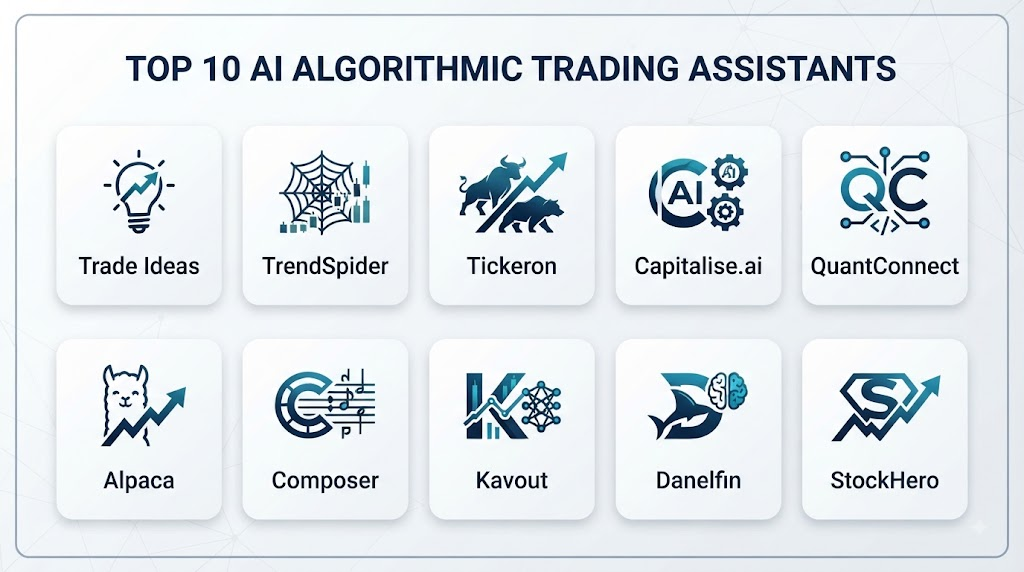
Top 10 AI Algorithmic Trading Assistants
1. QuantConnect
One-line verdict: Best for quantitative developers building, testing, optimizing, and deploying systematic trading strategies.
Short description
QuantConnect provides a developer-focused environment for algorithmic trading research and strategy development. It supports quantitative research, backtesting, portfolio construction, and algorithmic workflows, making it particularly useful for users who want substantial control over trading logic.
Standout Capabilities
- Algorithmic strategy development.
- Historical backtesting.
- Quantitative research.
- Strategy optimization.
- Portfolio construction.
- Cloud-based research.
- Python-oriented development.
- Algorithm deployment workflows.
AI-Specific Depth
- Model support: Supports custom quantitative and machine-learning workflows; specific model options vary.
- RAG / knowledge integration: Not a primary RAG platform; external data integration can be implemented.
- Evaluation: Backtesting, quantitative analysis, and strategy evaluation.
- Guardrails: Strategy and execution controls depend partly on implementation.
- Observability: Backtesting and performance metrics are available; detailed generative-AI observability varies.
Pros
- Strong developer flexibility.
- Extensive quantitative research capabilities.
- Suitable for systematic strategy development.
Cons
- Requires programming knowledge.
- Users remain responsible for strategy validation.
- Production trading requires careful risk and execution engineering.
Security & Compliance
Security depends on the selected environment and implementation. Organizations should verify current controls for sensitive financial data and connected trading accounts.
Deployment & Platforms
- Cloud.
- Web-based development environment.
- Programmatic workflows.
Integrations & Ecosystem
QuantConnect is designed around developer-oriented quantitative workflows.
- Python.
- Market data.
- Backtesting.
- Quantitative libraries.
- Brokerage connectivity.
- Algorithmic strategies.
- APIs.
Pricing Model
Tiered and usage-based options may apply. Exact pricing varies by service and usage.
Best-Fit Scenarios
- Quantitative developers.
- Algorithmic trading researchers.
- Systematic trading teams.
2. Alpaca
One-line verdict: Best for developers building automated trading applications with brokerage APIs and programmable trading workflows.
Short description
Alpaca provides brokerage and market-data infrastructure designed for developers building trading applications. Its APIs can be combined with machine-learning systems, algorithmic strategies, and AI-assisted development workflows.
Standout Capabilities
- Trading APIs.
- Market-data APIs.
- Automated trading.
- Paper trading.
- Programmatic order management.
- Developer-focused infrastructure.
- Portfolio access.
- Algorithmic strategy integration.
AI-Specific Depth
- Model support: Users can connect external AI and machine-learning models.
- RAG / knowledge integration: External knowledge systems can be connected through application architecture.
- Evaluation: Depends on the user’s strategy and model-testing framework.
- Guardrails: Trading permissions and account controls are important; application-level controls remain the developer’s responsibility.
- Observability: Trading and account data are available; generative-AI observability depends on implementation.
Pros
- Developer-friendly APIs.
- Useful for automated trading applications.
- Supports paper-trading workflows.
Cons
- AI strategy quality depends on external implementation.
- Developers must manage model risks.
- Availability of products and features varies by region and account type.
Security & Compliance
Security and account controls are provided as part of the brokerage infrastructure. Specific requirements should be verified for the intended jurisdiction and use case.
Deployment & Platforms
- Cloud APIs.
- Web-based developer environment.
- Programmatic applications.
Integrations & Ecosystem
Alpaca is particularly useful as infrastructure for custom trading applications.
- Trading APIs.
- Market-data APIs.
- Python.
- REST APIs.
- Algorithmic strategies.
- Machine-learning applications.
Pricing Model
Different services can use subscription, usage-based, or transaction-related pricing structures. Exact costs vary.
Best-Fit Scenarios
- Trading application developers.
- Quantitative researchers.
- Fintech startups.
3. Interactive Brokers
One-line verdict: Best for advanced traders and developers needing broad market access alongside programmable trading capabilities.
Short description
Interactive Brokers provides brokerage infrastructure and trading APIs that can support automated and algorithmic trading workflows. It is widely relevant to sophisticated traders who need access to multiple markets and financial instruments.
Standout Capabilities
- Multi-market trading.
- API-based trading.
- Automated strategies.
- Portfolio management.
- Market data.
- Order management.
- Professional trading tools.
- Algorithmic execution.
AI-Specific Depth
- Model support: External AI and machine-learning models can be incorporated through APIs and user-built systems.
- RAG / knowledge integration: Not a primary RAG platform.
- Evaluation: Depends on the connected trading strategy and research environment.
- Guardrails: Brokerage and order-management controls are available; AI-specific safeguards depend on implementation.
- Observability: Trading and portfolio information is available; AI telemetry depends on the application.
Pros
- Broad market and instrument coverage.
- Strong professional trading ecosystem.
- API capabilities for automation.
Cons
- More complex than beginner-oriented platforms.
- AI functionality generally requires external development.
- API integration can require technical expertise.
Security & Compliance
Enterprise and account-level security controls are available. Specific regulatory and account capabilities vary by jurisdiction and product.
Deployment & Platforms
- Desktop.
- Web.
- Mobile.
- API.
- Cloud-connected applications.
Integrations & Ecosystem
Interactive Brokers can act as a trading infrastructure layer for custom algorithmic systems.
- Trading APIs.
- Market data.
- Portfolio systems.
- Python.
- Third-party trading applications.
- Automated strategies.
Pricing Model
Brokerage and market-data pricing varies by product, market, account, and usage.
Best-Fit Scenarios
- Professional traders.
- Quantitative developers.
- Multi-market algorithmic trading.
4. MetaTrader 5
One-line verdict: Best for traders seeking an established automated-trading environment with programmable strategies and broker connectivity.
Short description
MetaTrader 5 provides a trading and strategy-development environment widely used for automated trading. Its programming capabilities allow users to build Expert Advisors and integrate systematic trading logic.
Standout Capabilities
- Automated trading.
- Expert Advisors.
- Strategy testing.
- Technical indicators.
- Market analysis.
- Algorithm development.
- Broker integration.
- Multi-asset functionality depending on broker.
AI-Specific Depth
- Model support: Custom AI and machine-learning models can be integrated through external applications or development workflows.
- RAG / knowledge integration: N/A as a native core capability.
- Evaluation: Strategy testing and historical evaluation are available.
- Guardrails: Trading parameters and account controls are available; AI-specific safeguards depend on implementation.
- Observability: Strategy and trading performance can be monitored.
Pros
- Mature automated-trading ecosystem.
- Extensive strategy-development functionality.
- Large community of algorithmic traders.
Cons
- AI integration can require additional development.
- Broker-supported instruments vary.
- Poorly designed automated strategies can create significant risk.
Security & Compliance
Security and regulatory arrangements depend on the broker and deployment environment.
Deployment & Platforms
- Windows.
- Web.
- Mobile.
- Broker-connected environments.
Integrations & Ecosystem
MetaTrader 5 supports a large ecosystem around automated trading.
- Expert Advisors.
- MQL5.
- Broker APIs and services.
- Indicators.
- Strategy testers.
- External data and applications.
Pricing Model
Platform availability and pricing depend largely on broker arrangements.
Best-Fit Scenarios
- Automated retail traders.
- Strategy developers.
- Technical trading teams.
5. Trade Ideas
One-line verdict: Best for active traders seeking AI-assisted market scanning, idea generation, and real-time trading analysis.
Short description
Trade Ideas provides market-scanning and trading-analysis functionality with AI-oriented tools for identifying potential opportunities. It is more focused on trading ideas and market analysis than on being a general-purpose AI development platform.
Standout Capabilities
- Market scanning.
- Trading idea generation.
- Real-time market analysis.
- Strategy testing.
- Stock screening.
- Automated alerts.
- Trading research.
- Performance analysis.
AI-Specific Depth
- Model support: Proprietary AI-oriented trading analytics.
- RAG / knowledge integration: N/A for the core workflow.
- Evaluation: Historical strategy testing and performance analysis are available.
- Guardrails: Trading and strategy controls vary by workflow.
- Observability: Market and strategy analytics are available.
Pros
- Useful for active trading research.
- AI-assisted idea discovery.
- Strong market-scanning functionality.
Cons
- More trader-focused than developer-focused.
- Not a general-purpose ML development platform.
- Strategy execution capabilities depend on configuration.
Security & Compliance
Specific enterprise security and compliance details should be verified for the applicable service.
Deployment & Platforms
- Web.
- Desktop-oriented workflows.
- Trading integrations vary.
Integrations & Ecosystem
Trade Ideas focuses on market research and trading workflows.
- Market data.
- Trading platforms.
- Scanners.
- Alerts.
- Strategy testing.
- Trading workflows.
Pricing Model
Subscription-based service. Exact pricing can vary.
Best-Fit Scenarios
- Active traders.
- Trading researchers.
- Market scanners users.
6. TrendSpider
One-line verdict: Best for traders combining automated technical analysis, market scanning, charting, and strategy research.
Short description
TrendSpider provides automated technical analysis, charting, market scanning, alerts, and trading research tools. Its automation can reduce repetitive technical-analysis tasks and help traders systematically evaluate opportunities.
Standout Capabilities
- Automated technical analysis.
- Market scanning.
- Strategy testing.
- Charting.
- Alerts.
- Multi-timeframe analysis.
- Pattern recognition.
- Trading research.
AI-Specific Depth
- Model support: Proprietary automation and analytical features; exact underlying model architecture is not publicly stated.
- RAG / knowledge integration: Not a core RAG platform.
- Evaluation: Strategy testing and analytical workflows are available.
- Guardrails: Trading decisions remain subject to user-defined rules and platform configuration.
- Observability: Strategy and market-analysis outputs are available.
Pros
- Strong technical-analysis automation.
- Accessible to non-programmers.
- Useful scanning capabilities.
Cons
- Less suitable for highly customized quantitative models.
- Advanced workflows may require learning.
- Exact AI methodology is not always publicly detailed.
Security & Compliance
Security and compliance capabilities should be verified based on the intended integration and account setup.
Deployment & Platforms
- Web.
- Desktop/browser workflows.
- Mobile capabilities vary.
Integrations & Ecosystem
TrendSpider integrates market analysis, scanning, charting, and trading workflows.
- Market data.
- Charts.
- Trading integrations.
- Alerts.
- Strategy testing.
- Technical indicators.
Pricing Model
Subscription-based. Exact pricing varies by plan.
Best-Fit Scenarios
- Technical traders.
- Active market researchers.
- Semi-automated trading workflows.
7. Composer
One-line verdict: Best for users wanting visual strategy construction and automated systematic-investing workflows without extensive programming.
Short description
Composer provides a visual environment for building systematic investment strategies using rules and portfolio components. It can simplify the process of creating, testing, and automating structured strategies.
Standout Capabilities
- Visual strategy builder.
- Rules-based strategies.
- Portfolio automation.
- Backtesting.
- Rebalancing.
- Strategy experimentation.
- No-code workflows.
- Systematic investing.
AI-Specific Depth
- Model support: Strategy automation; specific AI model architecture is not publicly stated.
- RAG / knowledge integration: N/A.
- Evaluation: Historical backtesting is supported.
- Guardrails: User-defined strategy rules provide basic constraints.
- Observability: Portfolio and strategy performance metrics are available.
Pros
- Accessible to non-programmers.
- Visual strategy creation.
- Simplifies systematic investing.
Cons
- Less customizable than developer-first platforms.
- Not designed as a full quantitative research environment.
- Complex institutional requirements may require other tools.
Security & Compliance
Users should verify current security, account, and data-handling controls before using the platform for sensitive workflows.
Deployment & Platforms
- Web.
- Cloud.
- Automated portfolio workflows.
Integrations & Ecosystem
Composer primarily focuses on strategy creation and portfolio automation.
- Portfolio data.
- Strategy rules.
- Backtesting.
- Automated investing.
- Account workflows.
Pricing Model
Subscription or service-based pricing may vary.
Best-Fit Scenarios
- Systematic individual investors.
- Financial professionals testing strategies.
- Low-code trading workflows.
8. QuantRocket
One-line verdict: Best for advanced developers building customizable, self-managed algorithmic trading and research infrastructure.
Short description
QuantRocket is designed for quantitative researchers and developers who need greater control over data, research, backtesting, and trading infrastructure. Its architecture is suited to users comfortable managing technical trading workflows.
Standout Capabilities
- Algorithmic trading.
- Historical market data.
- Backtesting.
- Research environments.
- Automated execution.
- Python development.
- Data management.
- Custom quantitative workflows.
AI-Specific Depth
- Model support: BYO quantitative and machine-learning models.
- RAG / knowledge integration: External systems can be incorporated through custom development.
- Evaluation: Backtesting and quantitative evaluation.
- Guardrails: Developer-managed.
- Observability: Trading and research metrics depend on deployment.
Pros
- High degree of control.
- Strong developer orientation.
- Suitable for custom infrastructure.
Cons
- Technical setup required.
- Users manage more infrastructure themselves.
- Not designed for casual traders.
Security & Compliance
Self-managed deployments require organizations to implement appropriate security controls, access management, secrets management, and monitoring.
Deployment & Platforms
- Self-hosted.
- Cloud.
- Linux-oriented technical environments.
- Containerized workflows may be used depending on configuration.
Integrations & Ecosystem
QuantRocket can form part of a broader quantitative development stack.
- Python.
- Jupyter.
- Market data.
- Backtesting.
- Trading APIs.
- Custom ML models.
- Databases.
Pricing Model
Subscription and service-based options may apply. Exact pricing varies.
Best-Fit Scenarios
- Quant developers.
- Research teams.
- Self-managed trading infrastructure.
9. TradingView
One-line verdict: Best for traders combining market analysis, scripting, alerts, and systematic strategy research in one accessible platform.
Short description
TradingView provides charting, market analysis, alerts, indicators, and strategy-development capabilities. Its scripting environment allows users to create and test custom trading logic and integrate selected automation workflows.
Standout Capabilities
- Advanced charting.
- Technical indicators.
- Strategy testing.
- Alerts.
- Market screening.
- Custom scripting.
- Trading integrations.
- Community-developed indicators.
AI-Specific Depth
- Model support: AI-specific capabilities vary; users can build external AI integrations.
- RAG / knowledge integration: Not a core RAG platform.
- Evaluation: Strategy backtesting is available.
- Guardrails: Alert and strategy controls are available; AI-specific safeguards depend on external integrations.
- Observability: Strategy and market metrics are available.
Pros
- Broad market-analysis ecosystem.
- Accessible scripting environment.
- Strong community and educational ecosystem.
Cons
- Not primarily an AI trading-agent platform.
- Complex AI workflows require external development.
- Automation depends on integrations and configuration.
Security & Compliance
Security features vary by account and integration. Trading-account connections should be configured carefully.
Deployment & Platforms
- Web.
- Windows.
- macOS.
- Linux/browser workflows.
- iOS.
- Android.
Integrations & Ecosystem
TradingView supports a broad market-analysis and trading ecosystem.
- Pine Script.
- Market data.
- Broker integrations.
- Alerts.
- Webhooks.
- Indicators.
- Strategy testing.
Pricing Model
Tiered subscription plans are available. Exact pricing varies.
Best-Fit Scenarios
- Active traders.
- Strategy researchers.
- Technical-analysis users.
10. Hummingbot
One-line verdict: Best for developers building customizable automated trading and market-making systems with open-source infrastructure.
Short description
Hummingbot is an open-source framework for automated trading and market-making strategies. It is particularly relevant to developers who want control over trading logic, integrations, and deployment rather than relying on a fully managed platform.
Standout Capabilities
- Automated trading.
- Market making.
- Strategy development.
- Exchange connectivity.
- Open-source architecture.
- Custom trading logic.
- Developer workflows.
- Containerized deployment options.
AI-Specific Depth
- Model support: BYO AI and machine-learning models can be integrated.
- RAG / knowledge integration: Custom integration is possible but not a core capability.
- Evaluation: Strategy testing capabilities vary by workflow.
- Guardrails: Developer-controlled.
- Observability: Trading metrics and logs are available depending on deployment.
Pros
- Open-source flexibility.
- Strong exchange-oriented architecture.
- Useful for custom automation.
Cons
- Requires technical knowledge.
- Users are responsible for infrastructure and strategy risk.
- AI functionality requires custom implementation.
Security & Compliance
Self-hosted users are responsible for securing API credentials, infrastructure, permissions, and deployment environments.
Deployment & Platforms
- Self-hosted.
- Cloud.
- Linux-oriented environments.
- Containerized deployment.
Integrations & Ecosystem
Hummingbot is designed around automated trading and exchange connectivity.
- Exchange APIs.
- Python.
- Docker.
- Custom strategies.
- Market data.
- Trading connectors.
Pricing Model
Open-source software; infrastructure and external service costs may apply.
Best-Fit Scenarios
- Algorithmic developers.
- Market-making researchers.
- Teams wanting self-managed infrastructure.
Comparison Table
| Tool Name | Best For | Deployment | Model Flexibility | Strength | Watch-Out | Public Rating |
|---|---|---|---|---|---|---|
| QuantConnect | Quant developers | Cloud | BYO/Custom | Quant research and backtesting | Requires coding | N/A |
| Alpaca | Trading developers | Cloud/API | BYO/Custom | Trading infrastructure | AI requires development | N/A |
| Interactive Brokers | Advanced traders | Desktop/Web/API | BYO/Custom | Multi-market access | Technical complexity | N/A |
| MetaTrader 5 | Automated traders | Desktop/Web/Mobile | Custom | Expert Advisors | Broker-dependent | N/A |
| Trade Ideas | Active traders | Web/Desktop | Proprietary | AI-assisted scanning | Trader-focused | N/A |
| TrendSpider | Technical traders | Web | Proprietary/Custom | Automated analysis | Less quantitative flexibility | N/A |
| Composer | Systematic investors | Cloud/Web | Strategy-based | Visual automation | Limited customization | N/A |
| QuantRocket | Quant developers | Self-hosted/Cloud | BYO/Custom | Custom infrastructure | Requires technical setup | N/A |
| TradingView | Active traders | Web/Desktop/Mobile | Custom | Charting and scripting | AI not the core focus | N/A |
| Hummingbot | Algorithmic developers | Self-hosted/Cloud | BYO/Open | Open-source automation | Engineering required | N/A |
Scoring & Evaluation
The scoring below is a comparative framework rather than a guarantee of trading performance. Scores estimate how well each platform supports the technical, AI, integration, and operational requirements of algorithmic trading.
A higher score does not mean a strategy will generate better returns.
Real-world performance depends on data quality, execution, strategy design, market conditions, costs, liquidity, and risk controls.
| Tool | Core | Reliability/Eval | Guardrails | Integrations | Ease | Perf/Cost | Security/Admin | Support | Weighted Total |
|---|---|---|---|---|---|---|---|---|---|
| QuantConnect | 10 | 10 | 8 | 10 | 7 | 9 | 8 | 9 | 9.00 |
| Alpaca | 9 | 8 | 9 | 10 | 9 | 9 | 9 | 9 | 9.00 |
| Interactive Brokers | 10 | 9 | 10 | 10 | 7 | 9 | 10 | 10 | 9.35 |
| MetaTrader 5 | 9 | 9 | 8 | 9 | 8 | 9 | 8 | 10 | 8.85 |
| Trade Ideas | 9 | 9 | 8 | 8 | 9 | 8 | 8 | 9 | 8.55 |
| TrendSpider | 9 | 8 | 8 | 8 | 9 | 8 | 8 | 9 | 8.40 |
| Composer | 8 | 8 | 8 | 7 | 10 | 9 | 8 | 8 | 8.35 |
| QuantRocket | 9 | 10 | 8 | 10 | 6 | 9 | 8 | 8 | 8.70 |
| TradingView | 9 | 9 | 8 | 10 | 9 | 9 | 8 | 10 | 9.00 |
| Hummingbot | 8 | 8 | 7 | 10 | 6 | 10 | 7 | 8 | 8.05 |
Top 3 for Enterprise
- Interactive Brokers — Strong market access, APIs, trading infrastructure, and professional workflows.
- QuantConnect — Strong quantitative research and algorithm-development capabilities.
- TradingView — Strong market-analysis ecosystem and integration potential.
Top 3 for SMB
- Alpaca — Developer-friendly trading infrastructure.
- TradingView — Broad analysis and scripting capabilities.
- TrendSpider — Accessible automated market-analysis workflows.
Top 3 for Developers
- QuantConnect — Strong quantitative development environment.
- QuantRocket — High infrastructure and research flexibility.
- Hummingbot — Open-source automated trading architecture.
Which AI Algorithmic Trading Assistant Is Right for You?
Solo / Freelancer
Solo traders should prioritize ease of use, transparent strategy testing, affordable infrastructure, and paper trading.
TradingView, Composer, and TrendSpider can be easier starting points for users who do not want to build an entire quantitative infrastructure stack.
Technical users can consider QuantConnect or Hummingbot when they need greater control.
SMB
Small trading teams should focus on API availability, data quality, execution reliability, monitoring, backtesting, and operational simplicity.
A managed platform can reduce infrastructure overhead, while developer-focused systems can provide more customization.
Mid-Market
Mid-market organizations should consider platforms that support:
- Multiple strategies.
- Centralized monitoring.
- API access.
- Portfolio controls.
- Historical data.
- Automated testing.
- Deployment workflows.
- Risk management.
- Auditability.
The ability to separate research from production execution is especially important.
Enterprise
Enterprise trading organizations need stronger controls around:
- Access management.
- API credentials.
- Execution permissions.
- Model governance.
- Strategy approval.
- Audit logs.
- Data lineage.
- Monitoring.
- Incident response.
- Disaster recovery.
- Model validation.
AI agents should never receive unrestricted trading permissions simply because they can interact with APIs.
Regulated Industries
Financial institutions should evaluate model governance, explainability, recordkeeping, security, human oversight, data handling, and applicable regulatory requirements.
Any AI-generated strategy should undergo appropriate testing before being connected to live execution.
Budget vs Premium
Budget platforms can be appropriate for research, education, strategy experimentation, and smaller portfolios.
Premium infrastructure becomes more valuable when organizations require professional market data, advanced execution, dedicated support, high availability, centralized governance, and sophisticated monitoring.
Build vs Buy
Build when you have specialized quantitative expertise, proprietary trading logic, strong engineering resources, and a requirement for customized infrastructure.
Buy when the cost of developing market-data pipelines, backtesting systems, execution controls, monitoring, and maintenance would outweigh the benefits.
A hybrid model can be effective: use a commercial platform for infrastructure while maintaining proprietary models and strategies separately.
Implementation Playbook: 30 / 60 / 90 Days
30 Days: Pilot + Success Metrics
Start with paper trading rather than immediately connecting AI-generated strategies to live capital.
Focus on:
- Define trading objectives.
- Select target markets.
- Establish data sources.
- Create baseline strategies.
- Build a small AI-assisted workflow.
- Backtest historical performance.
- Establish benchmark strategies.
- Measure drawdown.
- Measure turnover.
- Estimate transaction costs.
- Test slippage assumptions.
- Document model assumptions.
Create an initial AI evaluation harness that measures:
- Strategy consistency.
- Code correctness.
- Backtest reproducibility.
- Hallucinated APIs.
- Invalid trading logic.
- Data leakage.
- Unexpected behavior.
60 Days: Harden Security + Evaluation + Rollout
During the second phase:
- Add out-of-sample testing.
- Perform walk-forward validation.
- Conduct stress testing.
- Test extreme market scenarios.
- Review generated code.
- Implement credential isolation.
- Apply least-privilege API access.
- Add approval workflows.
- Establish prompt/version control.
- Add audit logging.
- Conduct red-team testing.
- Test prompt-injection scenarios.
- Validate trading limits.
AI-generated code should not automatically move from a development environment into live execution.
90 Days: Optimize Cost/Latency + Governance + Scale
At this stage:
- Monitor live or paper-trading behavior.
- Track model performance.
- Monitor data drift.
- Measure execution latency.
- Optimize infrastructure costs.
- Review API usage.
- Implement automated alerts.
- Establish incident-handling procedures.
- Create model-governance documentation.
- Expand validated strategies.
- Review vendor lock-in.
- Establish periodic strategy reviews.
AI observability should include model outputs, tool calls, errors, latency, costs, data dependencies, and execution outcomes where applicable.
Common Mistakes & How to Avoid Them
- Trusting AI-generated trading code without review: Validate every important strategy component.
- Using backtesting as proof of future performance: Combine backtesting with out-of-sample and forward testing.
- Ignoring look-ahead bias: Ensure historical strategies only use information available at the decision time.
- Overfitting: Avoid optimizing excessively against a single historical period.
- Ignoring transaction costs: Model commissions, spreads, slippage, and other realistic costs.
- Giving AI unrestricted trading access: Apply strict permissions and human approval.
- Ignoring prompt injection: Treat external text and untrusted data as potentially adversarial.
- Using unreliable data: Validate market-data quality and timestamps.
- Failing to monitor live behavior: Production systems require continuous monitoring.
- Ignoring model drift: Market relationships can change over time.
- Assuming AI explanations are accurate: Validate explanations against the actual strategy logic.
- Storing sensitive strategy information without controls: Apply appropriate retention and access policies.
- Ignoring API failures: Build retry, timeout, rate-limit, and fail-safe mechanisms.
- Creating excessive vendor dependency: Maintain portable data, strategy logic, and model interfaces where practical.
FAQs
What is an AI algorithmic trading assistant?
An AI algorithmic trading assistant is software that helps with trading research, strategy development, market analysis, coding, backtesting, monitoring, or automation using AI or related computational methods.
Can AI algorithmic trading assistants automatically place trades?
Some platforms can connect to brokerage or exchange APIs and automate orders. However, automation should be implemented with strict risk limits, permissions, monitoring, and appropriate human oversight.
Can AI generate trading strategies?
AI can generate or assist with strategy ideas and code. Generated strategies still need rigorous testing because they may contain logical errors, unrealistic assumptions, or overfitting.
Are AI trading assistants profitable?
There is no guarantee that an AI trading assistant will generate profits. Market conditions, execution costs, strategy design, data quality, and risk management all influence outcomes.
What is the difference between an AI trading assistant and an algorithmic trading platform?
An algorithmic trading platform provides infrastructure for developing, testing, and executing trading strategies. An AI assistant adds AI-driven capabilities such as natural-language analysis, code generation, research assistance, or machine-learning models.
Can I use my own AI model?
Some developer-focused platforms allow users to connect their own machine-learning or AI models. The exact integration method depends on the platform and architecture.
What should I test before using an AI-generated trading strategy?
Test the strategy with historical data, out-of-sample datasets, walk-forward analysis, realistic transaction costs, slippage assumptions, liquidity constraints, and stress scenarios.
Are AI trading assistants safe for beginners?
They can be useful educational and research tools, but beginners should not assume AI-generated recommendations are reliable. Understanding basic trading, risk management, and backtesting principles remains important.
Can AI trading assistants work with brokers?
Many algorithmic trading systems can connect to brokers through APIs or supported integrations. Availability varies by broker, region, asset class, and platform.
What is prompt injection in AI trading systems?
Prompt injection occurs when untrusted input attempts to manipulate an AI system into ignoring its intended instructions or performing unauthorized actions. Trading agents require particularly strong controls because they may interact with financial systems.
How can AI trading systems control costs?
Costs can be controlled through smaller models for simple tasks, model routing, caching, batching, efficient prompts, usage limits, and careful monitoring of API and infrastructure consumption.
Is self-hosting an AI trading assistant better?
Self-hosting can provide greater control over data, infrastructure, and models, but it also increases responsibility for security, maintenance, monitoring, updates, and operational reliability.
What alternatives exist to AI algorithmic trading assistants?
Alternatives include traditional algorithmic trading platforms, quantitative research environments, rules-based trading systems, spreadsheet models, custom Python applications, and conventional portfolio-management software.
How important is observability for AI trading systems?
Observability is critical when AI is connected to trading workflows. Teams should understand what the system produced, what data it used, what tools it accessed, how long operations took, and whether execution behaved as expected.
Can AI replace quantitative traders?
AI can automate portions of research, coding, analysis, and monitoring, but it does not eliminate the need for strategy validation, risk management, domain expertise, governance, and human judgment.
Conclusion
AI algorithmic trading assistants are becoming useful components of modern quantitative workflows, particularly for research, coding, strategy testing, market analysis, and controlled automation.The strongest platforms are not necessarily those that advertise the most AI features. Reliable data, robust backtesting, execution controls, security, observability, and disciplined evaluation are more important than AI branding.Developers may prefer flexible environments that support custom models and APIs, while active traders may prefer accessible platforms with automated analysis and market-scanning capabilities.